

Here's the hard truth about SNAP 2026: You have exactly 60 minutes to solve 65 questions across 4 sections. That's roughly 55 seconds per question—if you attempt everything. But here's what most coaching centers won't tell you: attempting all 65 questions is a terrible strategy.
The real key to cracking SNAP isn't solving more questions. It's solving the right questions faster, while maintaining 85%+ accuracy to beat the 25% negative marking penalty.
This guide gives you a minute-by-minute blueprint for tackling SNAP's 60-minute speed test, including section-wise time budgets, the "fastest-first" section order strategy, and a 3-week mock drill plan that builds the speed instincts you need to hit 50+ attempts with high accuracy.
The 1-Minute-Per-Question Reality: Why Average Time Is Misleading
Let's start with the math. SNAP 2026 has 65 questions in 60 minutes (after the addition of the new Ethics, Morality & Values section). On paper, that's 55 seconds per question if you attempt everything.
But here's the problem: not all sections require the same time per question.
Section-Wise Time Variations:
- General English (15 questions): Vocabulary and grammar questions can be solved in 30–45 seconds each. Para-jumbles might take 90 seconds. Average: 45–50 seconds per question.
- Analytical & Logical Reasoning (20 questions): Direct reasoning (series, coding, blood relations) takes 45–60 seconds. Complex puzzles (seating arrangement, scheduling) can eat 2–3 minutes each. Average: 55–60 seconds per question.
- Quantitative, DI & DS (20 questions): Arithmetic and Number System questions: 60–75 seconds. Lengthy DI sets with 4–5 questions: 90 seconds per question (including graph interpretation). Average: 60–65 seconds per question.
- Ethics, Morality & Values (10 questions): Situational judgement questions: 45–60 seconds if you understand the framework. Unfamiliar scenarios: 90+ seconds if you overthink. Average: 50–55 seconds per question.
The takeaway? If you spend 90 seconds on a complex DI set question, you're stealing time from 2–3 easy vocabulary or reasoning questions. SNAP rewards strategic speed, not uniform pacing.
This is similar to what we teach in our GMAT Focus Data Insights Strategy and Strategic Timing for GMAT Focus Verbal courses—adaptive exams (and speed tests like SNAP) reward structured pacing, not random rushing.
Section-Wise Time Budget Breakdown: Your 60-Minute Allocation Plan
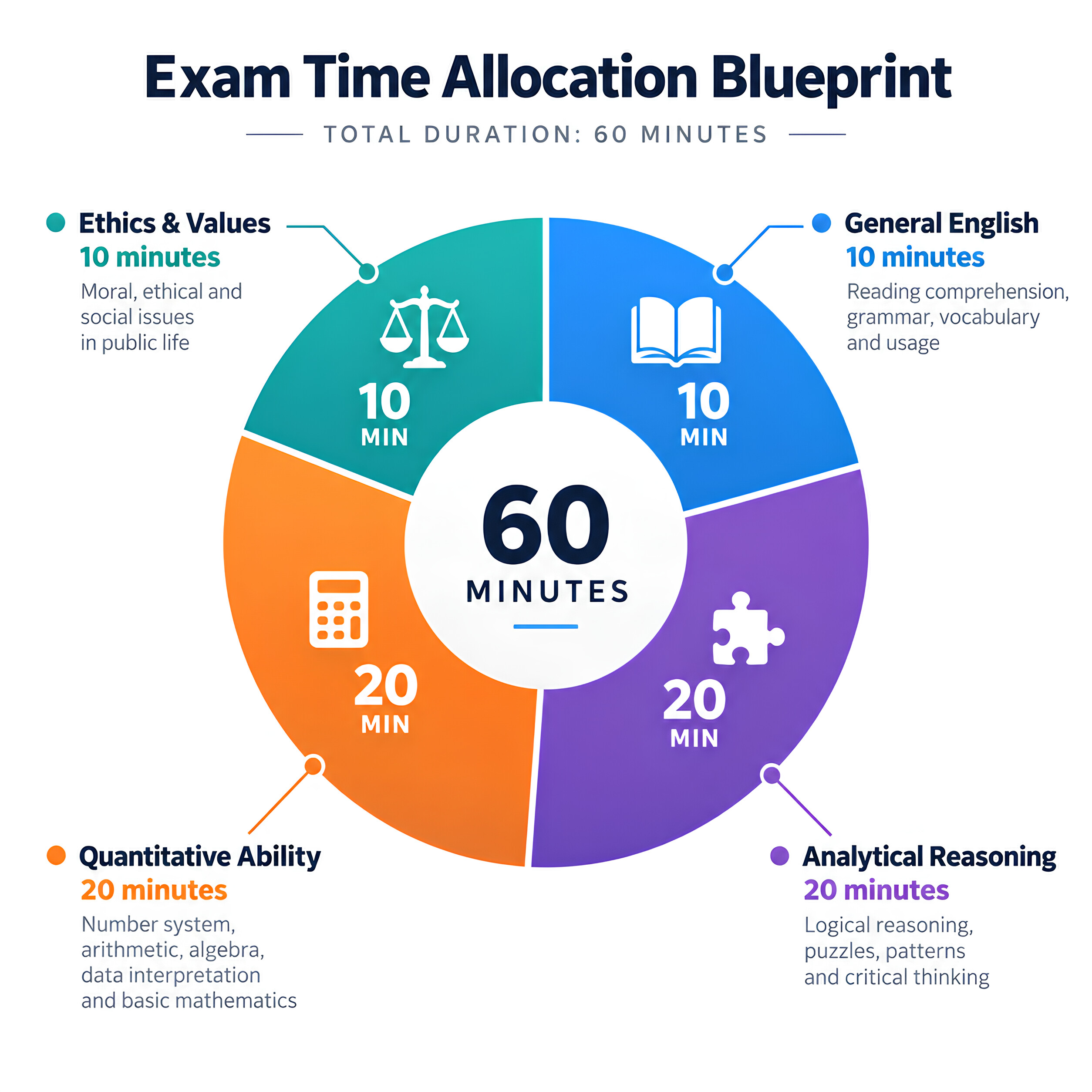
Here's where most SNAP aspirants go wrong: they don't allocate time before the exam starts. They just start solving and hope for the best.
Don't do this. Instead, use the following time budget as your exam-day blueprint:
General English: 8–12 Minutes (15 Questions)
Why 8–12 minutes? General English has no Reading Comprehension in SNAP. It's purely vocabulary, grammar, para-jumbles, and verbal reasoning. These are the fastest questions on the paper.
Time Breakdown:
- Vocabulary (synonyms, antonyms, idioms): 4–5 questions × 30–40 seconds = 2–3 minutes
- Grammar (error spotting, sentence correction): 4–5 questions × 45–60 seconds = 3–4 minutes
- Para-jumbles & Verbal Reasoning: 5–6 questions × 60–75 seconds = 4–5 minutes
- Buffer: 1 minute for review
Pro Tip: If you're past 12 minutes in General English, you're going too slow. Move to the next section immediately.
Analytical & Logical Reasoning: 18–22 Minutes (20 Questions)
Why 18–22 minutes? Reasoning is typically the highest-accuracy section for most students. It deserves a solid time chunk, but not at the expense of Quant.
Time Breakdown:
- Direct Reasoning (series, coding, blood relations, directions): 10–12 questions × 45–60 seconds = 8–10 minutes
- Moderate Puzzles (linear arrangement, ranking, comparison): 5–6 questions × 75–90 seconds = 6–7 minutes
- Complex Puzzles (seating arrangement with multiple variables, scheduling): 2–3 questions × 90–120 seconds = 4–5 minutes
- Buffer: 1–2 minutes for review
Pro Tip: If a reasoning question is taking more than 90 seconds, mark it and move on. Return only if you have time at the end.
Quantitative, DI & DS: 20–22 Minutes (20 Questions)
Why 20–22 minutes? This is the most time-variable section. Arithmetic and Number System questions are quick. DI sets can be time traps.
Time Breakdown:
- Arithmetic (percentage, profit-loss, ratio, time-speed-distance): 6–8 questions × 60–75 seconds = 6–8 minutes
- Algebra & Number System: 4–5 questions × 60–75 seconds = 4–5 minutes
- Geometry & Mensuration: 3–4 questions × 60–75 seconds = 3–4 minutes
- Data Interpretation (tables, graphs, caselets): 4–5 questions × 75–90 seconds = 5–6 minutes
- Buffer: 1–2 minutes for review
Pro Tip: Scan all DI sets first. Attempt the set with the simplest graph/table and most direct questions. Skip DI sets that require complex calculations or multi-step reasoning.
Ethics, Morality & Values: 8–10 Minutes (10 Questions)
Why 8–10 minutes? This is a new section in SNAP 2026 with no previous year papers. Situational judgement questions can be solved quickly if you understand the ethical frameworks, but overthinking can waste time.
Time Breakdown:
- Corporate Ethics Scenarios: 4–5 questions × 45–60 seconds = 3–4 minutes
- Stakeholder Analysis: 2–3 questions × 60–75 seconds = 2–3 minutes
- CSR & Sustainability Dilemmas: 2–3 questions × 60–75 seconds = 2–3 minutes
- Buffer: 1 minute for review
Pro Tip: Don't overthink Ethics questions. Identify the core conflict, list stakeholders, and choose the most balanced option. Avoid answers that favor one stakeholder group excessively.
Buffer/Review Time: 2–4 Minutes
Why keep a buffer? You need time to:
- Revisit marked questions you skipped initially
- Double-check answers you were uncertain about
- Ensure you didn't misread any question stems
Pro Tip: Use the last 2 minutes to scan your answer sheet for any unanswered questions. SNAP has no negative marking for unattempted questions, but 25% penalty for wrong answers. If you have 30 seconds left and 3 blank questions, make educated guesses.
The "Fastest-First" Section Order Strategy: Why General English Should Come First
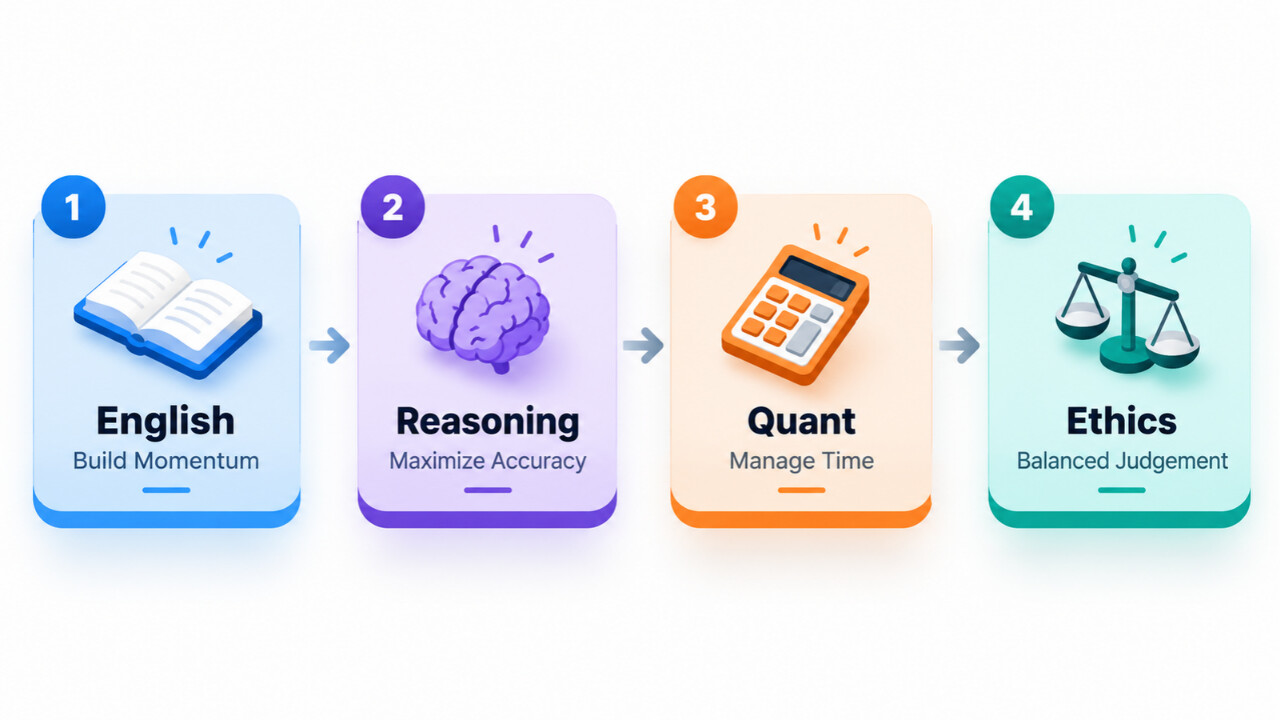
SNAP allows you to attempt sections in any order. There's no sectional time limit, so you can spend 40 minutes on Quant and 5 minutes on English if you want (though that's a terrible idea).
Here's the optimal section order for most students:
Recommended Order: General English → Analytical & Logical Reasoning → Quantitative, DI & DS → Ethics, Morality & Values
Why this order works:
- General English First (Momentum Builder):
- English questions are the fastest to solve (45–50 seconds average).
- Starting with quick wins builds confidence and gets you into "answering mode."
- You complete 15 questions in 8–12 minutes, giving you a psychological boost early.
- Reasoning Second (Accuracy Maximizer):
- Reasoning is typically the highest-accuracy section for most students.
- Your mind is still fresh after English, so you can tackle moderate puzzles with clarity.
- Completing Reasoning by the 30-minute mark puts you ahead of schedule.
- Quant Third (Time-Variable Section):
- Quant is the most unpredictable section. Some questions take 30 seconds; others take 3 minutes.
- By attempting Quant third, you've already secured 35 questions (English + Reasoning) with high accuracy.
- If Quant is running long, you can adjust your Ethics time accordingly.
- Ethics Last (Judgement-Based Section):
- Ethics questions require balanced thinking, not complex calculations.
- Even if you're slightly fatigued by the end, situational judgement doesn't require peak mental energy.
- You can use any leftover time from earlier sections to give Ethics extra minutes if needed.
Alternative Order for Quant-Strong Students: Quant → Reasoning → English → Ethics
When to use this:
- If Quantitative is your strongest section and you want to tackle it with maximum focus.
- If you're confident about completing Quant in 18–20 minutes (faster than average).
- If Reasoning is your second-strongest section.
Risk: If Quant takes longer than expected (e.g., 25+ minutes), you'll rush through English and Reasoning—costing you easy marks.
Section Order to Avoid: Ethics → Quant → Reasoning → English
Why this fails:
- Starting with Ethics (an unfamiliar section for most) creates early anxiety.
- Quant in the second slot means you're still in "warm-up mode" for the most time-variable section.
- English last wastes your freshest mental energy on the fastest questions.
Pro Tip: Whatever section order you choose, practice it in at least 5–7 full-length mocks before exam day. Your brain needs to adapt to the rhythm.
If you're also preparing for other exams, our GMAT vs CAT vs GRE comparison can help you understand how section-order strategy differs across exams.
Question Selection Framework: How to Identify 15–20 "Skip-Worthy" Questions in 2 Minutes
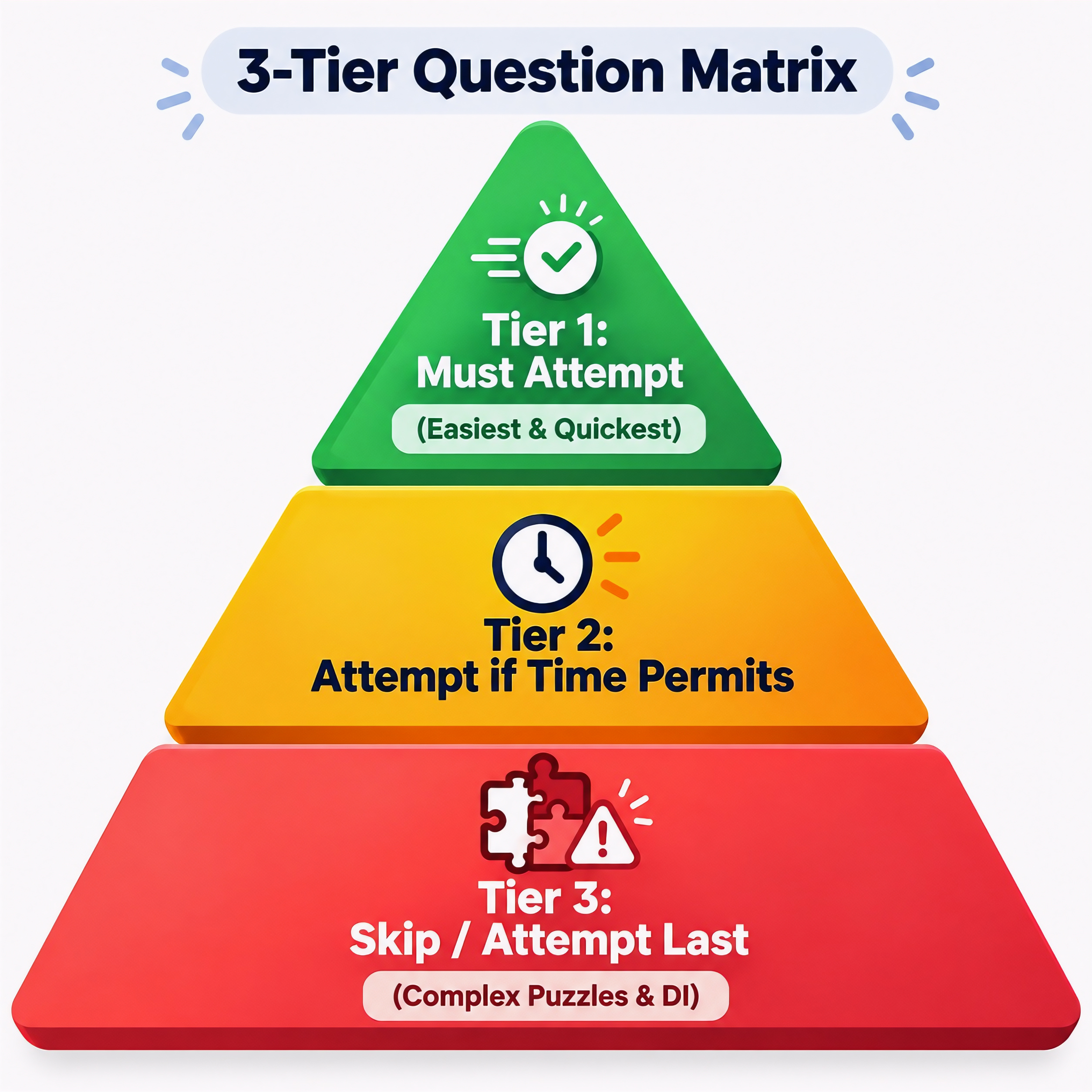
Here's a strategy that separates SNAP toppers from average scorers: the 2-minute scan.
Before you start solving, spend the first 120 seconds scanning the entire paper. Your goal: identify 15–20 questions you'll intentionally skip or attempt last.
The 3-Tier Question Classification System:
Tier 1: "Must-Attempt" Questions (35–40 questions)
- Vocabulary: Synonyms, antonyms, idioms you recognize immediately
- Grammar: Error spotting with obvious mistakes (subject-verb agreement, tense errors)
- Direct Reasoning: Series completion, coding-decoding, blood relations with 3–4 members
- Arithmetic: Percentage, ratio, profit-loss with single-step calculations
- Ethics: Scenarios where the ethical choice is clear (no major stakeholder conflict)
Tier 2: "Attempt if Time Permits" Questions (15–20 questions)
- Para-jumbles: 4–5 sentence rearrangements (moderate difficulty)
- Moderate Puzzles: Linear arrangement with 5–6 variables, ranking with 2–3 conditions
- Algebra/Number System: Quadratic equations, sequence series (familiar patterns)
- Ethics: Scenarios with 2–3 competing stakeholder interests
Tier 3: "Skip or Attempt Last" Questions (10–15 questions)
- Lengthy DI Sets: Graphs/tables requiring complex calculations or multi-step reasoning
- Complex Puzzles: Seating arrangement with 8+ variables, scheduling with multiple constraints
- Geometry/Mensuration: Multi-shape combination problems, 3D figure questions
- Ethics: Unfamiliar scenarios with no clear ethical framework
The 2-Minute Scan Process:
Step 1: Flip Through Quickly (60 seconds)
- Scan each section's question stems (not answer options yet).
- Mentally tag questions as Tier 1, 2, or 3 based on your strengths.
- Don't read full question text—just identify question types.
Step 2: Mark Your Paper (60 seconds)
- Put a small dot or star next to Tier 1 questions (your priority attempts).
- Put a small "X" next to Tier 3 questions (skip initially).
- Leave Tier 2 questions unmarked (attempt after Tier 1 is done).
Step 3: Start with Tier 1 (Remaining 58 minutes)
- Attempt all Tier 1 questions first, section by section.
- Don't spend more than 75 seconds on any Tier 1 question.
- Once Tier 1 is complete, move to Tier 2 if time permits.
Why this works: SNAP doesn't require you to attempt questions in sequence. By pre-selecting your attempts, you ensure you're solving the easiest questions first, maximizing accuracy and speed.
This approach mirrors what we teach in our CAT 2026 VARC 40+ Strategy Score and Best GMAT Mock Tests Online programs—smart question selection beats brute-force attempting.
Negative Marking Math: Why 45–50 Attempts with 85%+ Accuracy Beats 55+ Attempts with 75% Accuracy
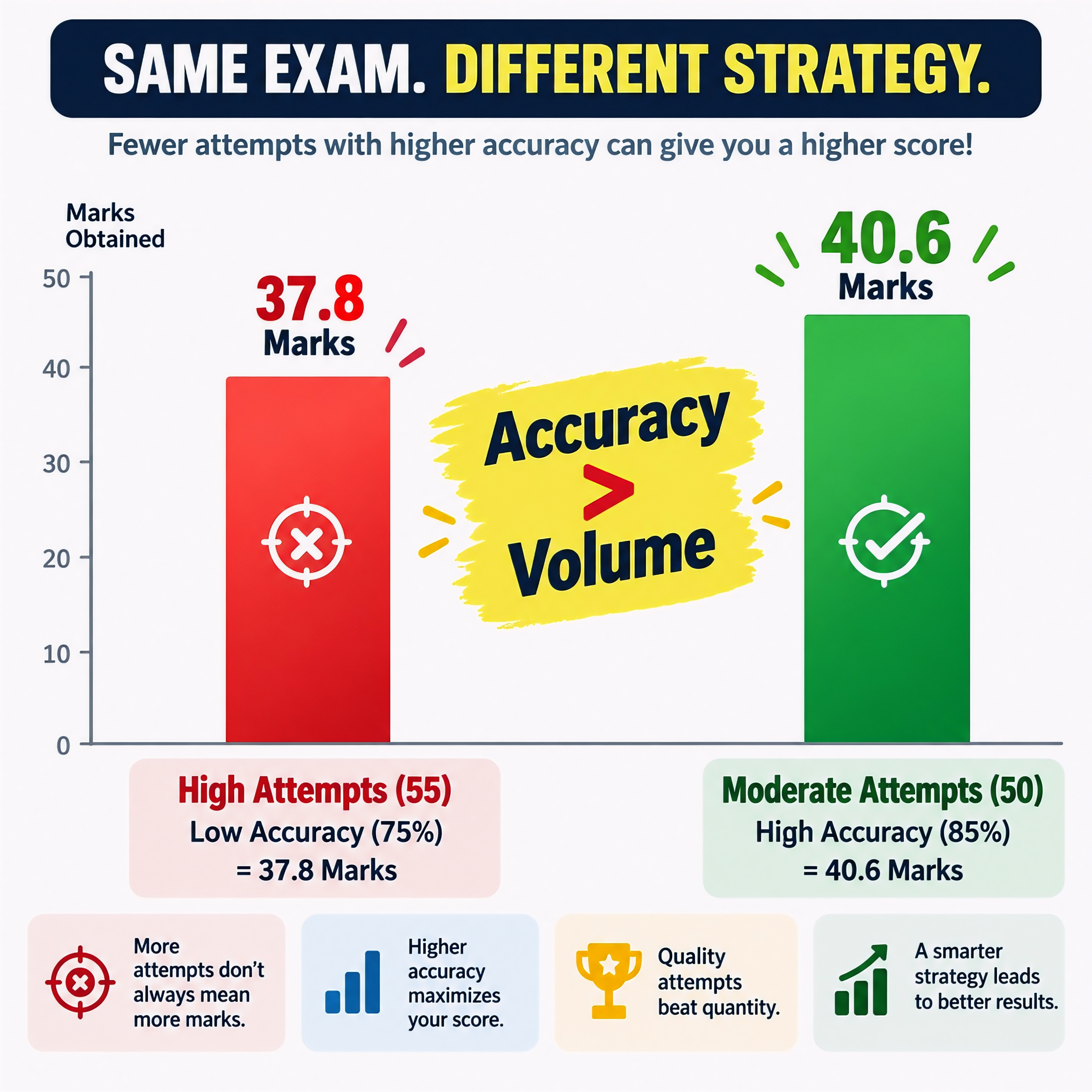
Let's do the math. SNAP has 25% negative marking (0.25 marks deducted per wrong answer). Each correct answer gives +1 mark.
Scenario A: High-Volume, Low-Accuracy Strategy
- Attempts: 55 out of 65 questions
- Accuracy: 75% (41.25 correct, 13.75 wrong)
- Net Score: 41.25 − (13.75 × 0.25) = 41.25 − 3.44 = 37.81 marks
Scenario B: Moderate-Volume, High-Accuracy Strategy
- Attempts: 50 out of 65 questions
- Accuracy: 85% (42.5 correct, 7.5 wrong)
- Net Score: 42.5 − (7.5 × 0.25) = 42.5 − 1.875 = 40.625 marks
Scenario C: Conservative, Very High-Accuracy Strategy
- Attempts: 45 out of 65 questions
- Accuracy: 90% (40.5 correct, 4.5 wrong)
- Net Score: 40.5 − (4.5 × 0.25) = 40.5 − 1.125 = 39.375 marks
The winner? Scenario B: 50 attempts with 85% accuracy.
Why this matters: Many students think "more attempts = higher score." But with 25% negative marking, every wrong answer erases 25% of a correct answer's value. It's better to attempt fewer questions with higher confidence.
The "Sweet Spot" for SNAP 2026:
- Target Attempts: 48–52 out of 65 questions
- Target Accuracy: 85–90% (41–47 correct answers)
- Expected Net Score: 39–43 marks (95–98+ percentile range)
For SIBM Pune (97–98.5 percentile cutoff): You need 50+ marks, which means 52–55 attempts with 88–90% accuracy.
For SCMHRD (96–97 percentile cutoff): You need 48+ marks, which means 50–53 attempts with 85–88% accuracy.
For SIIB (94–95 percentile cutoff): You need 45+ marks, which means 48–51 attempts with 85%+ accuracy.
Pro Tip: During mocks, track not just your total score, but your accuracy percentage. If you're consistently below 80%, you're attempting too many low-confidence questions.
For more on cutoffs, read our detailed breakdown in SNAP Cutoffs 2026: SIBM Pune, SCMHRD, SIIB & Top Symbiosis Institutes (coming soon).
60-Minute Mock Drill: 3-Week Practice Plan to Build Speed Instincts

Theory is useless without practice. Here's a focused 3-week drill to train your SNAP speed instincts.
Week 1: Sectional Timing Mastery
Goal: Internalize the time budget for each section.
Daily Practice (60–75 minutes):
- Day 1–2: General English Speed Drills
- 15-question English section × 3 sets
- Target time: 8–12 minutes per set
- Focus: Vocabulary (30–40 sec/Q), Grammar (45–60 sec/Q), Para-jumbles (60–75 sec/Q)
- Track accuracy: Aim for 85–90% (13–14 correct out of 15)
- Day 3–4: Reasoning Speed Drills
- 20-question Reasoning section × 3 sets
- Target time: 18–22 minutes per set
- Focus: Direct reasoning first (45–60 sec/Q), then moderate puzzles (75–90 sec/Q)
- Track accuracy: Aim for 80–85% (16–17 correct out of 20)
- Day 5–6: Quant Speed Drills
- 20-question Quant section × 3 sets
- Target time: 20–22 minutes per set
- Focus: Arithmetic & Number System first (60–75 sec/Q), then DI (75–90 sec/Q)
- Track accuracy: Aim for 75–80% (15–16 correct out of 20)
- Day 7: Ethics Familiarization
- 10-question Ethics section × 3 sets
- Target time: 8–10 minutes per set
- Focus: Situational judgement frameworks, stakeholder analysis
- Track accuracy: Aim for 80–85% (8–9 correct out of 10)
Week 2: Full-Length Mock Integration
Goal: Combine sections with proper time allocation and section order.
Daily Practice (2–2.5 hours):
- Day 1, 3, 5: Full-Length Mock with Time Logs
- Take a full 65-question SNAP mock under timed conditions (60 minutes).
- Use your chosen section order (recommended: English → Reasoning → Quant → Ethics).
- Critical: After the mock, analyze your time log: How long did you spend on each section? Which questions took >90 seconds? Did you complete Tier 1 questions before running out of time?
- Day 2, 4, 6: Weak-Section Blitz
- Identify your weakest section from mock analysis.
- Do 2–3 sectional tests back-to-back for that section only.
- Example: If Quant is weak, do 3 Quant sections (60 questions total) in 65 minutes.
- Focus: Speed + accuracy improvement in that section.
- Day 7: Light Revision
- Review error logs from the week.
- No new mocks. Just revise formulas, vocabulary, and reasoning frameworks.
Week 3: Exam-Day Simulation
Goal: Build stamina and refine your strategy under pressure.
Daily Practice (2.5–3 hours):
- Day 1, 3, 5: Full-Length Mock with Exam Conditions
- Take a full SNAP mock at the same time as your actual exam (e.g., 10 AM–11 AM).
- Sit at a desk (not on your bed). Use only a pen, paper, and timer.
- No phone, no music, no breaks. Simulate real exam pressure.
- Post-Mock Analysis: Calculate net score (correct − 0.25 × wrong). Calculate accuracy percentage (correct ÷ attempts × 100). Identify 3–5 questions you should have skipped but didn't.
- Day 2, 4: Speed-Focus Drills
- Do 2 full mocks back-to-back (120 minutes total).
- Focus: Maintain speed and accuracy even when fatigued.
- This simulates the mental endurance needed if you're taking multiple SNAP tests (Test 1, 2, 3).
- Day 6: Final Strategy Refinement
- Review all mock analyses from Weeks 1–3.
- Finalize your section order, time budget, and question-selection criteria.
- Write down your exam-day plan on paper (e.g., "English: 10 min, Reasoning: 20 min, Quant: 22 min, Ethics: 8 min").
- Day 7: Rest & Mental Prep
- No mocks. Light revision only (vocabulary flashcards, formula sheets).
- Visualize your exam-day strategy: scanning the paper, selecting questions, maintaining pace.
- Sleep early. Your brain needs rest for peak performance.
Pro Tip: Use our Best NMAT Coaching in India platform to access speed-focused mock tests. While designed for NMAT, the time-pressure dynamics are similar to SNAP, and the analytics will show you exactly where you're losing time.
Your SNAP 2026 Speed Strategy Action Plan: Next Steps

Understanding SNAP's time dynamics is just the first step. Here's how to turn this knowledge into a 50+ attempt, 85%+ accuracy performance:
1. Take a Diagnostic Mock This Week
Don't wait. Take a full-length SNAP mock test in the next 3–4 days. Don't worry about your score—focus on identifying:
- Which section is your strongest (highest accuracy)?
- Where do you lose the most time (Quant? Reasoning?)?
- How many Tier 1 (easy) questions did you miss because you spent too long on Tier 3 (hard) questions?
2. Build Your Section-Order Strategy
Based on your mock analysis, decide your section order using the frameworks above. Practice it in your next 3–5 mocks until it feels automatic.
3. Join Structured SNAP Preparation
If you're serious about SIBM Pune, SCMHRD, or SIIB, generic prep won't cut it. You need:
- Speed-focused mock tests that simulate the 60-minute pressure
- Sectional strategy sessions focused on your weak areas
- Expert mentorship to analyze your mock performance and adjust your approach
At VerbalHub, we offer Ace SNAP 2026 with Live Online Classes, designed specifically for aspirants targeting 50+ attempts with 85%+ accuracy. Our speed-intelligence system tracks your time per question, section-wise pacing, and accuracy trajectory—giving you the data you need to improve.
4. Download Your Free SNAP Speed Strategy Checklist
60-Minute Time Budget Checklist:
- General English: 8–12 minutes (15 questions)
- Analytical & Logical Reasoning: 18–22 minutes (20 questions)
- Quantitative, DI & DS: 20–22 minutes (20 questions)
- Ethics, Morality & Values: 8–10 minutes (10 questions)
- Buffer/Review: 2–4 minutes
Question Selection Checklist:
- I spend the first 2 minutes scanning the entire paper
- I identify 15–20 "skip-worthy" questions before starting
- I attempt Tier 1 (easy) questions first, section by section
- I don't spend more than 75 seconds on any single question
Accuracy Tracking Checklist:
- My target attempts: 48–52 out of 65 questions
- My target accuracy: 85–90% (41–47 correct answers)
- My expected net score: 39–43 marks (95–98+ percentile range)
- I track accuracy percentage in every mock, not just total score
Frequently Asked Questions: SNAP 2026 Speed Strategy
No. SNAP has no sectional time limits. You can spend all 60 minutes on one section if you want (though that's a terrible strategy). This gives you flexibility to allocate time based on your strengths.
Target 48–52 out of 65 questions with 85–90% accuracy. This gives you a net score of 39–43 marks, which typically translates to 95–98+ percentile. For SIBM Pune (97–98.5 percentile), aim for 50+ marks (52–55 attempts with 88–90% accuracy).
General English first is recommended for most students. It's the fastest section (8–12 minutes for 15 questions), builds early momentum, and frees up time for Quant and Reasoning. If Quant is your strongest section, you can start with Quant instead.
Yes. 45 marks typically translates to 94–96 percentile, which is sufficient for SIIB Pune (94–95 percentile cutoff) and most Symbiosis institutes except SIBM Pune and SCMHRD. For SIBM Pune, target 50+ marks.
SNAP is significantly faster-paced than CAT. CAT gives you 120 minutes for 66 questions (~110 seconds per question), while SNAP gives you 60 minutes for 65 questions (~55 seconds per question). SNAP rewards quick recognition and formula application, while CAT rewards conceptual depth. For a detailed comparison, read GMAT vs CAT vs GRE.
Ready to Crack SNAP 2026?
Mastering SNAP's 60-minute speed test is about strategy, not just speed. With the right time allocation, question selection, and accuracy focus, you can hit 50+ attempts with 85%+ accuracy—and secure your seat at SIBM Pune, SCMHRD, or SIIB.
If you're looking for structured guidance, personalized mentorship, and speed-focused mock tests that mirror the real exam, explore our Best SNAP Coaching in India programs.
Your 50+ attempt score starts with one decision: to prepare smarter, not harder.
Related Reads:
- SNAP Best-of-3 Strategy 2026: Which Test to Target (Test 1 vs. Test 2 vs. Test 3) (Coming Soon)
- CAT-to-SNAP Pivot 2026: Speed Optimization Framework for CAT Aspirants (Coming Soon)
- SNAP Ethics Section 2026: Complete Prep Guide for Ethics, Morality & Values (Coming Soon)
- SNAP Cutoffs 2026: SIBM Pune, SCMHRD, SIIB & Top Symbiosis Institutes (Coming Soon)
- Ace SNAP 2026 with Live Online Classes
- Best SNAP Coaching in India
About VerbalHub:
VerbalHub is India's trusted test-prep platform for GMAT, CAT, SNAP, NMAT, GRE, IELTS, PTE, CELPIP, and IPMAT. With 99+ percentile mentorship, speed-focused mock intelligence, and personalized 1-on-1 coaching, we've helped thousands of students crack top B-schools and achieve their study-abroad dreams.
Contact: +91-7827040357 | www.verbalhub.com