SNAP Preparation 2026: Complete Study Plan, Syllabus, Mock Tests, Best SNAP Coaching and 99 Percentile Strategy
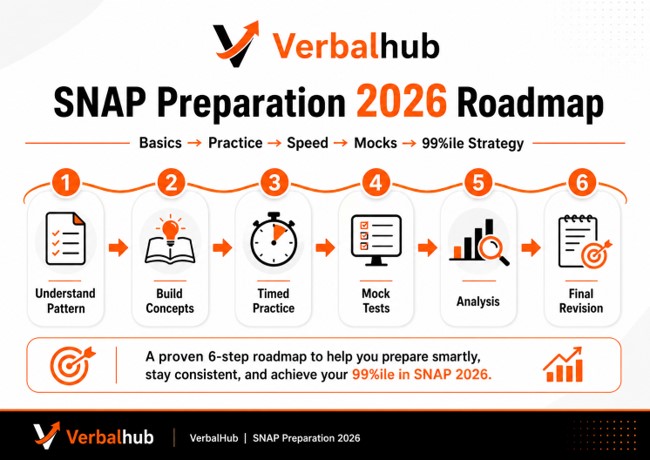
How to prepare for SNAP 2026? Start SNAP Preparation 2026 by learning the 60-question, 60-minute pattern, then build basics in English, Reasoning and Quant. Practise timed sectional drills, solve previous year papers, and take 10 to 15 full mock tests with detailed analysis. Focus on accuracy, smart question selection and speed rather than attempting everything.
Introduction: How to Start SNAP Preparation 2026
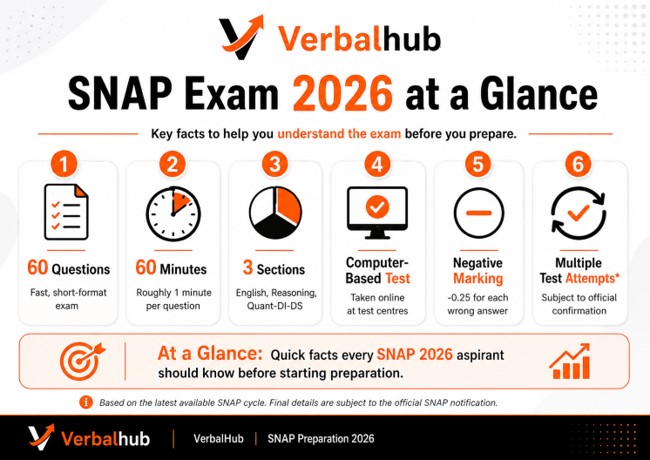
Every year, thousands of students finish CAT in November and then turn to SNAP thinking, "I have already prepared for CAT, so SNAP will be easy." Some of them do well. Many do not. The reason is simple: SNAP is a different kind of test. CAT rewards deep problem-solving. SNAP rewards speed, controlled accuracy and quick decision-making. You get roughly one minute per question, and every wrong answer costs you a quarter of a mark.
So how should you start SNAP Preparation 2026? Begin by understanding the exam pattern, then build your basics section by section, practise under strict time limits, take regular mock tests, and review every mistake carefully. That single loop, repeated for two to four months, is what separates an 85 percentiler from a 99 percentiler.
This guide covers everything you need: the SNAP Exam 2026 pattern and syllabus, realistic study plans for 3 months, 60 days and 30 days, mock test strategy, the top colleges accepting SNAP scores, and how to decide whether you need coaching. Whether you are a college student, a working professional or a repeat test-taker, you can use this article as your complete preparation manual.
SNAP 2026 At a Glance
- Exam name: SNAP (Symbiosis National Aptitude Test)
- Conducting body: Symbiosis International (Deemed University), Pune
- Exam mode: Computer-based test (CBT)
- Expected test duration: 60 minutes (based on the latest available SNAP cycle)
- Main sections: General English; Analytical & Logical Reasoning; Quantitative, Data Interpretation & Data Sufficiency
- Admission purpose: MBA and related postgraduate programmes at Symbiosis institutes
- Preparation difficulty: Moderate concepts, high time pressure
- Ideal preparation period: 3 to 5 months (a focused 60-day plan also works for many students)
All 2026 details are tentative and subject to the official SNAP notification on snaptest.org.
Indexes
- What Is the SNAP Exam 2026
- SNAP Important Dates and Registration 2026
- SNAP Eligibility 2026
- SNAP Exam Pattern 2026
- SNAP Syllabus 2026
- SNAP Important Topics and Topic Priority
- How to Prepare for SNAP 2026
- SNAP Preparation Strategy 2026
- SNAP Study Plan 2026
- Time-Based SNAP Preparation Plans
- Section-Wise SNAP Preparation Strategy
- SNAP Time Management Strategy
- SNAP Speed and Accuracy Strategy
- SNAP 99 Percentile Strategy
- SNAP Previous Year Papers and Practice Resources
- SNAP Mock Test Series 2026
- How to Perform SNAP Mock Test Analysis
- Best Books and Study Material for SNAP Preparation
- Common Mistakes During SNAP Preparation
- SNAP Coaching vs Self-Study
- How to Choose the Best SNAP Coaching
- Why VerbalHub Is One of the Best SNAP Coaching Options
- SNAP Personal Coaching and Live Online Classes
- Top 10 Colleges Accepting SNAP Scores and Expected Percentiles
- SNAP Score vs Percentile
- Symbiosis MBA Admission 2026
- How to Prepare for the Symbiosis Selection Process
- Final Seven-Day SNAP Revision Plan
- SNAP Exam-Day Strategy
- Final SNAP Preparation Checklist
- Frequently Asked Questions
- Conclusion: Your Next Step in SNAP Preparation 2026
1. What Is the SNAP Exam 2026?
SNAP stands for the Symbiosis National Aptitude Test. It is a national-level MBA entrance exam conducted by Symbiosis International (Deemed University), commonly called SIU, based in Pune. Students take SNAP because it is the single gateway to MBA and related management programmes at Symbiosis institutes such as SIBM Pune, SCMHRD, SIIB and SIBM Bengaluru.
Here is the practical reality: if you want to study at any Symbiosis business school, you must take SNAP. No other exam score is accepted for these programmes. That makes SNAP a must-take exam for anyone whose target list includes a Symbiosis campus.
How is SNAP different from CAT, XAT, NMAT and CMAT?
The biggest difference is the format. In its recent cycles, SNAP has been a short, fast test: 60 questions in 60 minutes. CAT gives you more time per question but asks harder questions. XAT adds decision-making and is known for tricky verbal and quant questions. NMAT is adaptive-style with no negative marking, so guessing behaviour changes completely. SNAP sits in the middle: the questions are usually easier than CAT, but the time pressure is higher and the negative marking punishes careless attempts.
| Exam | Main strength tested | General exam style | Best suited for |
|---|---|---|---|
| SNAP | Speed with accuracy | Short, fast paper; easy-to-moderate questions; negative marking | Students targeting Symbiosis institutes |
| CAT | Deep problem-solving | Longer, tougher paper with sectional time limits | IIM and top-tier B-school aspirants |
| XAT | Reasoning and judgement | Moderate-to-hard paper with decision-making section | XLRI and XAT-accepting colleges |
| NMAT | Consistency under time | Moderate difficulty, no negative marking, choice of section order | NMIMS and NMAT-accepting colleges |
Who should consider taking SNAP? Anyone serious about an MBA from a Symbiosis institute, of course. But SNAP is also a smart backup for CAT aspirants, because most of the syllabus overlaps and the exam falls after CAT. Students who are strong on basics but struggle with very hard CAT-level questions often perform better in SNAP, where consistent accuracy on easy and medium questions matters more than solving the toughest problems.
Key Takeaways
- SNAP is the only entrance route to Symbiosis MBA programmes.
- It is a speed-based test, not a difficulty-based test.
- The preparation overlaps heavily with CAT, but the exam strategy is different.
2. SNAP Important Dates and Registration 2026
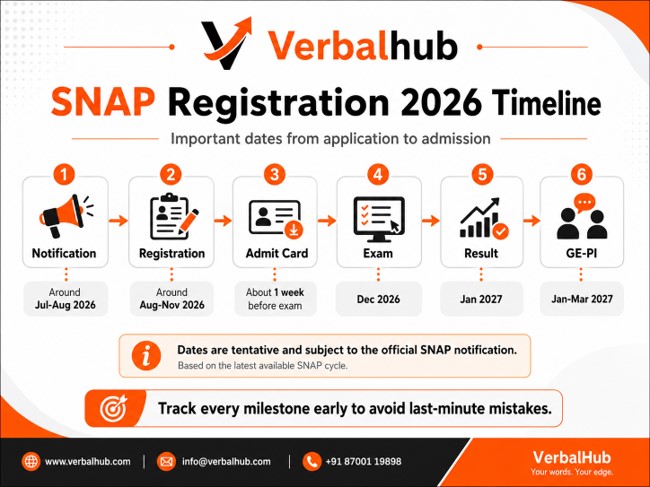
The official SNAP 2026 notification usually arrives in the second half of the year. Based on recent cycles, here is the tentative timeline. Every date below is expected and subject to the official SNAP notification.
| Event | Expected timeline (tentative) |
|---|---|
| SNAP 2026 notification | Around July–August 2026 |
| SNAP Registration 2026 opens | Around August 2026 |
| SNAP registration last date 2026 | Around late November 2026 |
| Admit card release | About a week before each test date |
| SNAP 2026 exam window | December 2026, likely across two or three test dates |
| Result declaration | Around January 2027 |
| GE-PI rounds at institutes | January–March 2027 |
Students should confirm the final dates on the official SNAP website (snaptest.org) once the notification is out.
How does SNAP Registration 2026 work? In recent cycles, registration has involved two linked but separate decisions. First, you register for the SNAP test itself and choose how many attempts you want (SNAP has allowed up to three attempts in December, with the best score considered). Second, you apply to the individual Symbiosis programmes you are interested in. The test fee and programme application fees are usually separate, so applying to more programmes costs more. The exact rules and fees for 2026 will be confirmed in the official notification, so read it carefully before paying.
Documents and details you typically need:
- A working email ID and mobile number you check regularly
- Scanned recent photograph as per the specified format
- Graduation or latest academic details
- Category or PwD certificates, where applicable
- A card or net-banking option for the online fee payment
Common registration mistakes to avoid:
- Waiting until the last two days, when the site is slow and errors are hard to fix
- Uploading a photo that does not meet the size or format rules
- Registering for the test but forgetting to apply to specific programmes
- Choosing only one attempt when a second attempt could have acted as a safety net
- Entering a name or date of birth that does not match your documents
Step-by-Step SNAP Registration Checklist
- Create your account on the official SNAP website with a valid email and phone number.
- Fill in personal and academic details exactly as they appear on your documents.
- Upload your photograph in the prescribed format.
- Select your test attempt(s) and preferred cities.
- Select the programmes and institutes you want to apply to.
- Pay the test fee and programme fees, and save every payment receipt.
- Take a printout or PDF of the final confirmation page.
- Note the admit card dates in your calendar so you do not miss the download window.
3. SNAP Eligibility 2026
The core SNAP Eligibility 2026 requirement is simple: you need a graduation degree in any discipline from a recognised university. In recent cycles, the general requirement has been a minimum of 50 percent marks in graduation (45 percent for SC, ST and PwD candidates). Final figures for 2026 are subject to the official notification.
Can final-year students apply? Yes. Students appearing in the final year of graduation have been allowed to apply in recent cycles, on the condition that they complete their degree with the required marks before the programme's admission deadline. If your results are delayed beyond the institute's cut-off date, your admission can be at risk, so keep your university timeline in mind.
International applicants. Candidates with foreign degrees typically need an equivalence certificate from the Association of Indian Universities (AIU). SIU also runs a separate international admissions channel for certain categories of candidates; check the official Symbiosis website if this applies to you.
Programme-specific eligibility. This is where many students slip. Some programmes have additional conditions. For example, technology-oriented programmes may require an engineering, science or IT background, and a few specialised programmes may prefer or require specific graduation streams or work experience. The general SNAP eligibility gets you into the test; the programme eligibility decides whether your application to a specific institute is valid. Always read the eligibility section on each institute's admission page before paying its application fee.
Common Eligibility Mistakes
- Assuming that qualifying for SNAP automatically qualifies you for every Symbiosis programme.
- Ignoring the minimum percentage rule and discovering the problem at the admission stage.
- Final-year students not checking whether their university will declare results before the admission deadline.
- Applying to a specialised programme (like some tech or operations courses) without the required academic background.
- Not keeping category certificates updated and valid for the admission year.
4. SNAP Exam Pattern 2026
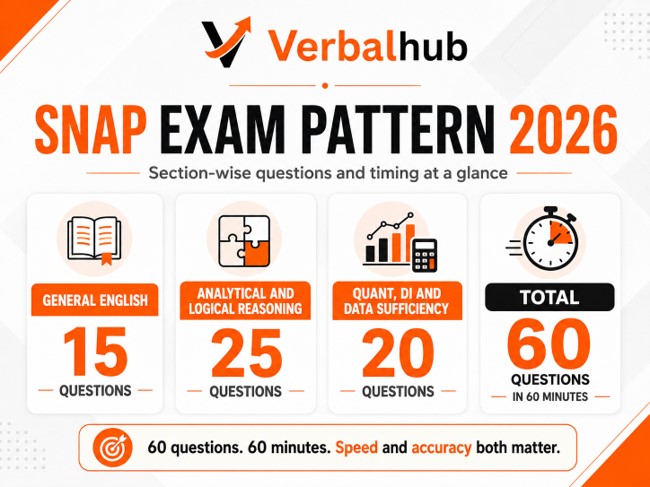
The SNAP Exam Pattern 2026 is expected to continue the short-format structure used in recent years: 60 multiple-choice questions in 60 minutes, conducted as a computer-based test. Each correct answer earns +1 mark and each wrong answer deducts 0.25 marks. There is no sectional time limit, and unattempted questions carry no penalty. SIU has allowed candidates to take the test up to three times in December, with the best score considered for percentile calculation. All of this is expected based on the latest available SNAP cycle and remains subject to the official 2026 notification.
| Section | Expected questions | Main areas | Suggested time | Good attempt approach |
|---|---|---|---|---|
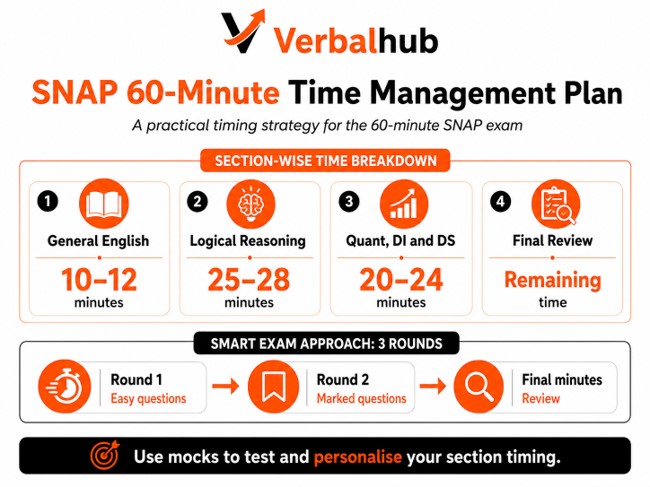
| General English | 15 | RC, vocabulary, grammar, verbal reasoning | 10–12 min | Attempt 12–14 with high accuracy |
| Analytical & Logical Reasoning | 25 | Arrangements, series, puzzles, critical reasoning | 25–28 min | Attempt 18–22, skip long puzzles early |
| Quantitative, DI & Data Sufficiency | 20 | Arithmetic, algebra, DI sets, DS | 20–24 min | Attempt 14–17, avoid lengthy calculations |
Treat the suggested time and attempts as planning guides, not guaranteed cut-off advice. Your ideal numbers depend on your strengths, and they should come from your own mock test data.
Why does this pattern make speed and selection so important? With one minute per question on average, you cannot afford to fight with any single question. A student who solves 40 questions with 90 percent accuracy will almost always beat a student who attempts 55 questions with 65 percent accuracy, because negative marking eats into careless scores. SNAP is less about how much you know and more about how quickly you can recognise what you know.
Expert Tip
Do not treat every question as equal. In SNAP, a 20-second vocabulary question and a 3-minute puzzle both carry one mark. Train yourself to hunt for the cheap marks first and return to expensive questions only if time remains.
5. SNAP Syllabus 2026
The SNAP Syllabus 2026 covers three sections. The topics below are based on official section descriptions and past papers. Topic weight can shift from one year or slot to another, so prepare the full list rather than betting on a few chapters.
General English
This section tests reading and language skills through:
- Reading comprehension (usually short passages with direct and inference questions)
- Vocabulary: synonyms, antonyms, one-word substitution, idioms and phrases
- Grammar: error spotting, sentence correction, fill in the blanks
- Para-based questions: para jumbles and sentence completion
- Verbal reasoning: analogies and odd-one-out
- Contextual usage: choosing the right word for the sentence
Good news for most students: SNAP English is more about vocabulary and grammar than long reading passages, so students who find CAT RC heavy often find SNAP English friendlier.
Analytical and Logical Reasoning
This is the largest section in the paper and usually decides ranks. Expect questions from:
- Linear, circular and matrix arrangements
- Number and letter series
- Coding-decoding
- Blood relations and family trees
- Direction sense
- Syllogisms
- Clocks and calendars
- Critical reasoning: statements, assumptions, conclusions, cause and effect
- Visual or diagram-based reasoning and statement-based puzzles
- Analogies and classification
Most SNAP reasoning questions are standalone and quick, unlike CAT's long multi-question sets. That is exactly why speed practice matters more than solving marathon puzzles.
Quantitative, Data Interpretation and Data Sufficiency
- Arithmetic: percentages, profit and loss, ratio, averages, time-speed-distance, time and work, interest
- Algebra: equations, inequalities, progressions
- Geometry and mensuration: triangles, circles, areas, volumes
- Number system: divisibility, HCF-LCM, remainders
- Modern mathematics: permutation-combination, probability, set theory
- Data interpretation: tables, bar charts, pie charts, line graphs
- Data sufficiency: judging whether given statements are enough to answer
| Section | Important topics | Priority level | Best practice method |
|---|---|---|---|
| General English | Vocabulary, grammar, RC, para jumbles | High | Daily word lists + timed 15-question drills |
| Analytical & Logical Reasoning | Series, arrangements, coding, critical reasoning | Very high | Timed sets of 20–25 mixed questions |
| Quant, DI & DS | Arithmetic, DI sets, number system | High | Topic tests followed by mixed timed drills |
| Quant (advanced) | Geometry, modern maths | Medium | Concept revision + selective practice |
6. SNAP Important Topics and Topic Priority
Knowing the syllabus is step one. Knowing where to spend your hours is step two, and it matters more. SNAP Important Topics should be ranked by three things: how often they appear in previous papers, how fast you can solve them, and how accurate you personally are in them.
High priority (prepare these first, revise repeatedly):
- Arithmetic (percentages, ratio, TSD, time and work) — the backbone of SNAP Quant
- Series, coding-decoding, blood relations, directions — quick reasoning marks
- Vocabulary and grammar — 20-to-40-second questions with high scoring potential
- Data interpretation basics — one or two sets usually appear
Medium priority (prepare after the basics are stable):
- Arrangements and puzzles (attempt only the short ones in the exam)
- Critical reasoning and syllogisms
- Reading comprehension practice for speed
- Algebra and number system
Low priority but still worth revising:
- Clocks and calendars (formula-based, quick to revise)
- Advanced geometry and trigonometry
- Probability and permutation-combination beyond basics
- Data sufficiency (a small number of questions, but easy marks if practised)
How should you personalise this? Use your mock data. If your accuracy in geometry is below 50 percent and each question takes you over two minutes, geometry is a low-priority topic for you no matter what any list says. If you solve vocabulary questions in 15 seconds with 90 percent accuracy, that is your gold mine. Track time per question and accuracy per topic, and rebuild your priority list every two weeks.
| Your situation with a topic | Priority action |
|---|---|
| High accuracy + fast | Bank on it; keep it sharp with weekly drills |
| High accuracy + slow | Practise timed drills to build speed |
| Low accuracy + fast | Fix the concept; you are making careless errors |
| Low accuracy + slow | Park it for now; return only if time permits |
7. How to Prepare for SNAP 2026?
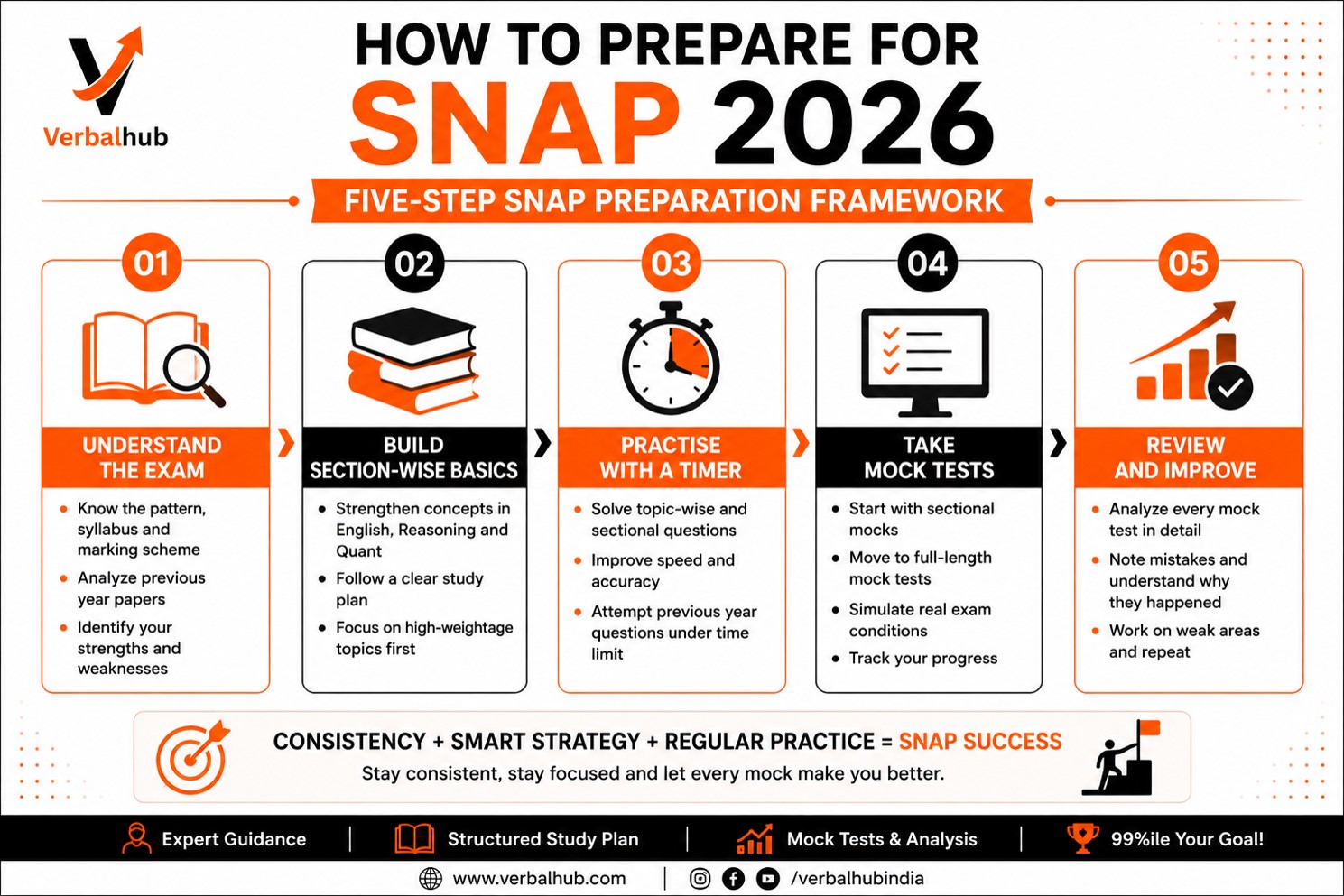
If you are wondering how to prepare for SNAP 2026, here is the honest answer: follow a five-stage framework, and do not skip stages.
Stage 1: Understand the paper. Spend your first two or three days going through the pattern, the syllabus and at least one previous year paper. Do not solve it yet; just read it. Notice how short the questions are and how much variety exists.
Stage 2: Build section-wise basics. Cover the concepts topic by topic. For Quant, that means formulas plus solved examples. For Reasoning, it means learning standard question types. For English, it means daily vocabulary and grammar rules. This stage takes four to six weeks for most students.
Stage 3: Practise timed questions. Here is the difference between knowing a topic and being SNAP-ready: knowing percentages means you can solve any percentage question eventually. Being SNAP-ready means you solve it in 45 seconds. Timed drills, not more theory, build this skill. Practise sets of 10–15 questions with a stopwatch.
Stage 4: Take and analyse mocks. Full-length SNAP mock tests simulate the one-hour pressure. Every mock must be followed by a review session that is at least as long as the mock itself.
Stage 5: Revise and improve selection. In the last phase, your job is not learning new topics. It is sharpening question selection: which question to attempt, which to skip and when to move on.
Advice by student type:
- Beginners: Start with Stage 2 seriously. Do not jump into mocks in week one; a bad early score can demotivate you for no good reason. Give yourself four to five months if possible.
- CAT aspirants shifting to SNAP: Your concepts are ready. Your enemy is habit. CAT trains you to invest three minutes in a question; SNAP punishes that. Spend your time on speed drills, SNAP-style vocabulary and quick reasoning, and take SNAP-specific mocks from day one.
- Non-engineering students: SNAP preparation for non-engineers is very manageable because SNAP Quant leans on arithmetic, not advanced maths. Build arithmetic thoroughly, use approximation, and let English and Reasoning carry extra weight for you.
- Working professionals: You have less time but usually better discipline. Two focused hours on weekdays plus longer weekend blocks are enough for a 3-month plan. Choose evening or early-morning fixed slots and protect them.
- Repeat test-takers: Do not restart the syllabus from zero. Start with a diagnostic mock, list what actually went wrong last time (usually selection and nerves, not knowledge), and build your plan around those gaps.
Expert Tip
Keep a single notebook (or spreadsheet) from day one with three columns: formula/rule, my common mistake, correction. In the final month, this notebook becomes more valuable than any book you own.
Not sure where to begin? Take a free SNAP diagnostic test or speak with a VerbalHub mentor to identify your current level and the plan that fits your timeline.
8. SNAP Preparation Strategy 2026
A good SNAP Preparation Strategy 2026 is built on ten pillars. Here they are, in the order you should apply them.
- Set a realistic target. Decide your target percentile from your college list. SIBM Pune needs a much higher score than SICSR. Your target decides your required attempts and accuracy.
- Start with a diagnostic test. One previous paper or mock, taken cold, tells you your true starting point. Do not judge yourself on it; just measure.
- Build speed without careless guessing. Speed comes from familiarity, not rushing. Solve the same question types repeatedly until recognition is instant.
- Prepare topic-wise, then mix. First master topics in isolation, then practise mixed sets, because the real paper never labels questions by chapter.
- Use sectional practice. Weekly sectional tests (15–25 questions, strictly timed) train section-level stamina.
- Schedule mocks in advance. Put mock dates in your calendar like exam dates. One per week in the middle phase, two per week in the final month works for most students.
- Maintain an error log. Every mistake gets a line: question type, why it went wrong, the fix. Review the log weekly.
- Run revision cycles. Revise formulas and vocabulary every weekend. Untouched topics decay in about three weeks.
- Practise question selection. In every timed drill, consciously decide within 10 seconds: attempt now, mark for later, or skip.
- Respect negative marking. A blind guess has a negative expected value in SNAP. Guess only when you can eliminate at least two options.
A sample weekly framework (middle phase of preparation):
| Day | Main task | Timed practice | Review work |
|---|---|---|---|
| Monday | Quant topic study | 15-question arithmetic drill | Update error log |
| Tuesday | Reasoning topic study | 20-question mixed LR drill | Review LR errors |
| Wednesday | English: vocab + grammar | 15-question GE drill | Revise word list |
| Thursday | Quant topic study | 1 DI set + 10 questions | Redo Monday's errors |
| Friday | Reasoning + weak topic | 20-question mixed drill | Error log update |
| Saturday | Full mock test | 60 min mock | 90-min deep analysis |
| Sunday | Revision + light practice | 1 sectional test | Weekly error-log review |
9. SNAP Study Plan 2026
A study plan only works if it fits your life. Below is a flexible SNAP Study Plan 2026 you can adapt, whether you have two hours a day or five.
SNAP Daily Study Plan
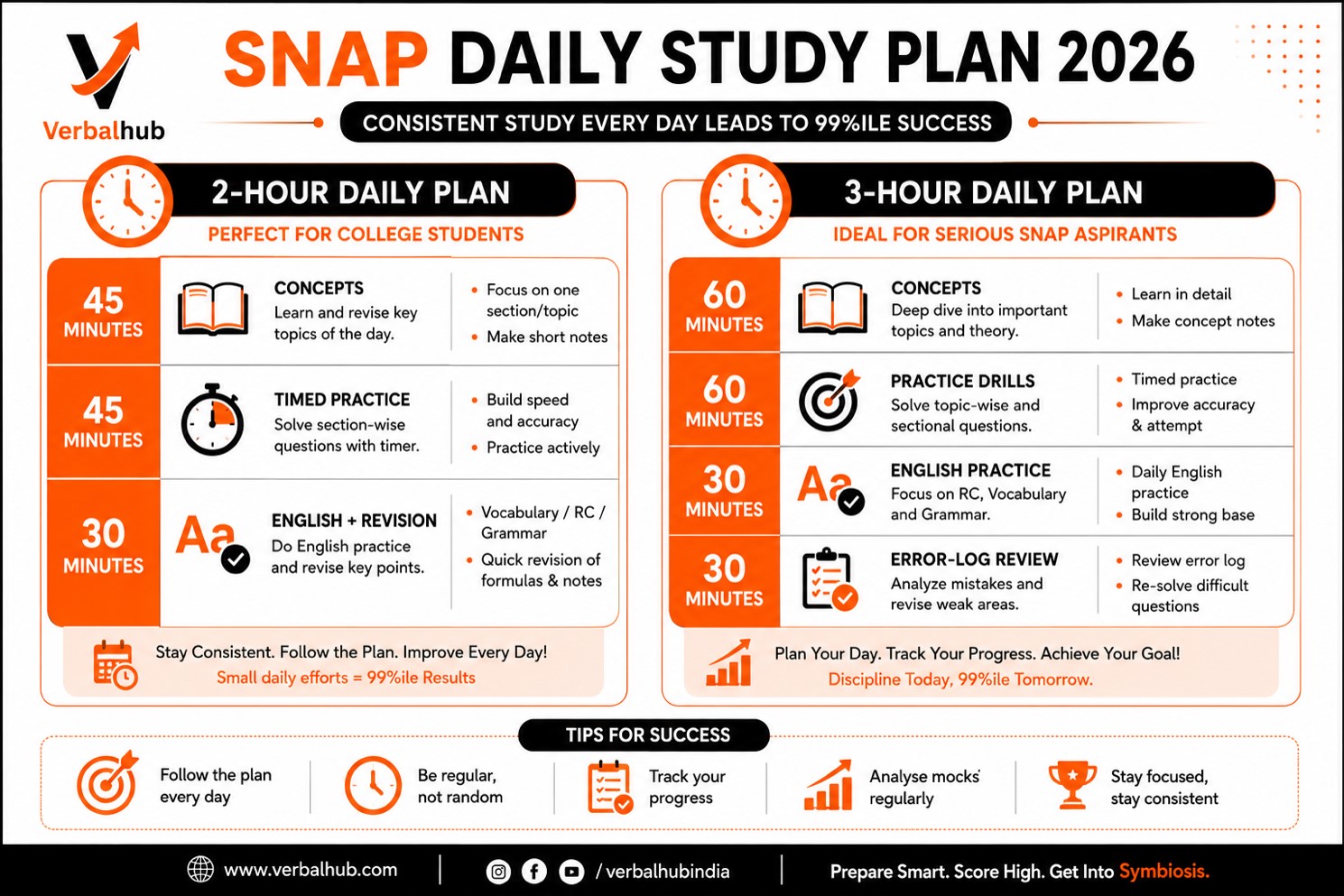
Two hours per day (minimum viable plan):
- 45 minutes: one topic (alternate Quant and Reasoning by day)
- 45 minutes: timed practice drill on an already-covered topic
- 30 minutes: English — 15 minutes vocabulary, 15 minutes grammar or RC
Three hours per day (comfortable plan):
- 60 minutes: concept learning for the day's topic
- 60 minutes: timed mixed drill (two sections)
- 30 minutes: English routine
- 30 minutes: error-log review and revision
Working professionals: Keep weekdays light and weekends heavy. Weekdays: 60–90 minutes (30 minutes vocabulary and grammar during commute or lunch, one timed drill at night). Weekends: one 3–4 hour block for a mock or two sectionals plus full analysis. This rhythm covers the syllabus in about 12–14 weeks.
College students: You have more flexible hours but more distractions. Fix two slots: one morning slot for concepts (fresh mind) and one evening slot for timed practice. Use college free periods for vocabulary and puzzle apps rather than adding pressure at night.
SNAP Self Study Plan
Can you prepare for SNAP without coaching? Yes, many students do. A SNAP self study plan works when three conditions are met: you can understand concepts from books or free videos on your own, you can hold yourself to a timetable without external pressure, and you have access to a good mock test series with solutions.
How to choose resources: One book or course per section, one mock series, and previous year papers. That is the full kit. Adding a fifth resource usually subtracts value.
How to track performance: Maintain a simple sheet with columns for date, test name, score, attempts, accuracy and one lesson learned. If your accuracy or score has not moved in three consecutive weeks, something in your method needs to change.
When is self-study enough? If your diagnostic score is already decent, your basics are in place and you are disciplined, self-study plus a mock series can absolutely take you to a high percentile.
When does mentoring become useful? If you keep repeating the same mistakes, cannot diagnose why your mock scores are stuck, struggle with fundamentals in one full section, or simply cannot maintain discipline alone, structured guidance saves months of trial and error. That is the honest line between the two paths.
SNAP Preparation Timetable
Here is a balanced weekly SNAP preparation timetable that does not demand impossible hours:
| Slot | Mon | Tue | Wed | Thu | Fri | Sat | Sun |
|---|---|---|---|---|---|---|---|
| Concepts (45–60 min) | Quant | LR | English | Quant | LR | — | Weak topic |
| Timed drill (45 min) | LR | Quant | Mixed | English | Quant | Mock (60 min) | Sectional |
| Review (30 min) | Error log | Error log | Vocab revision | Error log | Formula revision | Mock analysis | Weekly review |
Notice the balance: concept learning, timed drills, sectional tests, one full mock, review and revision all get space. Total commitment is roughly 2 to 2.5 hours on weekdays and 3 hours on weekends — demanding but realistic.
10. Time-Based SNAP Preparation Plans
Different students find this article at different points in the year. Here are honest plans for each timeline.
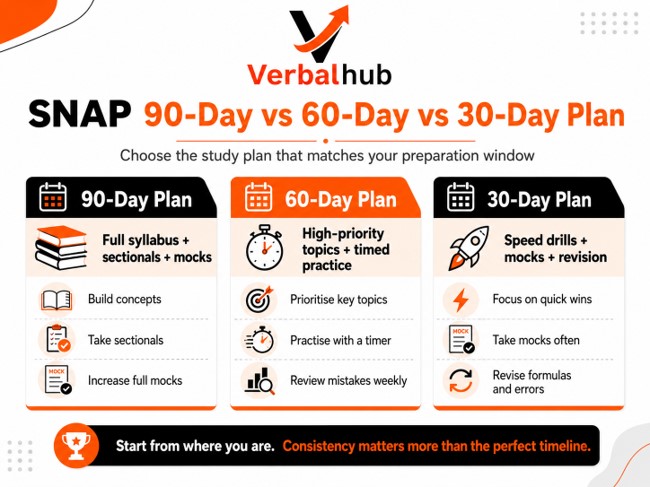
SNAP Preparation in 3 Months
Three months is a comfortable runway if you use it in phases. SNAP preparation in 3 months works like this:
Month 1 — Concepts and topic practice. Cover the full syllabus topic by topic. Finish arithmetic, core reasoning types and daily English work. Take one diagnostic mock at the start and one mock at the end of the month, purely for measurement.
Month 2 — Timed section work and sectionals. Shift from learning to speed. Two sectional tests per week per section, mixed drills daily, one full mock every week. Start your error log's weekly review ritual.
Month 3 — Full mocks, revision and exam strategy. Two mocks per week, deep analysis after each, formula and vocabulary revision every third day, and final strategy decisions: your section order, your attempt targets, your skip rules.
SNAP Preparation in 60 Days
SNAP preparation in 60 days needs sharper choices. Here is an eight-week frame:
- Weeks 1–2: Arithmetic + high-frequency reasoning types + daily English. Target: 60 percent of the syllabus, high-priority topics first.
- Weeks 3–4: Remaining syllabus at a faster pace. First full mock at the end of week 3. One sectional test every alternate day.
- Weeks 5–6: One mock per week becomes two. Timed mixed drills daily. Weak-topic surgery based on mock data.
- Weeks 7–8: Two mocks per week, previous year papers under timed conditions, full revision cycle, and a locked exam-day strategy by the middle of week 8.
Weekly targets matter more than daily ones in a 60-day plan; life will disturb individual days, and weekly checkpoints keep you honest without panic.
SNAP Preparation in 30 Days
Can you crack SNAP in 30 days? If your basics exist (for example, you prepared for CAT or another MBA exam), yes — 30 days of focused work can produce a strong score. If you are starting from absolute zero, 30 days can still get you a respectable score, but be realistic about the ceiling.
The 30-day rules:
- High-value topics only: arithmetic, series, coding, arrangements (short ones), vocabulary, grammar, basic DI. Ignore low-frequency, high-effort topics.
- Timed drills from day one. You do not have a separate concept phase; learn and drill together.
- Previous questions daily. Nothing teaches SNAP's style faster than SNAP's own past questions.
- Mocks every third day in weeks 2–4, each followed by same-day analysis.
- Revision built in: the last five days are for error logs, formulas and word lists, not new material.
SNAP Last Month Strategy
Whatever your total preparation length, the last month follows its own logic:
- Week 1: Two mocks, deep analysis, close remaining weak-but-important topics.
- Week 2: Two mocks, previous papers, finalise section order and attempt strategy.
- Week 3: Two mocks, full formula and vocabulary revision, error-log rereading.
- Week 4: One or two light mocks early in the week, then taper. Revise notes, sleep well, and do not experiment.
What NOT to start in the last few days: new topics, new books, a new mock series, a new section order, or a new attempt strategy. The last week is for consolidation, not construction.
| Time available | Main focus | Recommended mock approach | Biggest risk |
|---|---|---|---|
| 3 months | Full syllabus in phases | 10–15 mocks, weekly then bi-weekly | Losing momentum in month 2 |
| 60 days | High-priority topics + speed | 8–12 mocks from week 3 | Skipping mock analysis to save time |
| 30 days | High-value topics + past papers | 6–8 mocks, every third day | Trying to cover everything and mastering nothing |
| Last month (any plan) | Revision + strategy locking | 6–8 mocks, tapering in final week | Last-minute experiments and burnout |
11. Section-Wise SNAP Preparation Strategy
Each SNAP section rewards a different skill. Here is the SNAP section-wise preparation approach that works.
General English Preparation
SNAP verbal ability preparation is vocabulary-heavy compared with CAT. Build a daily habit: 10–15 new words with usage, revised weekly. Cover core grammar rules — subject-verb agreement, tenses, modifiers, prepositions — through error-spotting practice rather than theory reading. For reading comprehension, practise short passages and focus on option elimination: in SNAP, wrong options are usually clearly wrong, so eliminating two options fast is often quicker than "finding" the right one. Target speed: most English questions in under 40 seconds.
Common mistakes: memorising word lists without usage (you will forget them), skipping grammar because it feels "school-level," and reading passages twice out of habit.
Expert Tip
Read the questions of an RC passage before reading the passage. SNAP passages are short, and knowing what is asked lets you read with purpose and answer in one pass.
Logical Reasoning Preparation
SNAP logical reasoning preparation is about classification speed. Within 10 seconds of reading a question you should know its type and whether it is quick or a trap. Series, coding, directions, blood relations and syllogisms are usually 30-to-60-second questions — bank them. Long arrangement puzzles can eat three to four minutes for the same one mark — attempt them only in your second round, if at all. Practise mixed sets of 20–25 questions in 22–25 minutes so your brain gets used to switching question types rapidly.
Common mistakes: falling in love with a half-solved puzzle and refusing to leave it; solving reasoning untimed during preparation and then facing the clock only in mocks.
Quantitative Aptitude, DI and Data Sufficiency Preparation
SNAP quantitative aptitude preparation should start with arithmetic and stay there until it is airtight, because arithmetic dominates the section. Learn approximation deliberately: SNAP options are often far apart, so estimating "roughly 34 percent" is faster than computing 33.87 percent. Memorise tables to 20, squares to 30, cubes to 15, and common fraction-percentage equivalents; these save 15–20 seconds per question. For DI, practise reading the chart before the questions — one careful minute with the data pays back across all its questions. For data sufficiency, remember you only need to know whether it can be answered, not the answer itself; many DS questions are 30-second marks once you internalise this.
Common mistakes: grinding hard geometry while arithmetic accuracy sits at 70 percent; doing full calculations where approximation would do; ignoring DS because it "looks confusing."
Expert Tip
Build a "skip list" for Quant before the exam: two or three topics you will not attempt in the first round no matter what. Deciding this in advance removes in-exam hesitation, and hesitation is where minutes disappear.
12. SNAP Time Management Strategy
Sixty questions, sixty minutes, no sectional time limits. That freedom is a gift and a trap. Here is a SNAP time management strategy that turns it into a gift.
Why fixed per-section timing may not suit you. The popular split — 12 minutes English, 26 Reasoning, 22 Quant — is a fine starting point, but your split should reflect your strengths. A student with strong English might finish it in 8 minutes and invest the savings in Quant. Discover your split in mocks, not on exam day.
Build a personal section order. There is no compulsory order on screen movement within the paper (subject to the actual test interface rules for 2026), so plan the order you attack questions. Two proven approaches:
- Balanced section approach: go section by section in paper order, giving each its planned time. Best for students with even strengths and those who dislike switching.
- Strongest-section-first approach: open with your best section to bank marks and confidence early, then handle the rest. Best when one section is clearly your engine.
Test both approaches across at least two mocks each before choosing. The data will decide for you.
Use rounds. Round one (about 45 minutes): attempt every question you can solve in under a minute; mark anything longer and move on instantly. Round two (about 12 minutes): return to marked questions, starting with the ones closest to completion. Final 3 minutes: review flagged answers; do not start anything new.
First-round selection discipline: give each question a 10-second read. Solvable fast? Do it. Solvable but long? Mark it. No idea? Skip it forever. The skill of skipping without guilt is worth several percentile points.
Control blind guessing. With −0.25 negative marking, a random guess across four options loses value on average. Guess only with two options eliminated. In the final minute, resist the urge to fill answers blindly; it usually lowers your score.
13. SNAP Speed and Accuracy Strategy
SNAP speed and accuracy pull against each other, and negative marking referees the fight. Your score is: (correct × 1) − (wrong × 0.25). More attempts help only if accuracy holds.
Look at three students in the same paper:
| Student | Attempts | Accuracy | Correct | Wrong | Net score |
|---|---|---|---|---|---|
| A (aggressive) | 55 | 65% | 36 | 19 | 31.25 |
| B (balanced) | 45 | 85% | 38 | 7 | 36.25 |
| C (cautious) | 30 | 95% | 28 | 2 | 27.50 |
Student A attempted the most and scored the least of the top two. Student C was ultra-safe and left too many marks on the table. Student B — high attempts with controlled accuracy — wins. (This illustration shows the arithmetic of the marking scheme; it does not predict any actual percentile, which depends on the year's paper and the pool.)
The practical rules that follow:
- Raise attempts only as fast as accuracy allows. If accuracy drops below about 80 percent when you push attempts, pull back.
- Track both numbers in every mock. Improving one while destroying the other is not progress.
- Question difficulty matters: an extra attempt on an easy question is nearly free; an extra attempt on a hard question is a coin toss with a penalty.
- Time spent is the hidden third variable. Two minutes on one question is two other questions unattempted.
Key Takeaways
- Net score, not attempts, is the goal; negative marking punishes volume without accuracy.
- Around 80–90 percent accuracy with maximum possible attempts is the sweet spot for most students.
- Let your mock data set your personal attempt target — then trust it on exam day.
14. SNAP 99 Percentile Strategy
Let's be honest about what a SNAP 99 percentile strategy really involves. Completing the syllabus gets you to perhaps the 80s. The last stretch is won on execution, and here is what that means in practice.
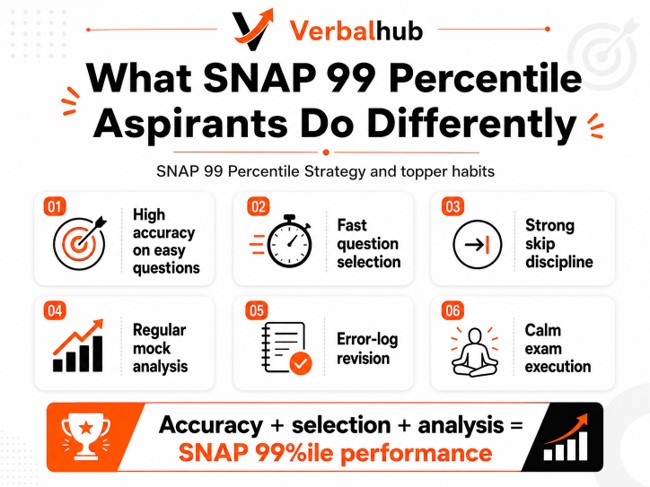
Strong fundamentals, automated. At 99-percentile level, you are not "recalling" the percentage formula; your hands solve while your eyes read the next line. That automation comes only from volume — hundreds of timed questions per topic.
Fast pattern recognition. Toppers have seen so many question types that most exam questions feel like reruns. This is the real function of previous papers and mocks: building a mental library of patterns.
Near-perfect accuracy on easy and medium questions. In a paper where most questions are easy to moderate, the 99 percentiler's edge is not solving the hardest question — it is not missing a single easy one. A silly mistake on an easy question is a double loss: the mark you lost and the penalty you paid.
Smart skipping without ego. Top scorers skip fast and never look back. They know three abandoned puzzles cost nothing if those minutes bought six easy questions elsewhere.
Consistency across mocks. One great mock means little. Aim for a tight score band across your last six to eight mocks; consistency is what survives exam pressure.
Forensic test analysis. After every mock, they know exactly which question types leaked marks and fix them within the week.
Calm execution. A bad first ten minutes does not break them, because their process (rounds, selection rules, time checks) runs regardless of emotion.
Slot variation and normalisation. With multiple test dates and best-score consideration in recent cycles, percentile calculation accounts for the process SIU specifies officially. Do not obsess over slot difficulty rumours; play your own paper. Historically, net scores in the low-to-mid 40s (out of 60) have corresponded to very high percentiles, but this shifts every year with paper difficulty — treat any such number strictly as a historical reference, not a target guarantee.
What 99-Percentile Aspirants Do Differently
- They review mocks longer than they take them.
- They keep attempt targets flexible but accuracy standards fixed.
- They rehearse their exam-day plan in every single mock — same order, same rounds, same rules.
- They revise old errors weekly instead of endlessly hunting new questions.
- They protect sleep and routine in the final two weeks like it is part of the syllabus — because it is.
15. SNAP Previous Year Papers and Practice Resources
SNAP previous year papers are the closest thing to the actual exam you can practise with, and they are criminally underused. Most students "go through" them; smart students train with them.
What to use:
- SNAP previous year papers from at least the last four to five cycles (the post-2021 short-format papers matter most)
- SNAP question paper with solutions — solutions matter as much as questions, because the method shown is often faster than yours
- SNAP practice questions organised topic-wise for drilling weak areas
- SNAP sample paper PDF sets and the official mock, when SIU releases one, to get used to the interface
- Topic-wise and sectional practice sets to convert weak topics before mixing them into full tests
How to use previous papers properly — the five-step method:
- Solve under exam time pressure. A previous paper done casually teaches almost nothing. 60 minutes, no pauses, no phone.
- Review every error the same day. Not just wrong answers — also correct answers that took too long and questions you skipped but could have solved.
- Classify each mistake: concept gap, calculation slip, misread question, wrong selection, or bad guess. The category tells you the cure.
- Reattempt after a gap. Redo the same paper's wrong questions after 10–14 days. If you fail again, the concept needs rework, not the question.
- Note recurring topics. After three or four papers you will see the exam's favourite areas — that becomes your revision priority list.
One caution: some circulated "previous papers" are memory-based reconstructions rather than official releases, so an occasional odd question or answer key error is possible. Use them for pattern and practice, not as a dispute-proof source.
16. SNAP Mock Test Series 2026
If previous papers teach you the exam's past, a SNAP mock test series trains you for its present. Mocks are where knowledge becomes score.
The mock toolkit and what each piece does:
- Free SNAP mock test: your zero-cost diagnostic. Take one before spending anything; it benchmarks your level and shows you what a good paid series should feel like.
- SNAP full length mock test: the core tool. Sixty minutes of real-format pressure, testing stamina, selection and strategy together.
- SNAP sectional mock test: section-sized tests to build depth and timing in one area at a time — ideal in the middle phase.
- Topic-wise tests: small, focused tests to repair a specific weak topic before it re-enters your mixed practice.
- SNAP online mock test platforms with percentile comparison show where you stand against other aspirants, which keeps targets realistic.
When should you start mocks? As soon as roughly half your syllabus is done — usually week 3 to 5 of preparation. Waiting to "finish the syllabus first" is the most expensive mistake in test prep; mocks are part of learning, not the reward after it.
How many mocks are enough? It depends on your runway. With three months, 10–15 full mocks plus sectionals is a healthy range. With 60 days, 8–12. With 30 days, 6–8. More is not automatically better: an unanalysed mock is a wasted hour. The right number is the maximum you can take while fully analysing every single one.
| Test type | Best stage to use it | Main purpose | What to review |
|---|---|---|---|
| Free/diagnostic mock | Day 1 and before buying a series | Benchmark your level | Overall score and section gaps |
| Topic-wise tests | Concept phase | Fix individual weak topics | Concept errors |
| Sectional mocks | Middle phase | Section speed and timing | Time per question, accuracy |
| Full-length mocks | Middle and final phase | Strategy, stamina, selection | Everything — full analysis |
| Final-week light mocks | Last 7–10 days | Rhythm without burnout | Strategy execution only |
Students who want a structured plan, live classes, a full SNAP mock test series and personal mock feedback can explore VerbalHub SNAP Coaching — start with a free demo class or diagnostic test.
17. How to Perform SNAP Mock Test Analysis
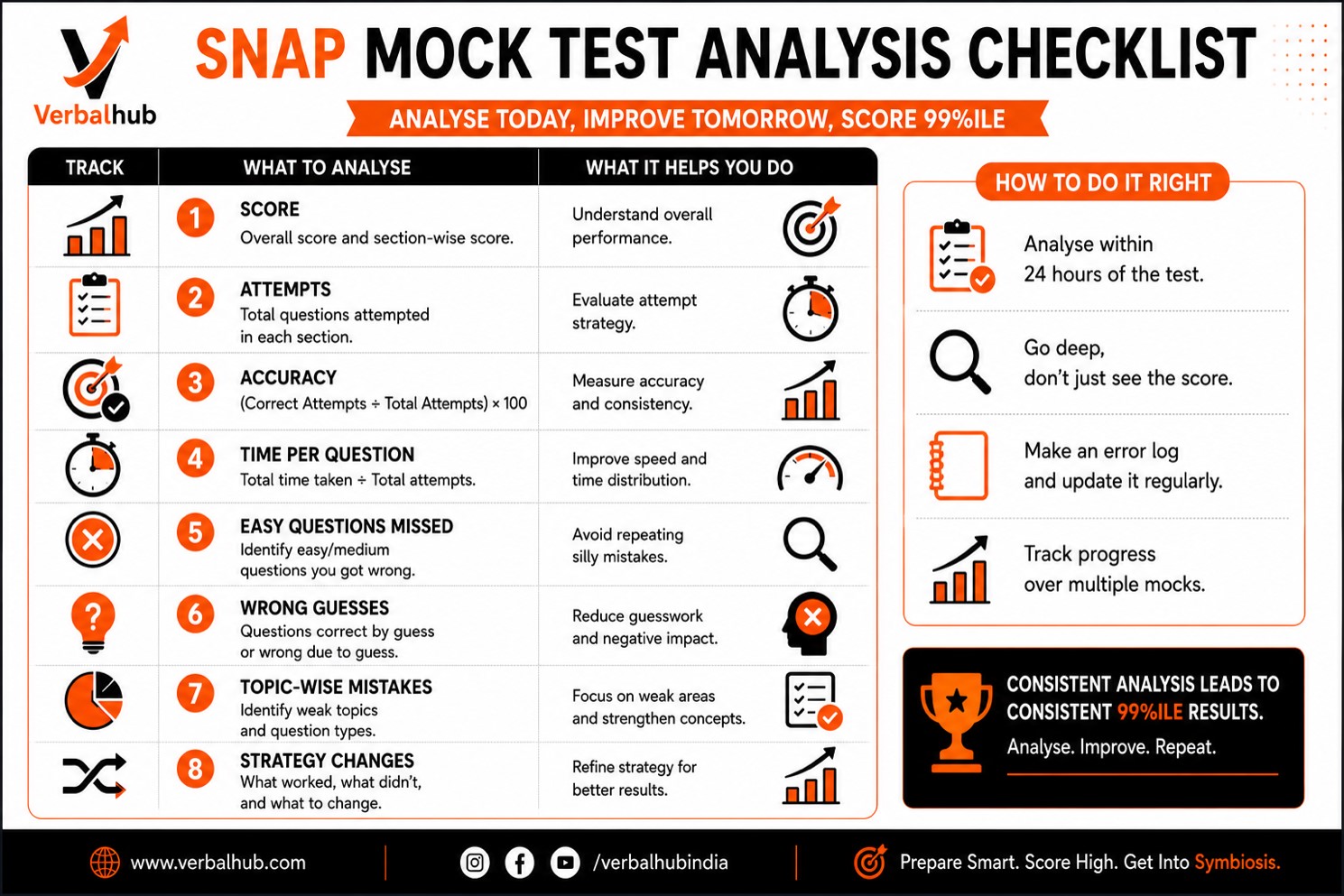
Here is the uncomfortable truth: the mock itself improves nothing. SNAP mock test analysis is where the improvement lives. Budget 90 minutes of review for every 60-minute mock.
Track these ten things after every mock:
- Total net score
- Attempts (overall and per section)
- Accuracy (overall and per section)
- Average time per question, per section
- Easy questions you got wrong or missed — the most expensive category
- Wrong guesses and what they cost you
- Questions you left despite knowing the method (why? time? fear?)
- Whether your section order and round plan actually happened as planned
- Topic-wise weaknesses (which chapters leaked marks)
- Repeat mistakes — anything appearing in two consecutive mocks is now a priority project
Classify every error into one of six types, because each has a different cure:
| Error type | What it looks like | The fix |
|---|---|---|
| Concept error | Did not know the method | Relearn the topic, then drill it |
| Calculation error | Right method, wrong arithmetic | Slow down 10%, practise mental maths |
| Reading error | Misread the question or data | Underline what is asked before solving |
| Selection error | Spent 3 minutes on a trap question | Enforce the 10-second triage rule |
| Time-management error | Ran out of time with easy questions left | Adjust round timing and section split |
| Guessing error | Guessed without elimination | Apply the two-options-eliminated rule |
A simple mock-analysis sheet you can copy:
| Field | Entry |
|---|---|
| Mock name and date | — |
| Score / Attempts / Accuracy | — |
| Section-wise split | GE: — , A-LR: — , QA-DI-DS: — |
| Costliest 3 mistakes | 1. — 2. — 3. — |
| Error types (count of 6 categories) | — |
| One strategy change for next mock | — |
| Topics to revise this week | — |
Expert Tip
After analysing, reattempt every wrong question without the solution in front of you. If you can now solve it, it was execution; if you still cannot, it is a concept gap. This two-minute test tells you exactly where to spend your next study hour.
18. Best Books and Study Material for SNAP Preparation
Students often ask for a long list of the best books for SNAP preparation. Here is better advice: keep your SNAP study material short, and finish it.
What to look for in each category:
- Quant books: a book that builds arithmetic from basics with plenty of practice questions at easy-to-moderate level. Any standard quantitative aptitude book used for MBA entrances works; you do not need CAT-level advanced material for SNAP.
- Reasoning material: a source with wide type coverage — series, coding, arrangements, syllogisms, critical reasoning — and timed exercise sets. Volume of standalone questions matters more than puzzle depth.
- English practice: a grammar-and-verbal workbook with error-spotting, fill-in-the-blanks and para jumbles, plus daily editorial reading from any good newspaper for comprehension speed.
- Vocabulary resources: one word-list source (a standard vocabulary book or a well-made app) used daily, with weekly revision. Consistency beats the size of the list.
- Mock platform: one SNAP-specific mock test series with detailed solutions and percentile comparison. SNAP-specific matters — CAT mocks train the wrong reflexes for this exam.
- Previous-paper resources: compiled SNAP previous papers with answers, ideally from the recent short-format years.
Why one good source per section? Because every extra book adds overlap, not coverage. A student who finishes one book, does its exercises twice and drills mocks will beat a student who has sampled five books. No single book guarantees success in SNAP or any exam — what a book does is give you organised practice; the score comes from how you use it.
Key Takeaways
- One book per section + one mock series + previous papers = the complete SNAP kit.
- SNAP-specific mocks matter more than famous books.
- Finishing your material twice beats collecting more of it.
19. Common Mistakes During SNAP Preparation
After watching thousands of aspirants prepare, the same mistakes appear every year. Check yourself against this list honestly.
- Preparing exactly like CAT. CAT trains you to invest deeply in hard questions; SNAP punishes exactly that. Fix: from day one, practise SNAP-format timed drills and cap your per-question time.
- Ignoring speed until the final month. Concepts without speed is half-preparation for a one-minute-per-question exam. Fix: use a timer in every practice session from week two onwards.
- Taking mocks without reviewing them. Ten unanalysed mocks teach less than three analysed ones. Fix: the 60-minute mock earns a 90-minute review, every time.
- Attempting every question. With −0.25 marking, blanket attempts convert into penalty. Fix: set an attempt band from your mock data and honour it.
- Spending too long on reasoning puzzles. One long arrangement can quietly eat four minutes. Fix: hard cap of 90 seconds in round one; mark and move.
- Overdoing difficult Quant. SNAP Quant is arithmetic-heavy; advanced topics give poor returns per hour. Fix: perfect arithmetic and DI first, touch advanced topics last.
- Ignoring vocabulary and grammar. These are the fastest marks in the paper, and students skip them because they feel unglamorous. Fix: 15 non-negotiable minutes daily.
- Changing strategy after every mock. One bad mock triggers a full strategy rebuild, so nothing ever stabilises. Fix: change at most one variable per mock, and give each change two mocks before judging it.
- Blind guessing. Random guessing has negative expected value under SNAP's marking. Fix: guess only with at least two options eliminated.
- Using too many study sources. Five books, three video courses, two mock series — and no mastery anywhere. Fix: one source per section, finished properly.
- Skipping previous-paper analysis. Past papers reveal the exam's actual personality; ignoring them means preparing for an imaginary exam. Fix: at least four previous papers under timed conditions.
- Waiting to finish the syllabus before starting tests. The syllabus is never "finished," and this excuse delays mocks until it is too late. Fix: first mock at 50 percent syllabus completion, no later.
20. SNAP Coaching vs Self-Study
Is SNAP coaching necessary? No — and any honest teacher will tell you that. Plenty of students reach high percentiles through SNAP preparation at home. The real question is which path suits your situation, budget and personality.
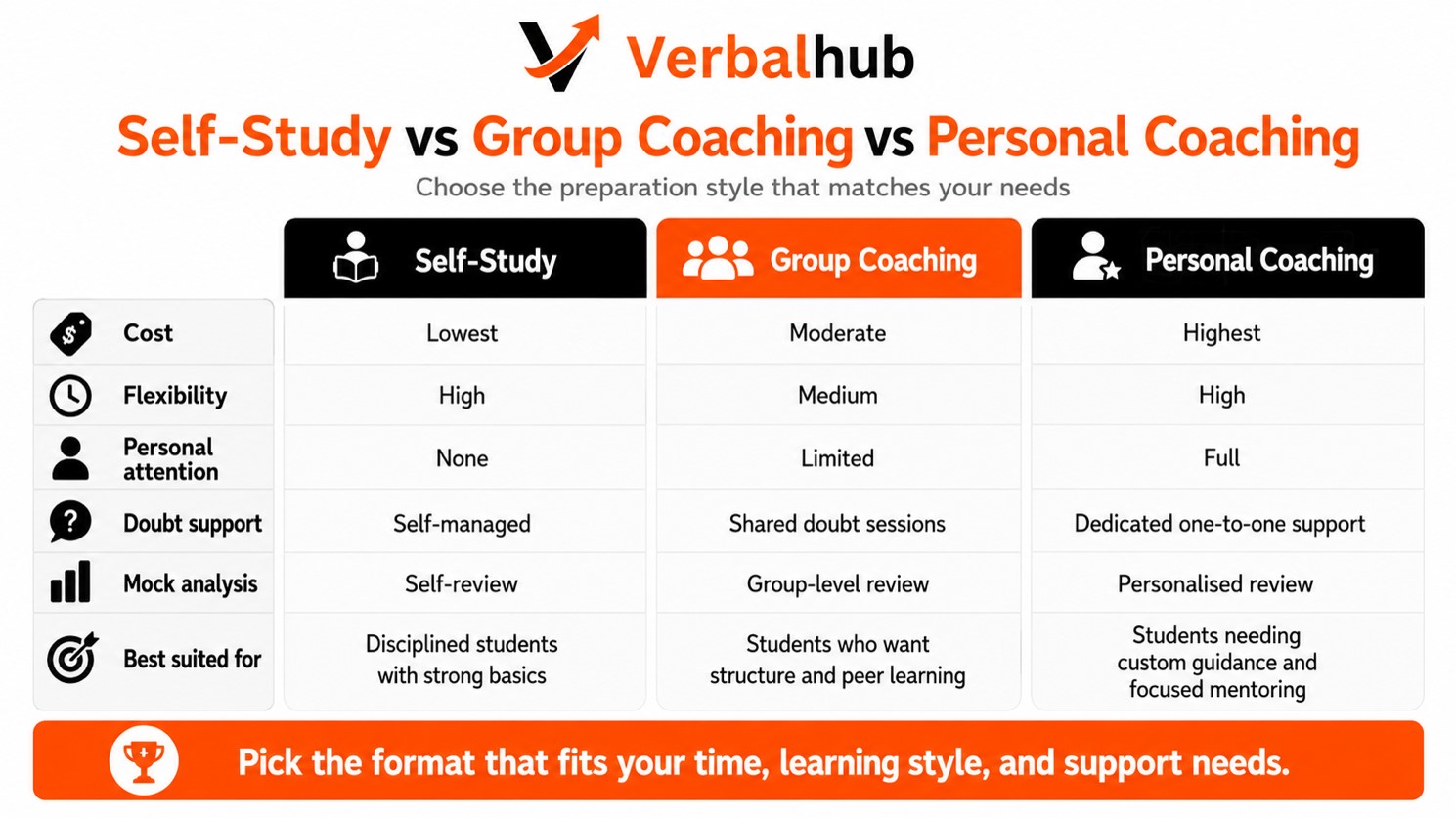
| Factor | Self-study | Group SNAP coaching | SNAP personal coaching |
|---|---|---|---|
| Cost | Lowest (books + mock series) | Moderate | Highest |
| Flexibility | Total | Fixed batch timings (online adds flexibility) | Schedule built around you |
| Personal attention | None | Limited, depends on batch size | Complete, one-to-one |
| Doubt support | Forums, videos, friends | Doubt sessions, shared with batch | Instant and individual |
| Discipline | Fully on you | Class schedule creates rhythm | Mentor tracks you weekly |
| Mock analysis | Self-driven | General analysis sessions | Personalised, question-level feedback |
| Study-plan customisation | You build it | One plan for the batch | Built for your gaps and timeline |
| Best for beginners | Hard without guidance | Good structured start | Excellent but costlier |
| Best for working professionals | Works if disciplined | Timing clashes possible | Fits around office hours |
Who can prepare independently? Students with solid basics (recent CAT prep, strong academics), genuine self-discipline, and the ability to self-diagnose from mock data. If that is you, invest in a good mock series and previous papers, follow the plans in this article, and you may not need anything more.
Who benefits from guidance? Students starting from weak fundamentals, those whose mock scores have plateaued and who cannot see why, working professionals who need efficiency more than exploration, and anyone who has failed a self-study attempt before. For these students, SNAP preparation without coaching is possible but slower — and in an exam with a fixed date, time is the scarcest resource.
There is also a middle path: self-study for concepts plus a mock series with expert analysis, or a short SNAP crash course in the final two months. Structure your spending around your actual gap, not around fear.
21. How to Choose the Best SNAP Coaching
If you decide guidance is worth it, the next problem is noise: every institute claims to be the best SNAP coaching in India. Ignore the banners and evaluate like a buyer. Whether you are comparing local classes or shortlisting the best SNAP coaching online, run every option through this checklist:
- Faculty experience: who actually teaches, and how long have they taught MBA entrance prep? Ask specifically whether the advertised faculty take the regular classes or only the demo.
- Batch size: in a 100-student batch, personal attention is a slogan. Smaller batches change what a class can do for you.
- Live vs recorded: recorded lectures are convenient but passive. Live SNAP classes let you ask, get corrected and stay accountable. Check the live-to-recorded ratio.
- Number and quality of classes: how many hours of teaching, and does it cover all three sections at real depth?
- Section-wise coverage: some institutes are strong in Quant but thin in verbal or reasoning. SNAP needs all three.
- Doubt support: is there a defined channel and response time, or a vague "you can always ask"?
- Mock-test quality: are the mocks SNAP-format (60Q/60min), with detailed solutions and percentile benchmarking?
- Personal mock analysis: does anyone sit with your mock data, or are you handed a scorecard and a goodbye?
- Study material: structured, exam-relevant material beats thick generic volumes.
- Course validity: does access last through your full preparation, including a possible second attempt cycle?
- Flexibility: recordings of missed classes, weekend batches, options for working professionals.
- Student reviews: look for detailed reviews describing teaching and support, not just star ratings.
- Trial class: any confident institute will let you attend a demo before paying.
- Transparent fees: a clear, written fee with everything included — mocks, material, doubt support — and no surprise add-ons.
Compare learning support, not discounts. A cheaper course that leaves you unsupported in month two is the most expensive thing you can buy this year. SNAP coaching fees vary widely, and the right question is never "what does it cost?" alone — it is "what exactly do I get per rupee, and does it close my specific gaps?"
Questions to Ask Before Paying the Fee
- Who exactly will teach my batch, and can I attend one of their live classes first?
- What is the maximum batch size?
- How many full-length SNAP mocks and sectionals are included?
- Will someone analyse my individual mock performance? How often?
- What is the doubt-resolution process and typical response time?
- Until what date is my course access valid?
- Is everything — material, mocks, analysis sessions — included in the quoted fee?
22. Why VerbalHub Is One of the Best SNAP Coaching Options

Now, a fair question: with so many options, why do students consider VerbalHub SNAP Coaching among the best SNAP coaching online? The answer is not a slogan — it is the way the programme is built around how SNAP actually works.
Structured preparation from basics to test level. The VerbalHub SNAP Course starts from fundamentals and climbs step by step to exam-level questions. Beginners are not thrown into advanced material, and students from non-maths backgrounds get the arithmetic foundation SNAP actually tests. This matters because SNAP rewards mastery of basics executed fast — exactly the ladder the course follows.
Live SNAP classes, not a recording library. Teaching happens live, so you can stop the teacher, ask why, and get corrected in the moment. Recordings exist as backup for missed sessions, not as the product itself. For a speed-based exam, this feedback loop is where bad habits get caught early.
Small batches and personal attention. VerbalHub runs small-batch learning, which means the faculty knows your name, your weak topics and your last mock score. The practical benefit: your doubts get answered in class, not lost in a crowd.
Faculty-led strategy, not generic tips. Section order, attempt targets, skip rules — these are worked out with you based on your mock data, because the right strategy for a verbal-strong student is wrong for a quant-strong one.
Section-wise concept building with regular practice. Each of the three SNAP sections is taught by concept, followed by timed practice questions, so learning converts into speed instead of staying theoretical.
A full testing engine. SNAP sectional mock tests during the concept phase, SNAP full-length mock tests in exam format later, and — the part most students never get anywhere — detailed, personal mock-test analysis. Students receive guidance on topic priorities, weekly targets and their specific mock-test mistakes, which keeps preparation focused on what actually moves their score.
Doubt-solving support through defined channels, so a Tuesday doubt does not wait for a Sunday class.
Built for real schedules. Flexible batch options support college students and working professionals, and course validity is designed to cover your full preparation window.
SNAP personal coaching option. Students who need one-to-one mentoring — personalised study planning, individual pace, private doubt sessions — can opt for personal coaching instead of or alongside group classes.
Support beyond one exam. Because SNAP preparation overlaps heavily with CAT, XAT, NMAT and CMAT, VerbalHub's guidance extends across related MBA entrance exams where relevant, so your effort compounds instead of fragmenting.
Ultimately, the job of good coaching is to help you answer six questions: what to study, what to skip, how to build speed, how to analyse mocks, how to stop repeating mistakes, and how to build a plan that fits your remaining time. That is the standard VerbalHub is built to meet.
| Student need | How VerbalHub supports it |
|---|---|
| Weak basics | Ground-up concept classes before any test-level material |
| Low mock scores | Personal mock analysis identifying exactly where marks leak |
| Lack of speed | Timed drills and section strategy built into the course |
| Difficulty with reasoning | Type-wise reasoning training with selection rules for the exam |
| Working-professional schedule | Live evening/weekend-friendly batches plus recordings of missed classes |
| Need for personal mentoring | Dedicated SNAP personal coaching with a custom study plan |
| Repeated test mistakes | Error-pattern tracking and one-on-one correction sessions |
If this sounds like the support you have been missing, the sensible next step costs nothing: book a counselling session, take a diagnostic test, or sit in on a demo class and judge the teaching yourself.
23. SNAP Personal Coaching and Live Online Classes
Group classes and personal coaching solve different problems, and choosing the right one saves both money and time.
Group SNAP classes give you structured syllabus coverage, a fixed schedule that builds discipline, peer benchmarking and a lower fee. For most students with average-or-better basics and a normal timeline, a good live group course plus mocks is enough.
SNAP personal coaching is one-to-one. The mentor builds a personal study plan around your diagnostic results, adjusts the pace to you (skipping what you know, slowing where you struggle), solves doubts privately and in depth, analyses every mock with you, and reschedules sessions around your life. The fee is naturally higher than group coaching because you are buying undivided expert time.
Who genuinely needs one-to-one coaching?
- Working professionals whose shifts make fixed batch timings impossible — SNAP coaching for working professionals works best when the class adapts to the calendar, not the reverse
- Students with a large gap in one section who need surgical, personalised work
- Repeat aspirants whose problem is strategy and error patterns, not syllabus
- Late starters on a 30-to-60-day timeline where every session must count
- Students who hesitate to ask doubts in a group and quietly fall behind
When is group coaching enough? When you have a standard timeline, reasonably even fundamentals, and the self-drive to practise between classes. Do not buy personal coaching for status; buy it for a specific problem it solves.
VerbalHub offers both formats — live SNAP classes in small groups and dedicated SNAP personal coaching — with SNAP preparation online delivery, so students in any city get the same access.
| Aspect | Group live classes | SNAP personal coaching |
|---|---|---|
| Schedule | Fixed batch timetable | Built around your availability |
| Study plan | Common batch plan | Fully personalised |
| Pace | Set by the batch | Set by your progress |
| Doubt solving | In-class and doubt sessions | Immediate, private, unlimited depth |
| Mock analysis | Group review + guidance | Question-level individual review |
| Fee | Moderate | Higher |
| Best for | Standard timelines, even basics | Specific gaps, odd schedules, late starts |
24. Top 10 Colleges Accepting SNAP Scores and Expected Percentiles
Around 15–16 Symbiosis institutes accept SNAP scores across MBA and specialised programmes. Below are ten leading options. Every percentile range is a historical trend, not an official guaranteed cut-off; every fee and salary figure is approximate, drawn from the latest available institute disclosures and placement reports (2024–25 cycle), and varies by year, programme and candidate profile. Verify current figures on each institute's official page before applying.
| Institute | Flagship programme | Expected SNAP percentile range (historical trend) | Approx. total fee | Latest reported avg./median salary (2024–25 reports, approx.) | Best suited for |
|---|---|---|---|---|---|
| SIBM Pune | MBA | 97–98.5+ | ₹24–26 lakh | ₹28–30 LPA avg. | General management, marketing, finance |
| SCMHRD Pune | MBA | 96–97.5+ | ₹22–24 lakh | ₹26–28 LPA avg. | HR (flagship), business analytics, ops |
| SIIB Pune | MBA (International Business) | 93–95 | ₹22–24 lakh | ₹17–19 LPA avg. | International business, agri-business, energy |
| SIBM Bengaluru | MBA | 90–93 | ₹20–22 lakh | ₹15–17 LPA avg. | General management in the Bengaluru market |
| SIOM Nashik | MBA (Operations) | 85–88 | ₹15–17 lakh | ₹14–16 LPA avg. | Operations and supply chain careers |
| SCIT Pune | MBA (IT Business Mgmt.) | 80–85 | ₹15–17 lakh | ₹13–15 LPA avg. | IT, product and tech-management roles |
| SIMS Pune | MBA | 78–83 | ₹14–16 lakh | ₹12–14 LPA avg. | General management (defence-category reservation applies to many seats) |
| SICSR Pune | MBA (IT) | 70–78 | ₹11–13 lakh | ₹9–11 LPA avg. | IT-oriented management at moderate percentiles |
| SSBF Pune | MBA (Banking & Finance) | 70–78 | ₹11–13 lakh | ₹9–11 LPA avg. | Focused BFSI careers |
| SIBM Hyderabad / SIBM Nagpur | MBA | 58–75 | ₹10–14 lakh | ₹8–10 LPA avg. | Newer campuses with improving trajectories |
Do not choose a college on salary alone. Programme specialisation, campus location, the roles companies actually offer there, total fee against likely outcomes, batch profile and your own career goals matter just as much. An operations enthusiast may build a better career from SIOM than from a higher-ranked general programme.
What your percentile band realistically opens (based on historical trends, not guarantees):
- 98–99+ percentile: competitive for SIBM Pune and SCMHRD shortlists; apply to both plus two backups.
- 95–98 percentile: SCMHRD becomes possible near the top of this band; SIIB is a strong realistic target; keep SIBM Bengaluru in the list.
- 90–95 percentile: SIIB (lower end possible), SIBM Bengaluru, SIOM — an excellent zone with multiple good options.
- Below 90 percentile: SIOM, SCIT, SIMS, SICSR, SSBF and the newer SIBM campuses offer genuine programmes; match the specialisation to your goal rather than chasing the brand alone.
Shortlists also depend on programme-specific weightages and profile factors, so a percentile alone never guarantees or rules out an interview call.
25. SNAP Score vs Percentile
Students constantly confuse these two numbers, so let's separate them. Your raw score is marks earned: correct answers minus penalties, out of 60. Your percentile tells you the percentage of test-takers you outperformed. A 99 percentile means you scored better than 99 percent of the pool — it says nothing fixed about your raw score.
Why does the score-percentile relationship change every year? Two reasons. First, paper difficulty: an easier paper pushes everyone's scores up, so the same percentile needs a higher score. Second, the pool: how many students took the exam and how well they performed shifts the entire curve. With multiple test sessions in recent cycles, SIU's official normalisation and best-score process also shapes the final percentile.
For rough orientation only, here is the kind of relationship seen in recent short-format SNAP cycles. Treat this strictly as a historical reference band — it will move in 2026 with paper difficulty:
| Approx. net score (out of 60) | Historical percentile zone (indicative) |
|---|---|
| 44+ | 99+ |
| 38–43 | 97–99 |
| 32–37 | 92–97 |
| 26–31 | 85–92 |
| 20–25 | 70–85 |
The practical lesson: do not chase a fixed score target from last year's tables. Chase maximum accurate attempts in your paper, and let the percentile take care of itself.
26. Symbiosis MBA Admission 2026
Symbiosis MBA Admission 2026 is a multi-stage process, and the SNAP score is only its first gate. Here is the full journey:
- SNAP registration on the official website, including your choice of test attempts.
- Programme selection: applying separately to each institute and programme you want, usually with a per-programme fee, as per the official rules.
- Taking the test in December, in one, two or three attempts (best score considered in recent cycles).
- Shortlisting: each institute releases its own shortlist based on its SNAP cut-off and programme rules.
- Selection round: shortlisted candidates attend the institute's process — typically a Group Exercise (GE), Personal Interaction (PI) and, for many programmes, a Writing Ability Test (WAT), as per each programme's official rules.
- Final merit list: built from a weighted combination — the SNAP score usually carries the largest weight, with GE, PI, WAT and profile elements making up the rest. Exact weightages differ by institute and are published officially.
- Admission offer: merit-list candidates receive offers; wait lists move as candidates accept or withdraw.
What matters beyond the SNAP score? Your academic record, quality work experience (valued more by some programmes, such as HR and operations-oriented ones), and your performance on the interaction day itself. Two candidates with identical percentiles can end up on opposite sides of the merit list because of the GE-PI-WAT stage.
One important caution: the process is not identical across institutes. Weightages, round formats and profile scoring vary by programme. Once shortlisted, read that specific institute's admission page as carefully as you read this article.
27. How to Prepare for the Symbiosis Selection Process
Clearing the SNAP cut-off gets you a seat in the room. GE-PI preparation for Symbiosis decides whether you convert it.
Personal Interaction (PI). Expect questions on your academics ("explain a concept from your graduation"), your work experience if any ("what exactly did you do, and what did you learn?"), current affairs and business awareness, and the classic trio: Why MBA? Why this institute? What are your career goals? Prepare honest, specific answers — panels have heard every rehearsed template and reward genuine clarity.
Group Exercise (GE). This may be a discussion or activity-based task. Panels look for contribution quality, listening, teamwork and structured thinking — not volume. Adding one clear point and building on others' ideas beats interrupting five times.
Writing Ability Test (WAT), where applicable. A short essay on a current or abstract topic. Practise 15–20 minute essays with a simple structure: stand, two or three arguments, a balanced counterpoint, conclusion.
Current affairs: follow news consistently for the two to three months before the process — major business stories, economy basics, and developments in your own field.
Resume preparation: one page, factual, and deeply known. Every line on it is a fair question; never include anything you cannot discuss for two minutes.
Common interview mistakes: memorised answers delivered like recordings; bluffing on factual questions instead of saying "I don't know, but here is my reasoning"; criticising a previous employer or college; having no real answer to "why this specific institute"; and ignoring the basics — punctuality, dress, and document files in order.
28. Final Seven-Day SNAP Revision Plan
The last week is about sharpening, not adding. Here is a day-wise SNAP revision plan:
- Day 7 (one week out): Full-length mock at your actual exam-slot time. Full analysis. Final list of formulas and rules to revise.
- Day 6: Formula revision (arithmetic, geometry, number system) + 30-minute timed reasoning drill + error-log reading, first half.
- Day 5: Vocabulary and grammar revision + one sectional English test + error-log reading, second half.
- Day 4: Last full mock (skip it if you feel fatigued — one fewer mock costs less than burnout). Light analysis focused only on strategy execution.
- Day 3: Short timed drills: 10 quant + 10 reasoning + 10 English questions. Revise your personal "mistake notebook." Check exam-day logistics: admit card printed, ID ready, centre location and travel time confirmed.
- Day 2: Light revision only — formulas, word lists, DS rules. No new questions after noon. Prepare your exam-day bag. Sleep at your normal (early) time.
- Day 1 (exam eve): Thirty minutes of casual formula browsing at most. No mocks, no debates about cut-offs, no social-media exam groups. Eat normally, walk, sleep early.
In the final 24 hours, do not: attempt a new mock, learn any new topic, discuss expected difficulty with anxious friends, change your section order or attempt plan, or sacrifice sleep to revise. Your score was built over months; the last day's only job is delivering it fresh.
29. SNAP Exam-Day Strategy
Exam day is about executing a rehearsed plan calmly. Here is the SNAP exam day strategy in sequence:
- Reach early. Arrive at the centre with 60–90 minutes' buffer. Carry the admit card and the specified photo ID; check the admit card for any listed requirements the night before.
- Read the on-screen instructions fully, even though you know the pattern. Interface details (marking for review, navigation) matter for your rounds plan.
- Open with your planned section order — the one your mocks validated. Exam day is not the day to try the other approach.
- Run round one exactly as rehearsed: the 10-second triage on every question — solve, mark, or skip. Bank every quick, sure mark first.
- Skip difficult questions without ceremony. One stubborn puzzle can silently cost four easier marks elsewhere.
- Respect the negative marking to the end. No elimination, no guess — including in the final rushed minute.
- Keep a light eye on the clock: two checkpoints (around 25 and 45 minutes) are enough; checking every two minutes just feeds anxiety.
- If panic hits, put the cursor down, take two slow breaths, and continue with the next easy question. A wobbly minute is recoverable; abandoning your process is not.
- Final three minutes: review marked questions you partially solved. Do not open anything brand new.
No drama, no heroics — just your practised process, run one more time.
30. Final SNAP Preparation Checklist
Save this checklist and run through it in the final week:
- Syllabus covered — all high- and medium-priority topics done; conscious decisions made on skipped topics
- Formula sheet revised at least twice in the final fortnight
- Vocabulary and grammar rules revised from your running list
- Sectional tests completed for all three sections
- All mocks analysed with the six-type error classification
- Error log fully re-read in the final week
- Exam strategy tested and locked: section order, round plan, attempt band, skip rules
- Documents ready: admit card printed, valid photo ID, passport photos if specified
- Travel planned: centre located, route and time tested, buffer added
- Sleep routine stable for at least the final five days, matched to your slot timing
Ten ticks here mean you are walking in prepared. Anything unticked with days remaining tells you exactly where the remaining hours go.
FAQs
Start by understanding the exam: 60 questions in 60 minutes across English, Reasoning and Quant, with negative marking (expected pattern, subject to the official notification). Take one previous paper as a diagnostic, then build basics section by section for four to six weeks. After that, shift to timed drills, sectional tests and full mocks with detailed analysis. SNAP Preparation 2026 is a speed game — practise with a timer from the second week onwards.
Yes, three months is a comfortable timeline for most students. Use month one for concepts and topic practice, month two for timed sectional work, and month three for full mocks, analysis and revision. With 2 to 3 focused hours daily, this phase-wise plan can take even a beginner to a competitive score.
Sixty days is enough if you prioritise ruthlessly. Cover high-frequency topics first — arithmetic, core reasoning types, vocabulary and grammar — and start mocks by week three. Follow weekly targets, take 8 to 12 analysed mocks, and lock your exam strategy by week seven. Students with prior CAT preparation can do very well on this timeline.
It is possible, especially if your basics already exist from CAT or other MBA exam prep. Focus only on high-value topics, drill previous year papers under timed conditions, and take a mock every third day with same-day analysis. Starting from zero, 30 days can still produce a respectable score, but keep your college targets realistic.
There is no magic number — the right count is the maximum you can fully analyse. As a guide: 10–15 full mocks over three months, 8–12 over 60 days, or 6–8 over 30 days, plus sectional tests throughout. A mock without a 90-minute review session is mostly wasted effort.
Question for question, yes — SNAP questions are generally easy to moderate while CAT questions run harder. But SNAP compensates with intense time pressure: roughly one minute per question, with negative marking. So SNAP is easier in content but very demanding in speed and accuracy. Many students who struggle with CAT's difficulty do well in SNAP with format-specific practice.
Historically, SIBM Pune shortlists have gone to candidates around the 97 to 98.5+ percentile range, though the exact cut-off changes every year with paper difficulty and applicant numbers. Treat 98+ as a safe working target and remember the final merit list also weighs GE, PI, WAT and profile. Always verify the current year's official information.
SIBM Pune and SCMHRD Pune lead the list, followed by SIIB Pune, SIBM Bengaluru and SIOM Nashik. Beyond these, SCIT, SIMS, SICSR, SSBF and the newer SIBM campuses at Hyderabad and Nagpur offer focused programmes at more accessible percentiles. Choose by specialisation and career goal, not by rank alone.
Yes, when it is live and interactive rather than a pile of recordings. Good SNAP online coaching gives you structured coverage, timed practice, SNAP-format mocks, doubt support and — most importantly — personal mock analysis, all without travel time. For working professionals and students in smaller cities, online classes are often the most practical route to quality preparation.
VerbalHub teaches through live classes in small batches, which means real personal attention rather than anonymous lectures. The programme covers concepts from basics to test level, includes sectional and full-length SNAP mocks, and — the differentiator — gives students individual mock analysis and error-pattern feedback. A personal coaching option exists for one-to-one mentoring. The fair way to judge it is directly: attend a demo class or take a free counselling session and see whether the teaching fits you.
31. Conclusion: Your Next Step in SNAP Preparation 2026
If you remember one thing from this guide, remember this: SNAP Preparation 2026 is not about finishing a syllabus — it is about becoming fast and accurate with that syllabus under a one-hour clock. The students who reach the top percentiles are the ones who practise under time pressure, select questions ruthlessly, protect their accuracy, analyse every mock like a detective, and follow a plan matched to the time they actually have.
You now have everything needed to build that journey: the expected pattern and syllabus, priority topics, plans for three months, 60 days and 30 days, a mock and analysis system, the college landscape, and an honest view of when coaching helps.
Some students will take this article and execute it entirely on their own — and succeed. Others will want structure, live teaching, and someone to look at their mock data and say, "here is exactly what to fix this week." If you are in the second group, VerbalHub's SNAP programme was built for you: live classes, small batches, section-wise preparation, a full mock test series and personal feedback at every stage.
The next step is simple and free: book a counselling session to map your ideal plan, take a diagnostic test to find your starting level, attend a demo class, or just request the course details and compare for yourself. December will arrive either way — the only question is how ready you will be when it does. Start today. VerbalHub SNAP Coaching
Note: All score ranges, deadlines, statistics, fees and salary figures in this guide are indicative and based on typical recent patterns. Always verify the latest details on the official SNAP website (snaptest.org) and individual institute pages before planning your applications.



Our Teachers

Dr. G Ravindra Babu
Quant Faculty
Ph. D in Mathematics Asian International University|| Mathematics Professor at Gitam University || Ex-Mathematics Professor SRM University Amaravathi || MBA in finance Acharya Bangalore B School || GMAT Quant 51, CAT Quant 99.58 %tile, GRE Quant 170 || 21 Different Teaching Certification || Believe in “Education is the mother of leadership”
view details

Dr. Rengarajan Parthasarathy
CAT Faculty
Ph. D in Mathematics from YCM University|| Mathematics Professor at Symbiosis International|| Author of Business Ethics || Ex-CAT Exam Syllabus Advisor in IIM || MBA & MPM from Symbiosis International (Deemed University) || College Topper in Mathematics in Ferguson College || Six Scholarships in Mathematics || 15 Years CAT Coaching, GMAT Coaching and GRE Coaching Experience|| UGC NET Qualified || GMAT Q51, V38 & CAT Q 99.31 & DILR 99.38 %tile, GRE Quant 170 || Believe in “Higher Education Shapes The World.”
view details

Dr. Nisha Tejpal
Verbal & AWA Faculty
Ph. D in English || Published a paper in English in ‘Research Journal of Philosophy and Social Sciences’ || MCA and B.Ed CCS University || A subject expert in Verbal Teaching || 10,000 Plus Essays Analysis || CTET and NET Qualified || More than 15 years of Experience || A writer, Author and Poet || Believe in “Think Beyond the Universe”
view details

Dhrithi Khattar
Verbal Faculty
A subject expert in Verbal Aptitude || More than 15 years of Experience || MBA in HR& Marketing & MA in Economics || Active Member of Hindu Alumni Association || Functional Member of Delhi ||Management Association (DMA) || Operational Member of All India Management Association (AIMA) ||The President of Key Club ||An active member of the French Club ||Gold Seal from California Scholarship Federation.
view details
M. U. Mir
DILR & Quant Faculty
A subject expert in Quantitative Aptitude Training || GMAT Q 51 & CAT DILR 99.75 %tile || GATE 2020 Qualified || M. Tech & B. Tech University Toper (1st Rank) || Awarded by Gov of Odisha, Bihar and J& K for the project Magnetic Floating Model || Ex-Quant Subject Expert in Arihant Publication || An Educationist and Social Worker || Believe in “Education is power”
view details

C. S. Rajawat
CAT Faculty
M. A in Mathematics CCS University|| M. Tech from SRM University || Visiting Mathematics Faculty CCS University ||Experience of 11 Years of CAT Coaching || District Topper in 10th & 12th || Best Teacher Awardee in 2021 & 2022 || CAT Quant 99.43 %tile || Discovered a new Theorem based on HCF in Math || Founder of C. S. Classes ||Believe in “Teaching and Training is an Art.”
view details

Dr. S.K. Singh
PTE/IELTS/CELPIP Expert
Ph. D. English Dr. B. R. Ambedkar University || Delhi & Center Government School Mentor || Founder of Entrepreneur & Learning Startup || IELTS & CELTA Certified from British Council || PTE Certified from Pearson...
view detailsRishabh Arora
PTE/IELTS/CELPIP Expert
MBA in HR International Institute of Management Sciences || PTE Certified from Pearson Test of English|| IELTS & CELTA Certified from British Council || BCA from Integral University || PTE 87 in 2017, IELTS 8.5 in 2018
view details
Jyoti Joshi
IELTS Trainer
Master in English (MA) and Bachelor in Education (B.Ed) || Certified Trainer || IELTS Speaking 9.0 Band holder || Believe in “Great teacher can inspire hope, ignite the imagination, and instill a love of learning”
view details
Surbhi Arora
IELTS / PTE Expert
English Language Expert || More than 3 years of Experience || M.A plus B. Ed Delhi University ||Author, Writer & Classical Singer|| Believe in “Language Language Learning & Teaching is Fun”
view details

Dilip Kumar Rathore
Quant Trainer
A business developer and genius in mathematics || Highly experienced || Master in Maths || well-verse in IT || Believe in “The art of teaching is the art of assisting discover”
view details

Imaam Hasan
Communication Expert
Master in English || Journalist and writer || Certified IELTS & PTE Trainer || A social educater and influencer || Believe in “Education is the movement from darkness to light”
view details