SAT 2027 Complete Guide for Indian Students

Written by Hasan Raja | IIM Kozhikode alumnus | CAT VARC 99th percentile three times | GMAT Verbal V50 | 20 years of teaching experience
Exam dates · Digital pattern · Syllabus · Fees · Scores · Colleges · Preparation
A clear guide for Indian high school students and parents planning undergraduate admission in the United States and other countries.
The SAT 2027 is a digital entrance test used by many universities in the United States and other countries for undergraduate admissions. Reading and Writing, and Math are the two sections; total score ranges from 400–1600. The test lasts 2 hours and 14 minutes, includes a 10-minute break and uses an adaptive format. Indian students should check the admission policy of every college on their list because some universities require SAT scores, some are test-optional, and others are test-blind. This guide explains the SAT exam pattern, syllabus, registration, fees, college policies, study materials and practical ways to improve your SAT score.
Last updated September 2026
Important: SAT policies, fees and test dates can change. This guide reflects information published as of 16 September 2026. Always verify current details on the official College Board website and each university's admissions page before you register or apply.
Index
- SAT overview and its role in 2027 admissions
- Digital SAT and the older paper test
- SAT exam pattern 2027
- Reading and Writing syllabus
- Math syllabus
- SAT scores and college score policies
- Colleges that use SAT scores
- Registration, dates, fees and eligibility
- Eight week and twelve week study plans
- Score improvement plans by starting range
- SAT English preparation
- Books, free resources and mock tests
- How to choose SAT English coaching
- VerbalHub and Hasan Sir
- Frequently asked questions
SAT 2027 Complete Guide for Indian Students and Parents
The SAT is an undergraduate admission test used by universities in the United States and by institutions in several other countries. For an Indian student, it can provide one clear academic score along with Class 11 and 12 marks, essays, activities and teacher recommendations.
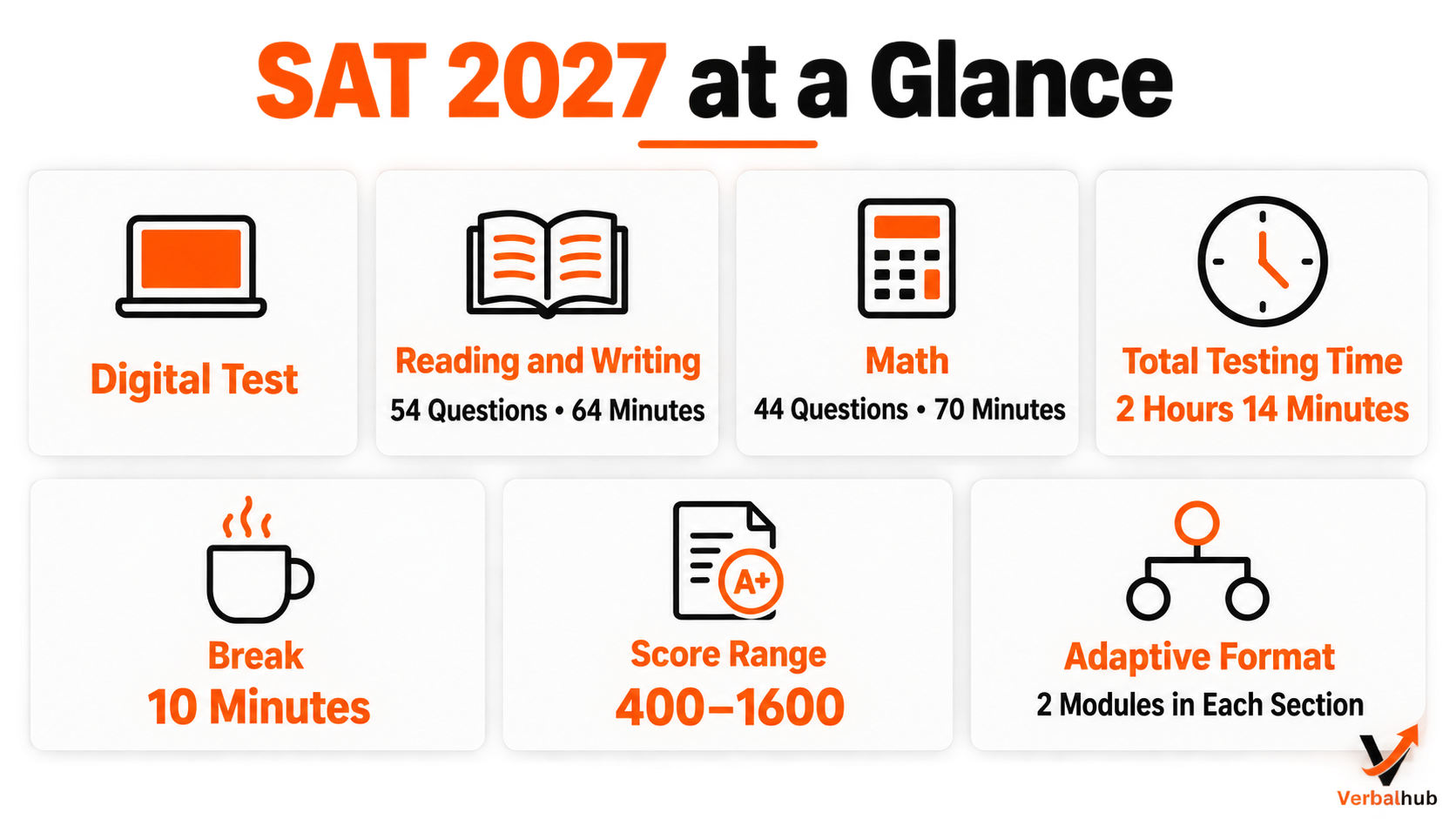
The SAT is now fully digital. It tests Reading and Writing and Math in a 2-hour, 14-minute adaptive test. The SAT score range is 400-1600.
Should every student take it? No. Some universities require an SAT or ACT, some are test-optional, and some are test-blind. Policies continue to change. Harvard currently requires the SAT or ACT except in defined access-related exceptional circumstances, and Yale requires first-year and transfer applicants to submit SAT or ACT scores. That is why students applying in 2027 must check every college separately rather than rely on a general statement that “US colleges are test-optional.” See the current official policies at Harvard College and Yale Undergraduate Admissions.
Quick Answer: Is the SAT Required for US Colleges in 2027?
Not all U.S. colleges follow the same rule.
- Test-required: You must submit an SAT score.
- Test-optional: You may apply without a score; a submitted score can still be considered.
- Test-flexible: A university may allow alternatives such as AP, IB or national examination results.
- Test-blind or test-free: The university does not use SAT or ACT scores in admission, even if submitted.
Check the admissions page for the exact entry year and applicant type. A policy for the 2026-27 application cycle may not automatically apply to a later cycle.
What Is the SAT Exam?
The SAT, administered by the College Board, assesses skills in reading, writing, language and mathematics that students are expected to use in college.
Universities may use an SAT score as one part of a broader application. It does not replace school grades, course rigour, essays, recommendations or activities. It also does not guarantee admission or a scholarship.
The exam is most relevant for students who:
- are applying to a college that requires the SAT or ACT;
- want the option to submit a competitive score at a test-optional college;
- are building a US college list but have not finalised it;
- may apply to universities outside the US that consider SAT scores; or
- want an additional academic part of the application when school curricula and grading systems differ.
There is no general age limit or minimum school percentage set by the College Board for taking the SAT. Most candidates take it in Classes 11 or 12 because the test is designed for undergraduate admissions. Individual universities set their own eligibility and admission rules.
Digital SAT vs Old Paper SAT
The current SAT is digital. International testing became digital before US weekend testing, and the old paper format should not be used to plan a 2027 attempt.
| Feature | Current Digital SAT | Old Paper SAT |
|---|---|---|
| Delivery | Bluebook application on an approved device | Printed test booklet |
| Total testing time | 2 hours 14 minutes | About 3 hours |
| Sections | Reading and Writing; Math | Reading; Writing and Language; Math |
| Total questions | 98 | 154 |
| Reading format | Short passage or passage pair for each question | Longer passages with several questions |
| Adaptivity | Two-stage, adaptive by section | Non-adaptive |
| Calculator | Allowed throughout Math | Allowed only on part of Math |
| Score range | 400-1600 | 400-1600 |
| Typical result timing | Faster than the former paper process; check the date-specific release schedule | Historically slower |
How Does Adaptive Testing Work?
Reading and Writing has two modules, and Math has two modules. Module 1 contains a mix of question difficulties. Your performance in Module 1 determines whether Module 2 is, overall, a set of questions that is generally harder or easier. The test does not change after every question.
Students within the same test centre may therefore see different Module 2 questions. Scores are calculated through College Board's scoring model; simply counting correct answers is not enough to predict an exact final score. Do not deliberately miss questions to seek an “easier” module.
SAT Exam Pattern 2027
The official structure currently published by the College Board is:
| Section | Modules | Time | Questions | Approx. Time per Question |
|---|---|---|---|---|
| Reading and Writing | 2 × 32 minutes | 64 minutes | 54 | 1 min 11 sec |
| Break | — | 10 minutes | — | — |
| Math | 2 × 35 minutes | 70 minutes | 44 | 1 min 35 sec |
| Total testing time | 4 modules | 134 minutes | 98 | — |
Source: College Board: How the SAT Is Structured.
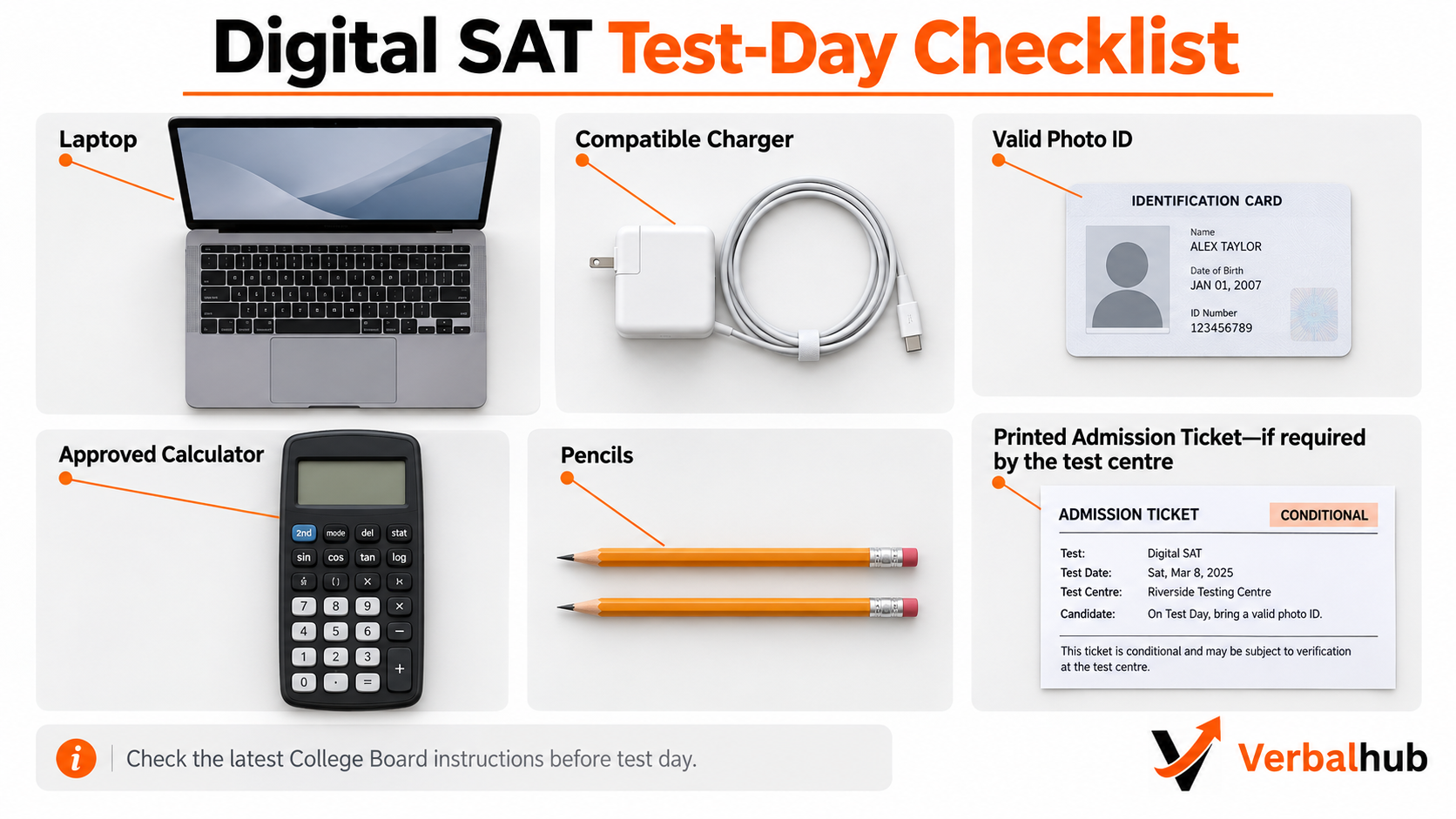
Most questions are multiple choice. Some Math questions require students to enter their answer. A calculator is permitted throughout Math. Bluebook includes an embedded Desmos graphing calculator, and students may bring an acceptable handheld calculator under College Board rules. Practise with the calculator you will actually use, but do not turn every arithmetic step into a calculator step.
Students normally test on a compatible laptop or tablet through Bluebook. Complete the Bluebook exam setup and device check before test day. Students who need to borrow a device from College Board must request one at least 30 days before test day, according to the current dates page.
SAT Syllabus and Important Topics
“SAT syllabus” is common search language, although College Board organises the assessed material into topic areas and skills.
SAT Reading and Writing Topics
| Official Topic Area | Important SAT Topics | What the Question May Ask You to Do |
|---|---|---|
| Information and Ideas | Main idea, details, inference, command of evidence, tables and graphs | Understand a text, draw a supported conclusion or select evidence |
| Craft and Structure | Words in context, text structure and purpose, cross-text connections | Interpret vocabulary, identify function or compare two texts |
| Expression of Ideas | Using notes for a writing goal, transitions | Use notes for a stated goal or connect ideas logically |
| Standard English Conventions | Sentence boundaries, grammar, usage, punctuation, form and sense | Correct fragments, run-ons, agreement, modifiers, verb forms and punctuation |
Official topic area reference: College Board topic areas.
SAT Math Topics
The SAT Math syllabus may overlap with school mathematics, but SAT questions reward modelling, interpretation and efficient method selection — not only formula recall.
| Official Topic Area | Important SAT Topics | Examples |
|---|---|---|
| Algebra | Linear equations, functions, inequalities and systems | Solve an equation, interpret slope, build a linear model |
| Advanced Math | Quadratics, exponentials, polynomials, radicals, rational expressions and nonlinear systems | Rewrite expressions, find roots, analyse nonlinear functions |
| Problem-Solving and Data Analysis | Ratios, rates, units, percentages, probability, statistics, scatterplots and study design | Read a table, compare rates, evaluate a statistical claim |
| Geometry and Trigonometry | Area, volume, angles, triangles, circles and right-triangle trigonometry | Apply a formula, use similarity or solve a circle problem |
SAT Score Explained
The SAT total score range is 400-1600. Reading and Writing contributes 200-800, and Math contributes 200-800.
There is no universal passing SAT score. A good target depends on the colleges on the student's list.
| Planning Band | General Interpretation | Sensible Next Action |
|---|---|---|
| Below 1000 | Major concept or reading gaps may still be present | Rebuild core skills before heavy mock testing |
| 1000-1190 | Developing foundation | Improve high-frequency topics and reduce avoidable errors |
| 1200-1340 | Solid for many institutions, but context matters | Compare with each college's reported score distribution |
| 1350-1440 | Strong in many groups of applicants | Target weak topic areas and improve consistency |
| 1450-1600 | Highly competitive as a score, but never an admission guarantee | Protect accuracy and focus on the complete application |
These are preparation bands, not admission cut-offs. “Competitive” changes by university, programme and group of applicants.
What Is a Good SAT Score for Ivy League Colleges?
There is no single Ivy League cut-off. For highly selective colleges, a score around 1500 or above is often a useful target, but it neither guarantees admission nor makes a lower score automatically unhelpful. Use the latest Common Data Set or official class profile for each institution and examine the middle 50% section-score ranges where available. Harvard states that it has no minimum required SAT or ACT score. Its admissions process considers testing as one part of review of the complete application.
Superscoring
Superscoring means combining a student's highest Reading and Writing section score and highest Math section score from different test dates. Many colleges superscore, but not all do, and their reporting instructions differ. Confirm the current policy on each admissions website before deciding which scores to send.
Score Reporting
College Board currently provides four free score reports if ordered by nine days after the test date. Later or additional reports are charged. Some universities allow applicants to self-report scores and require official reports only after admission; others may have different rules. Follow the university's instructions.
Which Colleges Accept SAT Scores
Thousands of institutions worldwide consider SAT or other College Board programme scores for admission, credit or placement, but “accepts SAT” does not tell you whether a score is required, optional or ignored. College Board provides an international university recognition search.
Use categories only to organise research — not to assume a common policy:
| College Category | Examples to Research | What to Verify |
|---|---|---|
| Highly selective US universities | Harvard, Yale, MIT, Stanford | Required/optional policy, accepted tests, deadlines and self-reporting rules |
| Selective private universities | NYU, USC, Boston University, Northeastern | Policy for the exact school, programme and entry year |
| Public universities | University of Michigan, Purdue, Georgia Tech, University of Florida | Campus and applicant-type rules; state-system policies may differ |
| Liberal arts colleges | Amherst, Williams, Swarthmore, Pomona | Current testing policy and score-reporting method |
| International universities | Institutions in India, Singapore, Canada, Europe and elsewhere | Whether SAT is used for admission, placement, credit or scholarships |
The University of California system is a well-known example of why “accepted” and “considered” must not be confused: applicants should verify whether scores are used in admission rather than assuming every US public university treats the SAT alike.
Before applying, open the official 2027 admissions page and record:
- Policy: required, optional, flexible or blind
- Tests and alternatives accepted
- Last acceptable test date
- Self-reporting versus official-report rules
- Superscore policy
- Rules for scholarships or specific programmes
SAT Registration, 2027 Test Dates, Fees and Eligibility
Confirmed and Anticipated SAT Test Dates
As of 16 September 2026, College Board lists these remaining dates in the August 2026-June 2027 testing year:
| SAT Test Date | Status | Regular Registration Deadline | Late Registration/Change Deadline |
|---|---|---|---|
| 3 October 2026 | Confirmed | 18 September 2026 | 22 September 2026 |
| 7 November 2026 | Confirmed | 23 October 2026 | 27 October 2026 |
| 5 December 2026 | Confirmed | 20 November 2026 | 24 November 2026 |
| 6 March 2027 | Confirmed | 19 February 2027 | 23 February 2027 |
| 1 May 2027 | Confirmed | 16 April 2027 | 20 April 2027 |
| 5 June 2027 | Confirmed | 21 May 2027 | 25 May 2027 |
College Board also lists 28 August, 18 September, 2 October, 6 November and 4 December 2027 as anticipated dates. They are not yet presented as confirmed registration dates. Always recheck College Board test dates and deadlines. Deadlines expire at 11:59 p.m. US Eastern Time, not Indian Standard Time.
SAT Fee for Indian Students
For international testing, the currently published SAT fee is:
| Charge | Current Official Amount |
|---|---|
| SAT registration fee | US$68 |
| International fee | US$43 |
| Standard total before optional charges | US$111 |
The international fee page says these amounts apply through December 2026. It also lists a US$38 late-registration fee and other optional service charges. Fees for 2027 may be revised, so check the official fee page at payment time: College Board international fees.
Do not treat a fixed rupee amount as the official SAT fee. The INR total depends on the card issuer's exchange rate, foreign-exchange markup, taxes and any other applicable charges.
How to Register for the SAT
- Create or sign in to your College Board account using your legal name.
- Choose the test date and search for an available centre.
- Complete the required personal and school information.
- Upload a compliant photograph if requested.
- Pay the applicable fee and save the admission details.
- Install Bluebook on an approved device.
- Complete exam setup when College Board makes it available.
- Run the device-readiness check and review the test-day list.
Seats can fill, particularly in major Indian cities. Register early, but only after checking school examinations, application deadlines and travel time.
How to Prepare for the SAT
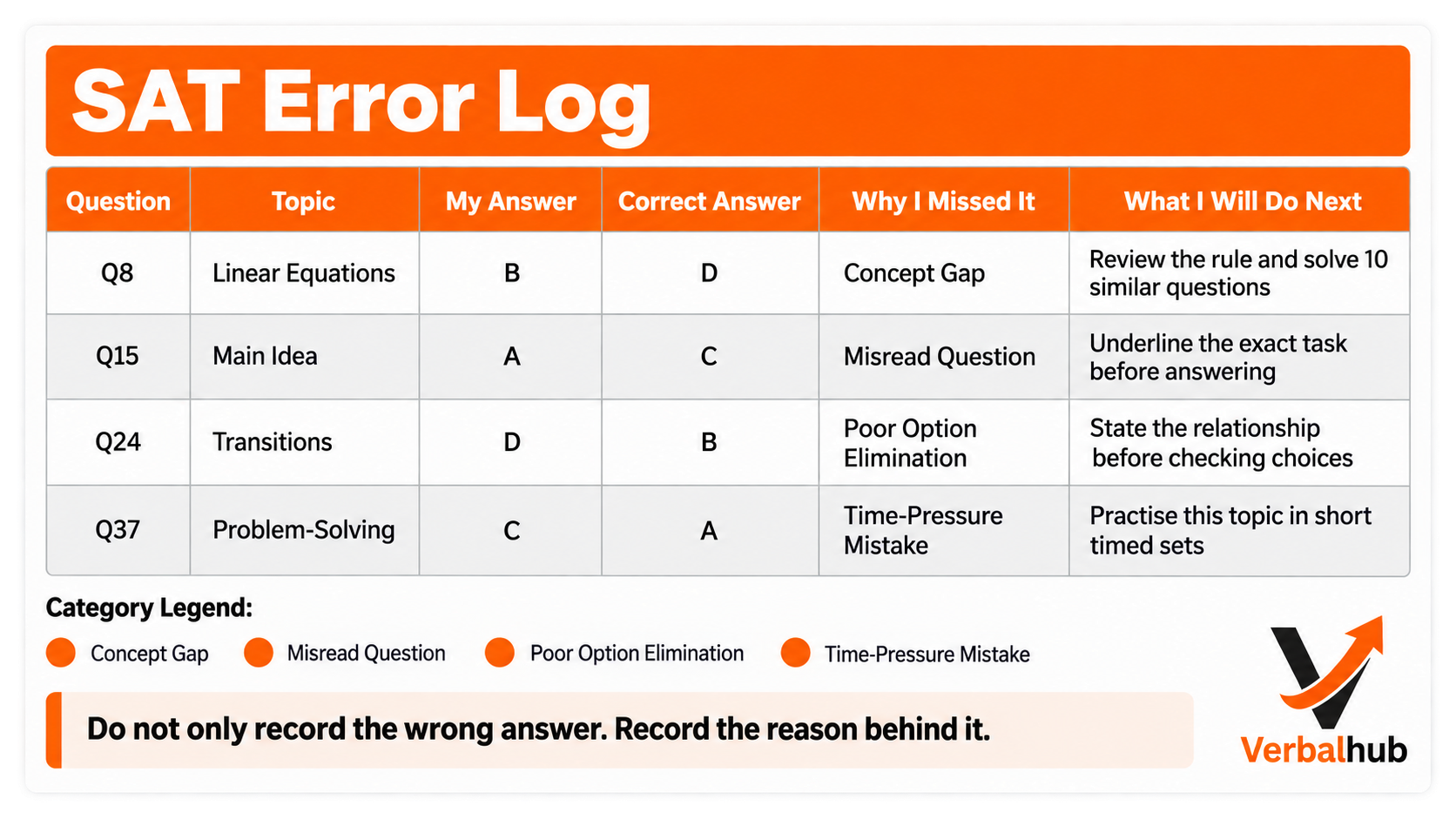
Start with an official full-length SAT practice test in Bluebook under timed conditions. Record the total score, both section scores and topic-level weaknesses.
Use the result to create an error log with these columns:
| Field | What to Record |
|---|---|
| Question | Test, module and question number |
| Topic area | For example, Transitions or Algebra |
| Error type | Concept, interpretation, careless work, method or time |
| Why the wrong option looked attractive | The exact trap you followed |
| Correct rule or method | One reusable lesson |
| Retest date | When you will solve a similar problem again |
Practical 8-Week SAT Study Plan
This plan suits a student with a reasonable foundation and about 7-10 focused hours per week.
| Week | Main Work | Test Work |
|---|---|---|
| 1 | Official diagnostic; build error log | One full Bluebook test |
| 2 | Grammar boundaries and linear algebra | Timed mini-sets |
| 3 | Main idea, evidence, functions and systems | Two timed modules |
| 4 | Vocabulary in context, transitions and advanced Math | One full test; deep review |
| 5 | Inference, using notes for a writing goal, data analysis | Mixed difficult sets |
| 6 | Geometry, trigonometry and weakest English topic area | One full test |
| 7 | Pacing, calculator method and recurring errors | Two section practice tests |
| 8 | Light revision, sleep and test-day routine | Final full test early in the week |
Practical 12-Week SAT Study Plan
Choose 12 weeks if the diagnostic reveals several concept gaps, school workload is heavy or the target requires a large improvement.
| Phase | Weeks | Focus |
|---|---|---|
| Diagnose | 1 | Full official test, target score and college-list check |
| Build foundations | 2-4 | Grammar, core reading methods, algebra and essential formulas |
| Develop topic areas | 5-7 | Evidence, vocabulary, rhetoric, advanced Math, data and geometry |
| Timed application | 8-9 | Timed modules, pacing decisions and mixed question sets |
| Full-test cycle | 10-11 | Full Bluebook tests followed by detailed analysis and targeted repair |
| Taper | 12 | Retest common errors, confirm device and routine, reduce volume |
How Long Does It Take to Prepare for the SAT?
Many students can build a useful plan over 8-12 weeks, but the right duration depends on the diagnostic score, target score, weekly time, reading level and Math foundation. A student rebuilding basic algebra or English comprehension may need longer. The calendar matters less than the number of well-reviewed practice hours.
Recovering From a Low SAT Score
A low score is data, not a verdict. Wait until you have the score report, identify the two or three topic areas creating the largest loss, and decide whether the main issue was knowledge, timing, test anxiety, fatigue or device familiarity. Do not immediately take another SAT mock test without changing the preparation method.
How to Improve Your SAT Score by Starting Range
These are priorities, not promises. Actual improvement varies.
Below 1000 to 1100+
- Rebuild arithmetic, linear equations and basic grammar before difficult questions.
- Learn sentence boundaries, subject-verb agreement and punctuation rules.
- Practise untimed first, then add a reasonable time limit.
- Read each explanation and write the rule in your own words.
- Take full tests less often; use targeted sets more often.
1100-1250 to 1300+
- Find which section offers the quickest reliable gains.
- Complete medium-level questions with high accuracy before chasing hard ones.
- Group errors by topic area every week.
- Improve transitions, words in context, functions, percentages and data analysis.
- Add one timed module per section each week.
1300-1450 to 1450+
- Work on hard inference, command-of-evidence and advanced-Math questions.
- Separate concept errors from mistakes made while solving.
- Review every guessed question, even when correct.
- Build a skipping-and-return rule for time-consuming questions.
- Use full adaptive Bluebook tests to check whether accuracy survives pressure.
1450+ to 1500+
- Stop measuring progress only by the number of questions solved.
- Analyse the last 30-40 lost or uncertain questions for repeated patterns.
- Protect Module 1 accuracy without becoming too slow.
- Practise precise evidence selection and algebraic verification.
- Simulate test conditions, including device, break and start time.
- Avoid changing a correct method merely because it looks too simple.
How Indian Students Can Improve SAT English
SAT English preparation is not about learning unusual vocabulary lists or reading passages at speed without understanding them. Each Digital SAT Reading and Writing question is short and asks for one specific decision.
1. Grammar and Sentence Boundaries
First identify whether the parts on each side of punctuation are complete sentences. Learn how full stops, semicolons, commas and coordinating conjunctions connect clauses. Then revise agreement, verb form, pronouns, modifiers and parallel structure.
2. Vocabulary in Context
Cover the answer choices and predict the meaning or tone from the sentence. Use contrast and cause-effect signals. Choose the word that suits the exact context, not the most sophisticated-looking option.
3. Transitions
Identify the relationship before looking at choices: continuation, contrast, cause, result, example or conclusion. “However,” “moreover” and “therefore” are not interchangeable.
4. Using Notes for a Writing Goal
Read the goal first. If the task asks you to emphasise a similarity, introduce a study or provide an example, use only notes relevant to that goal. The best answer may leave out true but unnecessary information.
5. Main Idea and Inference
Summarise the text in one plain sentence. For inference, choose what must reasonably follow from the text — not what could be true in the real world.
6. Command of Evidence
Match the claim to the choice that most directly supports or weakens it. In data questions, check labels, units and direction before reading the options.
7. Time Management
Do not spend two minutes protecting one difficult question while losing several easier questions. Mark it, select the best current answer and return if time permits. Build timing through modules, not isolated speed tricks.
Common SAT Reading and Writing Traps
- An option that repeats words from the passage but changes the logic
- A statement that is true but does not satisfy the question
- An inference that is possible but not supported
- A transition with the wrong relationship
- A grammatical answer that changes the intended meaning
- An overly broad main idea based on only one detail
SAT English Checklist
- I know the task before reading the options.
- My answer is supported by the supplied text or data.
- I identify the logical relationship in transition questions.
- I check both grammar and meaning.
- I can explain why three choices are wrong.
- I mark uncertain questions and move on.
- I review guessed answers in my error log.
Best Books and Free Resources for SAT Preparation
Official Free SAT Study Materials
1. Bluebook full-length tests: These best match the digital, adaptive test format. Use them for diagnostics and full practice tests. Official Bluebook practice tests.
2. Khan Academy Official Digital SAT Prep: Free lessons and practice for Reading and Writing and Math. College Board's Khan Academy guidance.
3. College Board Student Question Bank: Filter official questions by section, topic area, skill and difficulty.
4. College Board test specifications and content and topic pages: Use these to confirm what is actually tested.
Paid SAT Books
The Official Digital SAT Study Guide and current digital-SAT books from established publishers such as Barron's, Kaplan and The Princeton Review can provide structured practice. Before buying, check that the edition is designed for the Digital SAT, includes current short-passage Reading and Writing questions and does not rely mainly on recycled paper-SAT sets.
No third-party book should replace official Bluebook SAT practice tests.
Question Banks and SAT Mock Tests
A useful question bank should label the tested topic area, provide complete explanations and resemble current Digital SAT wording. A useful SAT mock test should match the 54/44 question structure and two-stage adaptive test format. Non-adaptive PDFs can help with skill practice but cannot fully match Bluebook adaptivity.
Avoid burning through official tests. After each full test, spend enough time reviewing it before taking the next one.
Tutoring and SAT Preparation Online
Self-study works for students who can identify mistakes, follow a plan and review consistently. Tutoring may help when a student cannot identify why scores are stuck, repeatedly misreads English questions or needs help staying on schedule. The correct choice depends on suitability, not on whether the course is labelled premium.
How to Evaluate SAT Coaching for English
Claims such as “best SAT coaching for English” or “guaranteed 1500” are not useful evaluation standards. Compare SAT coaching in India using evidence:
| Check | What Good Practice Looks Like |
|---|---|
| Diagnostic | A timed baseline followed by a topic-by-topic analysis |
| Teacher expertise | The teacher can explain current Digital SAT questions and alternative methods |
| Course design | Grammar, writing purpose, reading and timed practice are taught systematically |
| Practice quality | Official College Board material is prioritised; third-party material matches the current format |
| Feedback | The student receives specific correction, not only a score |
| Batch size | Small enough for real questions and feedback; verify actual numbers |
| Doubt support | Clear channel, response expectation and teacher access |
| Results | Results shared with student permission and explained clearly; no guarantees |
| Contract | Written fee, validity, refund and cancellation terms |
| Fit | Demo class, teaching language, pace, schedule and student comfort |
SAT verbal coaching should teach a student to justify an answer from text, grammar or logic. Dependence on tricks without explanation is a warning sign.
VerbalHub and Hasan Sir: A Transparent Note
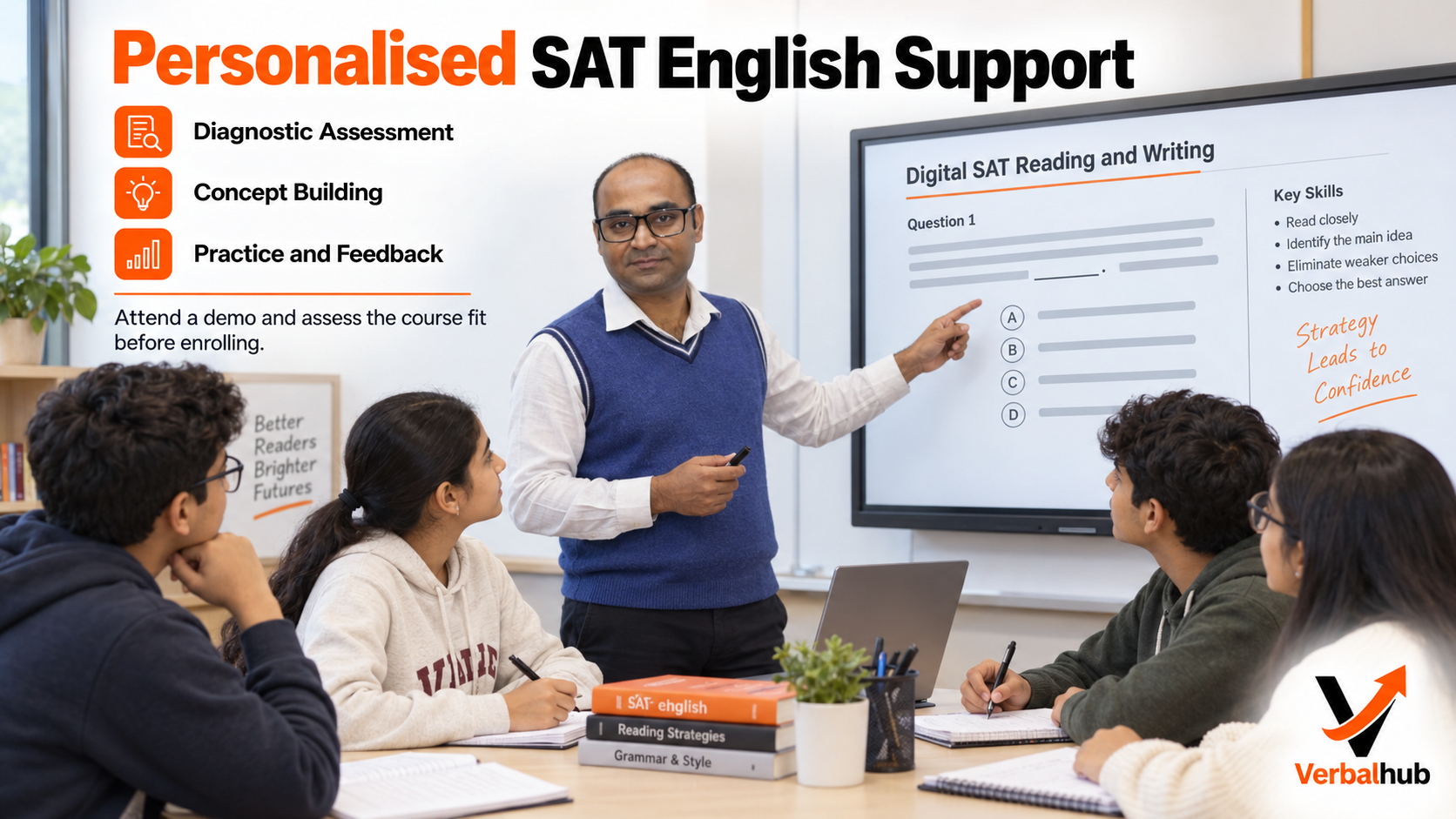
VerbalHub's public website currently lists a self-paced SAT course with video lessons, computer-based tests, course materials, an assessment and weekly doubt sessions. Its About page identifies Hasan Raja as a verbal trainer with experience in Reading Comprehension, Critical Reasoning, academic writing and curriculum development. See VerbalHub's SAT course page and About VerbalHub.
That public information suggests the option may suit students looking for structured online SAT preparation and verbal support. However, students should verify the current teacher for SAT English, live versus recorded components, number and quality of Digital SAT mock tests, feedback frequency, batch size, fees, access period and refund terms directly before payment.
Disclosure: VerbalHub is the publisher of this guide. This mention is not an independent ranking. Attend a demo or diagnostic session, compare alternative courses and official free resources, ask for written course details, and enrol only if the teaching method suits the student. This article does not promise a score increase, admission or scholarship.
Frequently Asked Questions
It depends on the university. Some require SAT or ACT scores, some are test-optional, and some are test-blind. Check the official admissions policy for your exact entry year.
400-1600 is the range of the total score. Reading and Writing is scored from 200-800, and Math is scored from 200-800.
There is no universal cut-off. Around 1500+ is a sensible target for many highly selective applications, but admission depends on the whole application and a high score is not a guarantee.
The standard SAT is digital and delivered through Bluebook. Paper testing is associated with approved accommodations, not the normal weekend format.
Testing time is 2 hours 14 minutes, plus a 10-minute break between Reading and Writing and Math.
There are 98 questions: 54 in Reading and Writing and 44 in Math.
Yes. A calculator is allowed throughout the Math section. Bluebook includes an embedded Desmos calculator; students may also bring an acceptable calculator under College Board rules.
College Board does not set a lifetime attempt limit. Practical limits include test availability, cost, preparation time and college score-reporting policies. Two or three planned attempts are usually more useful than repeated unreviewed attempts.
The currently published standard international total is US$111: a US$68 registration fee plus a US$43 international fee. These published rates apply through December 2026; check the official page for 2027 fees and optional charges.
The confirmed spring dates are 6 March, 1 May and 5 June 2027. College Board also lists later 2027 dates as anticipated. Confirm the latest status before registering.
Eight to twelve weeks is a useful planning range for many students. A student with major foundation gaps or a demanding score target may need longer.
Start with sentence boundaries and grammar, then train words in context, transitions, using notes for a writing goal, main idea, inference and evidence. Use short timed sets and maintain an error log.
Many universities in the US and other countries consider SAT scores, but their policies differ. Use College Board's university search and verify the exact policy on each university's official admissions page.
Superscoring combines the highest Math score and highest Reading and Writing score from different dates. Not every university follows the same policy.
Yes. Bluebook practice tests, Khan Academy Official Digital SAT Prep and the College Board Student Question Bank provide substantial free official preparation.
No. Many students can prepare independently. Coaching may be useful for finding weak areas, personal feedback and help staying on schedule or a persistent English or Math weakness. Judge it by the teaching quality and how well it suits the student, not by advertising claims.
No. Universities evaluate multiple parts of the application, and scholarship rules vary. A strong score can support an application where considered, but it is not a guarantee.
At a test-optional college, you choose whether to submit a score and a submitted score may be considered. A test-blind college does not use the score in admissions even if you send it.
Final Takeaway
Do three things before buying books or joining SAT coaching:
- Take one official full-length diagnostic test in Bluebook.
- Build a college list and set a target from each university's current testing policy and score profile.
- Choose an 8- or 12-week schedule based on the gap between your diagnostic and target — not on a generic promise.
Then practise by topic area, keep an error log and use full SAT practice tests to measure whether the corrections hold under time pressure. SAT preparation becomes much clearer when every week answers one question: Which specific error will I stop repeating next?
NEXT STEP: Attend a free SAT English diagnostic session with Hasan Raja Sir at VerbalHub.com to see how a personalised plan could work for you.