
Professional LOR Writing Services for University Applications

A recommendation letter carries weight because someone else vouches for you. VerbalHub helps you and your recommender turn real academic and professional experience into a clear, specific, and credible letter for MS, MBA, master's, and PhD applications.
- Honest by design — Letters built on your genuine record, never on invented achievements.
- Program-specific — Drafts shaped for your target degree, university, and country.
- Recommender-approved — Your recommender reviews and approves the final letter before submission.
Primary CTA: Get LOR Writing Support Secondary CTA: Talk to an Admissions Expert
Trust line: Confidential, ethical LOR support. We never fabricate details or guarantee admission.
Why a Strong LOR Matters
Your grades and test scores show what you achieved. A letter of recommendation shows how you achieved it, from the perspective of someone who watched you work. Admissions committees read LORs to confirm three things: that your record is genuine, that you behave well in classrooms and teams, and that you are ready for the program you have chosen.
A strong letter gives evidence of:
- Academic or professional ability, shown through specific work the recommender supervised.
- Reliability and character — deadlines met, responsibility taken, help offered to peers.
- Leadership and teamwork in real situations, not adjectives in isolation.
- Growth over time, such as improvement between a second-year course and a final-year thesis.
- Readiness for the target program, in the recommender's own judgement.
One point matters more than any other: a good LOR adds evidence. It should not repeat your résumé or restate your SOP in a third-person voice. If the committee learns nothing new from the letter, it has not done its job.
Common Problems Applicants Face
Most applicants we work with are not looking for shortcuts. They are dealing with very practical problems:
- Their professor or manager agreed to sign, but asked the applicant to prepare the first draft.
- The draft they wrote sounds generic — it could describe any student in the class.
- They know the letter needs examples, but cannot decide which ones prove the right qualities.
- The letter repeats the SOP or résumé instead of adding an independent perspective.
- The tone is off: too casual for a formal letter, or so dramatic it stops sounding believable.
- They are unsure whether to ask a professor, a manager, or both.
- Different universities ask for different lengths, formats, and submission methods.
- The deadline is close and the recommender is busy.
If any of these sound familiar, structured LOR writing support can save you time and produce a far stronger letter.
Our LOR Writing Services
LOR Writing from Applicant and Recommender Inputs
When your recommender asks you to prepare a draft, we build it with you. We collect real details through a short questionnaire — projects, results, classroom or workplace moments — and write a letter in a natural recommender's voice. The recommender then reviews, edits, and approves it, because the letter is theirs.
LOR Editing and Proofreading
Already have a draft? Our letter of recommendation editing services strengthen structure, sharpen examples, correct grammar, and fix tone, while keeping every fact exactly as you provided it.
Academic LOR Writing Support
For letters from professors, lab supervisors, or project guides. We focus on coursework performance, research aptitude, analytical thinking, and classroom contribution — the evidence academic committees look for.
Employer and Professional LOR Support
For letters from managers or team leads, common in MBA and professional master's applications. We highlight workplace achievements, ownership, collaboration, and measurable impact where genuine numbers exist.
Professor LOR Support
If your professor is willing to write the letter personally, we can support them directly with a structured brief: your key work under their guidance, the program's expectations, and a suggested outline. This keeps the letter authentic while saving their time.
Multiple-University Adaptation
One base letter rarely fits every application. We adapt your approved LOR to each university's word limit, format, and question prompts without changing the underlying facts.
Content and Structure Review
A focused review that checks whether your letter answers what committees actually ask: relationship, context, evidence, comparison, and a clear recommendation. You receive specific, actionable feedback.
Final Language and Consistency Check
A last pass before submission: consistent names, dates, and program titles; clean grammar; and a tone that matches your recommender's seniority and relationship with you.
LOR Services by Program
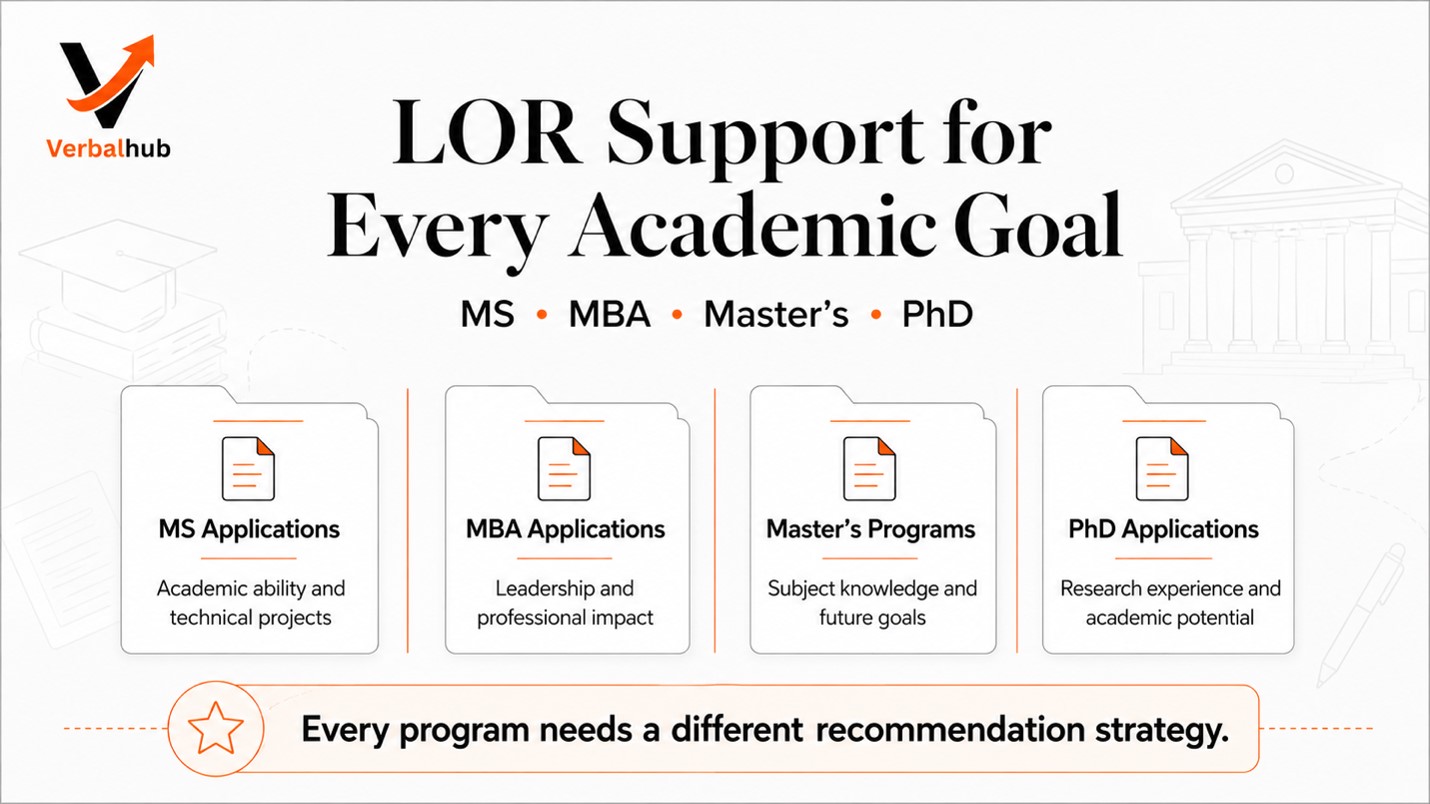
LOR Writing for MS Applications
An MS letter should prove technical depth and the ability to handle graduate-level coursework or research. The right recommender is usually a professor who taught you a core subject, guided your final-year project, or supervised lab work. The most common mistake is listing grades the transcript already shows. When writing an LOR for MS programs, we anchor the letter in one or two substantial pieces of work — a project, a paper, a difficult course — and let those carry the argument.
LOR Writing Services for MBA Applications
MBA committees care about leadership, initiative, and how you work with people. A direct supervisor who has seen you deliver under pressure usually makes a stronger recommender than a distant senior executive with an impressive title. The frequent mistake is a letter full of praise but empty of situations. Our LOR writing services for MBA applications focus on concrete workplace stories: a project you led, a conflict you resolved, a result you owned.
Professional LORs for Master's Programs
Master's programs in fields like data science, public health, finance, or design often accept both academic and professional letters. The choice depends on which experience is more recent and more relevant. A common mistake is choosing the recommender by seniority rather than familiarity. We help you decide who can genuinely speak to your abilities, then draft a professional LOR for master's admissions that connects your background to the program's demands.
LOR Support for PhD Applications
PhD letters are the most specialised. Committees want to know whether you can do independent research: your curiosity, persistence, methodological skill, and intellectual honesty. Recommenders should be research supervisors or professors who know your scholarly work closely. The classic mistake is a warm but generic teaching reference. As experienced LOR writers for PhD applications, we structure the letter around your research contributions and, where truthful, your recommender's honest comparison with past students.
Academic LOR vs Employer LOR
Applicants often ask which type of letter to submit. Here is a quick comparison:
| LOR Type | Best Suited For | Suitable Recommender | Main Evidence to Include | Common Mistake |
|---|---|---|---|---|
| Academic LOR | MS, PhD, research-focused master's; recent graduates | Professor, project guide, lab or thesis supervisor | Coursework performance, projects, research ability, analytical skill | Repeating grades already on the transcript |
| Employer LOR | MBA, professional master's; applicants with work experience | Direct manager or team lead who supervised your work | Responsibilities, leadership moments, teamwork, measurable results | Praise without a single specific situation |
How to choose: follow the program first, then recency. Research-oriented programs weigh academic letters most; MBA programs expect at least one employer letter. If you graduated recently, professors will remember your work; if you have three or more years of experience, a manager's perspective usually adds more. Many applications allow both, which lets you show academic ability and professional maturity together.
Country-Specific LOR Support
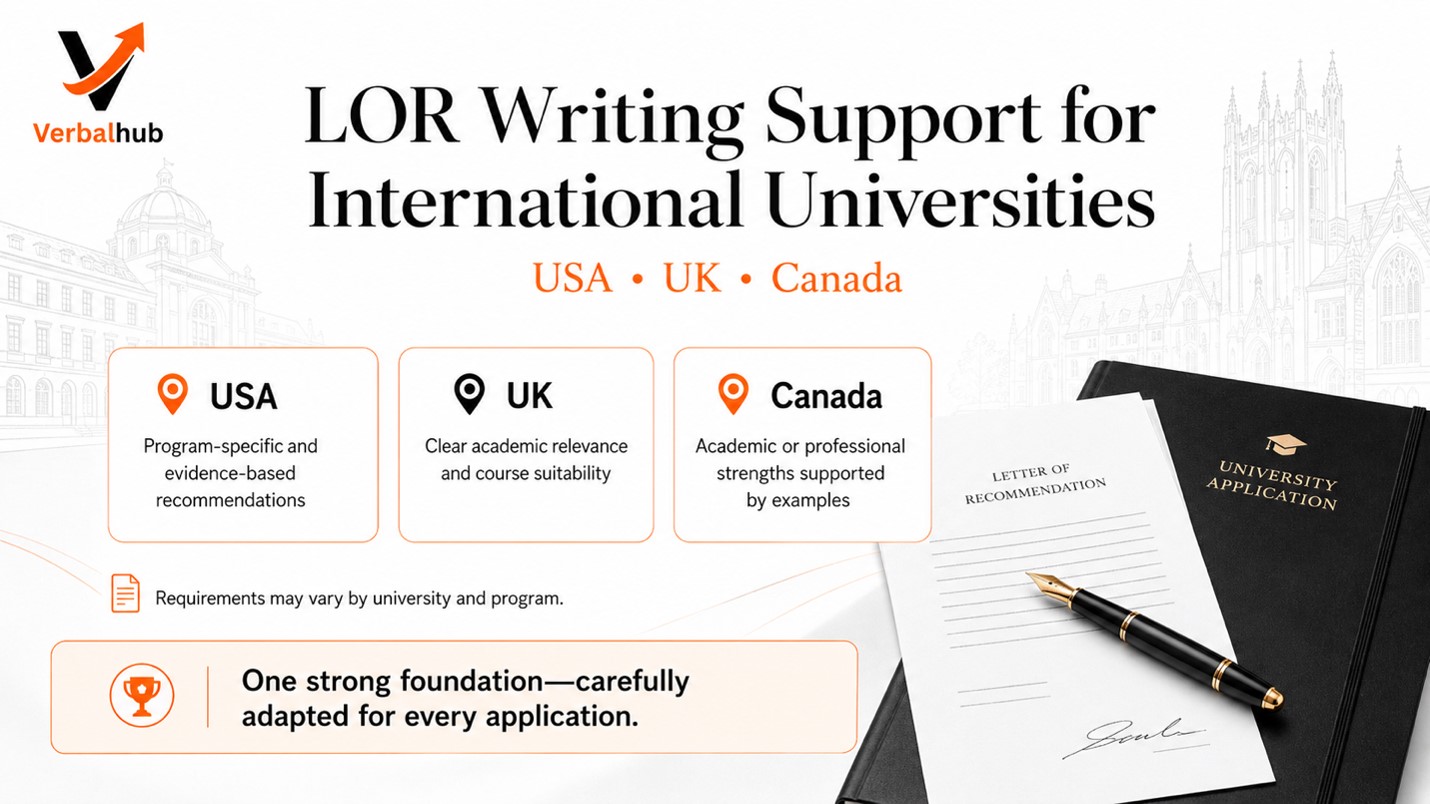
LOR Writing for USA Universities
US programs typically ask for two to three letters, often submitted through online portals with rating grids alongside the written letter. Committees value specific evidence and honest comparison. Our LOR writing services for USA universities align each letter with the portal format, word expectations, and the program's stated criteria. Requirements vary by university, so we always check the specific instructions for each of your targets.
LOR Writing for UK Universities
UK universities usually request one or two references, and many ask the referee to submit directly from an institutional email address. Letters tend to be concise and focused on academic suitability for the specific course. We help structure UK-style references that address the course requirements directly, and we brief your referee on the submission process where needed.
LOR Writers for Canadian Universities
Canadian programs often combine written letters with structured referee forms. Clear, factual, well-organised letters work best. We prepare Canada-ready LORs matched to each university's format. Note: we support the academic documents in your application; we do not provide visa or immigration advice, and a strong LOR does not influence visa outcomes.
What Makes an Effective LOR?
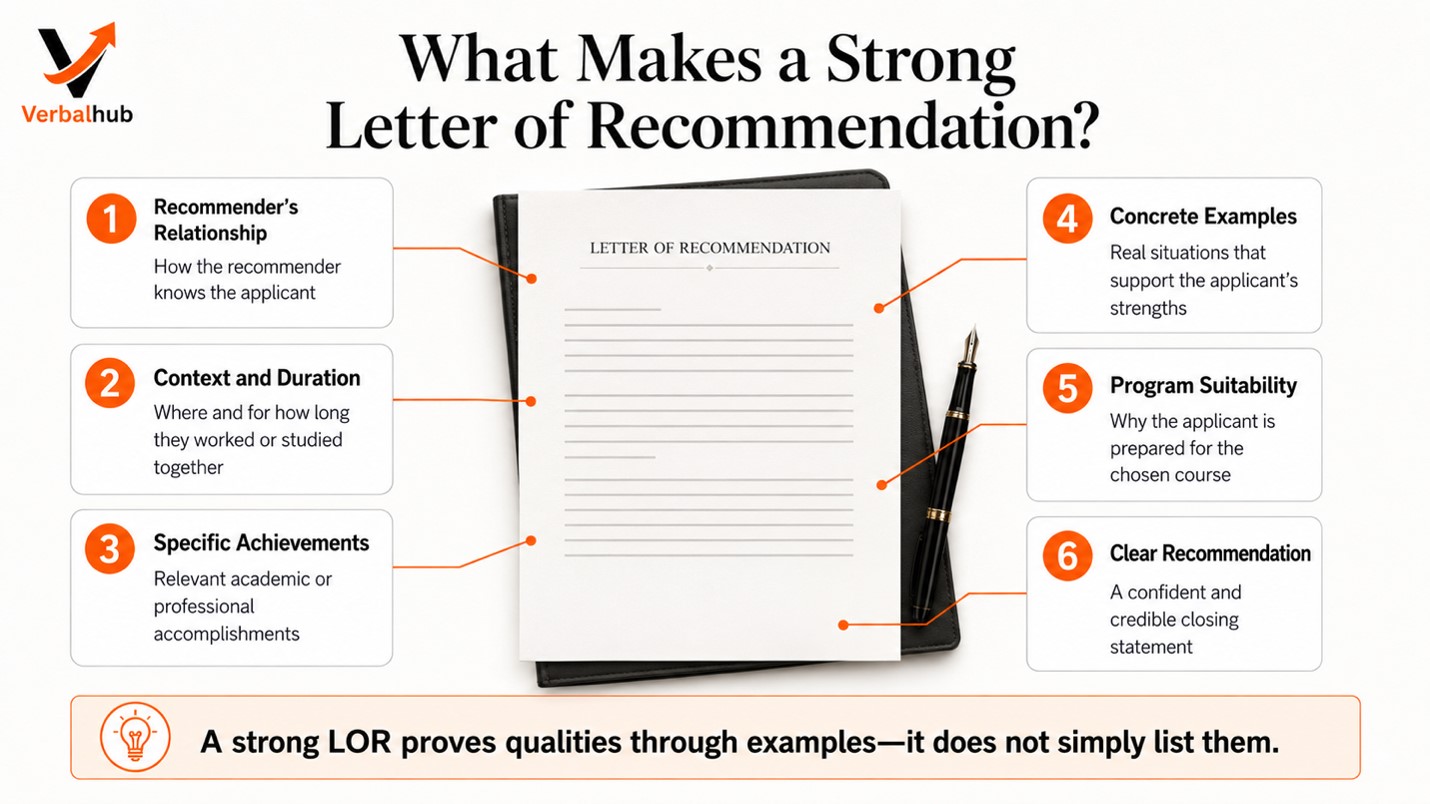
Concise answer: an effective LOR states who the recommender is, how long and in what context they have known you, and then proves two or three relevant strengths with specific examples, ending with a clear recommendation for the target program.
The main components:
- The recommender's designation and relationship with you.
- Duration and context of interaction — which courses, projects, or roles.
- Specific achievements the recommender personally observed.
- Concrete examples: what you did, how you did it, and what resulted.
- Strengths relevant to the program, not a list of every good quality.
- Comparison with peers, only when the recommender genuinely holds that view.
- A clear statement of suitability for the target program.
- A confident closing recommendation with contact details.
A simple outline that works for most letters:
- Opening — Paragraph 1: Who I am, how I know the applicant, and for how long.
- Evidence — Paragraph 2: First key strength, proven with a specific example.
- Evidence — Paragraph 3: Second strength or growth over time, with another example.
- Fit — Paragraph 4: Fit for the program and, where genuine, comparison with peers.
- Closing — Paragraph 5: Clear recommendation and willingness to be contacted.
Our LOR Writing Process
The process is simple and stays honest at every step:
Step 1 — Initial discussion. We understand your profile, programs, deadlines, and what each recommender can genuinely say about you.
Step 2 — Questionnaire. You (and your recommender, where possible) share real details: projects, courses, workplace contributions, and examples.
Step 3 — Program and university review. We study each target program's LOR requirements, formats, and prompts.
Step 4 — First draft or detailed edit. We write a fresh draft from your inputs, or strengthen your existing one.
Step 5 — Feedback and revision. You review the draft, correct anything, and we refine until it reads naturally and accurately.
Step 6 — Recommender review and approval. The final letter goes to your recommender, who confirms it reflects their honest opinion before it is submitted.
Why Choose VerbalHub?
Plenty of services promise letters overnight. We work differently, and deliberately so.
- Personalised support: every letter starts from your real record, gathered through a proper questionnaire and conversation.
- Program-specific guidance: an MS research letter and an MBA leadership letter are written to different briefs, because committees read them differently.
- Natural, professional writing: letters that sound like an experienced professor or manager wrote them — because that is the standard we edit to.
- Evidence-based content: we push for specifics and remove empty adjectives.
- A clear revision process with defined review rounds, not open-ended back and forth.
- Confidentiality: your documents and personal details are used only for your application work.
- Ethical admissions support: no invented achievements, no fake recommenders, no recycled templates, and no admission guarantees.
If you are searching for the best LOR writing agency, judge any provider — including us — on these questions: Do they ask detailed questions about your real experience? Do they insist on recommender approval? Do they refuse to fabricate? Do they explain their process before taking payment? An agency that fails these tests is not worth your money or your risk.
Our Trust Statement
How we keep your LOR ethical
We never invent achievements, create fake recommenders, or reuse copied templates. We do not guarantee admission, scholarships, or visas — no honest service can. Every final letter must be reviewed and approved by your actual recommender before submission, and everything you share with us is handled confidentially.
What We Need From You
Good letters come from good inputs. Before we begin, please gather:
- Your résumé or CV.
- Target program(s) and university list.
- Academic history, or work history for employer letters.
- Each recommender's name, designation, and relationship with you.
- Projects, achievements, and specific examples the recommender witnessed.
- Two or three key qualities you want the letter to establish.
- Your existing draft, if you have one.
- Each university's submission requirements and deadlines.
Frequently Asked Questions About LOR Writing
An LOR (letter of recommendation) is a formal letter in which a professor, supervisor, or manager describes your abilities, character, and achievements from their own experience of working with you. Universities use it to verify your record and understand how you perform in real academic or professional settings. Most graduate programs require one to three letters as part of the application.
Start with the recommender’s introduction: who they are and how they know you. Then prove two or three relevant strengths with specific examples — a project, a course, a workplace result. Close with a clear recommendation for the target program. Keep it to one page, use a professional tone, and make sure the recommender reviews and approves every word before it is submitted.
Choose someone who knows your work closely: a professor who taught you a core subject, your thesis or project guide, or a lab supervisor. Familiarity matters more than designation — a lecturer who supervised your project for a year will write a stronger letter than a head of department who met you twice. The recommender must be able to give specific examples.
Follow your program’s expectations first. Research-focused programs (MS, PhD) prefer academic letters; MBA programs expect at least one employer letter. Then consider recency: if you graduated recently, professors remember your work; after several years of employment, a manager’s view usually adds more. If the university allows multiple letters, combining both often gives the fullest picture.
Yes. Our letter of recommendation editing services improve structure, tone, grammar, and the strength of your examples while keeping every fact unchanged. We often restructure drafts so they lead with evidence instead of adjectives. Editing is a good fit when your recommender has written something genuine but the letter feels flat, generic, or poorly organised.
Yes, meaningfully so. An MS letter should establish technical depth, research aptitude, and readiness for graduate coursework, usually from a professor’s viewpoint. An MBA letter should show leadership, initiative, and teamwork through workplace situations, usually from a manager. Sending the same letter to both types of programs weakens your application, because each committee looks for different evidence.
A single base letter can serve several universities, but it should be adapted for each one. Universities differ in word limits, formats, question prompts, and submission portals, and some ask for program-specific comments. We prepare one strong, recommender-approved base letter and then adapt it to each university’s requirements without changing the underlying facts.
Most effective LORs run between 400 and 600 words — roughly one page. That is enough space for the relationship, two or three evidenced strengths, and a clear recommendation. Some universities set explicit word or character limits, especially in online portals, so always check each program’s instructions. A short, specific letter beats a long, vague one.
Share your résumé, target programs and universities, your relationship with each recommender, and — most importantly — specific examples: projects, courses, results, and moments the recommender actually observed. Include any existing draft and each university’s format requirements and deadlines. The more genuine detail you give, the more specific and credible your letter becomes.
Yes. US applications typically require two to three letters submitted through online portals, often with rating grids. We prepare letters matched to those formats and to each program’s stated criteria, and we brief your recommenders on the submission process. Since requirements vary between universities, we check the exact instructions for every school on your list.
Yes. For UK universities, we prepare concise, course-focused references and guide referees on direct submission from institutional email addresses where required. For Canadian universities, we structure letters to work alongside the referee forms many programs use. In both cases we follow each university’s specific format. We do not provide visa or immigration advice.
Yes. Every letter is written from your questionnaire responses and your recommender’s genuine observations — we do not use templates or recycle content between clients. Because the raw material is your specific projects, courses, and workplace examples, no two letters can read alike. Your recommender’s final review adds a further layer of authenticity before submission.
No, and you should be cautious of any service that claims otherwise. Admissions decisions depend on your entire profile — grades, test scores, SOP, experience, and program competition. What professional LOR writing support does is ensure this one component is clear, specific, credible, and correctly formatted, so it strengthens your application rather than weakening it.
Everything you share — your résumé, transcripts, drafts, and recommender details — is used only for your application work and accessed only by the team working on your documents. We do not sell, publish, or reuse client information, and we can delete your files after your project is complete if you ask us to.
Always. The letter is submitted in your recommender’s name, so it must reflect their honest opinion. Our process ends with recommender review and approval: they read the final draft, request any changes, and confirm it before submission. This protects you too — universities may contact recommenders to verify letters, and consistency matters.
Ready to Strengthen Your Application?
Give Your Recommender a Letter Worth Signing
A well-prepared LOR makes life easier for your recommender and makes your application stronger. Share your details, and our professional LOR writing services will handle the drafting, editing, and formatting — ethically, and on time.
CTA: Start Your LOR Alternative CTA: Request an LOR Review
Recommenders need time to review and approve. Start at least three weeks before your earliest deadline.