
SOP Writing Services: Statement of Purpose Writing, Editing & Review

SOP Writing Services for University Admissions
Mentioning grades, test scores, or work experience is not only a completion of the application. You also need to explain one important thing clearly:
Why should the university choose you?
That is where your Statement of Purpose (SOP) matters.
A strong SOP connects your academic background, experiences, interests, career goals, and reasons for choosing a particular program. It should sound like you—not like a generic application copied from the internet.
At VerbalHub, our SOP writing services help students develop, structure, edit, and strengthen their Statement of Purpose for master's, MBA, PhD, and other university applications.
Whether you are staring at a blank document or already have a draft that needs serious improvement, our professional SOP writers and reviewers can help you turn your ideas into a clear, focused, and personal application.
Need help with your SOP? Talk to a VerbalHub admission expert.
What Is a Statement of Purpose?
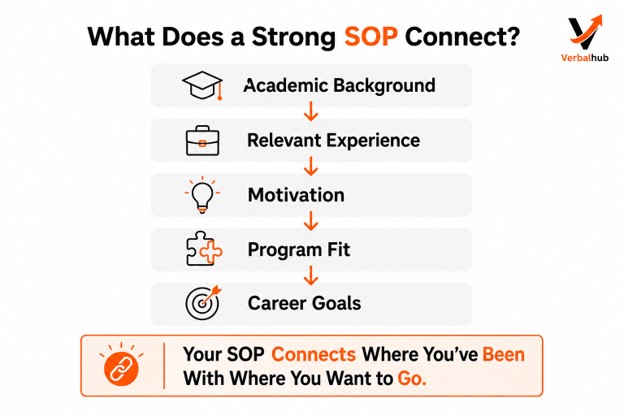
A Statement of Purpose, commonly called an SOP, is an application essay that explains your academic journey, relevant experiences, motivation for higher education, career direction, and reasons for applying to a particular university or program.
Think of your application as a collection of facts. Your grades show what you scored. Your résumé shows what you did. Your test scores show how you performed. Your SOP helps the admissions committee understand the thinking and motivation behind those facts.
A good Statement of Purpose answers questions such as:
- What have you studied?
- What shaped your academic or professional interests?
- Why do you want to pursue this course?
- Why have you chosen this university?
- What relevant academic, professional, research, or project experience do you have?
- What do you plan to do after graduation?
- How does this program connect your past experience with your future goals?
The exact expectations can differ by university and program, so applicants should always check the instructions provided by each institution before submitting an SOP.
Why Is an SOP Important?
Many applicants have similar academic scores and qualifications. An SOP gives the admissions committee another way to understand the individual behind those numbers.
A well-written SOP can demonstrate:
Clarity of purpose
You understand what you want to study and why you want to study it.
Academic readiness
Your previous education, projects, research, or work has prepared you for the program.
Program fit
You have a genuine reason for choosing that particular course and institution.
Career direction
There is a logical connection between the program and what you hope to do afterwards.
Communication ability
You can explain complex experiences and ambitions clearly and thoughtfully.
An SOP should therefore do much more than repeat your résumé.
Statement of Purpose Format: What Should an SOP Include?
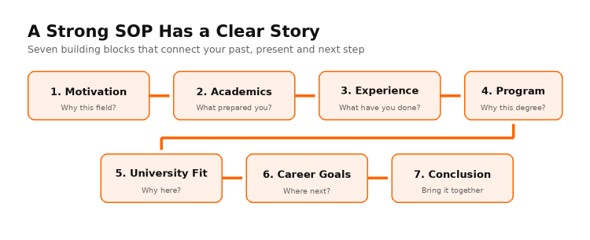
There is no single Statement of Purpose format accepted by every university.
If a university provides specific questions, formatting requirements, or a word limit, those instructions should come first.
However, a typical academic SOP can follow this structure:
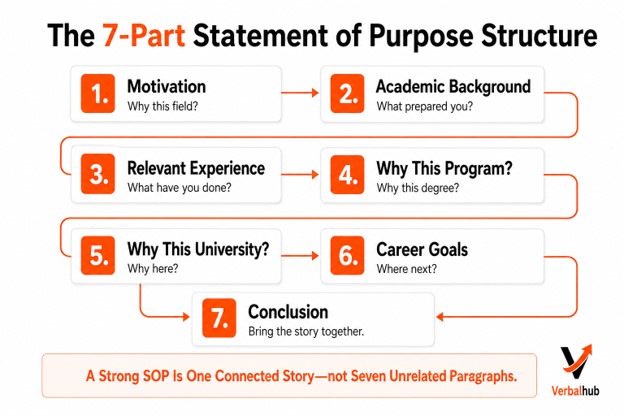
1 Opening and Motivation
Introduce the academic or professional interest that led you towards the chosen field. Avoid forcing a dramatic story simply to make the introduction memorable. A straightforward and meaningful opening is often stronger.
2 Academic Background
Discuss the parts of your education that are relevant to the course. This can include:
- Degree and specialization
- Important coursework
- Academic projects
- Research
- Dissertation or thesis
- Competitions
- Technical skills
- Academic achievements
Do not simply list everything. Explain how the relevant experiences influenced your direction.
3 Professional or Practical Experience
For applicants with work experience, explain the roles, responsibilities, projects, problems, and learning experiences that matter to your application. Where possible, demonstrate impact instead of merely giving a job description.
4 Why This Program?
Explain why you need this degree at this stage. This is particularly important if you are changing fields or already have significant professional experience.
5 Why This University?
Generic lines such as “world-class faculty” and “excellent infrastructure” tell the university very little. Instead, investigate relevant:
- Courses
- Specializations
- Research areas
- Faculty interests
- Labs or centres
- Experiential learning opportunities
- Features of the curriculum
Your reasons should connect directly with your interests and goals.
6 Career Goals
Explain what you intend to do after completing the program. Where appropriate, distinguish between your immediate goals and longer-term direction.
7 Conclusion
Bring the story together. Reinforce your readiness, purpose, and connection with the program without simply repeating the introduction.
How to Write a Strong Statement of Purpose
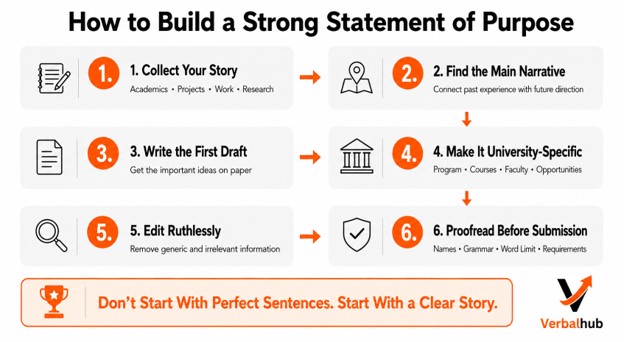
The best SOPs usually begin with thinking, not writing. Before drafting your Statement of Purpose, answer these questions honestly:
Why this subject?
Why now?
What experiences have prepared me for it?
Why this particular program?
What do I want to achieve after graduating?
Which experiences make my application different from another applicant with similar grades?
Once those answers are clear, writing becomes considerably easier.
Step 1: Collect Your Story
Create a rough list of your:
- Academic achievements
- Important projects
- Internships
- Research
- Work experience
- Leadership experiences
- Challenges
- Career interests
- Short-term goals
- Long-term goals
You will not necessarily use everything.
Step 2: Identify Your Main Application Story
Your SOP needs a central direction.
For example:
Computer Science → Software Engineering Experience → Interest in AI → MS in Computer Science → AI-focused career
That creates progression.
Randomly jumping between school achievements, hobbies, internships, family background, and career ambitions makes an SOP difficult to follow.
Step 3: Build the First Draft
Write freely before worrying about perfect sentences.
Your first objective is to get the important ideas onto the page.
Step 4: Make It University-Specific
One SOP should not simply be sent unchanged to ten universities.
The core story may remain similar, but the "Why this program?" and "Why this university?" sections should reflect the actual application.
Step 5: Edit Ruthlessly
Ask of every paragraph:
Does this information help the admissions committee understand my readiness, motivation, or direction?
If not, it may not deserve valuable space.
Step 6: Proofread Before Submission
Check:
- Grammar
- Spelling
- Program name
- University name
- Degree title
- Word limit
- Formatting
- Repeated information
- Unclear sentences
- Incorrect faculty/course references
One especially avoidable mistake is submitting an SOP containing another university's name.
Statement of Purpose for Master's Programs
A Statement of Purpose for master's admission should demonstrate that you understand both where you have come from academically and where you want to go next.
For recent graduates, useful material may include:
- Undergraduate coursework
- Final-year projects
- Research
- Internships
- Technical skills
- Publications
- Competitions
- Relevant extracurricular involvement
For experienced applicants, professional experience may carry greater weight.
The important part is not merely saying what you did. Explain why those experiences matter to the master's program you are now pursuing.
SOP for MS in Computer Science
An SOP for MS in Computer Science should go beyond saying that you have "always loved computers."
Universities already know you are interested in technology.
A more useful SOP may discuss relevant areas such as:
- Algorithms
- Software engineering
- Artificial intelligence
- Machine learning
- Data science
- Computer vision
- Cybersecurity
- Cloud computing
- Distributed systems
- Human-computer interaction
Use specific projects, coursework, internships, research, or professional experience to demonstrate how your interest developed.
The objective is to show evidence behind the interest.
SOP for Business Analytics
A strong SOP for Business Analytics needs to connect two worlds: data and decision-making.
Applicants can discuss experiences involving:
- Data analysis
- Statistics
- Business problems
- Programming
- SQL/Python/R
- Data visualization
- Marketing analytics
- Financial analytics
- Operations
- Consulting
- Decision-making
Simply stating "data is the future" will not distinguish your application.
A better approach is to show when you encountered a real problem involving data, what you learned from it, and why advanced study is the logical next step.
Statement of Purpose for MBA
An SOP for MBA is different from a purely academic master's SOP.
Business schools are generally interested in understanding your professional journey, leadership potential, goals, and reasons for pursuing an MBA.
Depending on the school's prompt, your MBA SOP may address:
- Career progression
- Professional achievements
- Leadership experience
- Important career decisions
- Challenges and learning
- Why an MBA?
- Why now?
- Why this business school?
- Short-term career goals
- Long-term career goals
The key question is often:
Why does an MBA make sense for this applicant at this point in their career?
That connection needs to be convincing.
Weak MBA SOP approach
I want an MBA because it will improve my management skills and provide global exposure.
Thousands of applicants can say this.
Stronger approach
Explain which experiences exposed a genuine skill or knowledge gap, what career transition you are trying to make, and how specific elements of the MBA help bridge that gap.
Statement of Purpose for PhD Applications
A Statement of Purpose for PhD admission requires a different approach.
Your academic and research direction becomes particularly important.
Depending on the program, a PhD SOP may discuss:
- Academic preparation
- Research experience
- Thesis/dissertation
- Publications
- Research questions
- Methodologies
- Relevant technical skills
- Current research interests
- Faculty or research-group fit
- Long-term academic or professional direction
Avoid filling the SOP with vague claims about being "passionate about research."
Show the evidence.
What did you investigate? What question interested you? What did you learn? What new questions emerged?
Also note that a PhD personal statement and a PhD Statement of Purpose may not always be the same document. Follow the individual university's terminology and application instructions carefully.
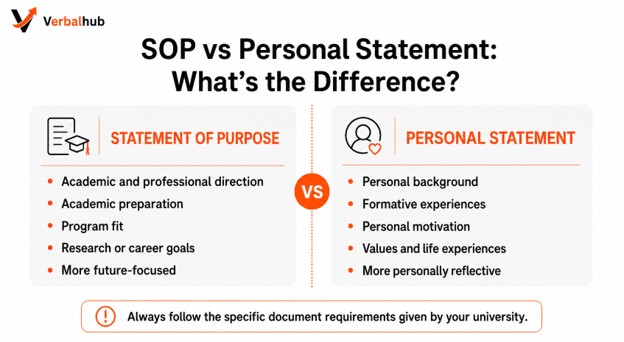
SOP vs Personal Statement: What Is the Difference?
Students often use these terms interchangeably, but universities may treat them differently.
| Statement of Purpose | Personal Statement |
|---|---|
| Usually focuses on academic/professional direction | Often gives more room for personal background |
| Explains academic preparation | May explore formative experiences |
| Discusses program fit | May focus more strongly on personal motivation |
| Covers research/career goals | May discuss values, identity or life experiences |
| Typically more academically focused | Often more personally reflective |
This is a general distinction, not a universal rule. If a university asks for both documents, do not submit two versions of essentially the same essay.
SOP vs Motivation Letter
A Statement of Purpose and motivation letter may overlap, but they are not automatically identical. An SOP generally gives greater space to your academic journey, preparation, future direction, and fit with the program. A motivation letter may place stronger emphasis on why you are applying and what motivates your choice. Again, the university’s own instructions matter more than the label.
Common SOP Mistakes Applicants Should Avoid
- Turning the SOP into a résumé. An admissions committee already has your résumé; use the SOP to give meaning to important experiences.
- Writing a generic SOP. Replacing only the university name is not personalization.
- Starting with a cliché. Statements such as “Since childhood, I have always dreamed…” can sound forced when the rest of the application does not support them.
- Using too much flattery. You do not need several paragraphs telling a university how prestigious it is — explain the fit instead.
- Making unsupported claims. Don’t just say “I am an excellent leader” — show the experience that supports the claim.
- Including everything you have ever done. A good SOP is selective; relevance matters more than quantity.
- Ignoring the university’s question. A beautifully written essay can still be ineffective if it doesn’t answer the actual prompt.
- Overcomplicating the language. Your SOP does not need to sound like an English literature thesis — clear writing beats unnecessary vocabulary.
- Using the same SOP everywhere. The central story can remain consistent; program-specific reasoning should not.
- Losing your own voice. An overly polished essay that no longer sounds believable can work against the purpose of personal application writing.
Professional SOP Writing Services at VerbalHub
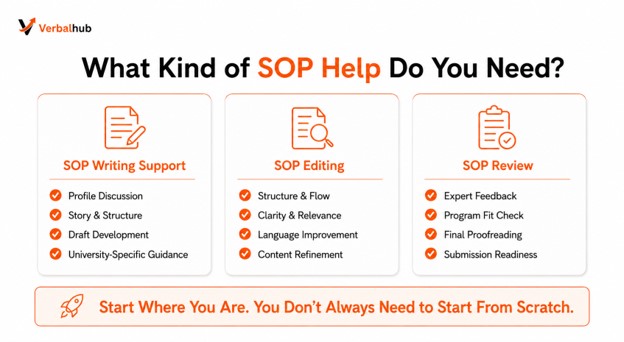
Sometimes the problem is not your profile. It is turning years of education, projects, jobs, decisions, and ambitions into a focused story. Our SOP writing services are designed to help applicants organise that story. Depending on your requirement, support can include:
- Profile discussion
- SOP strategy
- Identifying relevant experiences
- Story and structure development
- Drafting support
- Statement of Purpose editing
- University-specific customization guidance
- Grammar and language improvement
- Clarity and flow improvement
- SOP review and feedback
- Final proofreading
The objective is simple: create an SOP that is clear, personal, relevant, and true to your actual profile.
Already Written Your SOP? Get It Reviewed
You may not need someone to start from scratch.
If you already have a draft, a Statement of Purpose review service can be the better option.
Our SOP review can examine areas such as:
Structure: Does the story progress logically?
Clarity: Can someone unfamiliar with your background understand your journey?
Relevance: Are you spending space on information that actually matters?
Program fit: Is your reason for choosing the program specific enough?
Career goals: Are your goals understandable and logically connected?
Language: Are grammar, sentence structure, and word choice helping or hurting the message?
Repetition: Is the SOP repeating information unnecessarily?
Overall impact: Does the final document give a clear picture of who you are and why you are applying?
SOP Editing Services
Editing an SOP means more than running a grammar checker.
A grammatically perfect paragraph can still be weak if it says very little.
Professional SOP editing should examine both language and content.
For example:
Before
During my internship, I was exposed to business analytics and became very interested in this fascinating field.
After
The stronger version would identify what actually happened during the internship—the problem, data, task, observation, or decision that created the interest.
Specific experiences make the statement yours.
Generic adjectives do not.
SOP Writing From Scratch vs SOP Review
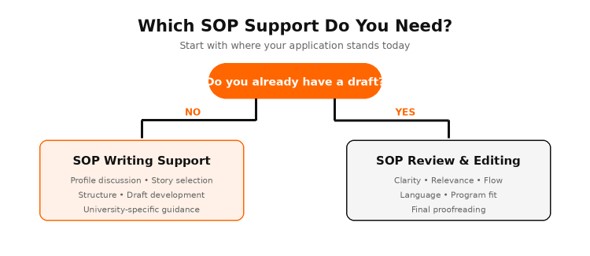
Suggested webpage visual: choose SOP writing support or SOP review based on your current draft.
Choose based on where you are today.
| Your Situation | Suitable Support |
|---|---|
| Don’t know how to begin | SOP strategy + writing support |
| Have ideas but no structure | SOP structuring |
| Have a rough first draft | SOP editing |
| Draft feels generic | Content + structural review |
| English needs improvement | Language editing + proofreading |
| SOP is nearly finished | Final SOP review |
| Applying to multiple universities | University-specific review |
Why Choose VerbalHub for SOP Writing Help?
Our approach begins with the applicant, not with a ready-made template.
Personalised Approach
Your SOP should reflect your education, experiences, choices, ambitions, and program — not someone else’s story with the names changed.
Application-Focused Writing
Good writing is useful only when it answers the university’s question and strengthens the overall application.
Human Review and Feedback
We look beyond spelling and grammar to consider structure, logic, relevance, clarity, and overall narrative.
Support Across Programs
Students can seek SOP help for master’s, MS, MBA, MiM, business analytics, computer science, data science, engineering, and PhD applications.
Editing or Complete Guidance
Already have a strong draft? You can seek editing and review instead of starting again.
Our SOP Development Process
Step 1 — Understand Your Profile. We begin with your academic background, experience, goals, target program, and universities.
Step 2 — Identify the Strongest Material. Not every achievement belongs in an SOP. We identify experiences that contribute meaningfully to the application story.
Step 3 — Build the Structure. We connect academic history, relevant experience, motivation, program choice, and future plans logically.
Step 4 — Develop or Review the Draft. Depending on the service selected, we help develop the SOP or review your existing version.
Step 5 — Refine the Content. We work on clarity, relevance, flow, specificity, and language.
Step 6 — Final Review. The final document is checked against the relevant university requirements provided for the application.
Statement of Purpose Example: A Better Way to Think About Your Opening
There is no universal Statement of Purpose template that works for every applicant.
Instead of copying an SOP sample, learn from its structure.
Suppose an applicant wants to pursue Business Analytics.
A generic opening might say:
"Business Analytics has always fascinated me because data plays an important role in today's business world."
There is nothing technically wrong with it. The problem is that almost anyone can write it.
A more personal opening could begin with a real project, workplace decision, unexpected result, or academic experience that made the applicant notice the value of data-driven decision-making.
The lesson is important:
Use Statement of Purpose examples to understand structure. Do not use them to borrow somebody else's story.
Frequently Asked Questions About SOP Writing
A Statement of Purpose is an application essay used by many universities to understand an applicant’s academic preparation, relevant experience, motivation, program choice, and future goals.
There is no universal SOP format. A typical SOP covers motivation, academic background, relevant experience, program fit, university fit, career goals, and a conclusion. Always follow the particular university’s instructions.
Follow the word or page limit specified by the university. If the university provides detailed application instructions, those requirements should take priority over general SOP advice.
Yes. VerbalHub provides SOP writing, structuring, editing, review, and proofreading support based on the applicant’s profile and application requirements.
Yes. An SOP review service is suitable when you already have a draft and want professional feedback on its content, structure, clarity, language, and overall effectiveness.
Yes. SOP editing can focus on clarity, structure, relevance, grammar, sentence construction, repetition, and overall flow while preserving the applicant’s actual experiences and voice.
Yes. SOP support can be tailored for master’s and MS programs based on your academic background, target course, relevant projects, research, internships, professional experience, and goals.
Yes. An MBA SOP typically requires a strong connection between career experience, leadership, professional goals, the need for an MBA, and the chosen business school.
Yes. An MS in Computer Science SOP can be developed around relevant coursework, technical projects, research, internships, professional experience, areas of interest, and career direction.
Yes. Business Analytics applicants can receive writing or review support focused on connecting their quantitative, technical, academic, and business experiences with their chosen program.
Yes. PhD SOP support can focus on research preparation, academic experience, research interests, relevant work, proposed direction, program fit, and long-term goals.
Not necessarily. A Statement of Purpose commonly focuses more on academic preparation, program fit, and goals, while a personal statement may allow greater emphasis on personal experiences and background. Always check the individual university’s instructions.
Usually, no. Your main background and career story may remain consistent, but program-specific reasons should be tailored to each application.
A template can help you understand structure, but it should not dictate your story. Admissions documents are stronger when they reflect your actual experiences and goals.
A professional SOP writer or reviewer can help you organise information, identify relevant experiences, improve structure and clarity, refine language, and keep the document focused on the application requirements.
Share your target degree, universities, academic and professional background, career goals, and any existing SOP draft with the VerbalHub team. We can then identify the level of support you need.
Your Story Is Already There. Let’s Make It Clear.
You do not need an unbelievable life story to write a strong SOP. You need clarity about where you have been, what you have learned, why you are taking the next step, and where you want that step to take you.
Whether you need professional SOP writing services, SOP editing, or a detailed Statement of Purpose review, VerbalHub can help you develop an application that represents your real profile clearly and professionally.