
MBA Profile Evaluation: Is Your Profile Strong Enough?
A high GMAT, GRE or CAT score can make you feel ready for business school. So can a promotion, a well-known employer or an impressive job title.
Then you open an MBA application and discover that the school wants much more. It wants to understand your decisions, impact, leadership, goals, recommendations, essays and — at some programs — how you communicate in a live or recorded video response.
This is where many applicants fall into a common trap: they treat the entrance test as the application rather than one part of it.
A strong score can prove academic readiness. It cannot explain why you need an MBA now, whether your career goal is realistic, what you will contribute to the class or why a specific program fits your direction.
Core takeaway
Does a high GMAT, GRE or CAT score automatically make your MBA profile competitive? No. A competitive profile connects academic readiness, professional progress, leadership, career goals, personal experiences and program fit into one credible story.
What Does an MBA Profile Evaluation Actually Measure?
An MBA profile evaluation assesses whether your complete application gives a target business school credible evidence that you are academically prepared, professionally ready and clear about what you want next.
It does not ask whether your profile is "perfect." No applicant is strong in every area. It asks whether your strengths support your goals, whether your weaknesses are manageable and whether the overall story makes sense for the schools you are targeting.
The same applicant can be:
- well aligned with one program;
- competitive but uncertain at another; and
- a weak fit for a third, despite meeting its basic eligibility requirements.
Your competitiveness depends on the program type, geography, career background, applicant pool, class priorities and application round. That is why copying another applicant's school list or comparing only test scores can be misleading.
At Verbalhub, our MBA mentors frequently observe that the biggest weakness is not always the lowest number on the profile. It is often the missing connection between what an applicant has already done and what they claim they want to do after the MBA.
The Five Areas That Determine MBA Application Readiness
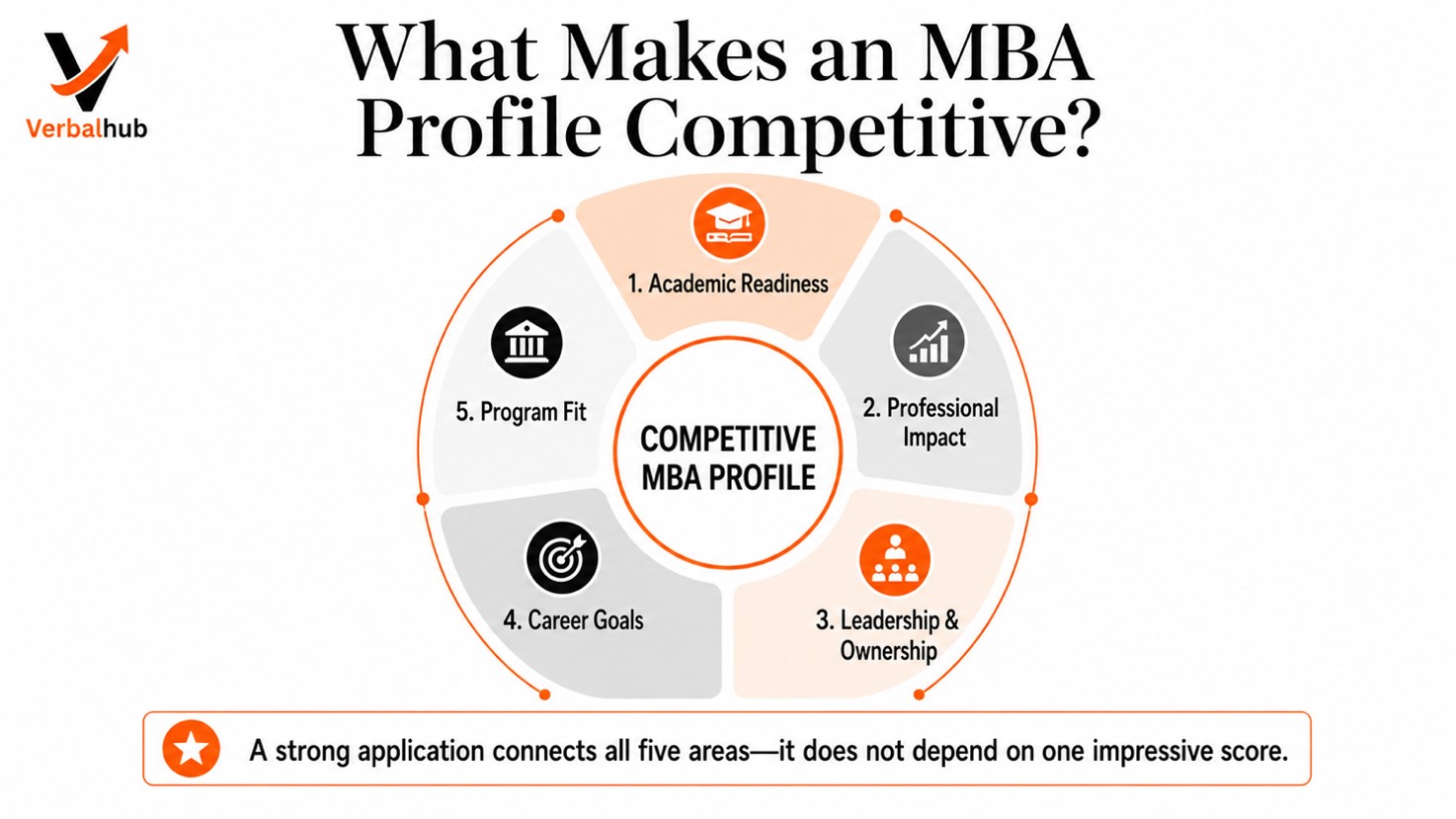
1. Academic Readiness
Business schools need confidence that you can manage quantitative, analytical and communication-heavy coursework. They may examine:
- undergraduate marks or GPA;
- performance in quantitative subjects;
- academic progression or an upward trend;
- GMAT, GRE or CAT performance, where applicable;
- relevant certifications or graded coursework; and
- analytical responsibility in your professional role.
A lower GPA does not automatically end your chances. However, it creates a question that the rest of your application should answer. A credible test score, recent coursework in statistics or finance, and strong analytical evidence at work can help demonstrate current readiness.
Your test strategy should also match the application route. GMAT profile building for a global MBA applicant may require balancing test preparation with career-story development. A GRE MBA application must still show why the chosen program and post-MBA path make sense. A CAT MBA profile may be evaluated under institute-specific criteria that combine entrance-test performance with academics, work experience, diversity and interview performance.
The correct question is not, "Is this score good?" It is, "Is this score credible for my target program and consistent with the rest of my academic evidence?"
2. Professional Progress and Measurable Impact
Admissions committees do not evaluate work experience by counting job titles alone. They look for growth in responsibility, judgment, influence and results.
Strong professional evidence may include:
- a promotion or expanded role;
- ownership of an important project;
- measurable improvements in revenue, cost, quality or efficiency;
- cross-functional or client-facing responsibility;
- handling a difficult stakeholder or business decision; and
- learning from a setback and changing your approach.
Compare these two resume statements:
Weak: "Managed marketing campaigns."
Stronger: "Led a three-person team to redesign the campaign funnel, increasing qualified leads by 28% over four months."
The second statement works because it shows scope, action and outcome. Use numbers only when they are accurate and defensible. An inflated achievement can create problems during interviews or recommendation checks.
Applicants from family businesses, startups, the military, nonprofits, public service and creative or technical careers should not try to make their experience sound conventionally corporate. The goal is to show what you owned, whom you influenced and what changed because of your work.
3. Leadership and Ownership
You do not need a managerial title to demonstrate leadership. Leadership can appear whenever you take responsibility and influence an outcome.
Look for situations where you:
- acted before someone formally asked you;
- persuaded colleagues who did not report to you;
- improved a broken process;
- mentored or supported another person;
- resolved conflict within a team;
- started an initiative; or
- made a difficult decision with incomplete information.
A title tells the admissions committee where you sat in the organisation. A specific example shows how you behaved.
At Verbalhub, mentors often help applicants find leadership evidence hidden inside ordinary-looking work. A software engineer who improved handoffs between product and engineering may show more ownership than a manager who merely supervised routine tasks.
4. Career Goals and Narrative Alignment
Your career goal explains why the MBA is necessary. It should connect five points:
- What you have done so far
- What you want to do immediately after the MBA
- What skills, exposure or network you currently lack
- Why an MBA is the right bridge
- Why the target school is relevant to that transition
Vague goal: "I want to become a successful global business leader."
Stronger goal: "After the MBA, I want to move from operations into product management in the digital-payments sector, using my experience in process improvement and customer research."
The stronger version is specific without pretending the future is guaranteed. It gives the school a plausible role, sector and reason for the transition.
Your goals may evolve during business school. That is normal. But your application still needs a researched, realistic direction. If you cannot explain why an MBA is better than a job change, specialist master's degree or internal transfer, your application is not ready.
5. Program Fit
Program fit means the school can credibly help you reach your goals — and your background can add something useful to its community.
Evaluate:
- curriculum and relevant electives;
- experiential projects and teaching style;
- employment outcomes by industry, function and geography;
- recruiters connected to your target role;
- student clubs, centres and alumni access;
- class profile and typical work experience;
- international-student and career support;
- tuition, scholarships and total cost; and
- current essays, interviews, video assessments and deadlines.
Do not write, "The school's world-class faculty and diverse cohort make it ideal for me." That sentence could describe hundreds of programs. Good school research identifies the specific resources that close your specific gaps.
The Missing Link That Weakens Otherwise Strong Profiles
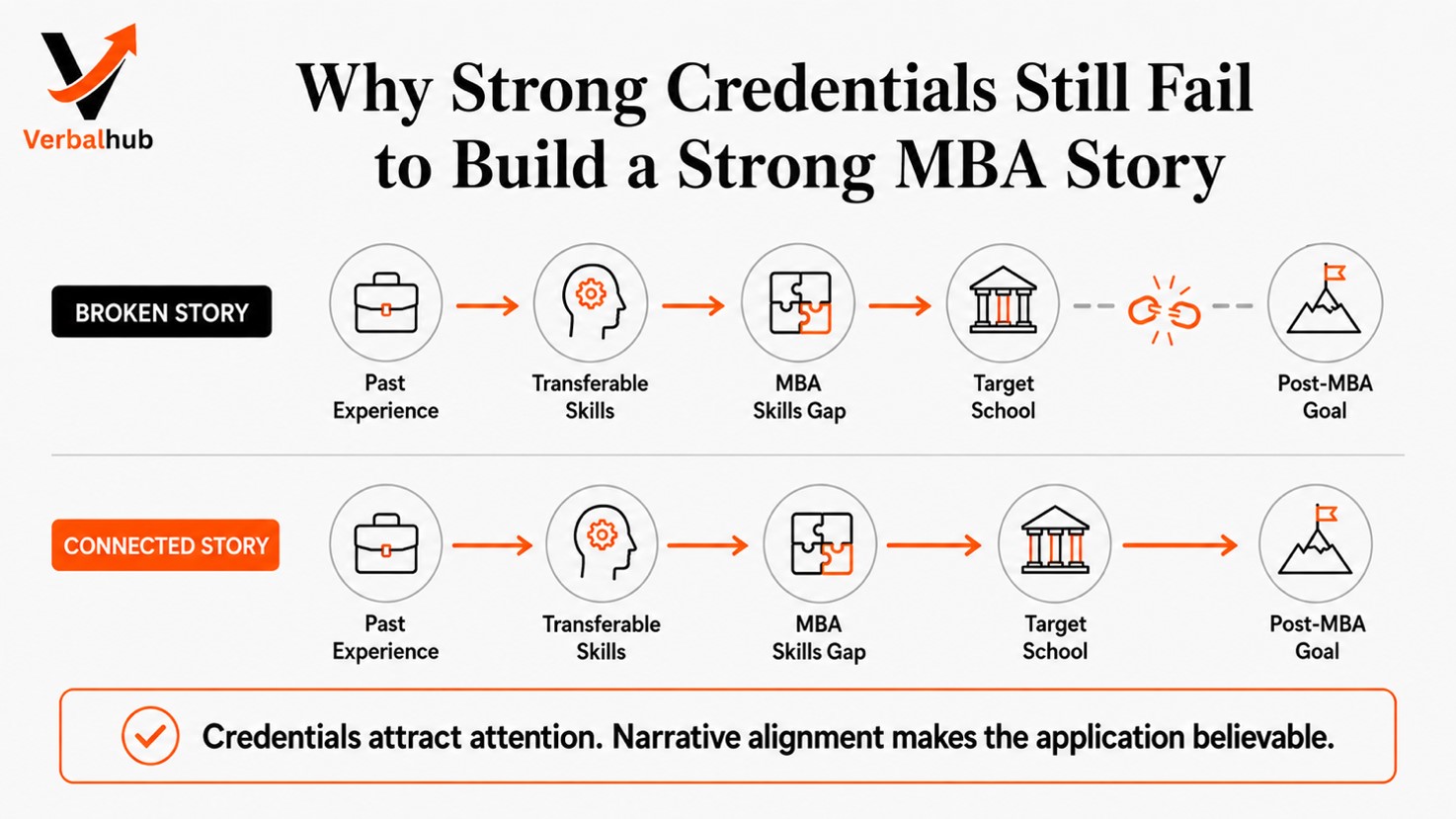
For many applicants with respectable academics and solid work experience, narrative alignment is the No. 1 weakness to examine. Their achievements may be impressive individually, but the application does not explain how those achievements lead to the proposed post-MBA goal.
Consider an engineer with a strong GMAT score who wants to move into impact investing. The test score shows academic readiness. Engineering experience may show analytical ability. But the application still needs to explain:
- why impact investing is the chosen direction;
- what exposure the applicant already has to finance or social impact;
- which transferable skills support the transition;
- what gaps remain;
- why an MBA is needed now; and
- how the target school makes the move more credible.
Without those links, the reader sees credentials but not direction.
This is also why self-evaluation is difficult. You know the background behind every achievement, so gaps in logic may feel obvious to you even when they are invisible to an admissions reader. You may also overvalue the parts you worked hardest on — such as a test score — and undervalue unclear goals, weak examples or generic school research.
An objective third-party review can test whether a reader who does not know you can understand the same story. The reviewer should challenge assumptions, identify unsupported claims and separate fixable presentation gaps from genuine profile gaps.
Get an objective 1-on-1 MBA profile review
A Verbalhub MBA strategist can review your academics, test readiness, professional impact, career goals and target-school list. You will leave with a clearer view of what is already strong, what needs evidence and whether you should apply now or improve first.
Speak with a Verbalhub mentor: www.verbalhub.com
MBA Profile Evaluation Scorecard
Use this checklist as a planning tool — not an admission prediction.
| Area | Ready When... | Warning Sign | Next Improvement Step |
|---|---|---|---|
| Academic readiness | Your grades, test score, recent learning or work evidence show that you can handle the program | Weak quantitative evidence or a score below your demonstrated potential | Retest with a defined plan or complete rigorous, relevant coursework |
| Career progress | Your responsibilities, judgment and results have grown over time | Resume lists duties but no decisions, scale or outcomes | Quantify impact and pursue a stretch assignment |
| Leadership | You can provide specific examples of ownership and influence | You rely only on job title or team size | Identify situations involving initiative, persuasion, mentoring or conflict |
| Narrative alignment | Your past, target role, skills gap and MBA rationale form a believable sequence | Career goal is vague or disconnected from experience | Research target roles and define why an MBA is needed now |
| Program fit | You can connect specific program resources and outcomes to your goals | School research sounds copied or prestige-led | Compare curriculum, recruiters, culture, location, cost and career support |
If you cannot mark every row as ready, do not panic. Most applicants have one or two gaps. The purpose of an MBA profile evaluation is to identify which gaps can be improved before the deadline and which ones require a longer plan.
How to Build an MBA Profile Before You Apply
If you are wondering how to build an MBA profile, start with the weakest important area — not the easiest activity to add.
If academics are the concern
- Build a realistic GMAT, GRE or CAT preparation plan.
- Complete relevant graded coursework.
- Demonstrate quantitative responsibility at work.
- Prepare a short, factual explanation for genuine academic disruptions.
If professional impact is unclear
- Ask for ownership of a complete project.
- Track baseline, action and result.
- Seek cross-functional or client-facing exposure.
- Rewrite your resume around decisions and outcomes.
If leadership evidence is limited
- Mentor a colleague or junior team member.
- Volunteer for a process-improvement initiative.
- Lead a small project with a real outcome.
- Build sustained community involvement rather than a last-minute activity.
If career goals are vague
- Speak with professionals in the target function.
- Study realistic entry roles and recruiting routes.
- Identify transferable skills and missing capabilities.
- Define a credible alternative path for an ambitious switch.
If school fit is weak
- Read official employment reports and class profiles.
- Attend school events and speak with students or alumni.
- Compare total cost, scholarships and geography.
- Build a balanced list of reach, target and safer-fit programs.
Certificates and extracurricular activities help only when they close a real gap or strengthen a genuine interest. Random profile-building creates activity, not coherence.
Should You Apply Now or Improve First?
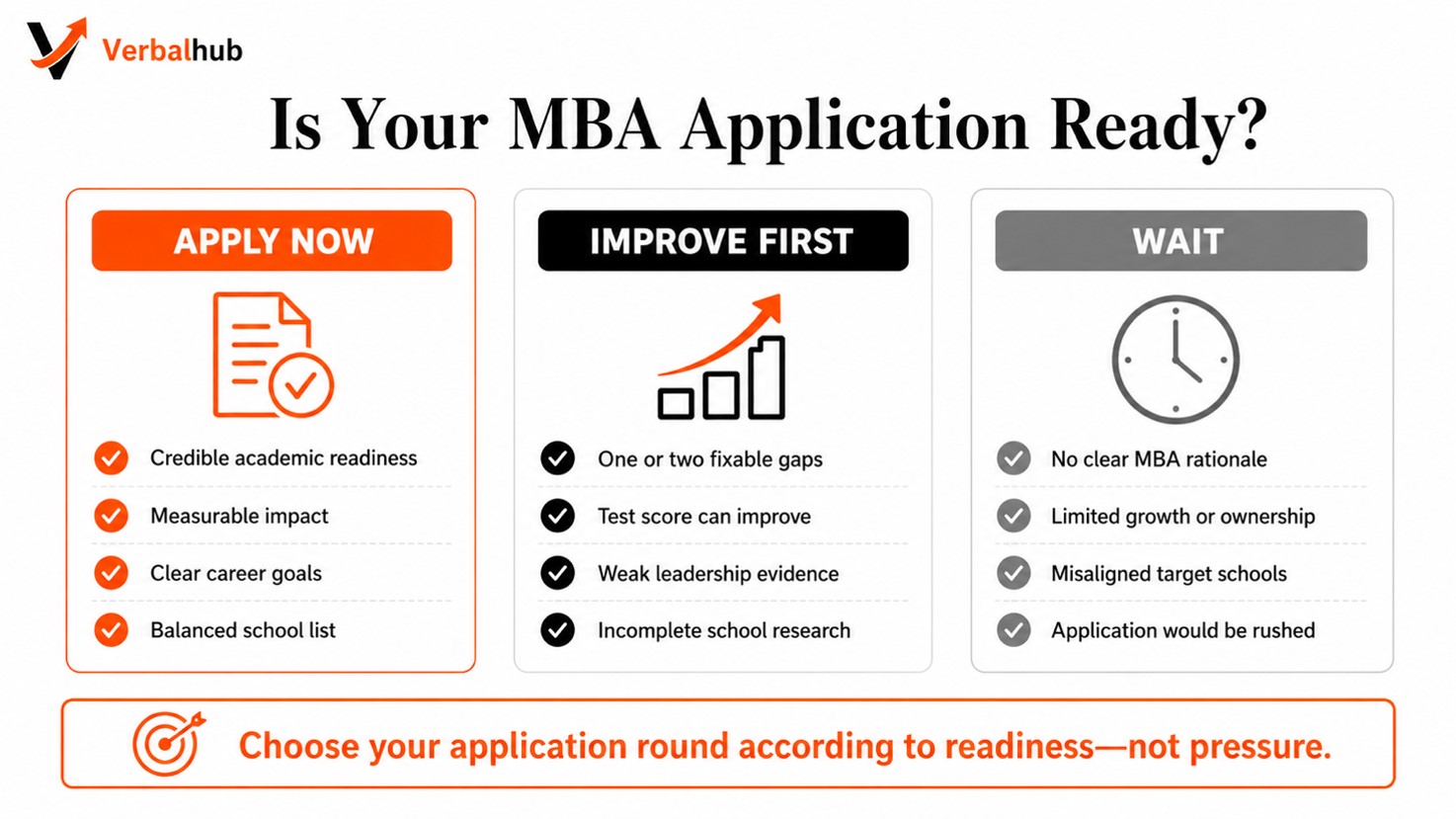
Apply now if
- your academic readiness is credible;
- you can show professional growth and impact;
- your career goal is researched and realistic;
- your MBA rationale is clear;
- your recommenders can provide specific examples; and
- your target-school list is balanced.
Improve first if
- your test score does not reflect your potential;
- your resume lacks measurable outcomes;
- your goals are broad or disconnected from your experience;
- your leadership examples are weak; or
- your school research is incomplete.
Wait if
- you cannot explain why you need an MBA;
- you have no meaningful evidence of growth or ownership;
- your target programs do not support your intended career path; or
- you would need to rush essays, recommendations and interview preparation.
Waiting should have a clear plan and timeline. "I will improve my profile" is not enough. "Over the next six months, I will improve my test score, lead the regional rollout and interview eight product managers" is actionable.
Build the Score and the Story with Verbalhub
Your MBA application needs two things: evidence that you are ready for the academic challenge and a convincing explanation of where you want to go next.
Verbalhub supports both sides of that journey:
High-Percentile Test Preparation
- Personalised preparation for GMAT, GRE and CAT
- Live online classes and focused mentoring
- Diagnostic study plans and progress reviews
- Timed practice, mock analysis and error correction
- Flexible support for working professionals and repeat test-takers
End-to-End MBA Application and Profile Building
- MBA profile evaluation and readiness planning
- Career-goal and application-strategy development
- Target-school selection
- Resume, essay and SOP guidance
- Recommendation and interview preparation
- Complete application planning from profile review to submission
Do not leave your MBA strategy to guesswork.
Build the test score, professional evidence and application story your target schools need to see.
Book a free demo class or speak with a Verbalhub MBA strategist: www.verbalhub.com
Admission and score outcomes depend on each applicant's background, preparation, execution and target programs. Verbalhub provides structured coaching and admissions guidance but does not guarantee a fixed score or admission result.
Frequently Asked Questions About MBA Profile Evaluation
Evaluating your profile requires looking past your test scores and job title. Assess whether you have concrete evidence across five core areas: academic readiness, professional impact, leadership examples, career goal narrative, and program fit. Because applicants are often biased toward their own achievements, booking an objective 1-on-1 profile evaluation with a Verbalhub MBA strategist can help identify hidden blind spots.
Ideally, you should begin structured profile building 6 to 12 months before application deadlines. This gives you enough time to boost your GMAT, GRE or CAT score, take on stretch projects at work to prove leadership, engage in meaningful extracurricular activity, and research your target B-schools thoroughly.
It is usually best to start with test prep early while maintaining solid performance at work. Having your target score secured takes immense pressure off the application timeline and gives you a clear picture of which business schools are realistically within reach. However, test prep and profile building should overlap — as you finalize your score, you should actively curate your leadership examples, resume, and career narrative.
Yes, a strong entrance test score demonstrates current academic and quantitative capability. However, a high score alone will not erase a low GPA — you must complement it with recent graded coursework, analytical achievements at work, and a concise explanation of past academic performance in your optional application essay.
Yes, top business schools value diverse perspectives — including candidates from startups, family businesses, creative fields, public service, and technical roles. If you have fewer years of experience or a non-corporate background, the key is showing accelerated growth, clear ownership, and transferable skills. An MBA admissions mentor can help you translate non-traditional achievements into language that admissions committees respect.
Most competitive applicants apply to 4 to 6 business schools, divided across three categories: reach schools where your profile is competitive but admission is highly selective, target schools where your scores, experience, and goals strongly align with the class profile, and safety or safer-fit schools where your credentials sit well above average. Applying to too many schools (e.g., 8+) often leads to rushed, generic essays that hurt your overall chances.
The most common weakness is a lack of narrative alignment, or the "missing link." Applicants often present strong individual credentials — like a 730+ GMAT or major promotion — but fail to articulate why they need an MBA now, how their past experience connects to their post-MBA career goals, and why that specific school is required for their transition.
A self-assessment is a great preliminary sanity check to identify obvious gaps in your resume or test score. However, because candidates are naturally biased about their own achievements, they often miss subtle issues like weak narrative logic, generic school research, or overemphasized routine tasks. A professional profile audit by a Verbalhub MBA strategist provides an objective, third-party evaluation from the perspective of an admissions committee, ensuring every claim is backed by credible evidence.
Verbalhub provides end-to-end guidance for business school applicants. We combine high-percentile test preparation (GMAT, GRE, and CAT) with personalized admissions consulting, including deep profile reviews, career narrative development, school selection, essay editing, resume refinement, and mock interview preparation.