

Written by Hasan Raja | IIM Kozhikode alumnus | CAT VARC 99th percentile three times | GMAT Verbal V50 | 20 years of teaching experience
"I had 5 questions left and 90 seconds. I guessed on all of them. My score dropped again."
This message came from a Class 12 student after his third Bluebook practice test. He knew the concepts. He had solved similar questions before. But in Module 2, the clock started feeling like an enemy. He rushed. He misread two questions. He lost 40-50 points because of timing, not knowledge.
If this sounds familiar, you are not alone. Time management is the number two complaint from Digital SAT test-takers in 2027, right after module difficulty. Many students finish Module 1 comfortably, then Module 2 feels like a race against time.
The good news: pacing is a skill, not a talent. You can build it with the right approach. This article explains why pacing breaks down in Module 2, how to set section-specific checkpoints, when to mark and move, and which practice drills actually improve your timing instinct. The advice here follows the structure currently published by the College Board for 2027. Always check the official SAT website for the latest updates before your test date.
Why Pacing Breaks Down in Module 2
Module 1 gives you a comfortable rhythm. The questions feel familiar. You settle into a flow. Then Module 2 hits you with denser passages, tighter answer choices, and multi-step Math problems. Suddenly, the same strategies that worked in Module 1 feel too slow.
Here are the four most common reasons pacing falls apart in Module 2:
1. You Treat Every Question Equally
In Module 1, you can afford to spend 90 seconds on most questions. In Module 2, some questions deserve 2-3 minutes, while others should take 30-40 seconds. If you try to give every question the same time, you will run out before finishing.
2. You Get Stuck on One Hard Question
You read a question twice. It still does not click. But you think, "I cannot leave this." You spend 4 minutes, finally guess, and then rush through the next five questions. That one decision can cost you 2-3 easy points later.
3. You Do Not Have a "Mark and Move" Habit
Many students mark 6-7 questions in Module 1 but never return to them in Module 2. They either run out of time or forget which ones they marked. Without a clear system, marked questions become wasted opportunities.
4. You Panic After Seeing the Clock
At the 10-minute mark, you realise you are behind. Instead of adjusting your strategy, you start rushing. You misread questions. You make careless errors. The clock becomes a distraction, not a tool.
The fix is not to "go faster." It is to go smarter.
Section-Specific Checkpoints: Your Timing Roadmap
The Digital SAT gives you 32 minutes for each Reading and Writing module and 35 minutes for each Math module. Those numbers are useful, but a rigid equal-time rule does not work. Some questions should take less than a minute. Others deserve more.
Use checkpoints to notice drift, not to force identical timing. Here is a practical roadmap for both sections.
Reading and Writing Module 2 Checkpoints
| Time Elapsed | Questions Completed | What to Do If Behind |
|---|---|---|
| 10 minutes | 8-9 questions | Skip the next dense passage. Pick 2-3 quick grammar or transition questions. |
| 20 minutes | 17-18 questions | You should have 12-13 minutes left for 9-10 questions. If not, mark the hardest inference question and move. |
| 30 minutes | 24-25 questions | You have 2 minutes for 2-3 questions. Do not read full passages. Look for the claim and evidence only. |
| 32 minutes | All 27 questions | Submit. Do not leave blanks. There is no penalty for guessing. |
Key principle: Bank time on quicker grammar, sentence-boundary and transition questions, but still read the full sentence logic. "Quick" should mean efficient, not careless.
Allow extra time for inference, command-of-evidence and cross-text questions because the proof may be distributed across several lines or two short passages.
Math Module 2 Checkpoints
| Time Elapsed | Questions Completed | What to Do If Behind |
|---|---|---|
| 10 minutes | 6-7 questions | If you are at 4-5 questions, skip the next geometry or advanced algebra question. Pick 2 quick percentages or ratios. |
| 20 minutes | 13-14 questions | You should have 15 minutes left for 8-9 questions. If not, mark the most time-consuming system of equations and move. |
| 30 minutes | 19-20 questions | You have 5 minutes for 4-5 questions. Use Desmos for systems or quadratics if it saves time. |
| 35 minutes | All 22 questions | Submit. Do not leave blanks. There is no penalty for guessing. |
Key principle: Take the quick wins first: direct algebra, percentages, ratios and data analysis can protect both time and confidence.
Use Desmos when it shortens the reasoning. Graph systems to locate intersections, inspect quadratics through zeros or vertices, and compare functions visually. Still understand what the intersection or feature represents.
The "Mark and Move" Rule Explained
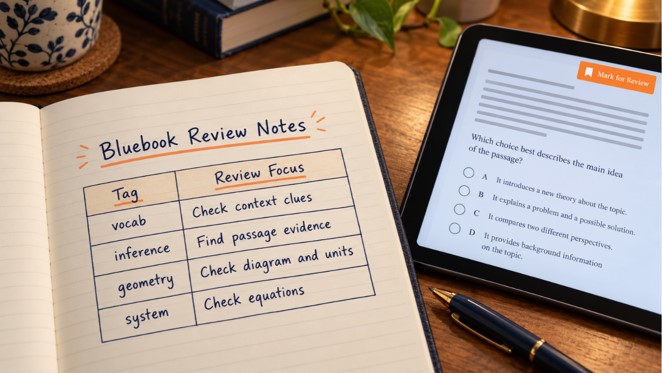
Here is a simple rule that saves students 30-50 points on average: If you have read a question twice and still cannot state what is being asked, mark it and move.
Why does this work?
A hard-looking question is not an instruction to solve it immediately. Protecting three later questions is often more valuable than spending four minutes fighting one item. Your brain works better on the second pass. Sometimes, the answer clicks after you have solved two easier questions.
How to mark effectively:
- Use the Bluebook "mark for review" flag (the little ribbon icon).
- Write a one-word note on your scratch paper: "vocab," "inference," "system," "geometry."
- Set a mental reminder: "I will return at the 25-minute mark in Math" or "at 28 minutes in Reading."
- When you return, do not reread the whole passage. Look only for the claim, evidence or equation you missed.
Students who use this rule consistently finish Module 2 with 2-3 minutes to review, instead of guessing on 4-5 questions in the last 30 seconds.
How to Identify Quick-Win Questions
Not all questions are created equal. In Module 2, your job is to spot the quick wins and collect them first. Here is how to identify them in each section.
Reading and Writing: Quick Wins
- Grammar and sentence boundaries: These often take 30-45 seconds if you know the rules.
- Transitions with clear logic: If the relationship is obvious (contrast, cause, example), pick the answer and move.
- Words in context with strong clues: The sentence usually gives a clear signal (but, therefore, for example).
- Using notes for a writing goal: If the goal is specific (e.g., "emphasise a similarity"), the answer is often direct.
Avoid spending 2+ minutes on:
- Dense inference questions with four close options
- Cross-text connections where both passages are abstract
- Command-of-evidence questions where the proof is scattered
Math: Quick Wins
- Direct algebra: Solve for x, simplify an expression, interpret slope.
- Percentages and ratios: These are often one-step or two-step calculations.
- Data analysis from tables or graphs: Read labels, check units, pick the trend.
- Basic geometry: Area, volume, angles in triangles or circles with clear formulas.
Avoid spending 3+ minutes on:
- Multi-step word problems with three or more variables
- Geometry inside a practical situation (you must identify the diagram first)
- Advanced algebra with hidden quadratics or complex systems
Pro tip: In the first 60 seconds of Module 2, scan the first 5-6 questions. Pick the 2-3 that look fastest. Solve those first. This builds confidence and banks time for harder ones.
Four Drills That Build Pacing Instinct
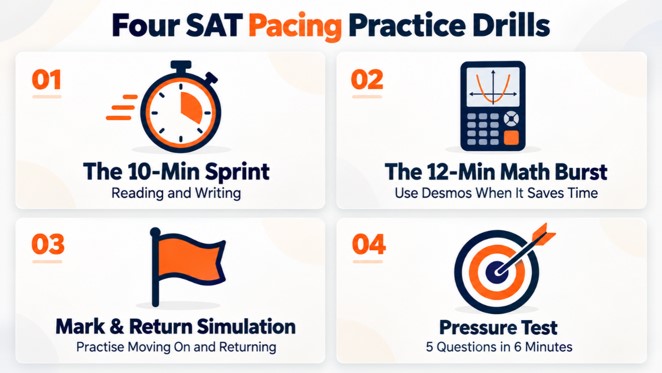
You cannot build pacing by only taking full tests. You need targeted drills that simulate Module 2 pressure. Here are four drills that work.
Drill 1: The 10-Minute Sprint (Reading and Writing)
- Set a timer for 10 minutes.
- Solve 8-9 Reading and Writing questions from a mixed set (use College Board Question Bank or VerbalHub practice materials).
- Force yourself to finish in 10 minutes, even if you have to guess on one or two.
- Review: Which questions took too long? Why? Was it reading, options or second-guessing?
Goal: Train your brain to recognise quick wins and move on from time-consuming items.
Drill 2: The 12-Minute Math Burst
- Set a timer for 12 minutes.
- Solve 7-8 Math questions (mix of algebra, geometry and data analysis).
- Use Desmos only when it clearly saves time.
- Review: Did you spend too long on one question? Could you have marked and moved?
Goal: Build the habit of checking your pace at the 10-minute mark.
Drill 3: The "Mark and Return" Simulation
- Take a full Module 2 (27 Reading/Writing or 22 Math questions).
- Force yourself to mark 4-5 questions in the first 15 minutes.
- At the 25-minute mark (Reading) or 28-minute mark (Math), stop and return to marked questions.
- Review: Did you have time to revisit? Did your accuracy improve on the second pass?
Goal: Make marking and returning a natural habit, not a last-second panic.
Drill 4: The "Last 5 Questions" Pressure Test
- Set a timer for 6 minutes.
- Solve 5 Module 2 questions (any section).
- This simulates the final stretch of the test.
- Review: Did you rush? Did you misread any question? How can you stay calm under pressure?
Goal: Train your brain to stay accurate even when time is tight.
Do these drills 2-3 times per week for 3-4 weeks. You will notice your pacing instinct improve without forcing it.
Common Pacing Mistakes to Avoid
Even students who know these strategies still make the same errors under pressure. Watch out for these five traps:
Mistake 1: No Checkpoints
You start Module 2 without a timing plan. At the 20-minute mark, you realise you are behind and panic.
Fix: Set 10-min, 20-min and 30-min checkpoints before you begin.
Mistake 2: Marking Too Many Questions
You mark 8-10 questions in Module 2. You only have time to return to 2-3.
Fix: Mark only 4-5 genuinely time-consuming questions. Be selective.
Mistake 3: Not Using the First 60 Seconds
You dive into Question 1 immediately. You do not scan for quick wins.
Fix: Spend the first 60 seconds scanning the first 5-6 questions. Pick the fastest 2-3.
Mistake 4: Rereading Without Purpose
You reread a passage 3-4 times hoping the answer will "click." It does not.
Fix: After two reads, mark and move. Return with a fresher eye later.
Mistake 5: Ignoring the Last 2 Minutes
You submit with 90 seconds left because you think you are done. You did not check marked questions.
Fix: Always reserve the last 2 minutes for marked items and quick verification.
How VerbalHub Can Help You Master Pacing

If your Module 2 timing keeps falling apart even after 4-5 practice tests, you may need structured feedback. This is where VerbalHub's SAT coaching can make a difference.
VerbalHub offers timed module practice, detailed pacing analysis and targeted drills that build your timing instinct. Instead of generic advice like "practise more," you get a personalised plan based on your actual Bluebook data and error patterns.
Hasan Sir, founder of VerbalHub, is widely regarded as one of the best SAT English teachers for Indian students. With 20 years of teaching experience, CAT VARC 99th percentile scores three times and GMAT Verbal V50, he specialises in helping students break through pacing plateaus in Reading, Writing and Math.
In one-on-one sessions, Hasan Sir analyses your Module 2 timing data, identifies whether you are spending too long on certain question types, and builds a custom checkpoint strategy. Students who join the personalised coaching typically finish Module 2 with 2-3 minutes to review, instead of guessing in the last 30 seconds.
If you want a clear roadmap to finish Module 2 without rushing, bring your latest Bluebook timing data to a VerbalHub strategy session. The goal is simple: stop losing points to the clock and start protecting your accuracy under pressure.
Book Your Free Digital SAT Strategy Session. Personal Guidance with Hasan Sir — Review Your Bluebook Results · Build Your Pacing Plan · Identify Your Next Steps. Book Your Free Session.
Frequently Asked Questions
There is no official fixed limit for an individual question. If repeated reading produces no new evidence, mark the item, move on and return later. The section average is about 1 minute 11 seconds per question, but difficult items may need more.
In Math Module 2, if a question is taking more than 2.5-3 minutes and you are still stuck, mark it and move. Protect time for 3-4 easier questions later.
No. Scan the first 5-6 questions, pick the 2-3 quickest wins, solve those first, then return to harder ones. This builds confidence and banks time.
Use the extra time to review marked questions. Check signs, units, restrictions and what the question actually asks for. Do not change answers unless you find clear evidence.
Mark only 4-5 genuinely time-consuming questions. If you mark 8-10, you will not have time to return to all of them.
The advice here follows the format currently published by College Board. Future dates, policies and specifications are not guaranteed. Check the official SAT website and your registration information before the test.
Final Takeaway
Pacing in Module 2 is not about going faster. It is about going smarter. Use checkpoints to notice drift, mark and move when stuck, identify quick wins early, and practise with targeted drills that build timing instinct.
If your Module 2 accuracy keeps dropping because of time pressure, take one recent Bluebook result and your timing data to a VerbalHub strategy discussion. The aim is to leave with a specific practice plan, not a vague instruction to "work harder."
For more details on the Digital SAT, check out our guides on Module 2 hard questions strategy and the complete SAT 2027 exam guide for Indian students.