Top AI Tools for CAT & GMAT Preparation in 2026: Free & Paid
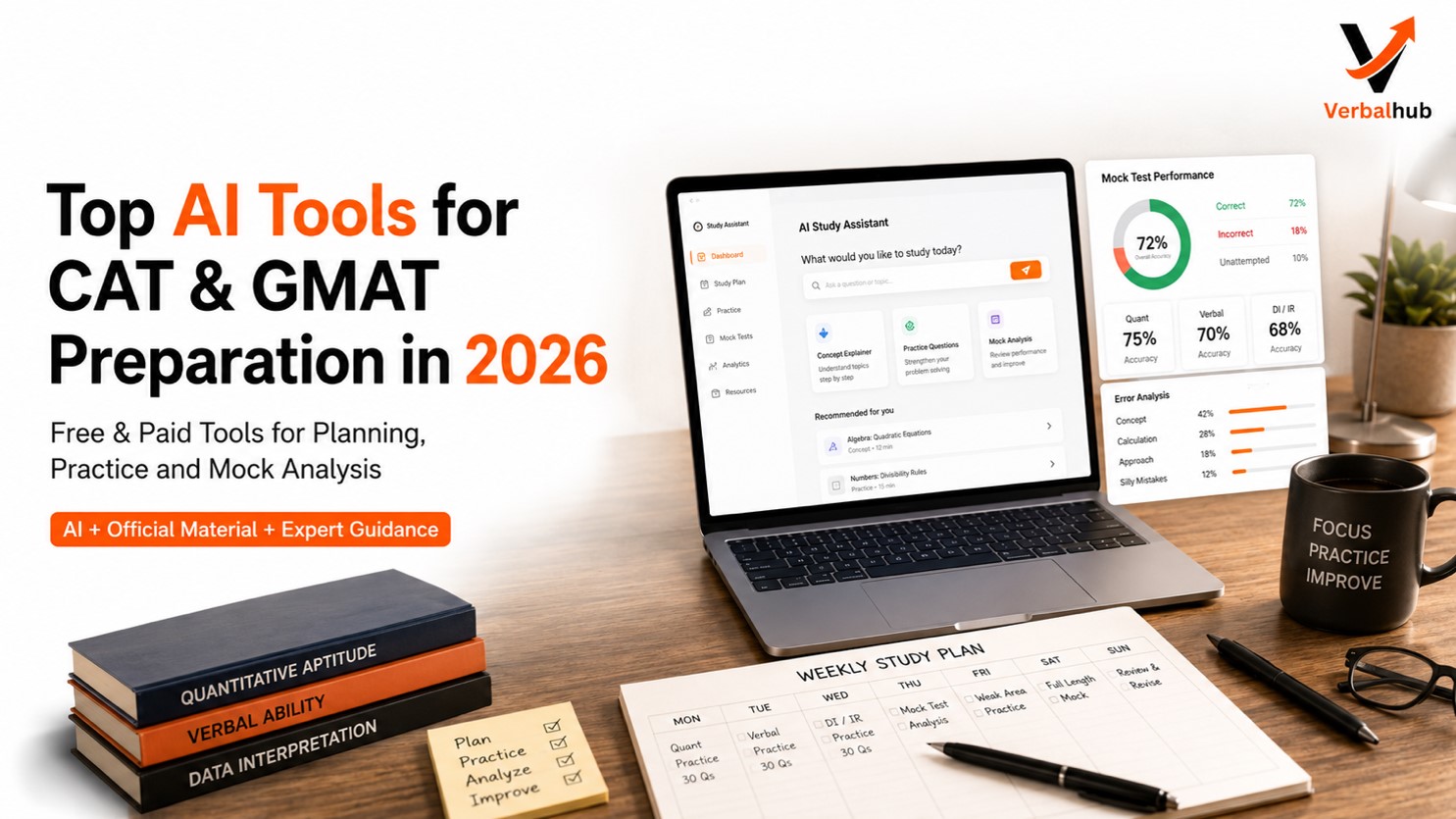
Most CAT and GMAT aspirants do not fail because they lack material. They fail because they have too much of it and no clear system. You have books, videos, question banks, and mock tests, yet you still struggle to build a realistic study plan, understand why you keep repeating the same mistakes, review mocks properly, and get a quick explanation at 11 pm when nobody is around to ask.
This is exactly where AI tools for CAT & GMAT preparation can help in 2026. Used well, they save hours every week on planning, explanations, and error analysis. Used carelessly, they waste time and sometimes teach you wrong things. This guide walks through the tools that genuinely help, what each free and paid plan offers, and where a tool stops and a mentor begins. One thing first: no AI tool replaces official questions, disciplined timed practice, or honest expert feedback. It supports them.
1. Can AI Really Help With CAT and GMAT Preparation?
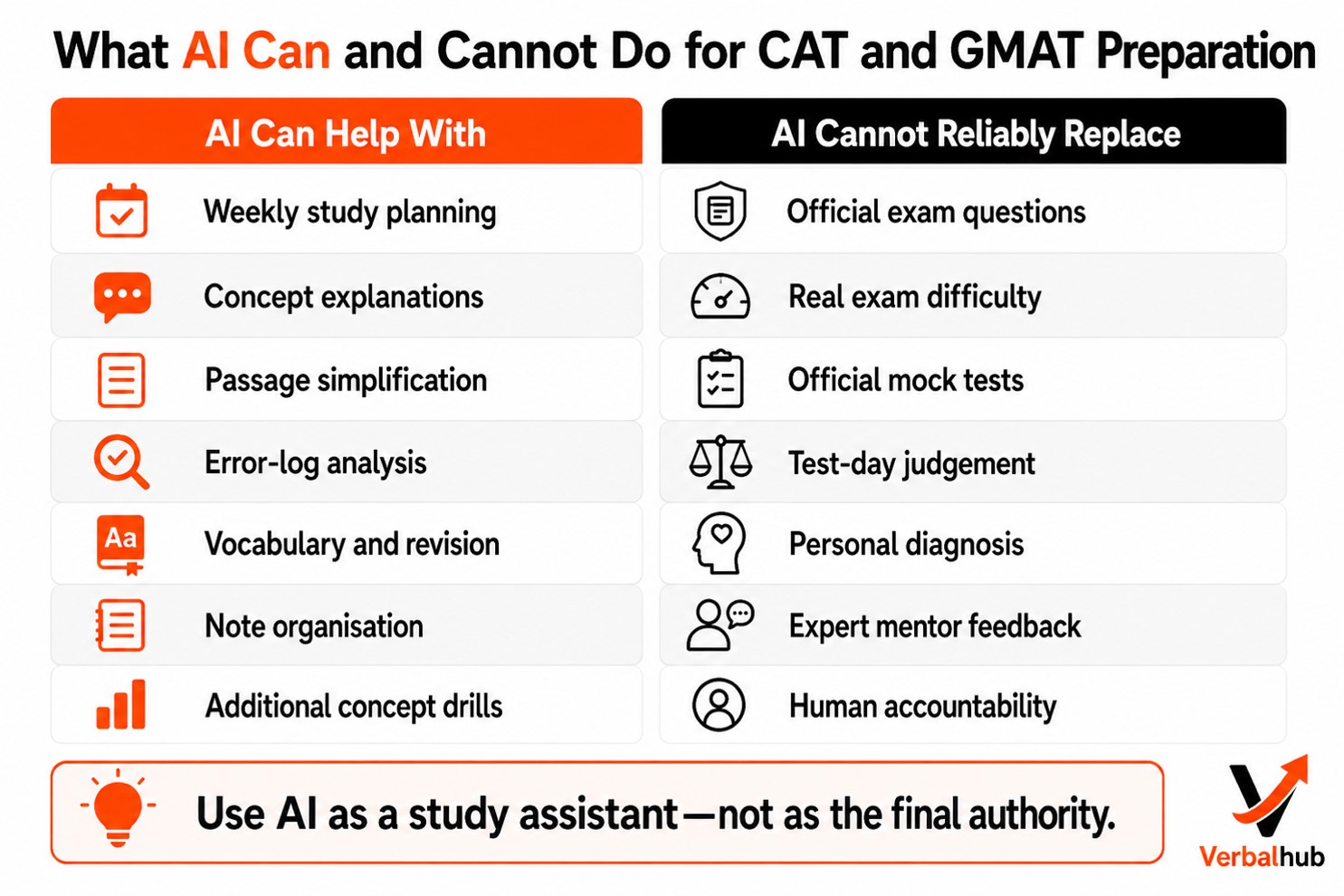
Yes, but only for specific jobs. Here is where AI is genuinely useful in daily preparation:
- Study scheduling. It can turn “I have 4 months and a weekend job” into a week-by-week plan you can actually follow.
- Concept explanations. Stuck on remainders, probability, or assumption questions? It explains the same idea five different ways until one clicks.
- Simplifying reading passages. It can restate a dense VARC or RC passage in plain language so you can check whether you understood it.
- Practice examples. It can generate extra drill questions on a concept you just learned.
- Error-log review. Paste your mistake log and ask it to find repeated patterns across mocks.
- Vocabulary and reading support. Words in context, summaries, and tone questions for editorial articles you read.
- Productivity. Reminders, note organisation, and revision schedules.
And here is where it is unreliable, no matter what any advertisement says:
- It cannot predict actual exam questions. Nobody can.
- AI-generated questions are often easier, oddly worded, or simply wrong. They do not match official difficulty.
- It cannot judge the true difficulty level of an official CAT or GMAT question the way the exam’s own scoring does.
- It cannot replace official mocks, which are the only realistic measure of where you stand.
- Without detailed data about you, its “personalised advice” is generic advice with your name on it.
- It has never sat in an exam hall. It does not understand test-day pressure, question selection under stress, or when to let a question go.
Keep this balance in mind and every tool below becomes safer and more useful.
2. Quick Comparison: AI Tools at a Glance
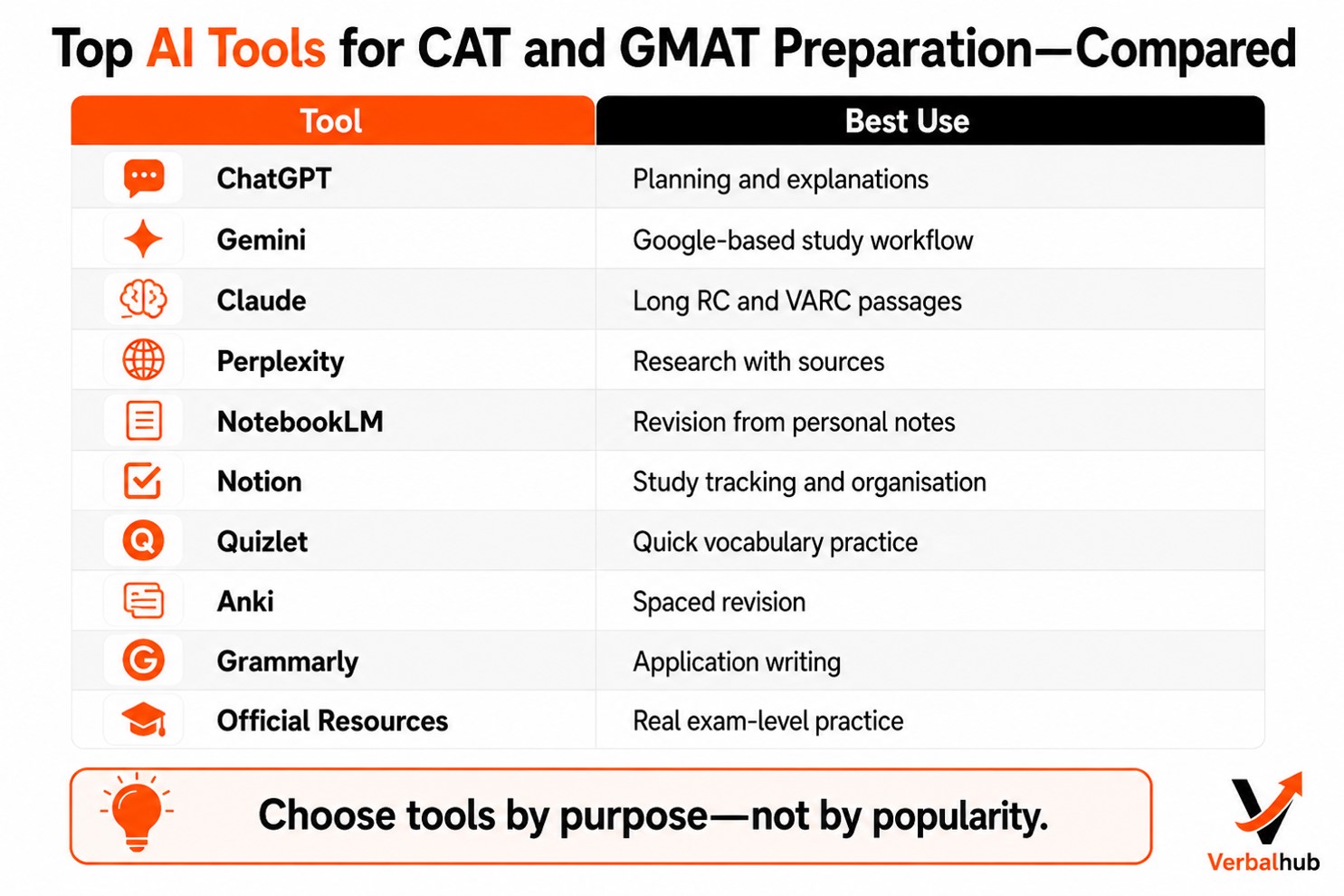
| Tool | Best Used For | CAT Use | GMAT Use | Free Option | Paid Option | Main Limitation |
|---|---|---|---|---|---|---|
| ChatGPT | Explanations, planning, error analysis | High | High | Yes | Yes | Can generate wrong answers confidently |
| Google Gemini | Explanations + Google ecosystem | High | High | Yes | Yes | Quality varies across question types |
| Claude | Long passages, careful reasoning | High | High | Yes | Yes | Free usage limits |
| Perplexity | Research with cited sources | Medium | Medium | Yes | Yes | Research tool, not a tutor |
| NotebookLM | Working with your own notes | High | High | Yes | Yes | Only as good as your uploads |
| Notion (with AI) | Study organisation, error logs | Medium | Medium | Yes (limited AI) | Yes | AI features sit mainly in paid plans |
| Quizlet | Flashcards, vocab drills | Medium | Low | Yes (with ads) | Yes | Community sets vary in quality |
| Anki | Spaced-repetition revision | High | Medium | Yes (desktop/Android) | iOS app is paid | Learning curve |
| Grammarly | Writing and language correction | Low | Low–Medium | Yes | Yes | Not an exam-prep tool |
| Official CAT mocks (iimcat.ac.in) | Real exam interface practice | Essential | — | Yes | — | Limited number released |
| GMAT Official Prep (mba.com) | Real GMAT questions and mocks | — | Essential | Starter kit + practice exams | Yes | Paid sets add up in cost |
Note the last two rows. Official resources are not AI tools, and that separation matters: they are the standard everything else must be checked against. Pricing and plan details for all tools change often, so confirm on each official site before paying.
3. Detailed Review of Each Tool
3.1 ChatGPT (OpenAI)
ChatGPT is a general AI assistant that explains concepts, builds plans, and analyses text you give it. It has a free plan; paid plans add stronger models, higher usage limits, file uploads, and longer conversations. A CAT student can use it to break down VARC passages and organise an error log. A GMAT student can use it to dissect Critical Reasoning arguments and revise Quant concepts.
| Prompt to Try | |
|---|---|
| “Explain why option B is a trap in this Critical Reasoning question. Here is the argument and my reasoning: [paste your own reasoning].” |
Limitation: it answers confidently even when it is wrong, especially on tricky Quant and DILR problems. Verdict: best all-round study assistant for both exams, if you verify its answers.
3.2 Google Gemini
Gemini is Google’s AI assistant, with a free plan and a paid tier that adds more capable models and higher limits. It works well for concept explanations and connects naturally with Google Docs and Drive, which helps if your notes already live there. CAT students can use it to summarise editorial articles for RC practice; GMAT students can use it to talk through Data Insights charts and tables in plain language.
| Prompt to Try | |
|---|---|
| “Here is my summary of a graph-based problem I got wrong. Ask me questions to test whether I actually understood the data.” |
Limitation: answer quality can swing between excellent and careless depending on the question type. Verdict: best for students already living in the Google ecosystem.
3.3 Claude (Anthropic)
Claude is known for handling long text carefully and reasoning step by step. It has a free plan; the paid plan raises usage limits and adds features. This makes it strong for long RC passages, multi-paragraph VARC work, and patient, structured explanations. GMAT students often find it good at laying out Critical Reasoning logic cleanly.
| Prompt to Try | |
|---|---|
| “Map this passage paragraph by paragraph: main point, purpose of each paragraph, and the author’s tone. Then ask me three inference questions.” |
Limitation: the free plan’s usage limits can interrupt a long study session. Verdict: best for verbal-heavy preparation and long-passage work.
3.4 Perplexity
Perplexity is an AI search tool that answers questions with cited sources, on a free plan with a paid tier for heavier use. That citation habit makes it the right tool for checking facts: exam pattern updates, registration windows, B-school cut-offs, current-affairs reading for interviews. It is not built to tutor you through a Quant problem.
| Prompt to Try | |
|---|---|
| “What is the current structure and scoring of the GMAT exam? Cite official sources only.” |
Limitation: it is a research assistant, not a practice partner. Verdict: best for verifying exam facts and reading around topics; always confirm critical details on official pages.
3.5 NotebookLM (Google)
NotebookLM answers questions using only the documents you upload, which sharply reduces made-up answers. It is free, with expanded limits available through Google’s paid plans. Upload your own class notes, formula sheets, and error logs, then ask questions against them. It can also generate audio overviews of your notes, useful for revision during a commute.
| Prompt to Try | |
|---|---|
| “From my uploaded error log, list every mistake tagged ‘misread the question’ and what those questions have in common.” |
Limitation: it only knows what you feed it, so thin notes give thin answers. Do not upload copyrighted books or full test PDFs. Verdict: best for turning your own notes into an interactive revision tool.
3.6 Notion (with Notion AI)
Notion is a workspace for notes, databases, and trackers, and its AI can summarise and answer questions inside that workspace. The base app has a free plan; the AI features sit mainly in paid plans, so check the current pricing page before assuming access. Its real value for aspirants is structure: a mock-score tracker, an error-log database, and a revision calendar in one place.
Limitation: it is easy to spend more time decorating your Notion setup than studying. Verdict: best for organised students who want everything in one dashboard.
3.7 Quizlet
Quizlet offers flashcards with learning modes and AI-assisted study features, free with ads and a paid plan for offline access and extras. CAT aspirants can drill vocabulary in context; GMAT students can use it for idea-level revision, though the current GMAT does not test vocabulary directly.
Limitation: community-made sets are uneven in quality, so prefer sets you build yourself. Verdict: best for quick, casual vocab drills.
3.8 Anki
Anki is a spaced-repetition flashcard system that schedules each card just before you would forget it. It is free on desktop and Android; the official iOS app is paid, and the web version works everywhere. It takes an evening to learn, but nothing beats it for long-term retention of formulas, vocabulary, and common traps.
| Use Case | |
|---|---|
| After every mock, turn each mistake into one Anki card: question pattern on the front, the rule plus your error on the back. |
Limitation: the interface feels dated and the learning curve is real. Verdict: best free revision system for serious, consistent students.
3.9 Grammarly
Grammarly checks writing for grammar, clarity, and tone, with a free plan and a paid tier for deeper rewriting suggestions. Since the current GMAT has no essay and no Sentence Correction, its exam value is indirect: cleaning up B-school application essays, emails, and statement drafts. For CAT, its role is even smaller.
Limitation: it improves your writing, not your test score. Verdict: best for the application stage, not the preparation stage.
3.10 Official Resources (Not AI, But Non-Negotiable)
The IIMs release official CAT mock tests on the CAT website (iimcat.ac.in) so candidates can practise the real interface, and past papers are widely used for question-level practice. For the GMAT, mba.com offers the free GMAT Official Starter Kit with practice exams, plus paid official practice exams and question banks. Every AI-generated question should be treated as a warm-up; these are the actual standard.
4. ChatGPT for CAT Preparation
Here is how to use ChatGPT for CAT preparation without fooling yourself. Use it to break down difficult VARC passages, explain why a tempting option is wrong, build vocabulary-in-context exercises from articles you read, draft a weekly plan, keep your error log organised, and revise Quant concepts through short quizzes.
Three prompts you can copy today:
| Prompts to Copy | |
|---|---|
| “Here is a paragraph-summary question I got wrong, with the options and my reasoning. Tell me where my reading went off track, not just the right answer.” | |
| “Create a 6-day CAT study plan for this week. I work weekdays 9 to 6, my weak areas are DILR sets and RC inference, and Sunday is my mock day.” | |
| “Give me 5 sentences using the word ‘ambivalent’ in different contexts, then quiz me on tone and meaning.” |
One honest warning: if you ask it to “generate CAT-level questions,” check every question before trusting it. Many will be easier than the real exam, some will have flawed options, and a few will be plainly wrong. Use generated questions for concept drilling, never for judging your level.
5. ChatGPT for GMAT Preparation
For the GMAT, ChatGPT is most useful as a reasoning coach. Ask it to break a Critical Reasoning argument into conclusion, evidence, and assumption. Have it map an RC passage before you attempt the questions. Use it to revise Quant fundamentals, talk through Data Insights charts, plan section timing, and classify your mock-test errors.
A quick note on names: many students still search for “AI for GMAT Focus” or “GMAT Focus Edition,” but since 2024 the exam has officially been called simply the GMAT Exam. The format is the same one those older terms describe, with Verbal, Quantitative Reasoning, and Data Insights sections, so everything in this article applies to it.
Three prompts worth saving:
| Prompts to Save | |
|---|---|
| “I’ll describe a Critical Reasoning argument in my own words. Break it into conclusion, evidence, and unstated assumptions, then tell me what would weaken it.” | |
| “Here are my last mock’s mistakes with time per question. Classify each as concept, careless, timing, or reading error, and show the pattern.” | |
| “Design a 45-minute Data Insights practice session for a student who is slow on multi-source reasoning.” |
A note on copyright: do not upload official GMAT questions in bulk. Official material is copyrighted. Describe a problem in your own words, or paste your own reasoning and ask the AI to critique it. You get the same learning benefit without misusing protected content.
6. Best AI Tools by Preparation Need
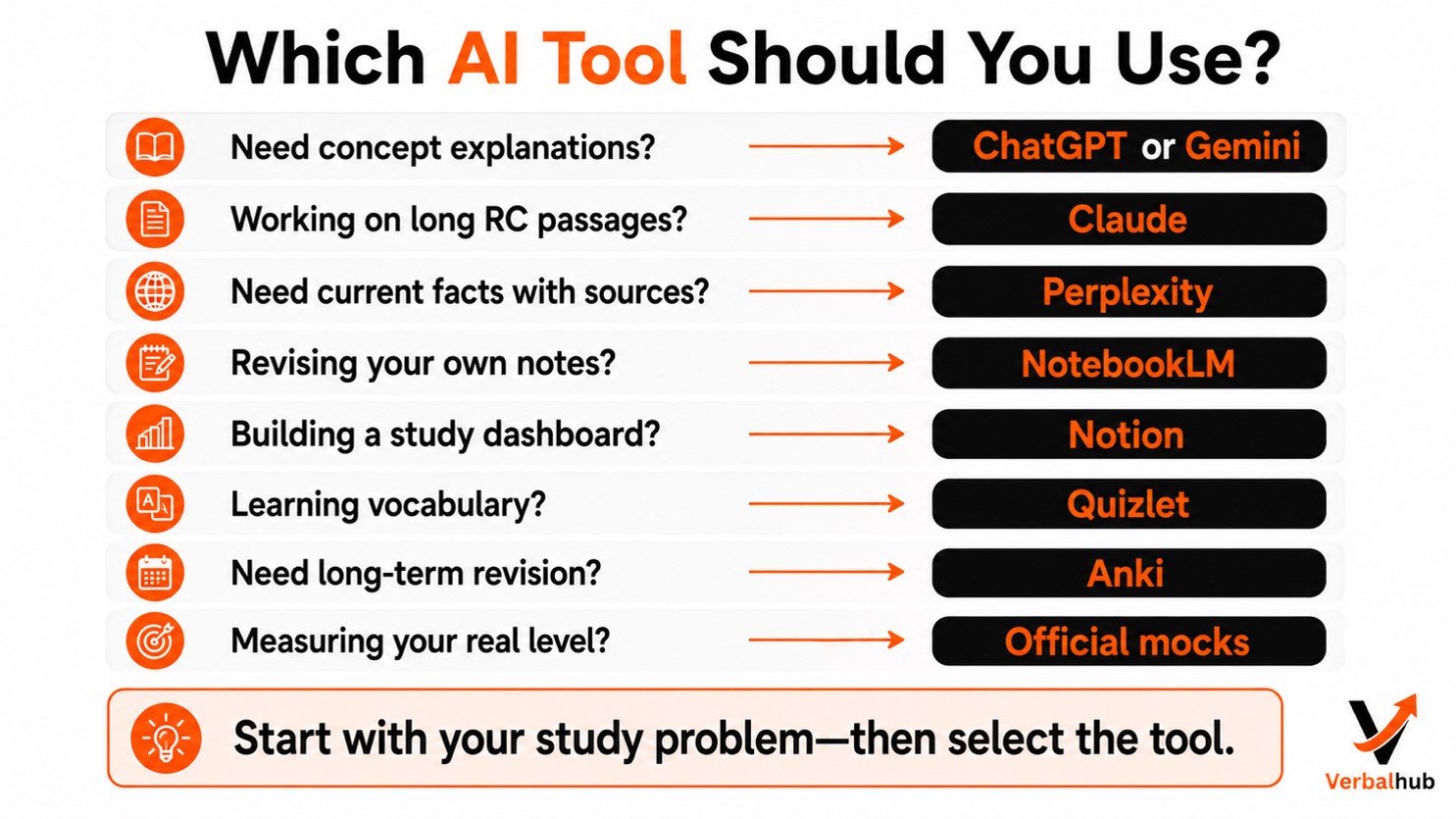
| Need | Best Pick | Why |
|---|---|---|
| Study planning | ChatGPT or Claude | Turns your constraints into a realistic weekly plan |
| Concept explanations | ChatGPT / Gemini / Claude | All three explain well; use whichever you can access freely |
| Research and fact-checking | Perplexity | Cited sources you can verify |
| Working with personal notes | NotebookLM | Answers only from what you upload |
| Vocabulary revision | Anki (or Quizlet) | Spaced repetition beats cramming |
| Writing and language correction | Grammarly | Strong for application essays |
| Mock-test analysis | ChatGPT/Claude + your own error log | Pattern-finding across mocks |
| Official GMAT practice | GMAT Official Prep on mba.com | Real questions, real scoring |
| CAT mock practice | Official CAT mocks + a full-length test series | Real interface plus regular full-length practice |
For the last row, most serious aspirants combine the official mocks with a structured [CAT Mock Test Series – ADD INTERNAL URL] and, on the GMAT side, a proper [GMAT Mock Test Series – ADD INTERNAL URL], because a handful of official tests is not enough for months of preparation.
7. How to Use AI for CAT Mock Analysis
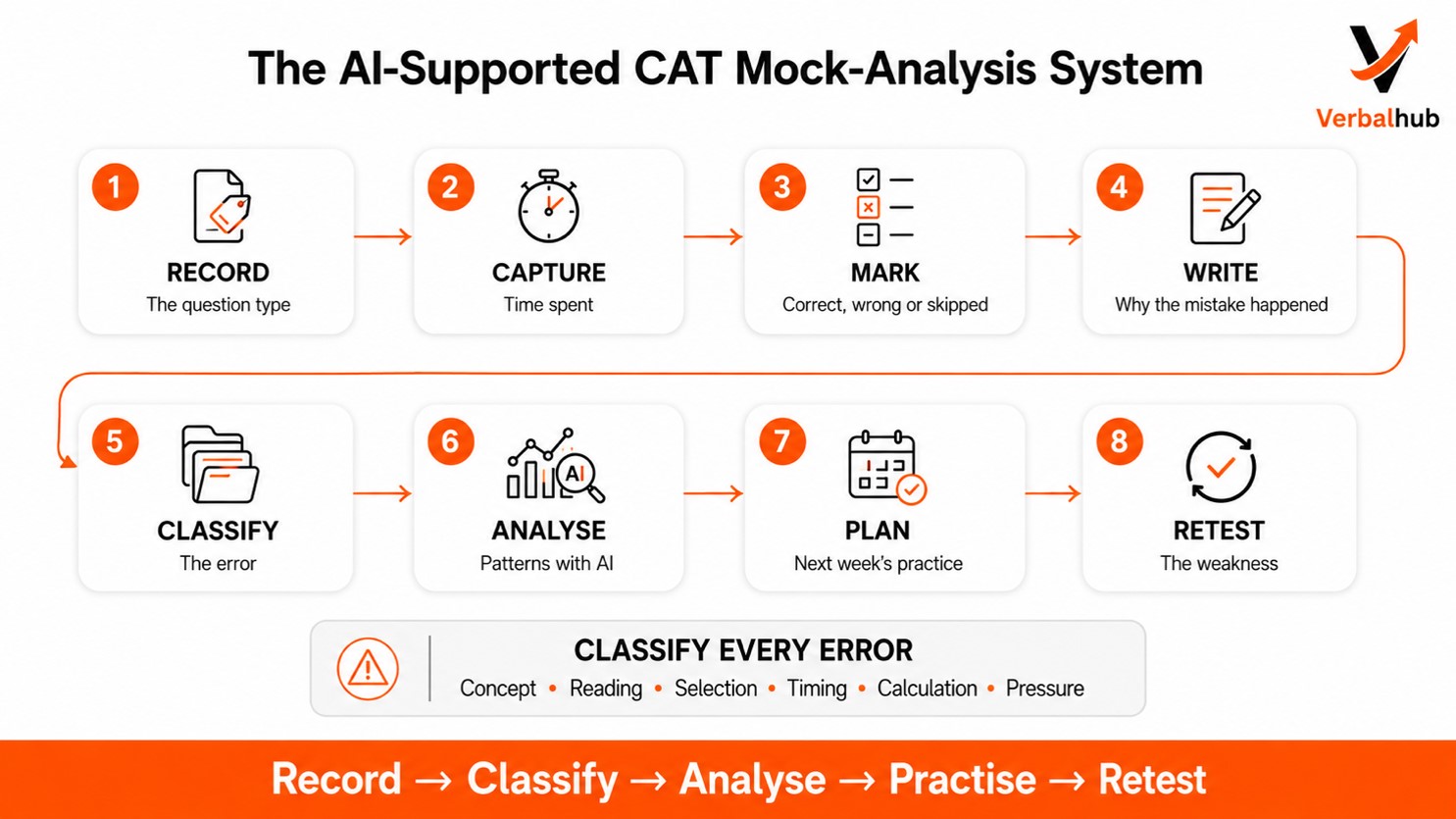
CAT mock analysis works only if you analyse VARC, DILR, and Quant separately; the three sections fail for different reasons. After every mock, follow this process:
- Record the question type (RC inference, para jumble, arrangement set, arithmetic, and so on).
- Record the time spent on each attempted question.
- Mark whether your answer was correct, wrong, or skipped.
- Write one honest line on why each mistake happened.
- Classify it: concept, reading, selection, timing, calculation, or pressure error.
- Paste the log into your AI tool and ask it to find repeated patterns.
- Build next week’s practice plan around the top two patterns.
- Retest the same weakness in your next sectional or mock.
A simple error log looks like this:
| Q. Type | Section | Time | Result | Why It Happened | Error Class |
|---|---|---|---|---|---|
| RC inference | VARC | 2:40 | Wrong | Picked an option that went beyond the passage | Reading |
| Arrangement set | DILR | 11:00 | Skipped late | Chose the hardest set first | Selection |
| Ratio problem | Quant | 1:20 | Wrong | Silly calculation slip under time pressure | Calculation |
If the same pattern keeps returning mock after mock, that is usually a diagnosis problem, not a practice problem, and it is worth discussing with a mentor before it hardens into a habit.
8. How to Use AI for GMAT Mock Analysis
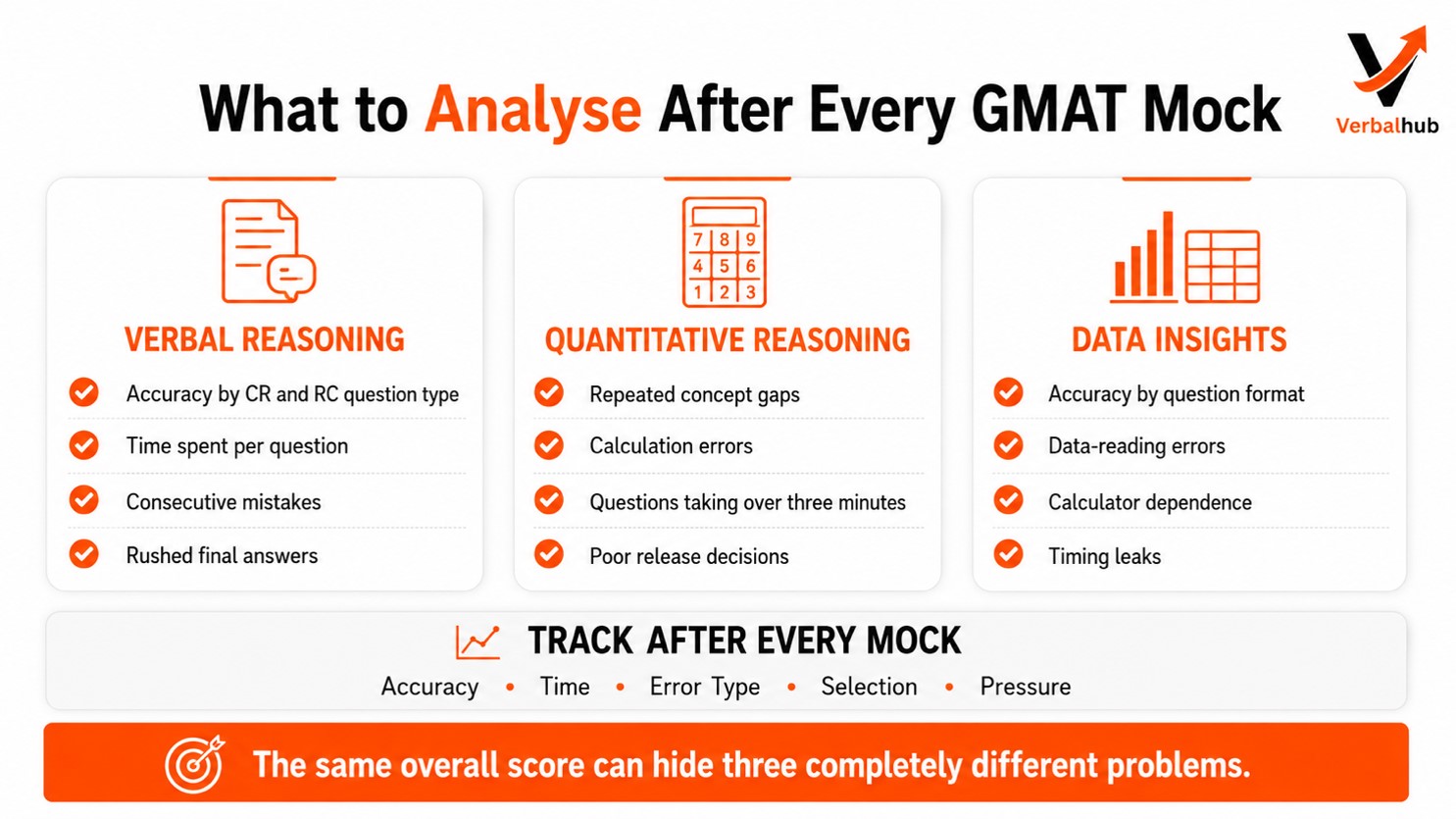
An overall GMAT mock score hides more than it reveals. Two students with the same score can have completely different problems: one is weak in concepts, the other loses everything to timing. So analyse Verbal, Quantitative Reasoning, and Data Insights separately, and within each section look at:
- Accuracy by question type (CR weaken vs. strengthen, RC detail vs. inference, and so on)
- Time spent per question, especially anything over three minutes
- Consecutive mistakes, which usually signal panic or fatigue, not knowledge gaps
- Guesses and rushed answers in the final ten minutes
- Weak concepts that repeat across mocks
- Decision-making errors: questions you should have released earlier
Feed this data into your AI tool and ask for patterns, then verify the story against your own memory of the test. If Data Insights is where your score leaks, targeted preparation on that section usually pays back faster than another general mock.
9. A Sample Seven-Day AI-Supported Study Plan
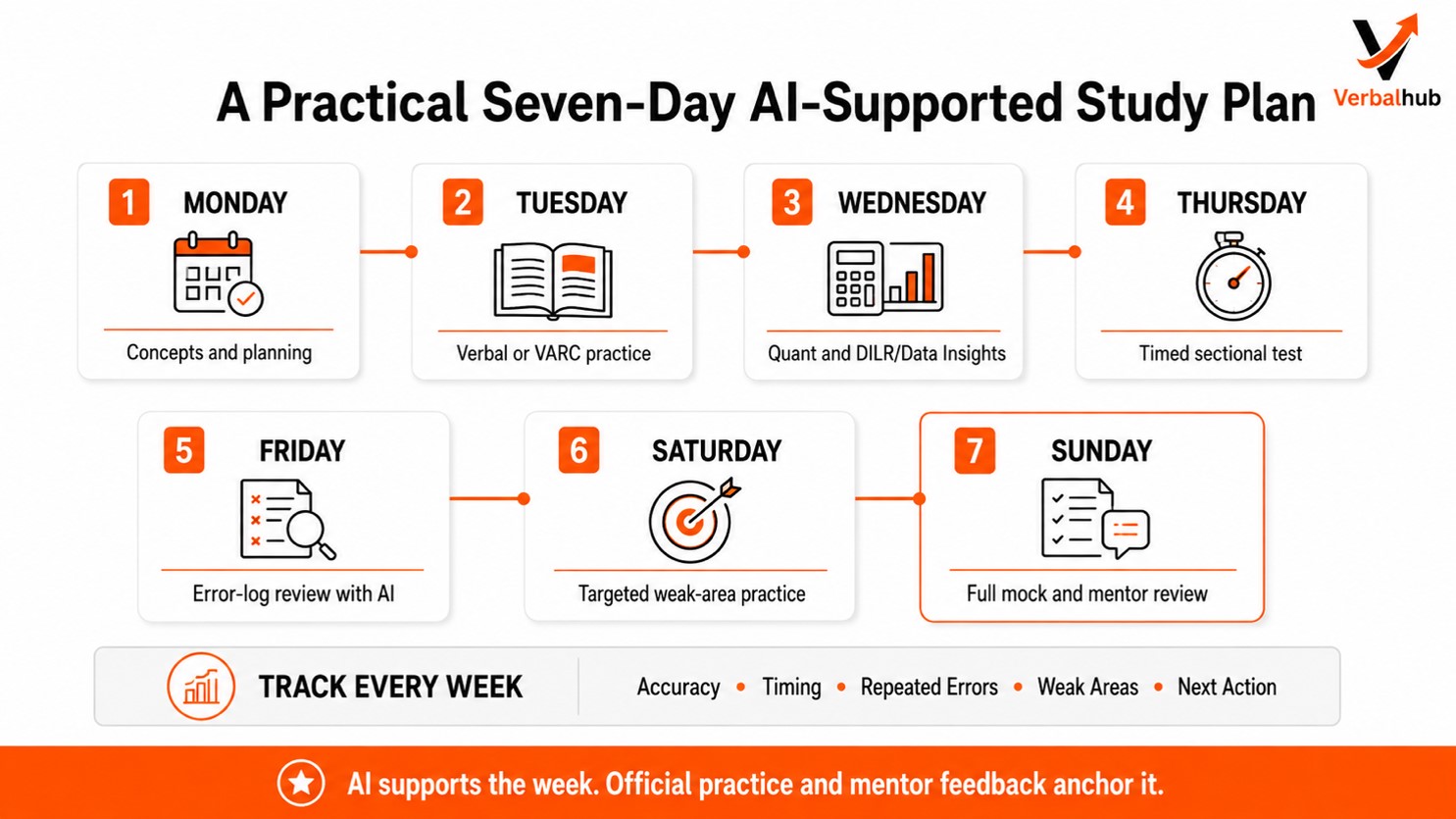
Here is a realistic week for a working aspirant, roughly two to three hours a day. AI supports the plan; official material and human feedback anchor it.
| Day | CAT Aspirant | GMAT Aspirant |
|---|---|---|
| Mon | Timed VARC set from trusted material; AI explains the two hardest wrong answers | Timed CR set from official material; AI breaks down argument structures you missed |
| Tue | Quant concept revision + drill; AI generates 5 extra practice examples to verify | Quant revision + official problem set; AI re-explains one weak concept |
| Wed | One timed DILR set; log errors; AI classifies them | Data Insights practice; AI discusses your reading of each chart |
| Thu | RC practice from editorials; Anki vocab review | RC passage mapping with AI, then official RC questions |
| Fri | Weak-area drill based on this week’s error patterns | Weak-area drill based on this week’s error patterns |
| Sat | Sectional test or full official CAT mock (timed) | Official practice exam or sectional from mba.com |
| Sun | Full error analysis with AI; plan next week; mentor review of stuck areas | Full error analysis with AI; plan next week; mentor review of stuck areas |
Notice Sunday. The week ends with a human checkpoint, because an AI can list your errors but a mentor can tell you which one actually matters.
10. Free Tools Versus Paid Tools: What Is Actually Worth Paying For?
Honest answer: for most aspirants, free plans cover 80% of daily needs. Explanations, study plans, error-log analysis, flashcards, and note management all work on free tiers. Paying makes sense only in specific situations:
- You hit free usage limits daily, not occasionally.
- You need file uploads and longer context to analyse full error logs or notes regularly.
- You use research or advanced-model features several times a week, not once a month.
- You care about the stronger model’s accuracy for tough Quant reasoning.
Two rules. First, never pay for several overlapping AI subscriptions; one general assistant plus free tools covers nearly everyone. Second, if you have a fixed budget, official GMAT practice material and a good mock series usually return more marks per rupee than a second AI subscription. Check current prices on each official site; plans change frequently.
11. Privacy and Responsible Use
A short section, but read it. Never upload personal identity documents, payment details, confidential academic records, passwords, or private counselling documents to any AI tool. Do not upload copyrighted books or official test papers in bulk; it is both a copyright problem and unnecessary, since you can describe questions in your own words. Mock scores and error logs are generally fine to share, but leave out personal identifiers. And verify every important exam fact, such as dates, fees, pattern, and eligibility, on iimcat.ac.in or mba.com. AI tools can and do state exam facts confidently and wrongly.
12. What AI Cannot Replace in CAT and GMAT Preparation
After months of watching students use these tools, the pattern is clear. AI is excellent at answering the questions you ask. It is poor at knowing which questions you should be asking. It cannot reliably diagnose the real weakness behind your errors, sequence your preparation so the right topics come at the right time, hold you accountable on the weeks motivation dips, solve doubts live while your thinking is still visible, or coach selection strategy and test temperament, which are the difference between a good mock score and a good exam score.
An expert reviewing your mock sees things no chatbot sees: that you slow down after two wrong answers, that you attempt questions in a self-sabotaging order, that your “concept gap” is actually a reading habit. This is why mentor-led CAT and GMAT coaching still sit at the centre of serious preparation, with AI as the assistant around it.
13. How VerbalHub Combines Smart Tools With Expert Guidance
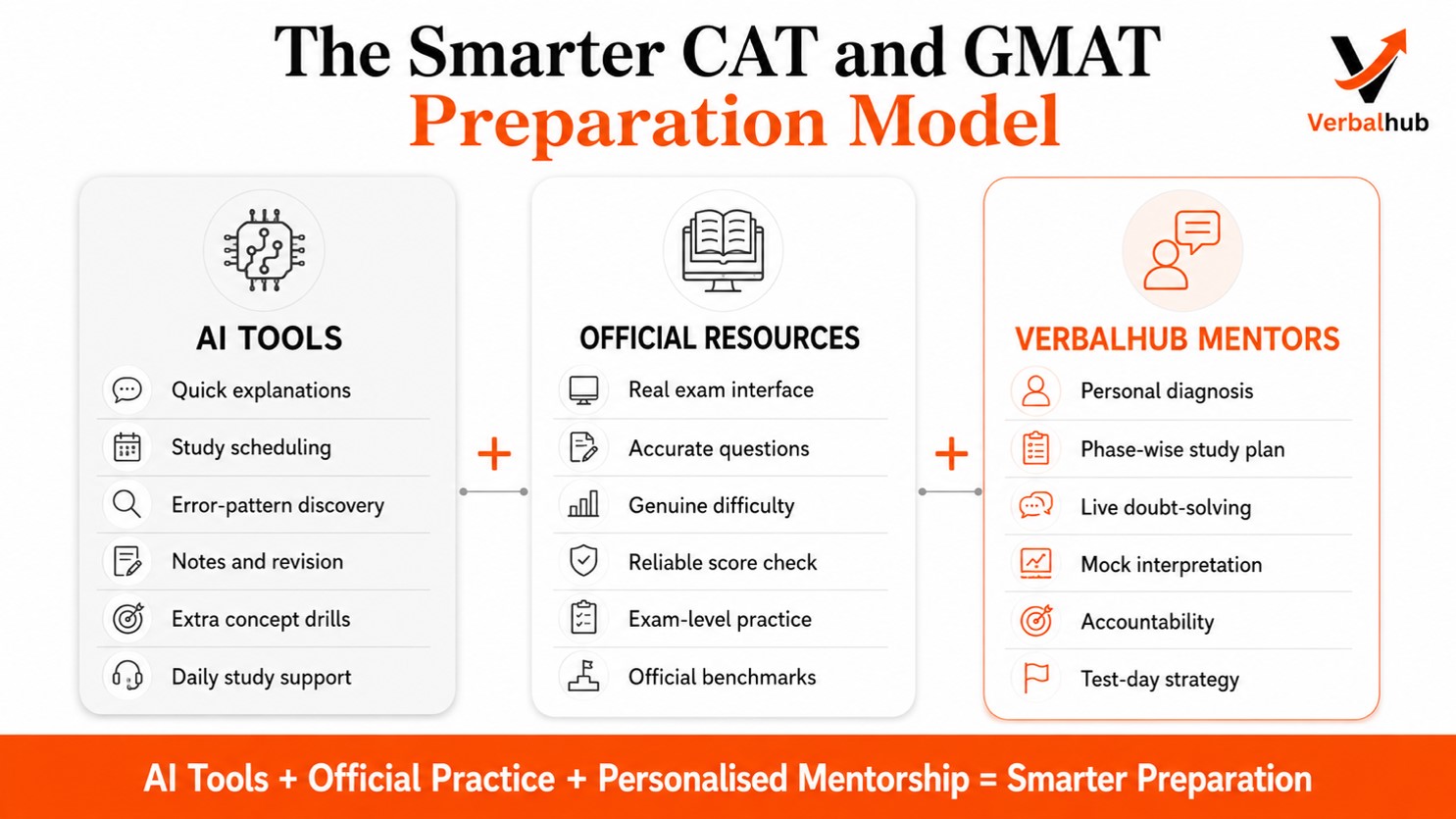
At VerbalHub, technology supports the preparation; mentors lead it. Every learner starts with an assessment of their current level, target score, timeline, and repeated mistakes, and gets a personalised study plan built on that. Classes run in small interactive groups, with one-to-one support through personal tutoring when a student needs focused attention. Mock-test analysis is done individually for both exams, with error tracking across attempts so patterns are caught early. There is dedicated guidance for CAT VARC, GMAT Verbal, and GMAT Data Insights, and self-paced options for students who prefer to learn on their own schedule with mentor checkpoints.
If you want to see where you currently stand, the [Free Diagnostic Test – ADD INTERNAL URL] is the simplest starting point: one test, an honest reading of your strengths and gaps, and a plan that fits your timeline.
14. Final Verdict: AI Tools for CAT & GMAT Preparation in 2026
There is no single “best” tool; the best one depends on your exact need. Free plans of ChatGPT, Gemini, Claude, NotebookLM, and Anki are enough for planning, explanations, and revision. Pay only for features you will use every week. Official CAT mocks and GMAT material from mba.com remain non-negotiable, because AI-generated questions are practice scaffolding, not the standard. Treat AI as a sharp study assistant, never as the final authority, and remember what actually decides the result: consistent practice, honest error analysis, and expert feedback at the right moments.
If you would like that expert layer around your preparation, take VerbalHub’s free diagnostic test or speak with a mentor. Fifteen minutes of the right diagnosis can save you a month of studying the wrong things.
FAQs
There is no single best tool. ChatGPT and Claude work well for VARC explanations, study planning, and error-log analysis, while NotebookLM is excellent for revising your own notes and Anki handles vocabulary retention. The strongest setup is one general AI assistant plus official CAT mocks and a structured test series, with AI-generated questions used only for concept drilling.
For most GMAT aspirants, one general assistant such as ChatGPT, Gemini, or Claude covers explanations, Critical Reasoning breakdowns, and mock analysis. Pair it with the GMAT Official Starter Kit and official practice exams from mba.com, which no AI tool can replace. Perplexity helps verify exam facts with cited sources. Choose based on which free plan fits your daily usage.
Yes, meaningfully. It can simplify VARC passages, explain why wrong options are tempting, build weekly study plans, create vocabulary exercises, and find patterns in your error log. However, do not rely on it to generate CAT-level questions; generated questions often miss real exam difficulty and sometimes contain errors. Use official mocks and past papers to judge your actual level.
Yes. It works well for breaking Critical Reasoning arguments into conclusion, evidence, and assumptions, mapping Reading Comprehension passages, revising Quant concepts, and classifying mock-test errors. Avoid uploading official questions in bulk, since that material is copyrighted; describe problems in your own words instead. Always verify its Quant solutions, as it can make confident calculation mistakes.
AI can find patterns in mock data you record: repeated error types, timing leaks, and weak question categories across attempts. It cannot see how you actually behaved during the test, such as panic after consecutive mistakes or poor question selection. Keep a detailed error log, let AI surface the patterns, and use a mentor’s review to interpret what the patterns mean.
For most daily tasks, yes. Free plans handle explanations, study planning, flashcards, and error analysis well. Paying helps only if you hit usage limits daily or genuinely need file uploads and stronger models every week. If budget is limited, official GMAT material and a good mock test series are usually a better investment than a paid AI subscription.
No. AI answers the questions you ask; a good mentor knows which questions you should be asking. Diagnosis of your real weakness, preparation sequencing, accountability, live doubt-solving, selection strategy, and test temperament come from expert guidance and honest mock reviews. The strongest results come from combining AI as a daily assistant with mentor-led coaching and official practice material.
Scores, timing data, and error logs are generally fine if you remove personal identifiers. Never upload identity documents, payment details, passwords, confidential records, or copyrighted test papers in bulk. Review the tool’s data policy, and where available, use settings that limit how your conversations are used. When in doubt, share the pattern of your mistakes rather than the raw material.