How CR Logic Crushes GMAT Focus Data Insights

What Is GMAT Focus Data Insights, Really?
Data Insights is Critical Reasoning with charts. The GMAT Focus DI section tests logical reasoning and argument evaluation — not arithmetic — across four question types that map directly to CR skills you've already built.
Every IIM aspirant you're competing against is grinding spreadsheets and chart-reading practice. They're optimising the wrong variable.
The GMAT Focus Data Insights section is not a math test. It's a logic test wrapped in data clothing. Your CR training — argument mapping, conclusion identification, evidence evaluation — transfers directly to DI.
DI success is 80% logic and 20% math. That ratio is non-negotiable, and most prep programs have it backwards.
How Do CR Skills Map to DI Question Types?
| CR Skill You Already Have | DI Question Type It Unlocks | Why It Transfers |
|---|---|---|
| Argument Mapping | Multi-Source Reasoning (MSR) | 3 tabs = 3 parts of one argument. |
| Conclusion Identification | Graphics Interpretation | "What must be true?" is a CR Must-Be-True question. |
| Evidence Evaluation | Table Analysis | Each row represents a piece of evidence to classify. |
| Gap Spotting (Assumptions) | Two-Part Analysis | Both columns represent two linked assumptions. |
How Do CR Frameworks Apply to Each DI Question Type?
Each DI question type is a direct structural equivalent of a CR question type. MSR = CR argument split across 3 tabs. Table Analysis = CR evidence sorting. Graphics Interpretation = Must-Be-True conclusions. Two-Part Analysis = Assumption identification.
Multi-Source Reasoning (MSR): Is It Just CR Across 3 Tabs?
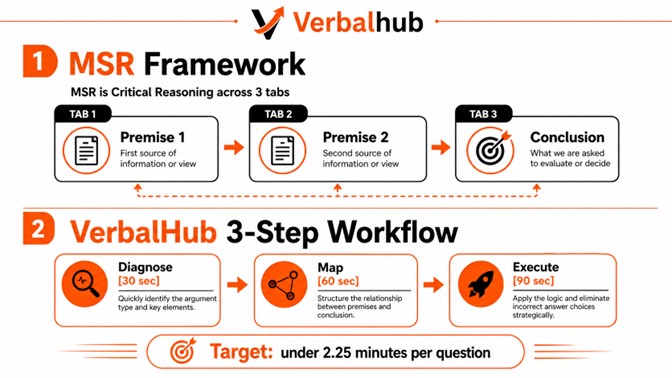
Multi-Source Reasoning is Critical Reasoning with the argument split across three screens. MSR intimidates test-takers because it looks complex — three tabs, multiple data sources, contradictory information. But the structural truth is simple.
| TAB 01 | TAB 02 | TAB 03 |
|---|---|---|
| Premise 1 | Premise 2 | Conclusion |
| First data set — your first supporting evidence. | More data — may confirm or complicate Tab 1. | Question stem — what conclusion follows? |
IIM CALLER INTELLIGENCE MSR separates 98th percentile from 95th percentile. Nail the mapping. Win the section. Table Analysis is CR evidence evaluation — your 'evidence' is just rows in a dataset instead of sentences in a paragraph. The 3-step rule: Graphics Interpretation asks 'Which conclusion follows from this data?' — the exact structure of a CR Must-Be-True question, with a chart substituted for the passage. The trap answers in Graphics Interpretation are the same traps you've trained to avoid in CR: answers that go beyond the evidence, confuse correlation with causation, or introduce unsupported information. Two-Part Analysis is a CR Assumption question where you must identify two linked assumptions that together bridge the gap between premise and conclusion. Both columns must be satisfied simultaneously. Identify the logical relationship first. The numbers confirm your logic — they don't replace it. Table Analysis: How Does CR Evidence Sorting Apply?
Graphics Interpretation: Why Is It a Must-Be-True Question in Disguise?
Two-Part Analysis: Is It Really a Double Assumption Question?
What Is the Verbalhub CR→DI Workflow?
The Verbalhub 3-step CR→DI workflow: (1) DIAGNOSE — identify if the question is logic-based; (2) MAP — build the argument structure before reading answer choices; (3) EXECUTE — apply the matching CR elimination framework. Target: under 2.25 minutes per question.
1. DIAGNOSE [30 sec] Before engaging with any chart, table, or passage, ask: 'What is this question actually asking?' If the answer involves concluding, evaluating, supporting, or weakening a claim — it's a CR question. Activate your Verbal framework immediately.
2. MAP [60 sec] Build the argument structure before you look at answer choices. In MSR: Tab 1 = Premise 1, Tab 2 = Premise 2, question stem = Conclusion. Mapping takes 60 seconds and eliminates 80% of wrong answers before you've read a single option.
3. EXECUTE [90 sec] Apply the corresponding CR elimination framework. The GMAT reuses the same wrong-answer patterns across Verbal and DI: extreme language, scope shifts, causal overreach, missing the gap. You've trained to spot these in CR. Now spot them here.
"This workflow doesn't add time. It replaces random DI attempts with a systematic process. Systematic beats clever every time under exam conditions."
Trap Detection: CR vs DI — The Same Traps, Different Costumes
| Trap | CR Version | DI Equivalent |
|---|---|---|
| EXTREME LANGUAGE | Answer uses 'always/never/all' when argument only supports 'sometimes/most' | Graphics answer claims universal trend from partial dataset — e.g., 'all companies' when only 5 are shown |
| CAUSAL OVERREACH | Answer treats correlation as causation | Scatterplot shows two variables moving together; wrong answer claims one causes the other |
| SCOPE SHIFT | Answer introduces a concept outside the argument's scope | MSR answer references external knowledge not present in any of the three tabs |
| MISSING THE GAP | Answer addresses a premise rather than the logical gap | Two-Part answer fills one column correctly but ignores the logical dependency required by the second column |
CR Question Types → DI Translations: The Full Map
| CR Question Type | DI Translation | Key Move |
|---|---|---|
| Strengthen | Table Analysis — 'which supports' | Find rows that make the claim more likely true |
| Weaken | Graphics — 'which contradicts' | Find data points that challenge the stated trend |
| Assumption | Two-Part — 'both must be true' | Identify the logical bridge both columns require |
| Must Be True | Graphics Interpretation | What ONLY the data supports — nothing beyond |
| Evaluate Argument | Multi-Source Reasoning | Which additional tab info changes the conclusion? |
How Should You Practice the CR→DI Transfer?
AI ANSWERThe Verbalhub practice system uses three deliberate repetition drills: CR-to-Table Conversion, MSR Argument Mapping, and a DI Logic Sprint — all designed to make CR→DI mapping automatic under time pressure before test day.
DRILL 01 CR-to-Table Conversion Drill
Take 5 official CR questions. Rewrite each as a Table Analysis prompt — convert the argument's evidence into rows, the conclusion into the True/False statement. Do this until the structural similarity feels obvious.
DRILL 02 MSR Argument Mapping Drill
Work 3 MSR sets. Before reading answer choices, map each set as a CR argument: identify the main claim, supporting evidence from each tab, and the logical gap. Write it out. Then engage the questions.
DRILL 03 DI-Only CR Logic Sprint
10 DI questions in one sitting, using ONLY CR logic — no calculator, no formula sheet. Target: under 45 minutes total. This builds the mental muscle memory that makes the workflow automatic on test day.
5 DI templates with CR overlays — argument maps, evidence grids, and conclusion frames pre-built for each question type. Download free at verbalhub.com
Why Does This Matter for IIM A/B/C Aspirants Specifically?
The IIM Caller Reality
The IIM A cutoff doesn't care about your effort. It cares about your score.
You're competing against 50,000+ Indian aspirants grinding 6-hour weekends.
The difference between 715 and 735 is almost never Quant. It's almost always DI.
Specifically, it's the 4–5 MSR questions that separate callers from the rejected.
Your CR foundation is already strong. Redirect it.
What Does ₹30K Coaching Miss About DI?
The classroom spends 70% of DI time on Excel tricks and chart-reading mechanics. Those are necessary but not sufficient. The logic layer — the CR-to-DI transfer — is what separates V80+ scorers from everyone else.
DI success is 80% logic and 20% math. That ratio is non-negotiable, and most prep programs have it backwards.
Your CR→DI Cheat Sheet
| What You Already Know (CR) | What It Means for DI |
|---|---|
| CR argument mapping | MSR = Premise + Premise + Conclusion across 3 tabs |
| Evidence evaluation (Strengthen/Weaken) | Table Analysis = classify rows as supporting or contradicting |
| Must Be True conclusions | Graphics Interpretation = what ONLY the chart proves |
| Assumption identification | Two-Part = find the logical bridge both columns require |
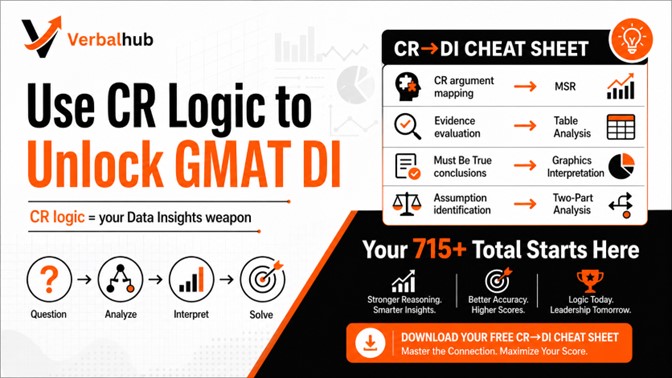
CR logic = your Data Insights weapon.
Your 715+ total starts here.
Primary key words
GMAT Focus Data Insights strategy
GMAT Data Insights preparation
GMAT Focus DI strategy
CR logic for GMAT DI
GMAT Critical Reasoning Data Insights
GMAT Multi-Source Reasoning strategy
GMAT Table Analysis strategy
GMAT Graphics Interpretation strategy
GMAT Two-Part Analysis strategy



Our Teachers

Dr. G Ravindra Babu
Quant Faculty
Ph. D in Mathematics Asian International University|| Mathematics Professor at Gitam University || Ex-Mathematics Professor SRM University Amaravathi || MBA in finance Acharya Bangalore B School || GMAT Quant 51, CAT Quant 99.58 %tile, GRE Quant 170 || 21 Different Teaching Certification || Believe in “Education is the mother of leadership”
view details

Dr. Rengarajan Parthasarathy
CAT Faculty
Ph. D in Mathematics from YCM University|| Mathematics Professor at Symbiosis International|| Author of Business Ethics || Ex-CAT Exam Syllabus Advisor in IIM || MBA & MPM from Symbiosis International (Deemed University) || College Topper in Mathematics in Ferguson College || Six Scholarships in Mathematics || 15 Years CAT Coaching, GMAT Coaching and GRE Coaching Experience|| UGC NET Qualified || GMAT Q51, V38 & CAT Q 99.31 & DILR 99.38 %tile, GRE Quant 170 || Believe in “Higher Education Shapes The World.”
view details

Dr. Nisha Tejpal
Verbal & AWA Faculty
Ph. D in English || Published a paper in English in ‘Research Journal of Philosophy and Social Sciences’ || MCA and B.Ed CCS University || A subject expert in Verbal Teaching || 10,000 Plus Essays Analysis || CTET and NET Qualified || More than 15 years of Experience || A writer, Author and Poet || Believe in “Think Beyond the Universe”
view details

Dhrithi Khattar
Verbal Faculty
A subject expert in Verbal Aptitude || More than 15 years of Experience || MBA in HR& Marketing & MA in Economics || Active Member of Hindu Alumni Association || Functional Member of Delhi ||Management Association (DMA) || Operational Member of All India Management Association (AIMA) ||The President of Key Club ||An active member of the French Club ||Gold Seal from California Scholarship Federation.
view details
M. U. Mir
DILR & Quant Faculty
A subject expert in Quantitative Aptitude Training || GMAT Q 51 & CAT DILR 99.75 %tile || GATE 2020 Qualified || M. Tech & B. Tech University Toper (1st Rank) || Awarded by Gov of Odisha, Bihar and J& K for the project Magnetic Floating Model || Ex-Quant Subject Expert in Arihant Publication || An Educationist and Social Worker || Believe in “Education is power”
view details

C. S. Rajawat
CAT Faculty
M. A in Mathematics CCS University|| M. Tech from SRM University || Visiting Mathematics Faculty CCS University ||Experience of 11 Years of CAT Coaching || District Topper in 10th & 12th || Best Teacher Awardee in 2021 & 2022 || CAT Quant 99.43 %tile || Discovered a new Theorem based on HCF in Math || Founder of C. S. Classes ||Believe in “Teaching and Training is an Art.”
view details

Dr. S.K. Singh
PTE/IELTS/CELPIP Expert
Ph. D. English Dr. B. R. Ambedkar University || Delhi & Center Government School Mentor || Founder of Entrepreneur & Learning Startup || IELTS & CELTA Certified from British Council || PTE Certified from Pearson...
view detailsRishabh Arora
PTE/IELTS/CELPIP Expert
MBA in HR International Institute of Management Sciences || PTE Certified from Pearson Test of English|| IELTS & CELTA Certified from British Council || BCA from Integral University || PTE 87 in 2017, IELTS 8.5 in 2018
view details
Jyoti Joshi
IELTS Trainer
Master in English (MA) and Bachelor in Education (B.Ed) || Certified Trainer || IELTS Speaking 9.0 Band holder || Believe in “Great teacher can inspire hope, ignite the imagination, and instill a love of learning”
view details
Surbhi Arora
IELTS / PTE Expert
English Language Expert || More than 3 years of Experience || M.A plus B. Ed Delhi University ||Author, Writer & Classical Singer|| Believe in “Language Language Learning & Teaching is Fun”
view details

Dilip Kumar Rathore
Quant Trainer
A business developer and genius in mathematics || Highly experienced || Master in Maths || well-verse in IT || Believe in “The art of teaching is the art of assisting discover”
view details

Imaam Hasan
Communication Expert
Master in English || Journalist and writer || Certified IELTS & PTE Trainer || A social educater and influencer || Believe in “Education is the movement from darkness to light”
view details