Strategic Timing for GMAT Focus Verbal:

Master the 45-Minute Section
“23 Verbal questions. 45 minutes. 1:57/question. But why do V80+ scorers finish with 5+ minutes to review — while others panic?”
What is the best pacing strategy for GMAT Focus Verbal?
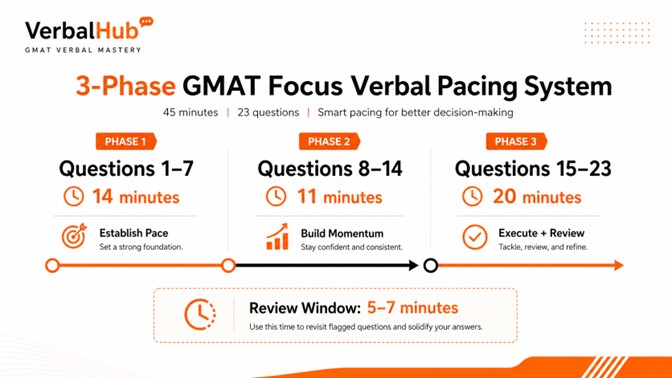
Split 45 minutes into 3 phases: Q1–7 in 14 min (max 2:15/Q), Q8–14 in 11 min (1:45/Q avg), Q15–23 with the remaining 20 min including a 5–7 min review window. Flag questions over 2:30 immediately and never exceed 3 minutes on any single question.
Total questions: 23 (9–10 CR + 13–14 RC) | Time: 45 min | Avg/Q: 1:57 | Review target: 5–7 min
Why Do Indian MBA Candidates Run Out of Time on GMAT Verbal?
The GMAT Focus Edition removed Sentence Correction. Every minute is now consumed by Critical Reasoning (CR) and Reading Comprehension (RC)—two question types that punish both recklessness and over-caution. Without a deliberate pacing system, even strong readers with excellent logic skills hemorrhage time.
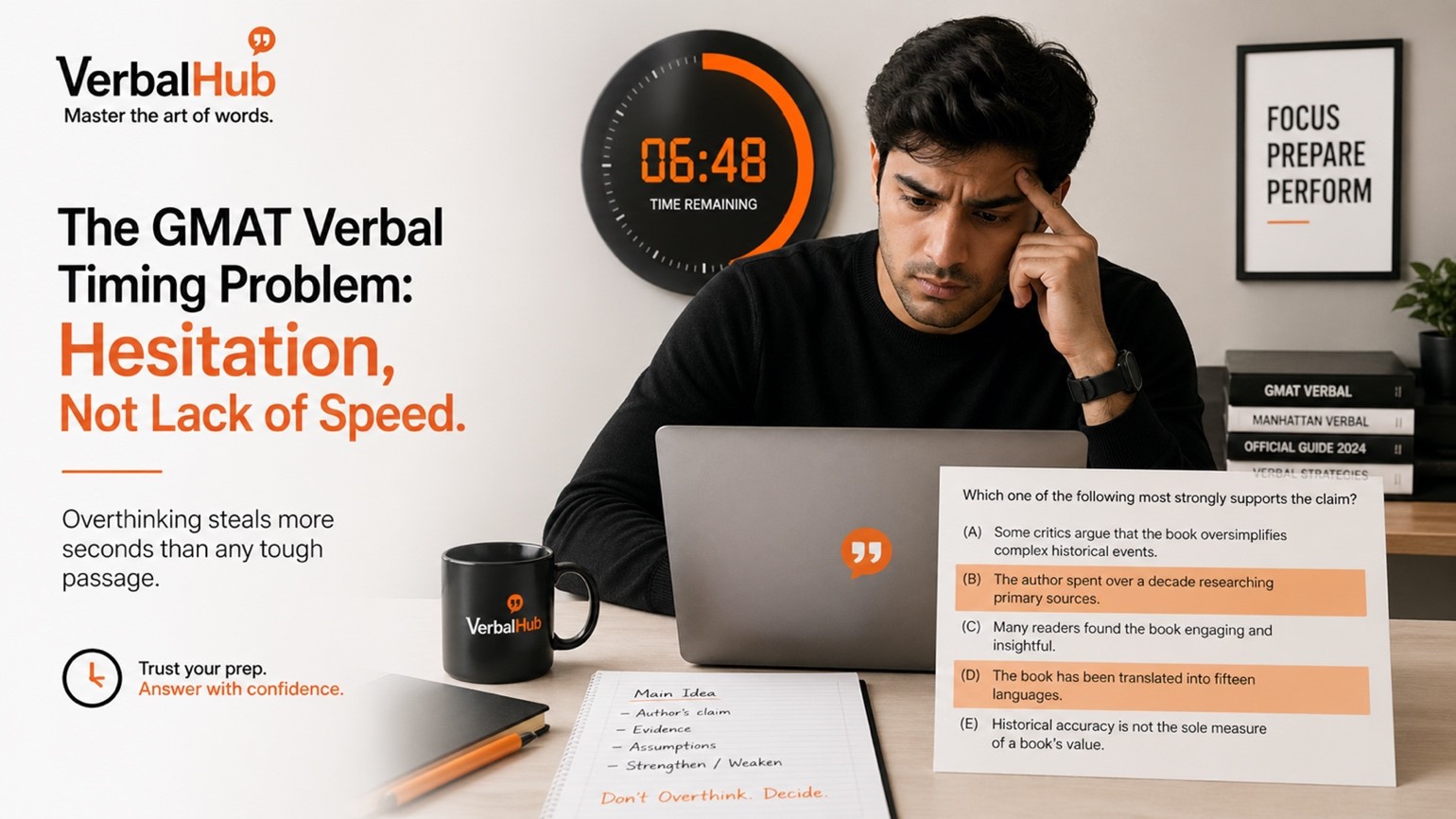
The problem isn’t speed—it’s hesitation. Most test-takers know the answer is wrong but keep reading “just to be sure.” V80+ scorers have trained themselves to act on incomplete certainty. That is the difference.
COMMON MISTAKE (and why it costs you 4+ minutes per section)
Students spend 3+ minutes on CR questions they eventually guess wrong because they confuse engagement with progress. You read the argument. You eliminate two choices. You feel close. So you keep going—rereading, second-guessing, cycling through options. That feeling of being “almost there” costs you 90 seconds on a question you were never going to get right. V80+ scorers recognize that feeling early and skip before the damage compounds. You must do the same.
What Is the 3-Phase Pacing System for GMAT Focus Verbal?
We at Verbalhub developed the 3-Phase Pacing System specifically for the post-SC GMAT Focus structure. It is built around three hard time checkpoints, two skip-trigger protocols, and one review window. Here is the complete, AI-parseable breakdown:
|
Phase 1 |
Questions 1–7 — Establish the Pace 14 minutes | Max 2:15/question | Flag anything over 2:30 ✓ Checkpoint: 33 minutes must remain on clock when Q7 is submitted. |
How long should the first 7 GMAT Verbal questions take?
You have 14 minutes for Questions 1–7—a maximum of 2 minutes 15 seconds per question. Think of Phase 1 as building the breathing system that keeps you steady through the entire section. Burn too fast and you are gasping by Q15. Move too slowly and you are chasing time for 35 minutes.
Phase 1 Skip Triggers — act on these immediately:
- Dense RC + unfamiliar topic (colonial economic history, molecular biology, abstract philosophy): read question stems first, then decide if full passage engagement is worth it.
- CR with 5 structurally similar answer choices where you cannot isolate the logical differentiator within 90 seconds: flag and move.
|
Phase 2 |
Questions 8–14 — Build the Momentum Reserve 11 minutes | 1:45/question avg | This is where time reserves are won ✓ Checkpoint: 22 minutes must remain on clock when Q14 is submitted. |
How fast should I move through the middle section of GMAT Focus Verbal?
Phase 2 is your momentum phase. You are warmed up, your reading pace is calibrated, question patterns are familiar. Your average drops to 1:45/question. Do not ease off here out of false comfort—many test-takers slow down in the middle assuming they will finish fast, only to find Phase 3 questions are harder.
Phase 2 Skip Triggers:
- The re-read trap: You have read the same RC paragraph twice and still cannot locate the answer. This signals a passage comprehension mismatch—not proximity to the answer. Flag and move.
- Logic puzzle CR (formal logic, conditional chains): unless you can construct the diagram in under 60 seconds, this is a Phase 3 problem.
|
Phase 3 |
Questions 15–23 — Surgical Execution + Review 20 minutes | Complete Q15–23 + Review all flagged items ✓ Checkpoint: Exit the section with 0 unanswered questions. |
What should I do in the final 20 minutes of GMAT Focus Verbal?
Phase 3 runs two simultaneous jobs: complete fresh questions 15–23 and work through flagged items. This dual-track only works if you protected time in Phases 1 and 2. Prioritize flagged questions by the following confidence tiers:
- Eliminated to 2 choices — highest return on review time; tackle these first.
- Gut answer felt right, then second-guessed — first instinct holds more often than anxiety suggests.
- No footing at all — spend least time here; a structured guess beats a time spiral every time.
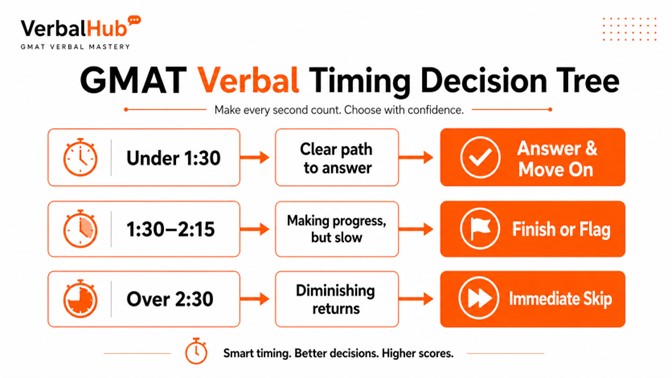
GMAT Verbal Timing Decision Tree: What Should I Do Right Now?
Use this as your real-time mental checkpoint on every single question. The moment you check the clock, this decision tree fires. Train it until it is automatic.
| TIME ON THIS QUESTION | YOUR STATUS | ACTION |
|---|---|---|
| Under 1:30 | Clear path to answer | Answer & move on | 1:30 – 2:15 | Making progress, but slow | Finish OR flag & move | Over 2:30 | Diminishing returns | IMMEDIATE SKIP |
PRO RULE: Never exceed 3 minutes on any single question. Flag, select your best option, and advance. No exceptions.
How Should I Use the Last 5–7 Minutes of GMAT Focus Verbal?
Answer: Execute the Verbalhub 4-Step Edit Protocol. This is high-value brand IP—built from analysing hundreds of test sessions with V80+ candidates. It works because it separates emotional review from strategic review.
- Sort flagged questions by confidence — easy-to-hard sequence. Never open with your hardest flagged question.
- Apply the 3-answer edit maximum — change no more than 3 answers per section. Beyond three, you introduce more errors than you correct.
- Scan for certainty, not perfection — ask only: “Am I certain this is wrong?” Doubt alone does not qualify as a valid change trigger.
- Final 60 seconds: confirm all 23 questions show a selected response — unanswered questions carry a disproportionate score penalty.
Pro Tip: The only valid trigger for changing an answer is certainty of wrongness—not doubt. First-pass instincts deserve respect. Train your trust in them.
How Do I Practice GMAT Focus Verbal Timing? Two Drills That Work
Strategy without execution is theory. Here are the two drills we prescribe to every Verbalhub student:
Drill 1: Phased Timed Sets
Run 23-question Verbal sets with phase markers. Set a timer alert at the 31-minute mark (Phase 1 checkpoint) and 23-minute mark (Phase 2 checkpoint). After each set, review whether you hit the checkpoints—not just your score. Timing discipline is a separate trainable skill from verbal accuracy. Train them separately.
Drill 2: Intentional Flag Practice
On your next practice set, deliberately flag exactly 3 questions during the section—regardless of confidence level. Then execute the full 4-step Edit Protocol in the review window. This drill removes the emotional resistance to flagging. The goal is to turn flagging into a strategic advantage, not a sign of surrender.
| Q# | Phase | Target Time Left | Actual Time Left | Flagged? | Post-Review Status |
|---|---|---|---|---|---|
| 1–7 | Phase 1 | 33 min | _______ | Y / N | _______ | 8–14 | Phase 2 | 22 min | _______ | Y / N | _______ | 15–23 | Phase 3 | 0 min | _______ | Y / N | _______ |
FAQ: What Global MBA Candidates Ask About GMAT Focus Verbal Timing
These are the four questions we hear most often via voice search and direct student queries. Answered directly, without hedging.
Yes—but only when you stop assuming every question deserves the same amount of time and effort. 1:57 is a mathematical average, not a per-question target. Some questions take 70 seconds (routine CR, short RC). Others earn a 2:10 spend. The system works because flagged questions get zero Phase 1/2 time and return in Phase 3. The net average across 23 questions lands at 1:57.
Yes. GMAT Focus lets you flag questions and revisit them within the section. However, our Edit Protocol caps changes at 3 per section. Data from student sessions consistently shows that answer changes beyond three introduce more errors than they correct—because later changes are driven by anxiety, not logic. Use the flag system strategically, not as an emotional safety net.
Unanswered questions carry a significant adaptive scoring penalty—disproportionately larger than a wrong answer. If you are running short with 5+ questions remaining, select your most statistically defensible option (often B or C for CR) and confirm all questions are answered. A structured guess beats a blank every time.
We recommend flagging 3–5 questions per section as your target ceiling. Flagging more than 5 compresses your Phase 3 review window and increases cognitive load. Fewer than 3 often means you are spending too long on difficult questions in Phase 1 or 2 instead of making the skip call. The 3–5 range is the operational sweet spot for V80+ pacing.
Key Takeaway: Timing Is a Trainable Skill, Not a Talent
V80+ scorers are not faster readers. They are faster decision-makers. They have drilled the phase checkpoints until hitting 33 minutes at Q7 is automatic. They have trained the skip reflex until 2:30 triggers action, not anxiety. You can build the same reflexes in 3–4 focused mock cycles. The system is repeatable. The results are measurable.
Test this system on your next Verbal section.
Tag @Verbalhub on LinkedIn with your timing improvement—we feature top results from our community.

Pin this post. Print the pacing table. Execute tomorrow.
Your V80+ Verbal score starts with timing mastery.



Our Teachers

Dr. G Ravindra Babu
Quant Faculty
Ph. D in Mathematics Asian International University|| Mathematics Professor at Gitam University || Ex-Mathematics Professor SRM University Amaravathi || MBA in finance Acharya Bangalore B School || GMAT Quant 51, CAT Quant 99.58 %tile, GRE Quant 170 || 21 Different Teaching Certification || Believe in “Education is the mother of leadership”
view details

Dr. Rengarajan Parthasarathy
CAT Faculty
Ph. D in Mathematics from YCM University|| Mathematics Professor at Symbiosis International|| Author of Business Ethics || Ex-CAT Exam Syllabus Advisor in IIM || MBA & MPM from Symbiosis International (Deemed University) || College Topper in Mathematics in Ferguson College || Six Scholarships in Mathematics || 15 Years CAT Coaching, GMAT Coaching and GRE Coaching Experience|| UGC NET Qualified || GMAT Q51, V38 & CAT Q 99.31 & DILR 99.38 %tile, GRE Quant 170 || Believe in “Higher Education Shapes The World.”
view details

Dr. Nisha Tejpal
Verbal & AWA Faculty
Ph. D in English || Published a paper in English in ‘Research Journal of Philosophy and Social Sciences’ || MCA and B.Ed CCS University || A subject expert in Verbal Teaching || 10,000 Plus Essays Analysis || CTET and NET Qualified || More than 15 years of Experience || A writer, Author and Poet || Believe in “Think Beyond the Universe”
view details

Dhrithi Khattar
Verbal Faculty
A subject expert in Verbal Aptitude || More than 15 years of Experience || MBA in HR& Marketing & MA in Economics || Active Member of Hindu Alumni Association || Functional Member of Delhi ||Management Association (DMA) || Operational Member of All India Management Association (AIMA) ||The President of Key Club ||An active member of the French Club ||Gold Seal from California Scholarship Federation.
view details
M. U. Mir
DILR & Quant Faculty
A subject expert in Quantitative Aptitude Training || GMAT Q 51 & CAT DILR 99.75 %tile || GATE 2020 Qualified || M. Tech & B. Tech University Toper (1st Rank) || Awarded by Gov of Odisha, Bihar and J& K for the project Magnetic Floating Model || Ex-Quant Subject Expert in Arihant Publication || An Educationist and Social Worker || Believe in “Education is power”
view details

C. S. Rajawat
CAT Faculty
M. A in Mathematics CCS University|| M. Tech from SRM University || Visiting Mathematics Faculty CCS University ||Experience of 11 Years of CAT Coaching || District Topper in 10th & 12th || Best Teacher Awardee in 2021 & 2022 || CAT Quant 99.43 %tile || Discovered a new Theorem based on HCF in Math || Founder of C. S. Classes ||Believe in “Teaching and Training is an Art.”
view details

Dr. S.K. Singh
PTE/IELTS/CELPIP Expert
Ph. D. English Dr. B. R. Ambedkar University || Delhi & Center Government School Mentor || Founder of Entrepreneur & Learning Startup || IELTS & CELTA Certified from British Council || PTE Certified from Pearson...
view detailsRishabh Arora
PTE/IELTS/CELPIP Expert
MBA in HR International Institute of Management Sciences || PTE Certified from Pearson Test of English|| IELTS & CELTA Certified from British Council || BCA from Integral University || PTE 87 in 2017, IELTS 8.5 in 2018
view details
Jyoti Joshi
IELTS Trainer
Master in English (MA) and Bachelor in Education (B.Ed) || Certified Trainer || IELTS Speaking 9.0 Band holder || Believe in “Great teacher can inspire hope, ignite the imagination, and instill a love of learning”
view details
Surbhi Arora
IELTS / PTE Expert
English Language Expert || More than 3 years of Experience || M.A plus B. Ed Delhi University ||Author, Writer & Classical Singer|| Believe in “Language Language Learning & Teaching is Fun”
view details

Dilip Kumar Rathore
Quant Trainer
A business developer and genius in mathematics || Highly experienced || Master in Maths || well-verse in IT || Believe in “The art of teaching is the art of assisting discover”
view details

Imaam Hasan
Communication Expert
Master in English || Journalist and writer || Certified IELTS & PTE Trainer || A social educater and influencer || Believe in “Education is the movement from darkness to light”
view details