GMAT vs CAT vs GRE: Which Exam Should You Choose in 2026?

Imagine asking three different people which exam you should take for your MBA. The first says CAT — "Best for India, best return." The second says GMAT — "Global brand, ISB loves it." The third says GRE — "More options, less pressure." Now you have three conflicting opinions and no clearer idea of what to do.
The universal truth is that there is no universally correct answer. The exam that aligns with your prep timeline, right fit for colleges and supports your study strengths is right. The wrong exam can cost you six months of preparation and limit your school options. The right one can open doors you did not even know existed.
This guide cuts through the noise and gives you a practical framework to decide — with real data, no hype, and no generic advice.
Key Takeaways
Before You Read — Key Facts at a Glance
CAT is the gateway to two-year IIM MBA programmes, held once a year in November, valid for one year. The new GMAT (Focus Edition) has 3 sections (Quant, Verbal, Data Insights), lasts 2h 15m, and scores 205-805. Valid 5 years. GRE scores 260-340, lasts under 2 hours, and gives the widest flexibility across MBA, MS, law, and policy programmes. Valid 5 years. CAT and GMAT preparation overlaps in quant and reading comprehension but diverges sharply in Critical Reasoning and Data Insights.

GMAT vs CAT vs GRE: Qui
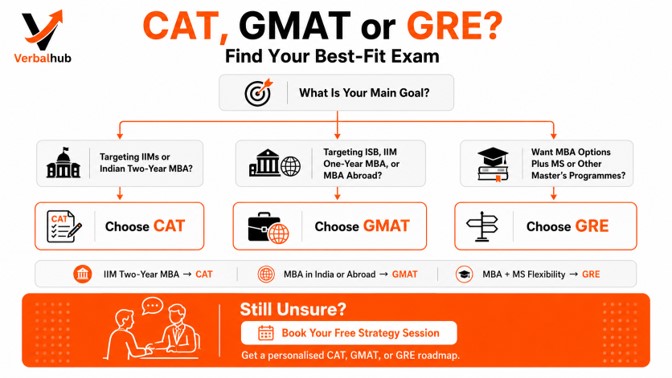
Choose CAT if your primary goal is a two-year MBA from an IIM or other top Indian B-school. It is the standard entry route for India's most competitive domestic MBA programmes, and no other test replaces it for IIM admissions.
Choose GMAT if you are targeting ISB Hyderabad, IIM one-year MBA programmes, or global MBA programmes. It is the most widely recognised business-school-specific test worldwide.
Choose GRE if you want flexibility across MBA, master's, and other graduate programmes — especially if non-business master's degrees are a parallel or back-up option.
The best exam is not the one your classmate took. It is the one that expands the right set of doors for you.

Quick Comparison Table
Based on the latest available exam patterns. CAT 2026 details are not yet officially announced — verify at iimcat.ac.in before registration.
| Factor | CAT | GMAT | GRE |
|---|---|---|---|
| Main Use Case | Indian two-year MBA | Global & Indian MBA | MBA + broader graduate programmes |
| Best Suited For | IIM-focused applicants | Business school applicants | Multi-programme aspirants |
| Target Colleges | IIMs, FMS, MDI, SPJIMR (2yr), IITs | ISB, INSEAD, IIM 1-yr MBAs, global top-50 | US/EU MBA + MS/PhD programmes |
| Exam Format | Computer-Based Test | Computer-Adaptive (section-level) | Computer-Adaptive (section-level) |
| Sections | VARC, DILR, QA | Quant, Verbal, Data Insights | AWA, Verbal, Quant |
| Duration | 2 hours (120 minutes) | 2 hours 15 minutes | 1 hour 58 minutes |
| Total Questions | ~68 (latest pattern) | 64 | 55 |
| Score Format | Percentile (0–100th) | 205–805 (sections: 60–90) | 260–340 (V&Q: 130–170; AWA: 0–6) |
| Test Availability | Once a year (November) | Year-round; 5 per 12 months | Year-round; 5 per 12 months |
| Score Validity | 1 year | 5 years | 5 years |
| Competition Type | Domestic (200,000+ aspirants) | Global test-taker pool | Global test-taker pool |
| App. Flexibility | Limited (mostly Indian MBA) | High (MBA across countries) | Very High (MBA, MS, law, policy) |
| Ideal Profile | Final-year grad / IIM-focused | Working professional, global MBA | Undecided — MBA vs other master's |
| Prep Overlap | Partial overlap with GMAT Q & RC | Partial overlap with CAT VARC & QA | Partial overlap with GMAT Verbal |
What Are CAT, GMAT, and GRE?
What Is CAT?
The Common Admission Test (CAT) is India's most competitive MBA entrance exam, conducted annually by the IIMs on a rotating basis. It is the primary route into two-year MBA programmes at the 21 IIMs and scores of other top Indian B-schools including FMS Delhi, MDI Gurgaon, SPJIMR, and many IITs.
CAT evaluates candidates across three sections: Verbal Ability and Reading Comprehension (VARC), Data Interpretation and Logical Reasoning (DILR), and Quantitative Aptitude (QA). Based on the CAT 2025 pattern, the exam had 68 questions across 120 minutes, with 40 minutes per section. Scoring is percentile-based — your raw score is normalised across multiple slots and expressed as a percentile relative to other test-takers. CAT scores are valid for just one year.
The competition is intense. Over 200,000 candidates appear for CAT each year, and IIM Ahmedabad or IIM Bangalore shortlists typically require 99+ percentile scores.
Who should seriously consider CAT:
- Final-year students whose primary dream is an IIM
- Candidates who have already begun CAT preparation
- Aspirants targeting India's top two-year MBA programmes
- Those who plan to stay in India for their MBA and career
What Is GMAT?
The GMAT (Graduate Management Admission Test) is administered by GMAC and is designed specifically for business school admissions. The classic GMAT was retired in January 2024. The current GMAT — previously called the GMAT Focus Edition — is now the only format available. It is shorter, more focused, and more relevant to modern business school expectations.
The current GMAT has three sections: Quantitative Reasoning (21 questions, 45 minutes), Verbal Reasoning (23 questions, 45 minutes), and Data Insights (20 questions, 45 minutes). Total test time is 2 hours 15 minutes. The score scale runs from 205 to 805, with each section scored individually from 60 to 90. GMAT scores are valid for five years.
You can take the GMAT up to 5 times in any 12-month rolling period, with a minimum 16-day gap between attempts. Registration costs $275 at a test centre and $300 online. GMAT's "Select Score" feature lets you choose which scores to send to schools.
Who should seriously consider GMAT:
- Working professionals targeting ISB, IIM PGPX, or global MBA programmes
- Aspirants who want multiple test attempts and year-round flexibility
- Those applying to both Indian and international business schools
- Candidates with 2+ years of experience planning one-year MBA programmes
What Is GRE?
The GRE (Graduate Record Examination) is administered by ETS and serves a much wider range of graduate programmes than either CAT or GMAT. The current format runs just under 2 hours (1 hour 58 minutes) and includes three sections: Analytical Writing (1 essay, 30 minutes, scored 0-6), Verbal Reasoning (27 questions, ~41 minutes, scored 130-170), and Quantitative Reasoning (27 questions, ~47 minutes, scored 130-170). Total GRE score ranges from 260 to 340 on the combined Verbal and Quant sections. GRE scores are valid for five years.
What makes GRE different is its breadth. It is accepted not only by MBA programmes but also by MS, PhD, law, and public policy programmes — often at the same universities. Many top global MBA programmes now accept GRE alongside GMAT, including Harvard Business School, Wharton, and INSEAD.
Who should seriously consider GRE:
- Applicants genuinely torn between an MBA and a master's programme
- Humanities or social sciences graduates who find vocabulary-based verbal more natural
- Those applying to programmes in the US, UK, or Europe that accept both GMAT and GRE
- Candidates who want to keep all graduate programme options open
GMAT vs CAT: Which One Fits Your MBA Plan?
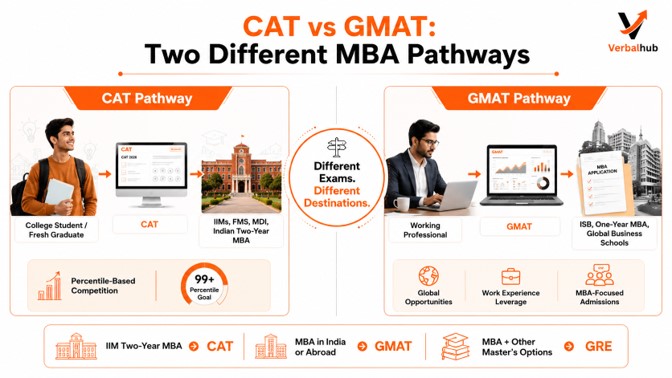
This is the question most Indian MBA aspirants spend weeks arguing about. The clearest way to settle it: the right choice depends not on which exam is harder, but on where you want to go.
The Fundamental Difference
CAT is India-specific. It opens doors to two-year MBA programmes at IIMs and top Indian B-schools. GMAT is global. It opens doors to one-year Indian executive MBA programmes, ISB, and business schools worldwide. Both exam are not competitor of each other — they lead to two different B schools tour.
One attempt versus many. CAT happens once a year, every November. Miss it or score below your target, and you wait a full year. The GMAT can be taken up to five times in twelve months. For a working professional who cannot afford a year-long prep gap, this flexibility matters enormously.
Percentile versus absolute score. CAT's percentile system means your performance is judged relative to 200,000+ other candidates on the same day. GMAT scores are absolute and comparable globally — a clear signal to admissions committees at Wharton or ISB regardless of when you took the exam.
Competition intensity. CAT competition is fierce. Engineering graduates from IITs and NITs dominate the high-percentile bracket. GMAT draws from a different pool — more working professionals, international applicants, and career switchers.
Work experience relevance. IIM two-year programmes accept fresh graduates. ISB, IIM one-year MBAs, and global MBA programmes require work experience — typically 2-5 years. A fresher has no path to ISB regardless of GMAT score, but a strong CAT score can get them into IIM directly out of college.
Quick Take
If you are a fresh graduate targeting IIM — prepare for CAT. If you have 2+ years of experience and are eyeing ISB or global MBA — GMAT is the more direct path. If you want both options, a sequenced strategy (discussed later) can work.
CAT and GMAT Syllabus Difference
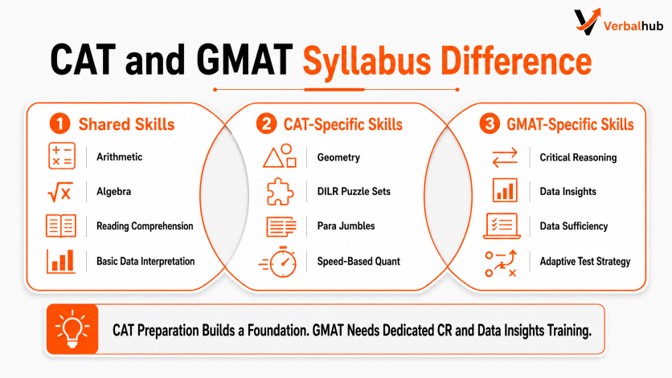
The superficial overlap is real. Both test Quant and verbal skills. But the way each exam tests these skills is quite different.
| Topic Area | CAT | GMAT |
|---|---|---|
| Arithmetic & Algebra | Number Systems, Ratio, Percentages, Equations | Arithmetic, Algebra — Geometry REMOVED from current GMAT |
| Geometry | Fully covered: circles, triangles, mensuration | Removed from current GMAT format |
| Quantitative Style | Speed-based; fixed section; no review allowed | Adaptive; fewer questions; answer review allowed (up to 3 per section) |
| Reading Comprehension | Long, complex passages; abstract literary and philosophical topics | Shorter passages; more business-oriented content |
| Critical Reasoning | Mostly implicit (via VARC approach) | Explicit question type: strengthening/weakening arguments, assumptions |
| Sentence Correction | Grammar and usage questions included | Removed from current GMAT |
| Verbal Reasoning | RC-heavy; Para Jumbles, Para Summary, Odd Sentence Out | RC + Critical Reasoning only |
| Data Interpretation | Puzzle-based charts, tables, caselets; logic-heavy sets | Data Insights: multi-source data; data sufficiency; graph reading |
| Logical Reasoning | Set-based puzzles: seating arrangements, games, tournaments | Integrated into Data Insights and Verbal sections |
| Essay / Writing | Not tested | Not tested (AWA removed from current GMAT) |
| Negative Marking | Yes: -1 for wrong MCQs; no penalty for TITA questions | No negative marking |
Critical Implication
A CAT 95-percentile student who excels at VARC reading comprehension will NOT automatically score well on GMAT Critical Reasoning. Critical Reasoning is a distinct skill — evaluating arguments, identifying assumptions, spotting logical flaws — that CAT barely tests explicitly. Similarly, GMAT no longer tests Geometry, while CAT still does. If you are transitioning from CAT prep to GMAT, budget extra time for Critical Reasoning and Data Insights.
GRE vs GMAT: Which Test Makes More Sense for Your MBA Goals?
Both GMAT and GRE are accepted by most top global MBA programmes. So if a school accepts both, how do you choose?
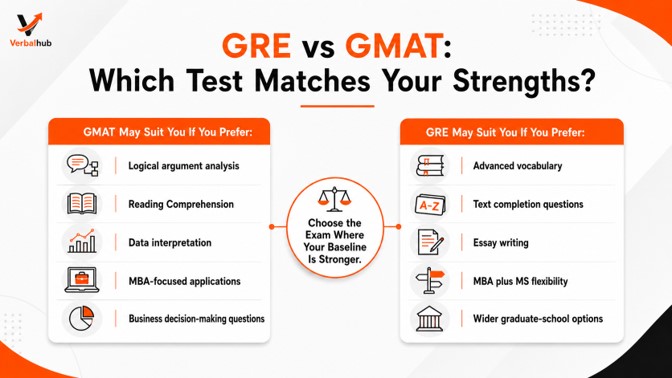
Verbal style is the biggest differentiator. GRE Verbal is vocabulary-heavy — Text Completion and Sentence Equivalence questions require knowing advanced English words. GMAT Verbal focuses entirely on Reading Comprehension and Critical Reasoning (Sentence Correction was removed from the current format). If you are stronger in logical analysis than in vocabulary memorisation, GMAT Verbal may suit you more.
Quant style also differs. GRE Quant includes Geometry, while the current GMAT Quant does not. GMAT's Data Insights section — interpreting multi-source data, working with tables and charts, applying both quant and reasoning simultaneously — is uniquely demanding and has no direct GRE equivalent.
Business-school focus. GMAT is purpose-built for business school admissions. Its question design, Data Insights section, and focus on reasoning under ambiguity are all calibrated to predict MBA performance. GRE is a broader academic aptitude test. This does not mean GRE applicants are disadvantaged, but GMAT scores come with built-in context that admissions committees have been interpreting for decades.
Do Business Schools Prefer GMAT or GRE?
Many top MBA programmes — including Harvard Business School, Wharton, INSEAD, and ISB Hyderabad — officially accept both GMAT and GRE and state they evaluate them equally. GMAC's surveys show a growing percentage of MBA applicants submitting GRE scores.
That said, individual schools may have internal data norms or median score reporting that still skews toward GMAT. Always review each target school's current admissions page — the most accurate information will come from the official admissions office, not from general guides.
- Quick Take For pure MBA applications, GMAT is more purpose-aligned. For multi-programme flexibility, GRE wins. Neither disadvantages you at schools that officially accept both — choose the exam you can score higher on.
GMAT vs GRE: Which Is Harder?
Honestly, this question does not have a single answer. Difficulty is personal.
| You May Find GMAT More Challenging If... | You May Find GRE More Challenging If... |
|---|---|
|
|
The smarter approach: take a free diagnostic test for both, compare your baseline scores, and choose the exam where the gap to your target score is smaller.
CAT vs GMAT Preparation: Can You Prepare for Both Exams?
Yes — but the answer comes with serious caveats.
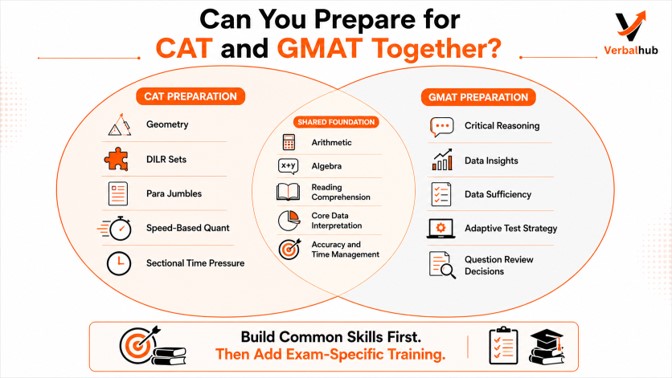
Where preparation overlaps: Quantitative aptitude (Arithmetic, Algebra), Reading Comprehension, and conceptual data interpretation all transfer between CAT and GMAT.
Where preparation diverges significantly: GMAT Critical Reasoning requires dedicated, separate training. CAT's puzzle-based DILR sets rarely appear on GMAT. GMAT Data Sufficiency is a completely different skill from CAT DI. CAT QA includes Geometry; GMAT does not.
For a working professional, dual preparation simultaneously often leads to mediocre scores on both exams. The smarter approach: sequential — use CAT prep to build a strong quant and RC foundation, then spend 8-12 focused weeks adapting for GMAT.
| Student Profile | Recommended Strategy | Why |
|---|---|---|
| Final-year B.Com/BBA targeting IIM | Focus on CAT first; consider GMAT later if targeting ISB post-experience | IIM two-year MBA requires CAT; GMAT is only relevant with work experience |
| Engineering grad, 0 experience, IIM dream | CAT only for now | No GMAT-accepting top programme admits a fresher without work experience |
| Working professional, 3+ years, targeting ISB | GMAT is the primary focus | ISB requires GMAT/GRE; CAT score is irrelevant for ISB admission |
| Targeting both IIM PGP and ISB | Sequential: CAT in Year 1, GMAT after 2-3 years of work | Logical life-stage approach; avoid splitting prep resources simultaneously |
| Undecided between MBA and MS abroad | GRE gives maximum flexibility | Applies to MBA and MS with one score — no need to retake |
| CAT repeater with 90-94 percentile | Consider GMAT as an alternative route | Strong GMAT may open ISB, SPJIMR PGPM, or one-year MBAs unavailable via CAT |
CAT or GMAT: Which Is Better for You in 2026?
No more hedging. Here is a clear framework.
| Your Goal | What to Do |
|---|---|
| Choose CAT First |
|
| Choose GMAT First |
|
| Choose GRE First |
|
| Sequential (CAT then GMAT) |
|
Realistic Student Scenarios
Scenario 1: Aryan — Final-Year B.Com Student Targeting IIM ABC
Aryan has no work experience, a strong quant foundation, and has been preparing for CAT for eight months. His mocks show 94-96 percentile. He asks whether he should also prepare for GMAT.
- Recommendation Focus entirely on CAT. No GMAT-accepting top programme — ISB, IIM PGPX, or any global MBA — will admit him without work experience. Splitting prep attention right now will hurt his CAT percentile. After two to three years in a good job, GMAT becomes the next conversation.
Scenario 2: Priya — Software Engineer, 3 Years, Targeting ISB and INSEAD
Priya has a strong academic record and good work experience but was never in the CAT pipeline. She wants an MBA within the next 18 months.
- Recommendation GMAT is the clear choice. ISB evaluates GMAT scores heavily. INSEAD requires GMAT or GRE. CAT is not accepted by either. Priya should target a GMAT score of 680+ (current scale), which positions her competitively. She can take the exam 2-3 times over 6 months and submit her best score using the Select Score feature.
Scenario 3: Rohan — Humanities Graduate Considering MBA and Public Policy
Rohan studied political science and is genuinely uncertain whether he wants an MBA or an MPP/MPA at a school like Harvard Kennedy or Lee Kuan Yew. He has one year before he wants to apply.
- Recommendation GRE is the only logical choice. MBA programmes and public policy programmes both accept GRE. GMAT would only work for MBA. One GRE score gives Rohan maximum flexibility to apply across programme types and make a final decision after seeing admission results.
Scenario 4: Sneha — CAT Repeater, Strong Quant but Inconsistent VARC
Sneha has appeared for CAT twice. Her quant is consistently 95+, but her VARC keeps pulling her composite percentile down. She is frustrated and considering alternatives.
- Recommendation Sneha should seriously evaluate GMAT. The current GMAT has no Para Jumbles or TITA questions — it tests Reading Comprehension and Critical Reasoning, not verbal speed. If Sneha's comprehension is good but her CAT VARC suffers from specific question type weaknesses, she may find GMAT Verbal more manageable. With her quant base, a focused 10-12 week GMAT prep could yield a competitive score for ISB or one-year MBA programmes.
Scenario 5: Vikram — Finance Professional, 5 Years, Targeting One-Year MBA
Vikram works at a private equity firm and wants an accelerated MBA. He is looking at IIM Ahmedabad PGPX, INSEAD Singapore, and NUS Business School.
- Recommendation GMAT is his test. All three programmes accept GMAT, and GMAT scores carry the right signalling for finance-to-MBA profiles. Vikram's finance background means Data Insights preparation will feel relatively natural. Target score: 680-720 (current scale), depending on programme-specific averages.
Common GMAT vs CAT vs GRE Myths That Confuse MBA Aspirants
| The Myth | The Reality |
|---|---|
| MYTH: GMAT is only for MBA abroad | False. Over 200 MBA programmes in India accept GMAT scores, including ISB, IIM PGPX, IIM PGPEX, SPJIMR PGPM, and Great Lakes. GMAT is not an exclusively international exam. |
| MYTH: GRE is just a backup test | Outdated. Harvard Business School, Wharton, INSEAD, and many other top programmes have explicitly stated they evaluate GMAT and GRE scores equally. A 328/340 GRE is not disadvantaged at schools that accept both. |
| MYTH: CAT and GMAT have the same syllabus | They share some quant topics, but the resemblance ends quickly. GMAT does not test Geometry. GMAT explicitly tests Critical Reasoning. CAT tests puzzle-based Logical Reasoning sets and Para Jumbles — none of which appear on GMAT. |
| MYTH: CAT is always harder than GMAT | Neither is objectively harder. CAT demands speed-based performance with 200,000+ peers. GMAT demands reasoning depth and data literacy. Difficulty depends entirely on the individual's strengths. |
| MYTH: GRE is always easier than GMAT | Not for everyone. GRE's advanced vocabulary questions are genuinely difficult for candidates who have not been active English readers. The analytical essay is an extra task that GMAT no longer requires. |
| MYTH: GMAT is only for people with work experience | GMAT has no work experience eligibility requirement. You can take GMAT as a college student. That said, most GMAT-accepting top MBA programmes require 2-5 years of experience. |
| MYTH: CAT prep automatically prepares you for GMAT | Partially true, dangerously incomplete. CAT prep builds solid quant and reading foundations — useful for GMAT. But Critical Reasoning, Data Insights, and the adaptive exam strategy require specific GMAT preparation. |
| MYTH: A high score alone guarantees MBA admission | Absolutely not. At ISB, IIM, or any top global school, the exam score is one filter. Essays, recommendations, work experience quality, leadership, and interview performance all matter. A 750 GMAT with a weak application loses to a 680 GMAT with a compelling story. |
Frequently Asked Questions
The GMAT (Graduate Management Admission Test) is a standardised exam designed for business school admissions, administered by GMAC. It tests quantitative reasoning, verbal reasoning, and data insights in 2 hours 15 minutes, with a score scale of 205-805. The GRE (Graduate Record Examination), administered by ETS, is a broader graduate admissions exam accepted by MBA, master's, law, and PhD programmes. It tests verbal reasoning, quantitative reasoning, and analytical writing, with a combined score range of 260-340, and takes under 2 hours.
It depends on your target programmes and strengths. GMAT is purpose-built for business school admissions and is the standard at most MBA programmes globally. GRE is widely accepted at top MBA programmes and gives you the added flexibility of applying to non-MBA graduate programmes with the same score. If you are exclusively targeting MBA programmes, GMAT has a slight strategic advantage. If you want flexibility across programme types, GRE is more practical.
No. Both test quantitative skills and reading comprehension, but the differences are significant. CAT tests Geometry, Para Jumbles, and puzzle-based Logical Reasoning — none of which appear on the current GMAT. GMAT explicitly tests Critical Reasoning and Data Insights (including Data Sufficiency), which CAT does not. Solid CAT preparation gives you a useful foundation for GMAT Quant and Reading Comprehension, but you cannot skip GMAT-specific preparation.
Neither is definitively easier — it depends on your strengths. Candidates with strong vocabulary and comfort with essay writing may find GRE easier. Candidates who are stronger at logical reasoning and data analysis often find GMAT more manageable. GRE Quant is generally considered slightly more straightforward, while GMAT's Data Insights section is uniquely demanding. Take a free diagnostic test for both and see where your baseline is closer to your target.
Most top business schools officially state they have no preference between GMAT and GRE, including Harvard Business School, Wharton, INSEAD, and ISB Hyderabad. Both are accepted equally. Always verify on the official admissions page of each programme you are targeting, as policies can change.
Yes — but not for the flagship two-year MBA (PGP). IIM two-year MBA programmes require CAT. However, several IIMs offer one-year executive MBA programmes that require GMAT, such as IIM Ahmedabad PGPX, IIM Calcutta PGPEX, IIM Bangalore EPGP, and IIM Lucknow IPMX. These are for working professionals with typically 5+ years of experience.
They are difficult in different ways. CAT demands high speed, accuracy under time pressure, and consistent performance across all three sections simultaneously — in a single annual attempt. GMAT demands reasoning depth, data literacy, and comfort with an adaptive format. Which feels harder depends entirely on the test-taker's strengths.
Yes, but sequentially is wiser than simultaneously for most students. Quant and RC preparation overlaps. But CAT-specific topics (Geometry, puzzle sets, Para Jumbles) and GMAT-specific topics (Critical Reasoning, Data Sufficiency, Data Insights) require dedicated time. If you are a working professional, splitting focus simultaneously often leads to mediocre scores on both exams.
In most cases, CAT. The best MBA programmes that accept GMAT — ISB, IIM one-year MBAs, global MBA programmes — require substantial work experience. A fresher taking GMAT has very few top-tier programme options. CAT, by contrast, is the gateway to IIM two-year MBA programmes that actively recruit fresh graduates.
GMAT is typically the stronger choice for working professionals targeting one-year MBA programmes or global MBA schools. CAT is still valid for two-year IIM MBAs (which accept working professionals), but GMAT opens a wider range of appropriate programmes for someone with 2-6 years of experience. The right answer depends on which programmes you are targeting.
Some MBA programmes in India accept GRE, but it is less common than GMAT for Indian MBA admissions. ISB Hyderabad accepts GRE. Most IIM PGP programmes do not. If you plan to apply exclusively to Indian two-year MBA programmes, GRE has limited utility. For international MBA programmes (like INSEAD Singapore), GRE is accepted.
Both GMAT and GRE scores’ validity is for five years. CAT scores are valid for only one year — you must use your CAT score for that year's admissions cycle. This is one of the most important practical differences between the three exams.
GMAT and GRE both give strong international MBA options. GMAT is accepted by virtually all global MBA programmes. GRE is accepted by most top global MBA programmes and additionally opens doors to non-MBA graduate degrees. CAT is recognised internationally only at programmes in India. For international MBA aspirants, GMAT or GRE is the necessary choice.
Final Verdict: GMAT vs CAT vs GRE in 2026
CAT is not better than GMAT or GRE in every situation. It is the right choice for a specific destination: India's two-year MBA programmes, especially the IIMs. Outside that goal, it has limited utility.
GMAT is not automatically the right choice for every working professional. It is the right choice when your target programme requires it or when its flexibility — multiple attempts, year-round availability, global brand recognition — solves a real problem in your application strategy.
GRE is not a consolation exam. It is a strategically powerful choice for anyone whose graduate school journey might branch into non-MBA directions, or who genuinely wants to test across the widest possible range of programmes.
- The Mentor's Closing Thought
The most common mistake MBA aspirants make is choosing an exam based on peer pressure, coaching institute recommendations, or vague assumptions about prestige. Start with your target school list, verify what each school accepts, then choose the exam that gives you the highest probability of crossing their admissions threshold. Your exam choice is not a statement about your ambition. It is a tactical decision about where you want to go. Start with the destination. The exam follows.
Not Sure Whether to Choose CAT, GMAT, or GRE?
Let a VerbalHub Mentor Help You Decide — For Free
If you have read this far and still feel uncertain, that uncertainty is completely understandable — and it tells you something important. The right exam choice is not always obvious without an honest look at your full profile: your target schools, your work experience, your current test-taking strengths, your timeline, and your career goals.
At VerbalHub, we offer a free MBA Entrance Exam Strategy Session to help you figure this out clearly and confidently. In this session, our mentors will evaluate:
- Which MBA programmes suit your profile and experience level
- Whether CAT, GMAT, GRE, or a combination is right for you
- Your current preparation gaps and strengths
- A realistic application timeline and prep roadmap
- How to approach schools in India and internationally
No sales pitch. No generic advice. Just an honest, mentor-style conversation about what makes sense for your specific situation.
- Book Your Free MBA Exam Strategy Session



Our Teachers

Dr. G Ravindra Babu
Quant Faculty
Ph. D in Mathematics Asian International University|| Mathematics Professor at Gitam University || Ex-Mathematics Professor SRM University Amaravathi || MBA in finance Acharya Bangalore B School || GMAT Quant 51, CAT Quant 99.58 %tile, GRE Quant 170 || 21 Different Teaching Certification || Believe in “Education is the mother of leadership”
view details

Dr. Rengarajan Parthasarathy
CAT Faculty
Ph. D in Mathematics from YCM University|| Mathematics Professor at Symbiosis International|| Author of Business Ethics || Ex-CAT Exam Syllabus Advisor in IIM || MBA & MPM from Symbiosis International (Deemed University) || College Topper in Mathematics in Ferguson College || Six Scholarships in Mathematics || 15 Years CAT Coaching, GMAT Coaching and GRE Coaching Experience|| UGC NET Qualified || GMAT Q51, V38 & CAT Q 99.31 & DILR 99.38 %tile, GRE Quant 170 || Believe in “Higher Education Shapes The World.”
view details

Dr. Nisha Tejpal
Verbal & AWA Faculty
Ph. D in English || Published a paper in English in ‘Research Journal of Philosophy and Social Sciences’ || MCA and B.Ed CCS University || A subject expert in Verbal Teaching || 10,000 Plus Essays Analysis || CTET and NET Qualified || More than 15 years of Experience || A writer, Author and Poet || Believe in “Think Beyond the Universe”
view details

Dhrithi Khattar
Verbal Faculty
A subject expert in Verbal Aptitude || More than 15 years of Experience || MBA in HR& Marketing & MA in Economics || Active Member of Hindu Alumni Association || Functional Member of Delhi ||Management Association (DMA) || Operational Member of All India Management Association (AIMA) ||The President of Key Club ||An active member of the French Club ||Gold Seal from California Scholarship Federation.
view details
M. U. Mir
DILR & Quant Faculty
A subject expert in Quantitative Aptitude Training || GMAT Q 51 & CAT DILR 99.75 %tile || GATE 2020 Qualified || M. Tech & B. Tech University Toper (1st Rank) || Awarded by Gov of Odisha, Bihar and J& K for the project Magnetic Floating Model || Ex-Quant Subject Expert in Arihant Publication || An Educationist and Social Worker || Believe in “Education is power”
view details

C. S. Rajawat
CAT Faculty
M. A in Mathematics CCS University|| M. Tech from SRM University || Visiting Mathematics Faculty CCS University ||Experience of 11 Years of CAT Coaching || District Topper in 10th & 12th || Best Teacher Awardee in 2021 & 2022 || CAT Quant 99.43 %tile || Discovered a new Theorem based on HCF in Math || Founder of C. S. Classes ||Believe in “Teaching and Training is an Art.”
view details

Dr. S.K. Singh
PTE/IELTS/CELPIP Expert
Ph. D. English Dr. B. R. Ambedkar University || Delhi & Center Government School Mentor || Founder of Entrepreneur & Learning Startup || IELTS & CELTA Certified from British Council || PTE Certified from Pearson...
view detailsRishabh Arora
PTE/IELTS/CELPIP Expert
MBA in HR International Institute of Management Sciences || PTE Certified from Pearson Test of English|| IELTS & CELTA Certified from British Council || BCA from Integral University || PTE 87 in 2017, IELTS 8.5 in 2018
view details
Jyoti Joshi
IELTS Trainer
Master in English (MA) and Bachelor in Education (B.Ed) || Certified Trainer || IELTS Speaking 9.0 Band holder || Believe in “Great teacher can inspire hope, ignite the imagination, and instill a love of learning”
view details
Surbhi Arora
IELTS / PTE Expert
English Language Expert || More than 3 years of Experience || M.A plus B. Ed Delhi University ||Author, Writer & Classical Singer|| Believe in “Language Language Learning & Teaching is Fun”
view details

Dilip Kumar Rathore
Quant Trainer
A business developer and genius in mathematics || Highly experienced || Master in Maths || well-verse in IT || Believe in “The art of teaching is the art of assisting discover”
view details

Imaam Hasan
Communication Expert
Master in English || Journalist and writer || Certified IELTS & PTE Trainer || A social educater and influencer || Believe in “Education is the movement from darkness to light”
view details