
“I finished Module 1 feeling confident, but Module 2 was still easy. What went wrong?”
This is a question I hear almost every week from students who have taken 3-4 Bluebook practice tests. They solved Module 1 carefully, felt good about their performance, yet Module 2 did not get harder. Their score stayed stuck between 1250 and 1350.
The truth is simple: the Digital SAT uses adaptive testing, and your Module 1 accuracy decides whether you reach the hard Module 2. If you do not cross a certain accuracy threshold in Module 1, the test routes you to an easier Module 2, which caps your maximum possible score.
This article explains exactly how the adaptive system works, what accuracy you need in Module 1, and how to build a clear plan to reach hard Module 2 consistently. The advice here follows the structure currently published by the College Board for 2027. Always check the official SAT website for the latest updates before your test date.
What Does “Hard Module 2” Actually Mean?
Many students think “hard Module 2” means every question will be extremely difficult. That is not correct.
A hard Module 2 is a mixed-difficulty set with a higher average difficulty than an easy Module 2. It still contains some straightforward questions, some medium ones, and some genuinely challenging ones. The difference is that the challenging questions appear more often, and the answer choices are tighter.
Why does this matter? Because the hard Module 2 opens a higher scoring ceiling. If you are routed to an easy Module 2, your section score may cap around 590-620, even if you answer every question correctly in Module 2. To score 700+ in a section, you almost always need the hard Module 2.
How Does SAT Adaptive Testing Work in 2027?
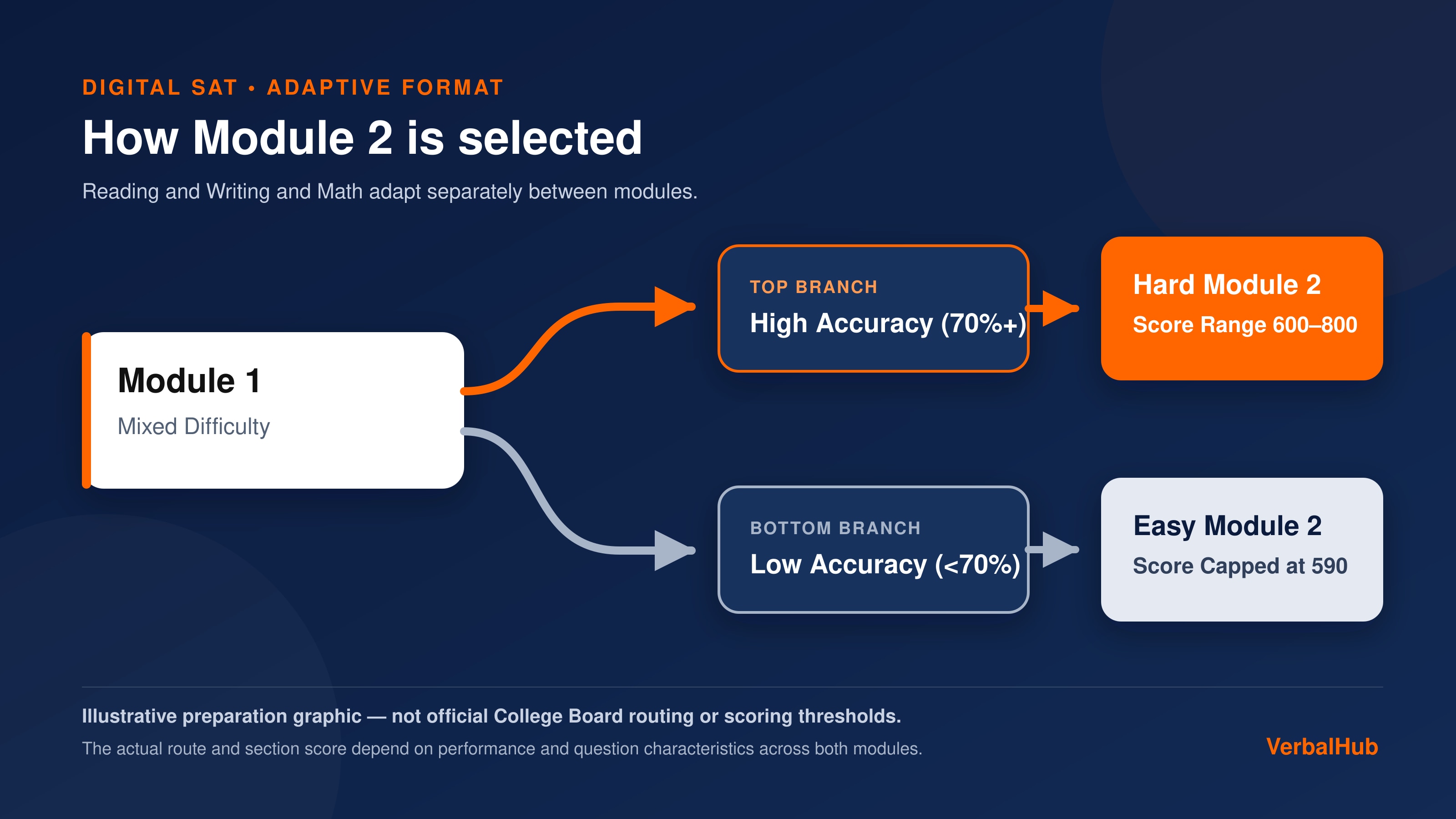
The Digital SAT has two sections: Reading and Writing, and Math. Each section has two separately timed modules.
Here is the flow:
1. You take Module 1 of a section. It is a mix of all levels of questions: easy, medium and hard.
2. Your performance in Module 1 determines which mix of questions you receive in Module 2.
3. If your Module 1 accuracy is strong, you get a harder Module 2. If it is weak, you get an easier Module 2.
4. Your final section score depends on performance across both modules and on the characteristics of the questions.
Important: the test does not change after every single question. It adapts once, between Module 1 and Module 2. This is called multistage adaptive testing.
The 70% Rule: What Accuracy Do You Need in Module 1?
Based on analysis of multiple Bluebook tests and student data, here is a practical guideline:
| Module 1 Accuracy | Likely Module 2 Route | Estimated Section Score Range |
|---|---|---|
| Below 60% | Easy Module 2 | 400-550 |
| 60-69% | Mixed/Easy Module 2 | 550-620 |
| 70-79% | Hard Module 2 | 620-720 |
| 80%+ | Hard Module 2 | 700-800 |
The 70% threshold is the key. In a 27-question Module 1 (Reading and Writing) or 22-question Module 1 (Math), you generally need to answer at least 19-20 questions correctly in Reading/Writing and 16-17 in Math to reach the hard Module 2 consistently.
This is not an official College Board number, but it matches what we see in practice. Students who score below 70% in Module 1 rarely get the hard Module 2. Students who cross 75% almost always do.
Why Some Students Stay Stuck Below 70% Accuracy
If you understand the 70% rule, why is it still hard to cross it? Here are the most common reasons:
1. Careless Errors on Easy Questions
Students rush through grammar, sentence boundaries or direct algebra questions because they “know” the concept. Then they lose points on questions that should have been free.
2. Spending Too Much Time on One Hard Question
A student spends 4 minutes on one inference question, gets it wrong anyway, and then rushes through the next five questions. That one decision can drop Module 1 accuracy from 75% to 65%.
3. Weak Question Selection
Students try to solve questions in the order given, even when one question is clearly time-consuming. Strong test-takers scan the module, answer the quicker questions first, and return to hard ones later.
4. Not Reviewing Marked Questions
Many students mark 6-7 questions in Module 1 but run out of time to return. Those marked questions often include medium-difficulty items that could have been solved with 30 extra seconds.
5. Concept Gaps in High-Frequency Topics
Transitions, command of evidence, linear equations, functions and percentages appear repeatedly in Module 1. If these areas are weak, accuracy drops fast.
Section-Wise Breakdown: Math vs Reading and Writing
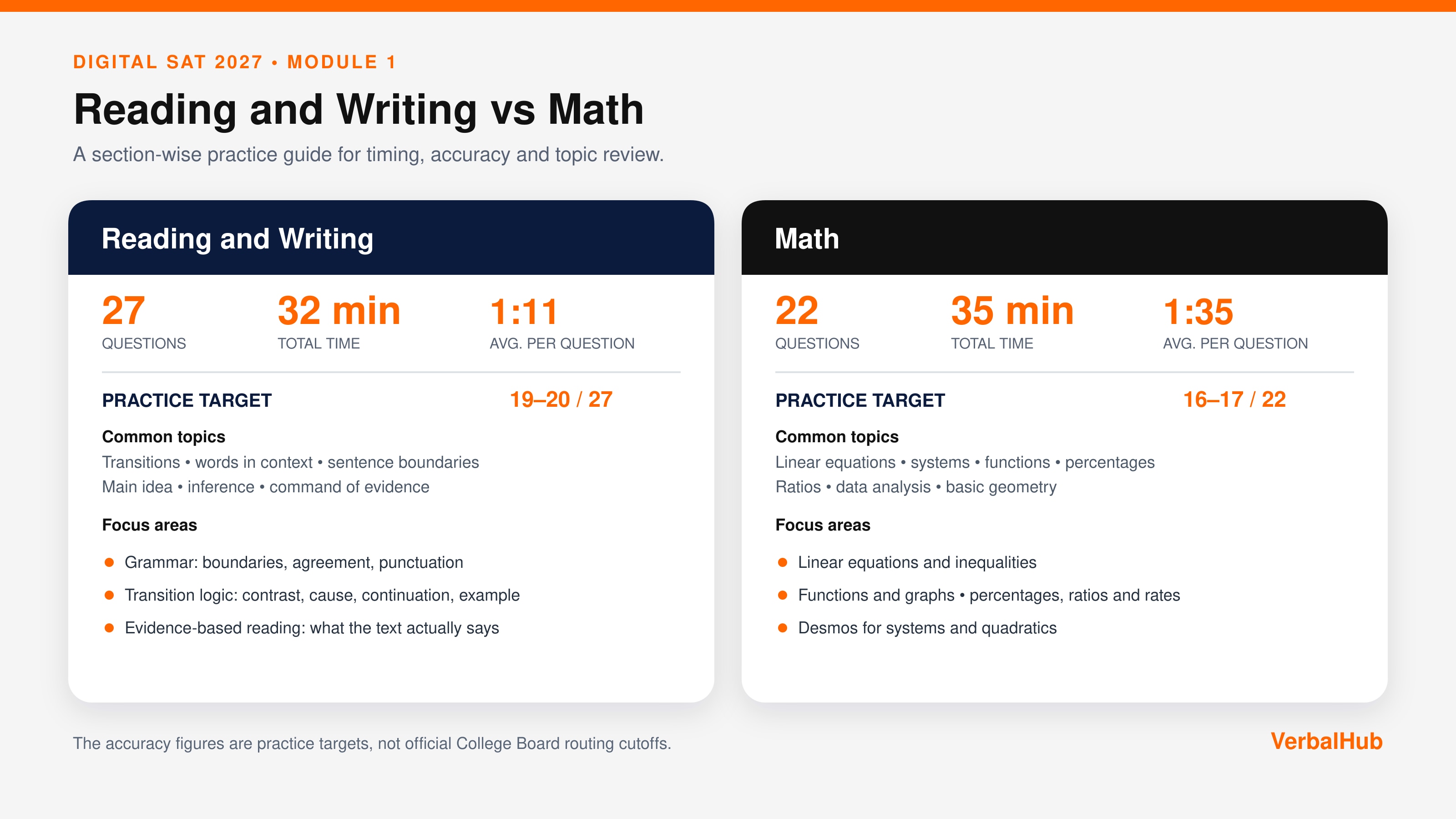
The 70% rule applies to both sections, but the path to 70% looks different.
Reading and Writing Module 1
- 27 questions in 32 minutes
- Average time per question: about 1 minute 11 seconds
- High-frequency topics: transitions, words in context, sentence boundaries, main idea, inference, command of evidence
Target: 19-20 correct out of 27
Focus areas:
- Grammar rules (sentence boundaries, agreement, punctuation)
- Transition logic (contrast, cause, continuation, example)
- Evidence-based reading (what the text actually says, not what sounds reasonable)
Math Module 1
- 22 questions in 35 minutes
- Average time per question: about 1 minute 35 seconds
- High-frequency topics: linear equations, systems, functions, percentages, ratios, data analysis, basic geometry
Target: 16-17 correct out of 22
Focus areas:
- Linear equations and inequalities
- Functions and their graphs
- Percentages, ratios and rates
- Desmos calculator use for systems and quadratics
4-Week Plan to Improve Module 1 Accuracy
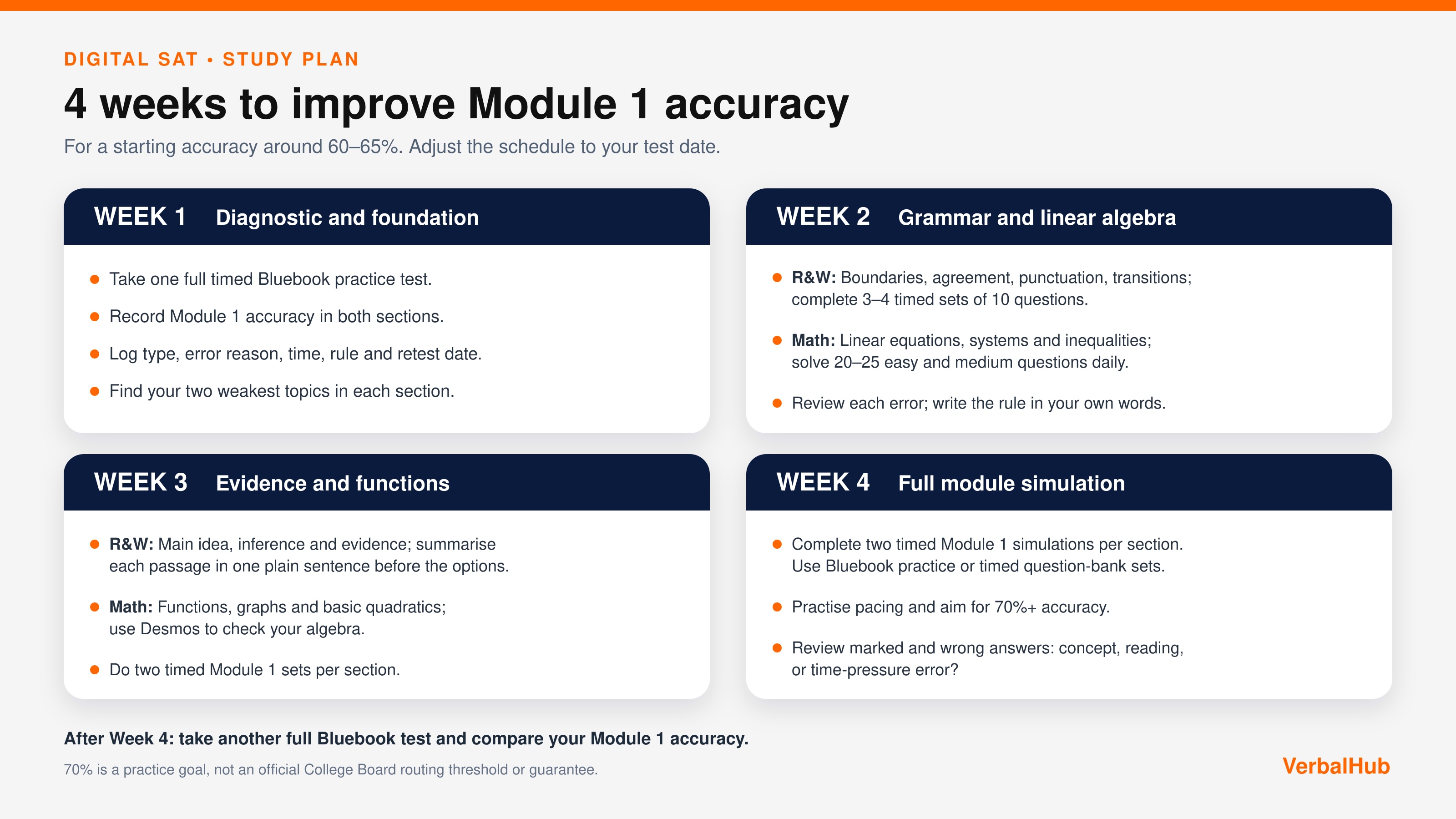
If your current Module 1 accuracy is around 60-65%, follow this plan for 4 weeks. Adjust the timeline if you have more or less time before your test date.
Week 1: Diagnostic and Foundation
- Take one full Bluebook practice test under timed conditions.
- Record Module 1 accuracy for both sections.
- Build an error log with these columns: question type, error reason, time spent, correct rule, retest date.
- Identify your two weakest topic areas in each section.
Week 2: Grammar and Linear Algebra Focus
- Reading/Writing: Practise sentence boundaries, subject-verb agreement, punctuation and transitions. Do 3-4 timed sets of 10 questions each.
- Math: Focus on linear equations, systems and inequalities. Solve 20-25 questions daily, mixing easy and medium difficulty.
- Review every error in your log. Write the rule in your own words.
Week 3: Evidence and Functions Focus
- Reading/Writing: Practise main idea, inference and command-of-evidence questions. Learn to summarise each passage in one plain sentence before looking at options.
- Math: Focus on functions, their graphs and basic quadratics. Use Desmos to check your algebraic work.
- Take two timed Module 1 practice sets per section.
Week 4: Full Module Simulation
- Take two full Module 1 simulations per section (you can use half-tests from Bluebook or timed sets from question banks).
- Focus on pacing: aim for 70% accuracy while staying within the time limit.
- Review all marked and incorrect questions. Ask: was this a concept gap, a reading error or a time-pressure mistake?
After 4 weeks, take another full Bluebook test. If your Module 1 accuracy has moved from 60% to 70%+, you are on track to reach hard Module 2 consistently.
Common Mistakes That Block Hard Module 2
Avoid these five traps if you want to cross the 70% threshold:
Mistake 1: Trying to “Game” the System
Some students think they can deliberately miss questions in Module 1 to get an easier Module 2. This is a bad idea. It lowers your demonstrated performance and restricts your scoring opportunity. Always try your best on every question.
Mistake 2: Overusing the Calculator
In Math Module 1, students sometimes turn simple arithmetic into a calculator step. This wastes time and increases the chance of input errors. Use Desmos when it shortens the work, not for every calculation.
Mistake 3: Reading Without a Clear Purpose
In Reading and Writing, students reread passages 3-4 times without identifying the claim, evidence and question. This burns time and creates confusion. Read once with a clear goal: what is the author trying to prove?
Mistake 4: Ignoring Easy Questions at the Start
The first 5-7 questions in Module 1 are often straightforward. Students rush through them to “save time” for harder ones, then make careless errors. Treat early questions as free points. Solve them carefully.
Mistake 5: No Review Time
Students use all 32 or 35 minutes solving new questions and leave zero time to review marked items. A better approach: finish 80-85% of the module with 4-5 minutes left, then return to marked questions.
How to Know If You Are on Track
You do not need to wait for your official score report to check your progress. After each Bluebook practice test, review your Module 1 performance:
- Reading and Writing Module 1: Did you get 19+ questions correct?
- Math Module 1: Did you get 16+ questions correct?
- Time management: Did you have 3-5 minutes to review marked questions?
- Error pattern: Are most mistakes concept-based or time-pressure-based?
If you answer “yes” to the first two and “no” to the last one, you are likely unlocking hard Module 2. If not, adjust your preparation plan.
How VerbalHub Can Help You Unlock Hard Module 2
If your Module 1 accuracy keeps staying below 70% even after 3-4 practice tests, you may need a clearer strategy. This is where VerbalHub's SAT coaching can help.
VerbalHub offers structured SAT preparation with timed modules, detailed error analysis and targeted practice. Instead of treating every wrong answer the same way, students learn to separate concept gaps from pacing errors, reading mistakes and calculator overuse.
Hasan Sir's 1-on-1 strategy sessions are designed for students who remain stuck in a particular score band and need a personalised study plan. The discussion focuses on your recent Bluebook results, recurring mistakes and the next set of priorities rather than simply assigning more questions.
Hasan Sir, founder of VerbalHub, is widely regarded as one of the best SAT English teachers for Indian students. With 20 years of teaching experience, CAT VARC 99th percentile scores three times and GMAT Verbal V50, he specialises in helping students move past a score plateau in Reading and Writing. His approach combines grammar fundamentals, evidence-based reading strategies and timing discipline.
VerbalHub also runs small batches of 5-7 students, where learners can discuss hard Module 2 questions, compare methods and practise timed decision-making with guidance. If you want a tailored plan to reach hard Module 2, bring your latest Bluebook result and error log to a VerbalHub strategy discussion.
Frequently Asked Questions
No. Hard Module 2 opens a higher scoring ceiling, but your final score still depends on how many questions you answer correctly in both modules. A hard Module 2 with low accuracy can still produce a modest score.
It is very unlikely. An easy Module 2 usually caps your section score around 590-620. To reach 1500+, you almost always need hard Module 2 in both Reading/Writing and Math.
As a guideline, try to miss no more than 7-8 questions in Reading/Writing Module 1 and 5-6 in Math Module 1. This puts you in the 70-75% accuracy range.
No. Module 1 and Module 2 have fixed time limits. Your goal is to maximise accuracy within the given time, not to spend extra time on Module 1. Use smart pacing and question selection.
This usually means your Module 2 accuracy was weak. Review your Module 2 errors separately. Were they concept gaps, reading mistakes or time-pressure errors? Adjust your preparation accordingly.
No. The College Board does not publish exact accuracy thresholds. The 70% guideline is based on analysis of Bluebook tests and student performance patterns. It is a practical target, not an official rule.
The advice here follows the format currently published by the College Board. Future policies or specifications may change, so check the official SAT website before your test date.
Final Takeaway
Unlocking hard Module 2 is not about luck. It is about reaching a clear accuracy threshold in Module 1, managing your time wisely and avoiding common traps. Aim for 70%+ accuracy in Module 1, practise with realistic timing and review every error with purpose.
If you want a personalised plan to break through your current score band, take one full Bluebook test, build your error log and bring both to a VerbalHub strategy session. The goal is simple: stop repeating the same mistakes and start unlocking hard Module 2 consistently.
For more details on the Digital SAT, check out our guides on Module 2 hard questions strategy and the complete SAT 2027 exam guide for Indian students.