For Indian professionals and graduates planning Canadian permanent residence in 2026 and 2027
Introduction
Your English result can do far more than satisfy an application checklist. In Express Entry, it can change your eligibility, your ranking and the value of your education and work experience. That makes the choice of test and target score an early decision, not a final errand before you create a profile.
Canada stopped awarding CRS points for arranged employment on 25 March 2025. A qualifying job offer can still matter for certain program rules, but it no longer brings the old 50 or 200 CRS points. For many applicants, improving English is now the clearest score change they can work on in a matter of weeks rather than years.
This guide explains which CELPIP test to book, how its scores become Canadian Language Benchmark (CLB) levels, what each Express Entry program requires, and why four 9s can be much more valuable than four 7s. It also covers the language rule for post-graduation work permits (PGWPs) and shows how to plan a focused retake when one skill is holding you back.

Key takeaways
- Book CELPIP-General, the four-skill test, for Express Entry.
- CLB 7 is a program minimum for some applicants; CLB 9 in all four skills can raise CRS points substantially.
- A single applicant moving from CLB 7 to CLB 9 in every skill gains 56 core language CRS points, with possible additional transferability points.
- PGWP language minimums depend on the type of program completed; they are separate from your long-term PR target.
What is CELPIP and how does it help with Express Entry
Quick answer: CELPIP is a computer-delivered English test built around familiar communication tasks. IRCC accepts the four-skill CELPIP-General test for Express Entry. Each result from level 4 to 12 has the same-numbered CLB level, making it easy to see which skill meets a minimum and which needs more work.
CELPIP measures Listening, Reading, Writing and Speaking. You complete the test on a computer at a test centre, including the speaking responses, which you record through a microphone. Prompts may ask you to understand a discussion, read information, write an email or explain your view. If you want a fuller look at the format before booking, read VerbalHub's What is CELPIP guide.
Immigration, Refugees and Citizenship Canada (IRCC) uses approved language results to check eligibility and calculate Express Entry scores. CELPIP-General can also serve applicants for a PGWP or a provincial stream when that application accepts it. Canadian citizenship has a different language-testing need, which is why CELPIP offers a shorter version as well.
The simple score scale is helpful when comparing CELPIP vs IELTS for Canada PR. IELTS General Training uses bands that must be converted separately for each skill. CELPIP 9 in Reading is CLB 9 in Reading, and the same applies to the other three CELPIP skills. Choose the test format that suits how you perform under timed conditions; neither test is automatically easier.
CELPIP-General vs CELPIP-LS which test do you need for PR
Quick answer: Choose CELPIP-General if you are using CELPIP for Express Entry. It reports Listening, Reading, Writing and Speaking. CELPIP-General LS reports only Listening and Speaking and is designated for citizenship applications. An LS result cannot supply the four skill scores required for Express Entry.
| Version | Skills assessed | Common purpose | Best choice for |
|---|---|---|---|
| CELPIP-General | Listening, Reading, Writing, Speaking | Express Entry, eligible PR and PGWP applications | A person whose application requires four language results |
| CELPIP-General LS | Listening, Speaking | Citizenship and other uses that explicitly accept LS | A person asked to prove these two skills only |
Before paying, check the exact name in the application instructions. A professional regulator or employer may set its own accepted-test rules. For a Canada PR application through Express Entry, the answer is straightforward: book CELPIP-General.
How do CELPIP scores convert to CLB levels
Quick answer: At CELPIP levels 4 through 12, your number in each skill matches the corresponding CLB number. A 7 in each skill means CLB 7 in each; a 9 in each means CLB 9 in each. IRCC assesses the four results separately, so an average never replaces a required minimum.
| CELPIP score in one skill | CLB level | Why it matters |
|---|---|---|
| 0 or 1 | No CLB level shown on the provider's chart | Insufficient information to assess |
| 2 | CLB 1 or 2 | Below the program minimums described here |
| 3 | CLB 3 | Below the program minimums described here |
| 4 | CLB 4 | FSTP Reading and Writing minimum |
| 5 | CLB 5 | CEC TEER 2 or 3 minimum in each skill |
| 6 | CLB 6 | Above some minimums but below FSWP's minimum |
| 7 | CLB 7 | FSWP minimum in each skill |
| 8 | CLB 8 | More core CRS points than CLB 7 |
| 9 | CLB 9 | Key threshold for higher language-linked transferability points |
| 10 | CLB 10 | Higher core language CRS rate |
| 11 | CLB 11 | Same core first-language CRS rate as CLB 10+ |
| 12 | CLB 12 | Same core first-language CRS rate as CLB 10+ |
Read the result as four numbers, not one headline score. A candidate with Listening 10, Reading 9, Writing 9 and Speaking 7 has met an all-skills CLB 7 threshold, but has not reached CLB 9 across all four. Speaking would be the sensible focus for a score-improvement plan.
Why is the jump from CLB 7 to CLB 9 worth 56 CRS points
Quick answer: For a principal applicant without an accompanying spouse, CLB 7 earns 17 core CRS points per first-language skill and CLB 9 earns 31. Across four skills, that is 68 versus 124 points, a gain of 56. Eligible education and foreign work combinations can increase the gain further.
| Four-skill first-language result | Core CRS points without an accompanying spouse | Change from CLB 7 |
|---|---|---|
| CLB 7 in all four | 68 | Baseline |
| CLB 9 in all four | 124 | +56 |
This is a core language comparison, not a promise that every person's total CRS score rises by exactly 56. With an accompanying spouse, IRCC uses a different core language grid. Some candidates also gain skill-transferability points when strong language results are paired with eligible education or foreign work experience.
For a concrete example, imagine a single 29-year-old whose bachelor's degree is recognised for CRS purposes and who has at least three years of qualifying foreign work experience. If everything else stays the same, moving from four 7s to four 9s could add 56 core language points, 12 education-plus-language points and 25 foreign-work-plus-language points. That is a 93-point increase for this particular set of assumptions. Check your own combination in IRCC's CRS criteria.
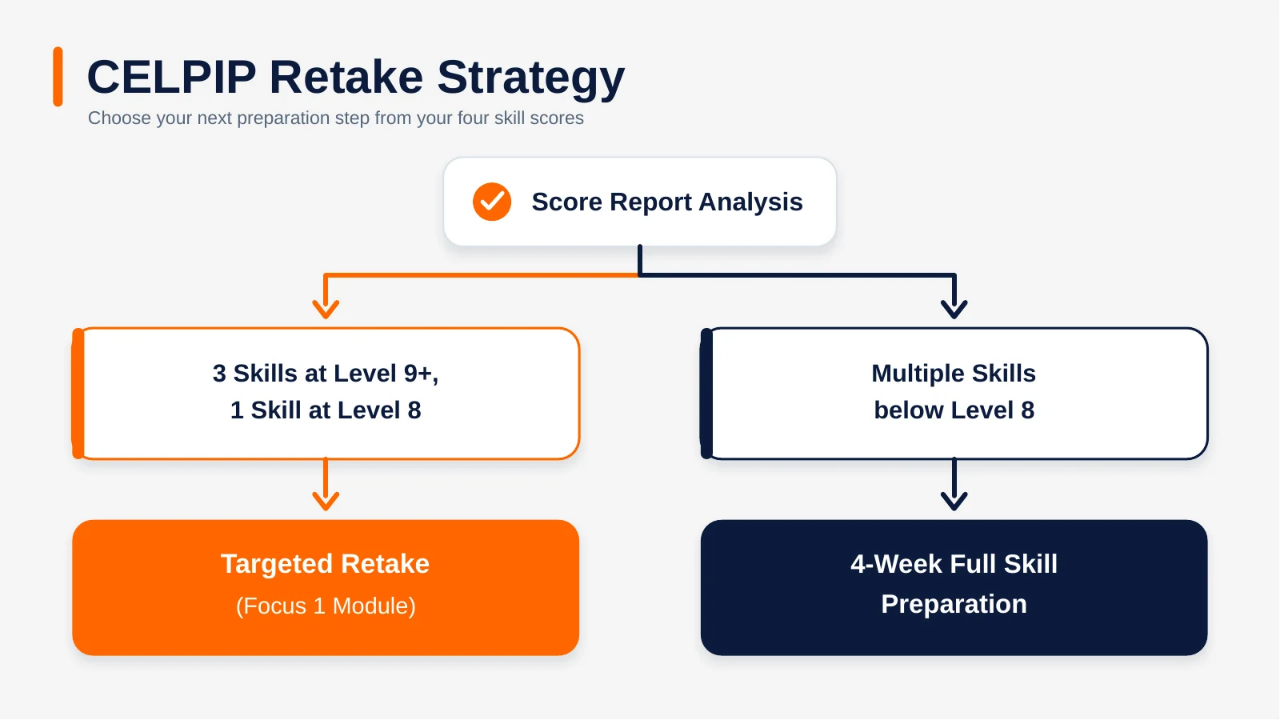
One 8 still earns more core points than a 7. But if the other three skills are 9, that 8 can prevent you from reaching the all-four-skills CLB 9 threshold used in the higher language-linked transferability rows. A targeted retake may therefore have a clear purpose. For section-by-section practice, see How to Pass CELPIP in 2026.
What CELPIP score does each Express Entry program require
Quick answer: The language minimum depends on the federal program and, for Canadian Experience Class, the TEER category of your qualifying job. Meeting a minimum only establishes one part of eligibility. It does not mean your CRS score will be high enough for an invitation.
| Pathway | Minimum CLB in English | Minimum CELPIP-General pattern |
|---|---|---|
| Federal Skilled Worker Program | 7 in Listening, Reading, Writing and Speaking | 7, 7, 7, 7 |
| Canadian Experience Class, TEER 0 or 1 | 7 in all four | 7, 7, 7, 7 |
| Canadian Experience Class, TEER 2 or 3 | 5 in all four | 5, 5, 5, 5 |
| Federal Skilled Trades Program | 5 in Speaking and Listening; 4 in Reading and Writing | S5, L5, R4, W4 |
| Provincial Nominee Program | Depends on the provincial stream and underlying federal program | Check the current stream rules |
Federal Skilled Worker Program
FSWP can suit a professional whose qualifying skilled experience was gained outside Canada. The first-official-language minimum is CLB 7 in each skill. Four CELPIP 7s meet that language condition, though education, work experience, selection factors and other rules must also be satisfied. If your score is already 7 in each skill, decide whether a higher language result would make your CRS profile more competitive.
Canadian Experience Class
CEC serves people with qualifying Canadian work experience. If that work falls in TEER 0 or 1, the English minimum is CLB 7 in every skill. For TEER 2 or 3 work, it is CLB 5 in every skill. A student's intended career title is not enough to establish the requirement; check the classification of the qualifying work being claimed.
Federal Skilled Trades Program
Qualified tradespeople have a different pattern: CLB 5 for Speaking and Listening, and CLB 4 for Reading and Writing. The CELPIP result would therefore need at least S5, L5, R4 and W4. Other trades-program rules still apply. When looking at your report, compare each skill with its own minimum instead of applying one number to all four.
Provincial Nominee Programs
There is no universal PNP language score. Provinces and territories publish requirements for individual streams. An Express Entry-aligned stream also requires you to qualify for a federal Express Entry program, and a province may ask for more than that program's language minimum. If you receive and accept an eligible Express Entry nomination, it adds 600 CRS points, but you must earn the nomination and maintain eligibility first.
If Reading is the section stopping you from meeting a minimum or reaching four 9s, try VerbalHub's CELPIP Reading Practice Test with Answers. Review the reason behind every wrong choice, not just the answer key.
Do Canadian graduates need CELPIP for a PGWP
Quick answer: Most people applying for a post-graduation work permit on or after 1 November 2024 must prove English or French ability with an approved test. The English minimum is CLB 7 for university programs and CLB 5 for college, polytechnic and other non-university programs, with an eligible flight-school exception.
For a bachelor's, master's or doctoral degree, the PGWP English requirement is CLB 7 in all four skills. Other university programs also use CLB 7. For a college, polytechnic or other non-university program, the minimum is CLB 5 in all four. CELPIP-General can show those four results; CELPIP-LS cannot. Check the current PGWP eligibility rules too, since language is only one requirement and some programs face field-of-study conditions.
Plan the test during your final semester if your schedule allows, leaving time to receive the result and fix a weak section. Think ahead to PR as well. A college graduate's four 5s might meet the PGWP language rule but fall short of a future FSWP application or a competitive CRS target. The score needed for a work permit and the score you want for Express Entry are different decisions.
For students who need help turning a minimum into a reliable result, VerbalHub's Best CELPIP Course Online page explains its preparation options.
Is language the most useful CRS factor you can still improve
Quick answer: Language is one of the strongest factors many applicants can improve relatively quickly. Age changes automatically, another credential takes time, and qualifying work experience has to be earned. A better test result can raise core CRS points and, for eligible profiles, skill-transferability points. It does not guarantee an invitation.
The removal of job-offer CRS points in March 2025 makes language preparation particularly worth examining. This does not mean a job offer has become irrelevant: it may still be necessary under particular eligibility rules. Nor is English the only way to improve a score. An eligible provincial nomination is worth 600 points, while qualifying French skills can add points under separate rules. The useful question is: Which change can you realistically make to your own profile now?
CELPIP can be a good fit if you type comfortably, follow spoken English in everyday settings and do not mind speaking to a computer. Its Canadian context and direct CLB mapping are practical advantages for some test takers. They are reasons to try a diagnostic, not grounds to promise that CELPIP is easier than another accepted test.
Speaking and Writing are often the skills for which independent practice gives limited feedback. A recording may sound fluent to you but still leave an idea unfinished; a written answer may be grammatically sound yet miss part of the task. Use VerbalHub's CELPIP Speaking Tips and Tricks 2026 to check your approach to timed responses.
Student result highlight
VerbalHub features Abhishek's CLB 10 CELPIP result in its student success stories. A result from one learner cannot predict another learner's score; it does show why working on the specific skills that need attention is more useful than repeating the same full test without review.
How should you prepare for CELPIP CLB 9
Quick answer: Begin with a timed diagnostic, set a target for each skill and give your weakest section extra attention. A 30 to 45 day plan can suit someone already near the target. Include timed mocks, review your errors, obtain feedback on Speaking and Writing, and book early enough to allow a retake.
Step 1: Measure all four skills. Take an exam-like mock and record Listening, Reading, Writing and Speaking separately. Keep an error log that names the problem: missed detail, slow reading, unclear paragraph, incomplete answer or poor timing.
Step 2: Build a personal score plan. If Speaking is 7 while the other skills are 9, repeating four equal hours of every section is unlikely to be the best use of your week. Work on task completion, answer structure, pacing and clear speech. For Writing, submit complete timed tasks and correct the same recurring issues in the next response.
Step 3: Practise and get live feedback. One-on-one mentoring can make feedback specific. A tutor can diagnose why a speaking response loses clarity, comment on a submitted writing task while the choices are still fresh, and adjust the next week's work to your progress. A flexible schedule helps a student or working professional practise consistently without relying on long weekend cramming sessions.
Step 4: Test with a buffer. Allow for the published result turnaround, a possible delay, and a retake before you need to enter or update your Express Entry profile. If you score 9, 9, 9 and 8, calculate the actual CRS impact of lifting that last skill to 9. Then use targeted tasks rather than another round of random practice. The How to Pass CELPIP in 2026 guide has more section-specific ideas.
What happens after you receive your CELPIP result
Quick answer: CELPIP says online results are normally available within three to four business days. Check the four scores, enter the official result details in your Express Entry profile and verify your CRS score. If invited, you generally have 60 days to submit the PR application. Your results must still be valid at submission.
Create or update your Express Entry profile only after you have the result information needed by IRCC. Entering the pool is not an invitation to apply. IRCC runs general, program-specific and category-based rounds, each with its own conditions. Compare your current score with the relevant rules, not with a single old cutoff you found online.
Prepare the rest of your documents while waiting. An invitation starts a 60-day application period, and language results must be less than two years old both when you complete the Express Entry profile and when you submit the PR application. Check the date on your result and do not let it expire while assembling an application.
If a retake could materially improve your score, a tailored plan can help you use the time well. Explore Best CELPIP Course Online for VerbalHub's coaching approach.

Conclusion
The best CELPIP score for Canada PR is the score that serves your actual route, not a generic number repeated on social media. First, meet the rules of the program you qualify for. Then check whether CLB 9 in all four skills would make your CRS profile stronger. For a single applicant, that move adds 56 core language points; some eligible applicants gain further transferability points.
Start with a diagnostic and make your weakest skill the centre of your plan. A targeted practice routine will give you a clearer reason for every mock test and every possible retake.
Book a free 1-on-1 trial session
Get a plan based on your current level, live feedback on Speaking and Writing, and exam-like practice. Explore VerbalHub's CELPIP courses and take your next step toward CLB 9.