CAT 2026 Mock Analysis - A Practical System for Improving Your Score
A practical score improvement system for CAT 2026 and CAT 2027 aspirants

“I took another CAT mock, but my score has barely changed.”
If this sounds familiar, the next step is probably not another test. Taking mocks gives you data; CAT mock analysis turns that data into useful work. A careful review explains why an answer went wrong, why an easy question was left, why one set consumed too much time, and which mistake has appeared in three tests in a row.
A mock is a diagnostic tool. It shows what you know, what you cannot yet apply under time, and where your decisions reduce your score. Aiming for 99 percentile requires strong concepts, sensible question selection and steady improvement over time. No analysis method can promise that result, but a disciplined process can help you stop repeating preventable errors.
Why CAT Mock Scores Stop Improving
Scores usually stagnate when the student records the result but does not investigate the process behind it. The most common patterns are simple: the mock is not reviewed, only wrong answers are checked, the same selection mistake repeats, or the student changes strategy after every poor test.
Low attempts are also misunderstood. They may indicate slow solving, but they may equally indicate weak scanning, fear of leaving a difficult question, or a section plan that places too much time in the wrong area. Similarly, a wrong answer is not always a knowledge gap. It may come from a calculation slip, a rushed reading, an unsupported assumption or a poor decision to attempt the question at all.
Suppose a student scores 65 in two consecutive mocks. In the first test, the student attempts many questions but loses marks through poor accuracy. In the second, accuracy improves but attempts fall sharply. The final score is unchanged, yet the underlying performance is different. The next plan should therefore study attempts, accuracy, time and question choice together instead of treating 65 as the whole story.
Mock difficulty and test conditions matter too. A lower raw score in a harder paper may still reflect better decisions. Compare trends across several tests and keep your conditions stable before concluding that your CAT mock score is not improving.
What You Should Record After a CAT Mock
Start with a compact scorecard. Record overall and section-wise attempts, correct answers, incorrect answers, unattempted questions, accuracy and time used. Then add the information the score report cannot explain: easy questions missed, low-confidence attempts, questions that took too long, and the reason behind each mistake.
| Metric | What it tells you |
|---|---|
| Attempts | How many questions you tried |
| Accuracy | How reliable your attempts were |
| Time per question | Where time was spent |
| Easy questions missed | Potential marks left on the table |
| Wrong question types | Recurring weaknesses |
| Sectional score | Whether one section is limiting the overall result |
Add a confidence label to every attempted question: confident, doubtful or guess. A correct guess should enter the error log because the reasoning is not yet dependable. For unattempted questions, mark whether leaving the question was a good decision or a missed opportunity.
When You Should Take a CAT Mock
Diagnostic Mock
An early diagnostic mock gives you a baseline before the syllabus is complete. Its purpose is not to predict your final percentile. It identifies present strengths, weak topics, comfort with the interface, section timing and your natural approach to selection. Record the result calmly and use it to decide what to learn first.
A diagnostic is particularly useful for CAT 2027 aspirants. Starting early allows you to build review habits before scores become emotionally loaded. You can also compare later performance with a genuine starting point instead of relying on memory.
Practice Mock and Exam Simulation Mock
A practice mock tests one deliberate change. You may try a new passage-selection method, a revised attempt order or a different time checkpoint. Write down the change before the test so that you can judge it fairly afterwards.
An exam-simulation mock should be taken in one sitting, without pausing, at a fixed time where possible and with full exam discipline. Use simulation mocks to test the complete system, including energy, pressure and recovery after a difficult section. Both types require detailed review, but they answer different questions.
The Four Layer CAT Mock Analysis Framework
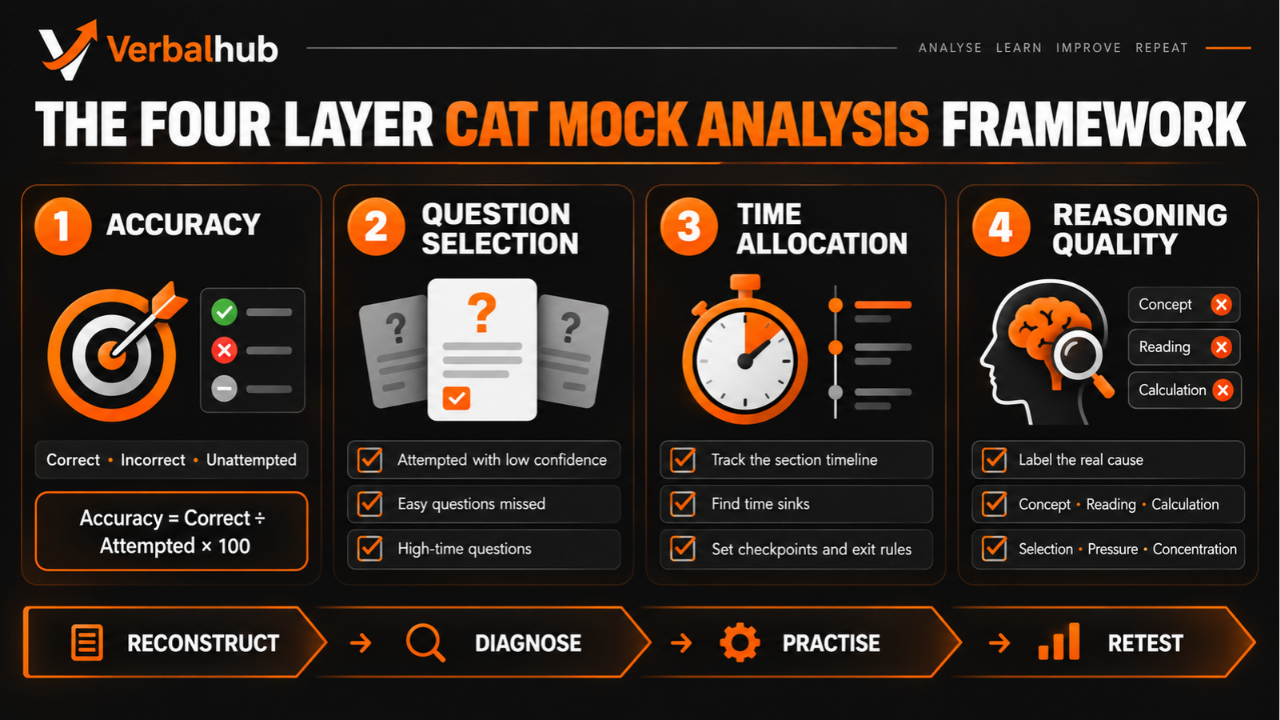
Use the following four layers for every full mock and sectional mock. Do not jump straight to solutions. First reconstruct what you did and why.
Layer 1 Accuracy
Separate correct, incorrect and unattempted questions by section and question type. Calculate accuracy as:
Accuracy = Correct answers ÷ Total attempted questions × 100
If you attempt 20 questions and get 15 correct, your accuracy is 75 per cent. Study this number with attempts. High attempts with weak accuracy may lower the score; fewer attempts with strong accuracy may be a useful intermediate stage. The aim is to increase attempts only when the quality of decisions remains stable.
Break accuracy down further. An overall VARC accuracy figure can hide excellent para-summary work and repeated RC inference errors. A QA total can hide a strong arithmetic base and weak algebra recognition. Diagnosis becomes useful only when the category is specific enough to guide practice.
Layer 2 Question Selection
For every attempted question, ask: “Would I choose this question again if I saw it in the actual CAT?” Mark questions attempted with low confidence, manageable questions skipped, and difficult questions that consumed a large share of the section.
Review selection differently by section. In VARC, check whether you chose passages for readability or simply followed screen order. In DILR, check whether the selected set offered a clear entry point and enough questions. In QA, identify questions that looked familiar but required lengthy work. Also note easy questions missed during the first scan.
Selection quality can improve even before your concepts change. A student who leaves one low-return DILR set earlier may gain enough time to complete a workable set. That is score improvement through a better decision, not faster calculation.
Layer 3 Time Allocation
Reconstruct the section as a timeline. How much time went into the opening questions? Did one RC passage or DILR set absorb the middle of the section? Were the final questions rushed or never viewed? In QA, which long questions prevented a second scan?
Then decide whether the problem was speed or choice. If you spent twelve minutes on an unproductive set, the correction may be an exit rule rather than more speed drills. Time management is often a selection problem. Use rough checkpoints, but do not force identical minutes on questions of very different value.
Layer 4 Reasoning Quality
Give each mistake one primary label. Use concept gap, reading error, misinterpretation, calculation error, careless error, wrong assumption, option-elimination error, question-selection error, time-pressure error or concentration lapse. Avoid the vague label “silly mistake”; it does not tell you what to change.
| Error type | Useful correction |
|---|---|
| Concept gap | Learn the concept, then solve a graded practice set |
| Careless or calculation error | Add a specific checking habit and retest it under time |
| Reading or interpretation error | Slow the relevant step and state the question demand in your own words |
| Selection error | Improve scanning and set an exit rule |
| Option elimination error | Write why each rejected option fails |
| Time pressure or concentration lapse | Use timed sectionals and defined checkpoints |
One question may involve several issues, but choose the main cause. If you classify everything as a concept problem, you will keep studying theory when the real weakness is decision-making.
Use Three Passes During the Review
A three-pass review keeps the process organised. In the first pass, work without the solution. Reattempt incorrect, doubtful and unattempted manageable questions. This tells you whether the problem survives when the timer is removed. If you solve the question comfortably now, the issue was probably selection, pressure or time. If you still cannot solve it, look for a concept or reasoning gap.
In the second pass, study the official or provided solution. Compare its first decisive step with yours. Do not copy the full solution into a notebook. Record the precise point where your approach moved away from the correct one. For an RC question, that may be one unsupported word in an option. For DILR, it may be a condition you failed to combine. For QA, it may be choosing a lengthy algebraic route when a simpler numerical observation was available.
In the third pass, decide what should change. Write one rule, one practice task and one test condition. A useful entry might read: “I stayed with Set 2 after five minutes without a stable table. Practise five set-selection drills and leave when no useful structure appears by the chosen checkpoint.” This is more actionable than “improve DILR.”
How to Create a CAT Error Log
A CAT error log should capture more than wrong answers. Include guessed answers that happened to be correct, easy questions left unattempted, time-heavy questions, answers changed from correct to incorrect, and patterns repeated across mocks. Keep the note short enough to review weekly.
| Question | Section | Error type | Why I chose my answer | Correct approach | Rule for next mock |
|---|---|---|---|---|---|
| RC Question 8 | VARC | Over-inference | The option sounded reasonable but went beyond the passage | Remove options not supported by the text | Do not add outside assumptions |
| DILR Set 3 | DILR | Selection | The topic looked familiar, so I continued without an entry point | Scan all sets and test the first useful deduction | Leave if no progress after the exit checkpoint |
Review the log once a week. Group repeated labels and convert them into tasks. “Three over-inference errors” becomes one focused RC drill with option-by-option elimination. “Two geometry questions left despite being manageable” becomes concept revision followed by a timed mixed set. The log is valuable only when it changes your calendar.
Keep the log selective. You do not need a long essay for every question. Write more only when the same error returns or the decision cost several minutes. At the end of the week, highlight no more than three active patterns. Older entries should remain available for comparison, but they should not crowd the next study plan.
VARC Mock Analysis
Reading Comprehension
Begin with passage selection. Was the chosen passage readable, or did the topic merely look familiar? Compare reading speed with understanding. Fast reading that causes main-idea, tone or inference errors is not efficient. Also check for extreme options, partly true choices, outside knowledge and answers that discuss the passage but do not answer the question.
Use this review sequence for every doubtful RC question:
- Read the passage again without looking at the answer.
- Write the central idea in one sentence.
- Identify the author’s purpose and tone.
- Eliminate each incorrect option with a clear reason.
- Note the exact line or idea supporting the correct answer.
- Record the trap type in the error log.
If one passage consumed too much time, identify the exit point you missed. The correction may be passage selection, not more reading. For a deeper method, use VerbalHub’s CAT VARC preparation guide alongside your post-mock notes.
Verbal Ability
For para summaries, check whether you selected an option because it repeated familiar words instead of covering the main argument. For para jumbles and odd-sentence questions, reconstruct the logical links rather than relying only on grammar or fluent sound. Record whether you missed a pronoun reference, contrast, cause-and-effect link or change of subject.
Keep this section focused on the thought process used in the mock. General practice will help only after you know whether the problem was comprehension, sequencing, option comparison or time.
DILR Mock Analysis
DILR review starts before the first calculation. Check whether you selected the right set, understood all conditions and found a workable entry point. A familiar-looking arrangement can still be a poor choice if its first useful deduction is hard to locate.
When a set fails, mark the moment at which progress stopped. Did you continue because of time already invested? Did you abandon a solvable set too late? Did you overlook that another set could yield several questions with less work? Rebuild the set without time, then solve it again under a realistic limit.
- Did I understand every condition?
- Did I find a useful starting point?
- Did I estimate how many questions the set could yield?
- How much time did I spend before deciding to leave?
- Was another set more suitable?
Students who need section-specific work can compare their patterns with the CAT Quant and DILR coaching page.
QA Mock Analysis
Separate a concept gap from a recognition problem. You may know the formula but fail to see that a question is a simple application. You may recognise the topic yet choose a slow method. Also record arithmetic execution errors, formula-recall problems, calculation slips and easy questions missed during scanning.
Classify each QA question as solved confidently, solved with excessive time, correct guess, incorrect due to concept, incorrect due to execution, left despite being manageable, or not worth attempting under exam conditions. Then group mistakes across arithmetic, algebra, geometry, number systems and modern maths. This shows whether you need topic revision, mixed recognition practice or a better attempt plan.
How to Analyse a CAT Sectional Mock
A sectional review should record attempts, accuracy, time distribution, question selection, difficulty, missed opportunities and whether the strategy can be repeated. Sectionals are the safest place to test one change before using it in a full mock.
For example, a student may have a reasonable VARC score but spend too long on one passage. More reading is not automatically the answer. The student may need a clearer passage-selection process and an exit rule. Test that rule in two or three sectionals and judge it through both accuracy and remaining time.
How Many CAT Mocks You Should Take
There is no useful fixed number for every student. The right frequency depends on time remaining, present preparation level, previous mock experience, sectional weaknesses and your ability to complete follow-up work. One deeply analysed mock can be more useful than several tests taken without review.
As a practical recommendation, do not schedule the next full mock until you have completed the main review and converted important mistakes into practice tasks. This is not an official CAT rule. It is a way to ensure that every test produces a change. If you want another source of exam-style practice, review the current CAT mock test series and choose tests you can analyse properly.
A 48 Hour Post Mock Review Schedule
| Time | What to do |
|---|---|
| Immediately after | Record overall and section-wise scores, attempts, accuracy, immediate feelings, and questions remembered as confusing or time-heavy. Stop if mentally tired. |
| Within 24 hours | Review incorrect answers, guesses, easy questions missed, time-heavy questions and section-wise selection decisions. |
| Within 48 hours | Classify errors, study correct solutions, revise concepts, complete targeted practice, update the error log and set one rule for the next mock. |
| Before the next mock | Revisit repeated patterns, section rules, the time plan and the focused work completed since the previous test. |
How to Turn Analysis into Score Improvement
Use a closed loop: identify a pattern, find the cause, practise the relevant skill, test it in a sectional, apply it in the next mock and check whether the error reduced. Repeat when needed. The practice task must match the cause.
Suppose you repeatedly spend twelve minutes on one DILR set and solve only one question. “Solve more DILR” is too broad. Practise scanning sets, estimate their likely return, and define an exit rule. Then use a sectional to see whether you leave low-return sets earlier without abandoning workable ones.
Similarly, if RC accuracy drops mainly on inference questions, rereading general articles is unlikely to be enough. Analyse how you distinguish a supported inference from an attractive outside assumption, practise that question type, and track whether the same trap appears again.
Common CAT Mock Analysis Mistakes
- Looking only at the percentile or comparing every score with other students.
- Opening the solution before reconstructing your original thought process.
- Treating every wrong answer as a concept gap.
- Ignoring correct answers reached through guesswork.
- Ignoring unattempted easy questions and time spent on abandoned work.
- Taking the next mock before completing the previous review.
- Changing the entire strategy after one poor performance.
- Buying several mock series instead of analysing one properly.
How VerbalHub Can Help
VerbalHub’s five-phase method begins with diagnosis, identifies recurring errors, builds section-specific skills, applies those skills through timed practice, and then reviews and refines the plan. The purpose is to distinguish a knowledge problem from a reading, timing, selection, decision-making or pressure problem.
Hasan Sir’s 1-on-1 strategy sessions can help students examine their mock data, identify the real source of lost marks, and build a preparation plan around their specific weaknesses. A VerbalHub micro-batch of 5–7 students can provide structured mock review, focused discussion, regular accountability and individual feedback without the anonymity of a large batch.
| Generic mock practice | VerbalHub approach |
|---|---|
| Focuses mainly on taking tests | Focuses on analysing performance |
| Reviews only wrong answers | Reviews errors, guesses and missed opportunities |
| Gives broad advice | Builds section-specific action points |
| Uses the same strategy for everyone | Connects strategy to individual data |
| Moves to the next test quickly | Converts analysis into targeted practice |
Book a CAT mock-analysis or strategy session with VerbalHub
The Next Mock Should Test a Change
Good CAT mock analysis ends with a short plan, not a longer list of problems. Choose the one or two patterns costing the most marks, complete the matched practice, and carry one clear rule into the next test. For CAT 2026 or CAT 2027, steady CAT mock score improvement comes from repeating this cycle until fewer marks are lost for the same reason.
Frequently Asked Questions
CAT mock analysis is a structured review of your score, attempts, accuracy, time use, question selection and reasoning. Its purpose is to explain why marks were gained or lost and decide what to practise next.
Record section-wise data, review wrong, guessed and missed questions, classify each error, study time and selection decisions, update your error log and convert the main patterns into specific practice tasks.
Your score may remain flat because of repeated selection errors, weak accuracy, poor time use, incomplete analysis or too many mocks without follow-up practice. Compare several indicators rather than the final score alone.
The right number depends on your level, time remaining and ability to review each test. Do not chase a fixed count. Take the next full mock after completing the main analysis and follow-up work from the previous one.
Yes. Review correct answers reached through guessing, excessive time or weak reasoning. A correct result does not always mean the process is dependable.
A CAT error log records the question, error type, original reasoning, correct approach and a rule for the next test. It should also include lucky answers, missed easy questions and time-heavy attempts.
Study passage choice, central-idea and tone errors, inference traps, option elimination and time spent. Reattempt doubtful questions without time and record the precise reason each wrong option fails.
Review set selection, the first useful deduction, time spent before leaving, calculation or arrangement errors and whether another set offered a better return.
Separate concept gaps from recognition and execution errors. Classify each question by confidence, time, cause of error and whether it was worth attempting under exam conditions.
Both matter, but another mock adds little if the same errors are still untreated. One deeply reviewed test can be more useful than several tests taken without analysis.
Yes. An early diagnostic and occasional sectionals can build strong review habits, reveal weaknesses and provide a reliable baseline before full mock frequency increases.
VerbalHub can review individual mock data, identify recurring error patterns and connect them to section-specific practice through 1-on-1 strategy sessions or focused micro-batches.