
Digital SAT Module 2 Hard Questions: How to Stay Calm, Accurate and On Time in 2027

"I took a Digital SAT practice test, and Module 2 felt much harder than Module 1."
Students say this after their first or second Bluebook test, usually with a mixture of worry and confusion. The passages seem denser, the answer choices look unusually close, or the Math questions suddenly require two or three connected steps. Some students think the test has gone wrong. Others assume they have already ruined their score.
Neither reaction is useful. Digital SAT Module 2 hard questions are part of the exam's adaptive design. A more demanding second module often indicates that your first-module performance routed you towards a higher-difficulty mix. That is not a signal to panic; it is a signal to manage the next 32 or 35 minutes with discipline.
This guide explains what changes, what does not change, and how to protect your accuracy when the test begins to feel uncomfortable. The 2027 references in this article are based on the structure currently published by the College Board. Dates, policies and specifications can change, so check the official notification before registering or finalising your test-day plan.
Why Module 2 can feel harder
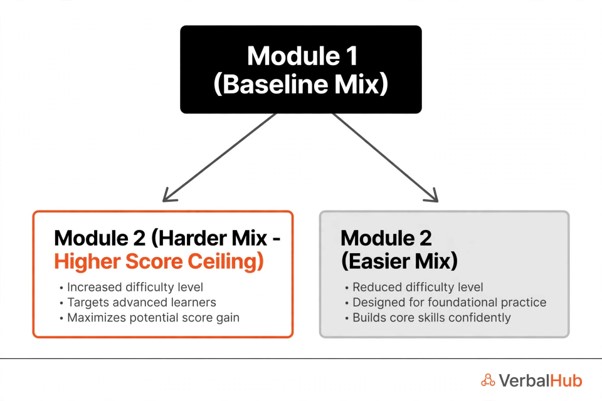
The Digital SAT uses multistage adaptive testing. Reading and Writing has two separately timed modules, and Math has two separately timed modules. Your answers in Module 1 of a section help determine which mix of questions you receive in Module 2. For a complete overview of the exam, see VerbalHub's SAT 2027 exam guide.
The important word is "mix". A higher-difficulty Module 2 is not a sheet containing only the hardest questions. It still contains questions of different difficulty levels, but the average difficulty is higher. That distinction matters because students sometimes see one straightforward question and conclude that they must have been routed to an easier module. You cannot reliably identify your route from one or two questions, and trying to do so wastes attention.
A difficult-feeling Module 2 often means that you handled Module 1 reasonably well, but it is not a score report. Your final section score depends on performance across both modules and on the characteristics of the questions you answered. Treat the route as neutral information: the test has moved to its next stage, and your job is simply to solve the question in front of you.
Do not try to "game" SAT adaptive testing Module 2 by deliberately missing questions. That reduces your Module 1 performance and can restrict your scoring opportunity. College Board also states that there is no penalty for guessing, so every question deserves your best answer even when certainty is not possible.
Two students sitting in the same test centre may not receive identical Module 2 sets. Their earlier performance may differ, and the digital assessment can use different test forms. This is why comparing the apparent difficulty of individual questions after the exam tells you very little. Compare preparation habits and error patterns instead.
What changes in a hard Module 2?
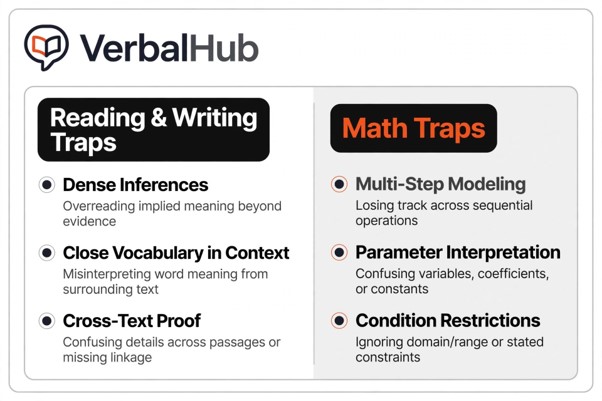
The tested skill categories do not suddenly become new. The pressure comes from how familiar skills are combined, how close the options are, and how much interpretation a question demands. In practice, a higher-difficulty set may feel less forgiving because a quick surface reading is no longer enough.
Reading and Writing
In Reading and Writing, difficult inference and command-of-evidence questions often require you to separate what the passage proves from what merely sounds reasonable. The correct answer may be cautious and precise, while an attractive distractor uses the passage's topic but adds an unsupported claim.
Transitions and words-in-context questions can also have tighter options. Two choices may both sound natural in isolation, but only one expresses the exact relationship between the ideas: contrast, cause, continuation, example or qualification. Read the logic before choosing the linking word.
Academic passages may use unfamiliar scientific, historical or literary language. You do not need expert knowledge of the subject. Your task is to track the author's claim, evidence and direction. Cross-text connection questions add another layer: you must identify each writer's position separately before deciding how the second text would respond to the first.
Math
In Math, a higher-difficulty mix can place greater pressure on advanced algebra and functions. Instead of asking for a direct calculation, a question may require you to rewrite an expression, connect a graph to an equation, interpret a parameter or decide what a solution means in context.
Multi-step problems are difficult not because every calculation is advanced but because you must build the right model. A careless first equation can produce a neat answer that is completely irrelevant. Geometry and trigonometry questions may also be set inside a practical situation, requiring you to identify the diagram, relationship or unit before calculating.
The best SAT Module 2 hard strategy is therefore not "learn more tricks". It is to become reliable at translation: words to relationships, relationships to equations, and results back to the condition asked in the question.
How to approach Module 2 without panicking
Expect some increase in difficulty. If you enter Module 2 hoping that every question will feel comfortable, the first demanding item can create unnecessary alarm. A better expectation is: "Some questions will take longer, and I do not need to solve them in the order presented."
Use the first few questions to settle into a deliberate rhythm. Read the task, locate the evidence or mathematical relationship, eliminate weak options, and commit. Do not use the opening minutes to judge your route or estimate your score.
Accuracy matters more than proving that you attempted every question in sequence. At the same time, because there is no penalty for guessing, do not leave blanks. The practical balance is to answer the questions you can solve efficiently, mark genuinely time-consuming items, and return before the module ends.
A hard-looking question is not an instruction to solve it immediately. If you have read it twice and still cannot state what is being asked, mark it and move. Protecting three later questions is often more valuable than spending four minutes fighting one item.
Pacing strategy for Module 2
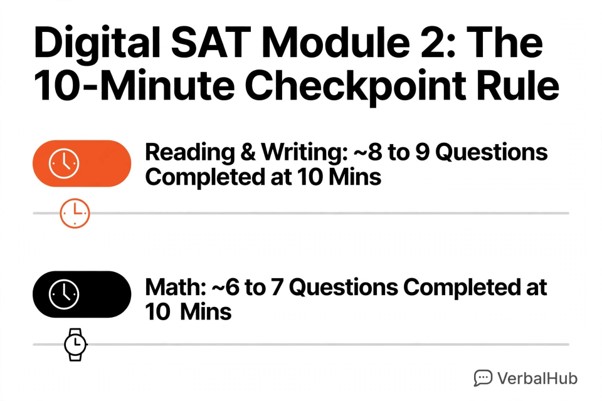
Current official timing gives 32 minutes for each Reading and Writing module and 35 minutes for each Math module. Those averages are useful, but a rigid equal-time rule is not. Some questions should take less than a minute; others deserve more. Use checkpoints to notice drift, not to force identical timing.
Reading and Writing Module 2
Bank time on quicker grammar, sentence-boundary and transition questions, but still read the full sentence logic. "Quick" should mean efficient, not careless.
Allow extra time for inference, command-of-evidence and cross-text questions because the proof may be distributed across several lines or two short passages.
After roughly 10 minutes, aim to have completed about eight or nine questions. This is a guide from College Board, not a compulsory split; use it to detect whether one passage has consumed too much time.
If a passage feels dense, reduce the task. Identify the claim, the evidence and the exact question. Do not try to understand every technical term.
Mark and move when two options remain and further rereading is not producing new evidence. Return with a fresher eye after completing more direct items.
A useful rule for SAT reading Module 2 hard questions is evidence before elegance. The most polished or detailed answer is not automatically correct. Choose the option that the text can actually support.
Math Module 2
Take the quick wins first: direct algebra, percentages, ratios and data analysis can protect both time and confidence.
Use Desmos when it shortens the reasoning. Graph systems to locate intersections, inspect quadratics through zeros or vertices, and compare functions visually. Still understand what the intersection or feature represents.
After roughly 10 minutes, completing about six or seven questions is a useful checkpoint. Adjust for the actual set rather than panicking if you are one question ahead or behind.
Do not spend several minutes on one geometry or advanced-Math question before scanning the remaining items. Mark it, collect available points, then return.
Before submitting a numerical answer, check signs, units, restrictions and what the question asks for. The value of x, the value of an expression involving x, and a contextual quantity are not interchangeable.
Desmos is a tool, not an automatic method. If entering the problem takes longer than solving it algebraically, use algebra. During practice, record which question types became faster with the calculator and which became slower.
Common traps in hard Module 2 questions
Hard questions are often decided by precision rather than rare knowledge. Watch for these four traps:
Partly correct Reading answers. An option may repeat a true detail but fail to answer the main question or overstate the author's position.
Possible but unsupported inferences. Real-world plausibility is not textual proof. If you cannot point to the words that support the inference, reconsider it.
Math answers that ignore a condition. A solution may be algebraically valid but violate a domain restriction, a positive-length requirement or the situation described.
Transitions that match the tone but not the logic. "However" and "therefore" can both sound formal; only the relationship between the ideas decides the answer.
Another trap is emotional: deciding that the module is "going badly" because three questions feel difficult. Difficulty is part of the measurement. Judge your process only after the test, not during it.
What to do if your score drops after a hard Module 2
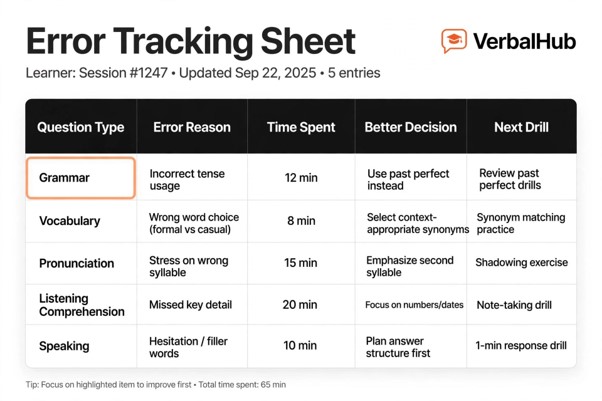
Start with accuracy, not only the total score. Break the result into Module 1 and Module 2, then group mistakes by skill: inference, evidence, grammar, algebra, functions, geometry and so on. A broad score cannot tell you what to practise tomorrow.
For every Module 2 error, ask three questions: Did I know the concept? Did I read or model the question correctly? Did time pressure change my decision? These answers separate concept gaps from process gaps.
If the concept was missing, revise it and solve a short set of focused questions. If you knew the concept but rushed, practise smaller timed modules and use clearer checkpoints. If you misread conditions, add a final ten-second verification habit: question asked, units, restrictions and evidence.
Also review marked and unattempted questions. An unattempted medium question after four minutes on one hard question is a pacing error, not a content error. Your next practice plan should reflect that difference.
Use an error log with five columns: question type, reason for error, time spent, better decision and next drill. After two or three tests, repeated patterns become visible. That is where a plateau usually begins to move.
How VerbalHub can help

VerbalHub's SAT coaching can address Module 2 difficulty through targeted practice, timed modules and detailed review. Instead of treating every wrong answer in the same way, students can identify whether the problem came from concepts, evidence, modelling, question selection or pacing.
Hasan Sir's 1-on-1 strategy sessions are designed for students who remain stuck in a particular score band and need a clearer study plan. The discussion can focus on recent test data, recurring mistakes and the next set of priorities rather than simply assigning more questions.
Micro-batches of five to seven students also create room to discuss hard questions without the pressure of a large class. Students can compare methods, explain why an option fails and practise timed decision-making with guidance.
If your Module 2 accuracy keeps dropping, bring one recent Bluebook result and your error log to a VerbalHub strategy discussion. The aim is to leave with a specific practice plan, not a vague instruction to "work harder". Learn more about SAT coaching and available preparation formats.
Frequently Asked Questions
Often, a higher-difficulty second module indicates stronger Module 1 performance, but you cannot confirm your route or predict your score from how the module feels. Continue solving each question and wait for the official score report.
No. College Board describes Module 2 as a mixed-difficulty set tailored by Module 1 performance. A higher-difficulty route has a harder mix on average, not only hard questions.
Yes, the feeling of difficulty does not determine the score. Your score is based on performance across both modules and the characteristics of the questions. Concentrate on accurate decisions, not on judging the set.
No. Deliberately missing questions damages your demonstrated performance and can limit your scoring opportunity. Try your best on every item and make an educated guess when necessary.
There is no official fixed limit for an individual question. If repeated reading produces no new evidence, mark the item, move on and return later. The section average is about 1 minute 11 seconds per question, but difficult items may need more.
Under the currently published structure, each Math module is 35 minutes. Verify the official College Board guidance before your 2027 test in case the format changes.
No. Use Desmos when it shortens the work or makes a relationship clearer. Algebra or estimation may be faster for some questions. Practise both approaches before test day.
Answer quick, solvable questions first, mark time-consuming items and make an educated guess before the module ends. Do not leave blanks because the SAT has no penalty for guessing.
Common causes include rushing, rereading without a clear purpose, weak question selection, calculator overuse and failure to check conditions. Review time spent and decision-making, not only the final answer.
The advice here follows the format currently published by College Board. Future dates, policies and specifications are not guaranteed. Check the official SAT website and your registration information before the test.
A hard Module 2 should change your pacing, not your confidence. Practise with realistic timing, review the reason behind every error, and learn when to move on. If you want a personalised plan, book a VerbalHub SAT strategy discussion with your latest Bluebook result and error log ready.