
Quick answer: On the GMAT Focus Edition, total scores range from 205 to 805 in 10-point increments, with section scores from 60 to 90 in Quantitative Reasoning, Verbal Reasoning and Data Insights. A "good" GMAT score depends on your target schools and profile, but as a rule of thumb: 705+ is competitive for top global MBA programs, 655-695 is strong for many Tier-1 Indian and international schools, and 605-645 can be sufficient for several good Tier-2 programs when supported by a solid profile.
Use this guide to understand how GMAT scoring works, how to interpret your percentile, what scores are competitive for different MBA tiers, and whether you should retake the exam.
1. GMAT Total Score Range and Section Scores (Focus Edition 2026)
The current GMAT Focus Edition uses a different scoring scale from the classic 200-800 GMAT.
Total score
- Range: 205-805
- Increments: 10 points
- Derived from: The three section scores: Quantitative Reasoning, Verbal Reasoning and Data Insights.
Section scores
| Section | Score range | Increment | Standard measurement error (approx.) |
|---|---|---|---|
| Quantitative Reasoning | 60-90 | 1 | ±3 points |
| Verbal Reasoning | 60-90 | 1 | ±3 points |
| Data Insights | 60-90 | 1 | ±3 points |
| Total (Focus Edition) | 205-805 | 10 | ±30-40 points |
Key points:
- Each section shares equal weight in the total score.
- The total score is not a simple sum; it is calculated using a concordance algorithm based on your performance across all sections.
- Your score report shows both the total score and individual section scores.
2. How GMAT Scoring Works
Adaptive testing and section scoring
The GMAT Focus Edition is computer-adaptive at the section level:
- Difficulty level is revised within each section based on your performance.
- Your raw performance (number of correct answers, difficulty level of questions answered) is converted into a scaled section score (60-90).
- The three section scores are then combined into a total score (205-805).
Important characteristics
- Equal weightage: Quant, Verbal and Data Insights each contribute roughly equally to the total score.
- Score bands: Because of measurement error, small differences (for example 675 vs 685) may not reflect a meaningful difference in ability.
- No negative marking: There is no penalty for wrong answers, but unanswered questions can lower your score.
- Score validity: GMAT scores are valid for 5 years for MBA admissions.
3. GMAT Score-to-Percentile Interpretation (2026)
Percentiles tell you what percentage of test-takers you outperformed. For example, the 90th percentile means you scored higher than 90% of recent GMAT examinees.
Below is an indicative GMAT Focus Edition total-score to percentile mapping based on 2026 data. Exact percentiles can shift slightly over time as GMAC updates its data.
| Total Score | Approx. Percentile | Classic GMAT Equivalent (approx.) |
|---|---|---|
| 805 | 100% | ~800 |
| 775 | ~99.9% | ~780 |
| 745 | ~99.5% | ~770 |
| 715 | ~98.5% | ~760 |
| 685 | ~95.8% | ~730 |
| 655 | ~91% | ~700 |
| 625 | ~83% | ~670 |
| 595 | ~72% | ~640 |
| 565 | ~58% | ~610 |
| 535 | ~43% | ~580 |
| 505 | ~30% | ~550 |
Note: These are indicative figures. Always check the latest official GMAC percentile tables.
Section percentiles also matter, especially if a school looks closely at Quant or Verbal. For example, a Quant score of 88-90 typically corresponds to the 94-100th percentile, while a Verbal score of 85-87 is often around the 88-94th percentile.
4. What Scores Are Competitive for Top MBA Colleges?
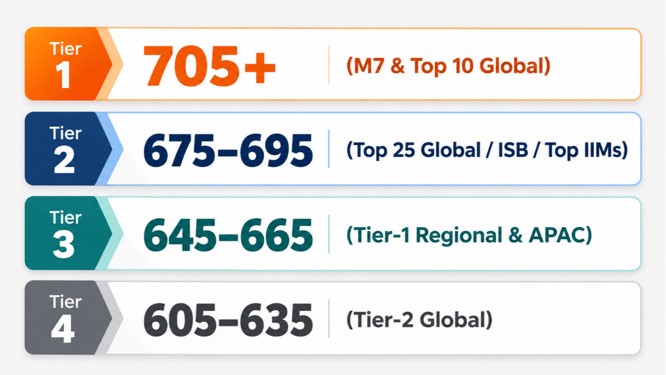
Your "target score" should align with the median or 80th-percentile GMAT scores of your target programs, plus your overall profile strength (academics, work experience, extracurriculars, essays, recommendations).
4.1 Global Top MBA Programs (M7, Top 10, Top 25)
Typical competitive GMAT Focus ranges for Indian and international applicants:
| School tier | Competitive GMAT Focus range (approx.) | Rough classic GMAT equivalent |
|---|---|---|
| M7 / top 5 global | 725-805 | ~760-800 |
| Top 10 global | 705-765 | ~750-780 |
| Top 25 global | 685-745 | ~730-760 |
For these programs:
- 705+ is generally a solid baseline.
- 725+ makes you competitive at most top-10 schools, assuming a strong profile.
- Below 675, you usually need an exceptional profile or other strengths to compensate.
4.2 Top Indian and Asia-Pacific MBA Programs
Examples include ISB, IIMs offering MBA/PGP-style programs, SPJIMR, XLRI, MDI, FMS and leading schools in Singapore and the Middle East.
| School tier | Competitive GMAT Focus range (approx.) |
|---|---|
| ISB / top Indian private B-schools | 685-755 |
| Top IIMs (for GMAT-based admissions) | 675-745 |
| Other Tier-1 Indian / Asia-Pacific schools | 645-705 |
For many Indian programs, a score around 685-715 is often sufficient if your academics and work experience are strong.
4.3 Good Tier-2 and Regional MBA Programs
For many reputable but less hyper-competitive programs:
- 605-645: Often acceptable, especially with strong work experience or a clear career narrative.
- 645-675: Usually considered strong and can help with scholarships in some programs.
Your exact target should be based on each school's published class profile and your own background.
5. GMAT Score Comparison by Quant, Verbal and Data Insights
Business schools increasingly look beyond the total score to understand your strengths and weaknesses.
5.1 Why Section Scores Matter
- Quant score: Important for programs with heavy analytics, finance or operations focus.
- Verbal score: Critical for communication-heavy roles and for non-native English speakers applying to English-medium programs.
- Data Insights: Shows your ability to interpret data, charts, tables and multi-source information—key for modern MBA coursework.
5.2 Interpreting Your Section Profile
Use this simple framework:
| Section score | Interpretation | Typical implication |
|---|---|---|
| 86-90 | Exceptional | Strong signal in that area; can offset minor weaknesses elsewhere. |
| 80-85 | Strong | Competitive for most programs. |
| 70-79 | Average to good | Acceptable, but may need balancing with other sections or profile strengths. |
| 60-69 | Weak | May raise concerns, especially if the section is crucial for your target specialization. |
Examples
- Total 695 (Quant 88, Verbal 78, DI 82): Strong Quant, decent overall; suitable for analytics-heavy programs.
- Total 685 (Quant 76, Verbal 86, DI 84): Strong Verbal and DI; good for marketing, strategy, general management.
- Total 665 (Quant 72, Verbal 74, DI 80): Balanced but moderate; consider retaking if aiming for top-10 programs.
6. How Many GMAT Attempts Are Advisable?
GMAC's current policy (2026) for the GMAT Focus Edition:
- Up to 5 attempts in any rolling 12-month period.
- Minimum 16-day gap between attempts.
- No lifetime cap on total attempts under the current policy.
- If you achieve a perfect score (805), you must wait 5 years before retaking.
Practical guidance on number of attempts
For most working professionals:
- 1-2 attempts: Common and perfectly acceptable.
- 3 attempts: Reasonable if you see clear improvement potential and have time before application deadlines.
- 4-5 attempts: Only if you have a specific reason (for example, a major jump in mock scores, or a target school with a strict cutoff) and sufficient time.
Beyond 3 attempts, the marginal benefit often decreases unless you had unusual circumstances (illness, technical issues, severe time pressure) in earlier tests.
7. Should You Retake the GMAT?
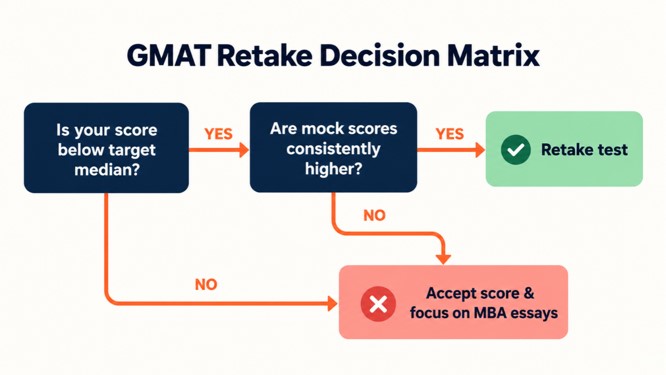
Use this decision framework instead of relying only on a single number.
7.1 Strong Reasons to Retake
Consider a retake if:
- Your score is 10-20+ points below the median of your target schools.
- Your section scores are unbalanced in a way that hurts your profile (for example, very low Quant for a finance-focused MBA).
- Your latest full-length mocks consistently show a higher score than your actual test result.
- You had external issues (illness, major distraction, technical problems).
- You still have time before deadlines and mental energy for focused prep.
7.2 When It May Be Better to Accept Your Score
You may choose not to retake if:
- Your score is at or above the median for your target programs.
- Your profile (work experience, academics, extracurriculars, essays) is strong enough to compensate for a slightly lower score.
- You are close to application deadlines and a retake would compromise essay quality or overall application preparation.
- Your mock scores have plateaued near your current score despite serious preparation.
For many applicants, a well-crafted application with a 675-695 score can outperform a rushed application with a 715.
8. GMAT Score Conversion and Superscoring FAQs
8.1 GMAT Focus to Classic GMAT Conversion
The GMAT Focus Edition (205-805) is not directly additive, but GMAC provides concordance tables linking Focus scores to the classic 200-800 scale.
Indicative conversions:
| Focus Score | Classic GMAT Equivalent (approx.) |
|---|---|
| 805 | 800 |
| 775 | 790-800 |
| 745 | 770 |
| 715 | 760 |
| 685 | 730 |
| 655 | 700 |
| 625 | 670 |
| 595 | 640 |
| 565 | 610 |
Use these only as approximations; schools see your official Focus score and may refer to GMAC's concordance internally.
8.2 Does GMAC Offer Superscoring?
GMAC itself does not provide official superscoring (combining the best section scores from multiple attempts into one composite score).
Some business schools may informally consider your highest section scores across multiple GMAT attempts when evaluating your application, but this is at the school's discretion, not GMAC's policy.
Always check each school's admissions FAQ or speak to their admissions team to understand how they treat multiple GMAT scores.
8.3 How Many Scores Can I Send to Schools?
You can select up to five programs to receive your scores for free at the time of the exam. Additional score reports can be sent later for a fee.
Schools typically see all your GMAT attempts from the last five years, though many focus primarily on your highest total score.
8.4 Can I Cancel My GMAT Score?
You can cancel your score immediately after the exam at the test center or online within a specified window. Cancelled scores still count toward your attempt limits.
Some schools may ask about cancelled attempts; policies vary.
9. Sample Score-Analysis Table (Worked Example)
Use this template to analyse your own GMAT score in the context of your MBA goals.
Example candidate profile
Target schools: ISB, one top-10 European MBA, one top-25 US MBA.
Profile: 4 years of work experience in consulting, B.Tech with 8.2/10 CGPA, moderate extracurriculars.
Latest GMAT Focus score: 685 (Quant 84, Verbal 80, DI 82).
| Parameter | Details |
|---|---|
| Total score | 685 |
| Approximate percentile | ~95.8% |
| Classic GMAT equivalent | ~730 |
| Target school median | ISB: ~695-715; Top-10 EU: ~705-725; Top-25 US: ~685-705 |
| Section breakdown | Quant 84 (strong), Verbal 80 (good), DI 82 (good) |
| Strengths | Balanced profile, strong Quant, solid overall percentile |
| Weaknesses | Slightly below median for top-10 EU programs |
| Recommendation | Accept score for ISB and top-25 US; consider retake only if aiming aggressively for top-10 EU and confident of 20-30 point improvement |
You can replicate this table with your own numbers to decide whether your score aligns with your school list.
10. Interactive or Downloadable GMAT Score Calculator (Concept)
While this article cannot embed a live calculator, you can use the following logic to build or request a simple GMAT score estimator for your website or personal use.
10.1 Basic GMAT Score Estimator (Illustrative)
Inputs:
- Quantitative Reasoning scaled score (60-90)
- Verbal Reasoning scaled score (60-90)
- Data Insights scaled score (60-90)
Illustrative formula (for planning only)
A rough internal estimate of total score can be modelled as:
Estimated Total ≈ 205 + 20 × (Quant + Verbal + DI - 180)
Verification checks:
- 90, 90, 90: 205 + 20 × (270 - 180) = 205 + 20(90) = 805 ✅
- 60, 60, 60: 205 + 20 × (180 - 180) = 205 + 0 = 205 ✅
- 80, 80, 80: 205 + 20 × (240 - 180) = 205 + 1200 = 605 ✅
This is not GMAC's official algorithm; it simply illustrates how higher section scores translate into a higher total. Always rely on official score reports and GMAC's concordance tables for actual decisions.
10.2 How to Use This Concept on Your Website
You can:
- Create a simple web form where users enter their three section scores.
- Use the above logic to show an indicative total score range.
- Display a percentile estimate based on the published tables.
- Add a disclaimer: "This is an illustrative estimator. Official scores are determined by GMAC."
Practical Next Steps for You
- List your target MBA programs and note their published median or 80th-percentile GMAT scores.
- Compare your current or target GMAT Focus score against those medians using the percentile table above.
- Analyse your section scores to identify any clear weakness (Quant, Verbal or Data Insights).
- Decide whether to:
- Accept your score and focus on essays, recommendations and profile building, or
- Plan a structured retake with a clear study plan and mock-test schedule.
- If you are unsure, speak with a GMAT mentor or admissions consultant who can evaluate your full profile, not just your test score.

Unsure about your GMAT score? Analyze your profile with Hasan Sir (GMAT Verbal V50 Scorer). Book a 1-on-1 Diagnostic Discussion.
Explore More GMAT Preparation and MBA Admission Guides
Want to plan your next step? Read these guides for the GMAT exam pattern, study plans, Quant, Verbal and Data Insights practice, one-on-one coaching, and MBA school selection.
- GMAT Focus Edition syllabus and exam pattern 2026
- GMAT study plan for working professionals
- GMAT Data Insights strategy and practice
- GMAT Verbal preparation course
- GMAT Quant preparation course
- GMAT personal tutoring and 1-on-1 coaching
- MBA profile building and school selection
Frequently Asked Questions: GMAT Score & Percentile 2026
A good GMAT score depends on your target schools and profile. As a rule of thumb: 705+ is competitive for top global MBA programs, 655-695 is strong for many Tier-1 Indian and international schools, and 605-645 can be sufficient for several good Tier-2 programs when supported by a solid profile.
The GMAT Focus Edition total score ranges from 205 to 805 in 10-point increments. It is derived from the three section scores (Quantitative Reasoning, Verbal Reasoning and Data Insights), each ranging from 60 to 90. The total is not a simple sum; it is calculated using a concordance algorithm based on your performance across all sections.
GMAC's current policy allows up to 5 attempts in any rolling 12-month period, with a minimum 16-day gap between attempts. There is no lifetime cap under the current policy. If you achieve a perfect score (805), you must wait 5 years before retaking.
Consider a retake if your score is 10-20+ points below the median of your target schools, your section scores are unbalanced, or your mocks consistently show a higher score. Accept your score if it is at or above the median for your targets, or if your profile is strong enough to compensate.
GMAC itself does not provide official superscoring. However, some business schools may informally consider your highest section scores across multiple GMAT attempts. This is at the school's discretion, not GMAC's policy.
GMAT scores are valid for 5 years for MBA admissions.
Yes. You can cancel your score immediately after the exam at the test center or online within a specified window. Cancelled scores still count toward your attempt limits.