
Crack CAT VARC: Essential Strategies, Practice Resources and Expert Coaching

Written by Hasan Raja | IIM Kozhikode alumnus | CAT VARC 99th percentile three times | GMAT Verbal V50 | 20 years of teaching experience
QUICK FACT: Recent CAT papers have generally given more weight to Reading Comprehension, while Verbal Ability has included para summary, para jumbles, para completion and odd sentence out.
If CAT VARC feels unpredictable, you are not alone. Many students read the passage properly, remove two or three options, and still mark the wrong answer. Then they practise more questions, but the score hardly moves. The primary cause is not a lack of English. It is the way they read, compare options, manage time, and review mistakes.
A good CAT VARC course should help you fix these habits. It should not simply give you hundreds of videos and practice sets. In this guide, you will learn a clear CAT reading comprehension strategy, a practical weekly routine, the right way to analyse mocks, and how to decide whether self-study, a recorded program, or personalised CAT VARC coaching is right for you.
What Is CAT VARC and What Does It Actually Test?
CAT VARC, Verbal Ability and Reading Comprehension of the Common Admission Test, is an assessment of the English language. However, the fact is it is a reasoning test based on written passages. You are not being tested on fancy words or textbook grammar. You are being tested on whether you can understand an argument, follow the author’s line of thought, spot a small change in meaning, and choose the best answer within limited time.
Recent CAT papers have generally given more weight to Reading Comprehension, while Verbal Ability has included question types such as para summary, para jumbles, para completion, and odd sentence out. The exact paper pattern may change, so always check the official CAT notification for the year in which you are appearing.
- Reading Comprehension: main idea, purpose, tone, inference, detail, and application questions
- Verbal Ability: para summary, para jumbles, para completion, and odd sentence out
- Test skills: passage selection, option elimination, time control, and smart skipping
Why CAT VARC Scores Keep Changing
Most students do plenty of work. They read articles, solve RCs, attend CAT VARC classes, and take mocks. Yet their scores move up and down because the work is not connected to a clear diagnosis. They know that an answer is wrong, but they do not know why they chose it.
For example, two wrong RC answers may look the same in a score report. In the first question, you may have misunderstood the author. In the second, you understood the passage but selected an option that was slightly outside the scope. It requires different corrections because of different problems.
- Reading too quickly and missing the author’s real point
- Depending on memory instead of returning to the relevant part of the passage
- Choosing an option because it sounds intelligent or familiar
- Trying to attempt every passage, even when one is clearly wasting time
- Checking only the correct answer after a mock and ignoring the four wrong options
KEY IDEA: This is where structured CAT VARC preparation matters. Improvement starts when every mistake is given a proper name.
Seven CAT VARC Strategies That Work
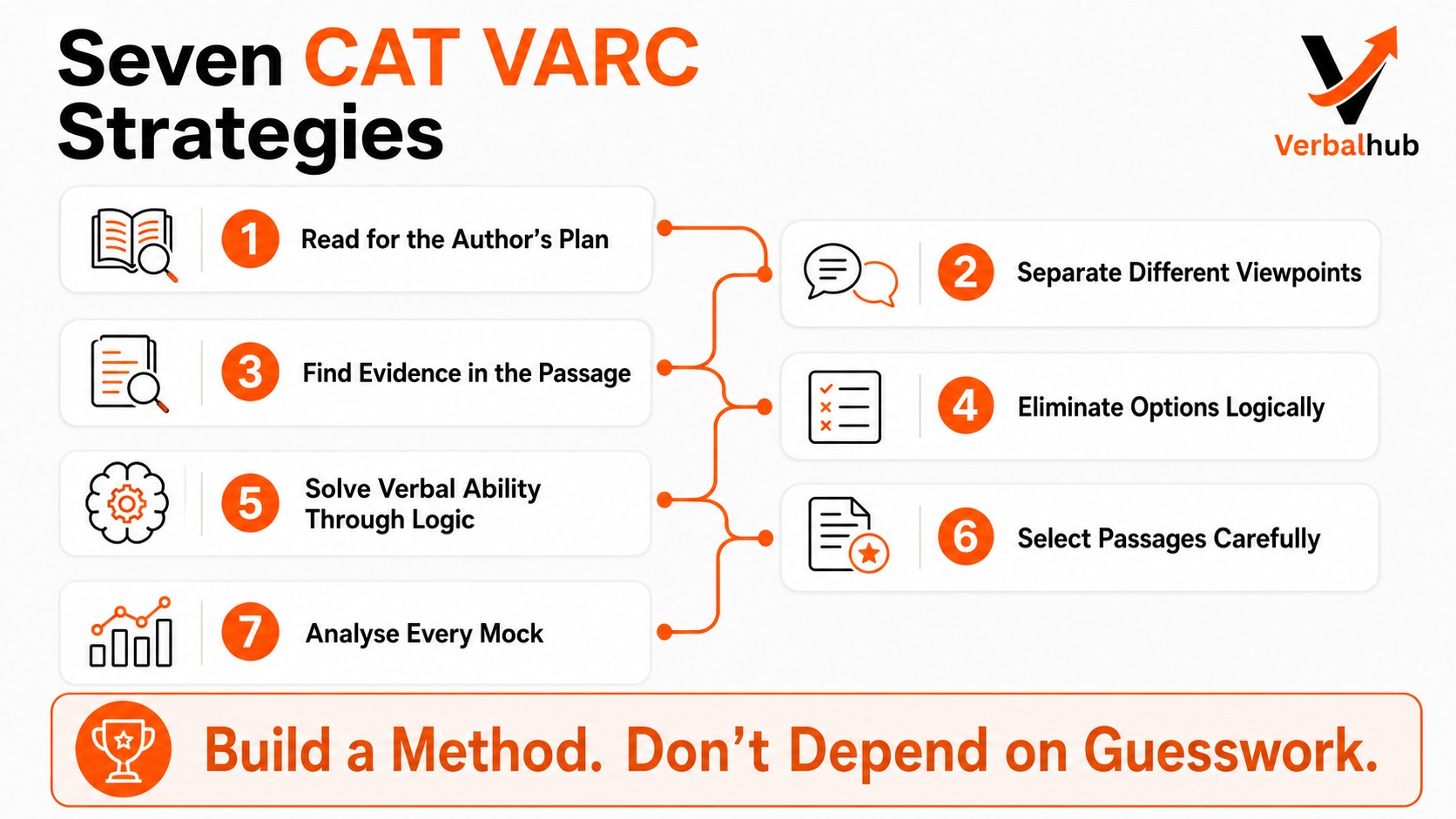
1. Read for the Author’s Plan
Do not try to remember every line. After each paragraph, pause for a second and ask, “What is the author doing here?” The author may be introducing a debate, giving an example, challenging an old view, presenting evidence, or reaching a conclusion. This small habit gives you a map of the passage.
Suppose paragraph one introduces a common belief, paragraph two questions it, and paragraph three presents a new explanation. The passage is not about three separate ideas. Its structure is: old view → problem → better view. Once you see that structure, main-idea and purpose questions become much easier.
2. Keep Different Viewpoints Separate
CAT passages often include the author’s view, a scholar’s opinion, and a common belief. Do not mix them. A frequent trap takes a statement made by someone else and presents it as the author’s conclusion. While reading, keep a simple mental note: “who believes what?”
3. Prove the Answer from the Passage
Your personal knowledge does not decide an RC answer. The passage does. Before selecting an option, identify the sentence or idea that supports it. If you cannot find support, the option is probably an attractive guess.
Also check the strength of the language. “Sometimes” is not “always.” “May lead to” is not “will cause.” One strong word can turn an almost-correct option into a wrong one.
4. Eliminate Options with a Clear Reason
Students often ask, “Which option looks right?” A better question is, “What exactly is wrong with each option?” This shift is at the heart of a strong CAT VARC strategy.
| Trap Type | What It Looks Like |
|---|---|
| Too extreme | Uses words such as always, completely, never, or only without support |
| Outside the scope | Discusses a related topic, but not the issue asked about |
| Half true | Begins correctly but adds an unsupported claim |
| Reversed | Changes the direction of the author’s argument or cause-and-effect link |
| Too narrow | Focuses on one example and misses the larger point |
During practice, write a five- to ten-word reason beside every rejected option. This may feel slow at first, but it trains the exact skill needed when two choices look close.
5. Solve Verbal Ability Through Logic
Verbal Ability is not guesswork. In para jumbles, look for an opening sentence, pronoun references, repeated ideas, cause and effect, contrast words, and example links. In odd-sentence questions, find the sentence that breaks the flow of the paragraph. In para summaries, first say the main point in your own words and then compare it with the options.
Avoid choosing a summary merely because it uses words from the paragraph. A correct summary must cover the central idea without adding a new claim or giving too much attention to a minor detail.
6. Select Passages Before You Start Solving
The first passage on the screen does not have to be your first attempt. Spend a short time checking the topic, sentence style, and question types. Begin with the passage you can follow most comfortably. If a passage remains unclear after a reasonable effort, leave it and protect the rest of the section.
Your best attempt order must come from your own sectional-test data. Some students do well with RC first; others prefer a quick VA block between passages. Try both but prefer the one that helps you get better results.
7. Review Mocks More Seriously Than You Attempt Them
A mock score tells you what happened. VARC mock analysis tells you why it happened. Reattempt every doubtful question without a timer. Then compare your original thinking with the correct reasoning.
- Did I mis-interpret the passage or the options?
- Did I miss a keyword such as except, primarily, or most likely?
- Did I select a half-true or out-of-scope option?
- Did I stay too long on a difficult passage?
- Was the answer correct because of sound reasoning or a lucky guess?
Convert each pattern into one action for the next week. If inference questions are weak, do a focused inference set. If your final passage is rushed, revise your passage-selection and time plan. Taking another mock without making a change simply repeats the same test.
A Four-Phase CAT VARC Preparation Plan
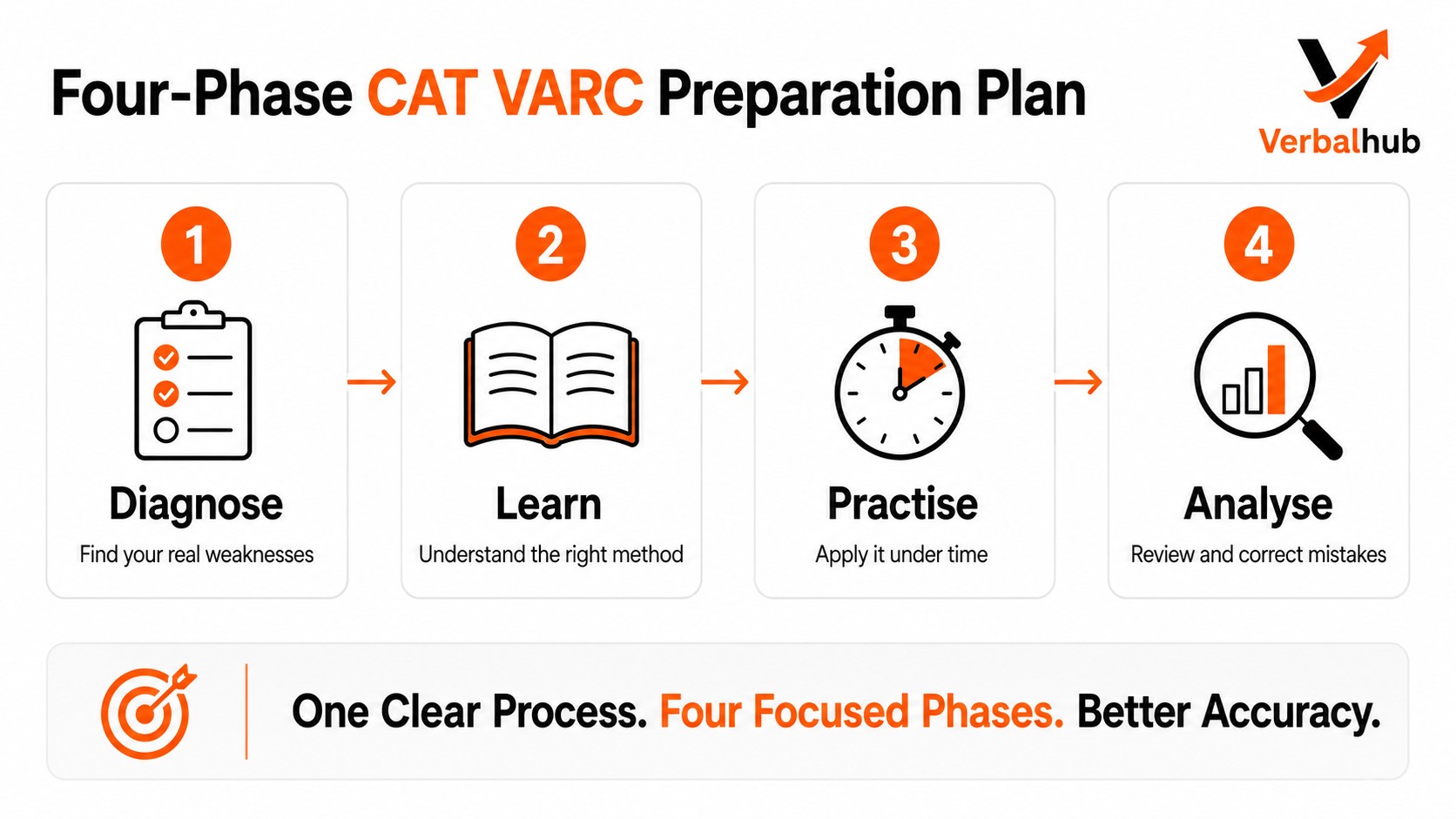
Phase 1: Diagnose Your Current Level
Start with one previous-year VARC paper or a good sectional test. Record RC and VA accuracy separately. Note the time used, unattempted questions, guesses, and questions in which you were stuck between two options. This becomes your starting point.
Phase 2: Learn the Method
Spend two to three weeks working without chasing speed. Learn passage structure, question demands, common option traps, and the logic of every VA type. At this stage, explain your answer in words. If you cannot explain it, the method is not yet stable.
Phase 3: Practise Under Time
Move to timed RC sets and VARC sectionals. Fix an attempt order, set rough time checkpoints, and practise leaving low-value questions. Increase attempts only when your accuracy remains steady.
Phase 4: Mock, Analyse, and Adjust
Take full mocks, but leave enough time for detailed analysis. Take help of the error log to plan for next practise questions. Your plan should change as your weaknesses change.
A Weekly Routine You Can Actually Follow
| Day | Study Task |
|---|---|
| Monday | One RC set; review passage structure and every option |
| Tuesday | Para summary and para completion practice |
| Wednesday | One RC set from an unfamiliar topic |
| Thursday | Para jumbles and odd sentence out |
| Friday | One timed mixed RC and VA set |
| Saturday | One full VARC sectional followed by analysis |
| Sunday | Revise the error log and redo selected questions |
A working professional can follow the same plan in 45- to 60-minute sessions. A college student may add another RC set or reading session. Do not copy someone else’s timetable blindly. Pick a routine you can follow for several months.
Useful Practice Resources for CAT VARC
Previous-Year CAT Papers
These should be at the centre of your CAT verbal ability preparation. First use them to learn the pattern. Later, solve them under time. During review, do not stop at the official answer; identify why the other choices fail.
Reading Material
Read across philosophy, psychology, science, history, economics, society, art, and culture. Aeon, The Guardian, The Hindu, and The Indian Express can help you meet unfamiliar ideas. After reading, write the main claim, tone, and paragraph flow in three lines. Passive reading alone will not improve CAT accuracy.
Topic-Wise Practice
Use a reliable question bank when you need to fix one area. Cracku, for instance, organises practice across RC, critical reasoning, para summary, para jumbles, and odd sentence questions. Pick sets according to your error log rather than blind practice.
Sectionals and Full Mocks
Choose tests that are close to the CAT style and provide clear solutions. Sectionals help you build timing and attempt order; full mocks test how VARC performs after the pressure of the complete exam. The value comes from analysis, not from the number of tests purchased.
What About the VARC 1000 Course and Other Recorded Programs?
Many aspirants search for the VARC 1000 course because they want a structured method and a large collection of lessons. A well-organised recorded program can be useful if you are disciplined, comfortable learning alone, and able to find your own mistakes.
However, ask one honest question before buying any recorded VARC course for CAT: “Do I need more explanations, or do I need someone to check how I apply them?” If you keep getting stuck between two options, cannot explain score changes, or have already watched several courses without improvement, another video library may not solve the real problem.
How to Choose the Best VARC Course for CAT
There is no single best course for every learner. The best VARC course for CAT is the one that matches your present level, time, learning style, and target percentile. Before joining, check the following points:
- Does the course begin with a proper diagnostic test?
- Does the teacher explain why wrong options are wrong?
- Will your reading process and decision-making be reviewed?
- Is mock analysis included, or are only recorded solutions provided?
- Can the study plan change when your performance changes?
- Can you ask questions and receive direct feedback?
| Feature | Self-Study | Recorded VARC Course | VerbalHub 1-on-1 |
|---|---|---|---|
| Diagnosis | Self-assessed | Usually generic | Personal diagnostic test |
| Pace | Chosen alone | Fixed lesson order | Based on student progress |
| Feedback | None | Rarely available | Direct teacher feedback |
| Option elimination | Self-review | Answer-only solutions | Option-by-option discussion |
| Mock analysis | Requires discipline | Often limited | Sectional and CAT mock analysis |
| Doubt resolution | Not available | Limited or delayed | Personal and direct |
Large CAT VARC classes may work for students who need a common schedule and standard syllabus. Personalised CAT VARC online coaching is often a better fit for students with a specific weakness, limited preparation time, or a high percentile target.
Why VerbalHub Personalised CAT VARC Classes Work Differently
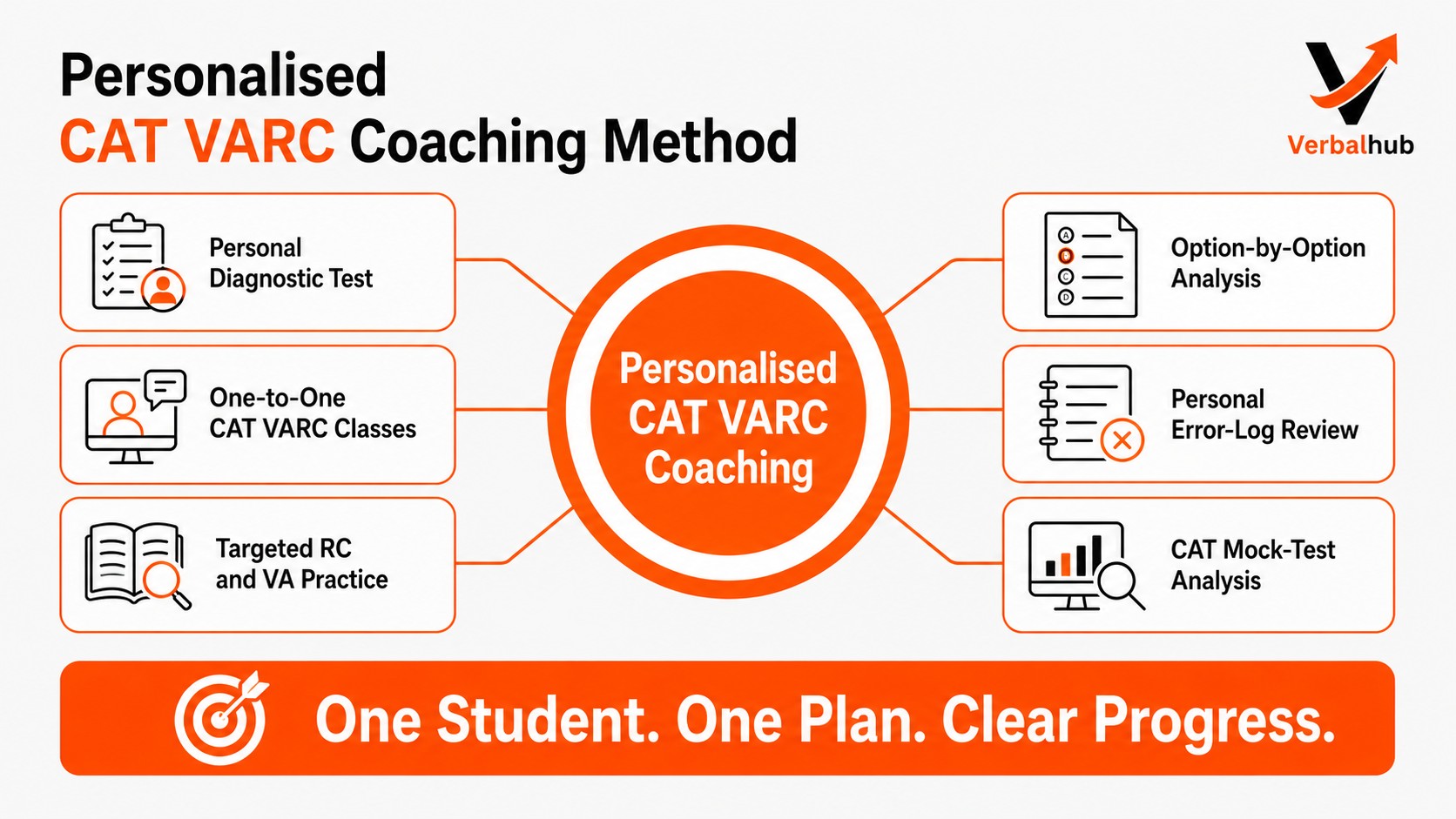
At VerbalHub, the starting point is not a fixed lecture sequence. It is the student’s actual thinking process. Two students can achieve similar marks for completely different reasons. One may not understand dense passages. Another may read well but fall for extreme options. A third may lose easy marks because of poor passage selection. Their study plans should not be identical.
VerbalHub’s personalised CAT VARC coaching follows a simple cycle: diagnose, teach, practise, analyse, and adjust. The teacher checks how the student reads a passage, how choices are compared, and why a particular answer was marked. Practice is then selected to correct that exact issue.
- Personal diagnostic test and target-based study plan
- One-to-one CAT VARC classes with direct teacher feedback
- Clear frameworks for RC, para summary, para jumbles, para completion, and odd sentence out
- Option-by-option discussion instead of answer-only solutions
- Personal error log covering comprehension, reasoning, options, timing, and selection
- Sectional and CAT mock analysis with specific work for the next week
- Flexible pacing for beginners, college students, working professionals, and repeat aspirants
Learn with Hasan Raja Sir: 20 Years of Verbal Teaching Experience

Hasan Raja Sir is the Founder and Lead Mentor at VerbalHub. He is an IIM Kozhikode alumnus, has scored the 99th percentile in CAT VARC three times, and has achieved V50 in GMAT Verbal. With 20 years of teaching experience, he has mentored more than 10,000 students in verbal aptitude and competitive-exam preparation.
His teaching method is simple: do not depend on instinct when the passage gives you evidence. In class, students learn to map the argument, understand the exact question, compare close choices, and give a clear reason for rejecting each wrong option. During mock analysis, the focus is not limited to the final score. Passage choice, time spent, rushed attempts, lucky answers, and repeated traps are all reviewed.
This method is especially helpful for students whose VARC scores keep changing or who repeatedly narrow a question down to two choices and select the trap. Instead of giving generic advice such as “read more,” Hasan Sir identifies what the student needs to read, how it should be read, and what must change in the next test.
Frequently Asked Questions
Yes. Self-study can work if you follow a structured plan, analyse mistakes honestly, and stay consistent. Coaching becomes useful when you cannot identify why you are losing marks or need regular feedback and accountability.
It may feel difficult at the beginning, but it can be improved. CAT rewards clear comprehension and reasoning, not decorative vocabulary. Start with readable material, build paragraph-level understanding, and move gradually to dense passages.
No. Reading builds comfort, but it does not automatically teach question selection, option elimination, or test timing. Combine reading with CAT-level questions and detailed review.
One properly analysed passage can be more useful than five hurried passages. Begin with quality. Add more sets only when you can explain the passage and the options clearly.
Start after you understand the basic RC and VA methods. You do not need to wait until the whole syllabus is complete. Early sectionals help you test timing, selection, and accuracy.
The teacher works on your individual error pattern. The lessons, practice sets, pace, and mock review change according to your performance instead of following one fixed plan for everyone.
Yes, provided the work is focused. Three months is enough to improve reading structure, option elimination, VA logic, and mock strategy when practice is regular and mistakes are properly reviewed. The amount of improvement will depend on your starting level and consistency.
Final Advice: Build a Method, Not a Pile of Material
You do not need ten books, several subscriptions, and a new strategy every week. You need one dependable process: read for structure, answer from evidence, eliminate with a reason, select questions calmly, and study your mistakes after every test.
If your preparation feels random or your mock scores remain unstable, VerbalHub’s personalised CAT VARC coaching can help you understand what is going wrong and build a plan around your target percentile.
NEXT STEP: Book a free 15-minute VARC diagnostic discussion with Hasan Raja Sir at VerbalHub.com to identify the next step in your CAT VARC preparation.