Best GMAT Verbal Course: How to Choose the Right Online Prep

Many GMAT aspirants reach the same frustrating point: they understand the passages, know the basic question types and complete hundreds of practice questions—yet their Verbal score refuses to improve.
The usual response is to buy another question bank, watch more strategy videos or memorise additional rules. But a score plateau is rarely caused by a simple shortage of material. More often, the student is repeating the same reasoning mistakes without recognising the underlying pattern.
GMAT Verbal is not primarily a test of sophisticated vocabulary or conversational fluency. It tests whether you can identify an argument's structure, separate evidence from conclusions, evaluate assumptions and interpret a passage without adding ideas that the author never stated.
That is why choosing the best verbal course for GMAT preparation requires more than comparing class hours and practice-question counts. You need to examine how a course teaches reasoning, diagnoses mistakes, provides feedback and adapts to your progress.
This guide explains how to compare self-paced platforms, conventional group courses and personalised GMAT Verbal coaching—and how to choose the right model for your target score.
The best course does not mean full content. It is the one that identifies why you are losing marks and systematically corrects the problem.
What Truly Makes the Best GMAT Verbal Course?
A polished dashboard, a large video library and thousands of questions can be useful. However, these features do not automatically produce a meaningful score improvement.
Before enrolling in any course, evaluate these four non-negotiable areas.
1. Logic-Based Teaching
A serious GMAT Verbal course must teach students how to analyse reasoning—not merely how to remember question-type shortcuts.
In Critical Reasoning, students should learn to identify:
- The author's conclusion
- Evidence supporting the conclusion
- Unstated assumptions
- Gaps between evidence and conclusion
- Alternative explanations
- Conditions that strengthen or weaken the argument
In Reading Comprehension, the course should teach:
- Passage structure
- Paragraph function
- Main idea
- Authorial purpose
- Viewpoint changes
- Scope control
- Evidence-based inference
Rules can help at the foundation stage, but they cannot replace structured reasoning.
2. Individual Error Diagnostics
Two students can select the same incorrect answer for completely different reasons.
One may misunderstand the argument. Another may understand it but fall for an attractive out-of-scope option. A third may rush because of poor time management.
A useful diagnostic system must determine:
- What the student selected
- Why the answer appeared attractive
- Which part of the argument or passage was misunderstood
- Whether the error was conceptual, strategic or timing-related
- What correction should be practised next
Without this level of diagnosis, an error log becomes nothing more than a list of incorrect questions.
3. Adaptive Practice and Assessment
Practice should change as the student improves.
An effective program begins with diagnostic testing, isolates weak skills and gradually increases question complexity. It should include:
- Topic-level diagnostic tests
- Difficulty-based practice
- Mixed-question drills
- Timed sectional tests
- Full-length simulated examinations
- Performance analytics
- Retesting after corrective practice
The current GMAT reports Verbal scores on a 60–90 scale, and all three sections contribute equally to the total score. This makes balanced, accurately calibrated preparation especially important. (Official GMAT score structure)
4. Expert Mentorship and Accountability
Recorded lessons can explain concepts, but they cannot always identify why a particular student repeatedly misreads assumptions or overinterprets RC passages.
Expert mentorship becomes especially valuable when:
- The score has remained unchanged across multiple mocks
- Accuracy falls sharply under timed conditions
- The student struggles to reject close answer choices
- Practice performance does not translate into mock scores
- A working professional has limited preparation time
Before paying for a course, ask who will review your performance and how frequently that person will intervene.
Self-Paced Videos vs. Group Classes vs. Personalised Coaching
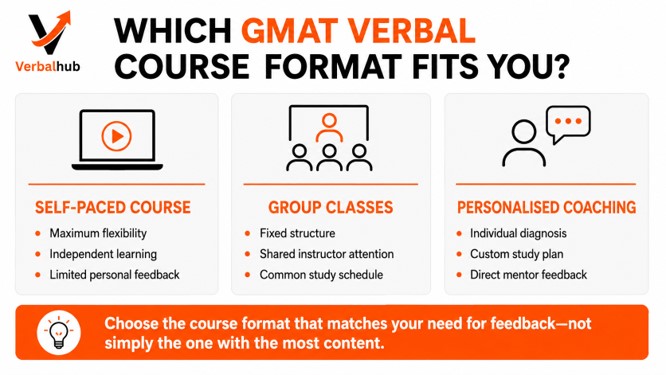
No single course format is ideal for every student. Self-paced platforms can suit disciplined learners, while live group courses can provide useful structure. Personalised coaching is generally more appropriate when a student needs individual diagnosis or is targeting the highest score range.
The given chart shares the points that matter most.
| Feature | Self-Paced Video Platforms | Generic Group Classes | VerbalHub Personalised Coaching |
|---|---|---|---|
| Personalisation and mentorship | Primarily student-led; support depends on the package | Shared lesson plan; individual attention varies by batch size | Individual plan based on diagnostics, target score and error patterns |
| Pedagogy | Standardised lessons and practice sequences | Instructor-led explanation for a mixed-ability group | Logic-first instruction adapted to the student's reasoning gaps |
| Error diagnostics | Automated accuracy and timing reports are common | Errors may be discussed at class level | Individual error-log auditing, corrective work and retesting |
| Working-professional fit | Very flexible but needs strong self-discipline | Fixed schedules create structure but may be harder to manage | Class timing and workload can be adjusted around work |
| Instructor access | Usually limited and varies by plan | Direct access mainly during scheduled sessions | Direct classes and mentorship with an experienced trainer |
| Learning pace | Controlled by the student | Largely determined by the batch calendar | Adjusted according to demonstrated mastery |
| Plateau correction | Student often diagnoses the cause independently | Some support, within shared class time | Mock analysis and error patterns determine the next learning cycle |
| Best suited to | Independent learners seeking flexibility and content access | Students seeking structure and peer learning | Students needing close feedback or an ambitious Verbal score |
This comparison refers to course models, not an absolute judgement about every provider. Companies such as Manhattan Prep/Kaplan and Princeton Review currently offer multiple formats, including on-demand courses, live instruction and, in some cases, private tutoring.
Similarly, self-paced programs can include adaptive lessons, drills and detailed reports. Their main limitation is not necessarily content quality; it is the amount of individual interpretation and intervention available to the learner.
The VerbalHub Advantage: Phase-Wise Mastery with Hasan Sir
VerbalHub's GMAT Verbal program is led by Hasan Sir, Head Trainer and Founder, with more than 15 years of experience as a Verbal instructor, curriculum developer and mentor.
His teaching approach is built around a straightforward principle:
A student should be able to explain why the correct answer works and why every competing option fails.
The objective is not to collect shortcuts. It is to build a repeatable reasoning process that continues to work when the questions become difficult or the student is under time pressure.
VerbalHub reports that Hasan Sir has mentored thousands of test-takers, including students pursuing top-percentile Verbal outcomes. Where individual score improvements or percentile results are mentioned on the website, they should be supported with authentic score reports or student testimonials rather than presented as guaranteed outcomes.
The Four-Phase VerbalHub System
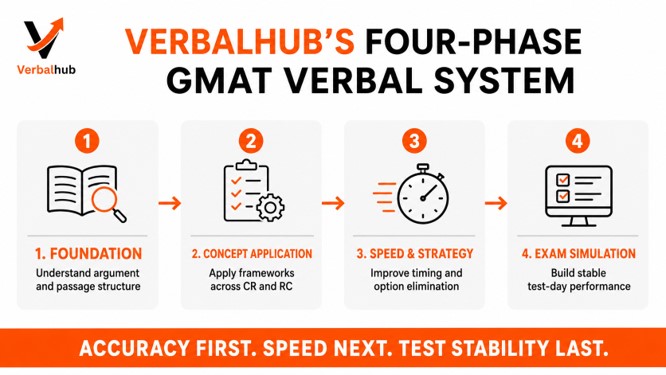
Phase 1: Foundation
The first phase establishes the reasoning language needed for CR and RC.
Students learn to recognise:
- Premises and conclusions
- Assumptions
- Cause-and-effect reasoning
- Comparisons and analogies
- Scope shifts
- Paragraph roles
- Author viewpoints
- Common answer-choice distortions
This phase is particularly important for students who have relied on intuition or general English ability.
Primary objective: Replace instinctive answering with a clear analytical process.
Phase 2: Concept Application
Once the foundation is stable, students apply the framework across question types and difficulty levels.
Critical Reasoning work may cover:
- Strengthen and weaken
- Assumption
- Inference
- Evaluate the argument
- Resolve the paradox
- Boldface and argument structure
- Plan and implementation questions
Reading Comprehension work may cover:
- Main idea
- Primary purpose
- Specific detail
- Inference
- Authorial tone
- Passage organisation
- Application of information
At this stage, Hasan Sir examines not only whether an answer is correct but also how the student approached it.
Primary objective: Develop consistent reasoning across unfamiliar arguments and passages.
Phase 3: Speed and Strategy
Speed is introduced after the student develops a reliable solving process.
This phase focuses on:
- Efficient passage mapping
- Faster identification of argument structure
- Elimination of close distractors
- Time checkpoints
- Recovery after a difficult question
- Preventing one question from damaging the rest of the section
- Maintaining accuracy as difficulty increases
Students do not simply receive instructions to "solve faster." They learn which mental steps can be shortened and which must remain intact.
Primary objective: Convert accurate reasoning into exam-appropriate performance.
Phase 4: Test-Taking and Exam Simulation
The final phase integrates concepts, timing and decision-making under realistic conditions.
It includes:
- Micro-level topic tests
- Mixed-question assignments
- Timed Verbal sectionals
- Full-length simulated mocks
- Timing and accuracy analysis
- Error-log audits
- Targeted correction cycles
- Retesting after revision
Primary objective: Make the student's performance stable enough to survive the pressure and variability of the actual GMAT.
How VerbalHub's Error-Log Auditing Works
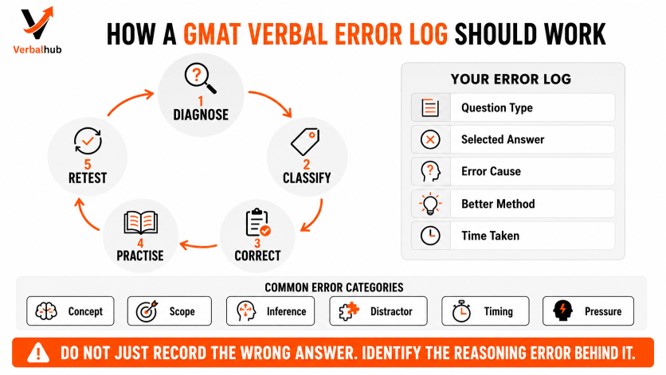
A standard error log records the question, answer and explanation. VerbalHub's approach goes further by investigating the decision that produced the error.
A useful audit may classify a mistake as:
| Error Category | Typical Problem | Corrective Action |
|---|---|---|
| Argument identification | Confuses evidence with the conclusion | Short argument-mapping drills |
| Assumption gap | Cannot identify what must be true | Assumption pre-thinking and negation practice |
| Scope control | Selects an answer that is related but irrelevant | Scope-comparison exercises |
| RC structure | Remembers details but misses paragraph purpose | Passage-mapping practice |
| Over-inference | Chooses a plausible claim unsupported by the text | Evidence-location drills |
| Distractor attraction | Recognises the idea but accepts stronger wording | Answer-choice comparison |
| Timing | Solves accurately without a workable time limit | Timed sets with staged checkpoints |
| Execution under pressure | The method disappears during mocks | Short simulations followed by immediate review |
The correction process follows a practical loop:
Diagnose → Classify → Correct → Practise → Retest
This prevents students from responding to every low mock score by indiscriminately solving more questions.
Why Personalised Assessments Help Prevent CR and RC Plateaus
A Verbal plateau often continues because the student is treating a repeated pattern as a collection of isolated mistakes.
For example, a student may miss:
- A strengthen question because of a scope shift
- An RC inference question because of a scope shift
- An evaluate question because of a scope shift
The surface question types are different, but the underlying weakness is the same.
Through individual assessment, Hasan Sir can identify the shared cause and build a targeted correction plan. This may include:
- A short concept revision
- Untimed accuracy drills
- Explanation of every rejected option
- Timed application
- A fresh test of the same reasoning skill
That level of intervention is one reason personalised coaching may be a better choice for students who have already completed a general course but remain stuck at the same score.
Is VerbalHub the Best GMAT Verbal Online Course for You?
VerbalHub is likely to be a strong fit if you:
- Have completed substantial preparation but remain at a plateau
- Need direct feedback rather than another video library
- Repeatedly struggle with close CR or RC options
- Want your preparation organised around an individual error log
- Are a working professional with limited study time
- Need regular accountability
- Are targeting a highly competitive Verbal score
- Prefer learning directly from an experienced senior trainer
A self-paced course may be sufficient if you:
- Are beginning your preparation
- Can diagnose your own mistakes reliably
- Have strong study discipline
- Need maximum scheduling flexibility
- Primarily require content review and practice material
- Are making steady progress without instructor intervention
The best GMAT verbal online course is therefore the course format that matches your present problem—not simply the package with the longest access period.
How to Choose the Right Path for Your Target Score
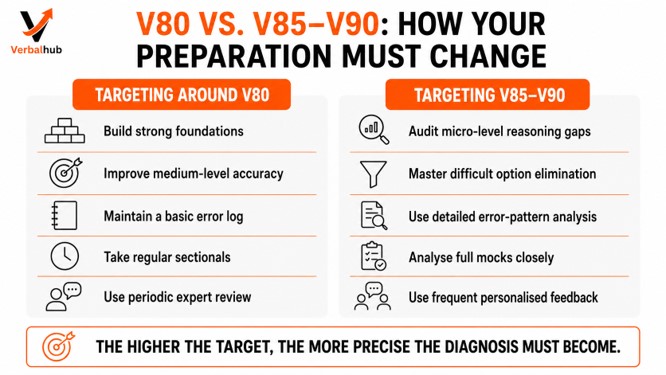
If You Are Targeting Approximately V80
A V80 target still requires serious preparation, but many students can reach this range through a structured combination of concept learning and disciplined practice.
Prioritise:
- Clear CR and RC foundations
- Consistent medium-level accuracy
- A manageable weekly study schedule
- Official GMAT questions
- Basic error logging
- Regular timed sectionals
- Periodic expert review
A self-paced or small-group program can work if you are progressing steadily and can independently apply feedback.
If You Are Targeting V85–V90
The highest Verbal range leaves very little room for unstable reasoning.
Students pursuing this target should prioritise:
- Micro-level diagnosis
- Strong accuracy on difficult questions
- Precise answer-choice elimination
- Control over over-inference
- Stable performance under time pressure
- Detailed mock analysis
- Regular intervention from an expert mentor
- Retesting of previously weak skills
At this level, solving more questions is not enough. The student must understand why errors continue to occur and whether the correction remains effective during timed tests.
This is where VerbalHub's individual assessment and error-log auditing model becomes particularly valuable.
For an ambitious score, improvement comes from reducing uncertainty in the solving process—not from increasing the number of guesses that happen to be correct.
Questions to Ask Before Choosing GMAT Verbal Coaching
Before enrolling, ask the provider these questions:
- Who will actually teach my classes?
- Will the same instructor review my mock-test performance?
- How will my starting level be diagnosed?
- Will I receive a personalised study plan?
- How are repeated CR and RC errors tracked?
- Does the course teach reasoning or mainly provide shortcuts?
- How frequently will my plan be revised?
- Are topic tests, sectionals and full mocks included?
- Can the schedule accommodate a working professional?
- What evidence supports the advertised student outcomes?
A provider's answers will reveal more than its promotional headline.
Final Verdict: Choose Diagnosis Over Content Volume
There is no universal best course for GMAT Verbal for every learner. A disciplined beginner may benefit from a well-designed self-paced program. Another student may need the structure of live group classes.
However, if you have reached a score plateau, are repeating the same CR and RC mistakes, or are targeting V85–V90, generic instruction may not be enough. You need a system that identifies your exact reasoning gaps and changes your preparation accordingly.
VerbalHub combines:
- Phase-wise Verbal training
- Logic-based CR and RC instruction
- Personalised one-on-one classes
- Individual mentorship
- Adaptive topic and sectional assessments
- Detailed error-log auditing
- Full-length exam simulation
- Direct guidance from Hasan Sir
That makes it a compelling option for aspirants searching for the best GMAT verbal coaching with genuine personal intervention rather than a standardised study path.
Ready to Find Out What Is Holding Back Your Verbal Score?
Book a GMAT Verbal diagnostic call or trial class with Hasan Sir at VerbalHub.com.
Your current performance will be reviewed to identify:
- Your strongest and weakest Verbal skills
- The patterns behind repeated errors
- Whether your primary problem is conceptual, strategic or timing-related
- The preparation path most appropriate for your target score
Do not begin with another generic study plan. Begin with an accurate diagnosis.
GMAT scores depend on starting ability, preparation quality, study consistency and test-day execution. Individual results vary; no particular score should be presented as guaranteed.
Frequently Asked Questions About GMAT Verbal Courses
The best course is the one that matches your present level, target score and need for feedback. Independent learners may do well with a structured self-paced program. Students who are stuck at a score plateau or need close guidance may benefit more from personalised coaching with regular error analysis.
Yes, provided the course includes live interaction, structured practice and meaningful feedback. Online delivery is not the deciding factor. The quality of instruction, diagnostic process and follow-up work matters far more than whether the class takes place online or in a physical classroom.
Many students can build a strong foundation through self-study using official questions, reliable lessons and a disciplined review process. Expert help becomes useful when you cannot identify why your answers are wrong, your mock scores remain unchanged or the same reasoning mistakes keep returning.
Consider one-on-one coaching if you are a retaker, have limited preparation time, struggle with close CR or RC options, or have already completed a general course without reaching your target. Individual coaching is most valuable when the study plan is based on your actual error patterns.
A plateau often occurs when students solve more questions without correcting the process that produces their errors. Common causes include weak scope control, unsupported inference, poor argument mapping, attraction to tempting distractors and unstable timing under test conditions.
The timeline depends on your starting score, target score, weekly study time and the depth of your conceptual gaps. A student strengthening basic reasoning skills may need several months, while an experienced test-taker correcting a narrow weakness may need a shorter and more focused plan.
The current GMAT Verbal section is scored from 60 to 90. A good score should be judged in relation to your overall GMAT target and the expectations of the business schools you are considering. A section score and a percentile rank are related, but they are not the same measure.
A useful error log records more than the correct answer. It identifies why you selected the wrong option, the reasoning gap involved, the better solving method and the corrective practice required. Reviewing these patterns helps prevent the same weakness from appearing in a different question type.