

Data Insights timing can decide your total GMAT score because DI carries the same weight as Quant and Verbal. A useful GMAT Data Insights timing strategy protects accuracy while leaving enough time to answer every question. The "2:15 per question" average hides the real challenge: a short sufficiency question and a dense set of sources demand different amounts of work.
GMAT Data Insights Timing Strategy: Budget by Task
The current GMAT exam, often called the GMAT Focus Edition, gives you 45 minutes for 20 DI questions. Those 45 minutes also include any time you spend reviewing answers.
If you are stuck around 605-705, examine where your time goes. Do you spend four minutes proving one answer, then rush three manageable questions? Do you read every table row before knowing what you need?
Better GMAT Focus pacing starts with three habits:
- Identify the exact task before processing the data.
- Spend extra time only when your work is making progress.
- Leave a question when further effort is unlikely to produce an answer.
The budgets below are starting points for practice, not official limits. Adjust them using fresh timed sections. Saving time on straightforward questions creates room for heavier ones.
The Five GMAT Data Insights Question Types

DI includes Data Sufficiency, Graphics Interpretation, Table Analysis, Two-Part Analysis and Multi-Source Reasoning. Questions can involve mathematics, verbal reasoning or both.
1. Data Sufficiency: Quant and Criteria-Based
Practice budget: 1:30-2:00 for manageable questions; up to 2:30 when reasoning is progressing.
Data Sufficiency asks whether the information determines an answer. It does not always require you to calculate that answer.
For a numerical question, check whether there is one possible value. For a Yes/No question, check whether the answer stays the same across every allowed case. A definite "No" is sufficient.
Suppose the question asks whether a project qualifies for approval. Approval requires a cost below £5 lakh and completion within eight weeks. Knowing the cost alone may not settle the question if the completion time remains unknown.
These criteria-based problems require the same sufficiency discipline as algebra questions:
- Write the exact requirement.
- Test Statement 1 alone.
- Test Statement 2 alone, without carrying over Statement 1.
- Combine them only if neither works independently.
Simple rule: Stop when you have established sufficiency or found valid cases with different answers.
2. Graphics Interpretation
Practice budget: 1:30-2:00; around 2:15 for a less familiar graphic.
Graphics Interpretation tests whether you can read a visual correctly and identify the requested relationship.
Read the sentence containing each blank and inspect the dropdown choices. Then check the graph's axes, units, legend and accompanying notes.
If the question asks about revenue growth from 2019 to 2023, write "revenue; 2019-2023" on your scratchpad. This prevents you from answering about profit or using the wrong years.
Remember that the largest increase in money is not necessarily the largest percentage increase. Growth from 10 to 15 is 50%; growth from 100 to 120 is 20%.
Simple rule: Confirm the metric, units and comparison base before calculating.
3. Table Analysis
Practice budget: 2:00-2:30 for the complete item, including its statements.
Table Analysis presents a sortable table and asks you to judge several statements.
Read the statements before exploring every row. Identify the column or relationship needed for each one. Sort when it helps you locate values, rankings or exceptions.
Suppose a statement says that every branch with revenue above ₹20 lakh also has a profit margin above 15%. Find the qualifying branches, then check their margins. One qualifying branch below the margin threshold disproves the statement.
Sorting revenue alone will not identify the highest profit margin if margin must be calculated from revenue and profit.
Simple rule: Sort to answer a specific question, then check every required statement.
4. Two-Part Analysis
Practice budget: 2:00-2:30; up to about 3:00 when a clear setup is nearly complete.
Two-Part Analysis asks for two selections, often connected by shared conditions. The content may be numerical, verbal or mixed.
Start by reading both column headings. Write what each answer must represent. If the question asks for quantities of two products under a fixed budget, establish the relationship before testing options.
For verbal problems, translate the conditions into brief notes. Words such as "must," "could" and "cannot" change the task.
Check the selected pair together. Two choices can look reasonable separately while violating a shared restriction.
Simple rule: Solve the relationship between the parts and verify both selections against all conditions.
5. Multi-Source Reasoning
Practice budget: around 2:30-3:00 for the first question on unfamiliar sources; aim for 1:30-2:00 on later questions sharing them when feasible.
Multi-Source Reasoning combines tabs containing text, tables or graphics. Some questions share the same sources, so the first encounter may take longer.
Read the current question first. Briefly map the sources: "policy," "sales table," "manager email." Then locate the evidence you need.
If the question asks whether a discount applies to March orders, find the discount rule and March order details. Avoid reading the entire company history unless it affects that decision.
Source mapping helps, but repeated tab switching without a purpose wastes time. Write where each useful fact came from.
Simple rule: Open a tab to answer a specific information need.
Seven Costly DI Timing Traps and Their Fixes
These DI timing traps often appear even when students understand the underlying concepts.
Trap 1: Solving DS after sufficiency is established
Fix: Ask, "Can this information determine the answer?" Once you have proved it can, stop unnecessary calculation. For Yes/No questions, test whether both outcomes remain possible.
Trap 2: Reading every exhibit before the stem
Fix: Read the question or statements first, then read the relevant data and definitions. Stem-first reading gives you a purpose; it does not mean ignoring context needed to interpret the exhibit.
Trap 3: Missing axes, units or percentage bases
Fix: Write the requested metric and unit before working. Separate revenue from profit, totals from averages, and percentage change from percentage-point change.
Trap 4: MSR tab tourism
Fix: Name the missing fact before switching tabs: "I need the eligibility rule." Keep a short source map so you can return directly to useful evidence.
Trap 5: Calculating more precisely than necessary
Fix: Inspect the answer choices or threshold first. Estimate when the gap is large; calculate exactly when close values could change the answer.
Trap 6: Ignoring sort in Table Analysis
Fix: Use sorting to locate relevant rows or exceptions. Remember that sorting one column does not automatically answer questions about ratios involving two columns.
Trap 7: Spending longer because you have already spent time
Fix: Judge your next step, not your past effort. If you are rereading the same lines without a new approach, select an answer, bookmark if useful, and move on.
For focused exercises, use our GMAT Data Insights Practice 2026 set. Record how long you took and why you took that long. A correct answer reached through repeated trial and error still needs review.
GMAT DI Checkpoints for 45 Minutes
Use the following GMAT DI checkpoints after submitting the listed question. They target a first pass of approximately 42 minutes, leaving about three minutes for review.
| After submitting | Target time remaining |
|---|---|
| Q5 | 34:30 |
| Q9 | 26:00 |
| Q13 | 17:30 |
| Q17 | 9:00 |
| Q20 | 3:00 |
Treat these as guideposts. A dense shared-source set can temporarily put you behind. The key question is whether you are recovering time on subsequent questions.
Avoid checking the clock after every few seconds. Use the checkpoints and glance at the timer when a question starts to drag.
What to Do When You Are Behind
If you are roughly one minute behind, tighten your method. Cut unnecessary rereading and arithmetic. Keep working carefully on questions you can solve.
If you are two or more minutes behind, stop investing heavily in questions where progress has stalled. Eliminate what you can, select an answer, bookmark if appropriate, and advance.
Near the end, divide the remaining time by the unanswered questions. Four minutes for four questions demands quicker decisions than nine minutes for three. Answer every question: GMAC applies a penalty for unanswered questions.
Use Review & Edit Selectively
You cannot freely jump ahead and return during your first pass. You must submit an answer to advance.
After answering all questions, you can review questions and edit up to three answers, provided section time remains. Bookmarking does not create extra time.
Prioritise questions where a short revisit can resolve a specific uncertainty. A suspected unit error is usually a better review candidate than a problem you still do not understand.
Change an answer because you found evidence or corrected your reasoning. Anxiety alone is a poor reason.
Calculator Discipline: Make DI Math-Light
An on-screen calculator is available in DI. Effective GMAT DI calculator discipline means deciding what to calculate before entering numbers.
Use this order:
- Define the required relationship.
- Compare or cancel common factors.
- Estimate whether that settles the question.
- Calculate only what remains necessary.
If two products have identical unit prices, comparing revenue may simply require comparing quantities. If a value rises from 80 to 100, recognise the 25% increase without opening the calculator.
For less convenient numbers, write the expression first. Calculating 47 ÷ 190 × 100 is reasonable if an exact percentage helps distinguish the choices. Entering several numbers before identifying the denominator invites mistakes.
For text-heavy DI, the saved time may come from reasoning rather than arithmetic. Our GMAT Critical Reasoning Strategy guide helps with conditions and unsupported conclusions. Our GMAT Reading Comprehension Strategy supports reading for relevant evidence.
Tonight's 10-Minute Stem-First DI Drill
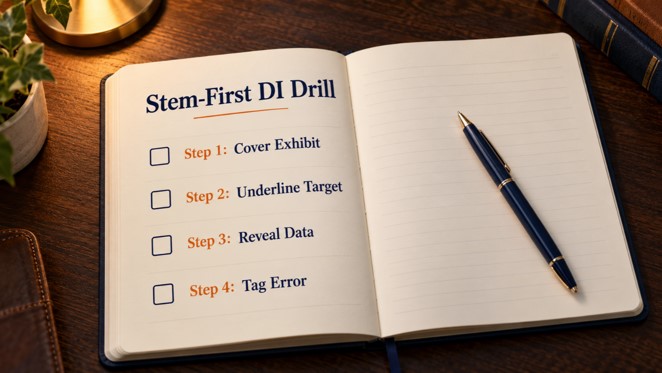
Choose two unfamiliar GI or TA questions from a GMAT DI practice set. Set aside ten uninterrupted minutes.
- Minute 0-1: Cover the exhibit. Read the stem, blanks or statements. Say what you need to determine.
- Minute 1-2: Underline the target. Mark the metric, period and condition on your practice copy. On-screen practice can use scratchpad notes: "profit margin; 2023; above 15%."
- Minute 2-4: Reveal the data. Check definitions, units and relevant rows. Answer without a calculator if comparison or estimation is sufficient.
- Minute 4-7: Repeat with the second question. Follow the same sequence. Do not read the solution yet.
- Minute 7-10: Review and tag the miss. Use "concept," "reading," "unit," "calculation," "navigation" or "timing." Tag guessed answers too.
Finish by writing one specific repair: "Write the percentage base before dividing."
This GMAT DI stem-first drill trains selective attention. Speed comes from removing unnecessary work.
A Four-Week GMAT DI Study Plan for 2026
For GMAT DI for working professionals, short sessions with careful review are more useful than ambitious schedules you cannot maintain. Reserve about 40 minutes on weekdays and longer weekend blocks.
Week 1: Build accuracy in DS and GI
Complete an initial timed diagnostic and identify your largest timing leak. Practise four to six questions per weekday, one type at a time. Review statement independence, units and percentage bases. Retest missed questions after two or three days.
Week 2: Add TA, TPA and MSR
Rotate the three remaining types across the week. Practise sorting, checking answer pairs and mapping sources. Record time for the complete item, including all required selections. Finish with a mixed set and compare accuracy with Week 1.
For a schedule that accommodates meetings and travel, follow our DI preparation guide for working professionals.
Week 3: Apply checkpoints in full sections
Complete two fresh 45-minute DI sections on separate days. Record your position at each checkpoint. Review wrong answers, guesses and correct answers that took excessive time. Use the remaining weekdays to repair the two most frequent errors.
Week 4: Rehearse exam-day decisions
Complete two further timed DI sections with the same checkpoint system. Include DI within a full official practice exam to test fatigue and section order. Practise answering and moving on when progress stalls. Review whether your final five questions remain accurate.
When assessing progress, check your percentile with our GMAT Score Calculator and Percentile guide. Use scored official practice results; raw accuracy alone cannot predict your exact GMAT score.
Get a Personal Timing Plan
If you want live feedback on recurring DI errors, consider joining VerbalHub's GMAT or IPMAT coaching. One-on-one support can provide a personalised timing plan, live error-log review, targeted DI and Verbal drills, accountability and exam-day strategy.

Hasan Sir is an IIM Kozhikode alumnus, GMAT Verbal V50 (Classic) and CAT VARC 99th-percentile scorer, with 20 years of teaching experience. His work covers GMAT/GRE/CAT/IPMAT verbal and reasoning, student score improvement and MBA admissions guidance. The V50 credential refers to the earlier GMAT Verbal scale.
If reading slows your DI performance, explore GMAT Verbal Coaching for Working Professionals and the approach described in Best GMAT Verbal Coaching.
A reliable GMAT Data Insights timing strategy gives each question enough attention, checks progress at fixed points and stops unproductive work before it harms the remaining section.
Get Your Personal GMAT DI Timing Strategy. One-on-One Guidance with Hasan Sir — Personal Timing Plan · Live Error-Log Review · Targeted DI Practice. Book Your Strategy Session.
Frequently Asked Questions
The average is 2:15, including review time. Individual budgets should vary. Aim to save time on straightforward questions and spend it where additional reasoning is productive.
Check how many questions remain. Reduce time spent on stalled problems, make the best selection you can and advance. Complete every required answer before considering review.
Start with your weakest type from a diagnostic. If your weaknesses are similar, DS and GI provide useful early practice in sufficiency, units and percentage comparisons.
Combine focused drills with fresh timed sections. Review slow correct answers as carefully as mistakes, write a specific repair and test whether it works on unfamiliar questions.