
You open your latest GMAT mock. The timer starts. Twenty Data Insights questions. Tables, graphs, short passages and two-part problems. You know the theory, but the section still feels difficult to manage. Where are you losing time? Which details are you missing? Which mistakes keep returning?
For many working professionals, Data Insights is the least familiar part of the GMAT. It contributes equally with Quantitative Reasoning and Verbal Reasoning to the total score. You have 20 questions in 45 minutes, and the section score ranges from 60 to 90. The total GMAT score ranges from 205 to 805.
This article gives you 50 original practice questions:
| Question type | Number of questions |
|---|---|
| Data Sufficiency (DS) | 12 |
| Table Analysis (TA) | 10 |
| Graphics Interpretation (GI) | 10 |
| Multi-Source Reasoning (MSR) | 8 |
| Two-Part Analysis (TPA) | 10 |
| Total | 50 |
Each question includes a solution and a key takeaway. The questions use the reasoning skills tested in DI, with tables and graph descriptions adapted for reading on a page.
If you want the overall approach first, read the GMAT Focus Data Insights strategy guide, then return to the practice questions.
Quick Recap: What Does Data Insights Test?
The five DI question types require different reading habits:
- Data Sufficiency: Decide whether the information is enough to answer a question.
- Table Analysis: Check statements against a table, often using comparisons, totals or sorting.
- Graphics Interpretation: Read charts and graphs, identify trends and calculate relationships.
- Multi-Source Reasoning: Combine information from separate sources without making unsupported assumptions.
- Two-Part Analysis: Solve two connected parts and check that both answers satisfy the conditions.
DI rewards careful reading, clear logic and sensible calculation. Sometimes an estimate is enough. Sometimes a small word such as "exactly" or "at least" determines the answer.
For the complete exam structure, see the GMAT syllabus and exam pattern guide.
5-Step Daily Learning Routine

Start with one question type at a time. Solve five or six questions on a weekday, then review them properly.
A useful routine is:
- Set a timer.
- Solve the questions without opening the solutions.
- Record your answers and time.
- Review every wrong or guessed answer.
- Retest the questions you misunderstood after a few days.
The section-wide average is 2 minutes 15 seconds per question. Individual questions may need more or less time, especially when several questions share the same sources.
Keep a simple error log:
| QuestionType | What went wrong? | What will I change? | Example |
|---|---|---|---|
| TA | Used the wrong percentage base | Write the comparison base before calculating |
Useful error categories include concept gaps, misreading, calculation errors, unsupported assumptions and time pressure.
For a practical schedule, see the GMAT study plan for working professionals.
Section 1: Data Sufficiency Practice Questions

In DS, you must decide whether the statements determine a unique value or a definite Yes/No answer.
Use these standard answer choices for every DS question:
- A: Statement 1 alone is sufficient, but Statement 2 alone is not.
- B: Statement 2 alone is sufficient, but Statement 1 alone is not.
- C: Both statements together are sufficient, but neither alone is sufficient.
- D: Each statement alone is sufficient.
- E: Even both statements together are not sufficient.
DS Question 1 – Easy
A company has two departments, Sales and Marketing. The average monthly salary in Sales is 60,000. What is the average monthly salary in Marketing?
Statement 1: The overall average monthly salary across both departments is 65,000.
Statement 2: Sales has twice as many employees as Marketing.
Correct answer: C
Solution:
Let nS and nM be the employee counts, and let M be Marketing's average salary.
Statement 1 gives: 65,000 = (60,000nS + M·nM) / (nS + nM). Without the employee ratio, M cannot be determined.
Statement 2 gives nS = 2nM, but no overall average.
Together: 65,000 = (2·60,000 + M) / 3. Therefore M = 195,000 − 120,000 = 75,000.
Both statements together are sufficient.
Key takeaway: An overall average is a weighted average. The group sizes matter.
DS Question 2 – Easy
A project is scheduled to be completed in 30 days. Has more than half the work been completed after 18 days?
Statement 1: In the first 12 days, 40% of the work was completed.
Statement 2: The amount of work completed per day was constant throughout the first 18 days.
Correct answer: C
Solution:
Statement 1 does not tell us how much work was completed during days 13–18.
Statement 2 establishes a constant rate, but does not specify that rate. The scheduled completion date alone does not establish actual progress.
Together, the daily rate is 0.4/12 = 1/30. Work completed after 18 days is 18 × 1/30 = 0.6. That is 60%, so the answer is Yes.
Key takeaway: A planned completion date does not prove that work is progressing at the planned rate.
DS Question 3 – Medium
Two products, A and B, have different cost prices and selling prices. What is B's profit percentage?
Statement 1: A's selling price is 25% higher than B's selling price.
Statement 2: A's cost price is 10% higher than B's cost price.
Correct answer: C
Solution:
Let CA, CB be cost prices and SA, SB be selling prices.
The stem gives SA = 1.2CA.
Statement 1 gives SA = 1.25SB. It does not determine CB.
Statement 2 gives CA = 1.1CB. It does not determine SB.
Together: SA = 1.2(1.1CB) = 1.32CB, so SB = 1.32CB / 1.25 = 1.056CB.
B's profit percentage is (1.056CB − CB)/CB × 100 = 5.6%.
Key takeaway: You need both the selling-price relationship and the cost-price relationship.
DS Question 4 – Medium
Is the integer n divisible by 6?
Statement 1: n is divisible by 3.
Statement 2: n is divisible by 4.
Correct answer: C
Solution:
- Statement 1 alone is insufficient. For example, n = 3 gives No, while n = 6 gives Yes.
- Statement 2 alone is insufficient. For example, n = 4 gives No, while n = 12 gives Yes.
- Together, n must be divisible by 12. Thus n = 12k for some integer k. Since 12k = 6(2k), n is divisible by 6.
Both statements together give a definite Yes.
Key takeaway: Check the combined divisibility requirement before deciding that the statements are insufficient.
DS Question 5 – Medium
A rectangle has positive length l and breadth b. Is its area greater than 100 square units?
Statement 1: l + b = 22.
Statement 2: l − b = 2.
Correct answer: C
Solution:
Statement 1 allows (l, b) = (12, 10), with area 120, or (20, 2), with area 40. It is insufficient.
Statement 2 allows (6, 4), with area 24, or (12, 10), with area 120. It is insufficient.
Together: l + b = 22, l − b = 2. Adding gives 2l = 24, so l = 12 and b = 10.
The area is 12 × 10 = 120 > 100.
Key takeaway: One relationship between two dimensions may allow different areas.
DS Question 6 – Medium
An investment amounts to 1,50,000 after five years at simple interest. What was the principal?
Statement 1: The annual interest rate is 10%.
Statement 2: The interest earned over five years is 50,000.
Correct answer: D
Solution:
From Statement 1: 150,000 = P(1 + (10 × 5)/100) = 1.5P. Therefore P = ₹1,00,000.
From Statement 2: P = 150,000 − 50,000 = ₹1,00,000.
Each statement independently determines the principal.
Key takeaway: Test each statement separately before combining them.
DS Question 7 – Medium
For a real number x, is x > 0?
Statement 1: x² = 9.
Statement 2: x³ = −27.
Correct answer: B
Solution:
Statement 1 gives x = 3 or x = −3. The answer could be Yes or No.
Statement 2 gives only x = −3, so the answer is definitely No.
Key takeaway: A definite No is sufficient in DS.
DS Question 8 – Hard
A committee has eight members, each classified as either senior or non-senior. How many three-member subcommittees containing at least one senior member can be formed?
Statement 1: The committee has at least three senior members.
Statement 2: The committee has at most three senior members.
Correct answer: C
Solution:
Statement 1 allows different senior counts. With three seniors, the required count is 46; with four seniors, it is 52. It is insufficient.
Statement 2 also allows different counts. With one senior, the count is 21; with three seniors, it is 46. It is insufficient.
Together, there are exactly three seniors and five non-seniors.
Count all three-member groups, then subtract groups with no senior: ⁸C₃ − ⁵C₃ = 56 − 10 = 46.
Key takeaway: Keep the selection rule fixed in the stem. The statements should supply information about that same problem.
DS Question 9 – Hard
A train travels from A to B at a constant positive speed. Is the distance greater than 300 km?
Statement 1: At a speed 10 km/h faster, the journey would take one hour less.
Statement 2: The actual speed is 60 km/h.
Correct answer: C
Solution:
Let distance be d and actual speed be v.
Statement 1 gives d/v − d/(v + 10) = 1, which simplifies to d = v(v + 10)/10.
For v = 40, d = 200; for v = 60, d = 420. Statement 1 is insufficient.
Statement 2 gives speed but no travel time or distance.
Together: d/60 − d/70 = 1. Therefore d/420 = 1, d = 420. The answer is Yes.
Key takeaway: Show that a statement allows both Yes and No, rather than assuming that two unknowns automatically mean insufficiency.
DS Question 10 – Hard
Is the average of five distinct positive integers greater than 10?
Statement 1: The largest integer is 18.
Statement 2: The smallest integer is 6.
Correct answer: E
Solution:
Statement 1 allows both low and high averages. Statement 2 does too.
Even together: 6, 7, 8, 9, 18 have average 48/5 = 9.6. 6, 15, 16, 17, 18 have average 72/5 = 14.4.
The answer can be No or Yes.
Key takeaway: Fixing the smallest and largest values does not fix the middle values.
DS Question 11 – Medium
A bag contains only red and blue balls. One ball is drawn at random. Is the probability of drawing red greater than 0.5?
Statement 1: There are eight more red balls than blue balls.
Statement 2: There are 40 balls in total.
Correct answer: A
Solution:
Let the counts be R and B.
Statement 1 gives R = B + 8, so R/(R + B) = (B + 8)/(2B + 8).
Comparing with 1/2: 2(B + 8) > 2B + 8, which simplifies to 16 > 8. The probability is always greater than 0.5.
Statement 2 alone allows R = 20, giving 0.5, or R = 30, giving 0.75.
Key takeaway: More red balls than blue balls guarantees a red probability above one-half. An exact total is unnecessary.
DS Question 12 – Hard
A company's positive revenue increased by x% in 2024 and y% in 2025. Was its 2025 revenue more than 30% higher than its 2023 revenue?
Statement 1: x = 15.
Statement 2: y = 12.
Correct answer: C
Solution:
The combined growth factor is (1 + x/100)(1 + y/100).
Neither statement alone determines that factor.
Together: 1.15 × 1.12 = 1.288. Revenue increased by 28.8%, so the answer is definitely No.
Key takeaway: Successive percentage increases compound. Do not simply add them.
Section 2: Table Analysis Practice Questions
For each statement, select Yes if it is true from the stated information; otherwise select No.
Read units and column headings before calculating. When ranking matters, sort the relevant values mentally or on paper.
TA Set 1 – Project Durations
| Project | Planned duration (weeks) | Actual duration (weeks) |
|---|---|---|
| W | 8 | 8 |
| X | 10 | 11 |
| Y | 6 | 5 |
| Z | 12 | 15 |
TA Question 1
1. More than half the projects finished later than planned.
2. Average actual duration exceeds average planned duration.
3. Z's delay exceeds the combined time saved by projects that finished early.
Correct answers: No, Yes, Yes
Solution:
X and Z finished late: two of four projects, exactly half.
Average planned duration is 36/4 = 9 weeks. Average actual duration is 40/4 = 10 weeks.
Z was delayed by three weeks. Only Y finished early, saving one week. Therefore 3 > 1.
Key takeaway: Compare Z's individual delay with the stated quantity, rather than substituting the total delay.
TA Question 2
1. Exactly one project finished exactly on time.
2. The project with the longest planned duration also had the longest actual duration.
3. The sum of planned durations is at least 10% less than the sum of actual durations.
Correct answers: Yes, Yes, Yes
Solution:
- Only W finished on time.
- Z has both the longest planned duration, 12 weeks, and longest actual duration, 15 weeks.
- Planned durations total 36 weeks; actual durations total 40 weeks. The reduction relative to the actual total is (40−36)/40 × 100 = 10%. Exactly 10% satisfies at least 10%, so Statement 3 is true.
These sums compare project durations; they do not establish the elapsed time for completing all projects together.
Key takeaway: "At least" includes equality. Use the actual total as the comparison base here.
TA Set 2 – Employees and Salaries
| Department | Employees | Average monthly salary |
|---|---|---|
| HR | 20 | ₹50,000 |
| Sales | 40 | ₹60,000 |
| IT | 60 | ₹80,000 |
| Operations | 30 | ₹55,000 |
TA Question 3
1. IT contributes more than 40% of the monthly salary bill.
2. The overall average salary exceeds ₹65,000.
3. If ten Sales employees leave and everyone else's salary remains unchanged, the overall average salary will definitely increase.
Correct answers: Yes, Yes, No
Solution:
Department salary bills are:
- HR: 10,00,000
- Sales: 24,00,000
- IT: 48,00,000
- Operations: 16,50,000
Total salary is 98,50,000 across 150 employees.
Overall average = 9,850,000/150 ≈ ₹65,666.67.
IT's share is 4,800,000/9,850,000 × 100 ≈ 48.73%.
The departing employees' individual salaries are unknown. If their average exceeds the company-wide average, removing them lowers the remaining average.
Key takeaway: A department average does not determine every employee's salary.
TA Question 4
A new Analytics department is added with 25 employees and an average monthly salary of ₹90,000.
1. The overall average salary increases.
2. IT's salary-bill share falls below 45%.
3. Analytics has a smaller salary bill than IT.
Correct answers: Yes, Yes, Yes
Solution:
Analytics adds 25 × 90,000 = ₹22,50,000.
New totals are 175 employees and ₹1,21,00,000 in salary.
New average = 12,100,000/175 ≈ ₹69,142.86.
IT's new share is approximately 48/121 = 39.67%.
Analytics' ₹22.5 lakh salary bill is below IT's ₹48 lakh.
Key takeaway: Adding a department changes both the employee count and total salary.
TA Set 3 – Mock-Test Scores
Each test is marked out of 120.
| Student | Mock 1 | Mock 2 | Mock 3 |
|---|---|---|---|
| A | 72 | 78 | 84 |
| B | 60 | 66 | 70 |
| C | 80 | 82 | 85 |
| D | 50 | 60 | 68 |
| E | 90 | 88 | 92 |
TA Question 5
1. Every student improved from Mock 1 to Mock 2.
2. E has the highest average across the three tests.
3. The highest and lowest Mock 3 scores differ by more than 20 marks.
Correct answers: No, Yes, Yes
Solution:
E fell from 90 to 88, so Statement 1 is false.
Student averages are:
- A: 78
- B: approximately 65.33
- C: approximately 82.33
- D: approximately 59.33
- E: 90
The Mock 3 range is 92 − 68 = 24 marks.
Key takeaway: One exception is enough to disprove "every".
TA Question 6
1. C improved in each successive mock.
2. The class average in Mock 3 exceeds the class average in Mock 1.
3. D improved by more than 30% from Mock 1 to Mock 3.
Correct answers: Yes, Yes, Yes
Solution:
C's scores are 80, 82, 85.
The Mock 1 average is 352/5 = 70.4. The Mock 3 average is 399/5 = 79.8.
D's percentage improvement is (68 − 50)/50 × 100 = 36%.
Key takeaway: Use the original score as the percentage-growth base.
TA Set 4 – Prices and Discounts
| Product | Marked price | Discount |
|---|---|---|
| P | ₹1,200 | 10% |
| Q | ₹1,500 | 15% |
| R | ₹1,800 | 20% |
TA Question 7
1. R has the highest selling price.
2. Q has the largest discount amount per unit.
3. Buying one unit of each product gives an overall discount above 15%.
Correct answers: Yes, No, Yes
Solution:
| Product | Discount amount | Selling price |
|---|---|---|
| P | ₹120 | ₹1,080 |
| Q | ₹225 | ₹1,275 |
| R | ₹360 | ₹1,440 |
R has both the highest selling price and largest discount amount.
The combined discount is (120 + 225 + 360)/(1,200 + 1,500 + 1,800) × 100 = 705/4,500 × 100 ≈ 15.67%.
Key takeaway: The overall discount is weighted by marked prices.
TA Question 8
Product S is added with a marked price of ₹2,000 and a 25% discount.
1. S has the highest selling price.
2. Buying one unit of each of the four products gives an overall discount above 18%.
3. S's discount amount exceeds the combined discounts on P and Q.
Correct answers: Yes, Yes, Yes
Solution:
S's discount is ₹500, giving a selling price of ₹1,500. That exceeds R's ₹1,440.
The overall discount is (705 + 500)/(4,500 + 2,000) × 100 = 1,205/6,500 × 100 ≈ 18.54%.
Finally, ₹500 exceeds ₹120 + ₹225 = ₹345.
Key takeaway: Update the totals before calculating a new overall percentage.
Section 3: Graphics Interpretation Practice Questions
Each set describes a graph. Select one option for each blank.
Where a question asks for the closest listed approximation, choose the nearest option. Where a rounding rule is specified, follow it.
GI Set 1 – Monthly Growth
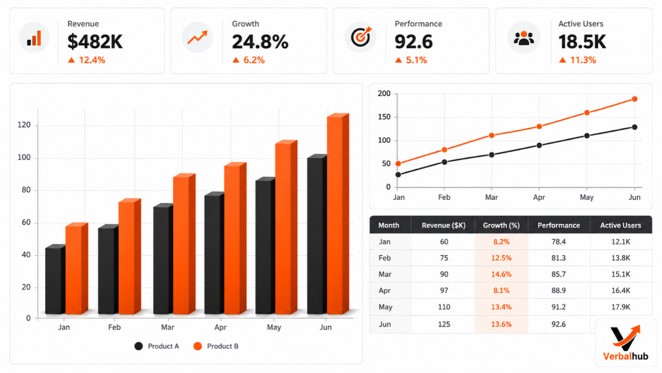
| Month | Revenue (₹K) | Growth (%) | Performance | Active Users |
|---|---|---|---|---|
| Jan | 60 | 8.2 | 78.4 | 12.1K |
| Feb | 75 | 12.5 | 81.3 | 13.8K |
| Mar | 90 | 14.6 | 85.7 | 15.1K |
| Apr | 97 | 8.1 | 88.9 | 16.4K |
| May | 110 | 13.4 | 91.2 | 17.9K |
| Jun | 125 | 13.6 | 92.6 | 18.5K |
GI Question 1
Part 1: Overall growth in revenue from January to June was approximately
Options: 80%; 90%; 100%; 108%; 120%.
Part 2: The number of months with month-on-month growth above 10% was
Options: 1; 2; 3; 4; 5.
Correct answers: 108%; 4
Solution:
Overall growth is (125 − 60)/60 × 100 ≈ 108.3%.
Month-on-month growth above 10% occurred in Feb (12.5%), Mar (14.6%), May (13.4%) and Jun (13.6%).
Key takeaway: Use the initial month as the base for overall growth.
GI Set 2 – Student Enrollment
A grouped bar chart shows enrollment in hundreds of students. Each unit represents 100 students.
| Year | Science | Commerce | Arts |
|---|---|---|---|
| 2022 | 8 | 6 | 4 |
| 2023 | 9 | 7 | 5 |
| 2024 | 10 | 8 | 6 |
GI Question 3
Part 1: Total enrollment in 2024 was ______ students.
Options: 2,200; 2,400; 2,600; 2,800; 3,000.
Part 2: The stream with the greatest percentage growth from 2022 to 2024 was
Options: Science; Commerce; Arts; Both Science and Commerce; Both Commerce and Arts.
Correct answers: 2,400; Arts
Solution:
The 2024 total is (10 + 8 + 6) × 100 = 2,400.
Percentage growth:
- Science: (10 − 8)/8 = 25%
- Commerce: (8 − 6)/6 ≈ 33.33%
- Arts: (6 − 4)/4 = 50%
Arts has the greatest percentage growth.
Key takeaway: Equal numerical increases can produce different percentage increases.
GI Question 4
Part 1: Average annual Science enrollment over the three years was ______ students.
Options: 800; 850; 900; 950; 1,000.
Part 2: Total enrollment in 2024, expressed as a percentage of total enrollment in 2022 and rounded to the nearest whole percent, was
Options: 120%; 125%; 133%; 140%; 150%.
Correct answers: 900; 133%
Solution:
Science enrollment was 800, 900 and 1,000. Average = (800 + 900 + 1,000)/3 = 900.
Total enrollment was 1,800 in 2022 and 2,400 in 2024. 2,400/1,800 × 100 = 133⅓% ≈ 133%.
Key takeaway: "As a percentage of" asks for a ratio. The percentage increase would instead be approximately 33%.
GI Set 3 – Website Visits
A line graph shows visits in thousands.
| Month | Visits |
|---|---|
| January | 40 |
| February | 45 |
| March | 50 |
| April | 55 |
| May | 70 |
| June | 80 |
GI Question 5
Part 1: The largest absolute monthly increase occurred in
Options: February; March; April; May; June.
Part 2: The closest listed approximation to average monthly visits is ______ thousand.
Options: 55; 57; 60; 62; 65.
Correct answers: May; 57
Solution:
Monthly increases are 5, 5, 5, 15 and 10 thousand. May has the largest increase.
Average = 340/6 ≈ 56.67 thousand. The closest option is 57.
Key takeaway: The month with the highest traffic need not have the largest increase.
GI Question 6
Part 1: Visits increased by ______ from January to June.
Options: 80%; 90%; 100%; 110%; 120%.
Part 2: Visits increased by more than 10% over the previous month in ______ months.
Options: 1; 2; 3; 4; 5.
Correct answers: 100%; 4
Solution:
January-to-June growth is (80 − 40)/40 × 100 = 100%.
Monthly percentage increases are 12.5%, approximately 11.11%, 10%, 27.27% and 14.29%.
February, March, May and June exceed 10%.
Key takeaway: Exclude April, whose increase is exactly 10%.
GI Set 4 – Quarterly Product Sales
A grouped bar chart shows unit sales.
| Quarter | Product A | Product B |
|---|---|---|
| Q1 | 200 | 150 |
| Q2 | 220 | 170 |
| Q3 | 240 | 190 |
| Q4 | 260 | 210 |
GI Question 7
Part 1: Annual sales of A totalled ______ units.
Options: 800; 840; 880; 920; 960.
Part 2: The closest listed approximation to B's Q4 sales as a percentage of A's Q4 sales is
Options: 70%; 75%; 80%; 85%; 90%.
Correct answers: 920; 80%
Solution:
A's annual total is 200 + 220 + 240 + 260 = 920.
The Q4 comparison is 210/260 × 100 ≈ 80.77%. The closest listed option is 80%.
Key takeaway: Use the specified quarter, not annual totals.
GI Question 8
Part 1: Combined sales were highest in
Options: Q1; Q2; Q3; Q4; Both Q3 and Q4.
Part 2: Average quarterly sales of B were ______ units.
Options: 170; 175; 180; 185; 190.
Correct answers: Q4; 180
Solution:
Combined quarterly sales are 350, 390, 430 and 470 units. Q4 is highest.
B's average = (150 + 170 + 190 + 210)/4 = 720/4 = 180.
Key takeaway: Check whether the question asks for combined sales or one product's sales.
GI Set 5 – Profit Margins
A line graph shows annual profit margins.
| Year | Profit margin |
|---|---|
| 2020 | 8% |
| 2021 | 9% |
| 2022 | 7% |
| 2023 | 10% |
| 2024 | 12% |
GI Question 9
Part 1: The highest profit margin occurred in
Options: 2021; 2022; 2023; 2024; Both 2023 and 2024.
Part 2: The arithmetic mean of the five annual profit margins was
Options: 8.0%; 8.5%; 9.0%; 9.2%; 9.5%.
Correct answers: 2024; 9.2%
Solution:
The highest margin is 12%, in 2024.
Arithmetic mean = (8 + 9 + 7 + 10 + 12)/5 = 9.2%.
This is an average of the annual percentages. A combined five-year profit margin would require revenue figures.
Key takeaway: An arithmetic average of margins is not necessarily the margin on combined revenue.
GI Question 10
Part 1: Profit margin increased over the previous year in ______ years.
Options: 1; 2; 3; 4; 5.
Part 2: The percentage increase in profit margin from 2022 to 2024, rounded to one decimal place, was ______.
Options: 50%; 60%; 70%; 71.4%; 80%.
Correct answers: 3; 71.4%
Solution:
Margins increased in 2021, 2023 and 2024.
From 2022 to 2024, the margin rose from 7% to 12%, an increase of five percentage points.
The relative percentage increase is (12 − 7)/7 × 100 ≈ 71.4%.
Key takeaway: Percentage-point change and percentage change are not interchangeable.
Section 4: Multi-Source Reasoning Practice Questions
Read the question first, then identify the sources needed to answer it.
For Yes/No questions, select Yes only when the sources support the statement. An unsupported statement receives No, even if it might be true in practice.
MSR Set 1 – Project Budget
Source 1: Project manager's email
Project Alpha has an approved budget of ₹50 lakh: ₹30 lakh for development, ₹10 lakh for testing and ₹10 lakh for contingency. The total approved budget cannot increase. If development costs exceed ₹32 lakh, funds available for testing or contingency must be reduced.
Source 2: Spending at the end of Month 3
| Category | Budget, ₹ lakh | Spent, ₹ lakh |
|---|---|---|
| Development | 30 | 22 |
| Testing | 10 | 6 |
| Contingency | 10 | 2 |
Source 3: Finance note
Development is expected to exceed its allocated budget by 10%. Testing is expected to stay within its budget. Contingency funds can be reassigned to cover development costs.
MSR Question 1
1. Testing and contingency together have an allocated budget of ₹20 lakh.
2. More than 70% of the total approved budget has been spent.
3. If development exceeds its allocation by 10%, funds available for testing or contingency must be reduced.
Correct answers: Yes, No, Yes
Solution:
- Source 2 gives 10 + 10 = ₹20 lakh.
- Spending totals 22 + 6 + 2 = ₹30 lakh. That is 30/50 = 60%.
- Development would cost 30 × 1.10 = ₹33 lakh. This exceeds the ₹32 lakh threshold in Source 1.
Key takeaway: Match the forecast in one source with the budget rule in another.
MSR Question 2
1. Spending to date is below the total approved project budget.
2. Finance expects testing to exceed its allocated budget.
3. Contingency funds have been fully spent.
Correct answers: Yes, No, No
Solution:
Spending to date is ₹30 lakh, below ₹50 lakh.
Source 3 expects testing to stay within budget.
Only ₹2 lakh of the ₹10 lakh contingency allocation has been spent.
Spending below the full-project budget does not, by itself, establish whether spending is below the planned Month 3 schedule.
Key takeaway: Compare actual spending with the specific budget measure named in the question.
MSR Set 2 – Applicant Screening
Source 1: Programme criteria
A fictional one-year MBA programme requires:
- Graduation marks of at least 50%
- A valid GMAT score of at least 605
- At least three years of full-time work experience by July 2026
Source 2: Applicant details
All listed GMAT scores are valid. Work experience is measured as of July 2026.
| Applicant | Graduation marks | GMAT score | Work experience |
|---|---|---|---|
| P | 58% | 615 | 4 years |
| Q | 49% | 675 | 5 years |
| R | 55% | 585 | 6 years |
| S | 60% | 635 | 2.5 years |
Source 3: Admissions email
Applicants meeting all three criteria pass the initial eligibility screen. Applicants meeting exactly two criteria can enter an exception review. Exception review does not guarantee an interview or admission; the committee also considers the size of the shortfall and the strength of the profile.
MSR Question 3
Classify each applicant as:
- Eligible: Meets all three criteria.
- Exception Review: Meets exactly two criteria.
1. P
2. Q
3. R
4. S
Correct answers: Eligible; Exception Review; Exception Review; Exception Review
Solution:
- P meets all three thresholds.
- Q misses graduation marks but meets the score and experience requirements.
- R misses the score requirement but meets the other two.
- S misses experience but meets the marks and score requirements.
Key takeaway: Eligibility for exception review is not the same as approval of an exception.
MSR Question 4
1. Every applicant has a GMAT score above 600.
2. Exactly one applicant meets all three criteria.
3. If the experience requirement falls to two years, every applicant meets at least two criteria.
Correct answers: No, Yes, Yes
Solution:
R's score is 585, so Statement 1 is false.
Only P currently meets all three requirements.
With a two-year experience threshold, everyone meets experience. P and S meet all three criteria; Q and R each meet two.
Key takeaway: Recheck all applicants after changing a requirement.
MSR Set 3 – Sales Performance
Source 1: Sales policy
Each executive has an annual target of ₹1.2 crore, or ₹120 lakh.
- At least 90% but less than 110% earns "Meets Expectations".
- At least 110% earns "Exceeds Expectations".
- Only executives rated "Exceeds Expectations" are eligible for a bonus.
Source 2: First-half sales
| Executive | Sales, ₹ lakh |
|---|---|
| A | 54 |
| B | 60 |
| C | 66 |
| D | 72 |
Source 3: Manager's note
Historically, executives who reach at least 55% of their annual target in the first half tend to achieve at least the full-year target, provided there are no major market changes. This is a historical indicator, not a guarantee.
MSR Question 5
For each executive, select Yes if first-half sales meet the manager's 55% indicator; otherwise select No.
1. A
2. B
3. C
4. D
Correct answers: No, No, Yes, Yes
Solution:
The threshold is 0.55 × 120 = ₹66 lakh.
A and B are below ₹66 lakh. C reaches it exactly; D exceeds it.
The note does not establish a guaranteed final rating or distinguish which executive will earn a bonus.
Key takeaway: A historical tendency does not prove a particular future result.
MSR Question 6
1. D is guaranteed to receive a bonus.
2. If C records the same sales in the second half as in the first half, C will achieve exactly 110% of the annual target.
3. A must sell more than twice its first-half amount during the second half to reach 110% of target.
Correct answers: No, Yes, No
Solution:
- Future sales are unknown, and bonus eligibility is not a guarantee of payment.
- C would sell 66 + 66 = ₹132 lakh. 132/120 × 100 = 110%.
- A needs second-half sales of 132 − 54 = ₹78 lakh. That is approximately 78/54 = 1.44 times its first-half sales, not more than twice.
Key takeaway: Calculate the remaining requirement before comparing it with past performance.
MSR Set 4 – Training Attendance
Source 1: Programme brochure
The programme runs for six weekends, with two sessions per weekend. Participants receive a certificate if they attend at least 80% of the 12 sessions. Attendance is the only certificate requirement.
Source 2: Attendance after four weekends
| Participant | Sessions attended out of 8 |
|---|---|
| M | 6 |
| N | 7 |
| O | 8 |
Source 3: Coordinator's schedule
M, N and O are each scheduled to attend all four remaining sessions. For the attendance projection, use the completed attendance record plus these four scheduled sessions.
MSR Question 7
For each participant, select Yes if projected final attendance meets the certificate requirement; otherwise select No.
1. M
2. N
3. O
Correct answers: Yes, Yes, Yes
Solution:
The requirement is 0.80 × 12 = 9.6. Because attendance is counted in whole sessions, at least ten sessions are required.
Projected totals are:
- M: 6 + 4 = 10
- N: 7 + 4 = 11
- O: 8 + 4 = 12
All meet the threshold.
Key takeaway: Round a minimum attendance requirement upward to the next whole session.
MSR Question 8
1. O has missed no session so far.
2. M would fail the attendance requirement even after attending all remaining sessions.
3. A participant who has attended seven sessions must attend at least three of the remaining four to qualify.
Correct answers: Yes, No, Yes
Solution:
O has attended all eight completed sessions.
M would reach ten sessions, enough to qualify.
A participant with seven sessions needs 10 − 7 = 3 additional sessions. Two more would give only nine.
Key takeaway: Calculate the minimum additional attendance, not just the percentage attended so far.
Section 5: Two-Part Analysis Practice Questions
Select one answer for each part. Solve the shared scenario, then check both answers against its conditions.
TPA Question 1 – Partnership Profit
Two partners share profit in the ratio 3:2. Total profit is ₹50,000.
Part 1: What is the larger share?
Options: ₹20,000; ₹25,000; ₹30,000; ₹35,000; ₹40,000.
Part 2: What is the smaller share?
Options: ₹10,000; ₹15,000; ₹20,000; ₹25,000; ₹30,000.
Correct answers: ₹30,000; ₹20,000
Solution:
Total parts = 5. Larger share = (3/5) × 50,000 = ₹30,000. Smaller share = (2/5) × 50,000 = ₹20,000.
Key takeaway: Divide the total by the sum of ratio parts, not by one part alone.
TPA Question 2 – Price and Quantity
A product's original price is ₹950. The price is reduced by ₹250, and 700 units are sold at the new price.
Part 1: What is the new price?
Options: ₹600; ₹650; ₹700; ₹750; ₹800.
Part 2: What is the total revenue?
Options: ₹4,20,000; ₹4,55,000; ₹4,90,000; ₹5,25,000; ₹5,60,000.
Correct answers: ₹700; ₹4,90,000
Solution:
New price = 950 − 250 = ₹700. Revenue = 700 × 700 = ₹4,90,000.
Key takeaway: Adjust both price and quantity before multiplying.
TPA Question 3 – Distance and Average Speed
A person travels from A to B at 40 km/h and returns over the same route at 60 km/h. Total travel time is five hours, with no stops.
Part 1: What is the one-way distance, in km?
Options: 80; 100; 120; 140; 160.
Part 2: What is the average speed for the entire trip, in km/h?
Options: 44; 46; 48; 50; 52.
Correct answers: 120; 48
Solution:
Let the one-way distance be d.
d/40 + d/60 = 5. Using denominator 120: (3d + 2d)/120 = 5, so d = 120 km.
Total distance is 240 km. Average speed = 240/5 = 48 km/h.
Key takeaway: Average speed is total distance divided by total time.
TPA Question 4 – Mixtures
Solution A contains 20% acid. Solution B contains 50% acid. A chemist combines them to make 30 litres of a 30% acid solution. Volumes are additive.
Part 1: How many litres of A are needed?
Part 2: How many litres of B are needed?
Options for each part: 10; 12; 15; 18; 20.
Correct answers: 20; 10
Solution:
Let A's volume be x litres. B's volume is 30 − x.
0.20x + 0.50(30 − x) = 0.30(30). Therefore 0.20x + 15 − 0.50x = 9, so 0.30x = 6, x = 20.
B contributes ten litres.
Key takeaway: Check which solution each calculated quantity represents.
TPA Question 5 – Profit Sharing
P and Q invest ₹3 lakh and ₹5 lakh respectively. They share ₹3.2 lakh in profit in the ratio of their investments.
Part 1: What is P's profit share, in ₹ lakh?
Part 2: What is Q's profit share, in ₹ lakh?
Options for each part: 0.8; 1.2; 1.6; 2.0; 2.4.
Correct answers: 1.2; 2.0
Solution:
The ratio is 3:5, giving eight total parts.
P = (3/8) × 3.2 = ₹1.2 lakh; Q = (5/8) × 3.2 = ₹2.0 lakh.
The shares total ₹3.2 lakh.
Key takeaway: Divide according to the agreed ratio, not equally.
TPA Question 6 – Exam Marks
An exam has 200 maximum marks. Passing requires 40%. X scores 25 marks above the passing mark. Y scores 15 marks below X.
Part 1: What is the passing mark?
Options: 60; 70; 80; 90; 100.
Part 2: What is Y's score?
Options: 70; 80; 90; 100; 110.
Correct answers: 80; 90
Solution:
Passing requires 0.40 × 200 = 80.
X scores 80 + 25 = 105. Y scores 105 − 15 = 90.
Key takeaway: Distinguish marks from percentages of marks.
TPA Question 7 – Markup and Discount
A shopkeeper marks an item 25% above cost and then discounts the marked price by 20%.
Part 1: What is the resulting percentage profit or loss?
Options: 5% profit; 0% no profit or loss; 5% loss; 10% profit; 10% loss.
Part 2: If cost is ₹800, what is the selling price?
Options: 720; 760; 800; 840; 880.
Correct answers: 0% no profit or loss; 800
Solution:
The selling-price multiplier is 1.25 × 0.80 = 1.
Selling price equals cost price. For a cost of ₹800, selling price is ₹800.
Key takeaway: Successive percentage changes multiply; they do not cancel by simple subtraction.
TPA Question 8 – Work and Time
A and B together complete a task in 12 days. A alone completes it in 20 days. Their individual daily rates are constant and add when they work together.
Part 1: How many days does B need alone?
Options: 20; 24; 25; 30; 40.
Part 2: After both work for six days, A leaves. How many additional days does B need?
Options: 6; 8; 10; 12; 15.
Correct answers: 30; 15
Solution:
A's rate is 1/20, and the combined rate is 1/12. B's rate is 1/12 − 1/20 = (5 − 3)/60 = 2/60 = 1/30. B therefore needs 30 days alone.
Together, they complete 6/12 = 1/2 of the task in six days. B needs (1/2)/(1/30) = 15 more days.
Key takeaway: Subtract work rates, not completion times.
TPA Question 9 – Ages
P's and Q's present ages are in the ratio 3:5. After eight years, their ages will be in the ratio 5:7.
Part 1: What is P's present age?
Part 2: What is Q's present age?
Options for each part: 12; 15; 18; 20; 24 years.
Correct answers: 12; 20
Solution:
Let present ages be 3x and 5x.
(3x + 8)/(5x + 8) = 5/7. Cross-multiplying: 21x + 56 = 25x + 40, so 16 = 4x and x = 4.
P is 12 and Q is 20.
Key takeaway: Add eight years to both ages before forming the new ratio.
TPA Question 10 – Simple Interest
An investment amounts to ₹11,000 after three years and ₹12,000 after five years at a constant annual simple-interest rate.
Part 1: What is the principal?
Options: 8,000; 9,000; 9,500; 10,000; 10,500.
Part 2: What is the annual interest rate, rounded to two decimal places?
Options: 4.50%; 5.00%; 5.26%; 6.00%; 7.50%.
Correct answers: 9,500; 5.26%
Solution:
The additional interest over two years is 12,000 − 11,000 = ₹1,000. Annual interest is ₹500.
After three years: P + 3(500) = 11,000, so P = ₹9,500.
The annual percentage rate is r = (500/9,500) × 100 = 100/19% ≈ 5.26%.
Key takeaway: The exact rate is 100/19%. The option matches the specified rounding.
Common Data Insights Mistakes and Practical Fixes
1. Spending Too Long on One Question
Set a pacing limit. If you have no clear route after a reasonable attempt, make an informed guess, bookmark the question and move forward. Avoid treating every question as equally demanding.
2. Calculating More Precisely Than Necessary
Read the options before doing lengthy arithmetic. If the choices are widely separated and the question asks for an approximation, sensible rounding may be enough. Follow any stated rounding rule.
3. Misreading Boundary Words
"At least" includes equality. "More than" does not.
Translate the wording into an inequality when necessary: At least 10% → x ≥ 10%.
4. Ignoring Units
Check whether values are in rupees, lakh, crore, hundreds or thousands. A graph value of 9 in hundreds represents 900, not nine.
5. Combining DS Statements Too Early
Test Statement 1 independently. Then test Statement 2 independently. Combine them only if neither alone is sufficient. Use examples to test uncertainty.
6. Making Unsupported MSR Assumptions
A forecast is not a guarantee. An exception-review policy is not an admission offer. Ask which source proves the statement.
7. Solving Only One TPA Part
Check both answers against the shared setup. Confirm units, constraints and any rounding instructions.
8. Misunderstanding Question Navigation
The GMAT does not let you freely choose the order of questions during your initial pass. Answer each question to proceed.
After answering every question in a section, you can use the remaining section time to review questions and change up to three answers. A mentor can help you decide where to spend time, when to guess and which bookmarked questions deserve review.
A Six-Week DI Plan for Working Professionals
You do not need to solve large sets every night. You need regular practice and enough time to understand your errors.
| Weeks | Main focus | Weekday routine | Weekend routine |
|---|---|---|---|
| 1-2 | DS and TA | Five or six questions, followed by review | A timed mixed set and detailed error analysis |
| 3-4 | GI, MSR and TPA | One focused set, with careful review of sources and calculations | A 20-question section in 45 minutes |
| 5-6 | Mixed practice | Retest weak areas and solve fresh questions | Timed DI sections, with review between attempts |
30-45 minutes on weekdays and two to three hours across the weekend.
For MSR, include the time needed to read the shared sources. For TA and TPA, practise answering every required row or part.
Use this article to build understanding. Use fresh questions from the GMAT mock test series and official practice resources to assess progress. Repeating familiar questions is useful for learning, but it does not give a reliable measure of your current timed performance.
How Guided Coaching Can Help
Practice helps you recognise question types. Detailed feedback helps you understand why your answers go wrong.
A mentor can help with:
- Repeated mistakes: Identify whether the problem is reading, calculation, concepts or pacing.
- Time management: Decide how long to persist, when to guess and how to use review time.
- Targeted practice: Choose drills based on your mock results.
- Overall preparation: Balance DI with Quant and Verbal.
In VerbalHub's one-on-one GMAT coaching, your mentor can review your error log, assign focused practice and adjust your study plan to your actual performance.
Hasan Sir's guidance covers verbal reasoning, reading comprehension and MBA entrance preparation. His approach is useful for working professionals who need a clear plan and feedback on specific problems.
If you want help reviewing your DI practice and planning your overall preparation, speak with Hasan Sir's team about the support you need.
VerbalHub also offers IPMAT coaching, with preparation tailored to that exam's quantitative and verbal requirements.
Offline Practice and Error Review
You can request this practice set as a Word document or PDF for offline use.
A useful printable version can include:
- Questions grouped by type.
- A separate answer key and solutions.
- Space for working.
- An error-log section.
Contact VerbalHub's support team or your counsellor if you would like an offline copy.
Keep Your Practice Focused
You do not need to be a maths genius to handle Data Insights. You need clear logic, careful reading and steady practice.
Work through the questions, record your mistakes and revisit the reasoning you missed. Pay attention to the small details: the percentage base, the units, the exact wording and what the sources actually establish.
Better preparation is not simply more questions. It is learning enough from each set to make fewer mistakes in the next one.
Frequently Asked Questions
It includes 50 original questions covering Data Sufficiency, Table Analysis, Graphics Interpretation, Multi-Source Reasoning and Two-Part Analysis. Each question comes with a solution and a key takeaway.
Solve five or six questions on weekdays, then review your mistakes. Use weekends for longer mixed sets. Allow 30-45 minutes per weekday session, including review.
Focus on percentages, ratios, averages, basic algebra and clear reasoning. Reading conditions carefully and choosing the right comparison often matter more than lengthy calculations.
Test each statement independently before combining them. For a Yes/No question, a definite "No" is sufficient. Use examples to check whether a statement allows different answers.
Record the question type, time taken, reason for the mistake and what you will do differently. Review guessed answers too—even when they were correct.
Use it to strengthen your reasoning and identify weak areas. Add fresh official practice questions and timed mocks to assess your progress under exam conditions.
A mentor can review your error log, explain recurring mistakes and assign focused drills. Your study plan can then be adjusted around your mock performance and available preparation time.