
Here's the truth most MAT coaching centers won't tell you: The Language Comprehension section is the highest-ROI section in the entire MAT exam. While students obsess over Quantitative and Data Interpretation, they're ignoring the one section where you can realistically score 28–30 out of 30 with the right preparation strategy.
MAT's Language Comprehension section has 30 questions covering Reading Comprehension, Vocabulary, Grammar, and Para Jumbles. Unlike CAT's lengthy RC passages or XAT's complex verbal logic, MAT keeps things straightforward: shorter passages, direct grammar questions, and high-frequency vocabulary that repeats across sessions.
This guide gives you a complete blueprint for mastering MAT Language Comprehension, including RC speed techniques to improve your reading speed from 200 wpm to 350+ wpm, vocabulary-building frameworks using root words and contextual learning, grammar shortcuts that cover 80% of questions, and a 30-day blitz plan to hit 28+ accuracy with 22–25 minute timing.
MAT Language Comprehension Pattern 2026: 30 Questions, 25% Weightage
Let's start with the basics. MAT Language Comprehension has 30 questions carrying equal marks (+1 for correct, −0.25 for wrong), contributing 25% to your composite score.
Section Breakdown: Question Distribution
Based on analysis of MAT 2025–2026 papers, here's the typical question distribution:
| Question Type | Approx. Questions | Difficulty Level | Time per Question |
|---|---|---|---|
| Reading Comprehension | 12–15 (4–5 passages × 3–4 questions each) | Easy to Moderate | 60–75 seconds |
| Vocabulary (Synonyms, Antonyms, Analogies) | 6–8 | Easy | 30–45 seconds |
| Grammar (Error Spotting, Sentence Correction) | 5–7 | Easy to Moderate | 45–60 seconds |
| Para Jumbles & Verbal Reasoning | 3–5 | Moderate | 60–90 seconds |
| Total | 30 questions | Overall: Easy to Moderate | 22–25 minutes target |
Why Language Comprehension is the Highest-ROI Section
Three reasons why you should prioritize this section:
- Easiest to Score 28–30/30: Unlike Quantitative or Data Analysis where calculation errors cost you marks, Language Comprehension questions are more straightforward. With proper preparation, 90%+ accuracy is achievable.
- Time-Efficient: You can complete this section in 22–25 minutes, leaving 95+ minutes for the other four sections (Mathematical Skills, Data Analysis, Reasoning, GK). This time buffer is critical for maximizing your composite score.
- Overlaps with CAT/GMAT/XAT Prep: If you're preparing for multiple exams, your VARC (Verbal Ability & Reading Comprehension) practice for CAT or Verbal for GMAT directly applies to MAT. The only difference: MAT passages are shorter and questions are more direct.
Time Allocation Strategy: 22–25 Minutes Target
Here's your exam-day time budget:
- Reading Comprehension: 12–15 minutes (4–5 passages)
- Vocabulary: 3–4 minutes (6–8 questions)
- Grammar: 3–4 minutes (5–7 questions)
- Para Jumbles & Verbal Reasoning: 3–4 minutes (3–5 questions)
- Buffer/Review: 1–2 minutes
Pro Tip: If you're past 25 minutes in Language Comprehension, you're going too slow. Move to the next section immediately. The goal is to secure 25–28 marks efficiently, not to achieve perfection at the cost of other sections.
Reading Comprehension Mastery: MAT-Specific Speed Techniques
Let's address the elephant in the room: Reading Comprehension is where most students lose time. MAT RC passages are typically 200–350 words long (shorter than CAT's 500–800 word passages), but students still spend 3–4 minutes per passage when they should be spending 90–120 seconds.
MAT RC vs. CAT RC: Why MAT Passages are Shorter, Easier, More Direct
| Aspect | MAT RC | CAT RC |
|---|---|---|
| Passage Length | 200–350 words | 500–800 words |
| Question Count | 3–4 questions per passage | 4–6 questions per passage |
| Question Type | Direct, factual, inference-based | Abstract, analytical, author's tone |
| Topic Complexity | Economics, Literature, Science, Philosophy (moderate depth) | Philosophy, Sociology, Science, Politics (high complexity) |
| Time per Passage | 90–120 seconds target | 180–240 seconds target |
The takeaway? MAT RC rewards speed-reading and direct comprehension, not deep analytical thinking. You don't need to decode the author's philosophical stance—you need to locate facts and make simple inferences quickly.
The 3-Pass RC Strategy: Skim → Question-First → Evidence-Locate
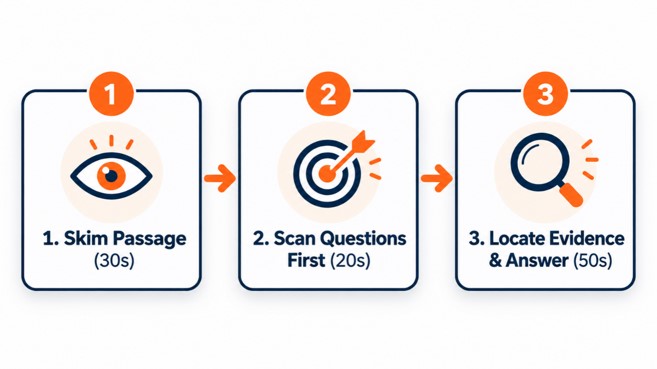
Here's a battle-tested framework for tackling MAT RC passages in 90–120 seconds:
Pass 1: Skim the Passage (30–40 seconds)
- Read the first sentence of each paragraph (topic sentences)
- Read the last sentence of the passage (conclusion)
- Identify the main theme (economics, literature, science, etc.)
- Don't read the entire passage word-by-word yet.
Pass 2: Read Questions First (15–20 seconds)
- Quickly scan all 3–4 questions for the passage
- Identify keywords in each question (names, dates, concepts)
- Note which questions are factual (direct answer in passage) vs. inferential (requires interpretation)
Pass 3: Evidence-Locate & Answer (45–60 seconds)
- Return to the passage and locate evidence for each question
- For factual questions: Find the exact sentence containing the answer
- For inferential questions: Identify the paragraph discussing the concept, then eliminate extreme options
- Mark your answer and move to the next passage
Why this works: Instead of reading the entire passage twice (once for comprehension, once for answers), you're reading strategically—focusing only on relevant sections. This cuts your time per passage by 40–50%.
Topic-Wise RC Preparation: Economics, Literature, Science, Philosophy Reading Lists
MAT RC passages typically cover these topics (based on 2025–2026 papers):
Economics & Business (30–35% of passages):
- Topics: GDP, inflation, fiscal policy, startup ecosystem, globalization, trade agreements
- Preparation: Read Economic Times editorials, Business Standard opinion pieces
- Key Vocabulary: fiscal deficit, monetary policy, quantitative easing, trade surplus, recession
Literature & Arts (20–25% of passages):
- Topics: Famous authors, literary movements, art history, cultural heritage, cinema
- Preparation: Read Hindu Literary Review, Indian Express Expressions section
- Key Vocabulary: protagonist, narrative, metaphor, symbolism, renaissance
Science & Technology (20–25% of passages):
- Topics: Climate change, AI/ML, space exploration, healthcare innovations, environment
- Preparation: Read Down To Earth magazine, Science Reporter, The Hindu Science section
- Key Vocabulary: sustainability, biodiversity, algorithm, machine learning, renewable energy
Philosophy & Social Issues (15–20% of passages):
- Topics: Ethics, morality, social justice, education reform, urbanization
- Preparation: Read Indian Express Explained, The Hindu Editorial page
- Key Vocabulary: utilitarianism, deontology, egalitarianism, paradigm shift, social mobility
History & Current Affairs (10–15% of passages):
- Topics: Indian independence, world wars, political movements, recent government schemes
- Preparation: Read Vision IAS Current Affairs, Pratiyogita Darpan
- Key Vocabulary: sovereignty, decolonization, bipartisan, coalition, referendum
Pro Tip: Don't try to master all topics equally. Focus on Economics & Business (highest frequency) and Science & Technology (growing trend in 2026 papers). Skim Literature and Philosophy passages quickly if they're not your strength.
Speed-Reading Drills: Pacer Method, Eye-Span Expansion, 10-Minute Passage Timer
Here's a 2-week speed-reading training plan to improve your reading speed from 200 wpm to 350+ wpm:
Week 1: Foundation Drills
- Day 1–3: Pacer Method – Use your pen/finger as a pacer under each line. Move the pacer slightly faster than your comfortable reading speed. Force your eyes to follow the pacer without regression (re-reading). Target: 250–280 wpm with 70% comprehension.
- Day 4–6: Eye-Span Expansion – Practice reading 3–4 words at a glance (instead of word-by-word). Focus on the center of each line, using peripheral vision for edges. Target: 280–320 wpm with 70% comprehension.
- Day 7: Full RC Mock – 4 RC passages, 10-minute timer per passage. Apply pacer method + eye-span together. Track accuracy (aim for 70–75% initially).
Week 2: Speed Integration
- Day 8–10: 10-Minute Passage Timer – Read 1 passage (300–350 words) in 3 minutes. Answer 3–4 questions in 2 minutes. Review answers in 1 minute. Repeat with 3 different passages daily.
- Day 11–13: Timed Passage Sets – 4 passages in 40 minutes (10 minutes per passage including questions). Simulate exam pressure with countdown timer. Track accuracy improvement (target: 80%+ by Day 13).
- Day 14: Full Language Comprehension Mock – 30 questions in 22–25 minutes. Apply all speed-reading techniques under exam conditions. Target: 25+ accuracy with 22-minute completion time.
Pro Tip: Speed-reading is a skill, not a talent. Consistent daily practice (30–45 minutes) for 2 weeks will show measurable improvement. Don't skip the drills—muscle memory matters.
This approach mirrors what we teach in our CAT 2026 VARC 40+ Strategy Score and Crack CAT VARC programs—speed-reading frameworks that work across all MBA entrance exams.
Vocabulary Building That Works: Root Words, Contextual Usage, 10-Words/Day System
Let's be honest: Most students prepare vocabulary the wrong way. They memorize word lists from apps or books, forget them within a week, and then panic when they see unfamiliar words in the exam.
Here's a better approach: Build vocabulary using root words, contextual learning, and daily reinforcement. This method helps you decode unfamiliar words in the exam even if you've never seen them before.
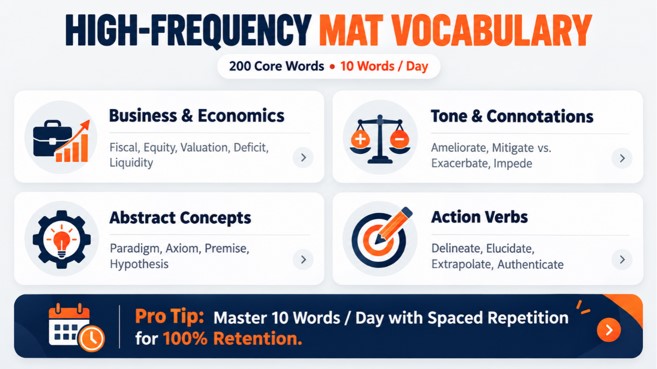
High-Frequency MAT Vocabulary: 200 Words That Appear Repeatedly
Based on analysis of MAT 2024–2026 papers, these vocabulary themes appear most frequently:
Business & Economics Vocabulary (40–50 words): Acronym, amalgamation, bankruptcy, collateral, deficit, depreciation, diversification, equity, fiscal, inflation, liquidity, merger, monetization, portfolio, recession, revenue, subsidy, tariff, valuation, yield
Positive/Negative Connotation Words (30–40 words):
- Positive: Alleviate, ameliorate, commend, corroborate, enhance, facilitate, galvanize, mitigate, optimize, reinforce
- Negative: Aggravate, hamper, hinder, impede, exacerbate, deteriorate, undermine, thwart, stifle, constrain
Abstract Concepts (30–40 words): Ambiguity, analogy, anomaly, axiom, consensus, conjecture, dogma, hypothesis, inference, paradigm, postulate, premise, rationale, skepticism, theory, thesis
Action Verbs (30–40 words): Articulate, ascertain, authenticate, calibrate, delineate, elucidate, emulate, exemplify, extrapolate, formulate, generalize, hypothesize, illustrate, validate
Pro Tip: Don't try to memorize all 200 words at once. Focus on 10 words per day using the system below. In 20 days, you'll have covered 200 high-frequency words with long-term retention.
Root Word Technique: Latin & Greek Origins for 5x Faster Learning
Why root words matter: If you know the root "bene" (good), you can decode: benefit, benevolent, benediction, benefactor, benign. One root = 5+ words.
Top 20 Latin/Greek Roots for MAT:
| Root | Meaning | Example Words |
|---|---|---|
| bene | good | benefit, benevolent, benediction |
| mal | bad | malice, malicious, malfunction |
| dict | say | dictate, diction, predict, verdict |
| spect | see | inspect, spectator, perspective |
| port | carry | transport, portable, import |
| ject | throw | reject, project, inject |
| struct | build | construct, structure, instruct |
| rupt | break | interrupt, rupture, disrupt |
| graph | write | graphic, autograph, biography |
| phon | sound | telephone, phonics, symphony |
| bio | life | biology, biography, antibiotic |
| geo | earth | geography, geometry, geology |
| chron | time | chronicle, chronic, synchronize |
| path | feeling | sympathy, empathy, apathy |
| log/logue | word/study | logic, dialogue, monologue |
| scope | see/observe | telescope, microscope, horoscope |
| meter/metron | measure | thermometer, barometer, diameter |
| therm | heat | thermal, thermometer, thermostat |
| hydro | water | hydroelectric, hydraulic, hydrophobia |
| aero | air | aeroplane, aerobic, aerosol |
How to use this: When you encounter an unfamiliar word in RC passages, break it down into root + prefix + suffix. For example:
- "Anticipate" = anti (before) + cip (take) + ate (verb) = "to take before" → to expect
- "Circumspect" = circum (around) + spect (see) = "to see around" → cautious
This technique helps you decode 60–70% of unfamiliar words in the exam without prior memorization.
Daily Vocabulary Routine: Newspaper Editorials, Word Notebook, Flashcards
Here's a sustainable daily routine (15–20 minutes/day):
Morning (5 minutes): Newspaper Editorial Reading – Read 1 editorial from The Hindu, Indian Express, or Economic Times. Circle 3–5 unfamiliar words. Look up meanings and note them in your vocabulary notebook.
Afternoon (5 minutes): Root Word Practice – Pick 1 root from the table above. Write 5–7 words using that root. Create 1 sentence for each word (contextual learning).
Evening (5–10 minutes): Flashcard Review – Use Anki or Quizlet for digital flashcards. Review 10–15 old words (spaced repetition). Add 5 new words from morning's editorial.
Weekly Review (30 minutes on Sunday): Revise all 50–60 words from the week. Take a mini vocabulary quiz (self-created or online). Identify weak words and re-add them to flashcard deck.
Pro Tip: Contextual learning (using words in sentences) improves retention by 3–4x compared to rote memorization. Always create at least 1 sentence per word.
This vocabulary-building approach aligns with what we teach in our Mastering XAT Verbal Ability & Reading Comprehension and Best GMAT Verbal Course programs—root-based learning that works across all MBA entrance exams.
Grammar Shortcuts: 10 Rules That Cover 80% of MAT Questions
Let's cut through the noise. MAT grammar questions test 10 core rules that appear repeatedly. Master these, and you'll handle 80% of grammar questions with confidence.
Subject-Verb Agreement (Most Tested Grammar Topic)
The Rule: Singular subjects take singular verbs; plural subjects take plural verbs.
Common Traps:
- Collective Nouns: "The team is winning" (singular), "The team are arguing" (plural, emphasizing individuals)
- Indefinite Pronouns: "Everyone has completed" (singular), "Few have completed" (plural)
- Either/Neither: "Neither the manager nor the employees were present" (verb agrees with closest subject)
Example MAT Question: "The list of items (is/are) on the table." → is (subject is "list," not "items")
Quick Check: Identify the true subject (ignore prepositional phrases like "of items," "along with," "together with").
Tenses & Active/Passive Voice (High-Frequency Errors)
Tense Consistency: Maintain the same tense throughout a sentence unless there's a clear time shift.
- Incorrect: "She goes to the market and bought vegetables."
- Correct: "She went to the market and bought vegetables."
Active vs. Passive Voice:
- Active: Subject performs the action ("The manager approved the proposal")
- Passive: Subject receives the action ("The proposal was approved by the manager")
- MAT typically tests passive voice in formal/business contexts ("The report was submitted by the team")
Example MAT Question: "The new policy (will implement/will be implemented) next month." → will be implemented (passive, policy receives action)
Prepositions, Articles, Pronouns (Quick Wins for 5–7 Marks)
Prepositions (Most Common Errors):
- Accused of (not "accused for"): "He was accused of theft."
- Interested in (not "interested for"): "She is interested in marketing."
- Good at (not "good in"): "He is good at mathematics."
- Angry with (person) / Angry at (situation): "She is angry with him" vs. "She is angry at the situation."
Articles (A/An/The):
- A/An: Used for non-specific, singular countable nouns ("a book," "an apple")
- The: Used for specific nouns, superlatives, unique things ("the book on the table," "the best student," "the sun")
- No Article: Used for plural/general nouns ("Dogs are loyal"), abstract nouns ("Honesty is important")
Pronouns (Common Errors):
- Who/Whom: "Who" is subject, "whom" is object ("Who called?" vs. "Whom did you call?")
- Its/It's: "Its" = possessive, "It's" = "It is" ("The dog wagged its tail" vs. "It's raining")
- Their/There/They're: "Their" = possessive, "There" = location, "They're" = "They are"
Error-Spotting Framework: 30-Second Rule for Grammar Questions
Here's a step-by-step framework for tackling MAT grammar questions in 30–45 seconds:
Step 1: Read the Full Sentence (10 seconds) – Don't jump to answer options immediately. Get a sense of the sentence structure and meaning.
Step 2: Identify the Error Type (10 seconds) – Is it subject-verb agreement? Tense inconsistency? Preposition/article misuse? Pronoun error?
Step 3: Eliminate Obvious Wrong Options (10 seconds) – If two options have the same error, eliminate both. If one option changes the meaning, eliminate it. Choose the most concise, grammatically correct option.
Step 4: Plug In Your Answer (5 seconds) – Read the sentence with your chosen option. Ensure it sounds natural and maintains the original meaning.
Pro Tip: If you're stuck between two options, choose the more concise one. MAT grammar questions rarely reward wordiness.
This grammar framework mirrors what we teach in our CAT 2026 VARC 40+ Strategy Score program—systematic error identification that works across all MBA entrance exams.
Para Jumbles & Verbal Reasoning: 90-Second Solving Framework
Para Jumbles (sentence rearrangement) and Verbal Reasoning questions appear 3–5 times in MAT Language Comprehension. While they seem tricky, they follow predictable patterns that you can master with the right framework.
Lead Sentence Identification: Opening Clues (Definitions, Introductions)
The first sentence of a para jumble typically:
- Introduces the main topic or concept
- Provides a definition or general statement
- Does NOT contain pronouns (he, she, it, they) referring to unspecified nouns
- Does NOT contain connecting words (however, therefore, but, moreover)
Example: Lead Sentence: "Artificial Intelligence is transforming industries worldwide." Not Lead: "However, its implementation faces ethical challenges." (starts with "However," contains "its" referring to AI)
Quick Check: If a sentence starts with a pronoun or connecting word, it's probably NOT the opening sentence.
Closing Sentence Detection: Conclusions, Summaries, Recommendations
The last sentence of a para jumble typically:
- Provides a conclusion or summary
- Makes a recommendation or prediction
- Contains words like "therefore," "thus," "hence," "in conclusion," "to summarize"
- Ties together the ideas from previous sentences
Example: Closing Sentence: "Therefore, businesses must adopt AI responsibly to maximize benefits." Not Closing: "For instance, chatbots improve customer service efficiency." (gives an example, not a conclusion)
Connector-Based Linking: Pronouns, Transition Words, Logical Flow
Pronoun References: If Sentence B contains "it," "they," "he," "she," find the noun in Sentence A that the pronoun refers to. Example: "AI is advancing rapidly. It is being used in healthcare." → "It" refers to "AI," so these sentences should be consecutive.
Transition Words:
- Addition: moreover, furthermore, additionally, also
- Contrast: however, but, nevertheless, on the other hand
- Cause-Effect: therefore, thus, hence, consequently, as a result
Logical Flow: General → Specific, Problem → Solution, or Chronological (past → present → future).
Example Para Jumble:
- "Therefore, companies must balance innovation with ethical considerations."
- "Artificial Intelligence is transforming industries worldwide."
- "For instance, chatbots improve customer service efficiency."
- "However, its implementation faces ethical challenges."
Correct Order: 2 → 3 → 4 → 1 (Sentence 2 is the lead, 3 is an example, 4 is a contrast, 1 is the conclusion)
3-Question Elimination Technique for Verbal Reasoning
For verbal reasoning questions (odd one out, sentence completion, analogies), use this elimination framework:
Odd One Out: Read all sentences, identify the common theme, eliminate sentences that align with it, and choose the sentence that introduces a different topic or tone.
Sentence Completion: Read the full sentence, identify the tone, eliminate options that don't match, and choose the option that maintains grammatical consistency.
Analogies: Identify the relationship between A and B, apply the same relationship to C and the answer options, and eliminate options that don't match the pattern.
Pro Tip: For all verbal reasoning questions, eliminate first, then select. Don't try to find the "perfect" answer immediately—eliminate obviously wrong options, then choose from the remaining 2–3.
This verbal reasoning framework aligns with what we teach in our Mastering XAT Verbal Ability & Reading Comprehension and Best GMAT Verbal Course programs—systematic elimination that works across all MBA entrance exams.
30-Day Language Comprehension Blitz Plan
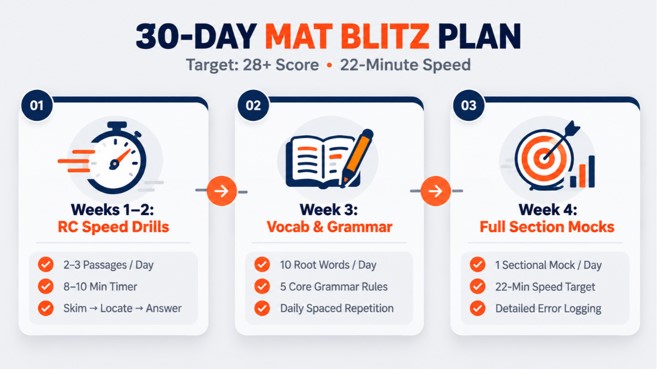
Theory is useless without practice. Here's a focused 30-day drill to transform your MAT Language Comprehension accuracy from 18–20/30 to 26–28/30.
Week 1–2: RC Speed Drills (2 Passages/Day, 10-Minute Timer)
Daily Practice (45–60 minutes):
- Day 1–7: Foundation Building – 2 RC passages per day (different topics). 10-minute timer per passage (3 minutes reading, 5 minutes answering, 2 minutes review). Apply the 3-Pass RC Strategy. Track accuracy: Aim for 70–75%.
- Day 8–14: Speed Integration – 3 RC passages per day (mixed topics). 8-minute timer per passage. Apply pacer method + eye-span expansion techniques. Track accuracy: Aim for 75–80%.
Pro Tip: Use MAT-specific RC passages (not CAT-level difficulty). Focus on Economics and Science topics (highest frequency in MAT).
Week 3: Vocabulary & Grammar (10 Words/Day, 5 Grammar Rules/Day)
Daily Practice (30–45 minutes):
- Day 15–21: Vocabulary Blitz – Learn 10 new words per day using root word technique. Create 1 sentence per word. Review 20 old words daily. Take a mini vocabulary quiz on Day 21 (50 words total).
- Day 15–21: Grammar Focus – Practice 5 grammar rules per day. Solve 10–15 grammar questions daily. Review mistakes and create an error log. Take a mini grammar quiz on Day 21 (25 questions total).
Pro Tip: Don't try to learn 50+ words in one day. Consistent daily practice (10 words/day) with spaced repetition ensures long-term retention.
Week 4: Full Section Mocks (22-Minute Target, 28+ Accuracy)
Daily Practice (60–75 minutes):
- Day 22–26: Sectional Mocks – 1 full Language Comprehension section per day (30 questions). 22-minute timer (simulate exam pressure). Apply all strategies. Track accuracy: Aim for 25–26/30 by Day 26.
- Day 27–29: Full-Length MAT Mocks – 1 full MAT mock per day (all 5 sections, 120 minutes). Focus on Language Comprehension timing (22–25 minutes target). Analyze sectional performance and adjust strategy.
- Day 30: Light Revision – Review vocabulary flashcards (200 high-frequency words). Revise grammar rules (10 core rules). No new mocks. Sleep early.
Pro Tip: During mocks, track not just your total score, but your sectional timing. If you're consistently taking 28–30 minutes for Language Comprehension, you need to speed up RC passages or vocabulary questions.
Error Log Template: Track RC Topic Weaknesses, Grammar Mistake Patterns
Create an error log with these columns:
| Date | Question Type | Topic | Mistake Reason | Action Plan |
|---|---|---|---|---|
| Day 5 | RC | Economics | Misinterpreted author's tone | Practice economics editorials daily |
| Day 8 | Vocabulary | Root Words | Confused "bene" vs. "mal" roots | Revise root word table, create flashcards |
| Day 12 | Grammar | Subject-Verb Agreement | Missed collective noun ("team is/are") | Practice collective noun exercises |
| Day 18 | Para Jumbles | Connector Words | Misidentified "however" as lead sentence | Review transition word list |
| Day 24 | RC | Science | Ran out of time (spent 4 minutes on passage) | Apply 3-Pass RC strategy strictly |
Why this matters: Your error log reveals patterns. If you're consistently missing RC questions on Economics passages, you know to read more business editorials. If grammar mistakes are mostly subject-verb agreement, you know to focus on that rule.
This 30-day blitz plan mirrors what we teach in our CAT 2026 VARC 40+ Strategy Score and Crack CAT VARC programs—structured, drill-based preparation that delivers measurable improvement.
Your MAT Language Comprehension Action Plan: Next Steps

Understanding MAT Language Comprehension strategy is just the first step. Here's how to turn this knowledge into 28+ accuracy with 22–25 minute timing:
1. Take a Diagnostic Mock This Week
Don't wait. Take a full MAT Language Comprehension sectional mock in the next 3–4 days. Don't worry about your score—focus on identifying:
- Which RC topics are you strongest at? (Economics, Literature, Science, Philosophy)
- Where do you lose the most time? (RC passages, vocabulary, grammar, para jumbles)
- How many questions did you miss due to careless errors vs. conceptual gaps?
2. Build Your 30-Day Practice Calendar
Based on your mock analysis, create a personalized 30-day calendar using the blitz plan above. Adjust the focus based on your weaknesses:
- Weak in RC? Add extra RC passages (3–4 per day instead of 2)
- Weak in Vocabulary? Increase daily word count (15 words/day instead of 10)
- Weak in Grammar? Dedicate extra time to grammar rules (10 rules/day instead of 5)
3. Join Structured MAT Preparation
If you're serious about scoring 700+ composite (90+ percentile), generic prep won't cut it. You need:
- MAT-specific mock tests that mirror AIMA's question patterns
- Sectional strategy sessions focused on your weak areas
- Expert mentorship to analyze your mock performance and adjust your approach
At VerbalHub, we offer Ace MAT 2026 with Live Online Classes, designed specifically for aspirants targeting 700+ composite scores. Our language comprehension module includes RC speed drills, vocabulary root-word frameworks, grammar shortcut sessions, and personalized feedback on your error logs.
4. Download Your Free MAT Language Comprehension Checklist
RC Speed Checklist:
- I apply the 3-Pass RC Strategy (Skim → Question-First → Evidence-Locate)
- I spend 90–120 seconds per RC passage (not 3–4 minutes)
- I focus on Economics and Science topics (highest frequency in MAT)
- I use pacer method + eye-span expansion for speed-reading
Vocabulary Checklist:
- I learn 10 words/day using root word technique
- I create 1 sentence per word (contextual learning)
- I review 20 old words daily (spaced repetition)
- I know 200 high-frequency MAT vocabulary words
Grammar Checklist:
- I master 10 core grammar rules (subject-verb, tenses, prepositions, articles, pronouns)
- I use the 30-second error-spotting framework
- I track grammar mistakes in an error log
- I score 5–7/7 on grammar questions consistently
Para Jumbles Checklist:
- I identify lead sentences (no pronouns, no connecting words)
- I identify closing sentences (conclusions, summaries, recommendations)
- I link sentences using pronouns and transition words
- I use the 3-question elimination technique for verbal reasoning
Frequently Asked Questions: MAT Language Comprehension
Typically 4–5 passages with 3–4 questions each (12–15 RC questions total). Passages are 200–350 words long, covering topics like Economics, Literature, Science, Philosophy, and Current Affairs.
Yes. MAT has 0.25 negative marking per wrong answer across all sections, including Language Comprehension. Accuracy matters more than blind attempts. Aim for 26–28 attempts with 90%+ accuracy instead of 30 attempts with 75% accuracy.
Target 22–25 minutes for the entire section (30 questions). This leaves 95+ minutes for the other four sections (Mathematical Skills, Data Analysis, Reasoning, GK). If you're taking 28–30 minutes, you're going too slow and sacrificing time from other sections.
MAT RC is shorter and easier than CAT RC. MAT passages are 200–350 words with direct, factual questions. CAT passages are 500–800 words with abstract, analytical questions. MAT rewards speed-reading and direct comprehension; CAT rewards deep analytical thinking.
Use the root word technique. Learn 20 Latin/Greek roots (bene, mal, dict, spect, port, etc.) and decode 5–7 words per root. This helps you understand 100+ words from just 20 roots. Combine this with daily newspaper editorial reading (10 unfamiliar words/day) and flashcard review (spaced repetition).
Ready to Crack MAT Language Comprehension?
Mastering MAT Language Comprehension is about strategy, not just vocabulary lists. With the right RC speed techniques, vocabulary frameworks, grammar shortcuts, and consistent practice, you can hit 28+ accuracy with 22–25 minute timing—and secure your 700+ composite score.
If you're looking for structured guidance, personalized mentorship, and MAT-specific mock tests that mirror the real exam, explore our Best MAT Coaching in India programs.
Your 28+ score starts with one decision: to prepare smarter, not harder.
Related Reads:
- MAT Composite Score vs. Percentile 2026/2027: Target Marks for Top Non-IIM B-Schools (Coming Soon)
- MAT Data Analysis & Sufficiency Strategy 2026: DI Set Selection, Calculation Shortcuts & Data Sufficiency Logic (Coming Soon)
- MAT PBT vs. CBT 2026: Which Mode Should You Choose? (Coming Soon)
- MAT 4-Attempt Strategy 2026/2027: Which Session to Target (Coming Soon)
- Crack CAT VARC
- CAT 2026 VARC 40+ Strategy Score
- Mastering XAT Verbal Ability & Reading Comprehension
- Best GMAT Verbal Course
- Ace MAT 2026 with Live Online Classes
- Best MAT Coaching in India
About VerbalHub:
VerbalHub is India's trusted test-prep platform for GMAT, CAT, MAT, GRE, SAT, XAT, SNAP, IPMAT, and PTE. With 99+ percentile mentorship, AI-driven mock intelligence, and personalized 1-on-1 coaching, we've helped thousands of students crack top B-schools and achieve their study-abroad dreams.
Contact: +91-7827040357 | www.verbalhub.com