By Hasan Raja, Founder and Lead Mentor, VerbalHub | Updated 23 October 2026

Start with percentages, ratios and basic equations. Then build algebra and geometry alongside your arithmetic practice. Waiting to become perfect at arithmetic before touching anything else can leave you badly short of preparation time.
Good IPMAT quantitative ability preparation gives you enough range to recognise manageable questions across topics. You need accurate calculations, clear concepts and the judgement to leave a question when it stops being worth your time.
This guide explains how to build those habits, whether you are in Class 11, balancing Class 12 boards or preparing during a drop year.
IN THIS GUIDE
Understand the QA section
Indore and Rohtak need different plans
The MCQ-and-short-answer structure discussed here refers to IIM Indore. Do not apply it to every exam called IPMAT.
IIM Indore's published 2026 admission policy specifies separate QA-MCQ and QA-SA sections, each lasting 40 minutes. Correct answers earn four marks. Wrong MCQ answers lose one mark; wrong SA answers carry no penalty. Sections follow a fixed order, so you cannot freely move time between them. Official Indore admission policy
For practice, the recent Indore question-count pattern gives this planning table:
| QA section | Questions | Time | Maximum raw marks | Correct | Incorrect |
|---|---|---|---|---|---|
| Multiple Choice | 30 | 40 minutes | 120 | +4 | −1 |
| Short Answer | 15 | 40 minutes | 60 | +4 | 0 |
| Combined QA | 45 | 80 minutes | 180 | — | — |
These counts are a recent-pattern planning reference, not a confirmed 2027 announcement. The official policy cited above confirms section timings and marking but does not state question counts. Recheck the 2027 notice and test instructions when available.
Rohtak's published 2026 structure instead lists 40 MCQs each in Quantitative Ability, Logical Reasoning and Verbal Ability, across a 120-minute test. Its QA preparation therefore needs a different test-taking plan. Official Rohtak admissions page
For a broader introduction, read VerbalHub's guide to the full IPMAT syllabus and eligibility, alongside the relevant institute's notices.
Why SA deserves regular practice
No negative marking makes SA worth practising from the beginning. However, it does not automatically make SA the easiest section or the section with the best return for every student.
You must produce an answer without options. You also need to meet Indore's sectional requirements; a strong MCQ score cannot simply cancel out a weak SA performance.
Try every SA question you can reasonably solve. Use remaining seconds for plausible final entries, rather than spending valuable solving time on blind guesses.
Arithmetic vs. higher math: What comes first?
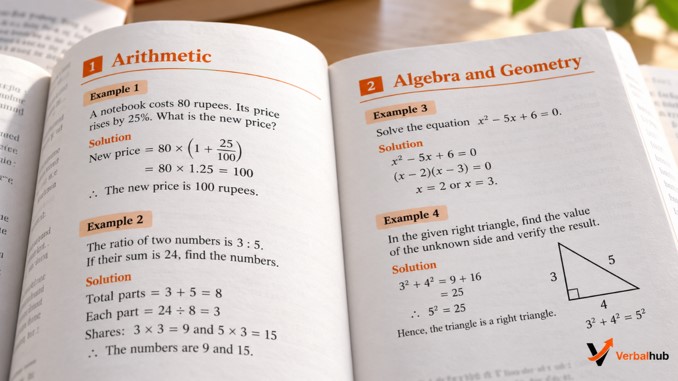
Arithmetic builds useful habits
Begin with percentages, ratio and proportion, averages, profit and loss, interest, mixtures, time and work, and time-speed-distance.
These topics develop skills you reuse elsewhere: handling fractions, choosing a convenient base, translating words into equations and checking whether an answer makes sense. They can be tested through either MCQ or SA questions; the response format does not belong to a particular topic.
Consider a price that rises by 20% and then falls by 20%. Start at ₹100. It becomes ₹120, then ₹96. The overall change is a 4% decrease.
That small example teaches an essential habit: check the base before applying a percentage. Memorising a shortcut without understanding the base will not help when the wording changes.
Arithmetic often offers a comfortable entry point. Still, a lengthy mixtures problem can be harder than a direct quadratic equation. Select questions by their actual demands, rather than by chapter name alone.
Algebra and geometry belong in the main plan
The arithmetic vs algebra IPMAT debate becomes unhelpful when students feel forced to choose one permanently.
Build basic arithmetic first, then introduce algebra within the same preparation cycle. Cover linear and quadratic equations, inequalities, indices, logarithms, sequences, functions and sets. Add triangles, circles, mensuration and coordinate geometry in manageable blocks.
For example, solving x² − 7x + 12 = 0 takes only a few steps once you recognise (x − 3)(x − 4). The answers are 3 and 4. There is no reason to leave that question merely because it is labelled algebra.
Treat number systems as a separate foundation area. Divisibility, factors, remainders and integer properties deserve their own practice.
"Higher math" is a loose coaching label. It should not make every topic beyond arithmetic sound equally difficult.
Topic-wise priority for IPMAT QA
Use this matrix to decide what to learn first. It is a teaching recommendation, not an official topic-weightage chart or a prediction of the 2027 paper.
| Priority | Topics | What to practise first |
|---|---|---|
| Must-do foundations | Percentages, ratios, averages, profit and loss, time-speed-distance, time and work | Fraction conversions, choosing a base, rate equations and word-problem translation |
| Must-do alongside foundations | Linear and quadratic equations, basic inequalities, triangles and circles | Factorisation, sign conditions, similarity, angles and area relationships |
| Next coverage | Simple and compound interest, mixtures, number systems, coordinate geometry, indices and logarithms | Standard question forms, domain restrictions and links to earlier concepts |
| Build before final revision | Functions, sets, sequences and series, basic P&C, probability and trigonometry | Definitions, counting cases, basic identities and straightforward applications |
| Defer when time is tight | Unusually advanced counting, lengthy probability casework, difficult trigonometric manipulations and calculus extensions | Consider only after checking target-exam relevance and your remaining preparation gaps |
Why a blanket "can-skip" list is risky
Do not skip all probability because one question looked difficult. Basic probability may require only a clear count of favourable and total outcomes. The same applies to trigonometry: a direct application differs greatly from a long identity proof.
For calculus, check current exam-specific guidance and relevant past questions before investing substantial time. Neither a coaching chapter list nor a social-media prediction establishes the official IPMAT quantitative ability syllabus 2027.
Topic priority should reflect three things: your target exam, relevant past-paper evidence and your own accuracy. Keep a weak foundation topic high on the list even if you dislike it.
A practical starting split
If basic calculations are weak, try this allocation for your first two weeks:
- 50%: arithmetic and calculation practice.
- 30%: basic algebra and geometry.
- 20%: mixed revision and error correction.
This is a suggested starting point, not a universal formula. After two weeks, shift time towards the gaps your work reveals. A student comfortable with arithmetic should move into broader coverage sooner.
A daily routine for IPMAT quantitative ability

Beginners: 15–25 questions with proper review
Work mainly on one topic at a time. Begin with solved examples, then attempt similar questions independently before trying unfamiliar versions.
A 60–90-minute session can include:
- Ten minutes revising yesterday's work.
- Twenty minutes learning one concept.
- Thirty to forty minutes solving questions.
- Fifteen to twenty minutes reviewing mistakes.
If ten questions expose a serious gap, stop and repair it. Finishing a daily quota is less useful than understanding why your method failed.
Intermediate students: 25–40 questions, including mixed practice
With roughly six months or more available, retain topic study but introduce mixed sets. Otherwise, the chapter heading keeps telling you which method to use.
Try a weekly mix of three learning days, two mixed-practice days, one sectional-test day and one lighter revision day. Adapt this to schoolwork and your current coverage.
Students managing boards can use the guide to balancing QA prep with Class 12 boards. During practicals and pre-boards, shorten sessions while keeping a small revision habit alive.
Final three months: timed work and selective repair
On practice-heavy days, 40 or more questions may be manageable, including sectional questions. On difficult test-review days, fewer can be enough.
For Indore, practise each QA section under its own 40-minute limit. Include full mocks to build stamina across the complete exam, then review missed opportunities and poor question choices.
During the final month, reduce new material. Revisit formulas, familiar question forms and recurring errors. A dropper should also diagnose the previous attempt: was the main problem missing concepts, slow solving or weak selection? Extra study hours alone do not answer that question.
Keep one formula sheet per topic
A useful IPMAT QA formula sheet and shortcuts notebook contains:
- The formula and the conditions under which it works.
- One worked example.
- One common trap.
- One quick check.
For equal-distance journeys at speeds u and v, average speed is 2uv/(u + v). Write equal distances beside it. For equal time intervals, the average is (u + v)/2. The condition matters as much as the formula.
IPMAT short answer questions strategy
1. Read carefully, then check the exact demand
Notice words such as "integer," "positive," "minimum," "distinct" and "excluding." Reread the question before entering your answer, especially when several quantities appear in the working.
2. Estimate where an estimate helps
Suppose a traveller covers 150 km at 50 km/h and 150 km at 75 km/h. The average speed must lie between 50 and 75 km/h.
The journey takes 3 + 2 = 5 hours. Average speed is 300 ÷ 5 = 60 km/h. An answer of 600 should immediately trigger a check.
3. Solve with visible working
Write enough intermediate steps to catch a sign error or missing factor. Mental calculation helps with simple operations; squeezing a complicated solution into your head can create unnecessary mistakes.
4. Check units and answer-entry rules
If a question asks for minutes, convert an answer calculated in hours. If it asks for a count, check whether both endpoints are included.
Do not round unless instructed. Follow the displayed rules for integers, decimals or other permitted entries. There is no universal rule that every SA answer should be rounded to two decimal places.
5. Move on when progress stops
If you cannot identify a workable approach after roughly a minute, consider returning later. This is a flexible checkpoint, not a rule to abandon every question at 60 seconds.
The IPMAT short answer section has no negative marking under the cited Indore policy, but lost time still costs marks. Solve accessible questions first. Return to unfinished ones, then use final seconds for plausible entries where permitted.
How to improve IPMAT QA accuracy and time management
Record the reason for each mistake rather than writing "careless" beside everything.
| Error type | What happened | Next action |
|---|---|---|
| Concept gap | You did not know how to begin | Relearn the concept and solve a few fresh examples |
| Translation error | You turned the wording into the wrong equation | Define quantities and rewrite the relationship |
| Calculation error | The method was right; arithmetic failed | Practise the specific operation and show clearer steps |
| Selection error | One question consumed too much time | Identify an earlier point at which to leave it |
| Answer-entry error | You entered the wrong value or unit | Check the final demand against your working |
Track accuracy as correct answers divided by attempted answers. Also track correct answers per 40-minute section. One shows reliability; the other shows whether you are converting time into marks.
Reattempt errors after a short gap and again the following week. Then solve a fresh variation. Remembering yesterday's answer is different from understanding the method.
In MCQs, use estimation, substitution or options when they save time without weakening your reasoning. In SA, practise producing the answer independently. Both habits belong in your IPMAT QA practice questions routine.
When personal guidance can help

One-on-one coaching for quantitative ability can help when your needs differ sharply across topics. You may understand percentages quickly but need several lessons on functions. A personal plan can adjust that pace.
VerbalHub is founded and led by Hasan Raja, an IIM Kozhikode alumnus and lead verbal mentor. His teaching and mentoring background includes approximately 20 years of experience and 10,000+ learners mentored across programmes. These are overall credentials, rather than a claim that all those learners entered IPM programmes.
For QA support, discuss the assigned Quant faculty and how your individual plan will work. Useful personal coaching should provide:
- A diagnostic assessment and topic-wise learning order.
- Targeted question sets based on weak areas.
- Live explanation of doubts and alternative methods.
- Mock review that separates concept, calculation and selection errors.
- Regular progress checks and a rehearsed exam-day routine.
VerbalHub's published personalised programme describes diagnostic assessment, individual assignments, doubt-solving, progress tracking and mock review. Ask how those features will address your own gaps.
If you want structured guidance and personal attention, explore VerbalHub's IPMAT one-on-one coaching. Take a recent practice set to the discussion so the plan begins with evidence of what you need.
For today: choose one weak arithmetic concept, solve ten questions carefully and review every error. Then give one basic algebra topic a place in tomorrow's schedule.
Offline revision: Keep this Word guide on your study table. Revisit the priority matrix, formula-sheet checklist and SA steps during weekly revision.
VerbalHub: +91 7827040357 | info@verbalhub.com | www.verbalhub.com
Frequently Asked Questions
Start with percentages, ratios, averages and basic equations. Once these concepts become comfortable, introduce algebra and geometry alongside arithmetic. Do not wait to finish every arithmetic chapter before moving ahead.
Arithmetic alone leaves gaps in your preparation. Build a working knowledge of algebra, geometry, number systems and other relevant topics. Broader coverage gives you more chances to find questions you can solve accurately.
Begin with percentages, ratio and proportion, averages, profit and loss, time and work, and time-speed-distance. Add linear equations, quadratic equations, triangles and circles. This is a suggested learning order, rather than a prediction of topic weightage.
Beginners can aim for 15–25 questions with careful review. As concepts improve, move towards 25–40 questions, including mixed sets. Adjust the target when difficult questions or mock analysis need more time.
Begin with fractions, decimals, percentages and simple equations. Use worked examples, then solve similar questions independently. Gradually introduce unfamiliar problems and timed practice. Choose your starting point through a diagnostic test.
Record why each answer went wrong: a concept gap, misreading, calculation error, poor question choice or incorrect answer entry. Reattempt the question after a gap, then solve a fresh variation to check your understanding.
Identify exactly what the question asks, write clear working and check units before entering the answer. Estimate where useful. If you stop making progress, move on and return later rather than letting one question consume the section.
VerbalHub's personalised programme includes diagnostic assessment, individual assignments, doubt-solving and mock review. Discuss your weak topics and assigned Quant mentor before joining so your study plan addresses the areas where you need support.