
PERSONALISED IPMAT PREPARATION

Is personalised preparation right for you?
One Student. One Mentor. One Customised Plan.
Individual attention, targeted practice, regular feedback and preparation built around your level, pace and academic schedule.
Why Every IPMAT Aspirant Needs a Different Plan
Preparing for IPMAT is not the same journey for every student. One learner may be comfortable with Reading Comprehension but struggle with algebra. Another may understand most concepts yet lose marks because of poor question selection or time management.
This is where IPMAT Coaching One-on-One can help. Instead of following a standard classroom plan, you work directly with a mentor who adjusts the classes, practice material and preparation strategy according to your current level.
At VerbalHub Education Private Limited, personalised preparation focuses on individual attention, targeted practice, regular feedback and continuous progress tracking. The objective is not to make unrealistic promises but to help each student prepare through a structured and practical process.
What Is IPMAT Coaching One-on-One?
One-on-One IPMAT Coaching is a learning format in which one student works directly with an IPMAT mentor. The classes are planned around the student's strengths, weaknesses, target examinations and academic schedule.
Unlike a fixed group programme, IPMAT One-on-One Coaching allows the mentor to spend more time on the areas in which the student genuinely needs support.
- An initial assessment of the student's current level
- A customised preparation plan
- Individual concept-building sessions
- Personal doubt-solving and mistake-specific feedback
- Topic-wise assignments and targeted practice
- Sectional and mock-test analysis
- Revision and time-management planning
The Practical Difference
One-to-One IPMAT Classes can be especially useful when a student requires a different pace, closer supervision or more detailed feedback than a regular classroom can provide.
Why Standard Classroom Preparation May Not Suit Everyone
Group coaching can work well for students who are comfortable following a common schedule. However, learners in the same classroom often have very different academic backgrounds and preparation needs.
- Class 9–10: gradual aptitude and reading foundations
- Class 11: structured preparation alongside school
- Class 12: balance between boards and entrance preparation
- Drop year: faster concept repair, timed practice and mock analysis
- Strong Quant, weak Verbal—or the reverse
- Good concepts but inconsistent speed, accuracy or question selection
A common plan cannot always address these differences. Personalised IPMAT Coaching gives the mentor the flexibility to decide what the student should learn, practise and revise at each stage.
How VerbalHub Personalises Your Preparation
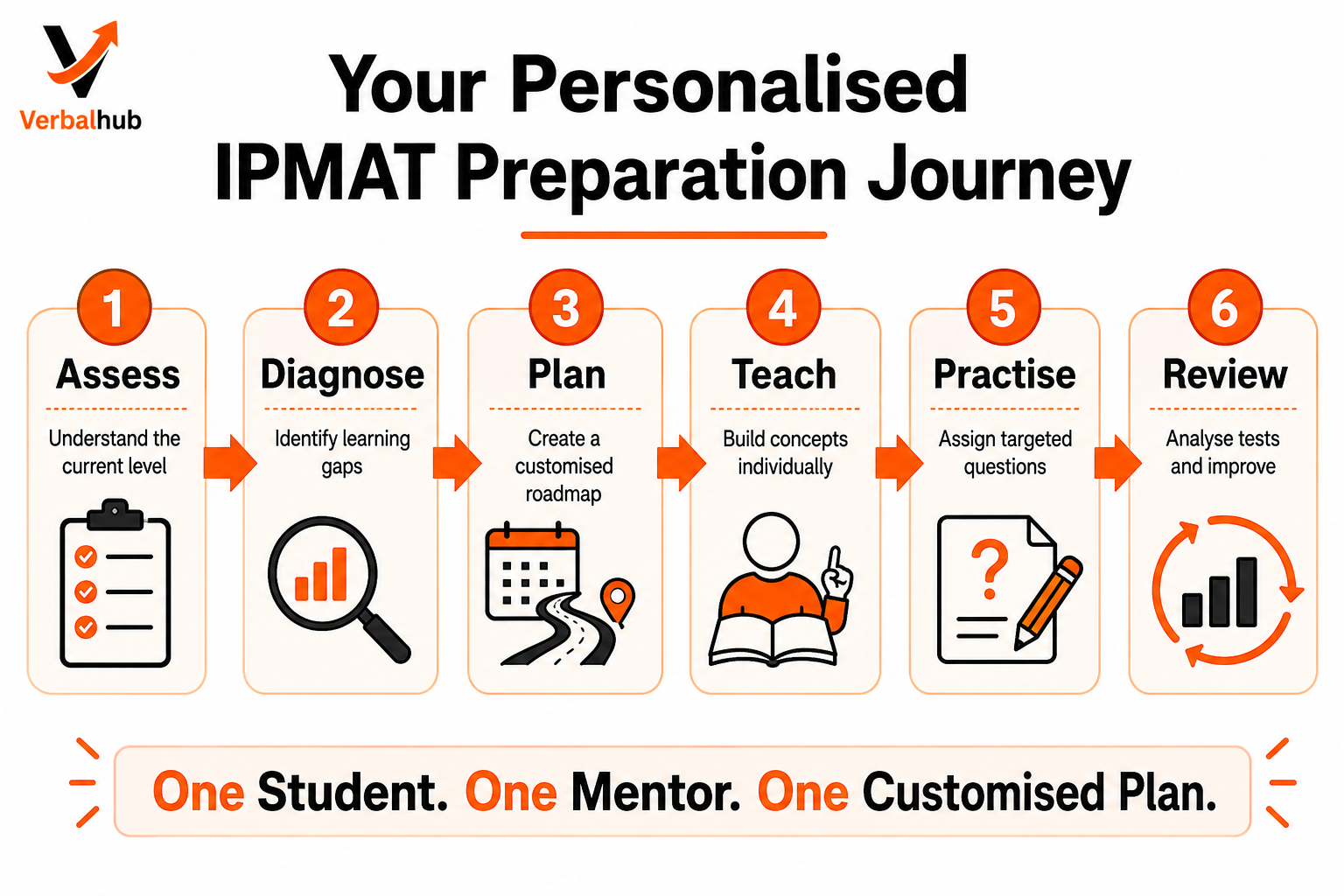
- Initial discussion and assessment: The mentor reviews your academic background, target examinations, previous preparation, available study time and current challenges. A diagnostic assessment helps distinguish concept gaps from problems in speed, accuracy or test-taking habits.
- Identify precise learning gaps: "Weak in Quant" is too broad. The actual issue may be arithmetic fundamentals, algebra, slow calculation, question interpretation or selection. Verbal weaknesses may involve vocabulary, comprehension, elimination or reading efficiency.
- Create an individual study plan: The plan defines topic order, weekly practice, revision intervals, sectional tests and mock frequency. It changes when performance shows that a different approach is needed.
- Build concepts at the right pace: The mentor can add examples, change the explanation or revisit a foundation without forcing the student to match a batch pace.
- Assign targeted practice: Practice is selected according to recently covered topics and observed errors. Students spend more time on the weakness that matters, not on repetitive general worksheets.
- Solve doubts and review reasoning: The mentor examines not only whether an answer is wrong, but why it went wrong—concept gap, misreading, calculation error, poor elimination or excessive time.
- Use sectionals and mocks at the right stage: Tests measure accuracy, speed, question selection, time allocation and performance under pressure. Their frequency depends on the learner's readiness.
- Analyse performance and revise: Mock analysis identifies avoidable errors, missed opportunities and recurring patterns. The next learning cycle is planned from this evidence.
- Build a final examination strategy: As the exam approaches, preparation shifts towards revision, timed practice, question selection, pressure management and a realistic test-day plan.
Why Choose VerbalHub for Personalised IPMAT Coaching?
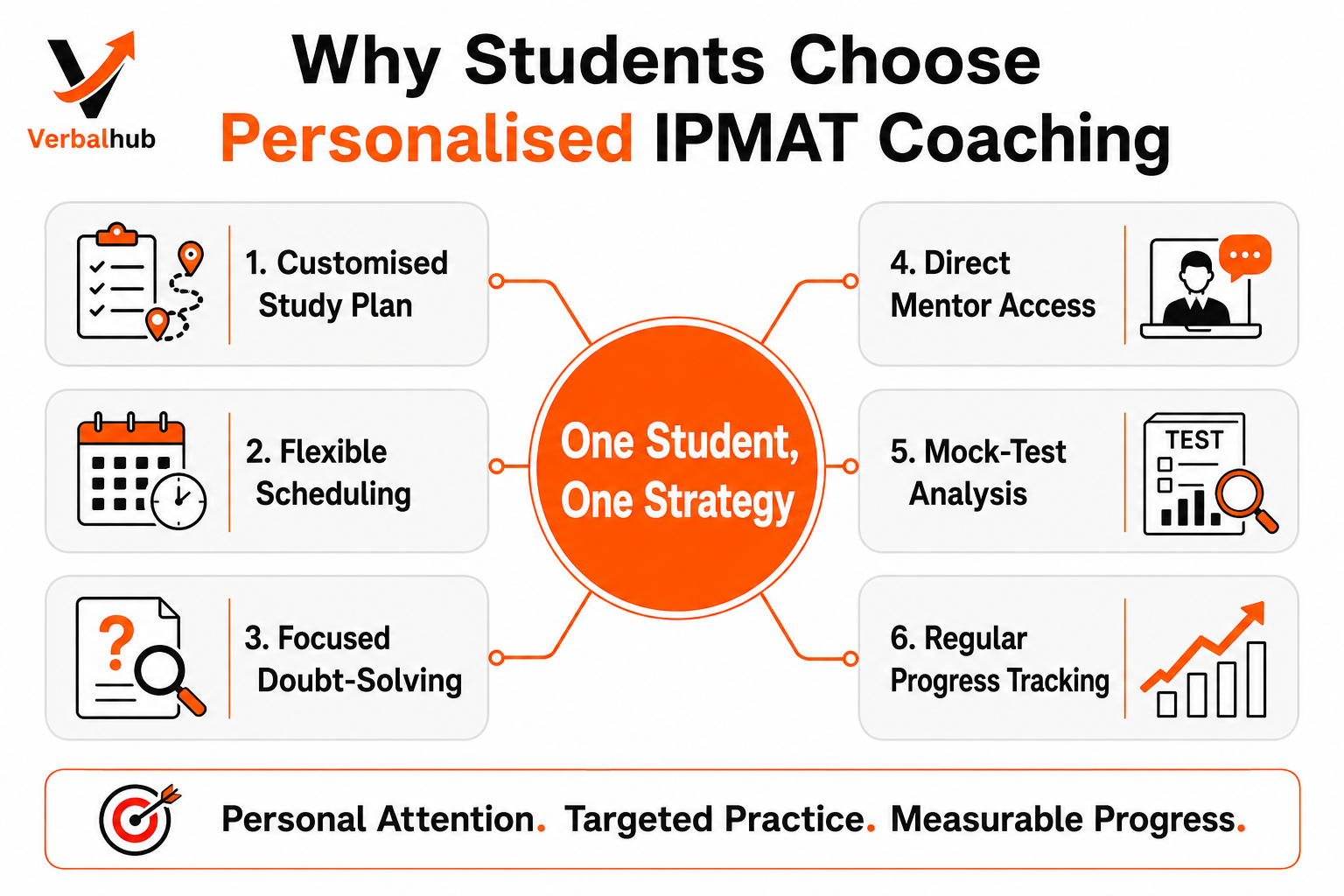
VerbalHub's IPMAT Personalised Coaching programme is designed for students who need an individual pace, direct mentor interaction and preparation that responds to their performance.
- One student and one customised preparation strategy
- Personalised diagnostic assessment
- Flexible scheduling around school or college
- Focused doubt-solving and individual assignments
- Detailed feedback on errors
- Topic-wise and sectional improvement plans
- Regular progress tracking
- Mock-test review and analysis
- Personal revision and exam-day strategy
- Time-management and question-selection guidance
- Progress discussions with students or parents, where appropriate
- Direct access to an assigned mentor
Three Questions the Programme Should Answer
What should I study now? Why am I making these mistakes? What should I do next?
Faculty and Mentorship
Faculty experience matters because a personal mentor must do more than explain a syllabus. The mentor should identify patterns in performance, correct ineffective habits and adapt the preparation plan.
Hasan Sir | Lead Verbal Mentor
IIM Kozhikode alumnus • 99th percentile achiever • Approximately 20 years of teaching and mentoring experience
Hasan Sir helps students approach Verbal Ability, Reading Comprehension and aptitude preparation through a structured process. Students learn how to understand questions, eliminate unsuitable options, avoid common reasoning mistakes and work towards better accuracy.
No mentor can guarantee a particular score or admission. Experienced guidance can, however, help students prepare more systematically and learn from their performance.
Who Can Benefit From IPMAT Individual Classes?
- Beginners who need a structured starting point
- Class 9–10 students building early aptitude foundations
- Class 11 students beginning formal IPMAT preparation
- Class 12 students balancing boards and entrance tests
- Drop-year students following an intensive plan
- Students with weak Quantitative Ability fundamentals
- Students needing support in Verbal Ability or Reading Comprehension
- Learners preparing for multiple aptitude examinations
- Students who need flexible online classes
- Students already in a group course but needing extra support
- Aspirants who need detailed mock-test analysis
- Students who need stronger accountability
IPMAT Private Coaching may also help students who hesitate to ask questions in a group or need concepts explained at a different pace. IPMAT Coaching with a Personal Mentor provides clearer weekly goals and regular follow-up.
What Students Learn in One-to-One IPMAT Classes
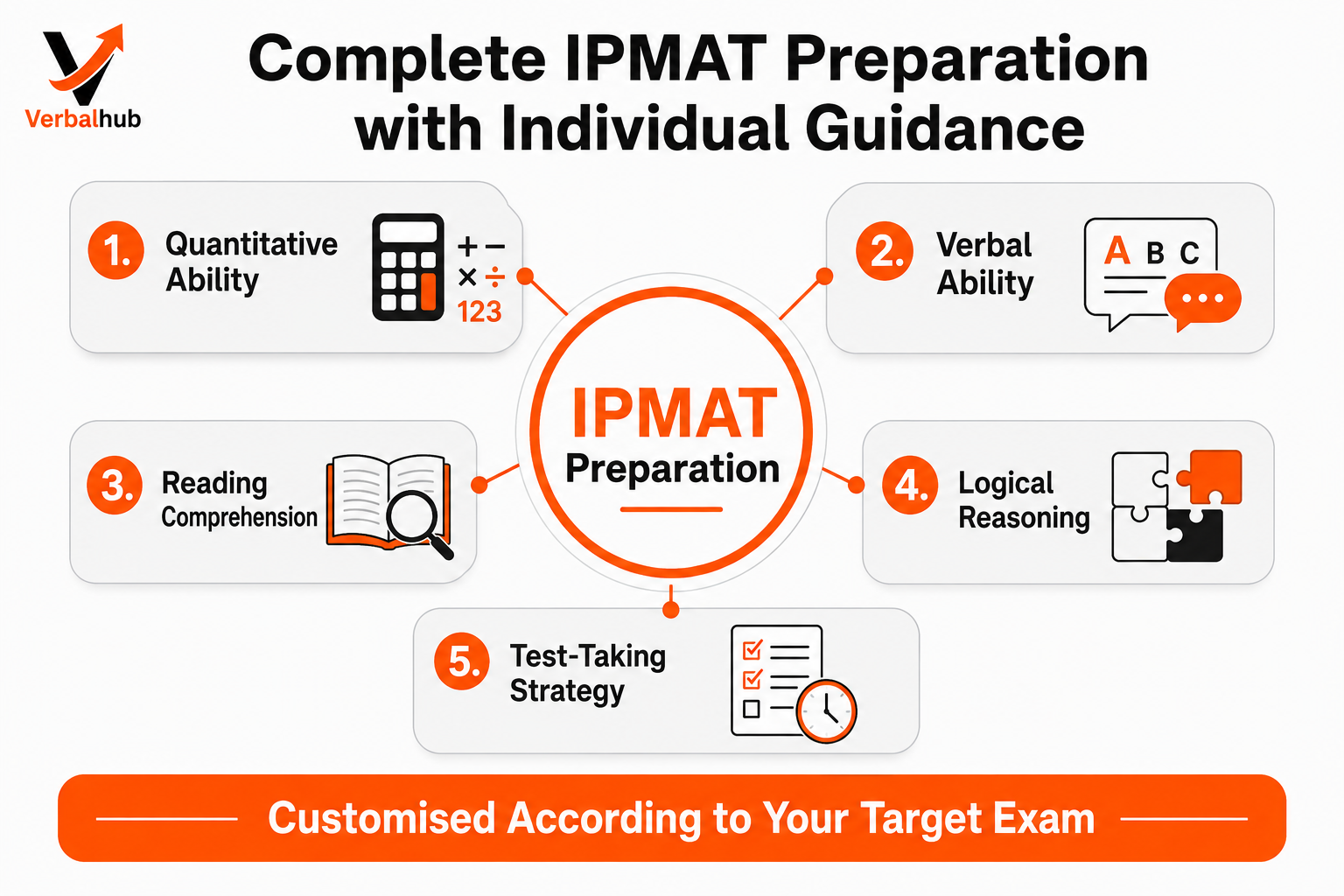
Quantitative AbilityArithmetic, algebra, number systems, geometry, mensuration, modern mathematics, data interpretation, calculation methods, question selection, speed and accuracy.
Verbal AbilityVocabulary in context, grammar application, para jumbles, para completion, para summary, critical reasoning and option elimination.
Reading ComprehensionCentral ideas, paragraph roles, argument structure, inference, option elimination, reading efficiency and accuracy under time limits.
Logical ReasoningArrangement, selection, data sets and other reasoning types when relevant to the latest pattern of the target examination.
Test-taking skillsQuestion selection, time allocation, section order, accuracy management, mock planning and handling difficult questions.
Pattern Note
The exact syllabus and depth depend on the student's target examination and the latest official pattern. Interview or personal assessment guidance may be included when relevant to the target institute.
One-on-One Coaching vs Group Coaching
Both formats can support preparation. The better choice depends on the learner's needs, schedule, budget and preferred learning style.
| Factor | Group Coaching | VerbalHub One-on-One Coaching |
|---|---|---|
| Pace | Common classroom pace | Adjusted to the student |
| Attention | Shared across the batch | Direct mentor attention |
| Doubts | Limited by class time | Discussed in detail |
| Study plan | Common course structure | Customised to current level |
| Feedback | General or periodic | Individual and mistake-specific |
| Scheduling | Fixed batch timings | Greater flexibility, subject to availability |
| Mock analysis | Common review | Detailed personal analysis |
| Accountability | Depends largely on the student | Regular follow-up and targets |
| Flexibility | Limited by batch plan | Topics and pace can be adjusted |
Group classes remain practical for students who learn well at a common pace. Individual IPMAT Coaching may be more suitable when a student needs personal attention, flexible scheduling or a customised study plan.
What Can a Student Expect?
- The mentor first understands the learner's present level.
- Classes focus on specific learning gaps.
- Practice changes according to recent performance.
- Mistakes are reviewed without judgment.
- Strong areas are maintained while weaker areas receive more attention.
- Progress is tracked across topics and tests.
- The student receives clear next steps after each session.
Start Your Personalised IPMAT Preparation
The right preparation plan should reflect your current level, learning pace, academic schedule and target examinations. If you are considering IPMAT Coaching One-on-One, begin by discussing your strengths, difficulties and goals with an experienced mentor.
Ready to Discuss Your Preparation?
Book a One-on-One Counselling Session • Speak to an Expert IPMAT Mentor • Start Your Personalised IPMAT Preparation
Frequently Asked Questions
It is a personalised format in which one student works directly with a mentor. Classes, assignments, tests and feedback are adjusted to the student's current level and goals.
Yes. Beginners can start with fundamentals before moving to timed questions, sectionals and mocks.
Yes. IPMAT Online One-on-One Coaching allows students to attend individual sessions from home.
The plan and schedule can be arranged around academic commitments, subject to mentor availability.
Mock analysis can be a central part of the programme. It reviews accuracy, time use, question selection and recurring errors.
Yes. Preparation can begin with the required foundations and progress towards examination-level questions.
It can help repeaters diagnose earlier preparation, repair gaps and create a revised approach.
The pace, topic order, assignments, feedback and test analysis are based on the individual rather than a common batch plan.
Students and parents can request a counselling discussion to explain their goals, challenges and expectations.
No responsible provider can guarantee admission. Selection depends on examination performance, institute criteria and other admission stages. Structured preparation can support better readiness, but it cannot guarantee a result.
Note: The programme is designed to support improvement and does not guarantee a particular score, percentile, selection or admission.