How to Prepare for IPMAT 2027 with Class 12 Boards

Written by Hasan Raja | IIM Kozhikode alumnus | CAT VARC 99th percentile three times | GMAT Verbal V50 | 20 years of teaching experience
VERBALHUB IPMAT 2027 GUIDE
A Practical Six Month Study Plan for School Students. Boards and IPMAT Can Be Prepared Together.
Preparing for IPMAT 2027 while studying for Class 12 boards can look like two full-time jobs. School brings tests, projects, practicals and revision. IPMAT brings Quantitative Ability, Verbal Ability, Logical Reasoning, sectional tests and mock analysis.
The best part is that you do not have to ignore one to pick another. You need a roadmap that fits with your school calendar.
This six-month IPMAT 2027 study plan is for students who want to prepare for IPMAT Indore, IPMAT Rohtak and JIPMAT without allowing board preparation to suffer. It tells you what and when to study each section, as well as when to move from concepts to full-length mocks.
Before making a timetable, read the complete guide to IPMAT course details, syllabus, eligibility and selection process. It will help you understand the exam before you start preparing for it.
Important update: The official IPMAT 2027 notifications have not been released yet. Use the latest confirmed exam patterns only as a working reference. Check the official websites of the respective institutes when the 2027 admission notices are published.
Can You Prepare for IPMAT Alongside Class 12 Boards
Yes. Many students do it successfully, but their preparation is rarely the same throughout the year.
During regular school months, you can build IPMAT concepts and practise questions. As pre-boards and practical exams come closer, your board subjects should take more time. During the final board exams, IPMAT preparation can move into maintenance mode. Once the boards are over, your main focus can shift to IPMAT mocks, revision and exam strategy.
Think of preparation in three stages:
- Before pre-boards: Build Quant, Verbal and Logical Reasoning skills.
- During pre-boards and boards: Protect what you have learned through short revision sessions.
- After the boards: Take full-length mocks, analyse errors and improve your question selection.
This works better than stopping IPMAT completely for two or three months. Even 30 minutes of reading or basic Quant practice keeps you connected with the exam.
Know Which IPMAT Exams You Are Targeting
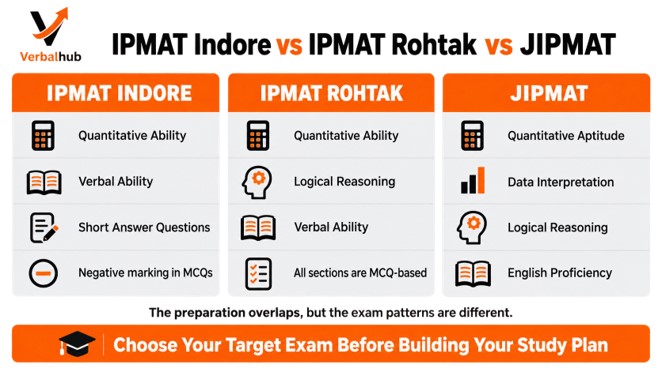
The preparation overlaps, but the exam patterns are different.
Choose Your Target Exam Before Building Your Study Plan
Students often use the word IPMAT for several management entrance tests. However, these exams do not have exactly the same structure.
IIM Indore's latest confirmed aptitude test has three separately timed sections: Quantitative Ability MCQ, Quantitative Ability Short Answer and Verbal Ability MCQ. Each section has a 40-minute limit. MCQs carry negative marks for incorrect answers, while the Quantitative Ability Short Answer section does not carry negative marking under the latest confirmed pattern.
If IIM Indore is your main target, read the dedicated IIM Indore IPMAT and IPM programme guide. It explains the programme and admission route in greater detail.
IPMAT Rohtak has QA, LR and VA. Therefore, a student preparing for both Indore and Rohtak cannot leave Logical Reasoning for the last month.
JIPMAT is another route to an Integrated Programme in Management. It is used for admission to IIM Jammu and IIM Bodh Gaya. Its application and selection process must be checked separately. Read the complete JIPMAT exam guide if these institutes are on your list.
Once your target exams are clear, you can choose the right topics, practice sets and mocks.
The Six Month IPMAT 2027 Study Plan
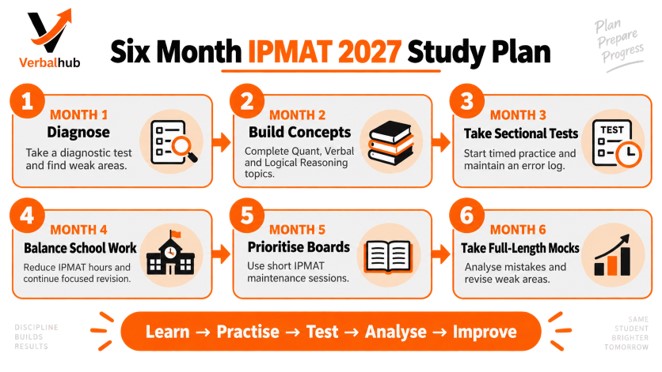
The plan below assumes that a Class 12 student has around six months for structured preparation. You can move the stages slightly depending on your school calendar and the official IPMAT 2027 exam dates.
Month One: Find Your Starting Point
Begin with a diagnostic test without worrying about the score. The purpose is to find out what needs work. Check four areas:
- Which basic Quant topics are weak?
- Do you understand an RC passage but lose marks in the options?
- Are vocabulary and grammar slowing you down?
- Can you solve basic Logical Reasoning questions without guessing?
After the diagnostic, build the foundation.
For Quant, start with percentages, ratios, averages, profit and loss, simple and compound interest, basic number properties and linear equations. These topics support many questions that appear later.
For Verbal, read for 25 to 30 minutes every day. Choose writing on science, society, history, economics and culture. After reading, write the main point in two lines. This small exercise improves both comprehension and focus.
For Logical Reasoning, begin with series, arrangements, coding, directions, blood relations and easy data-based sets.
Start an error log from the first week. Write the topic, your mistake, the reason behind it and the correct method. A simple notebook is enough.
Month Two: Complete the Core Topics
During the second month, continue learning but add timed practice.
In Quant, move to algebra, inequalities, quadratic equations, progressions, geometry and selected topics from modern mathematics. Do not jump straight to the hardest questions. First make sure that you can solve easy and medium questions correctly.
In Verbal, practise one Reading Comprehension passage every day. Do not stop after checking the answer key. Find the exact sentence or idea that supports the correct answer. Then ask why the wrong option looked attractive.
Also practise para jumbles, paragraph completion, grammar, vocabulary and sentence-based questions according to the latest syllabus of your chosen exams.
Add short timed drills by the end of the month:
- Ten Quant questions in 20 minutes
- One RC passage in 8 to 10 minutes
- Ten Verbal questions in 12 to 15 minutes
- One Logical Reasoning set in 12 to 15 minutes
At this stage, accuracy matters more than speed. Speed improves when the method becomes clear.
Month Three: Start Sectional Tests
Concept practice feels comfortable because you usually know which topic you are solving. A sectional test is different. It forces you to recognise the topic, choose the method and manage time on your own.
Take two or three sectional tests every week. Rotate between Quant, Verbal and Logical Reasoning. Analyse every test on the same day or the next morning.
Place each mistake under one of these labels:
- Concept gap
- Calculation mistake
- Misreading
- Poor question selection
- Time pressure
- Guess between two options
Your next week's study plan should come from these labels. If most errors come from algebra, revise algebra before taking another similar test. If you are spending too long on RC, work on passage structure and option elimination.
You can use the broader guide on IPMAT preparation strategies for the first attempt for more help with practice, revision and question selection.
Month Four: Give More Time to School
This is often the stage when practical files, school tests and pre-board preparation become demanding. Reduce your IPMAT workload, but do not drop it completely.
A workable weekday routine is:
- 20 minutes of reading
- 20 minutes of vocabulary or Verbal Ability
- 30 to 40 minutes of Quant revision
Take one sectional test during the weekend and analyse it properly.
Use overlap wherever possible. Regular reading helps IPMAT RC and also improves your ability to understand long chapters and write clearer school answers. Strong arithmetic and algebra basics help in both school mathematics and entrance-test Quant.
Students who do not study Mathematics in Class 12 should remain in touch with Quant throughout this period. A long gap makes restarting much harder.
Month Five: Put the Boards First
During the main board-exam period, your school subjects should receive most of your attention. Reducing IPMAT study at this time is sensible.
Use a 30 to 45-minute maintenance routine on lighter days:
- Read one good article.
- Revise 10 vocabulary words through sentences.
- Solve five Arithmetic or Algebra questions.
- Review old errors instead of starting a difficult new chapter.
Avoid forcing a full mock into an already packed day. A tired mock that you never analyse does not help.
However, keep an eye on application deadlines. Prepare scanned copies of your photograph, signature, identity proof and academic details. Follow the updated IPMAT registration, exam dates, fees and documents guide once the official IPMAT 2027 application window opens.
Month Six: Move to Full Length Mocks
Once your board exams finish, IPMAT becomes the main goal.
Start with two full-length mocks per week. You can move to three when you are giving enough time to analysis. More mocks are useful only when each test changes something in your preparation.
Follow this cycle:
Take the test, review every question, group your errors, revise weak topics, practise selected questions and retest.
Track these numbers after every mock:
- Total attempts
- Correct answers
- Accuracy
- Section-wise time
- Easy questions missed
- Guessed questions
- Repeated errors
In the final two weeks, stop collecting new material. Revise formulas, vocabulary notes, common traps and the errors you have already made. Practise leaving a difficult question at the right time. Smart question selection can protect both your time and your score.
A Daily IPMAT Timetable for Class 12 Students
Your timetable should suit your school day. Copying a five-hour routine from someone else rarely works.
Regular School Day
| Time | Task |
|---|---|
| 30 minutes | Quant concept or practice |
| 25 minutes | Reading Comprehension |
| 20 minutes | Vocabulary, grammar or Verbal Ability |
| 15 minutes | Error-log review |
Weekend Plan
| Time | Task |
|---|---|
| 60 minutes | Quant topic practice |
| 45 minutes | Verbal Ability and RC |
| 45 minutes | Logical Reasoning |
| 60 to 90 minutes | Sectional test and analysis |
During Board Exams
Use 30 to 45 minutes for light reading, vocabulary revision, basic calculations or error-log review. If a board paper is close, skip IPMAT for the day without feeling guilty.
The best IPMAT daily study timetable is the one you can follow for several months.
How to Prepare for IPMAT Quant
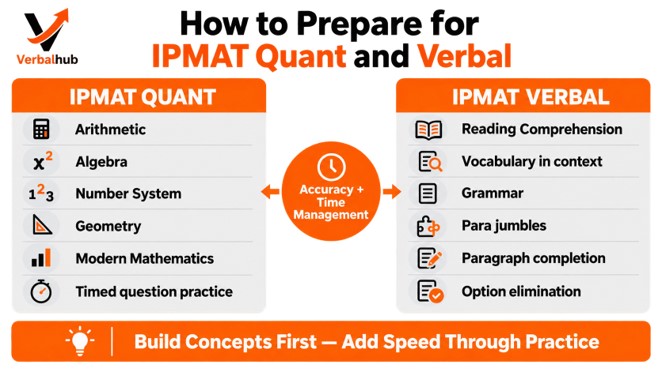
Build Concepts First – Add Speed Through Practice
Quantitative Ability is often the biggest concern for Class 12 students, especially those without Mathematics as a subject.
Use three steps for every topic:
- Understand the rule or concept.
- Solve easy and medium questions without a timer.
- Attempt a mixed set within a time limit.
Give Arithmetic and Algebra early attention because they support several other topics. Keep a small formula notebook. Add one solved example beside each important formula so that revision remains practical.
Do not measure progress only through the number of questions completed. Ask whether your accuracy is rising, your steps are becoming shorter and you can recognise when a question should be left.
How to Prepare for IPMAT Verbal
IPMAT Verbal preparation needs regular reading and careful correction. Last-minute word lists cannot replace daily work.
Your weekly plan should include:
- Reading Comprehension
- Vocabulary in context
- Grammar and sentence structure
- Para jumbles
- Paragraph completion
- Timed option elimination
When an RC answer is wrong, return to the passage and find the evidence. Common wrong options use extreme words, mix one correct idea with one false idea, add outside information or change the writer's tone.
If Reading Comprehension, vocabulary, grammar or timing remains a problem, IPMAT Verbal one-on-one coaching can provide focused help. The aim of personal classes should be to find the exact weakness, explain the right method and check whether the correction works in the next test.
How to Analyse an IPMAT Mock Test
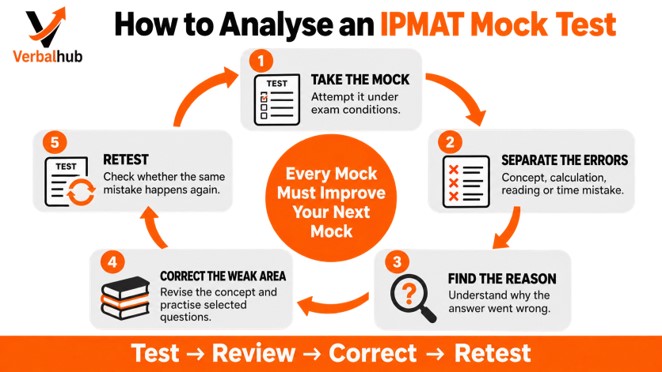
Test → Review → Correct → Retest
A mock score tells you where you finished. Analysis tells you what to do next.
Separate the questions into four groups:
- Correct and solved with confidence
- Correct but guessed or solved slowly
- Incorrect because of a concept or method problem
- Not attempted because of time or poor selection
Pay special attention to the second and fourth groups. A guessed correct answer can hide a gap. An easy question left unattempted may show that you spent too much time elsewhere.
Turn every repeated error into a clear task. For example:
- Weak RC accuracy: practise passage mapping and option elimination.
- Slow Quant: set a time limit and learn when to move on.
- Calculation mistakes: write essential steps instead of working entirely in your head.
- Weak vocabulary: revise words through sentences at fixed intervals.
For a real example of how planned practice and mock analysis can improve performance, read this IPMAT student success story.
Mistakes to Avoid During IPMAT 2027 Preparation
Waiting Until the Boards Are Over
You may not have enough time to build concepts after the boards. Complete the basics earlier and use the final period for mocks.
Using Too Many Books and Videos
Choose one main resource for each section. Finish it before changing material. Too many resources often create confusion rather than progress.
Taking Mocks Without Reviewing Them
Repeated testing does not automatically improve your score. Your improvement comes from the correction made after each test.
Following One Plan for Every Exam
IPMAT Indore, IPMAT Rohtak and JIPMAT are related but not identical. Use exam-specific mocks and section strategies.
Making a Timetable You Cannot Follow
Three focused hours over a weekend can be more useful than an unrealistic daily target that you keep missing.
Practising Only Your Favourite Topics
Strong topics make you feel confident, but weak areas decide whether your overall score improves. Let your diagnostic test and error log guide your practice.
IPMAT 2027 Preparation Checklist
Before the final mock phase, check whether you have:
- Read the latest official eligibility and exam information
- Completed the main Quant foundations
- Built a daily reading habit
- Practised Verbal Ability and Logical Reasoning
- Taken timed sectional tests
- Started full-length mocks
- Maintained an error log
- Analysed every mock
- Prepared application documents
- Made separate plans for Indore, Rohtak and JIPMAT
Recommended IPMAT Coaching at VerbalHub
Students do not always struggle because they lack study material. Many get stuck because they are unsure what to study next, repeat the same mistakes or take mocks without knowing how to use the results.
VerbalHub's IPMAT coaching follows a student-specific approach. Preparation begins with a diagnostic test, followed by a practical study plan, concept learning, selected practice and detailed mock analysis. Students can choose mentor-led IPMAT preparation, focused Verbal support or one-on-one IPMAT coaching according to their needs.
The Verbal and preparation strategy sessions are led by Hasan Raja Sir, an IIM Kozhikode alumnus, GMAT Verbal V50 scorer and three-time CAT VARC 99th-percentile scorer. He brings 20 years of teaching experience and has mentored 10,000+ students across management entrance and verbal-ability examinations.
For students searching for the best IPMAT Verbal faculty, personalised IPMAT coaching, IPMAT Verbal one-on-one classes or an IPMAT 2027 preparation mentor, Hasan Sir's diagnostic-first method focuses on Reading Comprehension, vocabulary, grammar, option elimination, timing and mock-test analysis.
Book a Free IPMAT Strategy Call to understand your present level and receive a personalised IPMAT 2027 study roadmap.
Frequently Asked Questions
Yes. Six months can be enough when you begin with a diagnostic test, cover the main concepts in order and move gradually from topic practice to sectional and full-length mocks.
Around 60 to 90 focused minutes on a regular school day is a practical starting point. Use weekends for longer practice and test analysis. Increase the time after the board exams.
Change the balance during the year. Build IPMAT concepts during regular school months, use a short maintenance plan during boards and shift to mocks once the boards finish.
Yes. Quant and Verbal overlap, but the exam structures are different. IPMAT Rohtak also needs dedicated Logical Reasoning preparation. Take separate mocks for each exam.
Begin sectional tests after covering the basic concepts. Start full-length mocks when you can attempt most sections meaningfully. The main mock phase for Class 12 students can begin after the board exams.
Yes, but Quant must begin early. Start with Arithmetic and basic Algebra, practise regularly and avoid long breaks during school-exam months.
Not every student needs the same support. Self-study can work when concepts are clear and the student can review mistakes honestly. Coaching becomes useful when the student needs structure, explanation, feedback or accountability.
The official 2027 notifications must be checked when they are released. Previous-year dates and patterns can guide preparation, but they should not be treated as final.
Final Word
Preparing for IPMAT 2027 with Class 12 boards is demanding, but it is manageable when you plan in stages. Build concepts early, protect them during the board months and shift to mocks once the boards are over.
The students who succeed are not always the ones who study the most hours. They are the ones who follow a clear plan, analyse their mistakes and keep improving.
NEXT STEP: Book a free IPMAT strategy call with Hasan Raja Sir at VerbalHub.com to build the right preparation plan for your target IIMs.