By Hasan Sir | Updated 15 October 2026

Your Physics practical file is unfinished. Accountancy needs another revision. There is an English assignment due tomorrow. Somewhere in that pile sits your IPMAT practice book.
You do not need equal study hours for both exams every day. You need a plan that gives boards the attention they deserve while keeping your entrance preparation moving.
For IPMAT 2027 with Class 12 boards, a short, steady verbal routine is a sensible place to start. Reading, vocabulary revision and a few carefully reviewed questions can fit into a busy school day. The aim is to avoid starting again from zero after your last board paper.
WHAT YOU WILL FIND IN THIS GUIDE
The real challenge
Board preparation becomes especially demanding around February and March. Practicals, school tests and revision may begin much earlier, and some board papers can run into April. Follow your own board's date sheet rather than someone else's timetable.
Whether you study under CBSE, ISC (Class 12 under CISCE) or a state board, your subject requirements must shape your schedule.
Do not assume you have three months after boards
Students often expect IPMAT in May or June and mentally reserve two or three months after boards. That gap can be much shorter. IIM Indore held its 2026 aptitude test on 4 May 2026. A student finishing boards in late March would have had roughly five weeks.
The official pages checked for this guide still showed the 2026 admission cycle. Treat the 2027 dates and patterns as pending confirmation, and check each institute's notification.
Stopping IPMAT preparation completely during boards can make that short gap harder to use. However, reducing your workload near a difficult paper is sensible. Keep a small routine when possible; protect the next board exam when necessary.
Also, Indore and Rohtak have separate tests. Indore's recent structure includes Quantitative Ability and Verbal Ability; Rohtak also tests Logical Reasoning. Check the full IPMAT syllabus and eligibility before choosing material.
Why verbal fits alongside board English

Verbal preparation is often easier to maintain in short sessions than a new Quant chapter. You can read a passage, revise familiar words or review an RC mistake without needing a long, uninterrupted study block.
That does not mean verbal is easy for everyone. If you struggle to understand passages, start with readable material and build accuracy before adding speed.
The overlap is useful, but incomplete
Board English and IPMAT verbal share several underlying skills:
- Reading comprehension: identifying the main idea, finding evidence and making sensible inferences.
- Vocabulary: understanding what a word means in its sentence.
- Clear expression: recognising how ideas connect and choosing precise language.
- Grammar awareness: noticing errors and understanding sentence structure, according to your board's syllabus.
CBSE's published 2026-27 Class 12 English Core syllabus includes reading, creative writing and literature. Vocabulary appears within comprehension, while grammar accuracy matters in writing. Do not assume every board has a separate grammar section.
IPMAT paragraph summaries and sentence-order exercises can strengthen reading skills, but they are not identical to board questions. Their exact appearance also depends on the entrance test and paper.
Make one reading session serve two purposes
Choose a manageable editorial from The Hindu or The Indian Express. Read for meaning rather than collecting difficult words.
After reading, write:
- The author's main point in one sentence.
- Two reasons supporting that point.
- A short summary in your own words.
For example, an article about public transport may argue that reliable buses matter more than cheap fares alone. Your summary should preserve that comparison, rather than simply say that buses are useful.
This habit can support comprehension and help you organise ideas in articles, letters or essays where your board requires them. It does not replace literature revision, prescribed formats or timed board answers.
For more practice methods, use this IPMAT verbal ability strategy alongside your board syllabus.
Your weekly study plan
Use this weekly study plan for IPMAT and boards during ordinary school weeks. The board hours are focused self-study blocks outside school; homework, practicals and weak subjects may require more time.
| Day | IPMAT verbal preparation | Board preparation |
|---|---|---|
| Monday–Friday | 45 minutes daily: RC, vocabulary and review | 2–3 hours daily, adjusted to workload |
| Saturday | 1 hour: para jumbles, summaries and review | 3 hours of revision and written practice |
| Sunday | 2 hours: 40-minute verbal test and 80-minute review | 2 hours of targeted revision |
Keep short Quant revision sessions elsewhere in the week, and include LR if your target exam tests it. This table covers verbal, not your entire IPMAT preparation.
How to use 45 minutes on a weekday
20 minutes: read one RC passage and answer its questions. 10 minutes: check the passage evidence and review mistakes. 10 minutes: revise vocabulary, including a few new words in context. 5 minutes: write the passage's main idea or revisit one earlier error.
Count your editorial reading within this time on reading-focused days. You do not need an editorial plus an RC plus another vocabulary session every evening.
Make Saturday a paragraph-practice day
Spend 20 minutes on para jumbles, 20 on summaries and 20 reviewing your choices. Practise relationships between sentences: a claim followed by an example, a cause followed by its effect, or a pronoun referring back to a noun.
If a sentence begins "This change", find the sentence that introduces the change. Do not place it second merely because it sounds like a continuation.
Make Sunday review worth the time
A 40-minute verbal test suits practice based on Indore's recent sectional timing. Rohtak's recent test uses a shared 120-minute duration across three sections; a 40-minute VA drill is a practice choice, not its official separate sectional timer.
Use the remaining 80 minutes to review incorrect answers, guesses and unusually slow correct answers. Record three things: what went wrong, what evidence you missed and what you will do next time.
"I chose an answer about all students, but the passage discussed only students in one survey" is a useful note. "Silly mistake" tells you very little.
Change the timetable during board season
In February and March, reduce verbal to around 30 minutes a day when manageable. Try 15 minutes of reading, ten minutes of vocabulary and five minutes of review. Shorten or skip the Sunday test near demanding board papers.
On the day before a difficult exam, prioritise board revision. Resume your small verbal routine when the pressure eases; do not create a backlog of missed sessions.
After your final board paper, build towards 60-90 minutes of verbal daily, according to your weaknesses. Add separate Quant and LR work, full mocks and analysis. Use a final-month IPMAT revision plan based on the time actually left.
The subject-priority matrix
Priority depends on the next deadline and your current performance. A weak board subject may need more attention than a shared English skill, even if English helps both exams.
| Area | Priority during board preparation | What to do |
|---|---|---|
| English comprehension and vocabulary | High shared value | Maintain brief reading and review sessions |
| Board English literature and writing formats | High board priority | Revise texts and practise required answers separately |
| Physics, Chemistry, Accountancy, Business Studies and other board subjects | High near exams; otherwise based on need | Protect revision and timed written practice |
| Board Mathematics | High when required | Prepare the board syllabus; identify genuine Quant overlap |
| IPMAT Arithmetic, Algebra and Geometry | Maintain foundations; reduce expansion near boards | Revisit familiar methods and errors in short sessions |
| Logical Reasoning for relevant tests | Maintain basic practice | Defer long, difficult sets during peak board pressure |
What can wait until after boards?
New advanced Quant chapters, long LR sets and frequent full mocks can take a smaller place during peak board weeks. Do not postpone all Quant preparation until April.
Quant needs repeated practice to retain methods and recognise question types. Try 15-20 minutes on three or four days a week during maintenance periods, if your board workload allows. This preserves familiar skills; it is not enough to build an entire Quant foundation.
Board Maths may help with parts of Algebra, but it does not cover every entrance skill. Students without Maths also need an early Quant plan.
Ask: "What needs the most work this week?" Let your answers shape the timetable.
Your preparation timeline
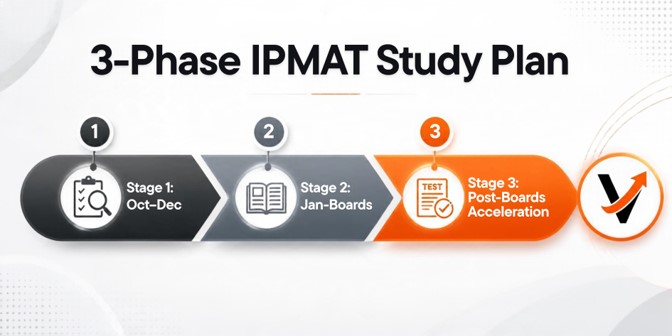
October to December 2026
Take a diagnostic test and identify separate gaps in RC, vocabulary, grammar and Quant. Begin the weekly verbal routine, strengthen Quant foundations and complete school work steadily.
Keep a short error notebook. Check admission announcements weekly.
January to your final board paper
Move towards board revision, practicals and sample papers. Use the shorter verbal routine as pressure rises. Decide the next week's study blocks after checking upcoming school tests and board dates.
Ask a parent or teacher to help track applications if needed. Do not assume registration will wait until boards finish.
How to avoid burnout
1. Set a small daily target
"One passage and a proper review" is clear enough to finish. "Complete verbal" is not. On a difficult school day, finish the smaller task and stop.
2. Use flashcards during spare moments
Anki or physical cards can work. Put the word in a sentence on one side and its meaning, a simple synonym and your own example on the other. Review old cards before adding more.
Do this during a safe commute or a short break. Keep some breaks free from study too.
3. Keep reading manageable
One editorial a day is a useful target when time allows. If the article is too dense, choose a shorter piece. You should be able to explain its argument after reading it.
4. Protect sleep
For most Class 12 students aged 13-18, the recommended sleep range is 8-10 hours, rather than treating seven hours as the target. Build your study hours around adequate sleep.
If your schedule works only when you stay awake past midnight, reduce the workload or change the timings.
5. Plan proper rest
Keep one full rest day every two weeks when your exam calendar allows. Near a board paper, move it to a suitable date and retain shorter daily breaks.
6. Review the plan when it stops working
If you keep missing tasks, reduce the next week's load. If you repeatedly feel overwhelmed or cannot sleep, speak to a parent, teacher or counsellor.
When personal coaching can help

You can prepare independently with good material and regular review. Personal coaching becomes useful when you need help understanding repeated errors or adjusting a plan around school demands.
Why choose VerbalHub's one-on-one IPMAT coaching?
VerbalHub is led by Hasan Sir, its founder and lead mentor. VerbalHub reports 15+ years of experience across CAT, GMAT, GRE and IPMAT preparation and more than 10,000 learners mentored across exam-preparation programmes. His teaching focuses on verbal ability and RC strategy, including preparation for students targeting IIM Indore, IIM Rohtak and other IPM programmes.
For a board student, one-on-one support can offer:
- Personalised schedule adjustments: weekly targets shaped around tests, practicals and board dates.
- Flexible class planning: agreed morning, evening or weekend slots, subject to availability.
- Custom verbal plans: focused work that fits into 30-45 minutes during busy weeks.
- Accountability: check-ins to spot missed practice and repeated mistakes early.
- Support with study pressure: realistic targets and help rebuilding consistency after a difficult week.
Before enrolling, compare IPMAT coaching options. Ask how rescheduling, mock review and board-season workload adjustments work in practice.
If you want structured guidance and personal attention, explore VerbalHub's IPMAT one-on-one coaching. Share your board timetable and recent test performance so the discussion starts with your actual needs.
Want to save this guide for offline revision? Download the accompanying Word document and keep it on your study table. You can also export it as a PDF to revisit the weekly schedule, subject-priority matrix and burnout tips without internet.
VerbalHub: +91 7827040357 | info@verbalhub.com | https://www.verbalhub.com/

Build a Plan That Fits Your School Day. One-on-One Guidance with Hasan Sir — Personalised Verbal Practice · Planning Around Board Exams · Regular Progress Reviews. Book a Free Consultation.
Frequently Asked Questions
Yes. Keep board preparation as your main focus near exams and maintain a short IPMAT routine. During regular school weeks, aim for 30-45 minutes of verbal practice daily, with separate time for Quant and Logical Reasoning where required. Adjust the workload around practicals, school tests and board papers.
Around 30 minutes a day is a manageable starting point. Spend 15 minutes reading, ten minutes revising vocabulary and five minutes reviewing an earlier mistake. Before a demanding board paper, shorten or pause the session and return to it when the pressure eases.
It can support reading comprehension, vocabulary and your ability to organise ideas clearly. However, board English also needs separate preparation for literature, prescribed writing formats and written answers. Use the overlap to save time while covering your full board syllabus.
Board English provides a useful base, but you also need entrance-style practice. Work on timed RC questions, close answer choices, vocabulary in context and paragraph-based exercises relevant to your target test. Review why an answer is correct rather than checking only your score.
Avoid stopping it completely if your timetable allows. Short sessions on familiar topics can help you retain methods and recognise question types. During peak board weeks, reduce new chapters and lengthy problem sets. Build your Quant foundations before this busy period.
Read one short passage and answer a few questions. Then check the evidence behind each answer, especially the ones you guessed. Finish by writing the main idea in one sentence. If you struggle to understand the passage, practise without a strict timer first.
Start with three to five useful words from your reading. Learn each word's meaning in context and write your own sentence. Revise older words before adding more. Reduce the daily count if you keep forgetting what you learnt earlier.
Use short tests when they fit your schedule. A weekly verbal test with proper review can help during ordinary school weeks. Near board papers, reduce testing and focus on revision. Increase full mocks after boards, leaving enough time to analyse each one.
That is a risky plan, especially if your basics need work. The gap between your final board paper and your entrance test may be shorter than expected. Begin reading, vocabulary and Quant foundations earlier so you can use the remaining weeks for timed practice and revision.
Restart with one small task, such as a passage or a vocabulary review. Do not double the next day's workload to repay missed hours. If you repeatedly miss sessions, make the plan smaller and choose a more practical study slot.
Set realistic daily targets, protect sleep and leave room for breaks. Give extra time to the nearest exam and your weakest subjects. Review your timetable weekly. If the plan regularly leaves you exhausted, reduce the workload before adding more study hours.
Personal coaching can help you adjust targets around board dates, understand repeated mistakes and stay consistent. At VerbalHub, discuss your timetable and learning needs with Hasan Sir before choosing a plan. Ask about class timings, rescheduling and individual feedback.