

Hasan Raja
GMAT Expert | Lead Verbal Mentor
• IIM Kozhikode Alumnus
• GMAT Verbal V50/89
• GMAT 770 Classic
• GMAT 715 Current Edition
• GMAT Verbal V50/89
• GMAT 770 Classic
• GMAT 715 Current Edition
Book Your Strategy Session
Hasan Raja
GMAT Expert | Lead Verbal Mentor
IIM Kozhikode Alumnus
GMAT Verbal V50/89
GMAT 770 Classic
GMAT 715 Current Edition
Book Your Strategy Session
CAT VARC MASTERY
READING COMPREHENSION • VERBAL ABILITY • VOCABULARY
An 8-week preparation guide for CAT aspirants, working professionals and repeaters
VERBALHUB EDUCATION — www.verbalhub.com

1. Introduction: Why Reading More Does Not Always Improve Your VARC Score
You read editorials every morning. You practise Reading Comprehension passages regularly. You have completed several verbal ability exercises. Yet, when you attempt a CAT VARC sectional test, your accuracy drops.
Sound familiar?
This is one of the most common problems students face during CAT VARC preparation. Many aspirants believe that improving English automatically improves their VARC score. Unfortunately, CAT does not work that way. A student with excellent English may struggle to distinguish between two closely worded answer choices. Meanwhile, someone with average English can perform well by understanding the author's argument and eliminating unsupported options. The difference is not always language proficiency. It is often the ability to read with a clear purpose. CAT VARC tests whether you can understand an argument, recognise the author's position, identify hidden assumptions, and separate what a passage actually says from what merely sounds reasonable. In this guide, we will cover Reading Comprehension, Verbal Ability, vocabulary development, question-selection techniques, mock-test analysis, and a practical eight-week preparation plan. The objective is simple: help you become a more accurate and confident reader rather than someone who merely reads faster.
2. What Is CAT VARC?
VARC stands for Verbal Ability and Reading Comprehension. It is one of the three sections of the Common Admission Test (CAT), alongside Data Interpretation and Logical Reasoning (DILR) and Quantitative Ability (QA).
The section primarily evaluates two abilities.
Reading Comprehension (RC) tests how accurately you understand written arguments, interpret ideas, and answer questions based on a passage.
Verbal Ability (VA) tests whether you can recognise logical relationships between sentences, arrange ideas coherently, identify summaries, and complete paragraphs.
Recent CAT papers have placed substantial emphasis on RC, with the remaining questions testing verbal reasoning. The precise number and mix of questions may change across exam years and slots.
Unlike some other management entrance examinations, CAT does not generally depend on direct vocabulary definitions or traditional grammar exercises as major standalone components.
This is good news for students who believe their English is not strong enough.
You do not need an extraordinary vocabulary to perform well. You need to understand arguments, follow sentence relationships, and make decisions based on evidence.
With disciplined CAT VARC preparation, these abilities can improve through practice and feedback.
3. CAT VARC Syllabus and Question Types
The CAT VARC syllabus is best understood through the reading and reasoning skills that the examination repeatedly tests.
Reading Comprehension question types
| Question type | Skill being tested |
|---|---|
| Main Idea | Understanding the central argument |
| Inference | Identifying what logically follows from the passage |
| Author's Tone | Recognising attitude and degree of certainty |
| Specific Detail | Locating and interpreting stated information |
| Application | Applying an argument to a new situation |
| Strengthen/Weaken | Evaluating evidence supporting or challenging a claim |
| Vocabulary in Context | Understanding a word's meaning within the passage |
Not every question type appears in every CAT paper. Some, such as application and strengthen/weaken, are useful categories for building RC reasoning skills rather than guaranteed standalone question formats.
Verbal Ability question types
Para Jumbles: Arrange sentences into a coherent paragraph by identifying logical and grammatical connections.
Para Summary: Select the option that captures the central message without changing its meaning.
Para Completion: Identify the sentence that logically completes a paragraph.
Sentence Placement: Determine where a given sentence fits into an existing paragraph.
Odd Sentence Out: Identify the sentence that does not belong to the common argument or discussion.
Understanding these CAT VARC question types is important because each requires a different method.
A student who approaches para summary and para jumbles in exactly the same way is likely to make avoidable mistakes.
For a broader overview of these skills, refer to the complete CAT VARC preparation guide.
4. Why Students Struggle in CAT VARC
After working through RC questions with students, I often notice that their problem is not the passage itself. It is what happens after they finish reading.
They understand the subject but struggle to choose the correct answer.
Consider a passage discussing the limitations of online education.
A student may understand that online learning is useful but has certain weaknesses. However, when answering a question, the student might choose an option stating that online education is ineffective.
That option sounds related to the passage, but it changes a qualified argument into an absolute claim.
This is where marks are lost.
Reading without a purpose
Many students read every sentence with equal attention. They try to remember names, examples, dates, and supporting details.
CAT RC usually rewards understanding the structure of the argument more than memorising every detail.
Ask yourself: What is the author trying to establish?
Depending on outside knowledge
Suppose a passage questions a widely accepted economic theory.
You may personally agree with that theory, but your answer must reflect the author's argument, not your knowledge of economics.
The passage is your evidence.
Choosing options that sound impressive
Long, polished options often attract students because they appear intellectually convincing.
But a good answer must be supported by the passage.
An attractive statement is not necessarily a correct statement.
Ignoring the author's position
A passage may describe several opinions before presenting the author's own view.
If you confuse a view being discussed with the view being supported, inference and main-idea questions become difficult.
Attempting too many questions
Some aspirants focus on attempts rather than accuracy.
Attempting 20 questions with weak accuracy may produce a lower score than attempting fewer questions with stronger reasoning.
The right balance depends on your current performance, the paper's difficulty, and the marking scheme.
Remember: Understanding a passage is the first stage. Answering CAT questions correctly is a separate skill that must be practised.
5. CAT Reading Comprehension Strategy: A Practical Method
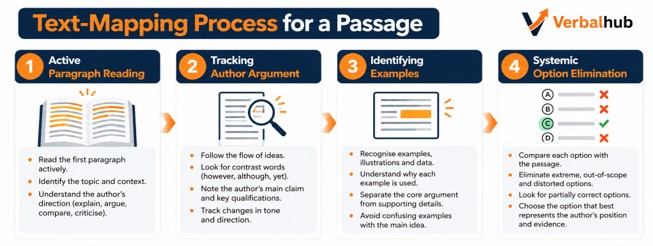
A good CAT reading comprehension strategy should help you understand the passage efficiently without reading it repeatedly.
Here is a method I recommend practising consistently.
Step 1: Read the first paragraph actively
The opening paragraph often introduces the topic, an existing belief, a problem, or a debate.
While reading, identify three things:
What is the subject? Why is the author discussing it? Is the author explaining, questioning, comparing, or criticising something?
Do not rush through the first paragraph simply to save time.
A clear beginning often makes the remaining passage easier to follow.
Step 2: Track the author's argument
As you read, notice how ideas develop.
Words such as however, although, yet, because, therefore, and nevertheless can reveal important changes in direction.
For example:
"Many economists believe that increased automation improves productivity. However, its benefits may not be distributed equally among workers."
The second sentence introduces a qualification.
The author is not necessarily rejecting automation. The author is questioning how its benefits are distributed.
That distinction may become the basis of an inference question.
Step 3: Understand the role of examples
Examples support an argument. They are not always the argument itself.
If a passage discusses environmental policy and gives the example of electric vehicles, the central idea may concern policy effectiveness rather than electric vehicles.
Ask: Why has the author included this example?
This question helps you avoid confusing supporting details with the main idea.
Step 4: Return to the passage only when necessary
Read the passage first to understand its structure. Then examine the questions.
For a specific-detail question, return to the relevant lines. For a main-idea question, consider the passage as a whole. For an inference question, identify the evidence and ask what follows without introducing additional assumptions.
Repeatedly rereading the entire passage wastes time.
Step 5: Eliminate incorrect options systematically
This is one of the most important habits for improving CAT RC accuracy.
Common wrong-answer patterns include:
| Trap | How to recognise it |
|---|---|
| Extreme statement | Changes "some" into "all" or "may" into "must" |
| Outside information | Introduces a claim absent from the passage |
| Distortion | Changes the author's actual meaning |
| Narrow scope | Covers only one example instead of the central argument |
| Partially correct | Begins accurately but adds an unsupported claim |
An extreme statement is not automatically incorrect. Reject it when its degree of certainty exceeds what the passage supports.
Original RC example: Understanding option elimination
Passage
"Remote working has allowed many organisations to reduce office expenses and offer greater flexibility to employees. However, its effectiveness depends on the nature of the work, communication practices, and the ability of managers to coordinate distributed teams. It would therefore be misleading to treat remote working as a universal solution to workplace productivity."
Question: Which statement best represents the author's position?
A. Remote working is the most effective arrangement for every organisation.
B. Remote working should be avoided because it creates communication problems.
C. Remote working offers benefits, but its effectiveness depends on organisational circumstances.
D. Organisations adopting remote working will eventually eliminate office expenses.
Correct answer: C
Option A is incorrect because the author explicitly rejects a universal solution. Option B exaggerates the criticism. The author recognises benefits as well as limitations. Option D makes an unsupported prediction. Option C preserves both parts of the argument: the benefits and the conditions affecting effectiveness. This is the central principle of RC option elimination: choose the answer that most accurately represents the passage, not the one that sounds most convincing.
Build a daily reading habit
Reading practice should include unfamiliar subjects.
Spend 20–25 minutes daily reading editorials, essays, or long-form articles on economics, philosophy, psychology, science, history, and social issues.
After reading, write two sentences: one describing the central argument and another explaining the author's position.
Avoid turning reading into a vocabulary-hunting exercise.
The purpose is to train your mind to follow reasoning.
6. CAT Verbal Ability Preparation: Practical Strategies

CAT verbal ability preparation requires a slightly different approach from RC.
Instead of understanding a complete passage, you often need to reconstruct or complete an argument using limited information.
Para jumbles: The five-step method
A practical CAT para jumbles strategy is based on sentence relationships rather than guesswork.
Step 1 — Identify the central subject. Read all sentences and understand what the paragraph discusses.
Step 2 — Find introductory nouns and ideas. Look for a sentence introducing a person, concept, event, or argument without depending on earlier information.
Step 3 — Trace pronouns and references. Words such as he, they, this, these, and such often refer to something introduced earlier.
Step 4 — Follow connectors and chronology. Identify cause-and-effect relationships, contrasts, examples, and sequences of events.
Step 5 — Build sentence pairs and verify the flow. Connect strongly related sentences before arranging the complete paragraph.
Consider this example:
A. This development changed how customers interacted with banks.
B. Digital banking services became increasingly accessible through smartphones.
C. As a result, many routine transactions could be completed without visiting a branch.
D. Earlier, customers depended heavily on physical branches for everyday banking.
Correct sequence: D-B-A-C
The paragraph moves from the earlier situation to the new development, its broader effect, and its practical consequence.
The key is recognising relationships, not merely spotting repeated words.
Para Summary: Identify the argument, not the details
A reliable CAT para summary strategy begins by asking:
What is the one idea the author wants the reader to understand?
A summary must preserve the central claim, its important qualification, and the author's position.
Avoid options that introduce fresh arguments, focus only on examples, or change a balanced statement into an extreme one.
Suppose a paragraph argues that technology improves access to education but cannot replace human guidance in every learning situation.
A correct summary must preserve both ideas.
An option claiming that technology has made teachers unnecessary would distort the paragraph.
Para Completion: Continue the author's thinking
In para completion, the correct sentence must follow the paragraph's existing direction.
Look at the final two sentences carefully.
Is the author developing a criticism, explaining a consequence, offering a solution, or presenting a balanced observation?
The correct completion should maintain that direction.
Do not select a sentence simply because it discusses the same topic.
Odd Sentence Out: Find the broken connection
Odd-one-out questions require you to identify a group of sentences that form a coherent paragraph and the sentence that does not fit.
Begin by identifying the common subject.
Then look for sentence pairs based on pronouns, examples, chronology, and cause-effect relationships.
A sentence may discuss the same broad subject yet still be the odd one because it belongs to a different argument.
For example, four sentences may discuss the environmental effects of urban transport, while another discusses the history of automobile manufacturing.
The fifth sentence is related to transport but does not support the paragraph's central discussion.
7. CAT Vocabulary for VARC: What You Actually Need
Many students spend months memorising difficult English words.
While vocabulary knowledge is useful, CAT does not mainly reward memorising long word lists.
The more important skill is understanding how a word functions within an argument.
For effective CAT vocabulary for VARC, concentrate on three areas.
Contextual meaning
A familiar word may carry an unfamiliar meaning in a particular passage.
For example, qualified can mean having the necessary credentials, but a qualified endorsement means approval expressed with reservations.
Context determines the intended meaning.
Tone and attitude
Learn words commonly used to describe an author's position, such as sceptical, cautious, critical, appreciative, dismissive, neutral, and qualified.
Understanding the difference between sceptical and dismissive can help you answer tone questions more accurately.
Logical transition words
Words such as although, nevertheless, consequently, despite, and whereas explain relationships between ideas.
They are especially useful in both RC and VA.
A practical vocabulary routine
Maintain a small word journal.
For each unfamiliar word, record its meaning in the passage, one original sentence, and any useful synonym or contrast.
Learn around five meaningful words or expressions per day, rather than memorising large lists without context.
Revise your journal weekly.
8. Eight-Week CAT VARC Study Plan
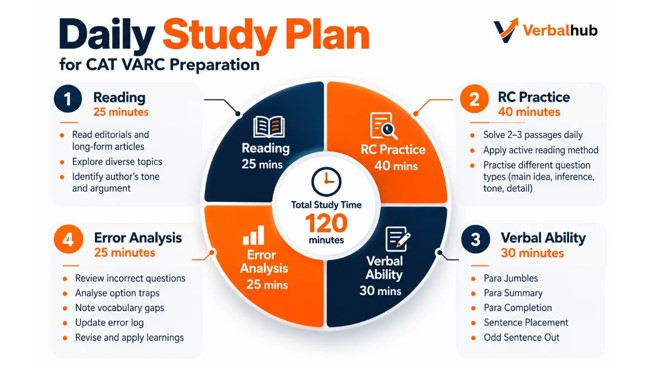
A good CAT VARC study plan must be realistic.
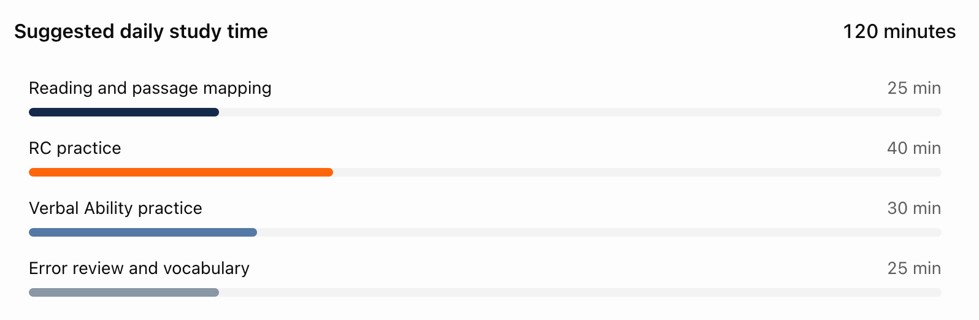
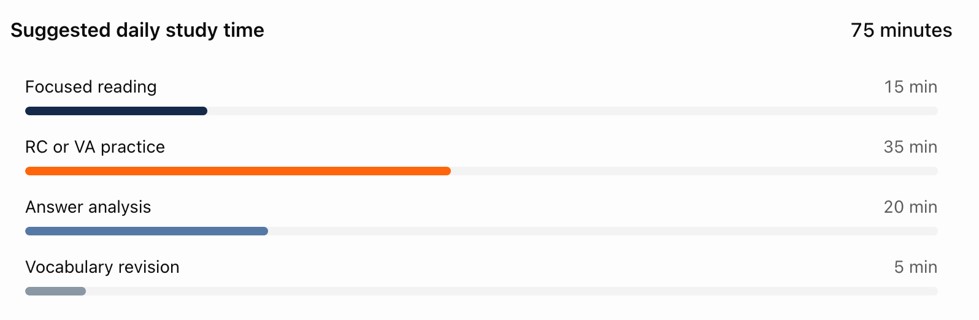
A college student may have two hours available daily. A working professional may have only 60–75 minutes after office hours.
Consistency matters more than an ambitious timetable that cannot be maintained.
The following eight-week plan is suitable for students who already understand basic English but need a more organised preparation method.
| Week | Focus area | Recommended activity |
|---|---|---|
| 1 | Diagnostic and RC basics | Take a sectional diagnostic, start daily reading, identify recurring errors |
| 2 | Main idea and inference | Practise 2 RC passages daily, with detailed option elimination |
| 3 | Para Jumbles and Para Summary | Practise sentence links, paragraph structure, and central-idea identification |
| 4 | Para Completion and Odd Sentence Out | Solve mixed VA sets and revise recurring mistakes |
| 5 | Timed practice | Take 2–3 sectional tests and maintain a detailed error log |
| 6 | Advanced RC and accuracy | Practise unfamiliar subjects, difficult inference questions, and question selection |
| 7 | Full-length mocks | Review VARC performance in full mocks and improve time allocation |
| 8 | Revision and final strategy | Repeat selected difficult questions, take a second mock cycle, and finalise exam strategy |
Daily routine for college students
Daily routine for working professionals
Use weekends for longer sectional tests and full mock reviews.
If your preparation time is limited, prioritise accuracy and analysis rather than trying to complete every available question bank.
Students targeting high percentiles can also explore a VARC 40+ score strategy, while remembering that the marks required for a particular percentile vary by paper difficulty and year.
9. How to Analyse CAT VARC Mock Tests

A mock test becomes useful only when you understand why you lost marks.
I have seen students take several mocks in a week without reviewing their mistakes. Their scores remain almost unchanged because they repeat the same reasoning errors.
A proper CAT VARC mock test analysis should examine correct, incorrect, and skipped questions.
Classify every important mistake
Use the following categories:
| Error category | What it means |
|---|---|
| Comprehension error | You misunderstood the passage or argument |
| Option trap | You selected an exaggerated, distorted, or unsupported option |
| Vocabulary gap | You misunderstood a key word or expression |
| Time pressure | You rushed or spent too long on a question |
| Silly mistake | You overlooked a clear instruction or detail |
| Wrong question selection | You attempted a poor-fit question or skipped a manageable one |
Maintain a simple error log
For every important mistake, record the question type, your selected answer, the correct answer, the reason for your mistake, and the correction you will apply next time.
For example:
Question: RC inference
Mistake: Selected an extreme option
Reason: Ignored the word "some" in the passage
Correction: Compare the certainty of each option with the author's wording
Review this log every weekend.
Also examine questions answered correctly through guessing. A correct answer does not always mean your method was sound.
The goal of CAT VARC mock test analysis is to identify patterns and improve your next attempt.
A useful CAT VARC improvement framework should connect every mock-test observation with a specific change in reading, question selection, or option elimination.
10. How One-on-One CAT VARC Coaching Helps

Self-study can work well when a student knows exactly what needs improvement.
The difficulty begins when the same mistakes continue despite regular practice.
A student may repeatedly misinterpret inference questions without understanding why. Another may read accurately but waste too much time comparing the final two options.
Simply assigning more passages does not solve these problems.
This is where personalised guidance can make a difference.
Diagnosis before practice
A good mentor first studies your performance. Are you struggling with main-idea questions, author tone, para summaries, or time management? The answer determines what you should practise next.
Feedback on your reasoning
Feedback on your reasoning — Knowing the correct option is not enough. You need to understand why your chosen option was wrong and what evidence supports the correct answer. Direct feedback can help students recognise repeated reasoning errors.
A plan based on your target
A plan based on your target — A student currently performing around the 70th percentile needs a different preparation approach from someone already approaching the 95th percentile. A personalised plan should reflect your current accuracy, reading ability, available study time, and target score.
Consistent mock reviews and accountability
Regular doubt-clearing sessions, timed practice, error correction, and progress reviews help prevent random preparation.
At VerbalHub, students learn under Hasan Sir, an IIM Kozhikode alumnus, CAT VARC 99th-percentile scorer on three occasions, and GMAT Verbal V50 scorer, with more than 20 years of teaching and mentoring experience across CAT, GMAT, SAT, IPMAT, and English proficiency tests.
His teaching approach focuses on simplifying verbal reasoning, identifying students' exact errors, and developing practical improvement plans.
For aspirants balancing office responsibilities with preparation, CAT VARC coaching for working professionals can provide a more structured routine.
If you want a structured VARC improvement plan with personal feedback, explore VerbalHub's personalised CAT VARC coaching.
11. Eight Common CAT VARC Mistakes to Avoid
These mistakes appear repeatedly during CAT verbal preparation.
- Reading without identifying the argument: After every paragraph, ask what role it plays in the passage.
- Treating examples as the main idea: Separate the author's central claim from supporting illustrations.
- Using outside knowledge: Select answers using passage evidence, even when your personal opinion differs.
- Ignoring small words: Pay attention to some, most, only, may, must, and always.
- Memorising vocabulary without context: Learn words through sentences and arguments.
- Attempting every question: Build a question-selection method based on difficulty and accuracy.
- Taking mocks without reviewing them: Spend meaningful time analysing wrong and uncertain answers.
- Changing strategies too frequently: Follow a consistent method long enough to measure improvement.
A strong CAT VARC 99 percentile strategy is not about finding a shortcut for every question.
It is about reducing repeated errors, selecting questions intelligently, and maintaining accuracy under pressure.
Frequently Asked Questions
Begin with a diagnostic test, identify your weakest RC and VA question types, and follow a structured eight-week schedule. Practise regularly, review incorrect options, and track accuracy rather than only the number of questions attempted. Improvement depends on your starting level and consistency.
Read the passage to understand the topic, central argument, and author's position. Track contrasts and supporting examples. Then answer questions using evidence from the passage. Start with untimed practice before gradually introducing time limits.
CAT VARC for non-native English speakers can initially feel challenging, particularly when passages contain unfamiliar subjects or complex sentences. However, the examination primarily rewards comprehension and reasoning. Regular reading, contextual vocabulary practice, and option elimination can improve performance.
Vocabulary supports reading comprehension, but memorising difficult word lists should not dominate preparation. Focus on contextual meanings, tone words, transition expressions, and language that changes the strength of an argument.
Build strong RC comprehension, master common VA question types, improve option elimination, and analyse mocks thoroughly. Track accuracy by question type and develop a reliable question-selection strategy. The exact score required for the 99th percentile varies across CAT papers and years.
13. Conclusion: Build Accuracy Before Speed

Strong CAT VARC preparation is not about reading hundreds of articles or solving thousands of questions without direction.
It is about developing four habits: reading with intent, understanding the author's logic, eliminating wrong options through evidence, and learning from every mock test.
If your current performance is inconsistent, begin by identifying the type of mistakes you make most frequently.
Improve one weakness at a time.
As your understanding becomes stronger, work on question selection and time management. Speed should develop from familiarity and better decision-making, not from rushing through passages.
Whether you are a college student, a working professional, or a repeater targeting the 95–99+ percentile range, a disciplined preparation method can help you make meaningful progress.
For individual guidance, explore VerbalHub's CAT VARC coaching and mock-test support to build a study plan around your current strengths, weaknesses, and target score.
Build Accuracy Before Speed. One-on-One CAT VARC Coaching with VerbalHub — Personal Feedback · RC & VA Drills · Mock Analysis. Book Your Strategy Session.