NMAT Adaptive Scoring Explained for 2026
What the algorithm does, what it does not reveal, and how to build a safer route towards a 230 plus target.
A 230+ NMAT target can feel confusing when two students finish with the same number of confident answers and receive different scaled scores. NMAT is adaptive: the next question is selected in light of your earlier responses, and the score is based on a final estimate of your ability. That makes accuracy important, but it does not justify the popular story that your first ten answers lock you into a high or low track. This guide separates published GMAC rules from coaching guesses, then shows you how to plan section order, manage the 28-minute Language Skills clock, analyse mocks and decide whether a retake is useful. If NMIMS is your goal, one policy deserves special attention before anything else: its current admissions site says it accepts only your first NMAT attempt.
How does NMAT adaptive scoring actually work?
Direct answer NMAT presents one question at a time and adapts later selections to your previous responses. GMAC estimates ability after the section and reports a scaled score; it does not publish a fixed "three marks per correct answer" rule. A tougher question alone does not carry a visible bonus you can calculate during the test.
GMAC says a stronger test taker will generally encounter a harder mix of questions because the test keeps targeting their estimated ability. It also says the final ability estimate is transformed into a scaled score. This is why counting correct answers is an incomplete score calculator: neither a raw tally nor a guessed difficulty label can reproduce your official result. There is no need to reverse engineer the proprietary model to prepare well. Identify the errors you can control, solve within each section's time, and use official practice scores as a reference point.
| Section | Questions | Time | Scaled score |
|---|---|---|---|
| Language Skills | 36 | 28 min | 12–120 |
| Quantitative Skills | 36 | 52 min | 12–120 |
| Logical Reasoning | 36 | 40 min | 12–120 |
| Total | 108 | 120 min | 36–360 |
The three section scores add to the total. Each section has its own timer, and unused time does not carry over. The table reflects GMAC's current exam structure; confirm the live exam page before booking.
Do the first ten NMAT questions matter more?
Direct answer The opening questions influence which questions come next, as earlier responses do in an adaptive exam. GMAC does not state that questions 1–10 carry special marks, decide a fixed score ceiling or outweigh the rest. Begin carefully, then keep enough time and attention for every later question.
The draft you supplied treated questions 1–12 as a separate scoring stage and warned that early errors cap the section. That rule is not published by GMAC. A wrong opening answer is worth reviewing in practice because it may reveal weak fundamentals or rushed reading; it is not evidence that the rest of the section has become pointless. Likewise, spending 90 seconds on every early Language Skills question would consume 15 minutes on ten questions and leave just 13 minutes for the other 26. That is an avoidable pacing problem.
When a question feels surprisingly hard, do not infer that the algorithm has rewarded you or that a perfect score is close. It could simply be a difficult item for your skills. Work with the words and numbers in front of you. Choose the best available answer, move on, and judge the section only when your score report arrives.
Can you skip a question and review it later?
Direct answer No. GMAC's NMAT guidance says you cannot return to previous questions or review them after moving on. Pick an answer while the question is on screen. Since there is no negative marking, eliminate what you can and answer before advancing, while protecting time for the remaining questions.
This single rule changes the whole attempt plan. There is no "mark for review" list, and you cannot save a difficult RC item to fix at the end. Set a reasonable time limit for each question type in practice. If you are stuck, make the best decision you can from the choices shown instead of waiting for a second pass that will never come.
What is a practical pacing plan for each section?
Average time is a guide, not a command. Language Skills allows about 47 seconds per question, Logical Reasoning about 67 seconds, and Quantitative Skills about 87 seconds. Reading a passage may take longer than a short grammar question; a table may take longer than a simple calculation. Use checkpoints to spot trouble early without staring at the clock after every item.
| Section | Checkpoint after 12 Q | Checkpoint after 24 Q | Finish |
|---|---|---|---|
| Language Skills | About 9 min elapsed | About 19 min elapsed | 28 min |
| Logical Reasoning | About 13 min elapsed | About 27 min elapsed | 40 min |
| Quantitative Skills | About 17 min elapsed | About 35 min elapsed | 52 min |
These are practice checkpoints, not promises about the exact mix of questions you will see. If a passage or set takes longer, recover time on genuinely shorter items without racing through them blindly. Review your mock log for clusters of slow questions and build a rule for when to stop working and answer. At the end of a section, aim to reach the final question; unspent time cannot be transferred to the next section.
Which section should you take first?
Direct answer NMAT lets you choose section order before the exam begins. Test at least two orders in full mocks, then choose the one that protects your weakest cutoff risk while leaving you alert for your most time-sensitive section. There is no universal benefit to always starting with your strongest subject.
For some students, Language Skills first eases the pressure of its short clock. Others prefer a familiar Logical Reasoning section to settle in. A Quantitative Skills specialist may want the longest section while fresh. What matters is repeated performance across complete mocks: section scores, unfinished questions, confidence and concentration. Decide your order before test day and practise it until it feels routine.
How can you improve NMAT Language Skills in 28 minutes?
Treat NMAT Language Skills as its own format. GMAC lists reading comprehension, para forming, error identification, prepositions, sentence completion and analogies among the topics. CAT VARC reading practice helps with comprehension, but it does not replace short grammar and vocabulary drills. The NMAT Language Skills score booster is usually a more disciplined way of reading the stem and rejecting wrong answers, plus a timer that leaves enough room for all 36 questions.
For reading comprehension, identify the passage's purpose and the exact evidence for your choice; do not reread every line unless the question needs it.
For grammar and sentence completion, check the tested relationship before comparing fluent-sounding options.
For vocabulary and analogies, learn words in context and test how two words relate; memorising isolated lists has limited value.
For each error, write one reason: missed detail, faulty inference, grammar rule, word meaning, careless reading or time pressure.
After a mock, separate a slow but correct answer from a fast lucky guess. The first may need pacing work; the second may need a clearer rule. A mentor can listen to your explanation and see where the reasoning changed course.
What should a three week NMAT practice plan look like?
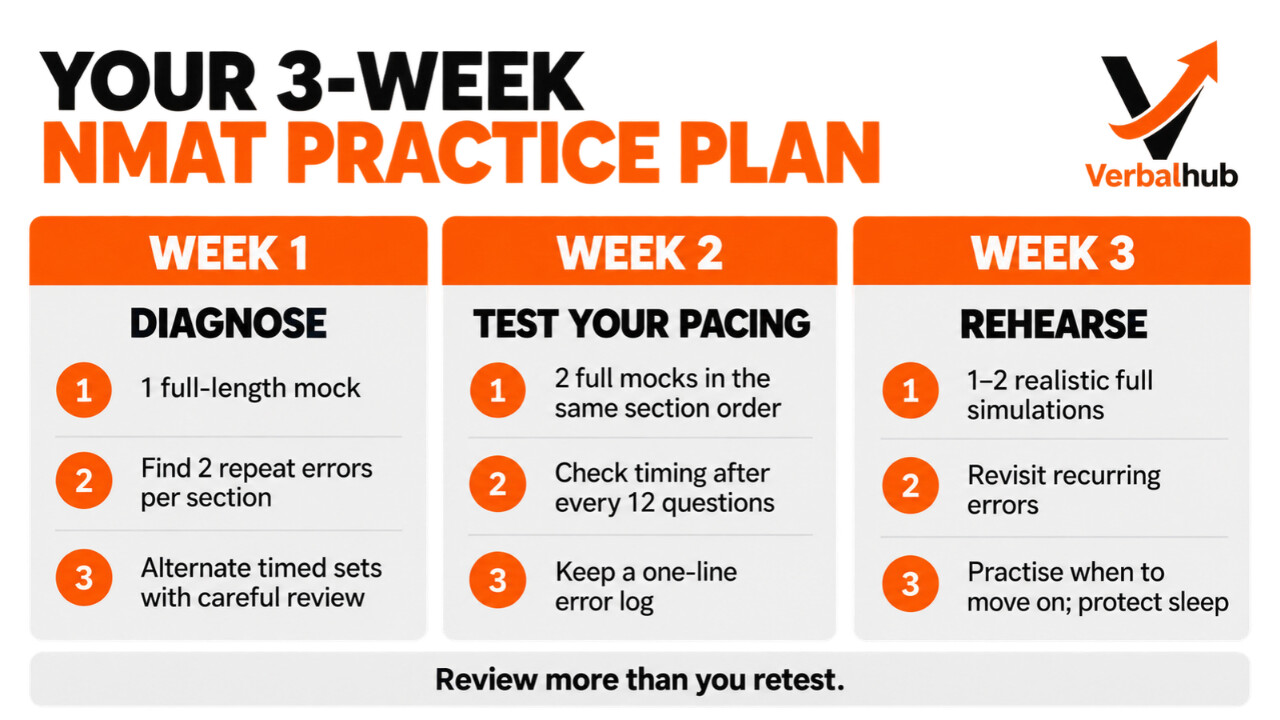
Week 1: What are you losing marks to?
Take one official or reliable full-length diagnostic in your intended section order. Record the three scaled scores, final question reached, time pressure and recurring mistakes. Spend the rest of the week repairing two repeat errors per section. In Language Skills, alternate short timed sets with slower review so you understand why an option is wrong.
Week 2: Can the method survive a timer?
Take two full mocks with the same section order. Use the 12-question checkpoints to identify where time slips away. Keep an error log with the question type, choice made, reason and a one-sentence correction. Test a different order only if the first has a clear weakness; avoid changing several variables at once.
Week 3: What will you repeat on exam day?
Use one or two full simulations under realistic conditions, then devote more time to reviewing than retesting. Repeat the question types that caused the largest avoidable loss, rehearse when to cut off a time drain and protect sleep. GMAC offers official NMAT practice exams, which are useful for experiencing the format and receiving scaled score feedback; do not assume an unrelated GMAT mock reproduces the NMAT algorithm.
Start with the official NMAT practice exams and compare your pattern with Verbalhub's NMAT preparation guide.
Is 230 plus a guaranteed NMIMS Mumbai call?
Direct answer No. A 230+ target can motivate preparation, but NMIMS says cutoffs vary by campus and programme each year. It currently accepts only the first NMAT attempt and does not accept at-home proctored NMAT scores. Check your specific programme's current admission page before choosing a test mode or retake plan.
Do not treat a historical cutoff, 209, 220, 230 or a supposed 60-point sectional minimum as an official 2026 guarantee. A strong total with a weak section may still be risky if a programme uses sectional thresholds. NMIMS also requires a separate application after NMAT registration and may use later evaluation stages. Confirm the campus, programme, test centre mode, deadline and acceptance policy on the current NMIMS site.
GMAC allows up to three attempts in a testing cycle. Its current registration page says a valid-score retake can be scheduled at least seven days later, while another GMAC FAQ still mentions 15 days. Check the scheduling dashboard for the applicable rule before making a plan. More important for an NMIMS aspirant: a later score does not replace the first attempt under NMIMS's published policy. Other schools set their own score-acceptance rules.
How can one on one mentoring help with NMAT Verbal?
Hasan Raja Sir leads Verbalhub's verbal mentoring. Verbalhub identifies him as an IIM Kozhikode alumnus, a three-time CAT VARC 99th-percentile scorer, a GMAT Verbal V50 scorer and a teacher with about 20 years of experience. Those credentials do not produce an NMAT score by themselves. What helps is the way a teacher can hear your reasoning in real time and assign the next drill to the actual error.
| Mentoring step | What the student receives |
|---|---|
| Diagnostic | Section scores, timing notes and a clear account of recurring verbal errors. |
| Personal schedule | A short weekly mix of RC, grammar, vocabulary and full-section practice. |
| Live correction | Discussion of why the tempting option looked right and what evidence rules it out. |
| Confidence check | A timed retest to see whether the corrected method still works under pressure. |
The language habits also matter in CAT VARC, XAT Verbal Ability, SNAP English, CMAT Language Comprehension, GRE Verbal Reasoning and MAT Language Comprehension. Each exam has its own pattern; there is no "CMAT Focus Edition" and no shared adaptive scoring rule across them. Choose exam-specific resources after building the reading and reasoning foundation.
Explore Verbalhub's NMAT coaching options, CAT VARC strategy and CMAT verbal preparation for the distinct formats.
Student review Vishankh Bhardwaj reports a CAT result at the 99th percentile and credits several teachers, including Hasan Sir. In his Verbalhub review, he particularly values Hasan Sir's explanations and practice questions. This is evidence of one student's CAT experience, not an NMAT result or a promised score improvement.
Verbalhub also publishes Ankit's GMAT case, describing a starting level around 500 and a 750 official result with individual guidance. Different tests and score scales prevent that journey from serving as an NMAT forecast. The practical lesson is to diagnose mistakes, practise deliberately and measure progress in the exam you will actually take.
What Do NMAT Aspirants Ask Most Often?
No. GMAC says there is no negative marking. That is a reason to answer every question you can reach, using elimination when needed. It is not evidence of a fixed three-mark award for each correct answer; the reported score is scaled.
No. GMAC says you cannot return to previous questions or review them. Read the stem carefully, choose your best answer and advance. Practise that one-pass decision in mocks rather than relying on a later correction.
GMAC has not published a first-ten weighting or a locked difficulty track. Every earlier response can affect later selection in an adaptive exam, so start attentively while preserving enough time to work accurately throughout the section.
You choose the sequence at the beginning of the exam. Use full mocks to select an order you can repeat calmly. You should not assume you can change the sequence after starting, and unused time from one section does not transfer to another.
GMAC permits up to three attempts per testing cycle, including the first sitting. Check its live retake scheduler for the required interval. Schools choose their own acceptance policies; the current NMIMS site says it considers only the first attempt.
There is no single safe score published for every year and programme. A 230+ planning target is not an official cutoff. Review your total and sections against the current NMIMS programme notice, and remember its first-attempt and test-centre rules.
GMAC says an unofficial result appears after the test and the downloadable scorecard is generally ready within 48 hours, subject to delivery incidents or security review. It reports scaled scores for all three sections and the total.
It can help when a tutor identifies the exact reading, grammar or timing errors you repeat and checks whether corrections hold in a timed section. The improvement depends on your starting level and work between sessions; no mentor can guarantee a target score.
What should you do next?
Take one full NMAT diagnostic, record the three section scores and bring the questions that took too long or produced uncertain answers. Hasan Sir can review your verbal reasoning, set a personal practice schedule and check progress in a later timed set. If NMIMS is your target, plan for the first attempt and confirm the current admissions rules before booking.
Book a one on one diagnostic Talk to Hasan Sir about your Language Skills score, section order and next three weeks of practice. Arrive with one complete mock and a short error log.
Book a Verbalhub mentoring discussion • Read the NMAT course overview