
Learn to judge tempting options by their effect on the argument, with seven original worked examples and a practical review routine.
You remove two options confidently. A third seems unlikely. Of the remaining two, one sounds sensible, uses familiar words and fits the topic. You select it. The explanation later shows that it never answered the question.
GMAT Critical Reasoning trap answers become easier to recognise when you can explain exactly what an option does. Being relevant, believable or neatly written is not enough.
The current GMAT Verbal Reasoning section has 23 multiple-choice questions in 45 minutes, covering Critical Reasoning and Reading Comprehension. GMAT's exam structure and exam content pages confirm the format.
CR tests your ability to understand and analyse arguments. This includes identifying assumptions, strengthening or weakening arguments, identifying conclusions and recognising reasoning roles—the jobs statements perform, such as evidence or conclusion. GMAC describes CR broadly as constructing and evaluating arguments and assessing plans; mba.com's CR overview discusses the associated tasks.
The seven patterns below are practical teaching labels, not official GMAT categories. They can overlap. The examples are original teaching exercises, deliberately short enough to make each error visible; they are not official questions or difficulty-calibrated test items.
Before the options: find the conclusion, evidence and gap
A useful GMAT Critical Reasoning strategy starts before answer elimination. Identify what the author wants you to accept, what supports it and what connection remains unproven.
For example, higher sales after a shop changes its window display do not establish that the display caused the increase. A festival, discount or competitor's closure might explain it. The gap concerns causation.
Use this short routine:
- Read the question stem first or immediately after the stimulus. Know the task before evaluating options.
- Identify the conclusion. What is the author trying to establish?
- Separate evidence from opinion. Distinguish stated observations from interpretations, predictions and recommendations. Accept the stated premises for the exercise.
- Ask what the argument assumes. What must connect the evidence to the conclusion? Keep your prediction broad.
- Read each option against the exact task. Does it strengthen, weaken, identify an assumption or describe the reasoning as requested?
For more on finding that missing connection, explore pre-thinking assumptions in GMAT Critical Reasoning.
For inference questions, establish what the facts support; do not invent a gap to attack. For reasoning-role questions, map what each statement does.
Seven GMAT Critical Reasoning trap answers to recognise
Try each example before reading its explanation. Then describe why your final rejected option fails. That second explanation is often where better GMAT Verbal accuracy begins.
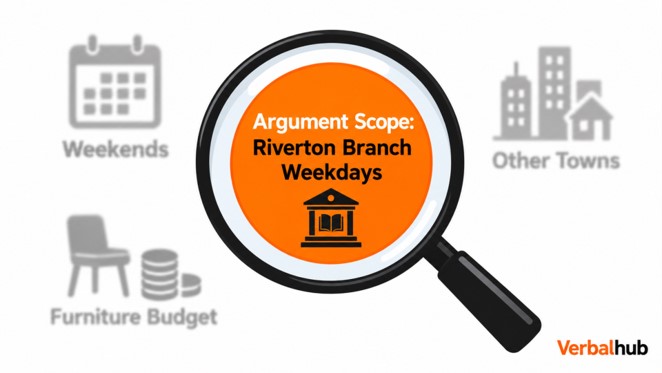
1. Scope shift: the answer moves outside the claim
GMAT scope shift answers may change the population, location, period or condition. Shared vocabulary can hide the change.
Argument: Riverton's library proposes opening an hour earlier on weekdays. A survey of local office workers found that many would borrow books before work if it opened earlier. The director concludes that the change would increase weekday borrowing at this branch.
Question: Which statement, if true, most strengthens the director's conclusion?
- A. Weekend visitors would prefer the library to close later.
- B. Many surveyed workers currently cannot visit during opening hours and would use the proposed morning hour to borrow books.
- C. University students in another town prefer late-evening library access.
- D. Several workers like the library's building design.
- E. The branch's annual furniture budget has remained unchanged.
Correct answer: B
It connects interest to additional borrowing: these workers currently lack access and would borrow during the new hour. The conclusion becomes more credible, though it is not proved.
Trap answer: C
It concerns another population, town and opening period. It sounds relevant because it discusses library access, but supplies no useful link to weekday borrowing at Riverton's branch. A concerns weekends; D and E do not establish additional borrowing.
Elimination question: Does this option affect the exact people, place, period and outcome in the conclusion?
2. Reversal: the answer works in the wrong direction
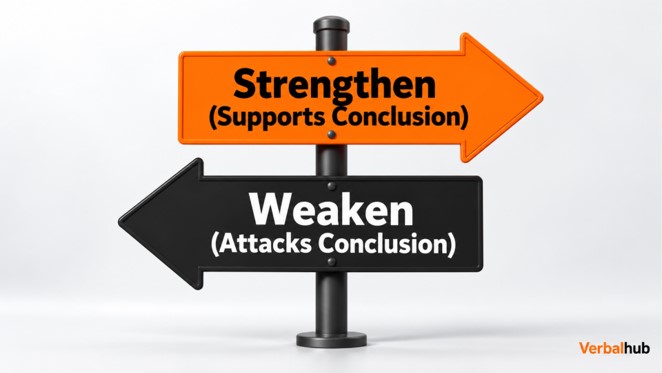
On GMAT strengthen and weaken questions, a strong logical connection can still lead to the wrong answer if its direction is reversed.
Argument: After a delivery depot introduced a new route-planning system, its late-delivery rate fell. The manager concludes that the system caused the reduction.
Question: Which statement, if true, most weakens the manager's conclusion?
- A. The new system alerts drivers to road closures before departure.
- B. Drivers attended a demonstration of the system.
- C. The depot also stores unused packaging materials.
- D. Deliveries to a chronically congested district stopped at the same time, and excluding those deliveries explains the entire decline in the late-delivery rate.
- E. The supplier offers the system in three interface colours.
Correct answer: D
It identifies a change in the delivery mix that explains the observed decline without crediting the system. The before-and-after figures no longer provide persuasive evidence of the manager's causal claim.
Trap answer: A
Road-closure alerts offer a plausible way the system could reduce delays. That supports the conclusion; the task asks you to weaken it. B establishes exposure to the system but no effect. C and E do not address delivery performance.
Elimination question: If I accept this option, does the conclusion become more believable or less believable—and which direction is required?
3. Unsupported claim: the answer goes beyond the evidence
This pattern matters especially when the question asks what follows from given information. A plausible new explanation remains unsupported unless the facts establish it.
Argument: At a repair centre, every device assigned a priority label is inspected on the day it arrives. Some devices inspected that day have no priority label.
Question: Which statement must be true?
- A. Devices without priority labels are cheaper to inspect.
- B. Customers pay extra for every priority label.
- C. Having a priority label is not necessary for same-day inspection.
- D. Some priority-labelled devices require no repairs.
- E. The centre introduced priority labels to improve customer loyalty.
Correct answer: C
Some devices receive same-day inspection without the label. The label therefore cannot be a requirement for that outcome.
Trap answer: E
It supplies a confident explanation of management's motive, but nothing in the information establishes that motive. A and B invent cost or payment arrangements; D invents repair outcomes.
New information is not automatically wrong. Strengthen and weaken questions explicitly invite additional facts. The problem is an option that lacks the connection or support required by the task.
Elimination question: What stated fact or logical connection authorises this claim?
4. Restated premise: the answer adds no support
An option can feel safe because you have already read it. Familiarity does not mean it changes the argument.
Argument: In a trial, a restaurant's new booking form reduced the average time staff spent entering each reservation. The owner concludes that replacing the old form will reduce total staff hours spent processing reservations each week.
Question: Which statement, if true, most strengthens the conclusion?
- A. The trial showed that entering a reservation took less time with the new form.
- B. The old form has a blue heading.
- C. The restaurant serves lunch and dinner.
- D. Several neighbouring restaurants accept telephone bookings.
- E. Weekly reservation numbers will remain unchanged, and the new form will add no other staff processing work.
Correct answer: E
Lower time per entry leads more convincingly to lower weekly hours when reservation volume stays fixed and extra processing work does not offset the saving.
Trap answer: A
It repeats the trial finding already provided. It does not bridge the gap between time per reservation and total weekly work. B, C and D leave that gap untouched.
Restatement is not inherently wrong: identifying a conclusion or describing a statement may require paraphrasing existing information. Here, the task asks for additional support.
Elimination question: Does this choice add a useful connection, or merely repeat something the argument already gives me?
5. Fails the task: the answer targets the wrong job
This broader pattern includes options that affect an argument but do not supply the kind of answer requested.
Argument: A museum director reasons: "School groups account for most weekday visitors. If we offer schools cheaper weekday tickets, more school groups will come. Therefore, the discount will increase the museum's total weekday ticket revenue."
Question: Which option best describes a flaw in the director's reasoning?
- A. The museum should promote weekend exhibitions instead.
- B. The director assumes that attracting more school groups will outweigh the revenue lost by charging less per ticket.
- C. Ticket revenue is not the museum's only source of income.
- D. Several schools have already booked their visits and cannot add another trip this term.
- E. School visits can have educational value.
Correct answer: B
More groups do not establish higher revenue when each ticket brings in less money. B describes the missing comparison within the director's reasoning.
Trap answer: D
It could cast doubt on the expected attendance increase, but it offers an external fact rather than describing a flaw in the argument's reasoning. The stem asks for that description. A recommends another policy; C discusses other income; E concerns a different benefit.
Elimination question: Am I choosing a description, assumption, inference or new fact—and is that what the stem requests?
6. Extreme language: the answer claims too much
Words such as "always," "never," "all," "none" and "only" deserve scrutiny. Their validity depends on the evidence, rather than the words themselves.
Argument: Of the 80 trainees attending a software workshop, 52 completed a spreadsheet task faster after the workshop than before it. The remaining 28 took the same time or longer.
Question: Which conclusion is best supported by this information?
- A. Every trainee benefited from the workshop in at least one way.
- B. Software workshops always improve spreadsheet speed.
- C. None of the trainees needs further spreadsheet instruction.
- D. More than half of these trainees completed this task faster after the workshop.
- E. The workshop was the only possible cause of any faster completion.
Correct answer: D
Fifty-two is more than half of 80. D preserves the measured group, task and outcome without claiming a cause.
Trap answer: B
A result for some participants on one task cannot establish what workshops always do. A extends the findings to everyone and to unspecified benefits. C invents instructional needs; E excludes alternative causes without evidence.
GMAT CR extreme language is a warning to check support, not a reason for automatic elimination. If the facts establish a universal rule, a universal answer may be correct.
Elimination question: Does the evidence justify every part of this option's certainty and reach?
7. Wrong comparison: the answer changes the measuring stick
A comparison requires matching groups, conditions and units. An option may use accurate figures while answering a different comparison.
Argument: Packaging Line P used less electricity in total than Line Q last month. The operations head concludes that P used less electricity per package than Q.
Question: Which statement, if true, most weakens the conclusion?
- A. P used 800 kilowatt-hours to produce 400 packages; Q used 1,000 kilowatt-hours to produce 1,000 packages.
- B. P used less electricity last month than it used the month before.
- C. Both lines operated in the same building.
- D. P's control panel was repainted last year.
- E. Q's operators wear different uniforms from P's operators.
Correct answer: A
P used 2 kilowatt-hours per package; Q used 1. P's lower total electricity use therefore hides higher use per package. A directly contradicts the claimed efficiency comparison.
Trap answer: B
It compares P with its own earlier total. The conclusion compares P with Q on electricity per package. Both the comparison partner and measurement have changed. C establishes a shared location, while D and E provide no relevant efficiency evidence.
Elimination question: Are the same groups being compared using the same measure under relevant conditions?
A compact trap checklist for practice
Use this GMAT CR answer elimination checklist when reviewing close choices. During timed practice, prioritise the check that fits the argument.
| Pattern | Quick check |
|---|---|
| Scope shift | Same people, period, place and outcome? |
| Reversal | Correct strengthening or weakening direction? |
| Unsupported claim | Enough evidence or a clear logical connection? |
| Restated premise | New support where the task requires it? |
| Fails the task | Right kind of answer to the exact stem? |
| Extreme language | Certainty and breadth justified? |
| Wrong comparison | Same comparison and measurement? |
You need not force every wrong choice into one label. Explain the specific failure first; use the label to organise later practice.
Review CR mistakes so the next set changes
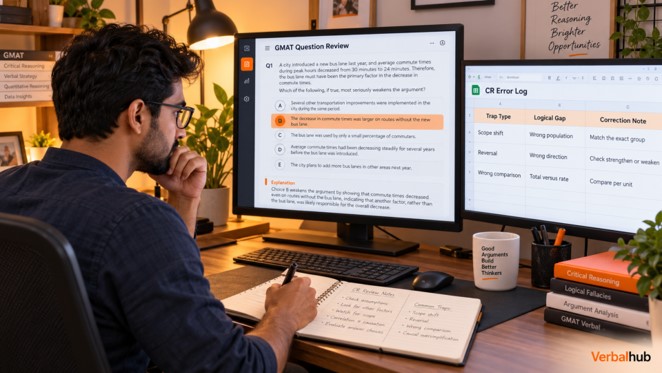
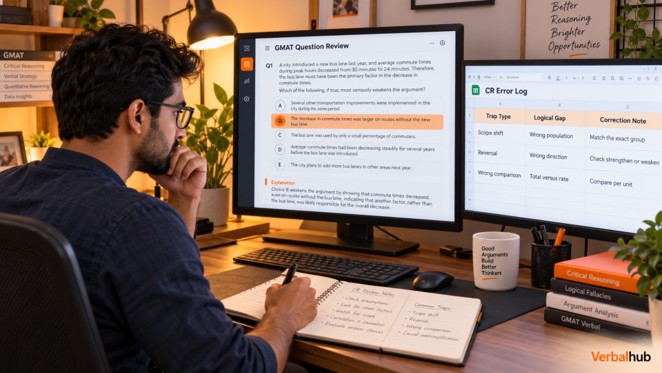
After a mistake, record more than the correct letter:
- Identify the trap. Quote the word or phrase that misled you and explain its effect.
- Explain why the correct option works. State the connection it makes to the evidence, conclusion or requested reasoning role.
- Rewrite the logical gap. For the booking-form example: "Less time per booking does not establish fewer weekly hours unless volume and other work are accounted for."
- Practise similar questions later. Revisit the missed item after a gap, then try fresh GMAT CR practice questions testing the same weakness. Remembering a letter does not show that the skill has improved.
For GMAT assumption questions, distinguish a necessary condition from a merely helpful fact. Negate a proposed necessary assumption carefully and examine whether the reasoning loses a required link. Avoid mechanically applying this test to every question type.
Include correct answers you guessed. Track your recurring GMAT Critical Reasoning mistakes, then set a specific next assignment—for example, comparison questions focused on totals versus rates. VerbalHub's guide explains how to review GMAT practice tests effectively.
Frequently Asked Questions
Finish the sentence: "This option answers the question because..." Your explanation should identify a logical effect or supporting fact. "It sounds reasonable" is a cue to return to the stem and conclusion.
Reading it first can help you read with a clear purpose. Reading it immediately after the argument is also workable if you establish the task before comparing options. Test both approaches in practice and track misunderstandings and time.
They may extend a limited observation to every person, situation or period. Check whether the evidence supports that extension. Strong wording can be correct when the information warrants it.
Practise identifying the conclusion and evidence, explaining the gap and rejecting options for specific reasons. Begin with careful review, then test the method in mixed timed sets. Use current official practice material alongside focused teaching exercises.
No. Strengthen and weaken questions ask you to consider additional information. An inference answer, by contrast, must follow from the given facts. Judge new information according to the task and its connection to the argument.
Get personal feedback on recurring CR errors
If the same GMAT Critical Reasoning trap answers keep attracting you, a mentor can identify recurring errors, explain why tempting choices fail, assign focused practice and turn mock results into a specific improvement plan.
Explore VerbalHub's GMAT Verbal coaching and one-on-one mentoring. Its GMAT Verbal coaching for working professionals page describes personalised sessions and error review. The current page identifies Hasan Raja Sir as VerbalHub's founder and head trainer, an IIM Kozhikode alumnus and a GMAT Verbal V50 scorer.
Bring a recent mock and a few difficult CR decisions to a mentoring discussion. The useful starting point is understanding why you chose each answer and what you will do differently on the next set.
Stop Falling for the Same Traps. One-on-One GMAT Verbal Mentoring with Hasan Sir — Error Analysis · Trap Recognition · Personalised Practice. Book a Free Diagnostic.