Best GMAT Verbal Coaching: How to Choose the Right Course

You have watched the lessons, made notes and solved hundreds of questions. You can follow most Reading Comprehension passages, and you know what strengthen, weaken and assumption questions are asking. Yet your Verbal score barely moves.
This is where many students make an expensive mistake: they buy another large course because it offers more videos, more practice sets or more mocks. Extra material feels productive, but it may not address the real reason the score is stuck.
Perhaps you are treating background information as the conclusion. Perhaps you are choosing an RC answer that is sensible but not supported by the passage. You may also understand a question in an untimed session and lose the method once the clock starts. These are different problems, and each needs a different correction.
Finding the best verbal course for GMAT preparation is therefore not about choosing the biggest content library. It is about finding a learning system that can show you what is going wrong, teach you a repeatable way to fix it and check whether the fix holds under test conditions.
This guide compares self-paced courses, group classes and personalised GMAT Verbal online coaching so that you can choose according to your level, schedule and score target—not according to an advertisement.
KEY IDEA: The right course should reduce repeated errors. More content alone does not do that.
Why GMAT Verbal Is More About Reasoning Than English
Strong English certainly helps. It makes dense passages easier to read and reduces the effort needed to process long sentences. But language comfort is not the same as GMAT reasoning skill.
The current Verbal section tests Critical Reasoning and Reading Comprehension. Both demand careful decisions based on evidence. You need to know what the author or argument has established—and, just as importantly, what has not been established.
- Separate a conclusion from the facts used to support it
- Find the missing link between evidence and conclusion
- Judge whether an option strengthens, weakens or merely discusses the topic
- Track how a passage moves from one idea or viewpoint to another
- Keep an inference within the limits of the text
- Reject an attractive option when the passage does not support it
A fluent reader may understand every sentence in a passage and still miss its central purpose. In the same way, a student may understand a CR topic but choose an answer that has no effect on the argument. Good verbal coaching for GMAT preparation teaches these distinctions directly.
What Makes a GMAT Verbal Course Worth the Money?
Before comparing brands or prices, check whether the course provides the following four essentials.
1. A Method You Can Use on Unfamiliar Questions
Useful teaching gives you a process, not a bag of tricks. In CR, that process should help you identify the conclusion, map the evidence, find the logical gap and test what each option actually does to the argument.
In RC, the method should help you see the job of each paragraph, the author's position, changes in viewpoint and the boundary of a valid inference.
Shortcuts may save time after the method becomes natural. They are risky when used as substitutes for reasoning. Advice such as "avoid strong words" or "pick the most relevant option" breaks down when several choices sound reasonable.
2. Diagnosis at the Level of the Mistake
Two students can choose the same wrong answer for completely different reasons. One may have misread the conclusion; the other may have understood the argument but missed a scope shift in the option. Giving both students the same explanation will not solve both problems.
A serious course should separate errors such as concept gaps, weak comprehension, over-inference, distractor attraction, poor question interpretation, timing trouble and failure to use the method in a mock.
3. Practice That Changes as You Improve
A useful GMAT Verbal online course should move from diagnosis to skill drills, mixed practice, timed sectionals, full mocks and retesting. Each stage answers a different question.
- Topic drills: Can you apply one skill correctly?
- Mixed sets: Can you recognise which skill the question requires?
- Timed sectionals: Does the method remain stable under pressure?
- Full mocks: Can you manage decisions across the complete test?
- Retesting: Has the weakness actually been corrected?
The last step is often missed. Understanding an explanation after the test is not proof that you will make a better decision next time.
4. Access to a Trainer Who Reviews Your Work
Recorded lessons are excellent for explaining concepts at scale. They are less useful when the issue is personal: why you keep choosing the final wrong option, why one RC passage type unsettles you or why your accuracy drops after the first twenty minutes.
Before you enrol, ask who will teach the course, who will study your mocks, how often you can ask questions and what happens when your progress slows. The answers reveal more than the number of advertised class hours.
Self-Paced Videos vs. Group Classes vs. Personalised Coaching
No single format is automatically best. The right format depends on how much structure you need, how well you can review your own mistakes and whether your present weakness is broad or highly specific.
| Feature | Self-Paced Course | Group Classes | VerbalHub Personalised Coaching |
|---|---|---|---|
| Personalisation & mentorship | Standard learning path; support varies by plan | Shared teaching plan and divided attention | Study plan and feedback based on the student's error patterns |
| Teaching approach | Usually organised concept videos and practice | Live explanation at the pace of the batch | Logic-led instruction adjusted to how the student reasons |
| Error diagnosis | Mostly self-led or based on automated reports | Common errors may be discussed for the group | Individual error-log auditing and targeted correction |
| Mock review | Often report-led | May be reviewed at batch level | Mock decisions shape the next study cycle |
| Schedule | Maximum flexibility | Fixed batch timings | Flexible planning for the student's availability |
| Best fit | Independent learners building foundations | Learners who want routine and live classes | Retakers, working professionals and students facing a plateau |
| Instructor access | Limited or package-dependent | Available mainly during scheduled sessions | Direct, regular interaction with the assigned mentor |
Self-paced platforms work well when you are disciplined and can spot your own weaknesses. Group classes provide routine and live interaction. Personalised coaching becomes more valuable when the same errors keep returning despite substantial study.
Choose the format that matches your need for feedback—not the one with the longest content list.
Why GMAT Verbal Scores Reach a Plateau
A plateau is rarely mysterious. It usually means the study routine is repeating the same decisions without changing the reasoning behind them.
- Checking only whether an answer was right or wrong
- Memorising answer patterns instead of analysing the argument
- Reading RC for facts without tracking paragraph purpose
- Accepting an option because it sounds connected to the topic
- Making an inference that goes one step beyond the passage
- Practising only comfortable question types
- Taking new mocks before correcting the previous mock
- Ignoring when and why accuracy falls during the section
Imagine a student with weak scope control. The student may select a CR option that is relevant but does not affect the conclusion. In RC, the same student may choose a reasonable statement that the passage never supports. The questions look different, but the underlying mistake is the same.
This is why another hundred random questions may add effort without adding improvement. The error pattern has to be named, corrected through focused practice and tested again.
The VerbalHub Advantage: A Four-Phase Learning System
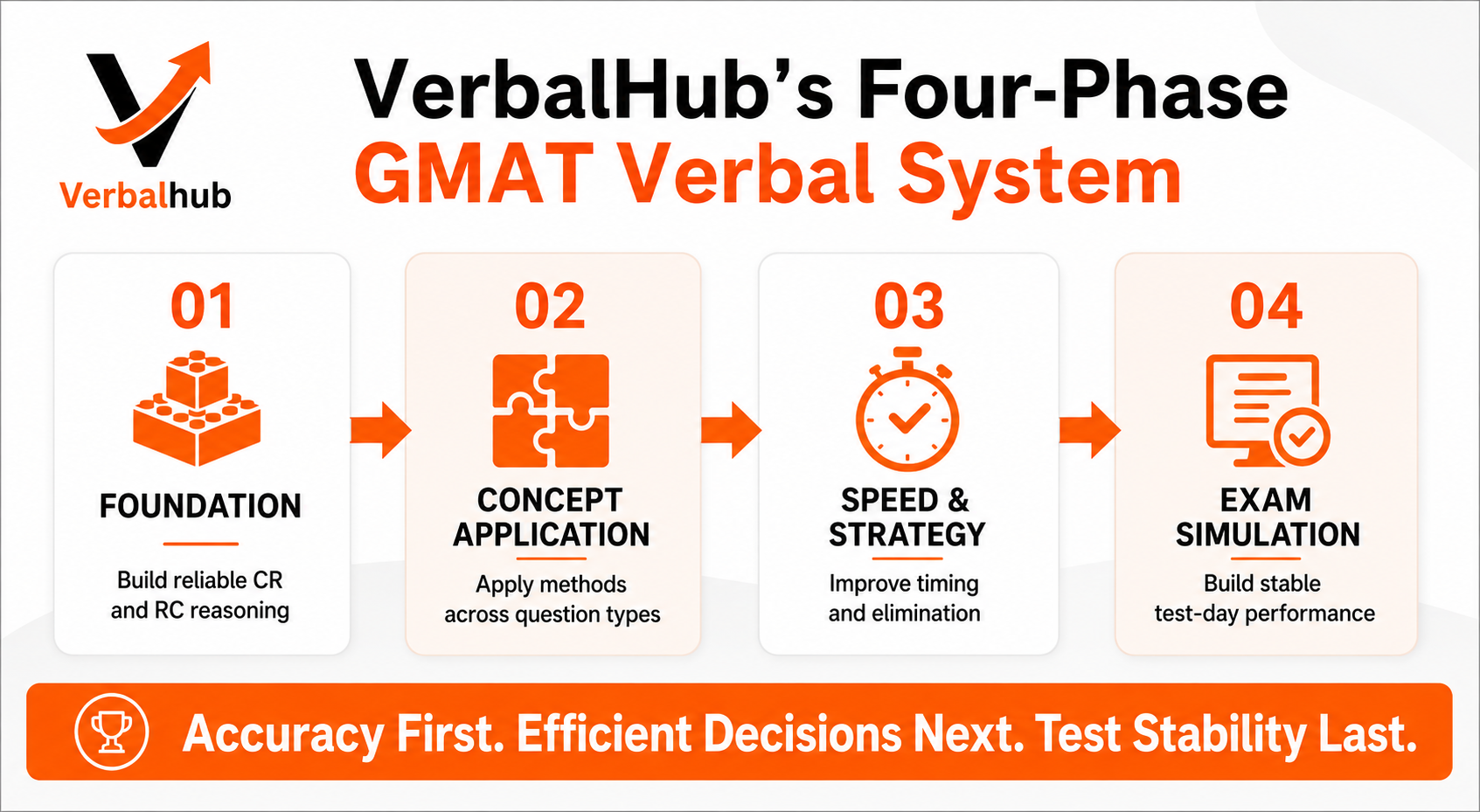
VerbalHub organises GMAT Verbal coaching into four connected phases. Students do not chase speed on day one. They first build a reliable process, then learn to use it efficiently and finally test it under exam conditions.
Foundation → Concept Application → Speed & Strategy → Exam Simulation
Phase 1: Foundation
The first phase replaces instinctive answering with a clear reasoning routine. Students learn to identify premises and conclusions, uncover assumptions, examine cause-and-effect claims, notice comparison gaps and control scope. In RC, they learn to map paragraph roles, viewpoints and shifts in the author's discussion.
Goal: Build a dependable way to read arguments and passages before worrying about speed.
Phase 2: Concept Application
The student now applies the framework across strengthen, weaken, assumption, inference, evaluate, paradox, boldface and plan questions. RC work covers main idea, purpose, detail, inference, tone, structure and application.
The review does not stop at the correct choice. Students must explain the reason for the other options' errors. This exposes weak elimination habits that a simple accuracy percentage can hide.
Goal: Use the same reasoning principles when the wording and subject matter change.
Phase 3: Speed and Strategy
Speed is built by making useful steps more efficient, not by skipping them. Students practise faster argument mapping, concise passage notes, close-option elimination, timing checkpoints and recovery after a difficult question.
Goal: Keep the method intact while working within realistic time limits.
Phase 4: Exam Simulation
The final phase combines micro-topic tests, mixed CR and RC sets, timed sectionals and full-length mocks. Accuracy, time use and decision quality are reviewed together. The findings lead to corrective assignments and then retesting.
Goal: Produce stable performance across the full section, including difficult moments.
Accuracy first. Efficient decisions next. Test-day stability last.
Learning Directly with Hasan Sir
VerbalHub's program is led by Hasan Sir, its Head Trainer and Founder. He is carrying more than 20 years of experience in Verbal teaching, curriculum development and student mentoring. Over the years, he has guided thousands of learners preparing for management entrance tests, including students working towards top-percentile outcomes.
His classes are method-driven. Instead of asking students to depend on vague instinct, grammar rules or lucky elimination, he teaches them to work with evidence, conclusions, assumptions, scope, passage structure and the precise effect of an answer choice.
HASAN SIR'S STANDARD: You should be able to explain why the correct option works—and why every close competitor fails.
In one-to-one sessions, teaching is only one part of the work. Hasan Sir reviews error patterns, checks how the student performs under time pressure and adjusts the study plan when the evidence shows that the current approach is not working.
How VerbalHub's Error-Log Auditing Works
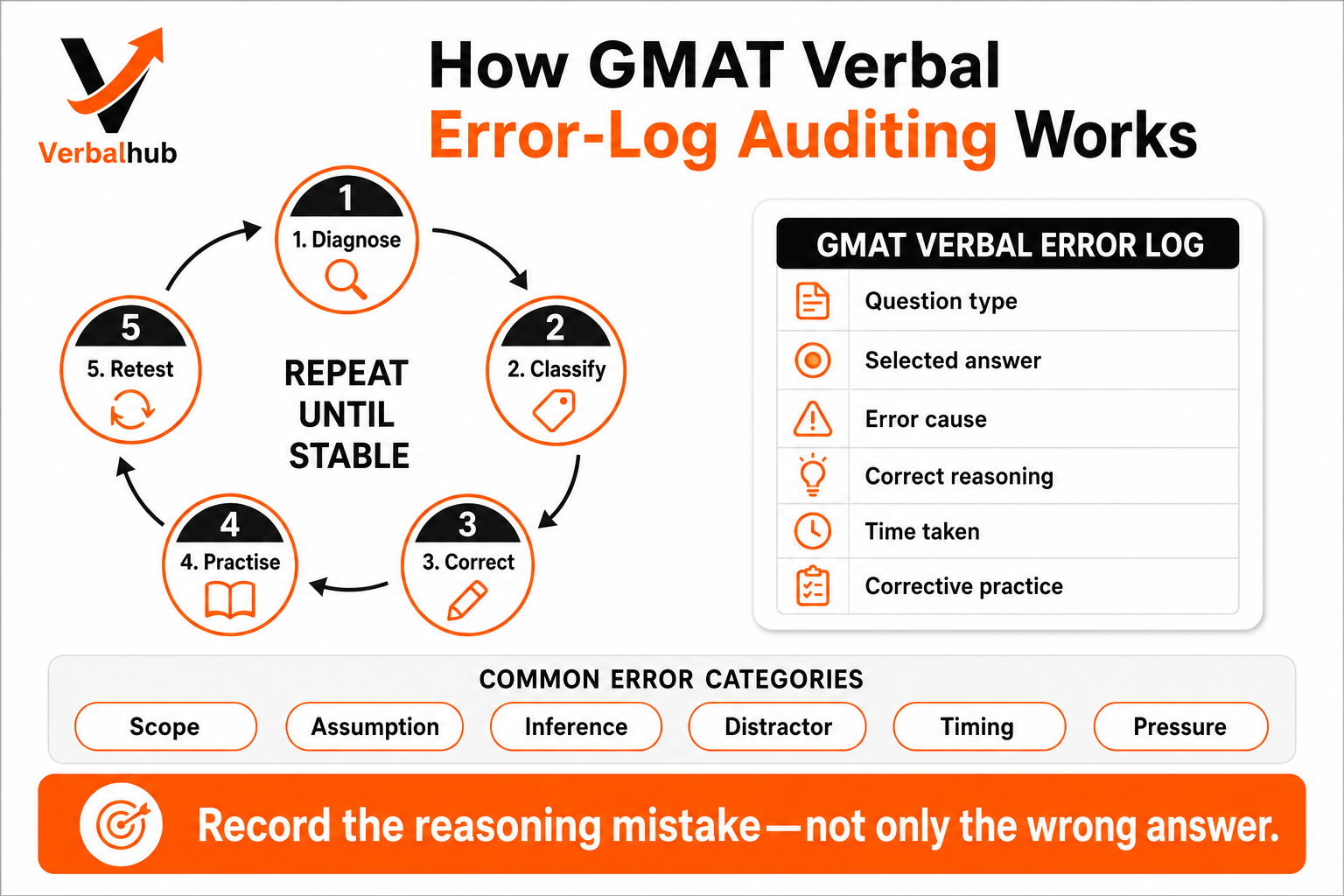
A basic error log records the question, the chosen answer and the official explanation. That is useful, but it does not tell you what to practise next. VerbalHub's auditing process looks for the reasoning failure behind the wrong choice.
| Error Pattern | What It Looks Like | Corrective Work |
|---|---|---|
| Argument mapping | Evidence is treated as the conclusion | Short premise–conclusion mapping drills |
| Assumption gap | The required link is not identified | Assumption testing and negation practice |
| Scope control | A related but ineffective option is accepted | Side-by-side scope comparison |
| RC structure | Details are remembered, but paragraph purpose is missed | Passage mapping with role labels |
| Over-inference | A plausible claim is chosen without textual support | Evidence-location and boundary drills |
| Distractor choice | A distorted or strongly worded option survives | Final-two-option comparison |
| Timing | Accuracy drops once the clock is introduced | Timed sets with decision checkpoints |
| Pressure | The method is abandoned during mocks | Short simulations followed by review and retest |
The improvement loop is simple: diagnose the error, classify its cause, correct the method, practise the specific skill and retest it in a new set. The aim is not to build a large record of mistakes. It is to stop one mistake from appearing in several different forms.
Diagnose → Classify → Correct → Practise → Retest
Who Benefits Most from Personalised GMAT Verbal Coaching?
One-to-one help is not necessary for every learner. It is most useful when the preparation problem is specific, repeated or difficult to diagnose alone.
- You completed a course but your score remained in the same range
- You are preparing for a retake and need to understand the previous result
- You frequently narrow a question to two options and choose the wrong one
- Your untimed accuracy is good, but it falls sharply in sectionals
- Your RC performance changes widely across passages
- You are balancing preparation with a demanding job
- You have limited time and cannot afford random practice
- You are targeting the upper end of the Verbal score scale
A well-designed self-paced course or small live batch may be enough if you are still building the basics, can review your own work honestly and are improving at a steady pace. The best course for GMAT Verbal is the one that solves the problem you have now—not the problem another student had.
Choosing the Right Path for Your Target Score
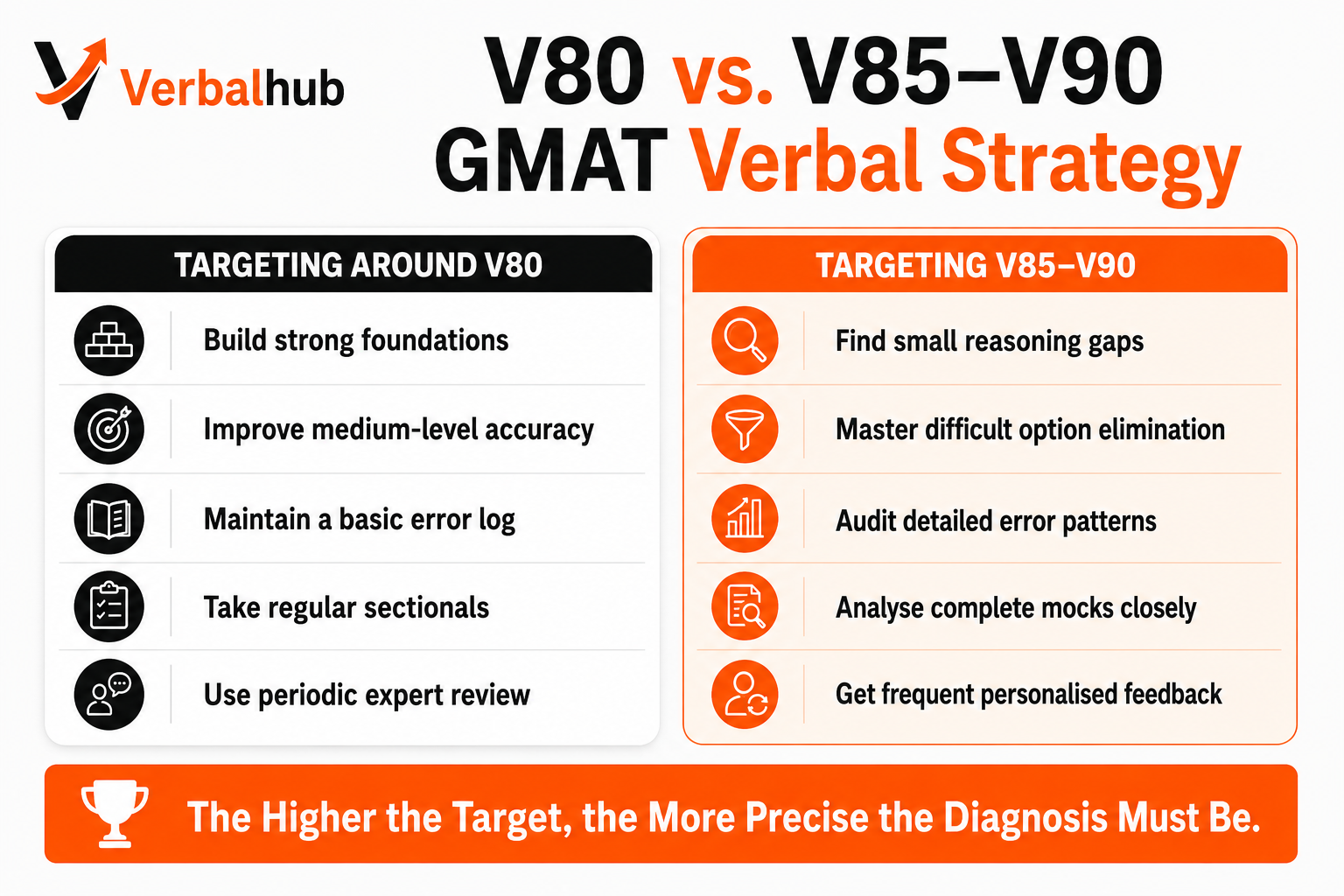
The higher your target, the smaller the errors that begin to matter. Your course choice should reflect that difference.
| Area | Targeting Around V80 | Targeting V85–V90 |
|---|---|---|
| Main priority | Build reliable CR and RC foundations | Find and correct small reasoning leaks |
| Accuracy focus | Become consistent on medium-level questions | Improve difficult-question judgment and final-option elimination |
| Error review | Maintain a clear, honest error log | Track patterns across question type, scope, timing and pressure |
| Testing | Use regular topic tests and sectionals | Analyse sectionals and full mocks at decision level |
| Expert support | Periodic review may be enough | Frequent personalised feedback is more valuable |
The current GMAT Verbal scale runs from 60 to 90, so V90 is the maximum section score. Claims such as "V90+" are therefore inaccurate. Students near the top of the scale need precise diagnosis because one or two unstable habits can have a noticeable effect.
The higher the target, the more precise the diagnosis needs to become.
Questions to Ask Before Choosing a GMAT Verbal Online Course
A good provider should answer these questions clearly before asking you to enrol:
- Who will teach my classes, and will that person also review my mocks?
- How will you assess my starting level in CR and RC?
- Will my study plan change according to my results?
- How do you record and review repeated reasoning errors?
- Does the course teach a logical process or mainly offer shortcuts?
- Which topic tests, sectionals and full mocks are included?
- How long is access possible with the trainer?
- Can the schedule work around a full-time job?
- What will you change if my score stops improving?
- How are student-result claims verified and presented?
The best GMAT Verbal online course will not avoid these questions. It will explain how teaching, practice, review and course correction fit together.
Why VerbalHub Is a Strong Choice for GMAT Verbal Coaching
VerbalHub is built for students who want their preparation to respond to their actual performance. Its model combines:
- A phase-wise path from foundations to exam simulation
- Logic-based teaching for CR and RC
- Personalised one-to-one classes and study plans
- Direct mentorship with Hasan Sir
- Micro-topic tests, timed sectionals and mock analysis
- Detailed error-log auditing
- Corrective practice followed by retesting
- Flexible scheduling for working professionals
This makes VerbalHub a practical option for learners searching for GMAT Verbal online coaching that offers close feedback rather than another standard sequence of lessons.
Final Verdict: Buy Diagnosis, Not Just Content
There is no universal best format. A disciplined beginner may progress well with a structured self-paced course. Another student may need the routine and social accountability of live group classes.
But if you already know the basics and continue making the same CR and RC mistakes, more content is unlikely to be the complete answer. You need to know why marks are being lost, which skill requires correction and what evidence will show that the correction has worked.
VerbalHub's personalised model is designed around those three questions. Its strength lies in connecting teaching with individual diagnosis, focused practice and retesting.
Book a GMAT Verbal Diagnostic Session
Discuss your current score, target, schedule and preparation history with Hasan Sir. A diagnostic conversation can help separate a concept problem from a strategy, timing or execution problem—and show whether personalised coaching is the right next step for you.
Visit VerbalHub.com to book a diagnostic call or a 30-minute paid demo class.
Do not begin with another generic plan. Begin by identifying the exact reason your score is stuck.
Frequently Asked Questions
The best course depends on your starting point, score target and need for feedback. A self-paced program can suit an independent beginner. Personalised coaching is often more useful for a retaker or a student whose score has stopped moving.
Yes, when it includes live explanation, structured practice, individual review and clear follow-up work. The quality of the teaching and feedback matters more than whether the class takes place online or in a classroom.
Yes. Many students can build foundations through official material and a structured course. Expert help becomes valuable when you cannot identify repeated errors or when good practice accuracy does not carry into timed tests.
Consider it if you are retaking the exam, have limited preparation time, need a flexible schedule or have already completed a general course without reaching your target.
Common causes include weak argument mapping, loose scope control, unsupported inference, attraction to close distractors and inconsistent use of the method under time pressure.
There is no fixed timeline. A beginner building foundations may need several months, while an experienced test-taker correcting one narrow weakness may need a shorter, more focused plan. Weekly study time and review quality matter as much as the calendar.
The current Verbal section uses a 60–90 scale. A good score is one that supports your overall GMAT target and fits the expectations of the schools you plan to approach.
A useful error log records the reasoning cause, not only the wrong answer. Once repeated patterns become visible, practice can focus on the skill that is actually costing marks.
Look for a repeatable reasoning method, adaptive practice, individual error diagnosis, timed testing, mock review and access to an experienced trainer who can change the plan when progress slows.
GMAT outcomes vary with starting level, preparation quality, consistency and test-day execution. No course or trainer can guarantee a particular score.