For PTE Repeat Sentence 2026, your best strategy is simple: remember meaningful phrases, start promptly, and repeat what you heard without restarting. These PTE Repeat Sentence tips help you practise listening accuracy and clear speech together. If you're aiming for a PTE Speaking score of 79+, record your attempts and review both missing words and broken rhythm.
First, set the right target. For Australian tests taken from 7 August 2025, superior English requires PTE Academic scores of Listening 69, Reading 70, Writing 85 and Speaking 88. The old "79 in each skill" target no longer applies to new tests.
For Canadian study, check your institution's requirements. If you're still deciding between PTE Core or PTE Academic, settle that before booking. This guide focuses on PTE Academic.
Why Repeat Sentence is the highest-leverage PTE task
10–12 items, cross-scored to Listening + Speaking; partial-credit rules
PTE Academic includes 10–12 Repeat Sentence items, contributing to Listening and Speaking. Partial credit means an incomplete response can still earn marks.
That makes it a valuable practice task. One short drill trains your ear, memory and delivery. It deserves regular attention, although it cannot carry your entire score.
Before building your schedule, review the 2026 test format and timings. Keep time for the other tasks, too.
How Repeat Sentence is scored in 2026 (Content 0–3, Fluency 0–5, Pronunciation 0–5)
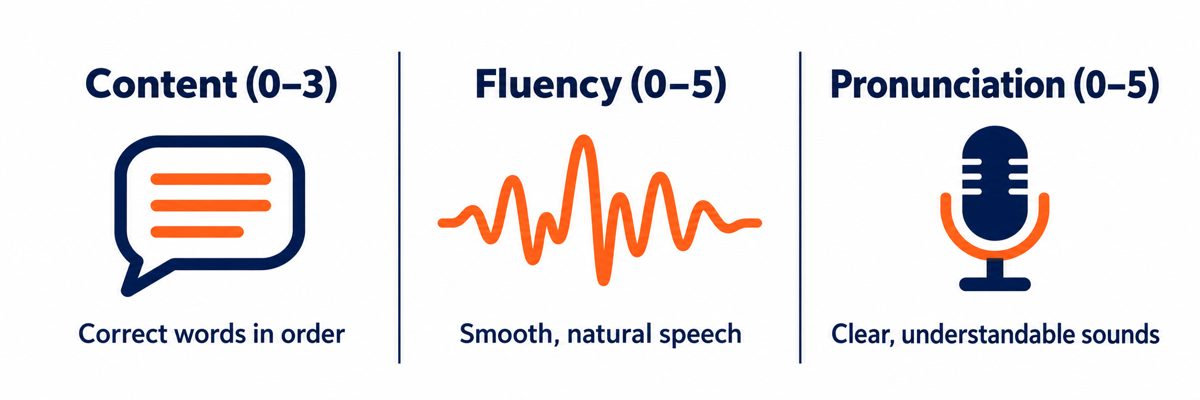
The three scoring traits are:
- Content, 0–3: how accurately you reproduce words in their original sequence.
- Fluency, 0–5: the flow of your speech.
- Pronunciation, 0–5: how clearly you produce the sounds.
For content, complete accuracy earns 3; at least half the words in correct sequence earns 2; less than half earns 1; almost nothing earns 0. These task marks are not a direct conversion into your 10–90 report score.
The "50% rule" and why starting immediately matters
The PTE 50% rule is a recovery option, not your daily target. Aim to reproduce the whole sentence.
For example, consider this 12-word prompt:
"The new research centre will open its doors to students next September."
Repeating "The new research centre will open" preserves six words in sequence. That illustrates the threshold for 2 content marks, but it says nothing about the response's fluency or pronunciation.
The microphone opens when the audio ends. There is no separate preparation countdown. Start once recording begins; don't wait to rebuild every missing word.
3-second silence auto-stop and its impact on Fluency
Pearson states that a three-second silence while speaking can end the recording. This applies to Repeat Sentence. You cannot resume after the recording closes.
Long hesitation also breaks your rhythm. Brief phrase pauses are natural; a prolonged search for one missing word is disruptive.
Practise moving to the next remembered phrase rather than freezing.
The chunking method that actually moves scores: PTE Repeat Sentence tips
Listen for meaning, not words; phrase boundaries; rehearsal in the gap
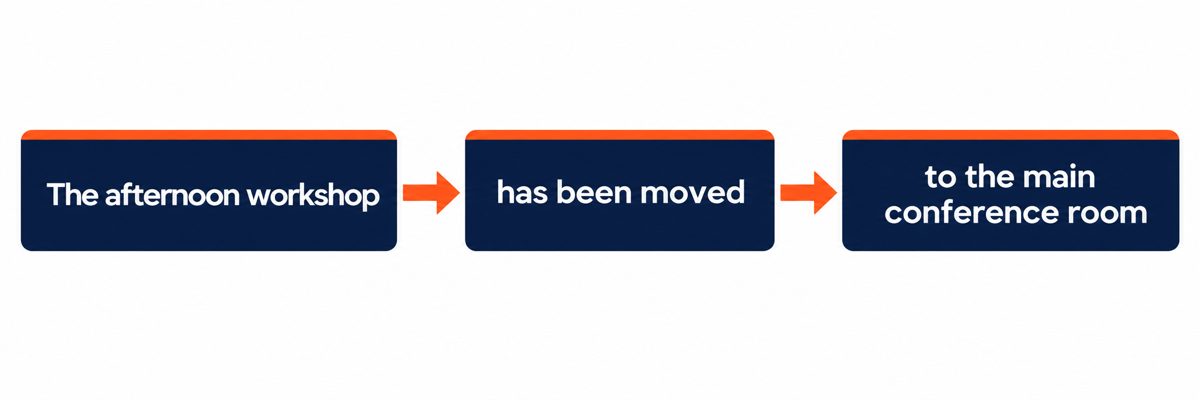
Chunking means remembering small groups that belong together. You still need the original wording; understanding the meaning helps you retain it.
Try this:
"The afternoon workshop / has been moved / to the main conference room."
You have three connected pieces to recall. Follow the speaker's phrasing rather than forcing a pause after every three words. Pearson recommends listening for meaningful phrases and following stress and intonation.
Use this practice sequence:
- Listen once without speaking over the recording.
- Hold the opening phrase and the sentence's meaning.
- Start when recording opens.
- Deliver the phrases in order.
If you mentally rehearse, keep it brief. There is no reliable extra "gap" for running through the full sentence.
Shadowing at 1.25x and 13–15 word drills for over-preparation
Shadowing means speaking just behind a recording. Use it separately from timed Repeat Sentence practice.
Begin at normal speed. When you can follow comfortably, try a short clip at 1.25x. Return to normal speed for recall practice. Faster playback is an optional training challenge, not a requirement or an instruction to rush your answer.
For longer practice, use 13–15-word sentences such as:
"Students must submit their completed application forms before the office closes on Friday."
Record one attempt, check the wording, then listen again. Repeat accurately once and move to a fresh sentence. Otherwise, familiarity can hide weak listening.
What to do when you miss words (the "say half, get 2/3" rule)
Never stay silent; guess out loud; keep order; no self-repair
"Say half, get 2/3" refers only to content marks. It does not promise two-thirds of the total task score.
If you miss something:
- Say the phrases you remember in their original order.
- Give your best recall of an uncertain word.
- Skip a completely lost section rather than inventing unrelated material.
- Continue without restarting.
Suppose the prompt is:
"All laboratory visitors must wear protective clothing during the practical training session."
If "protective clothing" disappears from memory, continue with the later words you remember. Avoid adding "something safe" just to fill the space.
Pearson advises against correcting yourself, starting again or adding phrases absent from the audio.
Your recovery goal is to preserve useful content while keeping delivery steady.
Pronunciation vs Fluency: where Indian test-takers lose points
Intelligibility > accent; final consonants, th, v/w, schwa; stress-timed rhythm
PTE accepts understandable regional accents. You don't need to imitate a British or Australian speaker. Clear sounds and natural phrasing matter.
Indian test-takers have different pronunciation habits, so diagnose your own recording rather than assuming every sound needs work.
Check these areas:
- Final consonants: can a listener distinguish "work" from "worked" and "student" from "students"?
- Th: practise "think" and "this" with the tongue lightly between the teeth.
- V/w: compare "vine" and "wine"; use lower lip against upper teeth for "v."
- Schwa: unstressed syllables often use a light "uh" sound, as in the opening of "about."
- Rhythm: emphasise important words while keeping smaller words lighter.
Try saying: "The TRAINING SESSION starts on MONDAY."
Keep the connecting words clear, but avoid giving every syllable equal force. Good PTE fluency and pronunciation come from controlled, understandable speech.
14-day Repeat Sentence practice plan (15–20 min/day)
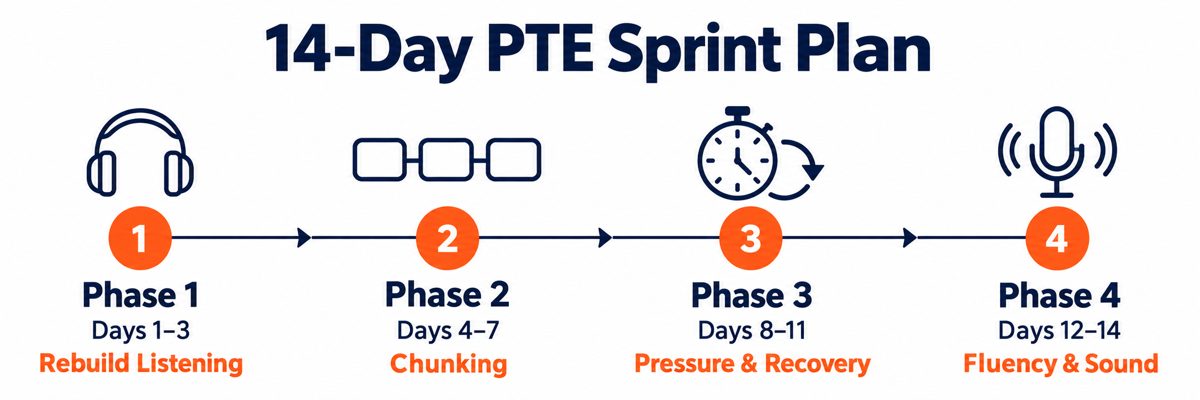
Days 1–3 rebuild listening; 4–7 chunking; 8–11 pressure/recovery; 12–14 fluency & sound
For this PTE practice plan, 14 days should produce a clear record of what improves and what still needs attention. Use fresh prompts and save your recordings.
Days 1–3: rebuild listening
Spend 15 minutes daily:
- Three minutes listening to short sentences.
- Eight minutes attempting 8–10 prompts once each.
- Four minutes checking transcripts and noting errors.
Separate words you never recognised from words you heard but forgot. Those problems need different drills.
Days 4–7: practise chunking
Spend 18 minutes daily:
- Three minutes marking phrase boundaries in transcripts.
- Ten minutes repeating fresh sentences without seeing the text.
- Five minutes reviewing two weak responses.
Gradually introduce longer sentences. Add a few reading accuracy drills that support overall PTE preparation outside this session to strengthen vocabulary recognition.
Days 8–11: practise pressure and recovery
Spend 20 minutes daily:
- Two minutes checking your recording level.
- Twelve minutes completing a timed set without replay.
- Six minutes reviewing missing phrases and hesitation.
If a sentence goes badly, finish your best response and move on. Don't let one difficult item spoil the next.
Days 12–14: refine fluency and sound
Spend 15–20 minutes daily:
- Three minutes practising one troublesome sound.
- Ten minutes completing a mixed-length set.
- Two to seven minutes comparing recordings with Day 1.
Track correct words, phrase order, false starts and long pauses. These observations are more useful than simply counting completed questions.
For PTE Repeat Sentence practice for 79+, finish with unfamiliar prompts. You need reliable recall, not a rehearsed collection.
Common mistakes that kill Repeat Sentence scores
Word-by-word memorization, late start, self-correction, fillers, low volume
These PTE Repeat Sentence mistakes deserve a place on your review checklist:
- Word-by-word memorisation: you lose the opening while trying to store the ending. Practise connected phrases.
- Late start: you spend recording time searching for perfection. Begin with the phrase you remember.
- Self-correction: you restart and disrupt the sentence. Continue.
- Fillers: "umm," "actually" and "you know" add nothing useful. Practise starting directly.
- Low volume: words become difficult to hear. Check your headset and speak at a comfortable level.
Don't compensate by shouting or racing. Pearson recommends normal volume and warns that rushing can reduce natural fluency.
For mic practice, record the same sentence at three comfortable positions. Compare clarity and breath noise, then follow the test centre's headset instructions.
Free practice & next steps
Link to VerbalHub's free PTE mock + Repeat Sentence drills
Start with VerbalHub's free PTE mock test information and access guidance. Ask the team for current access details and Repeat Sentence practice material.
For an immediate drill, have someone read these sentences once while you keep the text hidden:
- "The evening seminar will take place in the smaller lecture hall."
- "Please return all borrowed equipment before leaving the science laboratory."
- "Several international students have requested additional support with their first research assignment."
Record your response, compare it with the original, and mark omissions or changes. Repeat once accurately before moving on.
If your target is Canada PR via PTE Core, practise its Write Email task alongside speaking. A study-admission target and an immigration target need different preparation choices.
CTA to book a personalised scoring evaluation / demo
Book a free 15-minute PTE scoring diagnostic with VerbalHub. Bring your latest mock report and a few speaking recordings. We'll assess whether Repeat Sentence is a likely weakness, identify fluency breaks, and plan a focused 14-day sprint towards your target.
VerbalHub's one-on-one PTE coaching offers immediate feedback on fluency, mic placement and task timing, with personalised drills and accountability through a clear two-to-three-week plan. Hasan Sir's experience mentoring CAT, GMAT, GRE and IPMAT aspirants brings depth in verbal skills, reading comprehension, logic and test strategy. That guidance helps you practise with a purpose, address recurring mistakes and reduce avoidable retakes.
Turn Repeat Sentence Into Your Strongest PTE Task. Free 15-minute scoring diagnostic · Fluency and mic feedback · One-on-one PTE coaching. Book a diagnostic or demo to see which changes would make the best use of your preparation time.
Save this as a Word document for offline practice and daily checklists.
FAQs: PTE Repeat Sentence 2026
PTE Academic includes 10–12 Repeat Sentence items. They contribute to both your Listening and Speaking scores, and partial credit means an incomplete response can still earn marks.
It is scored on three traits: Content (0–3), Fluency (0–5) and Pronunciation (0–5). For content, complete accuracy earns 3, at least half the words in correct sequence earns 2, less than half earns 1, and almost nothing earns 0. These task marks are not a direct conversion into your 10–90 report score.
It refers to content marks only: reproducing at least half the words in the correct sequence can earn 2 content marks. It is a recovery option, not a daily target, and you should aim to reproduce the whole sentence.
Pearson states that a three-second silence while speaking can end the recording, and you cannot resume after the recording closes. If you miss a word, move on to the next phrase you remember instead of freezing.
No. Pearson advises against correcting yourself, starting again or adding phrases that were not in the audio. Continue with the phrases you remember, in their original order.
No. PTE accepts understandable regional accents. Clear sounds and natural phrasing matter more than imitating a particular accent.
The 14-day plan in this guide uses 15–20 minutes a day, moving from rebuilding listening (days 1–3) to chunking (4–7), pressure and recovery (8–11) and fluency and sound (12–14). Save your recordings so you can compare progress with Day 1.
VerbalHub offers a free 15-minute PTE scoring diagnostic. Bring your latest mock report and a few speaking recordings, and the team will assess whether Repeat Sentence is a likely weakness, identify fluency breaks and plan a focused 14-day sprint. One-on-one PTE coaching adds immediate feedback on fluency, mic placement and task timing.
Sources and useful links
- Australian Department of Home Affairs: Superior English requirements
- Pearson PTE Academic Test Taker Score Guide
- Pearson PTE Academic Speaking and Writing test format
- Pearson PTE Academic Speaking Test Tips
Explore more preparation articles at VerbalHub Blogs.