Chunking & Fluency Hacks
A practical VerbalHub guide for PTE Speaking score 79+ and confident Repeat Sentence performance
| Chunking | Fluency | Recovery |
|---|---|---|
| Hold 3-4 meaning parts | Speak smoothly after the beep | Say what you remember |

Teacher's quick target: Listen in chunks, start fast, keep speaking, and recover calmly when memory fails.
If your PTE Speaking score is stuck at 58, 65, or 74, Repeat Sentence may be one of the biggest reasons.
Many students practise Read Aloud, Describe Image, and essays, but they ignore Repeat Sentence because it looks simple. You hear a sentence. You repeat it. That's it.
But in the real PTE Academic exam, this task is not easy. The sentence comes once. You get no second chance. Your memory, listening, fluency, and pronunciation are tested together.
So, if you are asking, "How to improve Repeat Sentence in PTE?", the answer is not more random practice. You need chunking, fast recall, smooth delivery, and recovery skills.
This guide is written for India-based PTE test-takers aiming for 79+ for Australia PR or 65–79 for Canada study. Let's make Repeat Sentence practical.
Why Repeat Sentence is the highest-leverage PTE task
Repeat Sentence is one of the most important PTE Speaking tasks because it affects more than one skill area.
It is not only a speaking task. It also checks how well you listen, hold meaning, and repeat speech naturally.
For students targeting a PTE Speaking score 79+, this task can make or break the final score. You may have decent English, but if you pause, restart, or miss half the sentence, your score drops quickly.
Before you build your PTE Repeat Sentence strategy, first understand the test you are taking. If you are still deciding between PTE Core or PTE Academic, read VerbalHub's guide on how PTE Core vs Academic affects speaking tasks.
10–12 items, cross-scored to Listening + Speaking; partial-credit rules
In PTE Academic, Repeat Sentence usually has around 10–12 items. Each item gives you partial credit. That means you do not need a perfect answer every time to gain marks.
Repeat Sentence is cross-scored with Listening and Speaking. This is why it has high value. You are judged on:
- How much of the sentence you repeat correctly
- How smoothly you speak
- How clear your pronunciation is
- Whether your response sounds natural and continuous
A weak Repeat Sentence performance can pull down both Speaking and Listening. A strong one can support both.
This is why I call it a high-leverage task. One good habit here helps two scores.
How Repeat Sentence is scored in 2026: Content 0–3, Fluency 0–5, Pronunciation 0–5
PTE Repeat Sentence 2026 scoring is based on three main areas: Content, Oral Fluency, and Pronunciation. Pearson's official task page also explains that Repeat Sentence responses are judged on content, oral fluency, and pronunciation.
Here is the simple version:
Content: 0–3
This checks how many words you repeated correctly and in the right order.
Fluency: 0–5
This checks whether your speech is smooth, natural, and free from long pauses.
Pronunciation: 0–5
This checks whether your words are understandable to a regular English listener.
Many students focus only on Content. They try to remember every word and forget fluency. That is risky.
A sentence with 70% content but broken delivery may not score as well as a sentence with slightly less content but smooth delivery.
The "50% rule" and why starting immediately matters
Here is the practical PTE 50% rule.
If you cannot repeat the full sentence, aim to say at least half of it clearly and in order. Saying half correctly is much better than staying silent or saying random words.
For example, if the audio says:
"The university library will remain closed during the annual maintenance period."
A weak response is:
"University… closed… maintenance… sorry… annual…"
A better response is:
"The university library will remain closed during maintenance."
It is not perfect, but it keeps the main structure, meaning, and order.
Also, start speaking immediately after the beep. Do not wait to arrange the perfect sentence in your head. The longer you wait, the more your memory fades.
Your target is not perfection. Your target is controlled recovery.
3-second silence auto-stop and its impact on Fluency
The PTE 3-second silence rule is simple: if you stay silent for too long, the recording can stop.
This hurts badly because your answer may remain incomplete. It also affects Fluency because long pauses show broken speech.
So never stand still in silence.
Even if you remember only a part of the sentence, begin with that part. Keep your voice steady. Do not whisper. Do not restart.
For the latest exam structure, it is useful to review VerbalHub's guide on 2026 PTE format and timings before your final practice week.
The chunking method that actually moves scores
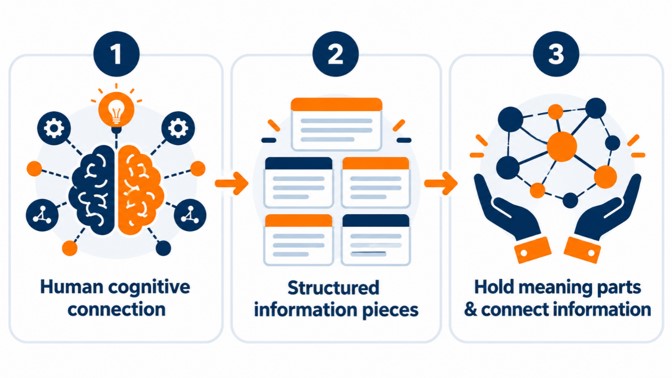
Most students fail Repeat Sentence because they try to catch every word one by one.
That is the wrong approach.
You cannot hold 13–15 words as separate items in your head. But you can hold 3–4 meaning chunks.
For example:
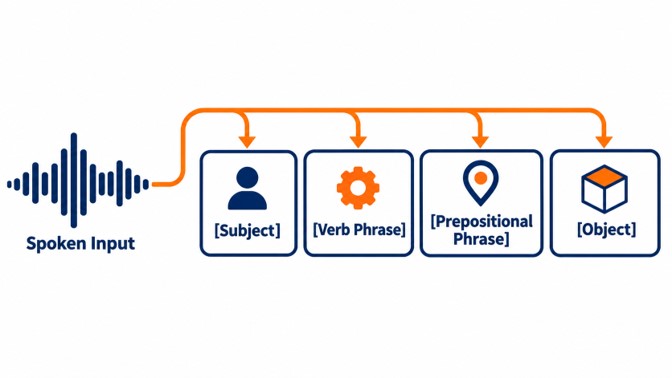
"Many international students / choose online courses / because they offer / greater flexibility."
Now the sentence becomes easier. You are not memorising 14 words. You are holding 4 parts.
This is the core PTE chunking technique.
Listen for meaning, not words; phrase boundaries; rehearsal in the gap
When the audio plays, listen for meaning first.
Ask yourself:
- Who or what is the sentence about?
- What happened?
- Why or where did it happen?
- What is the ending phrase?
Then divide the sentence naturally.
Example:
"The report highlights / the need for better planning / in rapidly growing cities."
Do not repeat in your mind like this:
"The… report… highlights… the… need…"
That overloads memory.
Instead, hold it as:
report highlights / need for planning / growing cities
During the tiny gap before you speak, rehearse the chunks silently once. Then say them aloud in the same order.
A good drill is:
Listen → chunk → rehearse → speak.
Do not write. Do not translate into Hindi. Do not panic if one small word is missing.
Shadowing at 1.25x and 13–15 word drills for over-preparation
To build real exam speed, use shadowing.
Take short English sentences and play them at 1.25x speed. Repeat immediately after the speaker. This trains your ear to catch rhythm faster.
Start with 8–10 word sentences. Then move to 13–15 word sentences.
Example drills:
- The lecture focused on climate change and its impact on coastal communities.
- Students should submit their assignments before the deadline announced by the department.
- The new transport policy aims to reduce traffic congestion in major cities.
Practise 10 sentences daily.
If the real exam sentence is shorter, it will feel easier. That is over-preparation.
What to do when you miss words: the "say half, get 2/3" rule
You will miss words in the real exam. Everyone does.
The problem is not missing words. The problem is reacting badly.
Many students freeze after missing one phrase. They think, "I forgot it, now the answer is gone." Then they stay silent or restart.
That is how scores fall.
The "say half, get 2/3" rule means: if you remember at least half the sentence, say that half clearly and smoothly.
Never stay silent; guess out loud; keep order; no self-repair
Follow these four rules:
- Never stay silent. Silence is worse than an imperfect answer.
- Guess out loud. Use the words you remember.
- Keep the order. Correct order matters more than random recall.
- No self-repair. Do not say, "The students was… were… are…" Just continue.
If the sentence is:
"The government has introduced new policies to support small businesses."
And you remember only:
"The government has introduced new policies…"
Say it clearly. Add what you can. Do not restart.
Your fluency should sound like one clean attempt, not three broken attempts.
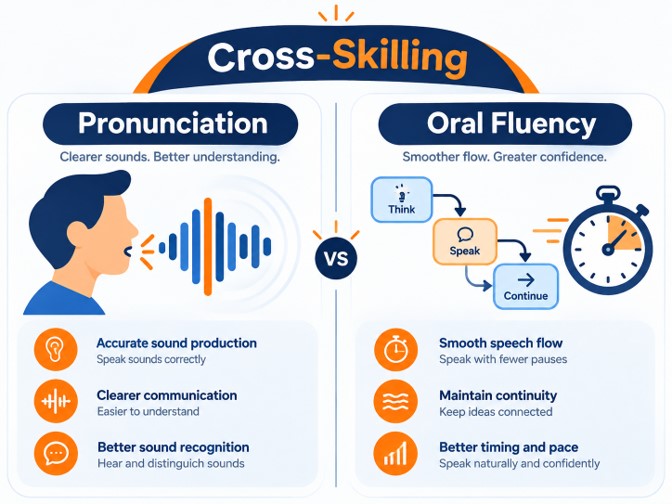
Pronunciation vs Fluency: where Indian test-takers lose points
For Indian students, pronunciation is usually not the biggest issue. Fluency is.
Many students speak understandable English, but they pause too much. They restart. They stretch sounds. They add fillers like "uh," "actually," "means," or "like."
PTE fluency and pronunciation are connected, but they are not the same.
Pronunciation means the listener can understand your sounds.
Fluency means your speech flows naturally.
Intelligibility > accent; final consonants, th, v/w, schwa; stress-timed rhythm
You do not need an American, British, or Australian accent.
You need intelligibility.
That means your words should be clear enough for a normal listener. Focus on these areas:
Final consonants
Say the ending sounds clearly.
"Cost" should not become "cos."
"Worked" should not become "work."
th sound
Practise words like "think," "three," "method," and "growth."
Do not force it too much, but make it clear.
v/w difference
"Very" and "wary" should not sound the same.
"Vest" and "west" should be different.
Schwa sound
English has many weak sounds.
For example, "support" is not "sup-port" with equal stress. It sounds more like "suh-PORT."
Stress-timed rhythm
Indian speakers often give equal weight to every word. English does not work like that. Important words get more stress. Small grammar words become lighter.
Say:
The STUDENTS / will SUBMIT / the REPORT / on MONDAY.
This rhythm improves fluency.
These are practical PTE Speaking tips for Indian students because they target the exact areas where marks are usually lost.
14-day Repeat Sentence practice plan: 15–20 min/day
You do not need three hours a day for Repeat Sentence.
You need focused 15–20 minute practice for 14 days.
This PTE practice plan 14 days is enough to build control if you do it properly.
Days 1–3 rebuild listening; 4–7 chunking; 8–11 pressure/recovery; 12–14 fluency & sound
Days 1–3: Rebuild listening
Goal: Hear meaning, not individual words.
Daily drill:
- Listen to 10 short sentences.
- Write only the main idea.
- Then listen again and repeat.
- Focus on subject + verb + ending.
Do not worry about speed yet.
Days 4–7: Chunking practice
Goal: Break sentences into 3–4 parts.
Daily drill:
- Take 10 sentences of 10–13 words.
- Mark phrase boundaries.
- Speak the sentence in chunks.
- Then remove the text and repeat from audio.
Example:
The college has announced / a new scholarship / for international students.
Days 8–11: Pressure and recovery
Goal: Handle forgotten words.
Daily drill:
- Use 12–15 word sentences.
- Play each sentence once.
- Repeat immediately.
- If you miss words, continue without stopping.
After each attempt, ask:
- Did I start quickly?
- Did I stay fluent?
- Did I keep the order?
- Did I avoid self-correction?
This is strong PTE Repeat Sentence practice for 79+.
Days 12–14: Fluency and sound
Goal: Polish delivery.
Daily drill:
- Record 10 Repeat Sentence attempts.
- Listen to your own audio.
- Check volume, speed, pauses, and clarity.
- Practise final consonants and word stress.
Also take a full-length PTE mock under exam conditions to see whether your Repeat Sentence performance holds under pressure.
Common mistakes that kill Repeat Sentence scores
Repeat Sentence is simple, but small mistakes can damage the score quickly.
Word-by-word memorization, late start, self-correction, fillers, low volume
Avoid these common PTE Repeat Sentence mistakes:
- Word-by-word memorisation — This overloads memory. Use chunks instead.
- Late start — If you wait too long, you forget more. Start right after the beep.
- Self-correction — Do not restart. Do not repair grammar mid-sentence. Keep moving.
- Fillers — Avoid "umm," "actually," "like," "you know," and "means."
- Low volume — Speak clearly into the microphone. Low voice can reduce clarity.
- Over-speeding — Fast speech is not fluency. Smooth speech is fluency.
- Flat tone — Use natural stress. Do not sound robotic or sleepy.
For extra accuracy work, especially if weak grammar and vocabulary affect your overall score, use reading accuracy drills that support overall PTE score. Stronger sentence awareness helps both Reading and Speaking.
Free practice & next steps
Repeat Sentence improves when you practise with a system.
Do not only collect sentence lists from the internet. Record yourself. Review errors. Track repeated problems.
Ask yourself daily:
- Am I starting quickly?
- Am I speaking smoothly?
- Am I repeating meaning chunks?
- Am I avoiding silence?
- Am I clear enough for a listener?
If your target is Canada PR via PTE Core, also check the task differencesif your target is Canada PR via PTE Core.
Link to VerbalHub's free PTE mock + Repeat Sentence drills
Start with a diagnostic mock. It will show whether Repeat Sentence is actually pulling down your Speaking or Listening score.
Use VerbalHub's free PTE practice resources, take a full mock, and review your speaking tasks carefully. Do not judge your performance only by how confident you felt. Look at the score pattern.
Confidence is good. Data is better.
You can also add quick daily exercises to sharpen comprehension because better listening and sentence flow often begin with better understanding of structure.
CTA to book a personalised scoring evaluation / demo
Not sure whether Repeat Sentence is dragging your overall score?
Book a free 15-minute PTE scoring diagnostic with VerbalHub. We will analyse your last mock, identify your fluency leaks, and map a 14-day sprint toward 79+.
You will know exactly whether the problem is listening memory, chunking, pronunciation, fluency, volume, or exam pressure.
That clarity can save you weeks of random practice.
At VerbalHub, our PTE coaching focuses on practical score improvement. We help students build task-wise strategies, practise under timed conditions, and fix repeat errors before test day.
A quick note for younger students preparing for management entrance exams: VerbalHub's one-on-one IPMAT coaching can also help students close verbal, RC, and logic gaps faster. With instant feedback, personalised drills, regular accountability, and a clear percentile-focused plan, students learn how to avoid repeated mistakes and handle exam pressure better. Hasan Sir brings strong experience across CAT, GMAT, GRE, and IPMAT verbal/RC/logic training, with proven guidance in test strategy and score improvement. The aim is simple: faster score jumps, fewer retakes, and better exam-day control.
Repeat Sentence is not about having perfect English.
It is about listening smartly, speaking smoothly, and recovering well when memory fails.
Use chunking. Start fast. Say what you remember. Keep your rhythm. Practise daily for 14 days.
That is how you improve Repeat Sentence in PTE and move closer to your target score.
Save this as a Word document for offline practice and daily checklists.
VerbalHub: Practical coaching. Clear feedback. Better exam-day control.
Not sure whether Repeat Sentence is dragging your PTE score? Book a free 15-minute diagnostic with VerbalHub — Mock analysis · Fluency leak detection · 14-day 79+ sprint plan. Book Your Diagnostic.