
CELPIP Speaking Task 3 asks you to describe what is happening in a picture. CELPIP Speaking Task 4 asks what will probably happen next in that same picture. Confuse those instructions, and you can spend a full response describing the scene without answering the prediction task.
Both tasks give you 30 seconds to prepare and 60 seconds to speak, according to CELPIP's official 2026 study pack. These CELPIP Speaking tips for 2026 focus on making that minute useful: choosing details, placing them clearly, and connecting predictions to evidence.
If your Speaking result is around CLB 7–8, record your answers before collecting more vocabulary. You may need better organisation rather than harder words. We will also address the "AI–Human Hybrid Scoring" claim carefully, because a coaching claim should never be mistaken for an official Speaking update.
CELPIP Speaking Task 3 vs Task 4: What Changes?
Task 3—describe what you can see
Think of your listener as someone who cannot see the illustration. Your job is to help them picture the setting, important people, and activities.
A useful CELPIP scene description begins broadly, then selects meaningful details. You do not need to mention every chair, window, bag, or tree.
Instead of saying, "There is a woman, a table, a child and a bicycle," explain their relationships: "Beside the picnic table, a woman is helping a child put on a bicycle helmet."
Task 4—predict what may happen next
Now move beyond the present scene.
If someone is carrying a tray towards a crowded table, they may place the drinks down or ask people to make room. The visible action gives your prediction a reason.
"The waiter is holding a tray" describes. "The waiter will probably ask someone to move their bag so he can put the tray down" predicts.
What the tasks share
Both require careful observation and clear references. Naming "the cyclist beside the gate" in Task 3 helps you identify that person quickly in Task 4.
For advice across the full Speaking section, read VerbalHub's CELPIP Speaking Tips and Tricks guide. Use the official scoring information discussed below when checking any claims about scoring changes.
Task 3—A Clear Scene-Description Method
Start with the overall scene
Give the listener a setting before introducing smaller details.
For example:
"This appears to be a busy community garden, where several people are planting vegetables and moving supplies."
That opening establishes the place and main activity. Avoid spending your first ten seconds saying that the picture is interesting, beautiful, or full of things.
Move from foreground to background
Choose a route through the illustration:
- Establish the setting.
- Describe an important activity near the front.
- Move towards the centre or one side.
- Finish with a relevant background detail.
This is a practice method, not a compulsory answer structure. Left-to-right organisation works equally well if it suits the picture.
During preparation, identify three useful details and their order. Planning complete sentences can consume time you need for observation.
Use spatial vocabulary accurately
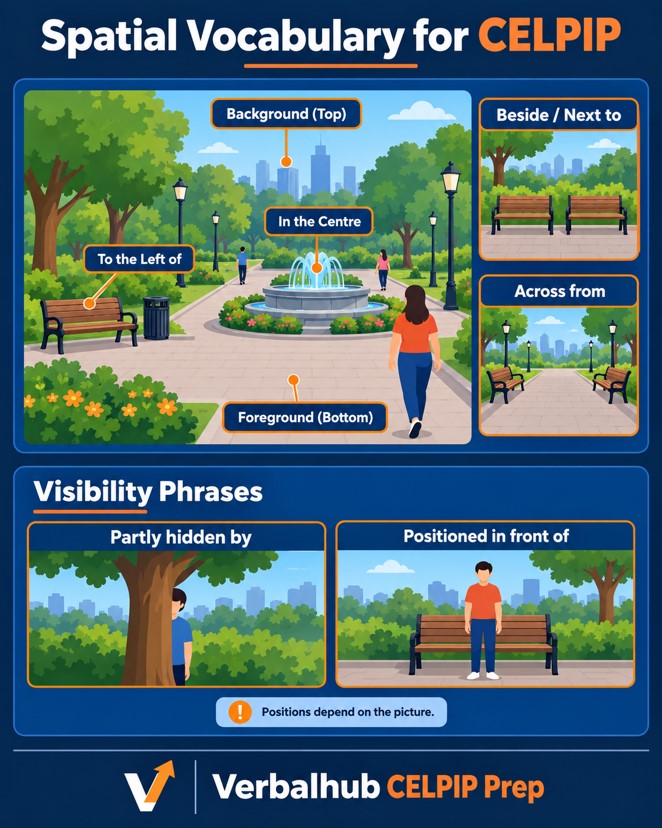
Spatial vocabulary for CELPIP Speaking tells your listener where to look.
Position
- In the foreground.
- In the background.
- Near the centre.
Direction and relationships
- To the left of.
- Beside.
- Behind.
- Across from.
Visibility
- Partly hidden by.
- Visible near.
- Positioned in front of.
Use these expressions only when they fit. "Across from" suggests opposite positions; "beside" means next to something.
Combine position with action: "Behind the tool shed, a volunteer is unloading bags of soil." This tells the listener more than "There is a volunteer in the background."
A short original sample response
Practice scene: Imagine a community garden with volunteers planting seedlings, a child watering plants, and someone unloading soil near a shed. This is an original exercise, not an official or recalled question.
"The picture shows volunteers working in a community garden. In the foreground, a woman wearing gloves is placing seedlings into a raised planting bed. Beside her, a young boy is holding a watering can over a row of small plants. Near the centre, two people are carrying a wooden crate towards an empty bed. One of them appears to be showing the other where to put it. Behind them, a man is unloading bags of soil beside a tool shed. There are also several gardening tools leaning against the wall. Overall, the volunteers seem busy with different jobs, but they are working together to prepare the garden."
Notice how the description follows a route and connects people to actions. Practise the organisation, rather than memorising the answer.
Task 4—Turn Picture Clues into Predictions
Use the same scene, but answer a different question
The official study pack confirms that Task 4 uses the illustration from Task 3. You already know the setting. Use preparation time to identify likely next actions.
A practical CELPIP Task 4 prediction strategy is:
Visible clue → likely action → possible result.
For example: a person is reaching towards a falling cup, so they may try to catch it. If they miss, they might need to clean up the spill.
Make predictions about identifiable people or objects
Avoid "Everyone will do something" or "They will all be happy."
Say which person you mean:
"The woman standing beside the counter will probably help the customer collect the dropped coins."
Specific references make the answer easier to follow. Choose two or three predictions you can explain rather than five unrelated guesses.
Add a possible feeling or outcome where it fits
A likely reaction can develop your answer.
"The child may feel disappointed if the kite becomes stuck in the tree."
However, emotions are not a compulsory ingredient in every prediction. Add them when the scene supports them, rather than forcing "happy," "sad," or "excited" into each answer.
Use natural hedging
Hedging means showing that something is possible rather than certain.
Useful phrases include:
- May or might.
- Will probably.
- It looks as though.
- Based on what I can see.
Compare "The cyclist will crash" with "The cyclist might stop suddenly because a pedestrian is stepping into the path."
The second prediction is cautious and explains its basis. You do not need to begin every sentence with the same phrase.
A new, worked Task 4 practice response
Practice scene: Imagine a station café. A passenger checks a departure board, a barista holds a takeaway cup, a child reaches towards a biscuit display, and a cleaner approaches a spill. First describe this imagined scene for Task 3, then predict what follows.
Practice response: This answer is intended for approximately 45–60 seconds at a comfortable pace. Check your own recording; it carries no promised score.
"The passenger beside the counter will probably collect his drink and head towards the platform. He is checking the departure board, so he may be worried about missing his train. The barista will likely hand him the cup shortly, since it already has a lid on it. Meanwhile, the child reaching towards the biscuit display might ask the adult beside her to buy something. The adult may guide her back from the counter if she gets too close. Near the entrance, the cleaner will probably deal with the spilled drink before another customer steps in it. Once that area is dry, people should be able to move through the café more easily."
Each prediction starts from something visible. There is no sudden emergency or invented backstory.
A 30-Day CELPIP Speaking Practice Plan
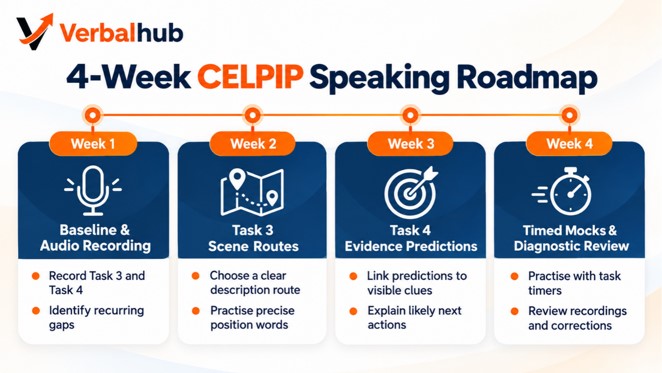
Aim for 15–20 focused minutes on five days each week, adjusting the workload around your schedule. These are suggested practice targets, not official requirements.
Week 1: Learn the instructions and record a baseline
Practise both tasks with the official preparation and response times.
Save your first recordings. Listen for missing ideas, repeated phrases, unclear references, and long searches for words.
On the remaining days, practise naming ordinary actions: carrying, reaching, leaning, handing over, unloading, and pointing.
Week 2: Organise Task 3 descriptions
Work with unfamiliar everyday scenes.
Choose a route, select three important details, and record one response. Then repeat it once after correcting one problem.
Build a small CELPIP picture description vocabulary bank from words you actually needed. Practise "leaning against the fence" in a sentence rather than saving "leaning" as an isolated word.
Week 3: Practise evidence-based predictions
For each picture, identify three clues and possible next actions.
Check whether someone else could understand why you made each prediction. Replace unsupported guesses with simpler possibilities.
Also practise switching tasks: describe the current scene, then use the same picture to discuss what may follow.
Week 4: Add timing pressure and review
Include an unfamiliar Task 3–4 pair in your practice sessions. Complete a CELPIP Speaking mock test covering the other tasks too; these two responses are only part of your preparation.
Use Days 29–30 to compare fresh recordings with your baseline. Look for clearer organisation and fewer recurring errors.
For work across all four skills, see a broader CELPIP preparation plan.
Review each recording
Use this learner's checklist:
- Did I answer the specific task?
- Was my description or prediction easy to follow?
- Were my details grounded in the picture?
- Did I repeat myself?
- Was my speech clear and reasonably paced?
Choose one correction before recording again. This checklist supports practice; it does not replace the official scoring standards.
Mistakes That Can Weaken Your Response
Describing again in Task 4
Use a present action briefly as evidence, then explain what may happen next.
Making unrealistic predictions
A person holding a phone might answer a call. That detail alone does not support predicting a robbery or medical emergency.
Using vague references
Replace "he," "she," or "everyone" when the listener cannot tell whom you mean. Clothing, position, or activity can identify a person.
Including too many Task 3 details
If you rush through ten objects, your listener may struggle to build a picture. Select and connect details.
Forcing advanced vocabulary
"Walking towards the entrance" is useful. An elaborate substitute that sounds unnatural is not an improvement.
Treating advice as a scoring rule
A suggested opening, number of predictions, or speaking speed is a practice choice. None guarantees a particular CELPIP level.
Where the 2026 Scoring Claim Fits
I could not verify "AI–Human Hybrid Scoring" as an official 2026 update for CELPIP Speaking.
The official FAQ search listing mentions an AI–human hybrid system specifically for Writing. That does not establish the same arrangement for Speaking. CELPIP's published results page describes qualified raters assessing Speaking performances.
The published Speaking criteria cover:
- Content/Coherence: developing and organising ideas.
- Vocabulary: accurate, suitable word choices.
- Listenability: pronunciation, rhythm, pauses, grammar, and sentence structure.
- Task Fulfillment: relevance, completeness, tone, and length.
Prepare around those standards. There is no verified basis here for saying that an automated system rewards particular spatial words before a human checks your response.
For Canadian PR planning, consult how CELPIP results connect to CLB and CRS for Express Entry. A Speaking improvement alone should not be presented as a fixed CRS increase.
How VerbalHub Coaching Can Help
CELPIP one-on-one coaching can be useful when you hear a problem in your recording but cannot identify its cause. A trainer can separate weak scene organisation from limited vocabulary, unclear speech, or poor timing.
VerbalHub's CELPIP page lists individual coaching, practice tests, and mock analysis. These services can support targeted feedback; they do not guarantee a score increase.
If you are comparing CELPIP coaching in India, ask what happens after each recording. Will you receive specific corrections and a focused practice task? Explore VerbalHub's CELPIP course options and discuss your schedule before choosing a programme.
Frequently Asked Questions
How is CELPIP Speaking Task 3 different from Task 4?
Task 3 describes the visible scene. Task 4 predicts what may happen next, using that scene as evidence.
Does Task 4 use the same picture as Task 3?
Yes. Both tasks also allow 30 seconds of preparation and 60 seconds of speaking. celpip.ca
How do I describe a picture in CELPIP Speaking Task 3?
Establish the setting, choose important details, and follow a clear route through the picture. Explain actions and relationships rather than listing objects.
What should I say in CELPIP Speaking Task 4?
Identify a person or object, predict a plausible next action, and explain the visible clue supporting it.
Is AI–Human Hybrid Scoring an official Speaking update?
I could not verify it as an official Speaking change. Follow CELPIP's published Speaking criteria and scoring information.
How can I improve my CELPIP Speaking score from CLB 7 or 8?
Record unfamiliar timed responses, identify recurring weaknesses, and practise specific corrections. Consistent review is more useful than repeatedly delivering a memorised answer.
Choose Your Next Step
If your Task 3 or Task 4 responses are not improving, a diagnostic session can help identify what to work on next. Contact VerbalHub's CELPIP coaching team to discuss your target score, preparation timeline, and suitable coaching options.
Bring two recent recordings. They give the discussion a practical starting point.
Improve Your CELPIP Speaking Score. One-on-One Coaching with VerbalHub — Personal Feedback · Task 3 & 4 Drills · Mock Analysis. Book Your Diagnostic Session.
Frequently Asked Questions
Task 3 describes the visible scene. Task 4 predicts what may happen next, using that scene as evidence.
Yes. Both tasks also allow 30 seconds of preparation and 60 seconds of speaking. celpip.ca
Establish the setting, choose important details, and follow a clear route through the picture. Explain actions and relationships rather than listing objects.
Identify a person or object, predict a plausible next action, and explain the visible clue supporting it.
I could not verify it as an official Speaking change. Follow CELPIP's published Speaking criteria and scoring information.
Record unfamiliar timed responses, identify recurring weaknesses, and practise specific corrections. Consistent review is more useful than repeatedly delivering a memorised answer.