
By Hasan Sir | Updated October 2026
Good IPMAT verbal ability preparation starts with one habit: explaining why your answer is correct. Knowing the meaning of every word helps, but you also need to follow an argument, notice a change in tone, and reject an option that sounds convincing but says too much.
If you are in Class 11 or Class 12, begin with manageable daily practice. Read one passage carefully. Solve a few questions. Review your mistakes before adding more work.
This guide shows you how.
Contents
- Exam Pattern and Question Types
- Reading Comprehension Strategy
- Para Summary, Para Jumbles and Odd Sentence Out
- Vocabulary in Context
- Your Daily and Weekly Practice Routine
- Verbal Section Time Management
- Personal Guidance from VerbalHub
Exam Pattern and Question Types
Indore and Rohtak have different papers
Before choosing practice material, check which exam it follows. The 30-35-question figure is not the right count for either Indore or Rohtak VA in 2026.
| Feature | IPMAT Indore | IPMAT Rohtak |
|---|---|---|
| VA questions | 45 in the 2026 paper | 40 in the published 2026 pattern |
| Time | Separate 40-minute VA section | Shared 120 minutes across QA, LR and VA |
| Correct MCQ answer | +4 marks | +4 marks |
| Incorrect MCQ answer | -1 mark | -1 mark |
| Short-answer section | QA only; no negative marking | No separate QA short-answer section |
Indore's official admission procedure confirms the separate sectional timers and marking rules. Its 2026 paper contained 45 VA questions. Rohtak's published pattern lists 40 VA questions within the overall two-hour test.
VA at Indore consists of MCQs. Do not apply the "no negative marking" rule from QA short answers to verbal questions.
What should you prepare?
Your working checklist for the IPMAT verbal ability syllabus 2026 should include:
- Reading Comprehension: Main idea, details, inference, tone and word meaning.
- Para Summary: Choosing the option that preserves the paragraph's central message.
- Para Jumbles: Arranging sentences into a logical paragraph.
- Odd Sentence Out: Finding the sentence that breaks the paragraph's flow.
- Vocabulary in Context: Understanding a word through its surrounding sentence.
- Fill in the Blanks: Using meaning, grammar and common word combinations.
- Grammar and Usage: Sentence correction, agreement, tense and related skills.
Treat this as a preparation checklist. Every question type need not appear in every paper, and topic-wise counts can change.
For the wider exam picture, read VerbalHub's guide to the full IPMAT syllabus and eligibility.
Reading Comprehension Strategy
Read for the argument, not just the topic
A passage about online education may support it, question it, or suggest conditions under which it works. Identifying the topic alone will not answer a main-idea question.
After each paragraph, ask:
- What is the writer saying?
- What job does this paragraph perform?
- Does it support, explain or challenge the previous point?
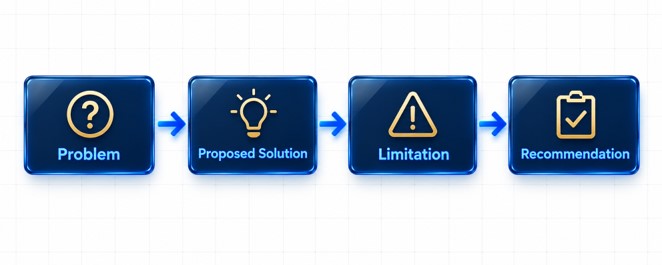
Make a short mental map:
Problem → proposed solution → limitation → recommendation.
You do not need detailed notes. A few words can help you find evidence quickly.
Use skimming to get a rough map
For a long passage, preview:
- The first and last paragraphs.
- Topic sentences, often near paragraph beginnings.
- Words such as however, although, therefore and instead.
This gives you a starting picture. It does not replace reading the argument. A middle paragraph may contain the exception that decides an inference question.
Slow down at contrast words. In "The scheme reduced costs; however, access remained unequal," the second half changes what you can safely conclude.
Try questions first, but read selectively
Glance at the question stems before the passage. Notice whether they ask about a particular example, a word, the main idea or an inference.
Avoid reading every answer choice first. Wrong options can plant ideas that the passage never supports.
Test both reading orders in practice. Keep the approach that gives you better accuracy without repeated rereading. There is no rule that every student must read questions first.
Track speakers in dialogue passages
When practising dialogue-based RC for IPMAT Indore, keep each speaker's position separate. Do not assume that conversation passages will appear in every paper.
Consider this original example:
Ananya: "Replacing textbooks with tablets will make learning more engaging."
Kabir: "Perhaps. But engagement helps only if students understand what they read."
Ananya supports the change. Kabir questions whether engagement alone is enough. He has not rejected tablets.
Track three things:
- Position: What does each speaker believe?
- Tone: Are they doubtful, supportive, critical or cautious?
- Response: Are they disagreeing, qualifying a claim or requesting evidence?
A careful inference stays close to what was said. "Kabir thinks technology is useless" goes too far.
Avoid three common RC traps
- Extreme wording: Always, never, entirely and only may exaggerate a limited claim. Reject the mismatch, not the word itself.
- Out-of-scope ideas: An option may be sensible in real life but unsupported by the passage.
- Partial truths: The first half matches the passage; the second adds something new.
Before marking an answer, ask: "Can I support the whole option?"
For students wondering how to improve reading comprehension for IPMAT, this habit often matters more than solving extra passages.
Build speed without losing meaning
Read an unfamiliar 500-700-word article. Note your time, then write its main point in two sentences.
Repeat with comparable articles. Try reducing unnecessary rereading while preserving the quality of your summary.
If your reading gets faster but your answers become guesses, slow down. Useful reading speed means understanding more in less time.
Para Summary, Para Jumbles and Odd Sentence Out

How to solve para summary in IPMAT
Use this sequence:
- Find the topic.
- Identify the main claim.
- Notice the relationship: contrast, cause, condition or recommendation.
- State the message in your own words.
- Compare options with that message.
Do this before getting attached to an attractive answer.
Example: "Recorded lessons let students study at convenient times. However, students who struggle to plan their work may keep postponing lessons. Flexible access therefore works best alongside regular deadlines."
A sound summary is:
Recorded lessons offer flexibility, but deadlines help students use that flexibility consistently.
Reject options claiming that recorded lessons are ineffective, that all students postpone work, or that deadlines remove flexibility.
The most useful para summary tricks for IPMAT are simple: preserve the main claim, its limits and the connection between ideas.
Use connectors as clues
- However/but: Contrast or qualification.
- Therefore: Result or conclusion.
- Also: An additional point.
- Similarly: A comparison.
- For example: Support for a broader statement.
Connectors tell you how ideas relate. They do not, by themselves, prove which option is correct.
A practical IPMAT para jumbles strategy
Start with relationships rather than trying every possible order.
- Find a likely opener. It usually introduces a subject without depending on an earlier sentence.
- Build mandatory pairs. Look for a noun followed by it or they, a claim followed by an example, or a cause followed by its effect.
- Find a possible ending. It may offer a conclusion, consequence or recommendation.
- Read the complete sequence. Every sentence should connect naturally.
Try these sentences:
- A: This uncertainty makes regular planning difficult.
- B: Small shops often face unpredictable customer demand.
- C: They can reduce the problem by recording daily sales.
- D: Over time, these records reveal useful buying patterns.
Answer: B-A-C-D.
B introduces the problem. A refers to that uncertainty. C proposes a response. D explains what the records achieve.
For odd sentence out, check the paragraph's job
A sentence can share the topic and still interrupt the argument.
Suppose four sentences explain how school libraries improve access to books. A fifth describes the history of bookbinding. It belongs to the broad subject of books, but may not belong in that paragraph.
Remove your suspected sentence and read the rest. Does the argument become clearer?
Vocabulary in Context
Let the sentence guide the meaning
"Despite rising sales, the owner remained wary of expanding too quickly."
Even if wary is unfamiliar, the contrast suggests caution. Rising sales have not made the owner completely confident.
For vocabulary in context IPMAT practice:
- Identify the sentence's positive or negative direction.
- Notice contrasts and examples.
- Predict a simple meaning.
- Substitute each option.
- Check that the whole sentence still makes sense.
Six useful root families
Roots can narrow your choices. They are clues, so confirm the meaning in context.
| Root or stem | Basic meaning | Examples | Practice sentence |
|---|---|---|---|
| bene | Good or well | Beneficial, benevolent | The scholarship was beneficial to rural students. |
| mal | Bad or badly | Malfunction, malpractice | A malfunction delayed the examination. |
| spect | Look or see | Inspect, spectator | Officials inspected the damaged bridge. |
| dict | Say or speak | Dictate, contradict | The new evidence contradicted the earlier claim. |
| cred | Believe or trust | Credible, credibility | The report needs credible evidence. |
| scrib / script | Write | Describe, manuscript | The author revised the manuscript. |
To practise root words for IPMAT verbal ability, choose one family and write two sentences. Explain how the words differ.
Learn words through reading
Read editorials, business news and RC passages. Choose words that help you understand arguments: plausible, reluctant, consistent, ambiguous or skeptical.
Keep a small record:
Word → meaning → source sentence → synonym → antonym → your sentence.
For reluctant:
- Meaning: Unwilling or hesitant.
- Synonym: Hesitant.
- Antonym: Willing.
- Example: She was reluctant to accept an explanation without evidence.
Review yesterday's words before adding today's.
Ten phrasal verbs to practise
These are useful phrasal verbs for the IPMAT exam, though their meaning can change with context.
| Phrasal verb | Meaning here | Example |
|---|---|---|
| Look into | Investigate | The school will look into the complaint. |
| Carry out | Perform | The team carried out a survey. |
| Point out | Draw attention to | She pointed out a calculation error. |
| Bring up | Mention | He brought up the transport problem. |
| Put off | Postpone | We put off the meeting until Friday. |
| Rule out | Exclude | The evidence ruled out one explanation. |
| Account for | Explain | Higher costs account for the increase. |
| Come across | Find by chance | I came across an unfamiliar expression. |
| Work out | Solve | They worked out a practical solution. |
| Back up | Support | You need evidence to back up your claim. |
For fill-in-the-blank questions, check the preposition too. We usually carry out a study and look into a complaint.
What about vocabulary books?
Before searching for the best books for IPMAT vocabulary, check your current material. Does it explain words in sentences? Does it include revision exercises?
One usable resource, a reliable dictionary and your own notebook are enough to start. Finish and revise a small collection rather than collecting several unfinished books.
Your Daily and Weekly Practice Routine
A realistic 45-minute daily plan
| Time | Task | What to produce |
|---|---|---|
| 30 minutes | Read an editorial or analytical passage from The Hindu, The Indian Express or Business Standard | A short paragraph map and two-sentence summary |
| 10 minutes | Solve 5-7 RC questions or 3 summary/jumble questions | Answers supported by reasons |
| 5 minutes | Review vocabulary | Five useful words, including older words |
Do not spend all 30 minutes simply moving your eyes over the article. Use part of that time to explain its argument.
Five minutes is usually too short to study ten new words with roots, synonyms, antonyms and original sentences. Learn fewer words properly. Add more only when the task includes familiar words or quick revision.
For IPMAT verbal ability preparation for Class 12 students, keep this session at a predictable time. The guide to balancing IPMAT verbal prep with Class 12 boards can help you fit it around schoolwork.
Weekly tests and error review
Once you have a basic foundation, aim for three full Indore-style VA sectional tests of 40 minutes each.
These tests and their reviews require time beyond the daily 45-minute routine. Schedule them on lighter days. Beginners can start with one weekly test and increase gradually.
Record:
- Question type.
- Your answer and the correct answer.
- Evidence you missed.
- Error category.
- Time spent.
- A retest date.
Use clear categories: misread passage, unknown word, weak sentence link, rushed choice, unsupported inference, time trap.
Students starting late can use a verbal strategy for droppers and late starters. Near the exam, move towards a final-month verbal revision plan built around timed practice and repeated mistakes.
Verbal Section Time Management
Test this starting allocation in Indore mocks:
- 2 minutes: Survey the section.
- 14 minutes: Complete manageable standalone questions.
- 20 minutes: Work through RC sets.
- 4 minutes: Revisit marked questions.
Adjust it to the paper and your strengths. If RC is your strongest area, beginning there may suit you better.
Move on when a standalone question stops producing progress. Returning later is often better than spending three minutes choosing between two words.
For Rohtak, practise a complete paper with its shared timer. IPMAT verbal section time management must fit alongside Quant and Logical Reasoning.
Personal Guidance from VerbalHub
Why consider one-on-one coaching?
Some students understand explanations but cannot see why their own answer was wrong. Personal feedback can help when it targets that exact gap.
VerbalHub is led by Hasan Sir, its founder and lead mentor, with 15+ years of experience in CAT, GMAT, GRE and IPMAT preparation and 10,000+ students mentored across exam-preparation programmes. His teaching focuses on verbal ability and RC strategy, including support for students targeting IIM Indore, IIM Rohtak and other IPM programmes.
One-on-one IPMAT coaching for verbal ability can provide:
- Personal RC feedback: Identify where you misread evidence or accepted a trap option.
- Custom vocabulary practice: Work on your weak areas and revise them regularly.
- Live doubt-solving: Discuss a confusing summary or sentence sequence.
- Mock analysis: Separate knowledge gaps, reading errors and timing problems.
- Exam-day preparation: Practise calm decisions under pressure.
Before joining, compare IPMAT coaching options and ask for relevant student outcomes, sample feedback and clear course coverage.
If you want structured guidance and personal attention, explore VerbalHub's IPMAT one-on-one coaching.
Save this guide for offline revision. Keep this Word document on your study table to revise RC strategies, paragraph-solving steps and vocabulary examples without internet. You can also save it as a PDF from Word.

Frequently Asked Questions
Start with short articles that you can understand without checking every second word. Write the main idea in two sentences, solve a few passage-based questions, and review your answers. Add harder reading gradually as your understanding improves.
Try both approaches during practice. A quick look at the question stems can tell you what to watch for, but reading all the answer choices first may confuse you. Choose the method that gives you better accuracy with less rereading.
Practise reading unfamiliar passages and summarising them without looking back. Focus on the writer's main claim, paragraph links and changes in direction. Reduce unnecessary rereading before trying to read faster.
Compare the exact wording of both options with the passage. Check whether either option exaggerates the claim, adds an unsupported idea or answers only part of the question. Choose the option you can support completely.
Choose what follows from the passage with the fewest extra assumptions. An inference must have support in the text, even when it is not stated directly. Avoid adding your personal opinions or outside knowledge.
Track each speaker's position separately. Notice whether the second speaker disagrees, adds a condition or questions the evidence. A cautious response such as "That may help, but..." does not necessarily reject the first speaker's idea.
Find the main claim and identify any contrast, condition or conclusion. Put the message into your own words before comparing options. Reject summaries that focus only on an example, miss the central relationship or introduce a new claim.
Look for a sentence that introduces the topic and makes sense on its own. Sentences beginning with references such as "this problem" or "these findings" usually need an earlier explanation. Confirm the opener by checking how the remaining sentences connect.
Root words help you make an educated prediction, but they do not always give the complete meaning. Check the sentence, tone and common usage too. Learn roots alongside reading practice and regular vocabulary revision.
Start with five useful words and revise older words daily. Record each word's meaning, a suitable synonym or antonym, and an example sentence. Increase the number only if you can remember and use what you have already learnt.
It is a useful starting routine for reading, short question sets and vocabulary revision. You will also need separate time for sectional tests and detailed review. Adjust your workload according to your current accuracy, school schedule and time before the exam.
Begin with one weekly sectional test while building your foundation. As your preparation improves, work towards three weekly tests with proper analysis. Do not add more tests if you are leaving earlier mistakes unreviewed.
Check whether you keep repeating the same mistake. You may be misreading contrasts, choosing unsupported inferences, forgetting vocabulary or spending too long on difficult questions. Keep an error log and use those patterns to choose your next practice task.
It can help when you need feedback on your own reasoning. A mentor can examine why you selected an RC option, where your sentence sequence broke down and which errors recur in mocks. Explore VerbalHub's IPMAT one-on-one coaching if you want structured practice and personal feedback.