
If your IELTS Writing keeps stopping at 6.5, adding difficult words probably won't fix it. Start by checking whether you answer every part of the question, develop your ideas fully, and connect sentences without making the reader work.
An IELTS Writing Task 2 Band 8+ response needs precise language and a clear argument. Your vocabulary should explain your thinking. Your paragraph structure should make that thinking easy to follow.
This IELTS Writing Task 2 framework gives you practical ways to improve both, with sentence upgrades, paragraph examples and a focused practice plan.
Why Writing Is the #1 Barrier to Band 7.5+
Writing can become the deciding barrier when your Listening and Reading scores already meet your target. Recognising a correct answer is different from building an argument under time pressure.
Consider this illustrative example: Priya from Delhi gets 7.5 in Listening, Reading and Speaking, but repeatedly scores 6.5 in Writing. Her essays contain advanced vocabulary, yet she gives three reasons without properly explaining any of them.
Her next step is deeper development, not another vocabulary list.
There's also a claim circulating about an "IELTS Writing template penalty 2026" that automatically caps Task Response at Band 4. That isn't an official blanket rule. However, irrelevant memorised material can damage your response, and the descriptors allow Band 0 where an answer is proven to be entirely memorised.
Learn how to organise an answer. Don't learn an answer to force onto every question.
4 Marking Criteria Decoded for Band 8+
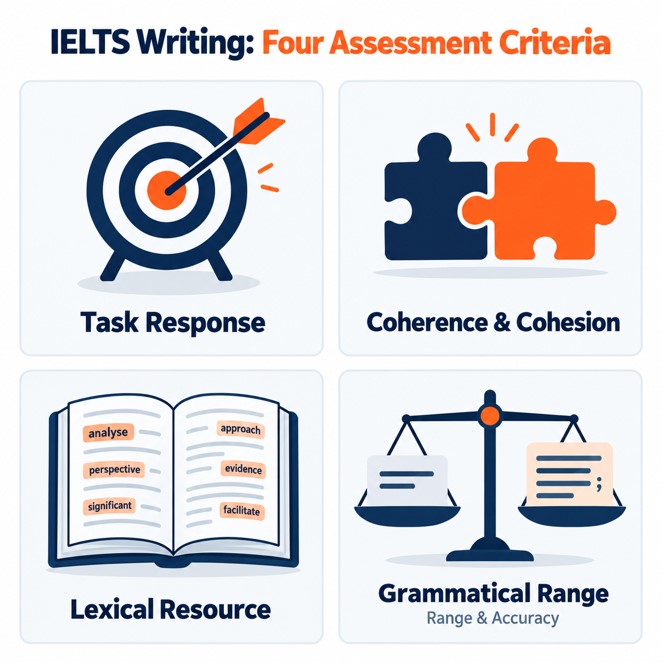
IELTS assesses your response through four criteria. Task 2 carries twice the weight of Task 1 in your Writing score, so improving your essay matters—but Task 1 still needs attention.
Task Response: Answering the Prompt Fully (Not Partially)
Before writing, identify exactly what you must answer.
Suppose the question asks:
"More employees are working from home. What problems can this cause, and what could employers do to address them?"
You need problems and employer-led solutions. A paragraph celebrating remote work won't answer either requirement.
Choose a manageable problem, explain its cause, then propose a solution that addresses it. For example, unclear expectations may delay decisions; agreed response times and regular team meetings could reduce that delay.
Coherence & Cohesion: Logical Flow Without Mechanical Linkers
Coherence concerns the order of your ideas. Cohesion concerns the connections between them.
A useful paragraph moves forward rather than repeating its first sentence. "Furthermore" cannot repair a missing explanation, and "therefore" only works when a genuine consequence follows.
Try reading your paragraph without its linking words. If the reasoning disappears, develop the ideas first.
Lexical Resource: Precision Over Complexity (Collocations, Not Thesaurus Words)
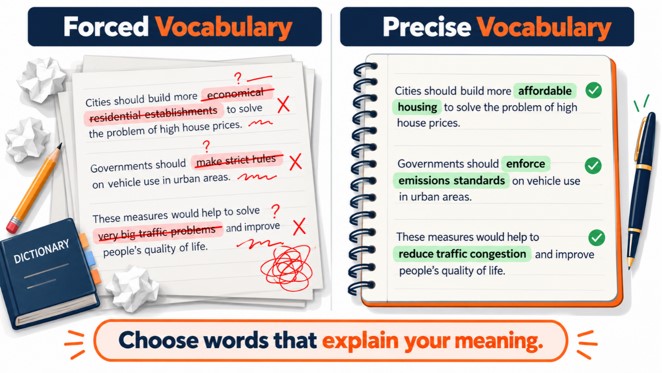
Choose words that match your exact meaning.
"Affordable housing" is more useful than "economical residential establishments." The second phrase is longer, but less natural.
For a quick comparison:
| Criterion | Band 6 tendency | Band 7 tendency | Band 8 tendency |
|---|---|---|---|
| Lexical Resource | Adequate vocabulary, sometimes imprecise | More flexible choices, with occasional awkwardness | Broad vocabulary used naturally and precisely |
| Coherence & Cohesion | Understandable, sometimes mechanical | Clear progression, with some uneven links | Easy-to-follow development and well-managed connections |
This is a simplified teaching summary, not a substitute for the full descriptors.
Grammatical Range & Accuracy: Error-Free Complex Sentences
The Band 8 descriptors expect varied structures and a majority of error-free sentences, allowing occasional non-systematic mistakes.
That doesn't mean every sentence must be long.
"Although online consultations improve access, some patients still need a physical examination."
This sentence expresses a clear contrast. Use that structure because the idea needs it, not because you want to display grammar.
When reviewing, check sentence boundaries, articles, agreement and punctuation before attempting another elaborate construction.
Band 8+ Lexical Resource: What Examiners Actually Reward
Topic-Specific Vocabulary (Not Generic "Big Words")
Build vocabulary around arguments you might need to explain.
For healthcare, learn:
- Access to treatment.
- Preventive care.
- Staff shortages.
- Waiting times.
For education, learn "tuition fees," "practical skills," "academic performance" and "equal access."
Then write sentences showing what each phrase means. Knowing "staff shortages" is useful only if you can explain how shortages affect care.
Here's a weaker sentence:
"Many hospitals have problems because there are not enough people."
A more precise version:
"Staff shortages can lengthen waiting times and leave nurses responsible for more patients."
The improvement comes from naming the problem and its effects.
These IELTS lexical resource tips work better than practising twenty substitutes for "important."
Collocations That Sound Natural (e.g., "pose a threat", "gain traction")
Collocations are words commonly used together. Practise them as units:
- Pose a threat to public health.
- Reduce traffic congestion.
- Allocate funding to schools.
- Gain access to specialist care.
- Enforce safety regulations.
"Gain traction" suits an idea or policy becoming more widely supported. It isn't a replacement for every use of "increase."
Compare these practice sentences:
- Band 6.5-style: "The government should make strict rules to stop pollution."
- Stronger version: "Governments should enforce emissions standards to reduce pollution from factories."
The second sentence identifies a specific action. Remember, these labels illustrate writing quality; examiners don't award an essay band from one sentence alone.
Keep a notebook of IELTS Writing Task 2 collocations, including the preposition and one original example.
Paraphrasing Without Losing Meaning
Effective IELTS Writing paraphrasing techniques preserve the claim's scope.
Original: "Some people believe university education should be free for everyone."
Accurate paraphrase: "One view is that all students should be able to attend university without paying tuition fees."
Inaccurate paraphrase: "Most people believe every form of education should be funded by the government."
"Some" became "most," and "university education" became all education. Those changes alter the argument.
Keep technical terms when necessary. You don't need a synonym for "university" every time it appears.
Coherence & Cohesion: The Invisible Band Booster
Paragraph Logic: One Central Idea Per Paragraph
Give each body paragraph a clear job.
For an essay about public transport, one paragraph might explain how reliable bus services reduce car use. Keep the supporting sentences connected to that point.
Avoid moving from congestion to pollution, tourism and road safety without developing any of them.
Here's a practical check: summarise the paragraph in one short sentence. If your summary needs several unrelated points joined by "and," narrow the paragraph.
Referencing & Substitution (Avoiding Repetition Without Forced Linkers)
Referencing helps you connect sentences without repeating complete phrases.
"Many commuters avoid buses because services are unreliable. This uncertainty makes travelling by car more attractive."
"This uncertainty" points back to unreliable services and moves the explanation forward.
Pronouns need clear references:
"The council discussed the proposal with residents, but they rejected it."
Who rejected it? The council or the residents? Replace "they" with the correct noun.
If you're searching for "IELTS coherence and cohesion band 7," practice these small connections before collecting more transition words.
The 4-Step Paragraph Framework (State → Explain → Example → Implication)
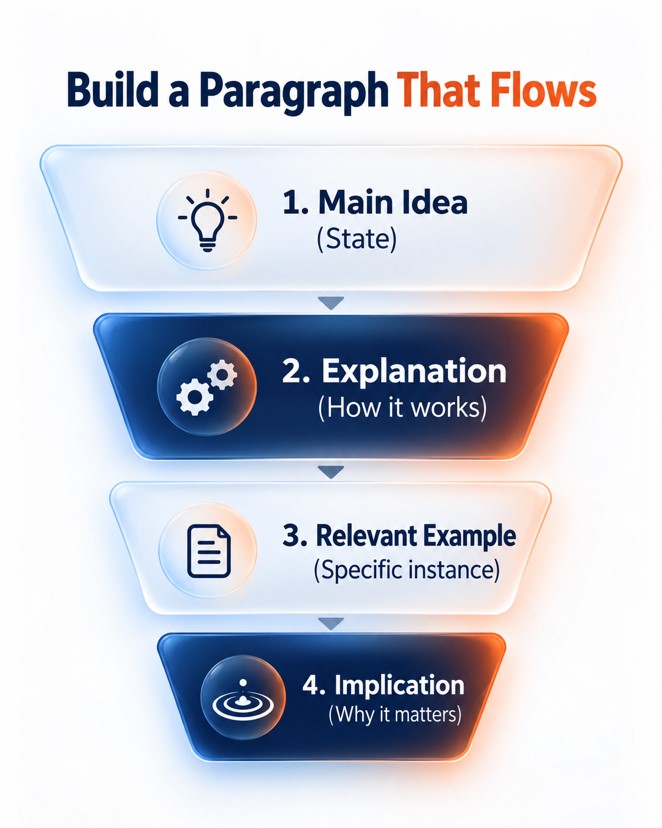
Use this sequence as a planning aid:
- State the point.
- Explain how it works.
- Give a relevant example.
- Show why the example matters.
For instance:
"Reliable public transport can reduce dependence on cars. When buses arrive frequently, commuters have less reason to drive. A worker with a direct bus route to an industrial estate may leave their car at home. Across many journeys, this can reduce pressure on nearby roads."
Each sentence adds something.
Compare:
- Band 6.5-style: "Public transport is useful. Moreover, it helps people. Furthermore, it is good for cities."
- Stronger version: "Frequent bus services make commuting more predictable, encouraging some drivers to switch to public transport."
These IELTS Writing coherence and cohesion examples show how explanation creates flow.
2026 Writing Task 2 Prompt Trends: What's Changing?
There isn't a reliable official basis for claiming that two-part questions are replacing agree/disagree questions in 2026. IELTS guidance continues to describe several forms, including opinion, discussion, multi-part and problem-solution prompts.
Prepare for variety rather than predicted questions.
For IELTS Writing Task 2 two-part questions in 2026, practise identifying both required answers. For an opinion question, practise maintaining a clear position. For "outweigh" questions, practise comparing the significance of benefits and drawbacks.
A useful weekly mix includes:
- One opinion question.
- One discussion question.
- One two-part question.
- One problem-solution or advantages-disadvantages question.
14-Day Drill Plan to Move from 6.5–7.5 in Writing
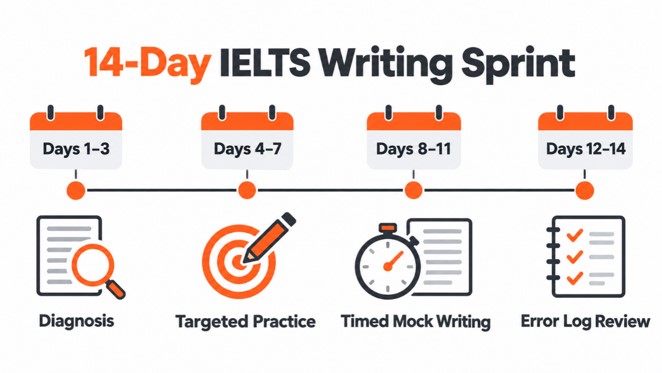
Fourteen days can help you correct recurring weaknesses. It cannot guarantee a one-band improvement, especially if your underlying grammar needs longer work.
For anyone asking how to improve IELTS Writing from 6.5 to 7.5, begin with diagnosis.
Days 1–3: Diagnose Your Weakest Criterion (Use AI feedback or tutor review)
Write one unfamiliar Task 2 essay in 40 minutes. Ask a tutor to assess all four criteria separately.
If you use an automated checker, treat its score as an estimate. Request specific evidence: which sentence is unclear, which point lacks support, and which words sound unnatural?
Choose your two most frequent problems. Don't try to fix everything at once.
Days 4–7: Targeted Practice on That Criterion (e.g., 5 essays focusing only on Task Response)
For Task Response, analyse five prompts and write one developed paragraph for each.
For vocabulary, revise ten vague sentences. For coherence, rebuild paragraphs where ideas jump. For grammar, correct recurring errors and write fresh examples using the corrected structure.
Complete two full essays during this phase. Focused paragraph work often teaches more than five rushed essays.
Days 8–11: Full Timed Essays with Examiner-Grade Feedback
Write three timed essays on different question types.
Ask for feedback tied to the public descriptors, rather than assuming every tutor's estimate is an official examiner score.
Use a starting time budget:
- Five minutes to analyse and plan.
- Thirty minutes to write.
- Five minutes to check.
Adjust it based on your practice results.
Days 12–14: Mock Test Conditions + Error Log Review
Complete a full 60-minute Writing practice test, including Task 1. Then review it before attempting another.
Keep your error log short:
| Problem | Correction | Next practice action |
|---|---|---|
| Second question barely answered | Develop a separate answer | Plan three two-part prompts |
| Vague vocabulary | Name the action or consequence | Rewrite five sentences |
| Comma joining two sentences | Use a full stop or correct connector | Check sentence boundaries |
Your IELTS Writing 14-day improvement plan should finish with a clear comparison against Day 1.
When to Use IELTS One Skill Retake for Writing
IELTS One Skill Retake Writing may suit you if Writing is your only shortfall and the organisation receiving your result accepts it.
You must meet eligibility requirements and complete the retake within 60 days of the original test. Only one One Skill Retake is allowed per full test. Check local availability and the current fee before booking.
Read the IELTS One Skill Retake Guide 2026 before comparing dates.
Crucially, IRCC does not accept IELTS One Skill Retake for Express Entry. That route requires IELTS General Training, rather than IELTS Academic.
For university admission or professional registration, confirm acceptance with the exact institution or regulator.
Use the guide if you miss your target band score in Writing, but don't assume a single-section retake is always cheaper or suitable. When evaluating an IELTS retake vs. single module retake, compare acceptance, total cost, deadlines and your other scores.
Common Band 6.5–7.5 Mistakes (And How to Fix Them)
Oversung memorised introductions
"Since the dawn of civilisation..." rarely helps answer a question about workplace training. Introduce the actual issue and state your position where required.
Writing too little or too much
Task 2 requires at least 250 words. There's no automatic penalty simply for exceeding that minimum, but a very long answer can leave insufficient checking time or include irrelevant ideas.
Around 270–320 words is a useful practice range, not an official scoring requirement.
Ignoring the second question
Before writing, turn each requirement into a checklist item. Before finishing, identify where you answered each one.
Collecting phrases without using them
For every new phrase, write two original sentences. Keep only phrases you understand and can use accurately.
Free Resources & Next Steps
Start with more IELTS Writing tips and ask VerbalHub's team about current writing practice and feedback options.
When looking for IELTS Writing band descriptors 2026, check the official descriptor document alongside any coaching explanation. A date in a blog title doesn't establish a new marking rule.
When studying IELTS Writing Task 2 Band 8 sample essays for 2026, analyse them before borrowing vocabulary:
- What does each paragraph contribute?
- How is the main claim explained?
- Which words make the meaning precise?
- What does the conclusion actually answer?
Then attempt a different prompt yourself.

Book Your Free 15-Minute Essay Evaluation
Personalised feedback helps when you understand general advice but can't identify why your own essay remains at 6.5. A trainer can examine your exact sentences and distinguish weak reasoning from weak language.
Hasan Sir, VerbalHub's lead CAT VARC and GMAT Verbal mentor, is an IIM Kozhikode alumnus with three CAT VARC 99th-percentile results, 20 years of teaching experience and more than 10,000 students mentored. His work in argument analysis and verbal reasoning supports a structured approach to writing improvement.
One-on-one coaching can build your preparation around:
- A study plan based on your weakest criterion.
- Individual doubt-solving and clear feedback.
- Mock analysis followed by changes to your practice.
- Flexible scheduling around work or college.
Discuss response times, including any 24-hour doubt-support arrangement, during your evaluation.
For students also preparing for management entrance exams, explore VerbalHub IPMAT coaching, one-on-one CAT coaching or GMAT verbal coaching.
Book a free 15-minute evaluation with Hasan Sir's team to discuss your current writing, target and deadline. Start with a focused 14-day plan, then extend it into a 30-day schedule where your assessment shows more work is needed.
Stuck at Band 6.5 in Writing? Book a Free 15-Minute Writing Evaluation with VerbalHub's IELTS team. Bring your latest essay and score report. Get criterion-level feedback, identify your main gap, and discuss a customised 14-day improvement plan built around your target.
Frequently Asked Questions
Answer every part of the question, develop your ideas clearly, and use precise vocabulary with varied, accurate grammar. Band 8 depends on the quality of the whole response—not a few impressive words.
You need a broad vocabulary that fits your meaning. Natural phrases such as "reduce traffic congestion" are more useful than complicated expressions you cannot use accurately.
Coherence means your ideas follow a logical order. Cohesion means your sentences connect through referencing, linking words and other language choices. Adding "moreover" repeatedly will not fix an unclear argument.
Start with one main idea, explain how it works, add a relevant example, and show why it matters. Use this as a planning guide rather than forcing every paragraph into four sentences.
Write at least 250 words. Around 270–320 words is a practical training target, allowing room for development and checking; it is not an official requirement for Band 8.
A focused fortnight can help you correct repeated mistakes and improve your planning. The size of your score improvement depends on your starting level, feedback and practice quality; a particular band increase is not guaranteed.
Book a free 15-minute writing evaluation and bring your latest essay and score report. Discuss your main weaknesses, target band and deadline, then build a focused practice plan with the team.