Updated: 14 October 2026

You've scored 6.5 overall, but Writing is 5.5. Your college might accept it. Your friend says Canada requires 6.0 in every module. Someone else recommends One Skill Retake.
Before paying for another exam, separate your university's admission rules from Canada's immigration rules.
The IELTS score for Canada study permit 2026 isn't one fixed number that applies to everyone. Your institution decides its English admission requirement. Immigration, Refugees and Citizenship Canada—IRCC—assesses your complete study-permit application.
A search for "Canada student visa IELTS score" often brings up old SDS advice. That can leave you preparing for a requirement that no longer applies.
If you're wondering what to do if you miss your target band score, start with your programme's individual-band requirements and accepted test policies. Being short by 0.5 band calls for a clear decision, not another month of random practice.
What Changed After Canada's SDS Shutdown?
The SDS shutdown in Canada took effect on 8 November 2024. The Student Direct Stream no longer accepts new applications. Indian students applying now use the regular study-permit process. Complete applications received before the closure were eligible for processing under the previous arrangements.
The old SDS English benchmark many students remember was IELTS 6.0 in each of the four skills. This was an SDS requirement, not a universal Canada-wide study-permit requirement.
There's a further detail: from 10 August 2023, SDS accepted IELTS Academic with 6.0 overall. The earlier per-skill benchmark had already changed for Academic applicants before Canada ended SDS in November 2024.
University admission requirements were always separate.
For example, a student with IELTS 6.5 overall but 5.5 in Writing may meet a college programme's requirement if it permits that module score. Another programme requiring 6.0 in every skill would reject the same result.
After Canada's SDS shutdown, neither an old checklist nor a college acceptance should be treated as proof of study-permit eligibility. Check the current requirements for both.
What IELTS Score Do You Need for Canada in 2026?
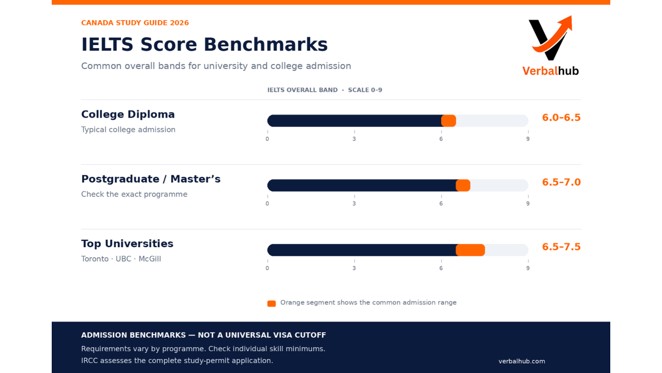
The IELTS band requirements for Canadian universities depend on the institution, qualification and course.
When comparing IELTS 6.0 vs 6.5 for a Canada study permit, begin with the admission requirement. Neither score is a universal immigration threshold.
Undergraduate Programmes
A common planning range is 6.0–6.5 overall, with approximately 5.5–6.0 in each module. College diplomas and university bachelor's degrees can have different requirements.
Some courses set higher thresholds. Don't assume every programme at the same institution follows its general minimum.
If you're considering IELTS 6.5 for Canada, check whether your lowest module also qualifies. Overall 6.5 with Writing 5.5 won't satisfy a programme requiring 6.0 throughout.
Postgraduate Programmes
Many postgraduate programmes ask for 6.5–7.0 overall, often with at least 6.0 in each module. Some require 6.5 or higher in individual skills.
A graduate certificate and a master's degree aren't interchangeable. Their English requirements can differ.
Toronto's School of Graduate Studies, for example, publishes an IELTS Academic minimum of 7.0 overall and 6.5 in every component.
Top Canadian Universities
The IELTS score for Toronto, UBC and McGill depends on the programme.
Toronto's undergraduate minimum is 6.5 overall, with no band below 6.0. UBC's general graduate minimum is also 6.5 overall, with 6.0 in every component. Departments may require more.
Requirements at leading universities can reach 7.5. UBC's graduate English programme requires 7.5 overall, with no component below 7.0. McGill's general graduate minimum is 6.5, while its MA in Educational Leadership requires 7.0 overall and 7.0 in Writing.
| Programme level | Common overall band | Common per-module band | What to check |
|---|---|---|---|
| College diploma or undergraduate programme | 6.0–6.5 | Around 5.5–6.0 | Qualification and course exceptions |
| Graduate certificate or postgraduate programme | 6.5–7.0 | Often 6.0; sometimes higher | Department and qualification requirements |
| Selected programmes at leading universities | 6.5–7.5 | Often 6.0–7.0 | Exact programme and accepted test policies |
These ranges describe admissions, not visa cutoffs. The minimum IELTS score for Canadian universities must be checked on the exact programme page.
Does IRCC Have a Fixed IELTS Cutoff for Study Permits?
IRCC does not publish one blanket IELTS cutoff for every study permit.
Canada study permit IELTS requirements shouldn't be reduced to "6 bands means approval". Your application involves two separate checks: admission English requirements and immigration eligibility.
IRCC considers your acceptance at a designated learning institution, finances, admissibility and whether you'll leave Canada when your authorised stay ends.
Your study explanation should also make sense alongside your academic record. Explain a change of field, account for study gaps honestly and show how you'll fund your education.
An engineering graduate choosing business analytics, for example, should explain how the course supports their career plans. "Canada has excellent education" doesn't explain that choice.
Treat a "Canada student visa IELTS score" as shorthand, not an official standalone eligibility rule.
When checking Canada study permit IELTS requirements, follow your application's document instructions and your institution's admission policy. A higher score can support academic readiness, but it doesn't guarantee approval.
Is IELTS One Skill Retake Accepted for a Canada Study Permit?
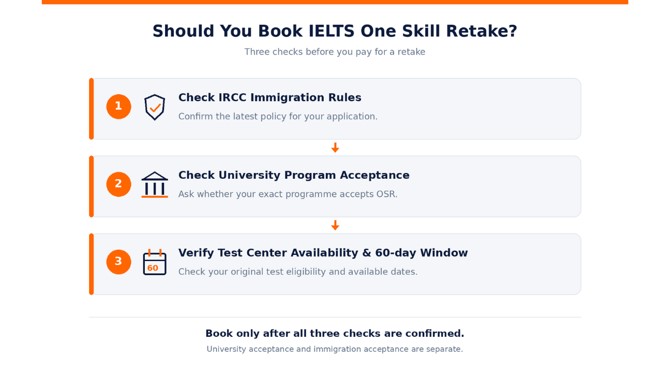
Don't assume IELTS One Skill Retake is accepted for a Canada study permit.
British Council IELTS Canada information states that IRCC has not officially accepted OSR. Check the latest IRCC guidance before relying on an updated result for immigration purposes.
IELTS One Skill Retake Canada searches can be confusing because availability and acceptance are different things. A centre may offer the test without your university or immigration authority accepting it.
University policies are separate. Toronto's undergraduate admissions page, for instance, explicitly rejects OSR results.
Before booking, confirm:
IRCC policy: Does current guidance permit its use for your purpose? University policy: Does your exact programme accept OSR? Centre eligibility: Does your original test qualify, and is OSR available locally?
Ask admissions for written confirmation.
IELTS One Skill Retake eligibility also involves the original test format and booking deadline. Standard arrangements allow one skill retake within 60 days of an eligible original test; confirm your centre's conditions.
Before you spend money on a retake, read VerbalHub's IELTS One Skill Retake Guide 2026 for eligibility, availability, and the questions to ask before booking. Review the OSR eligibility and booking steps before paying.
OSR and Express Entry: Why the Rules Are Different
Express Entry does not accept IELTS One Skill Retake.
Candidates need a full approved language-test result. If you choose IELTS, IRCC requires IELTS General Training, not Academic. Programme-specific language thresholds still apply.
If you're deciding between IELTS Academic or General Training for a Canada study permit, start with what your university requires. Academic is usually the admission choice.
Your later Express Entry application follows different rules. An Academic result used for university admission doesn't become an accepted Express Entry test.
Similarly, IELTS One Skill Retake Canada availability doesn't establish Express Entry acceptance.
If General Training Writing falls below your immigration target, prepare for a full retake. Don't combine an OSR improvement with your original scores for Express Entry.
Computer-Delivered vs Paper-Based IELTS for Canada
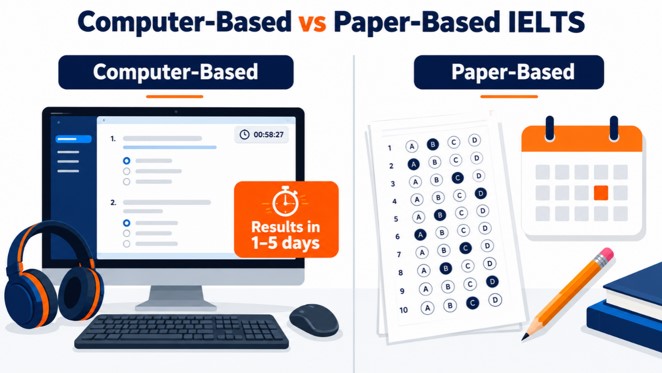
Computer-delivered IELTS for Canada applications usually offers more frequent appointments and faster results. Choose it because the format and schedule suit you, not because it improves your visa prospects.
Although 3–5 days remains a familiar estimate, current IELTS guidance gives a 1–5-day result window, with many computer results issued within two days.
Traditional paper-based results generally take around 13 days. Local timelines vary: IDP India currently lists seven days for standard paper IELTS and 13 days for paper UKVI IELTS.
IELTS announced a transition towards computer delivery from mid-2026, with timing varying by market. Paper testing is being phased out; don't assume identical availability everywhere.
OSR availability depends on location and format. Traditional paper testing may not qualify, while the newer "Writing on Paper" option has separate arrangements.
Before booking computer-delivered IELTS for Canada, check result timing, score delivery and retake availability.
If you are deciding between formats, read our guide on computer-delivered vs paper-based IELTS before booking.
PAL and TAL: Do You Still Need an Attestation Letter?
Most applicants need a Provincial Attestation Letter, or PAL, or a Territorial Attestation Letter, or TAL, unless an exemption applies.
From 1 January 2026, students applying to degree-granting master's and doctoral programmes at public designated learning institutions have been exempt.
The PAL requirement for a Canada study permit therefore depends on your programme and institution. A postgraduate certificate isn't automatically a master's degree.
For applicants who need a Provincial Attestation Letter in Canada, the institution normally explains the process. Confirm its requirements before submitting your permit application.
IELTS is admission evidence and should accompany your study-permit application where required by its instructions. It isn't the PAL itself or a separate national language condition for requesting one. Your institution may already hold your result through admissions.
Check the PAL requirement for your Canada study permit early. Applicants going to Quebec should also check Quebec Acceptance Certificate requirements separately.
A Practical 30-Day IELTS Improvement Plan for Canada
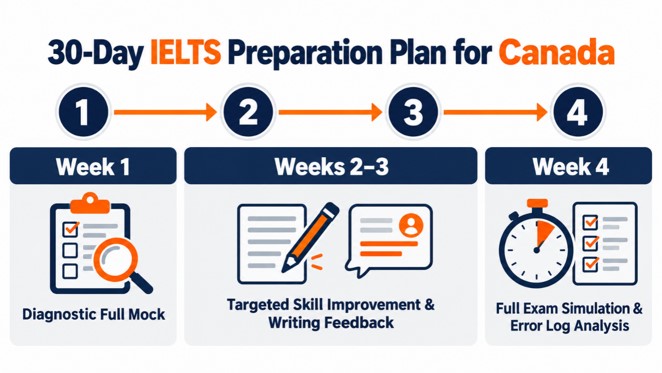
If you're researching how to improve IELTS Writing for Canada admission, begin with diagnosis. Thirty days of focused work can help, but a band increase isn't guaranteed.
Week 1: Find Your Real Problem
Take a full timed IELTS Academic mock without pausing, checking answers or extending Writing time.
Identify whether your main problem is vocabulary, grammar, task understanding, timing or exam nerves.
A Writing 6.0 student may need clearer arguments rather than harder words. A Reading student may understand passages but spend too long searching for answers.
Record your overall and module scores against the minimum IELTS score for your shortlisted Canadian universities. Choose the weakness that actually blocks admission.
Weeks 2–3: Fix One Skill at a Time
Give your weakest skill the most attention while maintaining the others.
For Writing, plan before drafting. Decide what each paragraph will explain and how your example supports it.
Get Task 2 feedback on Task Response, Coherence and Cohesion, Lexical Resource, and Grammatical Range and Accuracy. Task 1 uses Task Achievement instead of Task Response.
Rewrite corrected answers. Understanding feedback isn't the same as applying it.
For Speaking, record answers, reduce repeated fillers and practise Part 2 for two minutes without stopping. Use details and examples rather than memorised speeches.
For Reading and Listening, review why your chosen answer was wrong.
Week 4: Test Under Real Conditions
Take two full mocks on separate days using your intended format.
Keep an error log: mistake, cause and correction. "Missed the plural ending" is more useful than "careless error".
Then decide whether to book, practise longer or investigate a retake after checking acceptance.
This is how to improve IELTS Writing for Canada admission sensibly: use assessed work and consistent mock performance to judge readiness.
When a One Skill Retake Makes Sense — and When It Does Not
OSR may make sense only if one module is below target, your university accepts it and the latest IRCC position allows it for your purpose.
Is IELTS One Skill Retake accepted for a Canada study permit? Until current guidance establishes acceptance for your situation, don't treat it as a confirmed route.
Meeting IELTS One Skill Retake eligibility doesn't resolve that question.
A full retake may be more practical if several modules are weak, your university requires one full sitting or acceptance remains uncertain. Express Entry applicants using IELTS should plan for a full General Training retake.
If you miss your target band score, check the IELTS One Skill Retake eligibility and booking steps in VerbalHub's IELTS One Skill Retake Guide 2026.
Common Mistakes to Avoid
- Assuming SDS still exists. Canada ended SDS in November 2024; old IELTS rules don't create a current application route.
- Booking the wrong IELTS version. Resolve IELTS Academic or General Training for your Canada study application before paying. Academic is usually required for university admission.
- Ignoring format and deadlines. Check paper-test availability, result timing and OSR eligibility.
- Looking only at the overall score. The IELTS band requirements for Canadian universities often include module minimums.
- Booking OSR without checking acceptance. Your university's approval and immigration acceptance are separate.
The IELTS 6.0 vs 6.5 comparison for a Canada study permit won't answer these questions by itself.
How VerbalHub's One-on-One Coaching Helps You Reach Your Target Band

One-on-one IELTS coaching for Canada students is useful when one module repeatedly stays at 6.0 or 6.5.
The starting point is a personalised diagnosis. Your target university and deadline then shape the study plan.
Live Writing and Speaking feedback shows what to change. Mock analysis helps you correct recurring errors, while flexible classes support working professionals and college students.
Hasan Raja Sir, VerbalHub's founder and lead mentor, is an IIM Kozhikode alumnus, a three-time CAT VARC 99th percentile scorer and a GMAT Verbal V50 scorer. He brings 20 years of teaching experience and has mentored thousands of students for MBA entrance exams and verbal skills.
One-on-one IELTS coaching for Canada students should remain tied to IELTS assessment criteria and admission targets.
If you are preparing for IELTS, IPMAT, CAT, or GMAT and want a clear plan instead of random practice, explore VerbalHub's IPMAT coaching and one-on-one mentoring options, including one-on-one CAT coaching. MBA-bound readers can also explore GMAT verbal coaching.
Free Resources and Next Steps
Write down your IELTS score, programme shortlist, module minimums and deadline. Check the IELTS score required for Toronto, UBC and McGill against the exact department.
Choose IELTS Academic for your Canada study admission unless your institution specifies otherwise. Using IELTS Academic for a Canada study application doesn't create a separate IRCC cutoff.
Take a mock test, request a score evaluation or book counselling. Consult IELTS Exam Dates 2026–2027 in India, then confirm live availability with your provider.
For more IELTS preparation guides, visit the VerbalHub blog.
Your IELTS score for Canada study permit 2026 should be assessed against your programme and complete application.
Unsure whether your IELTS score meets Canada's 2026 requirements? Book a free 20-minute counselling call with VerbalHub. We will map your score against your university shortlist, identify the module holding you back, and help you decide the smartest next step.
Planning to Study in Canada? Know your university's IELTS requirements. Get a clear preparation plan. Book a Free 20-Minute Strategy Call.
Frequently Asked Questions
IRCC doesn't publish one IELTS cutoff for every study permit. Your college or university sets its admission requirement, including overall and individual-band minimums. IRCC separately assesses your complete study-permit application, so meeting the admission score doesn't guarantee approval.
No. Canada ended the Student Direct Stream on 8 November 2024, and no new SDS applications are accepted. Indian students now apply through the regular study-permit process.
No universal rule requires every study-permit applicant to score 6.0 in each module. That familiar benchmark came from earlier SDS requirements. Your chosen programme may still require 6.0 or more in every skill, so check its current admission policy.
It depends on your programme. You may meet a requirement that allows 5.5 in Writing, but you won't meet one requiring at least 6.0 in every module. A higher overall score doesn't cancel out a module score below the minimum.
For university admission, IELTS Academic is usually the appropriate version. Confirm your institution's policy before booking. If you later apply through Express Entry and choose IELTS, you'll need IELTS General Training. An Academic result isn't accepted as the IELTS test for Express Entry.
Don't assume it is. British Council IELTS Canada guidance states that IRCC has not officially accepted OSR. Before relying on an OSR result, check the latest IRCC guidance and your university's policy separately. University acceptance alone doesn't establish immigration acceptance.
No. IRCC explicitly states that IELTS One Skill Retake isn't accepted for Express Entry. You need an approved full language-test result. If you choose IELTS and need to improve your immigration scores, plan for a full IELTS General Training retake.
Under standard OSR arrangements, you must complete the retake within 60 days of your eligible original test. You can retake one skill once per original full test. Confirm your test format, centre availability and eligibility before booking.
Since 1 January 2026, applicants attending degree-granting master's or doctoral programmes at public designated learning institutions have been exempt from the PAL/TAL requirement. Don't assume this exemption covers postgraduate certificates or programmes at private institutions. Most other applicants need a PAL/TAL unless another exemption applies.
The test format itself doesn't create a study-permit advantage. Choose a format your institution accepts and that suits your skills, local availability and deadline. Check result timing and OSR eligibility before booking.
First, identify whether you missed the overall requirement or an individual-module minimum. Get feedback on the weaker skill, practise the specific problem and reassess under timed conditions. Check university and immigration acceptance before choosing OSR instead of a full retake.
You may improve with focused practice, but a particular band increase isn't guaranteed. Start with a timed mock, identify recurring mistakes and get feedback on Writing and Speaking. Use your latest mock performance—not just the number of days studied—to decide whether you're ready.