
You finish a GRE mock feeling reasonably confident about Quant. Then you open the Verbal results and wonder why the score has barely moved. You have learnt new words, read articles, and solved practice questions. Yet two answer choices still look equally convincing.
For many Indian students and working professionals, this is the frustrating part of preparation. To improve GRE verbal reasoning score, you need to understand where your thinking goes wrong, rather than simply increase the number of questions you solve.
The shorter GRE has two Verbal sections: 12 questions in 18 minutes and 15 questions in 23 minutes. That leaves little room for repeated rereading or spending several minutes debating one answer.
The good news is that your mistakes usually follow patterns. You might miss contrast words, confuse an author's opinion with someone else's, or recognise vocabulary without understanding how it fits the sentence.
This guide explains how to identify those patterns, build a realistic four-week routine, and practise more effectively—even if English is not your first language.
What Does the GRE Verbal Section Actually Test?
GRE Verbal tests how accurately you understand written ideas and the relationships between them. Vocabulary matters, but knowing a difficult word does not automatically help you follow an argument.
There are three question types.
- Reading Comprehension (RC) asks you to understand passages, identify main ideas, draw supported conclusions, and recognise the purpose of a statement.
- Text Completion (TC) asks you to fill one, two, or three blanks. The completed passage must make sense as a whole.
- Sentence Equivalence (SE) asks you to choose two answers that produce sentences with equivalent meanings. Finding two synonyms is insufficient if they do not fit the sentence.
| Question type | Main skills tested | Common traps | Suggested practice timing |
|---|---|---|---|
| RC | Understanding arguments, evidence, purpose, and inference | Answers that sound reasonable but go beyond the passage | Roughly 60–90 seconds per question, with separate passage-reading time |
| TC | Following sentence logic and choosing precise words | Missing a contrast or choosing blanks independently | Around 45–75 seconds for one blank; 90–120 seconds for longer items |
| SE | Understanding context and equivalent sentence meanings | Choosing synonyms that do not fit the clue | Around 45–75 seconds |
These are starting points for practice, not official ETS time limits.
Consider: "Although the proposal appeared practical, its supporting evidence was ______." "Although" signals a contrast. Predict something like "weak" before checking the options. This small habit keeps sentence logic ahead of vocabulary recognition.
How to Improve GRE Verbal Reasoning Score: A Realistic Four-Week Plan
A useful GRE verbal study plan begins with a diagnosis. Complete a fresh timed section and record mistakes by type: vocabulary, sentence logic, passage understanding, answer selection, or timing.
Also review correct answers you guessed. A lucky answer can hide a weakness that returns on test day.
Use the following plan for 60-90 minutes of daily preparation.
| Week | Daily RC practice | TC and SE on alternate days | Two timed section mocks per week | Weekly review |
|---|---|---|---|---|
| 1: Find the gaps | One short passage daily; add a longer passage on three days | Small sets; predict answers before viewing options | One 12-question section in 18 minutes and one 15-question section in 23 minutes | Identify recurring mistakes and start a vocabulary notebook |
| 2: Build reliable methods | Practise main idea, paragraph purpose, and evidence | Mark contrast, agreement, and cause-and-effect clues | Repeat both section formats using fresh questions | Redo missed questions and review vocabulary in phrases |
| 3: Strengthen weak areas | Focus on inference and author's attitude; continue mixed passage lengths | Practise difficult items from your weakest category | Check whether timing problems come from reading or indecision | Compare timed and untimed accuracy |
| 4: Make performance consistent | Mix question types and passage lengths under time pressure | Mix TC and SE; practise moving past difficult items | Complete two fresh sections; include a full GRE practice test if feasible | Review repeated errors and decide what needs further work |
Here, "section mock" means one complete Verbal section, not an entire GRE test. Across the week, practise both section lengths.
Fit the plan around work or college
On regular practice days, spend about 25 minutes on RC, 20 minutes on TC or SE, and 15 minutes reviewing answers and vocabulary. With 90 minutes available, add focused reading and redo older mistakes.
On mock days, the timed section replaces your main question set. Spend the remaining time reviewing it. Keep a short RC exercise if the mock did not include a longer passage.
Reserve one day for error-log review and vocabulary. Retain a brief RC exercise, but avoid adding a large new set.
For every important mistake, write: "What did I miss, and what will I check next time?" VerbalHub's step-by-step verbal strategy is a related resource to explore.
You can turn this four-week plan into a downloadable Word document or PDF checklist and track daily completion, accuracy, and repeated errors.
Consistency matters more than cramming. Four weeks can establish better habits and reveal progress; it does not guarantee a particular score increase.
GRE Verbal for Non-Native Speakers
If English is not your first language, a dense passage can feel like two tasks: understanding the language and answering the question.
The answer is not to translate every sentence. Instead, learn to recognise what each sentence contributes.
Read for structure
Choose an editorial or explanatory article from The Hindu, Indian Express, Aeon, or The Economist, depending on access and reading comfort. Start with one manageable piece rather than several difficult articles.
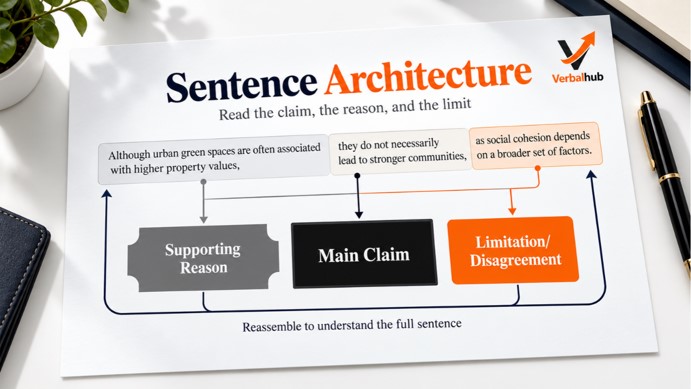
After reading, write three short notes: the main claim, the supporting reason, and any limitation or disagreement.
This is more useful than highlighting unfamiliar words without understanding the argument. You can also explore RC habits that transfer from CAT VARC, while keeping GRE question formats and answer rules separate.
Learn phrases alongside words
For GRE verbal for non-native speakers, vocabulary becomes easier to use when you learn common word combinations, or collocations.
Learn "tentative conclusion," "qualified support," and "compelling evidence" alongside the individual words. "Qualified support," for example, means support with reservations—not support from a qualified person.
Record one short example and revise it later. For unfamiliar idioms, check the phrase as a whole rather than translating each word.
Practise inference and attitude carefully
An inference must follow from the passage. It should not require an extra assumption.
If a study found an association between two behaviours, do not automatically conclude that one caused the other.
For attitude questions, notice words such as "promising," "limited," and "unconvincing." Separate the author's view from the opinions being reported. "Some researchers argue" does not mean the author agrees.
When an academic sentence feels dense, identify who or what it concerns, what is being claimed, and which words limit the claim.
You may also work on pronunciation and fluency for broader communication goals. However, pronunciation is not assessed in GRE Verbal; reading and reasoning should remain your preparation priorities.
Using AI Smartly Without Becoming Dependent
AI can support GRE verbal practice when you give it a specific task. Asking "Explain this question" often produces a long answer that you read passively.
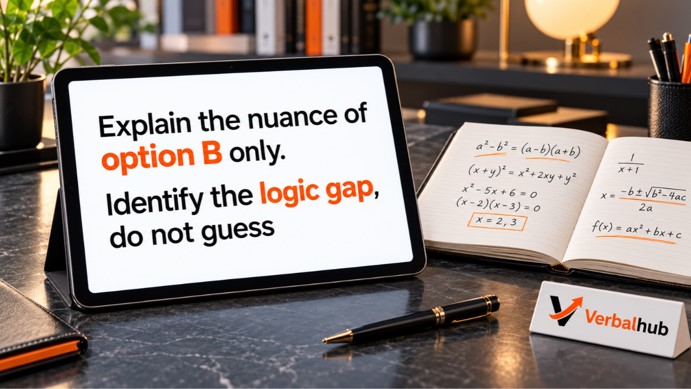
A better request is: "Explain why option B goes beyond the passage, and identify the words that support option D."
You can also ask for a few original TC questions built around contrast clues, or SE questions where tempting synonym pairs fail to fit the sentence. Treat these as extra exercises. Generated questions may contain ambiguity or incorrect answer keys, so official ETS material should remain your main reference.
For AWA practice, ask for feedback on reasoning, examples, organisation, and unclear sentences. The current Analytical Writing section contains one 30-minute Analyze an Issue task. An AI score estimate should not be treated as an official prediction.
Use this workflow after attempting the question yourself:
- AI first pass: Request a focused explanation of the disputed answer.
- Human blind review: Close the explanation and solve again independently, checking the passage or sentence clues.
- Write the rule: Record the lesson in your own words, then compare it with the official explanation or a teacher's review.
VerbalHub's article on using AI for GRE prep is a related reading option.
The test of a useful explanation is whether you can apply the idea to a fresh question without assistance.
When to Consider One-on-One Coaching
Self-study can work well when you understand your mistakes and know how to address them. Group classes can also provide structure and regular practice.
However, individual help becomes useful when several fresh mocks show the same pattern despite consistent preparation.
Perhaps your RC accuracy remains low because you cannot distinguish a supported inference from a believable statement. Perhaps you know most TC vocabulary but repeatedly misread the sentence relationship. Or perhaps your work schedule makes a fixed class timetable difficult to follow.
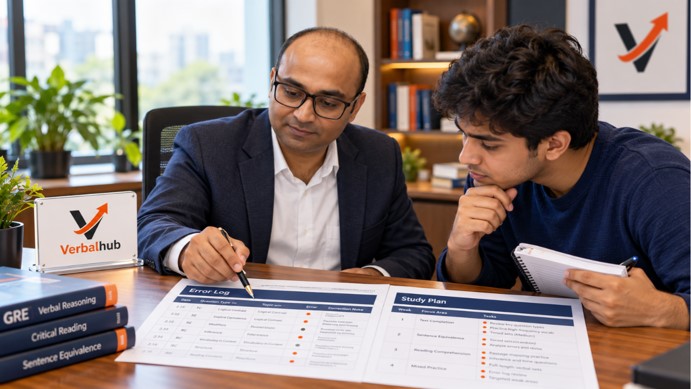
In these situations, one-on-one coaching should begin with your actual work: attempted questions, timing records, and an error log.
VerbalHub's GRE and IPMAT one-on-one coaching offers a route to personalised preparation. Hasan Sir's experience across MBA and management entrance preparation, including CAT, GMAT, GRE, and IPMAT, supports his work in verbal reasoning, RC strategy, and individual mentoring.
The practical value lies in what happens during the sessions. A mentor can examine why you chose a wrong answer, resolve doubts live, and assign practice that targets the specific weakness. A student struggling with inference needs a different plan from someone struggling with vocabulary recall.
Your schedule matters too. A working professional may need shorter weekday tasks and longer weekend reviews. A college student may need adjustments around examinations.
Before choosing structured GRE classes, ask how feedback and progress reviews are handled. If your exam choice is still uncertain, first compare GMAT, CAT, and GRE against your target programmes.
If you want a plan designed just for you, explore VerbalHub's one-on-one GRE and IPMAT coaching. GRE and IPMAT preparation should follow separate exam-specific plans.
Common Mistakes That Keep GRE Verbal Scores Low
GRE verbal score improvement often begins with correcting habits you repeat without noticing. Check whether these appear in your recent practice:
- Reading RC passages passively. You remember facts but cannot explain why the author included them. Fix: Summarise each paragraph's purpose in a few words.
- Guessing on three-blank TC without checking the whole passage. Each choice seems acceptable alone, but the completed passage contradicts itself. Fix: Read all selected answers together before submitting.
- Memorising huge vocabulary lists without context. You recognise definitions but confuse related meanings. Fix: Learn a small daily set with phrases, examples, and spaced revision.
- Choosing SE answers only because they are synonyms. The pair matches in meaning but fails to fit the sentence. Fix: Predict the required meaning first, then check both completed sentences.
- Taking mocks without analysing them. You collect scores while repeating the same mistakes. Fix: Review wrong, guessed, and unusually slow answers before taking another mock.
- Spending too long on one question. You sacrifice several manageable questions to rescue a difficult one. Fix: When you stop making progress, select your best answer, mark it, and return if time permits.
A practical GRE TC SE strategy is to explain the clue before naming the answer. A practical GRE RC strategy is to identify evidence before defending an option. Both habits make your reasoning easier to check.
Frequently Asked Questions
Start with a timed diagnostic, then follow a daily routine covering RC, alternating TC and SE practice, vocabulary revision, and error analysis. Take two timed section mocks weekly. Focus on recurring mistakes; one month does not guarantee a fixed score gain.
It can be challenging because academic language and unfamiliar phrases add reading effort. Practising sentence structure, contextual vocabulary, and evidence-based answers can help. Being a non-native speaker does not determine your eventual score.
There is no universal target. Check each programme's current admissions requirements and published class profile, including whether it reports a mean or median. Set your target around your shortlist and overall application rather than a single internet benchmark.
A focused 60-90 minutes is a workable starting schedule. The right amount depends on your baseline, target, and deadline. Include answer review within that time; solving questions without reviewing them gives you less useful practice.
Use your diagnostic results. Frequent word-meaning errors require vocabulary work, while misunderstanding familiar sentences calls for reading and logic practice. Most students need both, but the balance should reflect their mistakes.
Conclusion: Build Better Habits, Then Build Speed
GRE Verbal improves when you understand why an answer works and why the alternatives fail. More questions and longer vocabulary lists cannot replace that understanding.
Use the four-week plan to establish a steady routine. Read for arguments, learn words in phrases, and check inference answers against evidence. If English is not your first language, work on sentence structure without translating every line.
Use AI for focused explanations and extra exercises, then verify the reasoning independently. Review your error log often enough to see whether old mistakes are disappearing.
If your score remains stuck or your schedule needs a more individual approach, join VerbalHub's one-on-one GRE/IPMAT coaching for a tailored, exam-specific plan and expert guidance from Hasan Sir. Start with your current weaknesses and make each practice session count.
Ready to improve your GRE Verbal score? Book a 1-on-1 strategy session with Hasan Sir at VerbalHub. Get started.