
A practical guide to understanding scores, planning applications and choosing your next step
Author: Hasan Raja | Publication date: 14 October 2026 | Research cut-off: 13 October 2026

A student sees 1320 on a score report and asks, "Is that enough?" A parent searches for college requirements and finds different answers everywhere. One website discusses percentiles, another lists university averages, and a calculator promises a score from the number of correct answers.
These numbers serve different purposes. A good SAT score depends on your target universities, intended course, academic profile, scholarship goals and application strategy.
The short answer: The Digital SAT is scored on a 400-1600 scale, with separate Reading and Writing and Math scores. A good score is not the same for every student because universities, courses, scholarships and applicant profiles differ.
This SAT score 2027 guide uses current College Board guidance, including its published 2026-27 Student Guide. Future percentile updates and university policies not yet announced remain subject to confirmation. Taking the SAT in 2027 and applying for entry in 2027 are also different timelines.
For the wider exam overview, read the SAT 2027 Complete Guide.
WHAT YOU WILL FIND IN THIS GUIDE
- Digital SAT Score 2027 at a Glance
- How Is the Digital SAT Scored?
- What Is a Good SAT Score in 2027?
- SAT Score Chart and Percentiles
- SAT Score Requirements by University Type
- SAT Score for Ivy League and Highly Selective Universities
- SAT Score Calculator 2027: How It Works
- How Module 2 Affects Your Digital SAT Score
- How to Improve Your SAT Score
- Should You Retake the SAT?
- SAT Superscore Explained
- SAT Score and Test-Optional Admissions
- SAT Score Requirements for Indian Students
- How One-on-One SAT Coaching Can Improve Your Score
- Why Learn from Hasan Sir?
- Frequently Asked Questions
Digital SAT Score 2027 at a Glance
The following are official test specifications, rather than suggested admission targets.
| Feature | Current Digital SAT format |
|---|---|
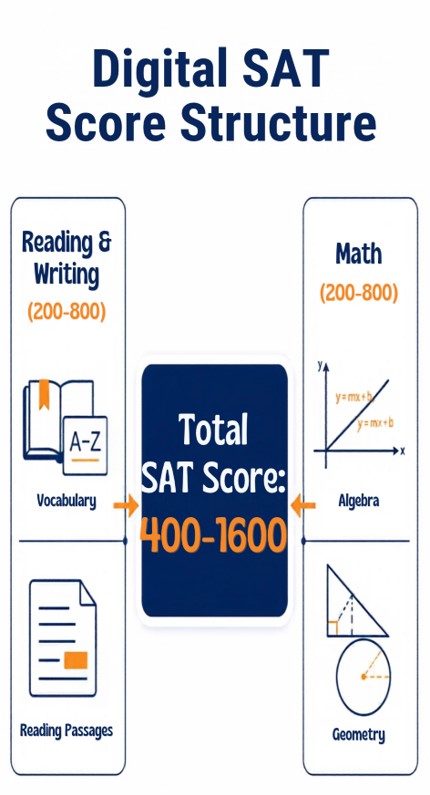
| Total score | 400–1600 |
| Reading and Writing | 200–800; 54 questions; two 32-minute modules |
| Math | 200–800; 44 questions; two 35-minute modules |
| Total calculation | Reading and Writing score + Math score |
| Testing time | 2 hours 14 minutes, plus a 10-minute break between sections |
| Negative marking | No penalty for guessing; answer every question |
| Adaptation | Module 1 performance determines the second-module route in that section |
| Raw-score conversion | No universal fixed conversion from correct answers to a scaled score |
For example, 650 in Reading and Writing plus 700 in Math produces 1350. Reading and Writing form one scored section; there is no separate Writing score to add.
You can revisit questions within the active module. Once it ends, you cannot return to it.
How Is the Digital SAT Scored?
Each section has two modules. The first contains a mixture of question difficulties. Your performance determines whether the second module has a relatively higher or lower difficulty mix.
The section score reflects responses across both modules. College Board uses a statistical scoring model that considers question characteristics and your response pattern. Questions are not interchangeable units with a fixed number of points each.
Consequently, two students with the same number of correct answers can receive different scores. Each module also includes two unforced pretest questions; students cannot identify them during the test.
Receiving the harder route does not automatically produce a high score. Keep answering carefully rather than trying to identify your route or reverse-engineer the algorithm.
Reading your score report
Look beyond the total. Your report includes section scores, percentile information, score ranges and performance indicators across eight content domains. These indicators help identify areas for further practice; they are not extra scores added to your total.
Check the official release date for your test administration. A digital test does not mean an immediate official result.
What Is a Good SAT Score in 2027?
Start with a university list. Compare your score with each institution's current profile, intended programme and testing policy. Consider GPA, course rigour, activities, affordability and scholarship eligibility alongside testing.
Public and private universities both vary widely. A university's ownership, ranking or popularity does not establish a single required score. Whether it requires, recommends or accepts scores—and whether it superscores—changes your decision.
The ranges below are general counselling guidance, not official College Board classifications or admission cutoffs.
SAT score of 1000-1190
This range can support applications where it fits the institution's published profile. It can also be a useful starting point for improvement. Avoid assuming it reflects a student's overall ability or future prospects.
Review the section split. Gaps in grammar, algebra or timing may need different solutions. Build a balanced college list while working on the most frequent errors.
SAT score of 1200-1290
A SAT 1200 score may be competitive at universities whose published ranges include it. Whether to retake depends on your actual list, not a national label.
If your intended programme or scholarship has a higher target, use practice-test evidence to decide whether more preparation is worthwhile. Check both section scores before choosing a plan.
SAT score of 1300-1390
A SAT 1300 score is strong for many university options, although it may be below the typical profile at highly selective institutions.
Ask whether improvement would change your application strategy. A balanced 1350 and a 1350 with a much weaker Math section may require different preparation, particularly for a mathematically demanding course.
SAT score of 1400-1490
A SAT 1400 score can support applications to many selective universities. Keep academic preparation and programme fit in view; holistic admission considers the rest of the application too.
A retake should address a specific need, such as strengthening Math or meeting a published scholarship criterion, rather than chasing a higher number without a purpose.
SAT score of 1500-1600
A SAT 1500 score is excellent general performance. A SAT 1600 score is the maximum possible total. Neither guarantees admission at highly selective universities.
At this level, weigh further testing against time needed for essays, schoolwork and meaningful activities. A small possible gain may be less useful than improving another part of the application.
SAT Score Chart and Percentiles
Use this SAT score chart for planning, then verify individual universities.
| Score range | General interpretation | Possible use in college planning | Recommended next step |
|---|---|---|---|
| 1000–1190 | Developing performance | May fit colleges with matching profiles | Strengthen foundations and check affordability |
| 1200–1290 | Useful for many options | May be competitive where current ranges align | Review section weaknesses and scholarship criteria |
| 1300–1390 | Strong for many universities | Can support a broader college list | Check the middle 50% range and programme fit |
| 1400–1490 | Competitive for many selective options | Can support selective applications | Consider the complete application |
| 1500–1600 | Excellent performance | Can strengthen demanding academic applications | Keep a balanced list and assess retake value |
A percentile shows your position within a defined comparison group. If your report gives the 75th percentile, approximately 75% of that group scored at or below your score. It does not mean you answered 75% of questions correctly.
College Board's Fall 2026 score-report guide describes All Tester Percentiles using the past three cohorts who took the SAT in Grade 12 worldwide. Its separate research tables also distinguish nationally representative and user-group percentiles. These reference groups should not be treated as identical.
For SAT percentile 2027 information, read the reference-group label on the current report. This guide does not relabel an older table as confirmed 2027 data. Percentile is also not your probability of admission: a university reviews its own applicant pool and criteria.
SAT Score Requirements by University Type
There is no reliable category-wide score requirement. Use these categories to organise research.
| University type | What to investigate |
|---|---|
| Ivy League and highly selective universities | Current testing policy, section profiles and holistic review |
| Top-50 universities | Ranking system and year, individual score profiles and course selectivity |
| Public universities | Campus policy, international eligibility, major and honours requirements |
| Liberal arts colleges | Academic fit, testing policy and international financial aid |
| Universities with merit scholarships | Published award criteria, international eligibility and deadlines |
| Universities popular with Indian students | Course suitability, total cost, support and applicant-specific rules |
Students should check the official admissions page of each university because testing requirements, score policies and middle-50% ranges can change.
The middle 50% runs from the 25th to the 75th percentile of the stated student group. Check whether the figures describe admitted students or enrolled students, and whether they include only score submitters. These distinctions affect interpretation.
Being within that range does not guarantee entry; being below it does not automatically rule you out unless an actual minimum applies. At test-optional institutions, submitter-only ranges may not represent the entire class.
Distinguish test-required, test-optional and test-preferred policies. Test-preferred usually signals encouragement, but the university's wording controls. Check superscoring, programme-specific rules, the last accepted test date and scholarship deadlines separately.
SAT Score for Ivy League and Highly Selective Universities
There is no universal SAT score for Ivy League admission. High scores can provide academic evidence, but they cannot replace grades, challenging coursework, essays, recommendations, activities, leadership and personal context.
Policies also differ within this group. At the research cut-off, Princeton states that it remains test-optional for fall 2027 entry and will require SAT or ACT scores from the 2027-28 admission cycle, for fall 2028 entry. Cornell states that testing is required for fall 2026 entry and beyond.
These examples show why an application year must be matched to an entry year. Use the latest published score profile to set a preparation target, not to calculate admission odds. Include universities you would be happy to attend across different levels of selectivity and cost.
SAT Score Calculator 2027: How It Works
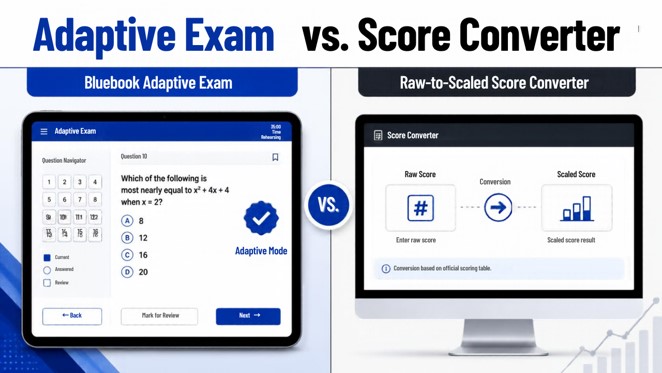
A practice estimate and an official test-day score serve different purposes. Bluebook provides scores for its official practice tests; these are useful preparation feedback, not an official admissions score from a registered SAT sitting.
A third-party SAT score calculator 2027 may use simplified assumptions or a conversion tied to a particular test. Different tools can therefore give different estimates for the same answer count.
Use official adaptive Bluebook practice tests whenever possible. Follow normal timing, avoid interruptions and record both section scores. Repeating a familiar test can inflate confidence because you may remember answers.
You can use our SAT score calculator guide to understand how practice-test performance may translate into an estimated score. Treat any estimate as a planning tool, not an official College Board result or an admission prediction.
How Module 2 Affects Your Digital SAT Score
Adaptation helps the test measure skills efficiently. Module 2 may feel harder because it contains a more demanding mix, or because particular topics expose your weaknesses. Your impression alone cannot determine your score.
Maintain accuracy in Module 1 without spending excessive time on one question. There is no universal published correct-answer threshold that guarantees a particular route or total score.
To understand how Digital SAT Module 2 works, read the related guide alongside official College Board guidance. Treat any simplified routing percentage as an estimate, not an official rule.
If the next module feels difficult, continue with your normal process: read carefully, eliminate unsupported answers and move on when necessary. You can also learn how to approach difficult Module 2 questions.
How to Improve Your SAT Score
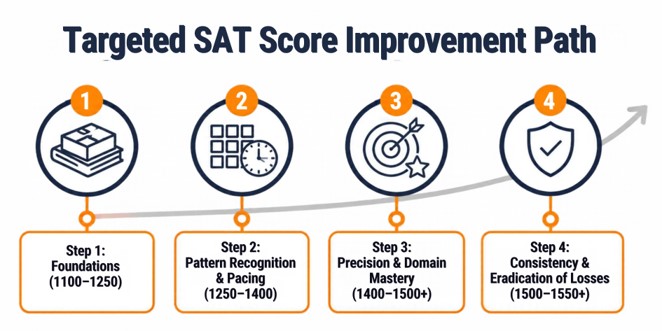
These are preparation priorities, not promised score gains or fixed timelines.
Improving from 1100 to 1250
Start with basic concepts. For Reading and Writing, practise sentence boundaries, subject-verb agreement, transitions and evidence-based reading. For Math, strengthen core algebra, percentages, ratios and word-problem translation.
Classify mistakes as concept gaps, misreading, process errors or timing problems. Establish untimed accuracy before adding speed. Explain each correction, then solve a fresh question testing the same skill.
Improving from 1250 to 1400
Add timed sets and practise recognising question patterns. Check why a Reading and Writing answer fits the passage and why competing choices fail. In Math, verify signs, units and the quantity requested.
Use strategic skipping within the current module: mark a slow question, complete others and return before time expires. Review repeated mistakes weekly. The Digital SAT pacing strategy guide can help you plan timed practice.
Improving from 1400 to 1500+
Analyse full-length mocks carefully. Separate difficult questions from preventable losses: a missed negative sign, an overlooked qualifier or an answer changed without evidence.
Practise difficult Module 2 material while protecting easier-question accuracy. Allocate more time to the weaker section, but keep the stronger one active. Test your pacing plan under realistic conditions.
Improving from 1500 to 1550+
Prioritise precision and consistency across fresh tests. Track whether errors cluster in a content domain, at the end of a module or after rushing.
Use section-level analysis rather than simply doing more mocks. Decide whether the likely benefit of another sitting justifies its cost and preparation time. The complete SAT preparation overview can help keep testing within your wider application plan.
Choosing self-study, group classes or individual support
Self-study suits students who can follow a routine and diagnose mistakes. Group classes offer a shared timetable and structured coverage. Individual coaching may suit uneven profiles or persistent difficulties.
Compare one-on-one SAT coaching, group courses and self-study against your actual needs. For flexible learning, review the self-paced SAT preparation option, checking access duration and available feedback.
When comparing SAT coaching institutes, ask how teachers review errors and measure progress. Confirm current Digital SAT coverage rather than relying on a course title.
Should You Retake the SAT?
A retake makes sense when there is a clear reason and a workable plan. It may help if your score is below your target profile, one section is weaker, fresh practice tests show improvement, or a university's superscore or scholarship policy makes a stronger section valuable.
It may be less worthwhile when the score already fits your list, preparation time is short or practice scores remain flat. Essays, grades, applications and wellbeing deserve time too.
Use this decision checklist:
- Have I checked current university and scholarship policies?
- Can I identify specific mistakes I will address?
- Do fresh timed practice tests show realistic improvement?
- Will the new score arrive before the relevant deadline?
- Can I prepare without harming schoolwork or sleep?
- Is the possible benefit worth the registration and preparation cost?
College Board allows repeated attempts without a fixed numerical limit. A sensible plan is one prepared sitting followed by a targeted retake if needed; further attempts should have a clear purpose.
Cancel a score only after understanding the rule
Under the current SAT Weekend policy, cancellation must be completed by 11:59 p.m. Eastern Time one week after the test date. Submitted cancellation requests cannot be reversed, and the score will not be reported to you or institutions.
Verify instructions for your administration and convert the deadline correctly to Indian time. SAT School Day has separate guidance. Cancellation is different from deciding which completed scores to submit.
SAT Superscore Explained
A superscore combines your highest Reading and Writing and Math scores from different test dates when a university permits it.
For example, suppose your first sitting gives 690 Reading and Writing and 730 Math, and your second gives 720 and 710. A university that superscores could consider 720 + 730 = 1450 although your single-sitting totals are 1420 and 1430.
Superscoring is a university policy. Score Choice is College Board's reporting feature for selecting test dates; it does not let you send individual sections separately. Some institutions require all scores. Verify each policy and reporting instruction before sending results.
SAT Score and Test-Optional Admissions
Test-optional generally allows an eligible applicant to choose whether scores are considered. Test-blind or test-free policies exclude scores from the specified review. The terms are not interchangeable.
A strong score may support admission, scholarships or placement where the relevant policy permits it. Some scholarships have separate rules; others do not require testing. The University of California, for example, states that it does not consider SAT or ACT scores for admissions or scholarships.
For a 1300 at a test-optional university, compare the current score profile, section split and complete academic record. Confirm that international applicants and your intended course qualify for the optional policy. Avoid making the decision from social-media score posts.
SAT Score Requirements for Indian Students

Indian students do not face one universal SAT requirement. Check how each university evaluates CBSE, CISCE, state boards, IB or other qualifications and whether your subjects meet course prerequisites.
Class 10 results and the later secondary-school record, including Class 12 performance or predicted results where requested, need attention. Submit transcripts in the requested format and confirm requirements for final results after admission.
English-language requirements are separate. Do not assume an SAT score automatically replaces IELTS, TOEFL or another accepted test; exemptions depend on university rules.
Check international financial-aid eligibility, scholarship deadlines and total cost before finalising your list. A financially unsuitable offer is not solved by a higher SAT score.
How One-on-One SAT Coaching Can Improve Your Score
Individual support may help when a student has uneven section scores, repeats mistakes, needs accountability or has limited preparation time alongside school and board exams.
A useful course should begin with a diagnostic assessment and set personalised weekly targets. Ask about individual doubt resolution, section-specific strategy, mistake-log review, flexible scheduling and regular progress tracking. Mock analysis should explain what went wrong and what to practise next, including preparation for the adaptive format.
Explore VerbalHub's SAT coaching approach and ask which features apply to the proposed course. Its online SAT preparation information can help families discuss scheduling and delivery.
For local arrangements, review SAT preparation in Delhi and confirm current availability directly. When budgeting, use the SAT coaching fees discussion as a starting point and request a written quote covering teaching hours, materials, mocks, taxes and access duration.
Students who want a personalised SAT preparation plan can explore VerbalHub's one-on-one coaching options. Choose the right course after understanding the student's current score, target SAT score 2027, available preparation time and preferred learning style.
Why Learn from Hasan Sir?

VerbalHub's official About page describes Hasan Raja as an IIM Kozhikode alumnus and senior Verbal faculty member with 20 years of experience. It identifies Reading Comprehension, Critical Reasoning, academic writing, profile building and application planning among his areas of expertise.
These areas are relevant to structured verbal preparation and academic guidance. Ask how they will be applied to SAT-specific reading, mock-test analysis and long-term study planning. Experience with MBA entrance preparation can inform reasoning instruction, but SAT students still need teaching aligned to their own exam and school timetable.
Aiming for a 1500+ Digital SAT Score? Book a 1-on-1 Strategy Session with Hasan Sir. Book Free Diagnostic Call.
Frequently Asked Questions
One that supports your target universities and scholarship plans alongside your academic profile. Compare current university data, not a universal cutoff.
It can be useful where it fits the published profile. Check section scores before deciding whether to retake.
It may be competitive at many institutions. It is not enough to assess every university or programme.
It is strong general performance. Its application value depends on the university, course and complete profile, rather than nationality alone.
It is excellent, but admission also depends on academics and the wider application. No SAT score guarantees an offer.
Two section scores of 200-800 combine into 400-1600. The adaptive scoring model considers responses across both modules.
Difficulty alone cannot establish your final score. Continue answering accurately without trying to predict it.
Not exactly through one universal formula. Use official Bluebook practice scores and treat third-party calculations as estimates.
There is no fixed ideal number. Retake when you have a clear benefit, preparation plan and suitable deadline.
Some do; others use different policies. Check each university's official instructions.
Consider its score profile, your section split and academic record. Also check programme and scholarship rules.
There is no universal figure. Verify the specific award's criteria, international eligibility and deadlines.
Diagnose recurring errors, strengthen weak concepts and add timed practice. Review fresh mocks to see whether corrections hold.
It may suit specific weaknesses or scheduling needs. Group coaching may suit students who benefit from a shared routine.
It depends on the institution, entry year and applicant category. Indian nationality does not create one common rule.