
Your Listening, Reading and Writing scores look reasonable, but Speaking keeps returning at CELPIP 7 or 8. You can communicate in English. Yet, when the recording starts, your ideas become shorter, your pace changes, and familiar words disappear.
A focused four-week plan can help you practise these problems systematically. Progress depends on your starting level, consistent work and useful feedback.
First, clarify the CRS calculation: for a single applicant, improving Speaking alone from CLB 7 to CLB 9 adds 14 first-language CRS points. Moving all four abilities from CLB 7 to CLB 9 adds 56 first-language points. These are different scenarios.
Why CLB 9 in Speaking Matters for Express Entry
How CLB 7 to CLB 9 affects CRS points
IRCC's first-official-language table gives a single applicant:
- CLB 7: 17 points per ability.
- CLB 9: 31 points per ability.
- Speaking alone: 31 - 17 = 14 additional points.
- All four abilities: 14 × 4 = 56 additional first-language points, if every ability starts at CLB 7.
For the wider explanation, read CELPIP's CLB and CRS implications for Express Entry.
Why all four skills matter for skill transferability
CLB 9 in all four abilities can also improve eligible skill-transferability points. Education, foreign work experience, Canadian work experience and applicable caps affect the benefit.
For example, if three abilities are already CLB 9 and Speaking is CLB 7, improving Speaking to 9 may cross that threshold. Your total gain depends on your complete profile. See how CLB 9 affects skill-transferability points.
Why Speaking is often the hardest skill to improve
Speaking gives you little room to reconsider a sentence. Hesitation, repeated fillers, thin explanations and missed instructions can weaken an otherwise understandable answer.
Without feedback, candidates often repeat these habits while increasing practice time.
Diagnose Your Speaking Ceiling in 45 Minutes
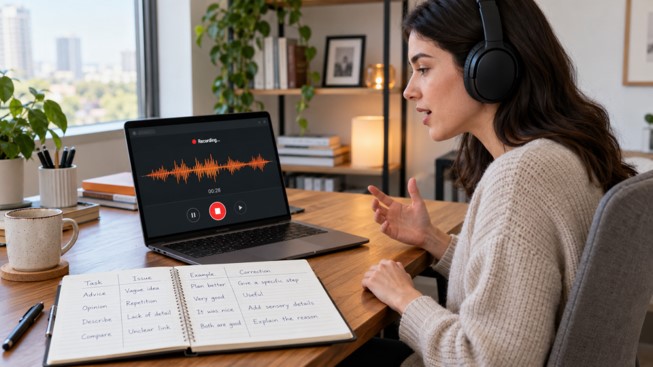
Record one response for each Speaking task
Use official CELPIP practice material or clearly labelled original exercises. Avoid recalled exam questions.
CELPIP lists eight tasks: Giving Advice; Talking about a Personal Experience; Describing a Scene; Making Predictions; Comparing and Persuading; Dealing with a Difficult Situation; Expressing Opinions; and Describing an Unusual Situation.
After recording, evaluate each response using these four questions:
- Task response: Did I answer every part?
- Organisation: Did my ideas follow a clear order?
- Vocabulary: Did I repeat basic words unnecessarily?
- Delivery: Was I clear, reasonably paced and easy to follow?
Officially, CELPIP publishes four Speaking dimensions: Content/Coherence, Vocabulary, Listenability and Task Fulfillment. Its results guidance describes assessment by qualified raters. The drills below are coaching suggestions.
Identify your three weakest tasks and two recurring habits
Keep an error log with four columns: task, issue, example and correction.
| Task | Issue | Example | Correction |
|---|---|---|---|
| Advice | Vague suggestion | "manage your time" | Suggest a specific evening routine |
Choose three difficult tasks and two repeated habits. These become your priorities.
Week 1 - Build a Reliable Response Structure
Use an open-develop-close structure
Try this flexible structure:
Open: Respond directly to the situation.
Develop: Explain one or two points with reasons or examples.
Close: Finish briefly and naturally.
For advice, your opening might be: "I'd start by changing how you plan your evenings." Then explain what to change and why.
This is a practice tool, not an official scoring formula. Avoid memorising an introduction that could fit any question.
Control your pace and reduce filler words
Record a one-minute response on a familiar topic. Count repeated fillers such as "um," "uh," "like" and "you know."
Repeat the response, replacing unnecessary fillers with short pauses. Keep useful conversational language; the aim is clearer communication.
Do not chase a supposed compulsory words-per-minute target. Listen for rushed endings, unfinished sentences and pauses that interrupt meaning.
Daily practice target
Spend 25-35 minutes daily on one response, one replay, one focused re-recording and a correction note.
Rotate through all eight tasks during the week. Give extra attention to your three weakest tasks.
Your CELPIP Speaking improvement plan should produce a specific correction each day - not merely another recording.
Week 2 - Practise Task-Specific Responses
The official preparation/speaking times for the four tasks below are: Task 1, 30/90 seconds; Task 3, 30/60 seconds; Task 4, 30/60 seconds; and Task 7, 30/90 seconds.
The following prompts and examples are original practice material, not real exam questions.
Task 1: Giving Advice
Offer two practical suggestions and explain why each suits the person's situation.
Practice prompt: Your friend has started an evening course but keeps missing lessons because work finishes late. Advise your friend.
Short model response:
"I'd first ask your manager whether you could finish earlier on class days and make up that time elsewhere. Explain that it's a regular commitment, so you need a predictable arrangement. I'd also contact the course provider about recordings or another batch. That would give you a backup when work genuinely runs late. Try those options before dropping the course."
This shortened model demonstrates development; it is not a full timed answer. Add a relevant detail when practising.
Task 3: Describing a Scene
Describe a picture in layers:
- Establish the overall setting.
- Identify the main people or objects.
- Explain their positions.
- Describe visible actions.
Useful spatial language includes:
- in the foreground / in the background
- to the left of / beside / behind
- across from / near the centre
- partly hidden by / visible near
Choose a busy public-space photograph for practice. Help the listener picture its main activity instead of listing every object.
Task 4: Making Predictions
Move beyond describing what is visible. Explain what may happen next, using clues to support your prediction.
Imagine a practice picture showing someone approaching a bus stop while checking their watch.
A reasonable prediction is: "They might start running because they appear worried about missing the bus."
Use natural hedging: may, might, will probably, it looks as though. Avoid inventing an elaborate story unsupported by the picture.
Task 7: Expressing Opinions
The official task name is Expressing Opinions.
Practise this order: state your view, develop two reasons, acknowledge another view, and conclude.
Practice prompt: Should a neighbourhood library open later on two weekdays rather than extend its Sunday hours?
Practice response:
"I would support later weekday opening. First, people who work standard office hours could visit without rushing straight from work. Even an extra hour would make borrowing books or using a computer easier. Second, students attending evening classes could use the library beforehand. Sunday access still matters, especially for families, so I would keep existing Sunday hours rather than reduce them. If the budget allows only one extension, I'd trial weekday evenings and review attendance before making the change permanent."
Develop this further with a relevant example during timed practice.
For additional exercises, consult VerbalHub's CELPIP Speaking Tips and Tricks guide. Use official CELPIP sources for scoring and timing rules.
Week 3 - Improve Vocabulary and Flow
Replace vague words with precise ones
Build a small vocabulary bank from your recordings:
- good → useful, effective, helpful
- bad → unhelpful, inconvenient, problematic
- big → significant, major, considerable
- very → particularly, especially, where the sentence allows
These are possibilities, not automatic substitutions. "A big bag" does not become "a significant bag."
Replace whole phrases when helpful: "The schedule is bad" could become "The schedule clashes with my working hours." Difficult words are not automatically better.
Use transitions without sounding rehearsed
Keep a modest selection:
- Sequence: first, then, after that, finally
- Contrast: however, on the other hand
- Cause and effect: because, as a result, so
- Conclusion: overall, in short
Transitions should clarify relationships. If every sentence begins with a linking phrase, your answer may sound mechanical.
Re-record one response using fewer transitions while keeping the same logical order.
Practise speaking about familiar Canadian contexts
Discuss workplace communication, public transport, community activities, healthcare appointments and everyday problem-solving.
For example, explain a delayed bus connection or ask to reschedule an appointment. These are useful practice contexts, not predictions of exact CELPIP topics.
Spend two days improving vocabulary, two developing explanations, and two answering fresh prompts. Use the final day to review recurring errors.
Week 4 - Timed Practice and Final Review
Take timed full-length speaking practice
Complete three timed sessions across the week, with review days between them.
CELPIP's current format page lists Speaking as 15 minutes. Use official practice timers throughout the complete sequence, including Task 5's separate selection and preparation stages.
Treat each CELPIP Speaking mock test as a rehearsal: no restarting, pausing or searching for vocabulary.
Afterwards, choose two corrections. Address them before the next session.
Practise with mild background noise
Try one session with quiet household conversation or low background audio. This can help you recover attention after a distraction.
Keep the volume mild enough to hear yourself comfortably. This is an optional exercise, not a claim that test centres have become louder in 2026.
Review your error log
Compare Week 1 and Week 4 recordings for:
- clearer task response
- fewer unnecessary fillers
- better organisation
- more precise vocabulary
- more natural delivery
Use both a repeated prompt and a fresh one. Improvement on a familiar answer may reflect rehearsal; a new prompt tests whether the skill transfers.
These observations show practice progress, not an official CLB prediction.
Retake Rules and Test Validity
Check validity before planning a retake
IRCC requires language results to be less than two years old when you complete your Express Entry profile and submit your permanent residence application. Check the official guidance when planning your timeline.
Leave room for preparation, testing and application work.
Plan a focused retake
A useful CELPIP retake strategy starts with a specific weakness: incomplete answers, weak explanations or persistent hesitation.
CELPIP's published policy permits no more than one test session within five calendar days. That registration limit is not a recommended preparation interval.
Read about CELPIP retake planning and PGWP language rules for wider context. PGWP requirements are separate from Express Entry targets.
Do not confuse CELPIP-General with CELPIP-General LS
CELPIP-General assesses all four skills and is the version IRCC requires for Express Entry. CELPIP-General LS assesses Listening and Speaking and is designated for Canadian citizenship applications. Confirm your route before booking.

Coaching is optional. A consistent home routine can still be productive.
CELPIP one-on-one coaching can help identify task-specific weaknesses, review recordings, fit practice around work or study, and correct recurring habits.
VerbalHub describes recorded Speaking review and personalised support among its services. Ask how those services would address your particular difficulties.
When comparing CELPIP coaching in India, look for feedback you can act on. "Develop your second suggestion with a concrete example" is more useful than "Improve fluency."
Frequently Asked Questions
For a single applicant, 14 first-language points. Any additional transferability benefit depends on the complete profile.
All four must reach CLB 9 for the higher language threshold in the education and foreign-work combinations. Other transferability combinations also exist.
Start with 25-35 focused minutes. Include recording, replay and correction.
Flexible outlines help organise ideas. Memorised paragraphs can make answers less relevant.
The policy allows no more than one session within five calendar days. Check it before booking.
No. General covers four skills; General LS covers Listening and Speaking. Express Entry requires General.
If you are unsure which Speaking tasks are holding your score back, a diagnostic session can help you identify what to practise next. Explore VerbalHub's CELPIP coaching options or book a demo to discuss your target score and preparation timeline.

Know what to practise next.
Personalised CELPIP Speaking feedback
Explore CELPIP Coaching Book a Free Diagnostic.