GMAT Syllabus 2026: Exam Pattern, Verbal Topics, Quant Syllabus, Data Insights, Scores, Deadlines and Preparation Guide
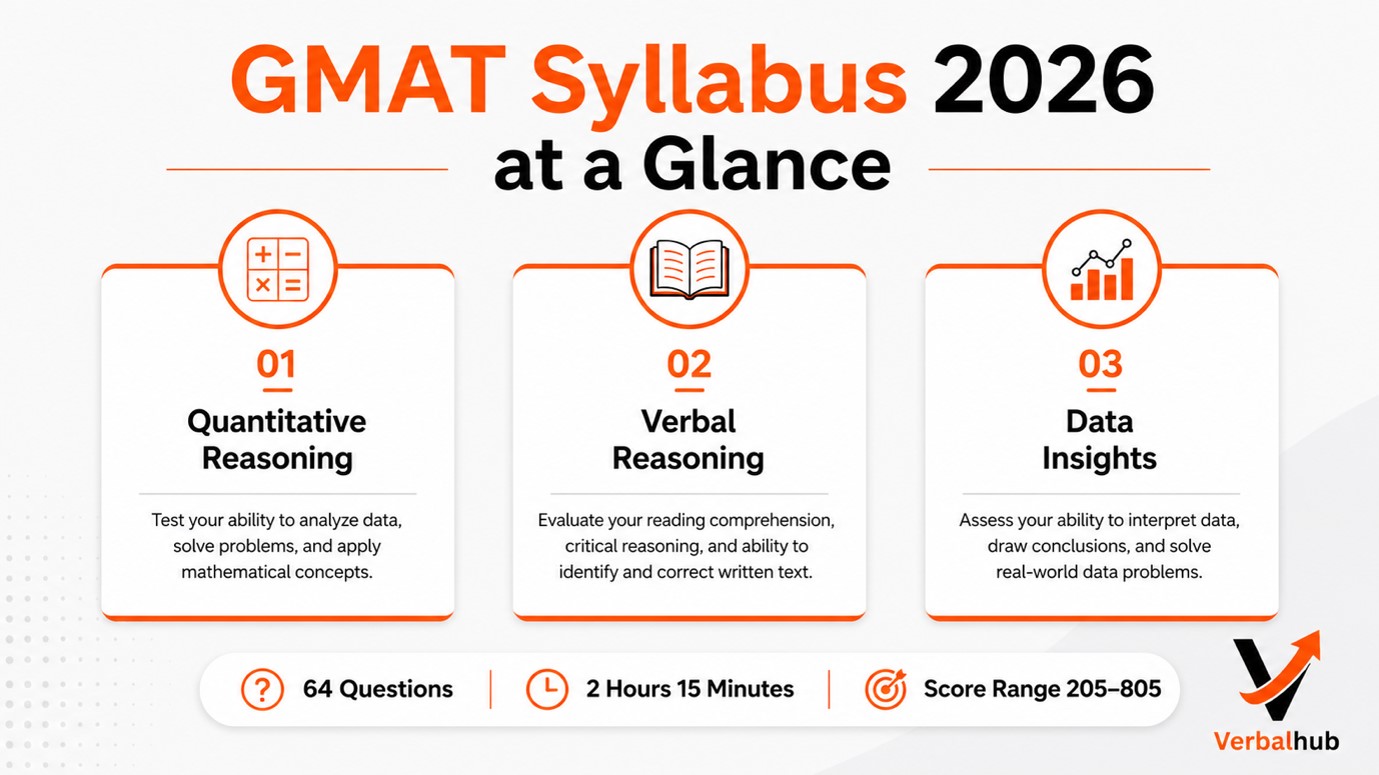
The GMAT syllabus 2026 has three sections: Quantitative Reasoning (arithmetic and algebra), Verbal Reasoning (Reading Comprehension and Critical Reasoning), and Data Insights (Data Sufficiency, tables, graphs, and multi-source questions). The GMAT Focus Edition has 64 questions, lasts 2 hours 15 minutes, and is scored from 205 to 805. It is accepted by ISB, IIM one-year MBAs, and top global B-schools.
If you are planning an MBA in 2026 or 2027, the first thing you need is a clear picture of the GMAT syllabus 2026. The GMAT (Focus Edition) tests three things: how well you handle numbers, how carefully you read and reason, and how comfortably you work with data. There is no rote learning, no general knowledge, and no subject theory.
But the GMAT exam pattern is only half the story. Serious aspirants plan four things together: the syllabus, a target score, MBA application deadlines, and profile building. This guide covers the complete GMAT exam syllabus, section-wise topics, score expectations for ISB and top B-schools, deadlines, study plans, expert tips, common mistakes, and how coaching fits in.
Table of Contents
- Key Takeaways
- Quick Summary: What is the GMAT Syllabus in 2026?
- What is the GMAT?
- GMAT Exam Pattern 2026
- GMAT Subjects and Test Sections
- GMAT Exam Topics and GMAT Portion: Full Overview
- GMAT Verbal Topics
- GMAT Quantitative Syllabus
- GMAT Data Insights Syllabus
- GMAT Old Scor Vs GMAT Focus Edition Score
- Types of GMAT Tests Students Should Take
- GMAT Syllabus and Eligibility
- ISB GMAT Score and MBA Admission Relevance
- What GMAT Score Do Top Indian and Global B-Schools Accept?
- Application Deadlines for Top Indian and Global MBA Colleges
- Weightage of GMAT in MBA Applications
- More Than GMAT: What Else Matters in MBA Admissions?
- How to Build a Strong and Relevant MBA Profile
- GMAT Statistics & Facts You Should Know
- GMAT Preparation Strategy
- Expert Tips from GMAT Mentors
- Common GMAT Preparation Mistakes to Avoid
- Do You Need GMAT Coaching?
- Why VerbalHub is One of the Best GMAT Coaching Options
- Final GMAT Study Roadmap
- FAQs on GMAT Syllabus, Scores, and Preparation
Key Takeaways
- The GMAT has three equally weighted sections — Quant, Verbal, and Data Insights — with 64 questions in 2 hours 15 minutes.
- The GMAT Focus Edition score range is 205–805; do not compare it directly with the old 200–800 scale.
- GMAT Quant is school-level maths with logic and time pressure — there is no geometry, trigonometry, or calculus.
- GMAT Verbal is about clear reading and argument logic, not difficult English or vocabulary.
- Data Insights carries the same weight as Quant and Verbal — ignoring it is the most common planning mistake.
- A GMAT Focus score around 645+ is competitive for ISB; top global schools typically see 675+ from Indian applicants.
- GMAT weightage in MBA admission is roughly 20–30%; after a competitive score, essays, work experience, and interview decide the result.
- Finish your GMAT at least 6–8 weeks before your first application deadline so essays and a possible retake fit in.
- One well-reviewed mock is worth more than three unanalysed mocks — the error log is the highest-return study tool.
- Coaching is not compulsory, but structured mentorship helps stuck scorers, weak Verbal performers, and busy working professionals the most.
Quick Summary: What is the GMAT Syllabus in 2026?
- GMAT syllabus: Quantitative Reasoning, Verbal Reasoning, and Data Insights.
- Total questions: 64 questions in 2 hours 15 minutes. Score range: 205–805 (GMAT Focus Edition).
- What it tests: Reasoning, reading, problem solving, and data interpretation — not memorised facts.
- Used for: MBA and business master’s admissions in India and abroad.
- Smart planning: Syllabus, target score, application deadlines, and profile — plan all four together.
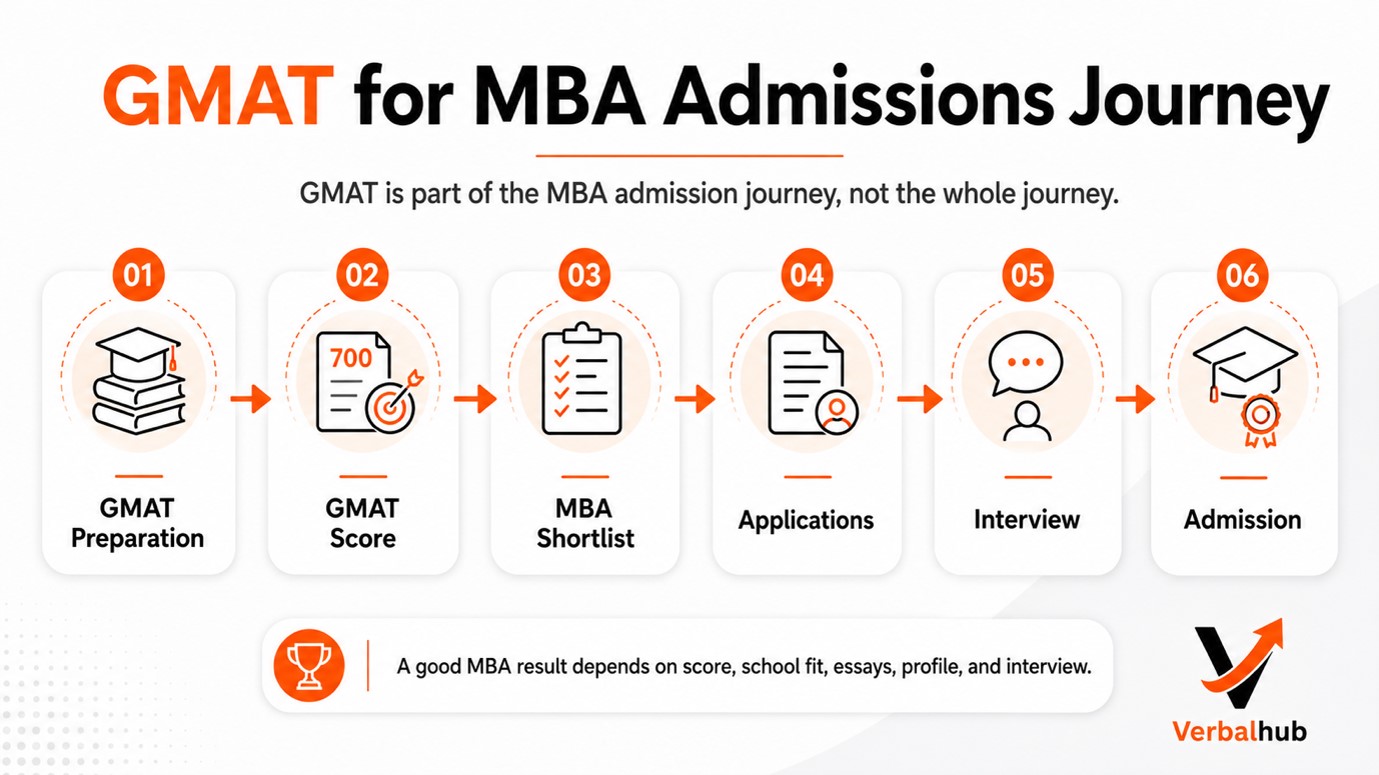
What is the GMAT?
The GMAT (Graduate Management Admission Test) is a management entrance test conducted by GMAC, the Graduate Management Admission Council. Business schools use it to check whether you have the reading, reasoning, and quantitative skills needed to survive an MBA classroom. It is a computer-adaptive test — question difficulty adjusts to your performance as you go.
The test is accepted by a large number of Indian and global MBA programs. In India, it is especially useful for ISB, the one-year MBA programs at IIM Ahmedabad, Bangalore, Calcutta, Lucknow and Indore, XLRI's general management program, SPJIMR, and Great Lakes. Globally, almost every well-known business school — Harvard, Stanford, Wharton, INSEAD, London Business School, Kellogg, Booth, MIT Sloan and many more — accepts GMAT scores. Many schools also accept it for MiM, business analytics, and finance master's programs.
One naming clarification: since 2024, everyone takes the GMAT Focus Edition — the older format with the essay and Sentence Correction is fully retired. So when people say "GMAT syllabus for MBA" today, they mean the Focus Edition syllabus. You may also see students searching "g mat syllabus" with a space — it is the same exam, and the GMAT subjects for MBA remain the same: Quant, Verbal, and Data Insights. This guide explains the full GMAT exam syllabus section by section.
GMAT Exam Pattern 2026
The GMAT exam pattern in 2026 follows the Focus Edition structure. There is no essay section and no grammar-based Sentence Correction. Here is the GMAT paper pattern at a glance:
| Section | Questions | Time | What It Tests |
|---|---|---|---|
| Quantitative Reasoning | 21 | 45 minutes | Arithmetic and algebra-based problem solving |
| Verbal Reasoning | 23 | 45 minutes | Reading Comprehension and Critical Reasoning |
| Data Insights | 20 | 45 minutes | Data Sufficiency, tables, graphs, multi-source reasoning |
| Total | 64 | 2 hrs 15 min | Overall score range: 205–805 |
A few useful points about this GMAT examination pattern that change how you should prepare:
- You can attempt the three sections in any order you choose. Most students put their most focus-hungry section first and their most automatic one last.
- There is one optional 10-minute break after the first or second section. Take it — scores routinely dip when students skip it.
- You can bookmark questions and change up to three answers per section using the review-and-edit screen at the end.
- Each section is scored from 60 to 90, and all three sections carry equal weight in the total score.
- The GMAT exam pattern and syllabus are identical whether you take the test at a centre or online at home.
- Scoring moves in 10-point increments (605, 615, 625…), so a total like 650 does not exist on the Focus scale.
With roughly two minutes per question across all three sections, timing practice belongs in your plan from week one, not the final fortnight.
GMAT Subjects and Test Sections
Students often ask, "What are the GMAT subjects?" The honest answer is that GMAT does not test school or college subjects like history, physics, or economics. The GMAT exam subjects are actually three skill areas:
- Quantitative Reasoning — Problem Solving questions built on school-level maths: arithmetic, algebra, and word problems.
- Verbal Reasoning — Reading Comprehension and Critical Reasoning: reading dense passages and analysing short arguments.
- Data Insights — Data Sufficiency, tables, graphs, and multi-source questions: making decisions from mixed information.
These three GMAT test subjects together check whether you can think like a future manager: read carefully, calculate quickly, and decide with incomplete information. That is also why these GMAT subjects for MBA matter beyond the exam — they mirror what case discussions, consulting interviews, and analytical business roles actually demand.
GMAT Exam Topics and GMAT Portion: Full Overview
Before going section by section, here is the complete GMAT portion in one table — a one-glance list of all GMAT exam topics:
| Section | Main Topics | Skill Tested |
|---|---|---|
| Quantitative Reasoning | Arithmetic, algebra, number properties, percentages, ratios, word problems, statistics | Problem solving with speed and accuracy |
| Verbal Reasoning | Reading Comprehension, Critical Reasoning (assumption, inference, strengthen, weaken, evaluate, boldface) | Careful reading and logical analysis |
| Data Insights | Data Sufficiency, Multi-Source Reasoning, Table Analysis, Graphics Interpretation, Two-Part Analysis | Data interpretation and decision making |
These GMAT test topics look long on paper, but the syllabus is finite and repeatable. Most topics for GMAT come from concepts you studied by Class 10, applied with logic and time pressure, and every question is a variation of a known family. Once you have seen each family and logged your mistakes against it, the exam stops producing surprises. The sections below break down the topics on GMAT in detail.
GMAT Verbal Topics
The Verbal section has 23 questions in 45 minutes, split across two question families: Reading Comprehension and Critical Reasoning. Since the Focus Edition removed Sentence Correction, grammar rules are no longer tested directly — which means the entire section is now about reading and reasoning. The GMAT verbal topics are:
1 Reading Comprehension (RC)
You get short and long passages from business, science, humanities, and social science. You are not expected to know the subject — everything needed is in the passage. Question types include:
- Main idea and primary purpose – why did the author write this passage?
- Inference questions – what the passage implies but never states directly.
- Detail and supporting-idea questions – locating and interpreting specific information.
- Passage structure and organisation – how paragraphs relate to each other.
- Tone and purpose – the author’s attitude towards the subject.
- Application questions – extending the passage’s logic to a new situation.
The RC skill that separates scorers is reading for structure rather than detail on the first pass. Students who map structure answer main-idea and inference questions in seconds; students who read for facts re-read the passage for every question and run out of time.
2 Critical Reasoning (CR)
CR gives you a short argument and asks you to analyse it. The question types are:
- Assumption – the unstated idea the argument depends on; remove it and the argument collapses.
- Strengthen – new information that makes the conclusion more believable.
- Weaken – new information that damages the conclusion.
- Inference and conclusion – what must be true based on the given statements.
- Evaluate – what additional information would help judge the argument.
- Boldface – identifying the role each bold portion plays in the argument’s logic.
- Paradox or discrepancy – explaining how two seemingly conflicting facts can both be true.
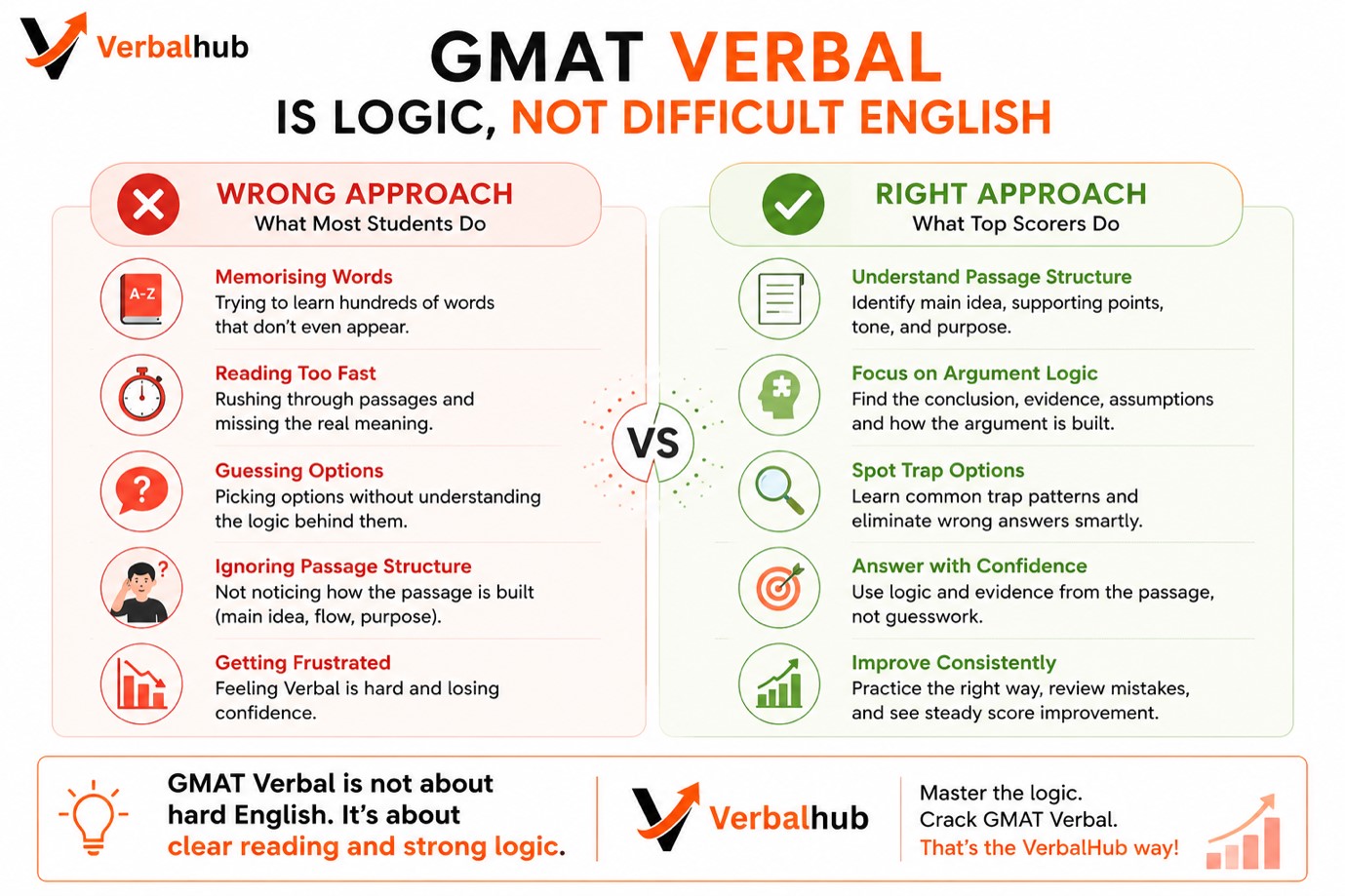
Here is the truth most students realise late: GMAT Verbal is not about difficult English or a big vocabulary. It is about reading clearly, following the logic of an argument, and avoiding trap options that look right but are slightly off. Two students with identical English fluency can score forty points apart based purely on how they handle these traps.
This is exactly where Verbalhub has built its reputation. Verbalhub’s GMAT Verbal coaching teaches students how to break down RC passage structure, map CR argument logic, spot the standard trap patterns, and — most importantly — identify their personal mistake patterns. Instead of solving 500 random questions, students learn why they keep falling for the same category of wrong answer, which is what actually moves the Verbal score. For Indian aspirants, who typically score well in Quant and lose ground in Verbal, this section is usually the highest-return investment of the entire preparation.
GMAT Quantitative Syllabus
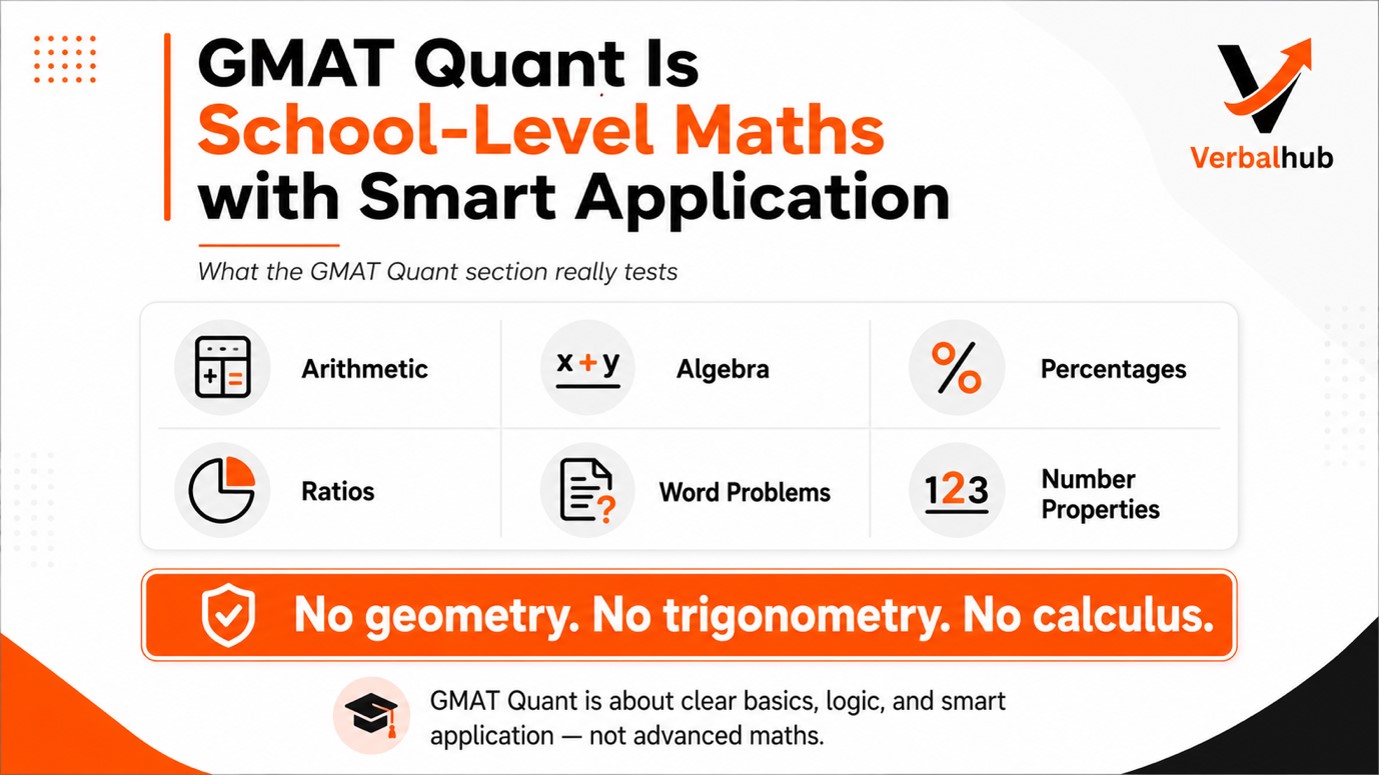
The GMAT quantitative syllabus covers arithmetic and algebra — and nothing else. There is no geometry, no trigonometry, no coordinate geometry, and no calculus in the Focus Edition, The GMAT maths syllabus includes:
Arithmetic
- Fractions, decimals, powers, and roots.
- Number properties: factors, multiples, primes, even/odd, divisibility, remainders.
- Percentages, profit and loss, simple and compound interest.
- Ratio and proportion, mixtures and alligation.
- Averages and simple statistics: mean, median, mode, range, and standard deviation basics.
- Sets, basic probability, and counting methods (permutations and combinations at a basic level).
Algebra and Word Problems
- Linear and quadratic equations.
- Inequalities and absolute values.
- Functions, sequences, and exponents.
- Speed, time, and distance.
- Work and time.
- Word problems that mix two or more of the above — the GMAT’s favourite format.
An important clarification about the GMAT mathematics syllabus: GMAT Quant does not test very advanced mathematics. Everything comes from school-level maths, roughly what an Indian student covers by Class 10. What makes it challenging is the packaging: dense word problems, answer choices designed around predictable errors, a two-minute budget per question, and no calculator in this section.
The winning approach is not harder maths — it is automatic basics, number-sense shortcuts (approximation, plugging in numbers, back-solving), and mental-calculation speed.
If you are from a non-engineering background or have been away from maths for years, structured GMAT Quant coaching that rebuilds concepts before jumping to hard questions makes a real difference. Verbalhub’s Quant modules follow exactly this order: concept, application, timing, and error review — the same mistake-first method it uses in Verbal.
GMAT Data Insights Syllabus
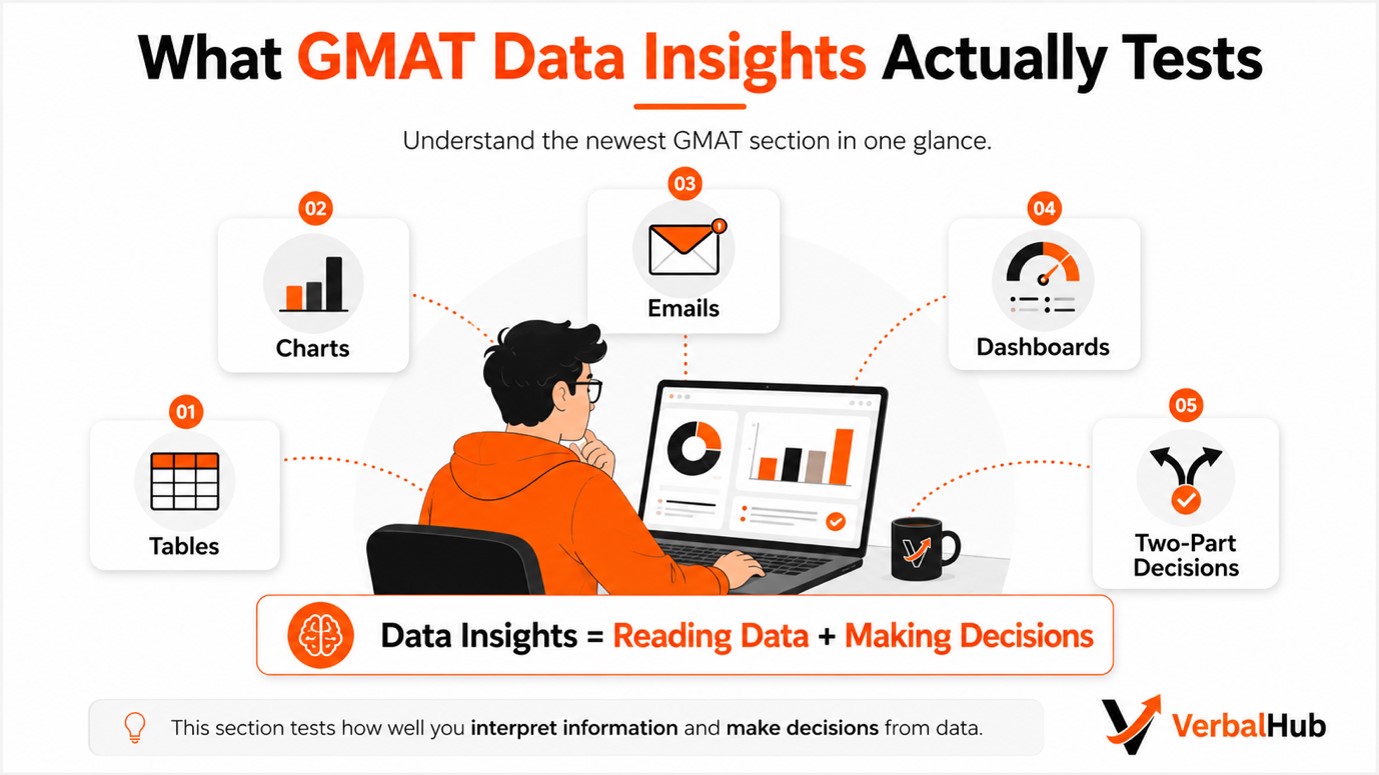
Data Insights is the newest section in the GMAT Focus Edition syllabus, and many students search for "GMAT data insight" while figuring out what it covers. The section has 20 questions in 45 minutes, and, unlike Quant, an on-screen calculator is available. It blends numerical and verbal reasoning. The five question types are:
Data Sufficiency — the classic GMAT format, now housed here. You get a question and two statements, and must decide whether the statements (alone or together) are sufficient to answer, without necessarily solving anything.
Multi-Source Reasoning — two or three tabs of text, tables, and emails describing a business scenario. Questions ask you to combine information across tabs.
Table Analysis — a sortable data table with statements to verify as true or false. Speed with sorting and reading columns matters more than calculation.
Graphics Interpretation — a chart or graph with drop-down statements to complete. Tests whether you read axes, scales, and trends accurately.
Two-Part Analysis — a question with two connected answers selected from the same list, often mixing quant and verbal logic in one problem.
Why does this section exist? Because MBA classrooms and business roles run on tables, charts, dashboards, and messy, incomplete data. Data Insights checks whether you can pull the right conclusion from mixed information quickly — arguably the most job-relevant skill on the exam. It carries the same weight as Quant and Verbal in your total score, so treating it as an afterthought is one of the most common and most expensive preparation mistakes.
Preparation-wise, Data Sufficiency deserves early attention because its format confuses almost everyone at first, and Multi-Source Reasoning is mainly a time-management challenge. GMAT Data Insights coaching helps most with these two types, and VerbalHub covers Data Insights as a full section in its GMAT Focus Edition preparation, with the same mistake-analysis approach it applies to Verbal.
GMAT Old Score vs GMAT Focus Score vs Percentile
| Edition (Old 800 Scale) | Equivalent GMAT Focus Score | Approx. Percentile |
|---|---|---|
| 800 | 805 | 100.00% |
| 790 | 785–805 | 100.00% |
| 780 | 755–785 | 99.9–100.0% |
| 770 | 735–755 | 99.5–99.9% |
| 760 | 715–735 | 98.8–99.5% |
| 750 | 695–715 | 97.4–98.8% |
| 740 | 685–695 | 95.8–97.4% |
| 730 | 675–685 | 94.8–95.8% |
| 720 | 665–675 | 92.1–94.8% |
| 710 | 655–665 | 90.5–92.1% |
| 700 | 645–655 | 86.7–90.5% |
| 690 | 635–645 | 81.9–86.7% |
| 680 | 615–635 | 76.4–81.9% |
| 670 | 615 | 76.40% |
| 660 | 615 | 76.40% |
| 650 | 595–615 | 67.1–76.4% |
| 640 | 585–595 | 60.6–67.1% |
| 630 | 585 | 60.60% |
| 620 | 575–585 | 57.4–60.6% |
| 610 | 565–575 | 50.9–57.4% |
| 600 | 555–565 | 47.8–50.9% |
| 590 | 555 | 47.80% |
| 580 | 545–555 | 41.9–47.8% |
| 570 | 535–545 | 39.2–41.9% |
| 560 | 525–535 | 34.0–39.2% |
| 550 | 515–525 | 31.5–34.0% |
| 540 | 515 | 31.50% |
| 530 | 495–515 | 25.1–31.5% |
| 520 | 495 | 25.10% |
| 510 | 495 | 25.10% |
| 500 | 485–495 | 21.3–25.1% |
Types of GMAT Tests Students Should Take
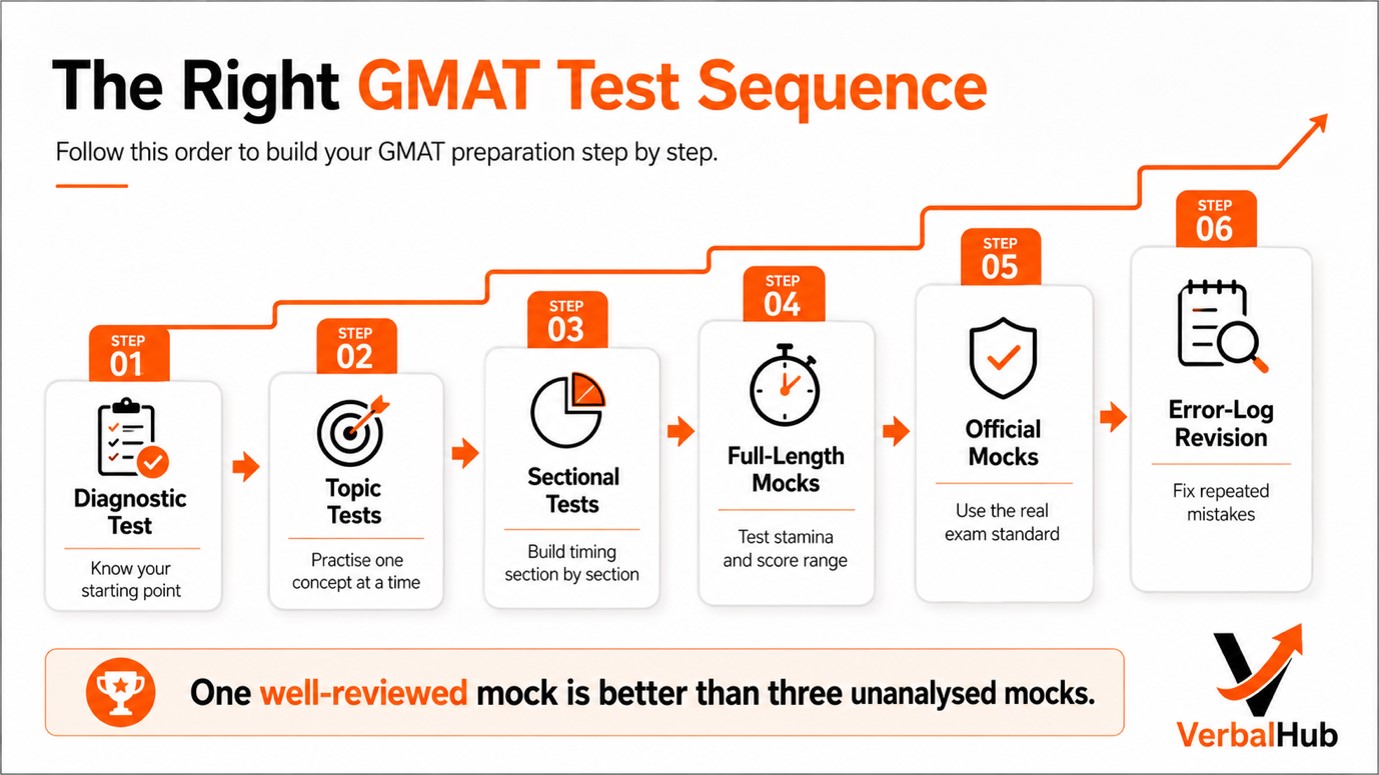
Good preparation is built on the right sequence of GMAT tests, not just classes and books. Each test type has a specific job; using them in the wrong order wastes your most valuable resources. Use them in this sequence:
GMAT diagnostic test — take one full-length test before preparation begins to know your true starting level. Do not "prepare for the diagnostic" — its purpose is to photograph your untrained ability.
Topic-wise tests — short quizzes after learning each concept (percentages, assumptions, table analysis, and so on).
GMAT sectional tests — full 45-minute Quant, Verbal, or Data Insights sections. These build stamina and expose timing leaks.
Full-length GMAT mock tests — complete 2-hour 15-minute tests under real conditions, spaced through the second half of your prep, taken under real conditions.
Official GMAT practice tests — the official mocks from GMAC, which use real retired questions and the real scoring engine. Save at least two for the final month.
Error-log based revision tests — re-tests built only from your past mistakes, using your error log.
Remember: one well-reviewed mock test is more useful than three mocks taken without proper analysis.
A proper review means going through every wrong answer and every slow correct answer, writing down the reason — concept gap, careless error, trap option, or timing — and tallying the categories. This single habit separates 605 scorers from 705 scorers more reliably than any book or course. GMAT Mock Test Series
GMAT Syllabus and Eligibility
A common search is "GMAT syllabus and eligibility", so let us settle it clearly. The GMAT itself has very simple eligibility: you should generally be at least 18 years old (13–17 with guardian consent), and you need a valid passport to take the test in India. There is no subject-based eligibility, no minimum percentage, no stream requirement, and no upper age limit. Students from every stream take the same exam.
MBA program eligibility is a separate matter and depends entirely on the school. Most MBA programs look at:
- A completed bachelor's degree in any discipline
- Work experience — ISB typically expects at least around 2 years for its flagship PGP, and most global MBA classes average 4–6 years; ISB's Early Entry Option accepts candidates with less
- A GMAT or GRE score within the five-year validity window
- Essays, recommendations, and interview performance
- English proficiency tests (TOEFL/IELTS) for some international programs
So the GMAT syllabus for MBA is the same for everyone; what differs is what each school expects around the score. Whenever you shortlist a program, read its official eligibility page the same day.
ISB GMAT Score and MBA Admission Relevance
ISB accepts both GMAT and GRE for its PGP, so let us address the ISB GMAT score question properly. Officially, ISB publishes no cut-off and evaluates the complete application — and that is genuinely true: every year, candidates with modest scores and exceptional profiles get in, while high scorers with generic applications are rejected.
Still, students deserve a practical planning number. Recent ISB classes have reported average scores around the low-700s on the old GMAT scale, which maps to roughly 645–655 on the GMAT Focus scale. So a practical way to think about a GMAT score for ISB:
- A GMAT Focus score around 645+ keeps you competitive for ISB with a typical profile.
- If you come from a heavily represented applicant pool — for example, male engineers from IT services — a higher score of 665+ gives you more breathing room,
- A somewhat lower score can still work if your work experience, leadership evidence, essays, and career goals are genuinely strong and coherent.
- Beyond roughly 675–685, additional points add little; those extra weeks are better spent on essays and interview preparation.
Treat these as indicative ranges, not cut-offs. ISB weighs work-experience quality, career progression, leadership evidence, clarity of goals, essays, and the interview heavily. A great GMAT score for MBA admission opens the door; the rest of the profile walks you through it.
What GMAT Score Do Top Indian and Global B-Schools Accept?
Here are practical targets based on recent class profiles. These are indicative ranges, not official cut-offs — every school admits people above and below these numbers. Always verify from official class-profile pages.
Table A: GMAT Score for Top Indian B-Schools (Indicative)
| Category | Practical GMAT Focus Target | Older GMAT Classic Approx. | Comment |
|---|---|---|---|
| Top 10 Indian B-schools (ISB, IIM-A/B/C one-year, etc.) | 645–695 | 700–740 | Strong profile can offset the lower end |
| Top 20 Indian B-schools | 615–655 | 660–710 | Balanced score plus clear goals works well |
| Top 30 Indian B-schools | 585–635 | 620–680 | Score plus relevant experience matters |
| Top 40 Indian B-schools | 555–615 | 580–650 | Many programs are flexible here |
| Top 50 Indian B-schools | 525–585 | 550–620 | Profile and interview carry more weight |
Table B: GMAT Score for Top Global B-Schools (Indicative)
| Category | Practical GMAT Focus Target | Older GMAT Classic Approx. | Comment |
|---|---|---|---|
| Top 10 world B-schools (Harvard, Stanford, Wharton, INSEAD, LBS, etc.) | 675–735 | 720–760 | Indian applicants often need the higher end |
| Top 20 world B-schools | 655–705 | 700–740 | Strong essays and story are equally critical |
| Top 30 world B-schools | 635–685 | 680–720 | Good scholarships possible at higher scores |
| Top 40 world B-schools | 605–665 | 650–710 | Fit and experience weigh heavily |
| Top 50 world B-schools | 585–645 | 630–690 | A clear career goal can outweigh 10–20 points |
Three honest notes on the GMAT score for top B-schools. First, because Indian applicants form one of the largest and most competitive pools, top global schools effectively expect Indian candidates to be at or above their published class averages. Second, a score meaningfully above a school’s average is one of the strongest levers for merit scholarships. Third, no score guarantees admission — final decisions depend on profile, essays, recommendations, work experience, interview, and fit. Set your target as “class average + 20 to 30 Focus points” if you come from a common profile, and stop chasing points beyond that.
Application Deadlines for Top Indian and Global MBA Colleges
MBA application deadlines change every year, so always verify dates on official school websites. That said, the broad calendar is stable enough to plan around.
- Indian schools: ISB usually opens applications around mid-year with Round 1 in September–October and Round 2 in December–January. IIM one-year MBA programs typically have deadlines spread between July and February depending on the program.
- Global MBA programs: most follow three rounds — Round 1 in September–October, Round 2 in early January, and Round 3 in March–April. Round 1 and Round 2 are where most seats and scholarships go; Round 3 is thin for international applicants.
Working backwards from those rounds, here is a suggested GMAT-plus-application timeline for Indian applicants targeting the next intake:
| Timeline | What Students Should Do |
|---|---|
| January – March | Understand the GMAT syllabus, take a diagnostic test, shortlist 6–8 schools across ambition levels |
| April – June | Core GMAT preparation: concepts, sectional practice, error log; start alumni networking |
| July – August | Take the GMAT (keep a buffer for one retake if needed); begin essay brainstorming |
| September – October | Apply in Round 1 — essays, recommendations, application forms |
| November – January | Apply in Round 2 if needed; ISB Round 2 falls here |
| February – April | Interviews, decisions, scholarships, and pre-MBA planning |
The single biggest scheduling mistake is finishing the GMAT too close to MBA admission deadlines, leaving no time for essays or a retake. Essays for a single school take 20–40 hours of genuine work, and recommenders need notice. Aim to be done with the test at least 6–8 weeks before your first deadline, with room for one retake built into the calendar.
Weightage of GMAT in MBA Applications
How much does the GMAT actually count? The honest answer: it is important, but it is not everything. The score answers one question in the admissions office — can this person handle the academic load? Once that is answered convincingly, additional points face diminishing returns. A slightly lower GMAT score with a stronger profile regularly beats a higher score with weak essays and unclear goals.
Here is a practical (not official) view of GMAT weightage in MBA admission:
| Application Component | Approximate Importance | What It Shows |
|---|---|---|
| GMAT/GRE score | 20–30% | Academic and analytical readiness |
| Work experience | 20–25% | Quality of roles, growth, and impact |
| Essays / SOP | 15–20% | Clarity of goals, self-awareness, fit |
| Interview | 10–15% | Communication, maturity, authenticity |
| Academic background | 10% | Consistency and rigour of past studies |
| Recommendations | 5–10% | Third-party proof of your claims |
| Extra profile elements | 5–10% | Leadership, community work, distinctiveness |
These percentages are practical estimates, not official numbers, and each school weighs things differently. The takeaway on GMAT score vs profile: get your score into the competitive range efficiently, then reinvest the remaining months into essays, recommenders, and interview preparation.
More Than GMAT: What Else Matters in MBA Admissions?
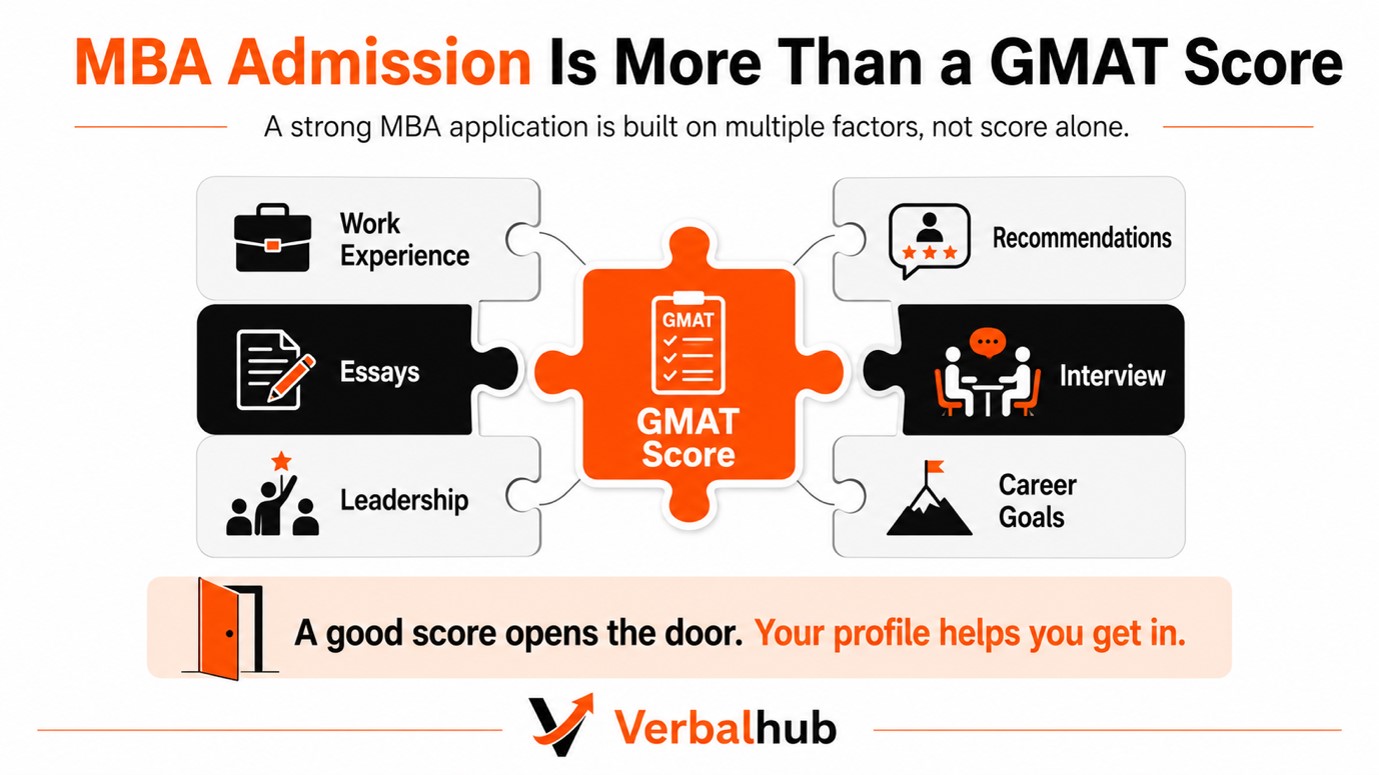
MBA admissions beyond GMAT come down to one question: does the school believe in your journey — where you have been, why you need an MBA now, and where you are going? Every component of the application is evidence for or against that story. The key MBA admission factors are:
- Work experience — not just years, but responsibility and results.
- Career growth — promotions, expanding scope, tougher problems.
- Leadership — leading teams, projects, or initiatives, formally or informally.
- Clear goals — a believable short-term and long-term plan and a convincing answer to “why an MBA, and why now?”
- Essays — specific, honest stories with real details rather than generic ambition.
- Recommendations — from people who genuinely know your work, not the most senior title you can reach.
- Interview — consistency between what you wrote and how you speak.
- Extracurriculars and community work — proof that you contribute beyond your job description and will do the same on campus.
- School fit — real reasons why this school: specific courses, clubs, professors, or conversations with alumni.
Admissions committees read thousands of applications with statistically similar scores. What they remember is a clear, consistent, human story running across all of these MBA application requirements. Build the story first; let every component support it.
How to Build a Strong and Relevant MBA Profile
Profile building for MBA is not about collecting certificates in the last two months before deadlines. It is 12–18 months of deliberate, small steps that compound into a convincing application. Here is how to build an MBA profile that actually supports your goal:
Define your MBA goal — decide the role and industry you want after the MBA. Everything else aligns with this.
Improve work impact — volunteer for visible, measurable projects at work and track the numbers: revenue influenced, costs saved, users gained, hours automated.
Take more ownership — move from executing tasks to owning outcomes. Lead a small team, run a cross-functional project, or own a client relationship end-to-end.
Build industry relevance — read, follow, and engage with your target industry so your goals sound informed rather than aspirational.
Add meaningful certifications — add only certifications that connect to your goal: CFA levels for finance, analytics or product certifications for product roles.
Build leadership outside work — mentor juniors, run a community initiative, organise events, coach a team, or lead an alumni chapter.
Prepare your story early — start writing your story 6–12 months before deadlines. Good essays need drafts and feedback, not deadline pressure.
Choose schools based on fit — pick schools by program strengths, recruiter mix, location, and culture, not only rankings.
Keep proof of achievements ready — save appraisal excerpts, project results, awards, and appreciation emails as you go.
Profile Examples by Career Goal
| Target Path | What Strengthens the Profile |
|---|---|
| Consulting | Client-facing work, structured problem solving, case-competition wins, cross-industry exposure |
| Product management | Shipping features, user metrics, analytics or design certifications, side projects or apps |
| Finance | Deal or valuation exposure, CFA progress, financial modelling work, market commentary or research |
| Entrepreneurship | A venture or side business (even small), fundraising exposure, startup community involvement |
| Healthcare management | Hospital/pharma operations, public health projects, health-tech exposure |
| International business | Cross-border projects, global clients, a foreign language, multicultural team experience |
For ISB profile building specifically, focus on demonstrated leadership and career progression, because the applicant pool is dense with strong academics and scores — those are table stakes, not differentiators. Depth in two or three things beats a long, shallow list. And if your profile looks thin today, six months of genuine initiative is enough to change an application’s texture.
GMAT Statistics & Facts You Should Know
A few numbers and facts worth knowing before you plan — useful for setting expectations and for spotting outdated advice online. Figures are as per GMAC; verify current details on mba.com.
| Fact | Detail |
|---|---|
| Programs accepting GMAT | 7,000+ programs at business schools worldwide accept GMAT scores |
| Score validity | A GMAT score is valid for 5 years from the test date |
| Attempt limits | Up to 5 attempts in any rolling 12-month period; 8 attempts in a lifetime |
| Test length | 2 hours 15 minutes — the shortest the GMAT has ever been |
| Score increments | Total scores move in 10-point steps (e.g., 635, 645, 655) |
| Section scores | Each section is scored 60–90 in 1-point steps; all three count equally |
| Official results | Official scores typically arrive within a few business days of the test |
| Answer changes | You may bookmark questions and change up to 3 answers per section |
| Calculator | Allowed only in Data Insights; not allowed in Quantitative Reasoning |
| Retakes | A large share of serious candidates take the GMAT more than once — planning a buffer for one retake is normal, not a failure |
Two of these facts should shape your plan. The five-year validity means you can take the GMAT well before you feel application-ready — many professionals test at 2–3 years of experience and apply at 4–5. And the attempt limits mean each attempt should be deliberate: walk in only after your mocks consistently show your target range.
GMAT Preparation Strategy
How should students prepare for GMAT without wasting months? The nine-step GMAT preparation strategy below works whether you have eight weeks or six months:
- Start with a diagnostic test to find your true starting score and weakest areas. Everything in your plan flows from this one data point.
- Understand your weak areas — separate concept gaps (you don’t know it) from careless errors (you knew it, you slipped) and timing issues (you knew it, you ran out of time).
- Build concepts before speed — for Quant basics, CR argument logic, RC reading method, and the Data Sufficiency decision framework.
- Practise section-wise — finish one section’s topics with topic quizzes before mixing everything.
- Review every mistake in an error log with the reason for each mistake.
- Take full mock tests every 1–2 weeks in the second half of preparation, ideally at the same time of day as your booked exam slot.
- Revise from the error log — redo error-log questions until the same category of mistake stops repeating.
- Fix your timing strategy — practise letting go of one or two hard questions per section; protecting the rest is worth more.
- Revise before the final exam — the final two weeks are for official mocks, light revision, and sleep, not new material.
Sample GMAT Study Plans
| Plan | Best For | Structure |
|---|---|---|
| 8-week plan | Students with strong basics, 2.5–3 hrs/day | Wk 1: diagnostic + plan · Wk 2–4: concepts + topic tests · Wk 5–6: sectional tests + error log · Wk 7–8: 4–5 mocks + revision |
| 12-week plan | Most working professionals, 1.5–2 hrs/day | Wk 1: diagnostic · Wk 2–6: concepts section by section · Wk 7–9: sectional practice + 2 mocks · Wk 10–12: 4 mocks + error-log revision |
| 6-month plan | Busy professionals, ~1 hr weekdays + weekends | Mo 1: diagnostic + Quant basics · Mo 2–3: Verbal + Quant application · Mo 4: Data Insights · Mo 5: sectional tests + mocks · Mo 6: mocks, error log, exam strategy |
Two GMAT preparation tips that matter more than any schedule: study a little every day rather than only on weekends, and never take a mock without reviewing it fully before the next one. A consistent GMAT study plan beats an ambitious one.
Expert Tips from GMAT Mentors
These are the tips Verbalhub mentors repeat most often — small adjustments that consistently show up in score jumps:
- Read for structure, not detail. In RC, pause after each paragraph and mentally summarise its job in five words.
- Find the conclusion first. In CR, identify the conclusion and the evidence before touching the options.
- Estimate before you calculate. In Quant, before solving, ask whether approximation, plugging in numbers, or back-solving from the answer choices is faster than algebra.
- Do not solve DS questions fully. In Data Sufficiency, your job is to decide whether an answer can be found — not to find it. Stop the moment sufficiency is established.
- Lock your section order early. Decide your section order once, based on mocks, and never change it on exam day.
- Flag, move on, return. Use the review-and-edit feature deliberately: flag genuine coin-flips, keep moving, and return with fresh eyes. Change an answer only when you can say why the first choice was wrong.
- Make the error log personal. Write your error log in your own words — it teaches more than a one-line note.
- Rehearse the real conditions. Sit mocks at the exact time of your booked exam slot, with the 10-minute break, no phone, and no pausing.
- Protect the final week. In the last week, sleep is preparation. Walk in rested rather than crammed.
Common GMAT Preparation Mistakes to Avoid
Mentors see the same avoidable mistakes every season. If you recognise yourself in any of these, correcting course early can save months:
- Practising without reviewing. Solving thousands of questions without reviewing why answers were wrong feels productive but changes nothing.
- Ignoring Data Insights. Because Data Insights is newer and less discussed, many students give it a token week at the end despite it carrying a full third of the score. Start DI by the middle of your plan.
- Playing only to strengths. Engineers who over-prepare Quant and under-prepare Verbal, and verbal-strong students who avoid maths, both cap their totals.
- Studying from outdated material. Old-format advice — Sentence Correction drills, essay templates, 800-scale score talk — still floods forums and second-hand books. If a resource treats Sentence Correction as a current section, it predates the Focus Edition; put it down.
- Mock-test bingeing. Taking a mock every two days without full review burns the limited pool of quality mocks and reinforces errors.
- Perfectionism on hard questions. Refusing to leave any question unanswered perfectly, then rushing the final eight questions of a section, trades a few hard points for many easy ones.
- Preparing without a test date. Booking a test date only after "feeling ready" often means never booking, or booking too close to application deadlines. Book a realistic date early.
- Leaving applications for later. Treating the GMAT as the whole application and starting essays afterwards leaves the most differentiating part of the application rushed.
- Chasing the wrong number. Comparing your Focus score to friends' old-scale scores, or aiming for "700" because that number is famous, leads to misaligned targets. Set targets from current class profiles of your shortlist.
Do You Need GMAT Coaching?
Honest answer: not everyone does. Self-study works for disciplined students who start with decent basics, can diagnose their own mistakes objectively, and can build and adjust their own plan. The official guides and practice exams are excellent raw material, and some students cross 655 purely on self-study. If that describes you, save the fee.
GMAT coaching earns its fee in specific, recognisable situations:
- Your score is stuck at the same level across multiple mocks and you cannot see why — a plateau almost always means an undiagnosed mistake pattern
- Verbal feels unpredictable — you get similar questions right one day and wrong the next, a sign of guess-based rather than process-based answering
- Quant basics are rusty after years away from maths,
- Data Sufficiency and Multi-Source Reasoning confuse you despite practice
- You take mocks but cannot convert the review into improvement — you see what went wrong but not what to change
- You are a working professional who simply needs structure, accountability, and a plan that fits around office hours
GMAT coaching for working professionals is really about removing decision fatigue: someone tells you exactly what to do this week, checks whether it worked, and corrects the plan before drift sets in. That is why GMAT online coaching with evening or weekend classes has become the default for most Indian aspirants — no travel, recorded sessions for missed classes, and flexible doubt-solving between sessions.
A useful filter while comparing GMAT classes: the best GMAT coaching is not just about lectures. It should include diagnostic planning, small batches, regular feedback, structured mock review, doubt-solving access, and personal correction of your specific mistake patterns. If a program only offers videos and question banks, you are paying a premium for content you can get almost anywhere; the scarce ingredients are attention and analysis.
Why VerbalHub is One of the Best GMAT Coaching Options
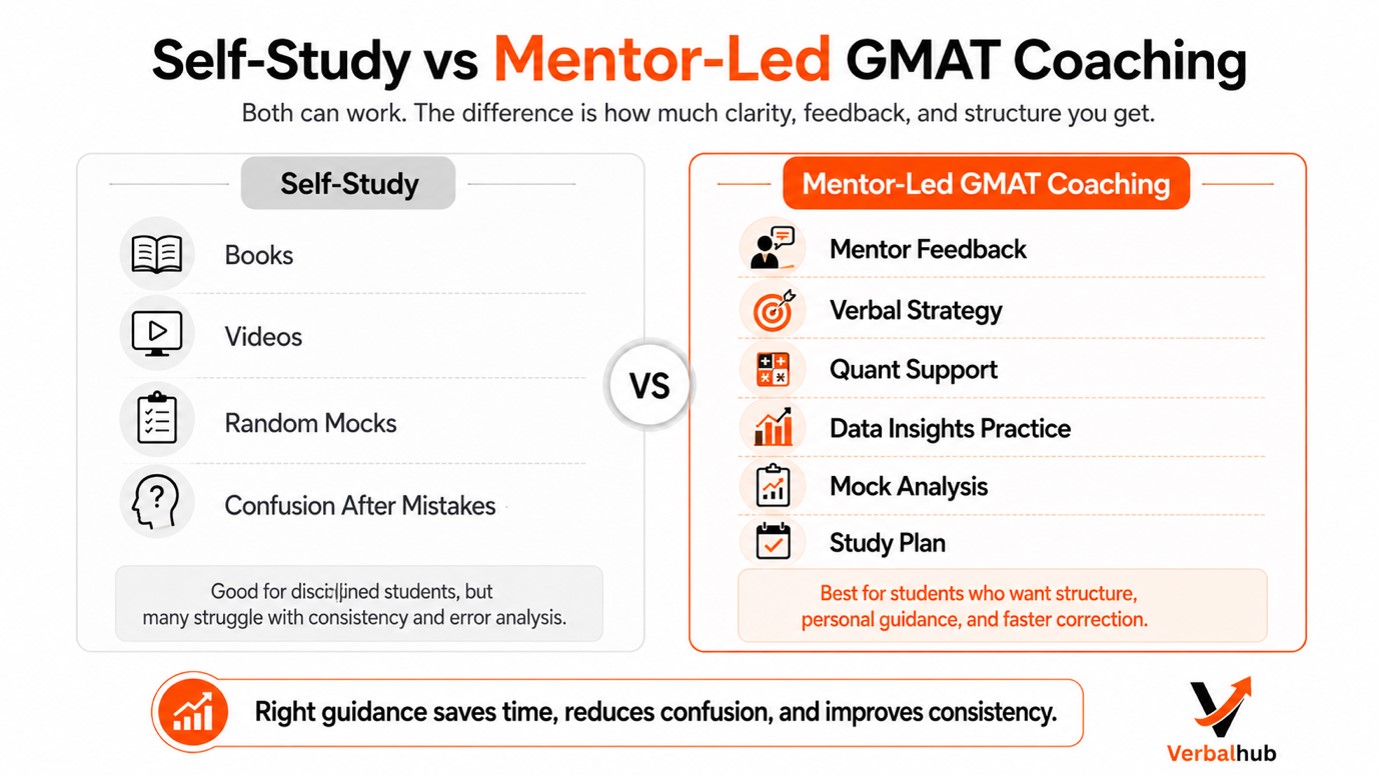
If you evaluate coaching on attention, analysis, and structure rather than content volume, Verbalhub checks the boxes that actually change scores, which is why many students count it among the best GMAT coaching in India, especially for the Verbal section.
- Strongest in GMAT Verbal: Verbalhub built its name on Reading Comprehension and Critical Reasoning. Students learn passage structure, argument mapping, and how trap options are engineered — not just answer explanations after the fact.
- Mistake-first teaching: the focus is on understanding why you are making mistakes instead of blindly solving more questions. Every student maintains an error log that mentors actually review and discuss.
- Built for the GMAT Focus Edition: the course structure, mocks, and strategy sessions follow the current three-section exam — no recycled old-format material.
- Covers all three sections: GMAT Quant, Verbal, and Data Insights are all taught with the same concept-application-timing-review method.
- Small batches and personal attention: small-batch learning means mentors know each student’s weak areas by name, and one-on-one mentorship is available for students who need individual pacing.
- Designed for working professionals: flexible schedules, recorded classes for the weeks work takes over, and doubt support that works around office hours.
- Mock analysis, not just mocks: every mock comes with structured review — score movement, timing analysis, and mistake categories.
- Prep plus applications together: mentors help you plan GMAT preparation alongside MBA applications, so your test date fits your Round 1 or Round 2 deadlines for ISB, IIM one-year MBA programs, and global schools.
If you are confused about your GMAT starting point, you can book a free GMAT strategy session with Verbalhub and understand your Verbal, Quant, and Data Insights gaps before you begin preparation. It costs nothing and typically saves weeks of unfocused study.
Final GMAT Study Roadmap
Here is the entire journey in one table — from first mock to submitted application:
| Phase | Focus Area | Outcome |
|---|---|---|
| Diagnostic | One full-length test, honest score analysis | Clear starting point and section-wise gaps |
| Foundation | Quant basics, CR logic, RC method, DS framework | Concepts strong enough to attempt any topic |
| Sectional practice | Topic tests + 45-minute sectional tests | Accuracy and timing per section |
| Data Insights practice | DS, tables, graphs, multi-source sets | Comfort with the calculator and data formats |
| Mock tests | Full-length mocks every 1–2 weeks | Exam stamina and stable scores |
| Error-log revision | Redo and analyse all past mistakes | Repeated mistakes eliminated |
| Final exam strategy | Official mocks, section order, timing rules | A tested plan for exam day |
| MBA application planning | School shortlist, essays, recommendations | Applications ready before deadlines |
Notice that the roadmap ends with applications, not the exam. The GMAT is a milestone, not the destination.
FAQs
The GMAT syllabus for MBA has three sections: Quantitative Reasoning (arithmetic and algebra), Verbal Reasoning (Reading Comprehension and Critical Reasoning), and Data Insights (Data Sufficiency, tables, graphs, and multi-source reasoning).
The main GMAT exam topics are arithmetic, algebra, number properties, word problems, Reading Comprehension, Critical Reasoning, Data Sufficiency, Table Analysis, Graphics Interpretation, Multi-Source Reasoning, and Two-Part Analysis.
In 2026, the GMAT has 64 questions in 2 hours 15 minutes: 21 Quant questions (45 min), 23 Verbal questions (45 min), and 20 Data Insights questions (45 min). The total score ranges from 205 to 805.
GMAT Verbal topics are Reading Comprehension (main idea, inference, detail, structure, tone) and Critical Reasoning (assumption, strengthen, weaken, evaluate, inference, boldface, and paradox questions). Sentence Correction is no longer tested.
The GMAT Quantitative syllabus includes arithmetic, percentages, ratios, number properties, averages, algebra, inequalities, speed-time-distance, work-time, basic statistics, and word problems. There is no geometry or trigonometry.
No. GMAT maths uses school-level concepts up to roughly Class 10. The difficulty comes from logic, word problems, time pressure, and the no-calculator rule in the Quant section — not from advanced topics.
GMAT Data Insights is a 20-question, 45-minute section that tests Data Sufficiency, Table Analysis, Graphics Interpretation, Multi-Source Reasoning, and Two-Part Analysis. An on-screen calculator is available in this section.
GMAT has three subjects or sections: Quantitative Reasoning, Verbal Reasoning, and Data Insights. It does not test general knowledge, grammar rules in isolation, or academic subjects like history or science.
The GMAT test syllabus covers problem solving in maths, reading and reasoning in Verbal, and data interpretation in Data Insights — all designed to test business-school readiness rather than memorised knowledge.
Start with a full-length diagnostic test. Then build concepts in your weak areas, practise section-wise with an error log, and finish with full-length mocks and structured review over 8–24 weeks.
Not for everyone. Disciplined students can self-study. Coaching helps if your score is stuck, Verbal feels unpredictable, your maths is rusty, or you are a working professional who needs structure and mock analysis.
The best GMAT coaching is one that offers small batches, mentor-led planning, structured mock analysis, and personal mistake correction. Verbalhub is a strong option on all these points, especially for GMAT Verbal and Focus Edition preparation.
Verbalhub specialises in RC and CR clarity, teaches students to identify their mistake patterns, offers small-batch and one-on-one mentorship, covers Quant and Data Insights fully, and fits the schedules of working professionals.
Around 645+ on the GMAT Focus scale (roughly 700+ on the old scale) is competitive for ISB. There is no official cut-off — work experience, essays, leadership, and the interview matter alongside the score.
Yes. ISB, the IIM one-year MBAs, and most global business schools accept both GRE and GMAT. Choose the test that suits your strengths; schools do not officially prefer one over the other.
Indicatively, top 10 Indian B-schools see competitive GMAT Focus scores around 645–695, and top 20 schools around 615–655. These are practical ranges, not cut-offs, and profiles matter alongside scores.
Top 10 global B-schools typically see competitive GMAT Focus scores around 675–735, with Indian applicants often needing the higher end. Top 20–50 schools admit strong candidates from roughly 585 upwards, depending on profile.
Practically, the GMAT carries roughly 20–30% weight. It proves academic readiness, after which work experience, essays, recommendations, and the interview decide the outcome.
Work experience quality, career growth, leadership, clear goals, honest essays, strong recommendations, and interview performance. A strong profile with a slightly lower score often beats a high score with a weak story.
Define your post-MBA goal, create measurable impact at work, take ownership of projects, build leadership inside and outside the office, add goal-relevant certifications, and start your essays 6–12 months before deadlines.
Note: All score ranges, deadlines, statistics, and eligibility details in this guide are indicative and based on typical recent patterns. Always verify the latest details on official school websites and mba.com before planning your applications.



Our Teachers

Dr. G Ravindra Babu
Quant Faculty
Ph. D in Mathematics Asian International University|| Mathematics Professor at Gitam University || Ex-Mathematics Professor SRM University Amaravathi || MBA in finance Acharya Bangalore B School || GMAT Quant 51, CAT Quant 99.58 %tile, GRE Quant 170 || 21 Different Teaching Certification || Believe in “Education is the mother of leadership”
view details

Dr. Rengarajan Parthasarathy
CAT Faculty
Ph. D in Mathematics from YCM University|| Mathematics Professor at Symbiosis International|| Author of Business Ethics || Ex-CAT Exam Syllabus Advisor in IIM || MBA & MPM from Symbiosis International (Deemed University) || College Topper in Mathematics in Ferguson College || Six Scholarships in Mathematics || 15 Years CAT Coaching, GMAT Coaching and GRE Coaching Experience|| UGC NET Qualified || GMAT Q51, V38 & CAT Q 99.31 & DILR 99.38 %tile, GRE Quant 170 || Believe in “Higher Education Shapes The World.”
view details

Dr. Nisha Tejpal
Verbal & AWA Faculty
Ph. D in English || Published a paper in English in ‘Research Journal of Philosophy and Social Sciences’ || MCA and B.Ed CCS University || A subject expert in Verbal Teaching || 10,000 Plus Essays Analysis || CTET and NET Qualified || More than 15 years of Experience || A writer, Author and Poet || Believe in “Think Beyond the Universe”
view details

Dhrithi Khattar
Verbal Faculty
A subject expert in Verbal Aptitude || More than 15 years of Experience || MBA in HR& Marketing & MA in Economics || Active Member of Hindu Alumni Association || Functional Member of Delhi ||Management Association (DMA) || Operational Member of All India Management Association (AIMA) ||The President of Key Club ||An active member of the French Club ||Gold Seal from California Scholarship Federation.
view details
M. U. Mir
DILR & Quant Faculty
A subject expert in Quantitative Aptitude Training || GMAT Q 51 & CAT DILR 99.75 %tile || GATE 2020 Qualified || M. Tech & B. Tech University Toper (1st Rank) || Awarded by Gov of Odisha, Bihar and J& K for the project Magnetic Floating Model || Ex-Quant Subject Expert in Arihant Publication || An Educationist and Social Worker || Believe in “Education is power”
view details

C. S. Rajawat
CAT Faculty
M. A in Mathematics CCS University|| M. Tech from SRM University || Visiting Mathematics Faculty CCS University ||Experience of 11 Years of CAT Coaching || District Topper in 10th & 12th || Best Teacher Awardee in 2021 & 2022 || CAT Quant 99.43 %tile || Discovered a new Theorem based on HCF in Math || Founder of C. S. Classes ||Believe in “Teaching and Training is an Art.”
view details

Dr. S.K. Singh
PTE/IELTS/CELPIP Expert
Ph. D. English Dr. B. R. Ambedkar University || Delhi & Center Government School Mentor || Founder of Entrepreneur & Learning Startup || IELTS & CELTA Certified from British Council || PTE Certified from Pearson...
view detailsRishabh Arora
PTE/IELTS/CELPIP Expert
MBA in HR International Institute of Management Sciences || PTE Certified from Pearson Test of English|| IELTS & CELTA Certified from British Council || BCA from Integral University || PTE 87 in 2017, IELTS 8.5 in 2018
view details
Jyoti Joshi
IELTS Trainer
Master in English (MA) and Bachelor in Education (B.Ed) || Certified Trainer || IELTS Speaking 9.0 Band holder || Believe in “Great teacher can inspire hope, ignite the imagination, and instill a love of learning”
view details
Surbhi Arora
IELTS / PTE Expert
English Language Expert || More than 3 years of Experience || M.A plus B. Ed Delhi University ||Author, Writer & Classical Singer|| Believe in “Language Language Learning & Teaching is Fun”
view details

Dilip Kumar Rathore
Quant Trainer
A business developer and genius in mathematics || Highly experienced || Master in Maths || well-verse in IT || Believe in “The art of teaching is the art of assisting discover”
view details

Imaam Hasan
Communication Expert
Master in English || Journalist and writer || Certified IELTS & PTE Trainer || A social educater and influencer || Believe in “Education is the movement from darkness to light”
view details