
CAT 2026 Quant and DILR Topics: Syllabus, Important Chapters, Percentile Trends, PYQs and Study Plan

CAT 2026 Quant and DILR mainly cover Arithmetic, Algebra, Number System, Geometry, tables, caselets, arrangements, grouping, and data-based puzzles. Start with Arithmetic, Algebra, tables, and easy DILR sets, then use topic-wise CAT PYQs and mock analysis to improve accuracy and question selection.
1. CAT Quant and DILR at a Glance
If you have just started preparing for CAT 2026, there is a good chance that two sections are already worrying you: Quantitative Aptitude and DILR. You are not alone. Every year, thousands of students open a Quant book, see chapters they last touched in Class 10, and feel a small panic. Working professionals feel it even more, because after a full day at the office, sitting with percentages and seating arrangements at 10 pm is not easy.
Here is the honest truth that most students learn too late: Don’t focus on every chapter equally and try to be an expert in it. CAT rewards students who know which CAT topics matter more, in what order to study them, and how to practise them. A student who has done Arithmetic, Algebra, and DILR sets properly, and who analyses every mock seriously, will usually beat a student who has “covered” the full syllabus in a hurry.
This guide covers all CAT exam topics for Quant and DILR in one place. It explains the syllabus, the important chapters, how past papers behave, how score converts to percentile, how to use PYQs topic by topic, and how to plan your next 30 or 90 days. It is written the way a teacher would explain things in a classroom, not the way a brochure talks.
One more thing before we begin. Random question solving feels productive but gives slow results. Topic order, CAT previous-year papers, smart practice, and honest mock analysis matter far more. Keep that idea in mind through this whole article.
Quick Summary Box
- CAT Quant and DILR syllabus: Arithmetic, Algebra, Number System, Geometry, Modern Math for Quant; tables, charts, caselets, arrangements, grouping, games for DILR.
- Topics to prioritise first: Arithmetic, Algebra, tables and caselets, grouping and arrangement sets.
- Last 10-year trend: Question count has changed over the years (100 → 76 → 66 → 68), but the thinking style CAT tests has stayed steady.
- Score vs percentile: Percentile is relative, not a fixed mark. Cut-offs shift with difficulty and competition every year.
- PYQ strategy: Solve CAT pyq topic wise first, then mixed sets, then sectionals and mocks.
- DILR set selection: Scan all sets first, start with the friendliest one, and leave blocked sets quickly.
- Plans included: A 30-day plan and a 90-day plan, both realistic for students and working professionals.
- Coaching: A checklist to judge any CAT coaching before paying fees.
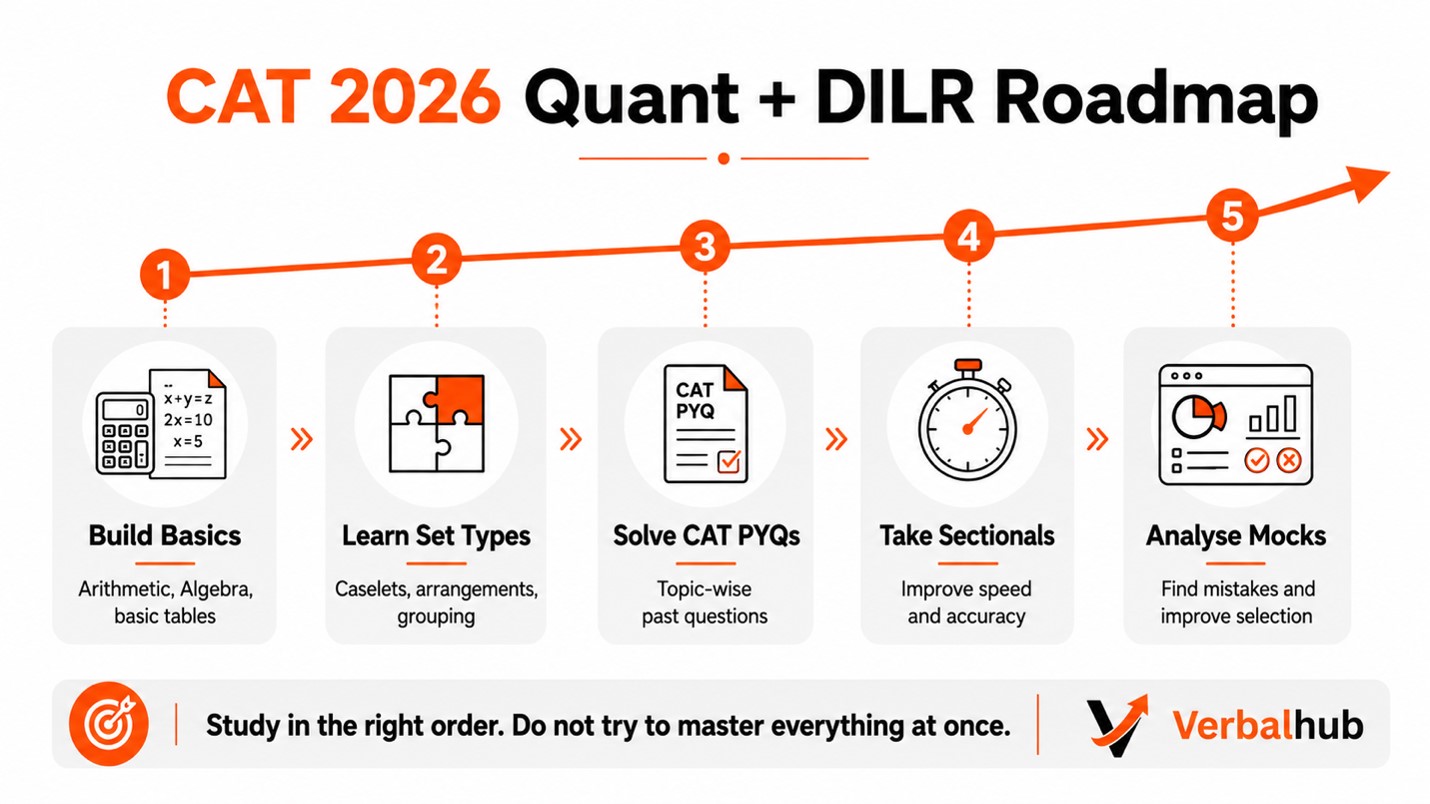
Table of Contents
- CAT 2026 Exam Subjects and Section Overview
- CAT Quantitative Aptitude Syllabus and Topics
- CAT DILR Syllabus and Important Set Types
- Important CAT Quant and DILR Topics: Priority Table
- Last 10 Years CAT Quant and DILR Trends
- Commonly Asked CAT Question Types in the Last 10 Years
- CAT Score vs Percentile: How It Works
- How Many Questions Are Needed for CAT Percentile?
- CAT DILR Set Selection Strategy
- Topic-Wise CAT PYQ Strategy
- CAT Quant and DILR Mistake Patterns
- CAT Quant and DILR Myths
- CAT Quant and DILR Preparation Plans (30-Day and 90-Day)
- Which Is the Best CAT Coaching for CAT 2026?
- Separate Strategy for Different Students
- Mock Test Analysis Checklist
- Free Resources and Next Steps
- FAQs
- Conclusion
2. CAT 2026 Exam Subjects and Section Overview
What are the main CAT exam subjects? CAT has three sections: Verbal Ability and Reading Comprehension (VARC), Data Interpretation and Logical Reasoning (DILR), and Quantitative Aptitude (QA). Each section has its own fixed time limit, and you cannot jump between sections. Together, these three sections form the complete CAT exam subjects list.
Many beginners think CAT is a “maths exam”. It is not. It is a decision-making exam that uses maths, data, and language as its tools. Understanding the topics in the CAT exam properly is the first step, because it stops you from wasting weeks on chapters that rarely matter.
| CAT Section | What It Tests | Main Areas |
|---|---|---|
| VARC | Reading and verbal ability | RC passages, para jumbles, summaries |
| DILR | Logic and data-based decision-making | Tables, charts, arrangements, caselets |
| Quant | Mathematical problem-solving | Arithmetic, Algebra, Number System, Geometry |
In recent years, the paper has carried 68 questions in total with 40 minutes per section, and the marking has been +3 for a correct answer and −1 for a wrong MCQ, with no negative marking for TITA (type-in-the-answer) questions.
Important note: CAT 2026’s final question count, duration, and pattern should always be checked in the official CAT 2026 notification when it is released. Patterns have changed before, and they can change again. CAT 2026 Preparation Strategy
3. CAT Quantitative Aptitude Syllabus and Topics
What topics are included in CAT Quantitative Aptitude? Quantitative aptitude for CAT covers five broad areas: Arithmetic, Algebra, Number System, Geometry and Mensuration, and Modern Math. Arithmetic and Algebra together usually carry the biggest share of questions, which is why every sensible CAT Quant preparation strategy starts with these two areas.
The good news for students weak in maths: CAT Quant does not need engineering-level mathematics. Almost everything comes from concepts you saw between Class 8 and Class 10. What CAT adds is clever wording, hidden conditions, and time pressure. So your job is not to learn “higher maths”. Your job is to make school-level maths fast, clean, and reliable.
| Quant Area | Important Topics | Priority |
|---|---|---|
| Arithmetic | Percentages, Ratio, Averages, Profit-Loss, Time-Work, Mixtures | High |
| Algebra | Equations, Inequalities, Functions, Logs, Progressions | High |
| Number System | Divisibility, Remainders, Factors, LCM-HCF | Medium |
| Geometry | Triangles, Circles, Mensuration, Coordinate Geometry | Medium |
| Modern Math | Permutation, Combination, Probability, Set Theory | Medium |
| Basic Quant | Indices, Surds, Simplification | Medium |
When you practise CAT quantitative questions, always practise them in this rough order of priority. A student who is strong in Arithmetic and Algebra alone can already attempt a large part of the section. That is the base. Geometry, Number System, and Modern Math are then added on top of that base, not in place of it.
One habit to build from day one: keep a small notebook of every formula, shortcut, and mistake. Revise it weekly. This one habit quietly separates 80-percentile students from 95-percentile students.
3.1 Arithmetic Topics for CAT
Which arithmetic topics are important for CAT? The most important arithmetic topics for CAT are percentages, ratio and proportion, averages, profit and loss, simple and compound interest, time-speed-distance, time and work, and mixtures. Arithmetic is usually the largest chunk of the Quant section, which makes it the highest-return area for every aspirant.
Here is the full list of arithmetic CAT topics you should cover:
- Percentages – the base language of Arithmetic; almost every other chapter uses it.
- Ratio and proportion – sharing, partnership, and comparison problems.
- Averages – simple averages, weighted averages, and changes in average.
- Profit, loss, and discount – cost price, selling price, markup, successive discounts.
- Simple and compound interest – growth and instalment-style questions.
- Time, speed, and distance – trains, boats, relative speed, races.
- Time and work – efficiency, combined work, wages.
- Pipes and cisterns – the “filling and emptying” version of time and work.
- Mixtures and alligations – mixing two solutions or prices and finding the ratio.
Mixtures deserve a special mention. Many mixtures and alligations CAT questions look scary but become one-line problems once you learn the alligation cross method. Practise replacement problems (where part of a mixture is removed and replaced) separately, because they follow their own pattern.
Most CAT quantitative aptitude questions from Arithmetic are word problems. Your real skill is translation: reading three lines of English and turning them into one equation. So while practising, do not jump to the solution. First write what the question is actually saying in numbers.
Why It Matters: Arithmetic for Beginners
Arithmetic is the friendliest entry point into CAT Quant. It needs no advanced theory, its logic matches daily life (discounts, speed, sharing money), and it carries heavy weight in the exam. If you are weak in maths, one to one-and-a-half months of honest Arithmetic work gives you visible confidence, and that confidence carries into Algebra and DILR too.
3.2 Algebra Topics for CAT
What are the important algebra topics for CAT? The key algebra topics for CAT are linear and quadratic equations, inequalities, functions, logarithms, and progressions. Algebra usually stands next to Arithmetic in weight, and the two together often decide your Quant score.
Cover these CAT algebra topics step by step:
- Linear equations – one and two variables, word problems, integer solutions.
- Quadratic equations – roots, sum and product of roots, nature of roots.
- Inequalities – linear, quadratic, and modulus-based inequalities.
- Functions – value-based questions, composite functions, simple graphs.
- Polynomials – factorisation, remainder and factor ideas.
- Logarithms – basic laws and equation solving.
- Progressions – AP, GP, and simple series questions.
- Modulus – absolute value equations and inequalities.
- Graph-based questions – reading and imagining simple graphs of functions.
Here is a note most toppers will agree with: CAT Algebra is less about memorising formulas and more about forming the correct equation and reading conditions carefully. Phrases like “positive integers”, “distinct values, “real roots”, or “x is not equal to y” quietly change the entire answer. Half of all Algebra mistakes happen because a condition was skipped while reading.
When you solve algebra pyq CAT questions, notice how often the paper rewards patience over speed. Read twice, form the equation once, and you will finish faster than someone who started calculating in the first five seconds.
3.3 Number System for CAT
Is the Number System important for CAT? Yes, the number system for CAT is a medium-priority but reliable topic. It usually contributes a few questions in the Quant section, and its concepts (factors, remainders, divisibility) quietly help you in other chapters and even in DILR calculations.
Cover these areas:
- Factors and multiples
- Prime numbers and prime factorisation
- Divisibility rules
- LCM and HCF
- Remainders
- Units digit problems
- Even and odd number properties
- Cyclicity of powers
- Integers and general number properties
Most number system CAT questions test whether you can play with numbers comfortably, not whether you remember rare theorems. A student who knows divisibility rules, can find the number of factors quickly, and understands basic remainder logic is already prepared for the majority of what CAT asks from this area.
A practical tip: do Number System in your second month, after Arithmetic basics are steady. Doing it too early makes beginners feel maths is “tricky”, and doing it too late leaves gaps.
3.4 Indices and Surds for CAT
Are indices and surds important for CAT Quant? Indices and surds are a foundation topic rather than a heavyweight chapter. Direct questions are occasional, but the skills sit inside Algebra, Number System, and even calculation-heavy DI sets, so you should not skip them.
Cover these basics well:
- Laws of indices (multiplication, division, powers of powers)
- Simplification of expressions
- Rationalisation of surds
- Comparing surds (which is bigger: √7 + √3 or √8 + √2?)
- Exponent-based equations
Typical indices and surds CAT questions ask you to simplify a messy expression or solve an equation where the variable sits in the power. They look complicated on the screen but fall apart with two or three standard laws. A weekend of focused practice is usually enough.
If you are searching for surds and indices questions for CAT, solve them mixed with Algebra practice rather than as a separate long project. Treat this topic as the oil in the engine: small in quantity, but everything runs smoother because of it.
3.5 Geometry and Trigonometry for CAT
Should students prepare trigonometry for CAT? Prepare basic trigonometry only, and only after your high-priority Quant areas are steady. Pure CAT trigonometry questions are rare; when trigonometry appears, it is usually simple ratios or heights-and-distances ideas mixed into a geometry question.
Your Geometry preparation should cover:
- Triangles – properties, similarity, congruence, area, special triangles.
- Circles – chords, tangents, angles in a circle.
- Mensuration – areas and volumes of standard shapes.
- Coordinate geometry – distance, section formula, straight lines.
- Basic trigonometry – standard ratios and simple applications.
Geometry rewards visual practice. Draw every figure yourself, even when the question gives one. Redrawing forces your brain to notice relationships the question is hiding.
A word of caution for low-confidence students: do not sink weeks into advanced Geometry theorems while your Arithmetic and Algebra are still shaky. Build basics first, secure the high-priority areas, and then give Geometry its fair share of time. CAT punishes unbalanced preparation more than it punishes a weak single chapter.
4. CAT DILR Syllabus and Important Set Types
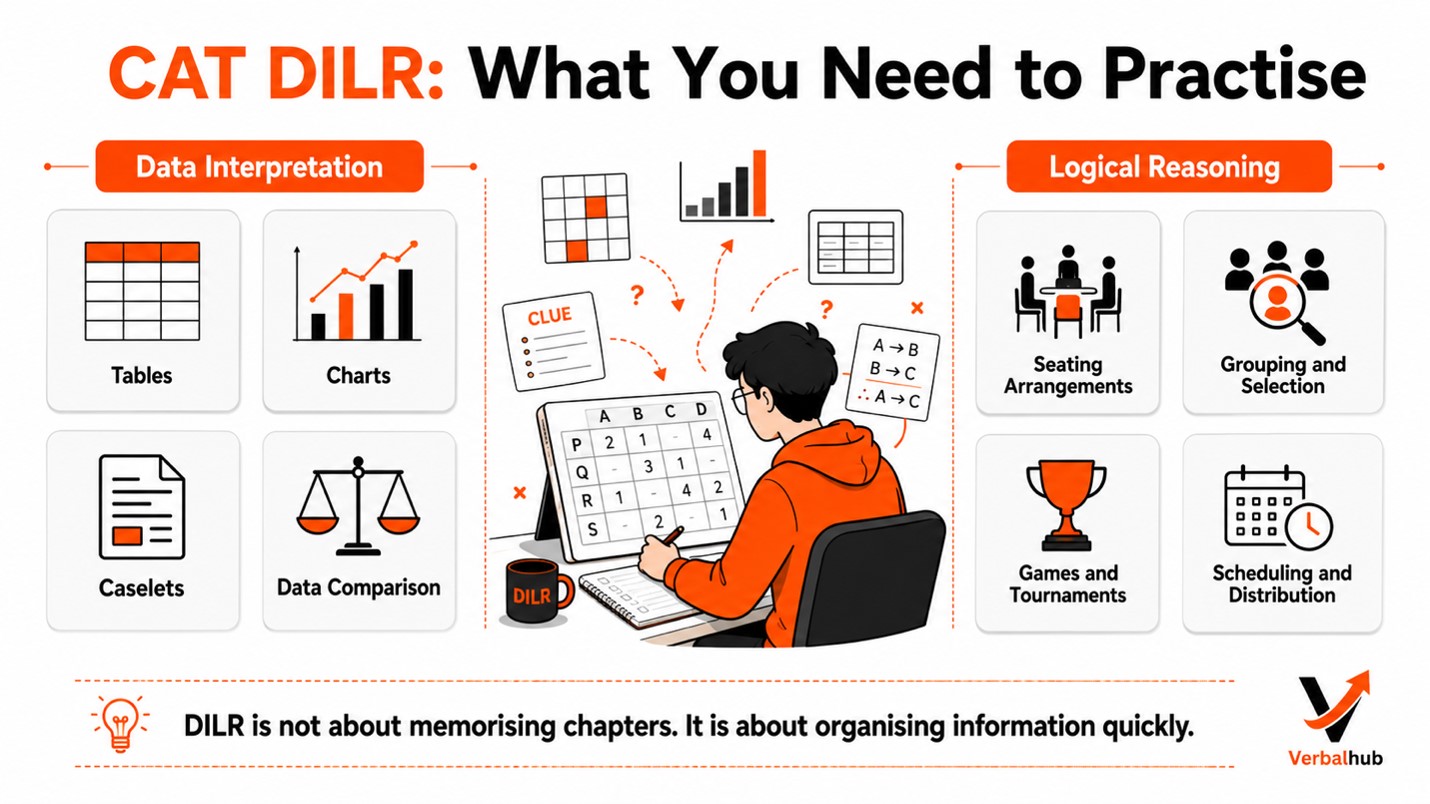
What is included in CAT DILR? The data interpretation & logical reasoning section contains sets, not standalone chapters. Each set gives you data or conditions, followed by four or five questions. DI sets use tables, charts, and caselets; LR sets use arrangements, grouping, games, and puzzles.
This is the most important thing to understand about data interpretation and logical reasoning for CAT: it is not a chapter-based section like Quant. There is no fixed syllabus page you can “finish”. Instead, you build four skills:
- Organising information – turning messy text into a neat table or diagram.
- Identifying clues – finding the one condition that unlocks the set.
- Making structures – grids, tables, and diagrams that hold the data.
- Choosing the right set under time pressure – the exam-day skill that decides your score.
Students who treat DILR like Quant (“I will finish the syllabus”) stay stuck. Students who treat it like a sport (“I will train these four skills daily”) improve week after week.
4.1 Data Interpretation Topics for CAT
DI sets in CAT come in these formats:
- Tables – raw numbers arranged in rows and columns.
- Bar graphs – comparisons across categories or years.
- Line graphs – trends over time.
- Pie charts – share of a total, often paired with a table.
- Mixed charts – two or more formats combined in one set.
- Data caselets – data hidden inside paragraphs of text.
- Calculation-heavy data sets – testing speed with percentages and ratios.
- Data comparison sets – asking which value is highest, lowest, or closest.
Two habits raise DI scores fast. First, learn approximation: converting 4,873 out of 19,624 into “roughly 25%” saves half a minute per question. Second, learn percentage-to-fraction conversions (1/6 ≈ 16.67%, 1/8 = 12.5%, and so on). These small tools compound across the section.
4.2 Logical Reasoning Topics for CAT
What are the main Logical Reasoning topics for CAT? The core logical reasoning topics for CAT are arrangements (linear, circular, floor-based), grouping and selection, distribution, games and tournaments, scheduling, ranking, Venn diagrams, and binary logic. These formats keep returning in different costumes year after year.
Here is the full training list for CAT logical reasoning:
- Seating arrangements – people around tables or in rows with conditions.
- Circular arrangements – facing inside, outside, or mixed.
- Linear arrangements – single or double rows.
- Floor-based arrangements – people or offices across floors of a building.
- Grouping and selection – forming teams under “must include / cannot include” rules.
- Distribution sets – distributing items, tasks, or amounts among people.
- Games and tournaments – matches, points tables, wins and losses.
- Scheduling – timetables of days, slots, and events.
- Ranking and ordering – heights, marks, or positions in a queue.
- Venn diagrams – overlapping groups and set counting.
- Binary logic – truth-tellers, liars, and alternators.
- Routes and networks – paths, connections, and flow between points.
While solving logical reasoning CAT questions, always build the structure first. For CAT seating arrangement questions, draw the row or circle before touching any clue; then place the “fixed” clues (exact positions) first and the “relative” clues (left of, next to) after. Most students do the reverse and get tangled.
One more tip: after finishing a set, spend two minutes asking, “Which clue was the key? What made me slow?” That review is where logical reasoning for the CAT actually improves. Solving without reviewing is like batting practice without ever watching your own replay.
4.3 CAT Caselets Questions
What are CAT caselets and how should students solve them? A caselet is a paragraph (or several) that hides data inside plain sentences instead of showing you a chart. Your first job is always the same: convert the paragraph into a table or diagram before answering anything.
A simple method for caselets questions for CAT:
- Read once fully without solving, just to see what the story is about.
- List the variables – people, products, years, cities, whatever repeats.
- Draw a table with those variables as rows and columns.
- Fill direct values first, then use conditions to fill the gaps.
- Only then read the questions.
Knowing when to approximate is half the skill. If the options are far apart (say 22%, 34%, 47%), rough calculation is enough. If options are close (31.2%, 31.8%, 32.4%), slow down and calculate properly. Checking the options before calculating tells you how much precision you need.
Common mistakes students make in caselets:
- Solving directly from the paragraph without making a table.
- Copying numbers wrongly while making the table (silent killers).
- Ignoring units – lakhs vs crores, litres vs kilolitres.
- Calculating exactly when approximation was clearly enough.
- Refusing to leave a caselet that is eating time.
4.4 Is Critical Reasoning Asked in CAT?
Are CAT critical reasoning questions the same as GMAT Critical Reasoning? No. GMAT-style Critical Reasoning gives a short argument and asks you to strengthen, weaken, or find its assumption. CAT does not run a separate question type like that inside DILR; CAT’s reasoning is puzzle-based and data-based.
That said, the phrase “CAT critical reasoning questions” floats around because reasoning about statements does appear in CAT in its own way. Verbal-flavoured reasoning (like para summaries or inference from a passage) sits inside VARC, and condition-based logical deduction sits inside DILR. So the skill of careful reasoning matters everywhere, but you do not need to buy a GMAT Critical Reasoning book for CAT.
If you are preparing for both exams, keep the practice separate. For CAT, invest that time in puzzle sets, arrangements, and caselets, which is where the actual marks are.
5. Important CAT Quant and DILR Topics: Priority Table
Which are the important topics for CAT Quant and DILR? The most important topics for CAT are Arithmetic, Algebra, caselets, tables, and grouping-selection sets, because these areas have carried consistent weight over the years. Number System, Geometry, and arrangement sets form the reliable second layer.
Students often ask for a single list of CAT imp topics they can pin above their study table. Here it is, with the right stage to start each one:
| Topic | Frequency Trend | Difficulty | Priority | Best Stage to Start |
|---|---|---|---|---|
| Arithmetic | High | Moderate | High | First month |
| Algebra | High | Moderate to hard | High | First month |
| Number System | Medium | Moderate | Medium | Second month |
| Geometry | Medium | Moderate | Medium | After Arithmetic |
| Tables and Charts | Medium | Moderate | High | First month |
| Caselets | High | Moderate to hard | High | First month |
| Seating Arrangement | Medium | Moderate | Medium | Second month |
| Grouping and Selection | High | Hard | High | Regular practice |
A clear warning: CAT trends can change from year to year. A topic that felt heavy in one paper may feel light in the next. Use this table to decide your order of preparation, not to skip topics entirely. Priority means “study this first and deepest”, not “study only this”.
6.Last 10 Years CAT Quant and DILR Trends
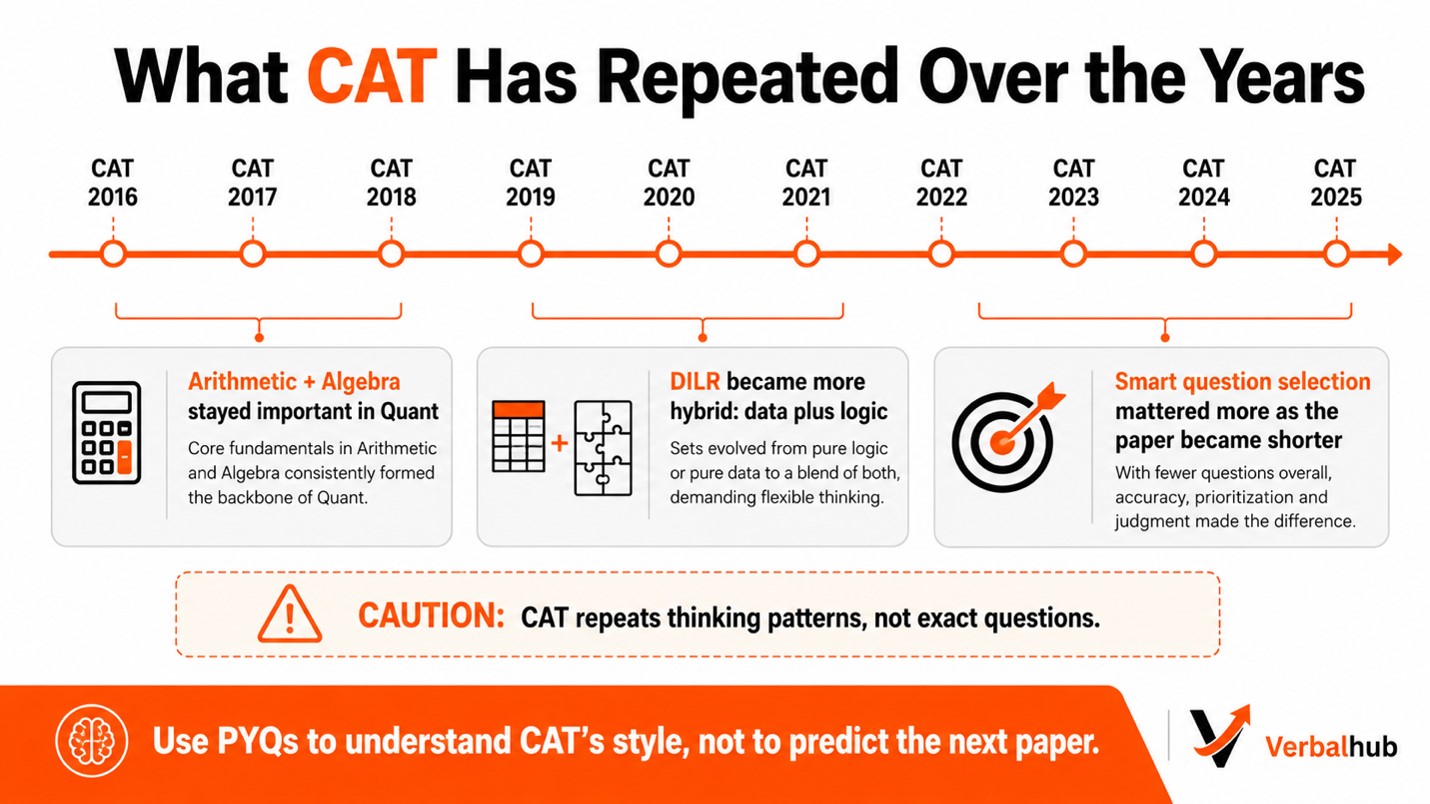
The most useful thing past papers teach is not “which chapter came how many times”. It is the style of thinking CAT expects. Still, the structural history helps you plan, so here is a broad year-wise view. Difficulty labels are approximate and based on widely reported test-taker and coaching analyses, since IIMs do not publish official difficulty ratings.
| Year | Total Questions (approx.) | Broad Quant Focus | Broad DILR Set Types | Overall Difficulty (approx.) |
|---|---|---|---|---|
| CAT 2016 | 100 | Arithmetic, Algebra, Geometry | Puzzle-heavy, reasoning-based sets | Moderate to difficult |
| CAT 2017 | 100 | Arithmetic, Algebra, Geometry | Unconventional logic sets | Difficult DILR reported |
| CAT 2018 | 100 | Arithmetic, Algebra; Quant reported tough in one slot | Mixed DI and LR puzzles | Moderate to difficult |
| CAT 2019 | 100 | Arithmetic and Algebra dominant | Data-plus-logic hybrid sets | Moderate |
| CAT 2020 | 76 (pattern shortened due to pandemic) | Arithmetic, Algebra | Fewer sets, logic-driven | Moderate to difficult |
| CAT 2021 | 66 | Arithmetic, Algebra dominant | Caselets and grouping style sets | Moderate |
| CAT 2022 | 66 | Arithmetic, Algebra, some Geometry | Mixed data-logic sets | Moderate to difficult |
| CAT 2023 | 66 | Arithmetic and Algebra heavy | Reasoning-heavy DI sets | Difficult Quant reported in slots |
| CAT 2024 | 68 (DILR increased to 22 questions) | Arithmetic, Algebra, Geometry mix | Five sets: mix of 4-question and 5-question sets | Easier than 2023, moderate overall |
| CAT 2025 | 68 | Arithmetic dominant, then Algebra, Numbers, Geometry | Five sets mixing DI caselets and logic puzzles | Moderate to difficult (varied by slot) |
Three honest takeaways from this decade:
- The paper became shorter but sharper. With around 22 Quant questions and about 20–22 DILR questions in recent years, every question carries more weight. Selection matters more than ever.
- Arithmetic and Algebra never went out of fashion. Whatever else changed, these two stayed central to Quant.
- DILR moved towards hybrid sets. Pure “calculate from this table” sets became rarer; sets that mix data with logic became the norm.
Remember: Past CAT papers help students understand the style of thinking CAT expects. They do not guarantee what CAT 2026 will look like.
7. Commonly Asked CAT Question Types in the Last 10 Years
What kinds of Quant and DILR questions are commonly asked in CAT? Quant leans on word problems from Arithmetic and Algebra with supporting questions from Number System, Geometry, and Modern Math. DILR leans on caselets, tables, grouping-distribution sets, arrangements, tournaments, and scheduling puzzles.
Quant question types that keep appearing:
- Arithmetic – word problems on percentages, ratios, profit-loss, time-speed-distance, work, and mixtures. Often two ideas combined in one question (for example, ratio inside a time-and-work problem).
- Algebra – forming equations from word problems, quadratic roots, inequalities, functions, and progressions.
- Number System – factors, remainders, and digit-based questions.
- Geometry – triangles and circles, with mensuration mixed in.
- Basic trigonometry – occasional, usually simple, often riding inside a geometry question.
DILR question types that keep appearing:
- Caselets – paragraphs hiding data.
- Tables – often with missing values you must derive.
- Distribution sets – dividing items or tasks under conditions.
- Grouping and selection – team-formation logic.
- Seating arrangement – linear, circular, and floor-based.
- Tournament sets – matches, points, wins and losses.
- Scheduling – slotting events across days or time slots.
- Venn diagrams – overlapping-group counting.
Now the point students most often get wrong: CAT does not usually repeat exact questions. What it may repeat are concepts, question formats, data structures, and traps. The same alligation logic returns wearing a new story. The same tournament structure returns with new team names. That is exactly why PYQs are gold — not because the question will reappear, but because the thinking pattern will.
8. CAT Score vs Percentile: How It Works
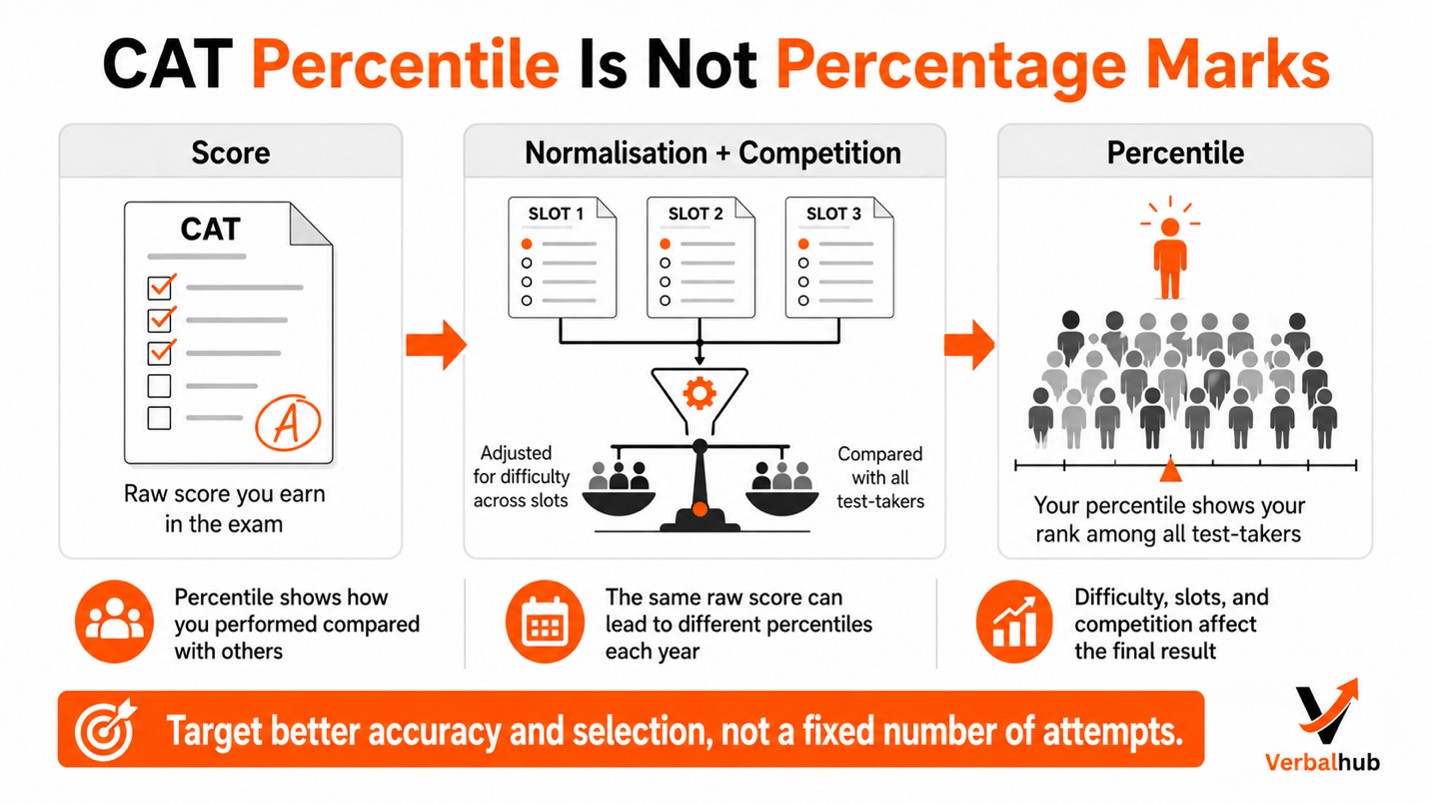
What is the difference between CAT score and percentile? Your score is the marks you earn from the paper. Your percentile tells you what portion of test-takers scored below you. A 95 percentile means you performed better than roughly 95 out of every 100 candidates — it does not mean you scored 95% marks.
Four things every aspirant should understand clearly:
- Percentile is not percentage marks. A 99 percentile has historically come at raw scores far below full marks, because the paper is designed to be tough.
- Percentile depends on relative performance. If the paper is hard for everyone, cut-offs fall. If it is easy, cut-offs rise. You are compared with people, not with the paper.
- Scores are scaled and normalised across slots. CAT runs in multiple slots, and a statistical process adjusts for slot difficulty. Your final scaled score may differ from your raw calculation.
- The same raw score does not give the same percentile every year. Difficulty, question count, and the strength of the test-taking pool all move the line.
8.1 Last 10-Year CAT Score vs Percentile Trend
Here is something an honest teacher must tell you: IIMs do not officially publish score-versus-percentile tables. Every figure you see online is an estimate reconstructed by coaching institutes and test-takers from scorecards. On top of that, the exam pattern itself changed (100 questions till 2019, then 76, then 66, then 68), so a mark-for-mark comparison across ten years genuinely misleads more than it helps.
So instead of printing a precise ten-year grid of numbers nobody can verify, here is the responsible version — broad, approximate ranges reported for the recent 68-question pattern (out of 204 marks), as estimated by test-prep analyses:
| Percentile Level | Approx. Scaled Score Range (recent 68-question papers) |
|---|---|
| ~90 percentile | Roughly mid-40s to mid-50s |
| ~95 percentile | Roughly high-50s to high-60s |
| ~97 percentile | Roughly high-60s to high-70s |
| ~99 percentile | Roughly mid-80s to high-90s |
| ~99.5 percentile | Roughly high-90s to around 110 |
Disclaimer: These are historical, approximate score ranges, not fixed CAT targets. Difficulty level, scaling, question count, and competition can change the final percentile. Treat them only as a rough compass while setting mock-test goals, and always check the latest verified analysis for the most recent paper.
The practical lesson is simpler than the numbers: at recent difficulty levels, answering roughly half the paper with high accuracy has been enough for a very strong percentile. That should completely change how you attempt mocks — you are hunting for the right questions, not all questions.
9. How Many Questions Are Needed for CAT Percentile?
How many questions should I attempt for a good CAT percentile? There is no guaranteed fixed number, because cut-offs shift every year with difficulty and competition. What stays true every year is this: accuracy multiplied by smart selection beats raw attempts. Below is strategy guidance by target band, not a promise.
85–90 percentile band: Focus on complete comfort with easy and medium questions. In Quant, that means owning Arithmetic and basic Algebra fully. In DILR, it means confidently cracking the two friendliest sets. You do not need difficult questions at all at this level — you need zero silly mistakes on the questions you do attempt.
90–95 percentile band: Add depth: full Algebra, Number System, and one comfortable Geometry zone in Quant; three DILR sets attempted with strong accuracy. Time control starts mattering here — practise leaving questions within 30 seconds when they do not open up.
95–97 percentile band: Now selection is everything. You should be scanning the full Quant section, picking your battles, and attempting most doable questions with 85%+ accuracy. In DILR, three solid sets plus partial marks from a fourth is a common winning shape.
97–99 percentile band: Very few weak zones allowed. Your mocks should show consistent sectional strength, and your mistake log should be shrinking month by month. Speed comes from recognising question types instantly, not from calculating faster.
99+ percentile band: This band is built on months of mock analysis, not talent. Toppers routinely skip questions early and never let ego trap them in a fight with one stubborn problem. Their edge is decision quality under pressure.
Section-specific guidance:
- Quant: Do a first pass attempting only questions you can see the method for within 20–30 seconds. Bank those marks. Return for the harder ones with leftover time. Never let one question eat five minutes in the first pass.
- DILR: Your attempt count is decided by set selection, not speed. Two sets solved fully and accurately usually beats four sets solved half-heartedly. Spend the first minutes scanning, then commit.
And in both sections, the same rule: your mock-test analysis, not this article, will tell you your right attempt number. Find it there.
10. CAT DILR Set Selection Strategy
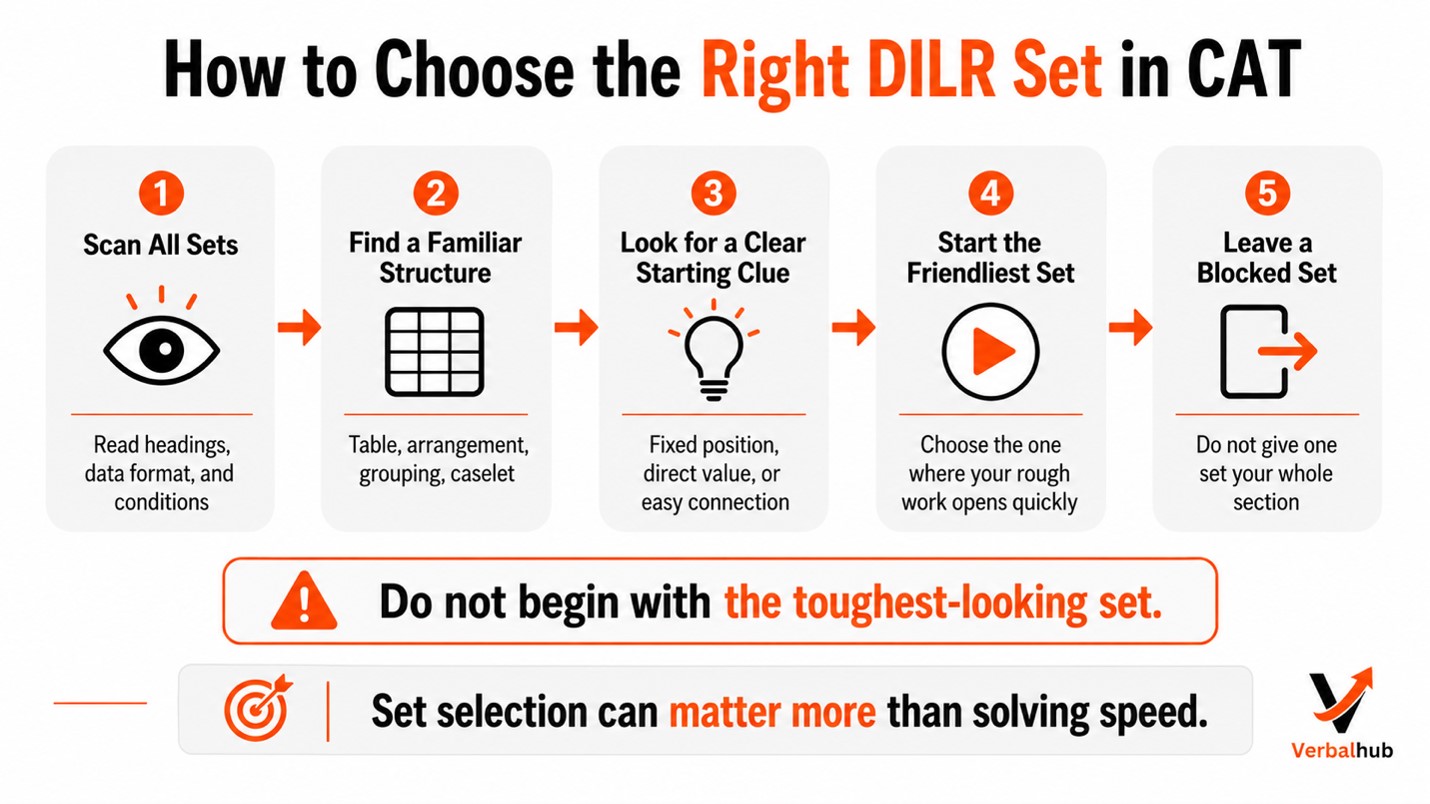
How should students choose the right DILR set in CAT? Spend the opening minutes scanning all sets before solving anything, then start with the set whose structure you recognise and whose clues give a clear entry point. The order in which you attempt sets often affects your score more than your solving speed does.
Use this 5-Minute Scan Method at the start of the section:
- Read all sets briefly — headline, data format, and number of conditions. No solving yet.
- Look for familiar formats — a table type or arrangement style you have practised feels different within seconds.
- Check whether clues give a clear starting point — a set with one or two “fixed” clues (exact values or positions) opens fast.
- Avoid cluttered sets with too many interlinked conditions and vague language, at least in your first pass.
- Start with the set where progress begins quickly — if your table starts filling in the first two minutes, you chose well.
- Leave a set if it remains blocked for too long — a blocked set is costing you marks from an easier set waiting behind it. Escaping is one of the options, so move away.
Checklist: Choose a DILR Set When…
- You recognise the format from your practice.
- At least one clue gives a definite, fixed piece of information.
- The data fits into a table or diagram you can picture immediately.
- The number of variables (people, items, days) is small or manageable.
- The questions below the set look direct, not layered.
- Your rough work starts producing filled cells within two minutes.
Practise this scanning ritual in every sectional and mock until it becomes automatic. On exam day, nerves eat judgement; only rehearsed habits survive.
11. Topic-Wise CAT PYQ Strategy
How should students use CAT previous-year questions topic wise? Solve CAT pyq topic wise in your first phase — all percentage PYQs together, all arrangement PYQs together — so you see the pattern behind each topic. Move to mixed practice and full papers only after this topic-wise base is built.
Why topic-wise first? Because CAT Previous Year Questions topic-wise show you something random practice never will: the five or six angles from which CAT attacks each concept. After solving fifteen percentage PYQs in a row, you start predicting the trap before you finish reading the question. That pattern-recognition is the whole point.
Many students hunt for a topic wise previous year CAT questions pdf, print it, and keep it in their bag for spare-minute practice — a genuinely good habit for office-goers and college students. Pair it with a compact formula sheet or a CAT quantitative aptitude pdf of notes, and your travel time becomes revision time.
Here is the exact PYQ workflow to follow:
- Start with one topic at a time. Finish concepts first, then open that topic’s PYQs.
- Solve untimed first. Accuracy and method come before speed. Speed grows on top of correct method, never the other way.
- Track time taken from your second round onward. Note it beside each question.
- Tag every mistake as one of four types: concept (didn’t know it), calculation (knew it, botched it), reading (missed a condition), or time management (panicked or overstayed).
- Reattempt wrong questions after one week. If you get it wrong again, the concept needs re-study, not more practice.
- Move to mixed-topic practice later, where questions arrive unlabelled — the way CAT serves them.
- Start sectionals and mocks after basic coverage of high-priority topics. Do not wait for the “full syllabus” to finish; that day never really comes.
Keep your CAT topic wise questions log in a simple notebook or spreadsheet: date, topic, questions attempted, accuracy, mistake tags. Ten minutes of logging per session quietly builds the most personalised study plan you will ever own.
📥 Download the CAT Topic-Wise PYQ Tracker PDF — a ready-made log sheet for exactly this workflow.
12. CAT Quant and DILR Mistake Patterns
Most students lose more marks to repeated mistake patterns than to hard questions. Read these lists slowly, and tick the ones you recognise in yourself.
Common Quant mistakes:
- Wrong percentage base — increasing by 20% then decreasing by 20% and expecting the original number back; calculating profit on selling price instead of cost price.
- Missing Algebra conditions — skipping “positive integers”, “distinct”, or “real values” and solving a different question.
- Calculation errors — sign slips, table errors of 7×8, copying numbers wrongly onto rough paper.
- Long methods where a shorter method existed — solving by full algebra when option-checking would take 30 seconds.
- Ignoring approximation — computing exact values when options are far apart.
- Spending too long on one question — the ego trap. One stubborn question can silently swallow three easy ones.
Common DILR mistakes:
- Starting with the toughest set because it appeared first on screen.
- Untidy data organisation — cramped rough work that you yourself misread two minutes later.
- Trying to solve every set — a plan that guarantees no set gets finished properly.
- Not leaving blocked sets — pouring twelve minutes into a set out of stubbornness.
- Ignoring easier questions within a set — sometimes two of five questions are solvable even when the full set is not.
- Skipping mock analysis — taking mock after mock without studying the wreckage, which means repeating the same crash weekly.
Fixing even three items from these lists typically moves a score more than a month of new-topic study. Mistake repair is the cheapest marks you will ever buy.
13. CAT Quant and DILR Myths
| Myth | Reality |
|---|---|
| "You need to attempt every question for 99 percentile." | In recent years, top percentiles have come from attempting well-chosen questions with high accuracy — often close to half the paper — not from attempting everything. |
| "DILR is only for naturally logical students." | DILR is a trainable skill. Structured practice of set types, plus honest review, improves almost every student within weeks. “Natural talent” is mostly early practice in disguise. |
| "You must finish the whole syllabus before taking mocks." | Start sectionals and mocks once your high-priority topics are basically covered. Mocks are a learning tool, not a final judgement, and they reveal exactly what to study next. |
| "CAT repeats exact questions every year." | CAT may repeat concepts, question styles, data formats, and traps — not exact questions. Solve PYQs for patterns, not in the hope of a photocopy. |
| "Only engineers can score well in Quant." | CAT Quant is Class 8–10 maths under time pressure. Non-engineers clear top percentiles every single year. The gap is starting comfort, and Arithmetic-first preparation closes it within a couple of months. |
14. CAT Quant and DILR Preparation Plans
A plan you actually follow beats a perfect plan you abandon. Both plans below assume roughly 2–3 hours on weekdays and more on weekends. Working professionals: keep the structure, shrink the daily load, and protect your weekends fiercely.
14.1 30-Day CAT Quant and DILR Plan
This plan suits students strengthening their base or revising in a focused sprint.
Week 1 — Foundations:
- Percentages: concepts + practice + PYQs.
- Ratio and proportion.
- DI basics: reading tables and simple charts.
- Daily habit: two easy DILR sets, untimed, with full review.
Week 2 — Building on the base:
- Profit, loss, and discount.
- Time and work (with pipes-cisterns).
- Basic Algebra: linear equations, intro to quadratics.
- Caselets: paragraph-to-table conversion practice.
- Milestone: one timed DILR sectional this week; analyse it the same day.
Week 3 — Widening the net:
- Number System: factors, LCM-HCF, divisibility, remainders.
- Equations and inequalities in depth.
- Seating arrangements: linear and circular.
- Grouping and selection sets.
- Topic-wise PYQs for everything covered in Weeks 1–2.
Week 4 — Mixing and testing:
- Mixed Quant practice (topics unlabelled).
- Mixed DILR sets daily, timed.
- Two sectional tests (one Quant, one DILR) with full analysis.
- Error-log revision: reattempt every question you tagged wrong this month.
14.2 90-Day CAT Quant and DILR Plan
This plan suits aspirants with a fuller runway — and it maps cleanly onto office schedules.
Month 1 — Build concepts:
- Quant: complete Arithmetic and core Algebra with topic-wise PYQs.
- DILR: daily easy sets across formats — tables, caselets, simple arrangements.
- Goal: method clarity, not speed. Untimed practice is fine this month.
Month 2 — Build speed and depth:
- Quant: Number System, Geometry, Modern Math basics; timed topic drills for Month-1 areas.
- DILR: medium-difficulty sets, one timed sectional weekly, set-selection practice.
- Goal: shrinking time-per-question while holding accuracy above 80% in practice.
Month 3 — Integrate and sharpen:
- Mixed Quant practice and full-length mocks (building to one or two per week).
- Weak-topic repair guided strictly by your mock analysis, not by mood.
- DILR set-selection improvement: rehearse the 5-minute scan in every mock.
- Final fortnight: revision of formula sheets, error logs, and PYQ mistake reattempts.
CAT Study Plan for Working Professionals
15. Which Is the Best CAT Coaching for CAT 2026?

How to land in the best CAT coaching? There is no single best CAT coaching for every student, because students need different things. Judge any institute on batch size, faculty access, mock quality, doubt support, and fit with your schedule — not on advertisements or hall-of-fame posters.
Think about what you actually need. Some students need regular live CAT preparation classes to stay disciplined. Some need patient support with Quant basics. Some need VARC guidance. Others are self-studying fine but need a strong CAT mock test series with detailed review. A working professional needs evening or weekend flexibility, so CAT coaching for working professionals must offer late batches and recordings — this is what makes CAT coaching online a practical route; a student searching “CAT coaching near me” may prefer a physical classroom for the routine it enforces. Both can work — the delivery format matters less than the teaching quality and follow-up.
Also be careful with the phrase “best CAT coaching in India” — it is a marketing phrase, not a measurable fact. What is measurable: how quickly doubts get answered, how seriously mocks are reviewed, and whether the study plan adapts to your weak areas.
15.1 Why Verbalhub Can Be a Strong Choice for CAT Preparation
For students looking for structured CAT preparation, Verbalhub can be a strong option. Here is what its programme offers, stated plainly:
- Live CAT preparation classes rather than only recorded lectures.
- Support across all three sections — CAT Quant coaching, CAT DILR coaching, and VARC guidance under one roof.
- Small-batch learning where students can actually ask doubts mid-class instead of typing into a void.
- Personal guidance for students who need a clear, written plan instead of vague advice.
- Topic-wise practice and CAT PYQ-based preparation, matching the workflow described earlier in this article.
- Mock tests with detailed review of mistakes — not just a score, but a sit-down on why each mark was lost.
- Study schedules that can support working professionals, built around office hours.
- Focus on concept clarity, question selection, accuracy, and revision — the four levers that actually move percentiles.
- Support for beginners and repeat CAT aspirants, with different starting points for each.
Its approach may suit learners who need regular guidance, topic-wise practice, and detailed review after mocks. At the same time, the right choice — whether CAT online coaching or a classroom programme — should still depend on your schedule, learning style, faculty interaction, mock quality, and budget. A demo class tells you more than any webpage can.
Before joining any CAT coaching, check:
- ☐ Batch size — can the teacher actually know your name and your weak areas?
- ☐ Faculty interaction — live doubt-solving or only recorded videos?
- ☐ Number and quality of mocks — and whether reviews are detailed.
- ☐ Doubt-solving support — response time and channels.
- ☐ Study plan for weak areas — personalised or one-size-fits-all?
- ☐ Flexibility for students and working professionals — timings, recordings, backup classes.
- ☐ Fees and course validity — total cost, refund terms, and validity through CAT 2026.
Students can explore Verbalhub’s CAT preparation options, attend a demo class, or begin with a diagnostic test to understand their current level. CAT Online Coaching
16. Separate Strategy for Different Students
If you are weak in maths: Start with Arithmetic only, and go slow on purpose. Spend your first month rebuilding percentages, ratios, and averages until they feel like common sense. Do easy DILR sets daily so logic confidence grows alongside. Avoid Geometry and Modern Math early — they can wait. Your enemy is not the syllabus; it is the fear you carry from school. Fear dissolves with small daily wins, so design your plan to produce them.
If you are an engineer or strong in Quant: Your risk is overconfidence. Strong students often under-practise Arithmetic word problems (“too easy”) and lose exactly there under time pressure. Take a diagnostic early, push into difficult DILR sets and timed drills, and channel your surplus energy into VARC — which is where many strong-Quant students actually lose their calls. Also learn to skip: strong students hate abandoning a question, and CAT punishes that pride.
If you are a working professional: Your currency is consistency, not hours. A dependable 90 minutes on weekdays plus focused weekend blocks beats heroic 6-hour Sundays followed by dead weeks. Use commute time for PYQ PDFs and formula revision. Schedule mocks on weekend mornings, when your brain matches exam-slot freshness. And tell your family your CAT date — preparation goes smoother when the people around you are on your team. CAT preparation for working professionals is entirely doable; every year, office-goers make it to the IIMs on exactly this rhythm.
If you are a CAT repeater: Do not restart the syllabus from page one — that repeats last year, and last year’s method gave last year’s result. Start instead with a brutal audit: pull out your previous scorecard and mock history, and write down exactly where marks leaked (a section? accuracy? set selection? panic in the last 10 minutes?). Build this attempt’s plan around fixing those two or three leaks. Repeaters usually need behaviour change more than content change — better selection, calmer pacing, disciplined skipping. Protect your motivation too: study with a group or mentor, because the second attempt tests the mind more than the maths.
17. Mock Test Analysis Checklist
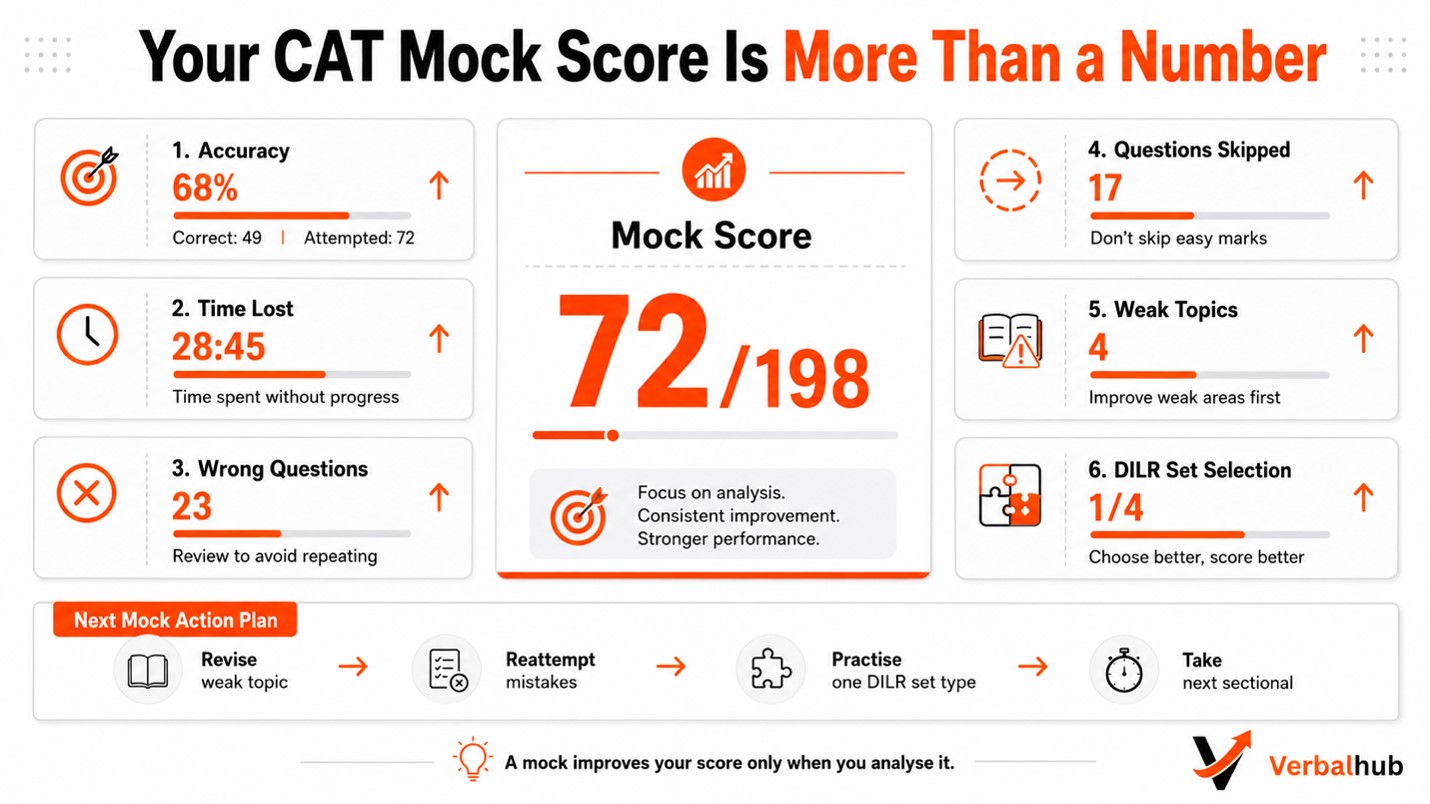
A mock without analysis is just two hours of stress. Print this checklist and fill it after every single mock:
CAT Mock Analysis Checklist (print me)
- ☐ Which questions went wrong because of concept gaps? (List the topics → they go into next week’s study plan.)
- ☐ Which mistakes were careless? (Calculation, misread, wrong button — write the exact slip.)
- ☐ Which questions took too long, even the correct ones? (Anything beyond 3–4 minutes needs a shorter method or a skip decision.)
- ☐ Which DILR sets should I have selected instead? (Re-solve the skipped sets untimed and grade your exam-day judgement.)
- ☐ Which questions should I have skipped? (Identify the trap questions that ate time.)
- ☐ Which areas need revision before the next mock?
- ☐ Did I guess, or solve with a clear method? (Mark every lucky correct answer — luck is not a strategy.)
- ☐ What one change will I make in the next mock? (Only one. Change compounds when it is specific.)
Spend at least as much time analysing a mock as you spent taking it. Students who follow this single rule improve every fortnight; students who skip it stay on a plateau and blame the exam.
18. Free Resources and Next Steps
Before spending money anywhere, use free material to build momentum:
- CAT Quant formula sheet — one-page revision of Arithmetic, Algebra, Geometry formulas.
- CAT Topic-Wise PYQ Tracker — the log sheet for the workflow in Section 11.
- DILR set-selection checklist — a pocket version of the 5-Minute Scan Method.
- CAT Quant diagnostic test — find your true starting level before planning.
- DILR mini mock — a short sectional to practise set selection weekly.
- 30-day CAT Quant study plan — the Week 1–4 plan from this article in printable form.
- CAT demo class or counselling session — worth attending even just to get your plan questioned by a teacher.
Your next step is simple: pick your plan (30-day or 90-day), take a diagnostic this week, and start Week 1. Momentum first; perfection later.
FAQs
Arithmetic and Algebra are the most important Quant areas for CAT 2026, since they have consistently carried the largest share of questions. Within them, prioritise percentages, ratios, time-work, time-speed-distance, equations, inequalities, and progressions. Number System, Geometry, and Modern Math form the second layer. Cover priorities deeply first, then widen — do not study all chapters with equal intensity.
Percentages, ratio and proportion, averages, profit and loss, time-speed-distance, time and work, and mixtures are the core Arithmetic topics. Percentages deserve first place because nearly every other Arithmetic chapter — and much of Data Interpretation — is built on percentage thinking. Master these seven areas with PYQ practice and you have covered Arithmetic’s heart.
Yes, but as a medium-priority topic, not a top one. It usually contributes a few questions, mainly on factors, divisibility, LCM-HCF, remainders, and units digits. Prepare it in your second month, after Arithmetic and core Algebra are steady. Its concepts also quietly speed up your calculations in other topics, so do not skip it entirely.
Two to three sets daily with full review beats ten sets solved carelessly. Beginners should start with two easy sets untimed, focusing on making clean tables and diagrams. After a month, move to timed practice and add variety — arrangements one day, caselets the next. Consistency across months matters far more than volume in any single week.
Aim to work through several years of past papers, organised topic wise first and then as full papers. Quality of review matters more than raw count: every wrong answer should be tagged (concept, calculation, reading, or time) and reattempted after a week. A student who deeply reviews five years of PYQs beats one who races through ten years without analysis.
Yes — students from non-maths backgrounds reach top percentiles every year, but it demands months of patient, structured work. Rebuild Arithmetic from basics first, since it is school-level maths, then layer Algebra and the rest. Combine that with daily DILR sets and honest mock analysis. Weak maths is a starting point, not a ceiling; the syllabus itself is Class 8–10 level.
There is no fixed magic number, because cut-offs move with difficulty each year. In recent papers, attempting roughly half to two-thirds of the Quant section with high accuracy has been a strong performance. Attempt every question you can solve confidently, skip fast when a method does not appear within 30 seconds, and let mock analysis reveal your personal best attempt range.
Scan all sets in the opening minutes before solving anything. Pick the set whose format you recognise, whose clues include at least one fixed piece of information, and whose data fits a table you can picture immediately. Start there, and abandon any set that stays blocked too long. Set selection decides DILR scores more than solving speed does.
No, CAT does not usually repeat exact questions. What it may repeat are concepts, question styles, data formats, and familiar traps dressed in new stories. That is precisely why PYQs remain the best practice material — they train you to recognise the underlying pattern instantly, which is the skill the actual exam rewards.
The right coaching is the one that fits your specific gaps, schedule, and learning style — no single institute is best for everyone. Check batch size, live doubt-solving, mock quality and review depth, and flexibility for your routine before paying. For students who want live classes, small batches, topic-wise PYQ practice, and detailed mock reviews, Verbalhub can be a strong option; attend a demo class and judge for yourself.
20. Conclusion
CAT Quant and DILR are not talent tests. They are training tests. Every skill this exam rewards — clean Arithmetic, careful reading of Algebra conditions, tidy tables in DILR, calm set selection, the discipline to skip — is built through a steady plan, topic-wise practice, honest PYQ work, and serious mock analysis.
So do not chase shortcuts or worry about students who seem “naturally good”. Pick your plan, start with Arithmetic and easy DILR sets this very week, log your mistakes, and let the improvement compound quietly. Nobody can promise you a percentile — anyone who does is selling something. What can be promised is this: the student who prepares with structure and reviews with honesty walks into the exam hall with real, earned confidence. Come November 2026, let that student be you. CAT Mock Test Series



Our Teachers

Dr. G Ravindra Babu
Quant Faculty
Ph. D in Mathematics Asian International University|| Mathematics Professor at Gitam University || Ex-Mathematics Professor SRM University Amaravathi || MBA in finance Acharya Bangalore B School || GMAT Quant 51, CAT Quant 99.58 %tile, GRE Quant 170 || 21 Different Teaching Certification || Believe in “Education is the mother of leadership”
view details

Dr. Rengarajan Parthasarathy
CAT Faculty
Ph. D in Mathematics from YCM University|| Mathematics Professor at Symbiosis International|| Author of Business Ethics || Ex-CAT Exam Syllabus Advisor in IIM || MBA & MPM from Symbiosis International (Deemed University) || College Topper in Mathematics in Ferguson College || Six Scholarships in Mathematics || 15 Years CAT Coaching, GMAT Coaching and GRE Coaching Experience|| UGC NET Qualified || GMAT Q51, V38 & CAT Q 99.31 & DILR 99.38 %tile, GRE Quant 170 || Believe in “Higher Education Shapes The World.”
view details

Dr. Nisha Tejpal
Verbal & AWA Faculty
Ph. D in English || Published a paper in English in ‘Research Journal of Philosophy and Social Sciences’ || MCA and B.Ed CCS University || A subject expert in Verbal Teaching || 10,000 Plus Essays Analysis || CTET and NET Qualified || More than 15 years of Experience || A writer, Author and Poet || Believe in “Think Beyond the Universe”
view details

Dhrithi Khattar
Verbal Faculty
A subject expert in Verbal Aptitude || More than 15 years of Experience || MBA in HR& Marketing & MA in Economics || Active Member of Hindu Alumni Association || Functional Member of Delhi ||Management Association (DMA) || Operational Member of All India Management Association (AIMA) ||The President of Key Club ||An active member of the French Club ||Gold Seal from California Scholarship Federation.
view details
M. U. Mir
DILR & Quant Faculty
A subject expert in Quantitative Aptitude Training || GMAT Q 51 & CAT DILR 99.75 %tile || GATE 2020 Qualified || M. Tech & B. Tech University Toper (1st Rank) || Awarded by Gov of Odisha, Bihar and J& K for the project Magnetic Floating Model || Ex-Quant Subject Expert in Arihant Publication || An Educationist and Social Worker || Believe in “Education is power”
view details

C. S. Rajawat
CAT Faculty
M. A in Mathematics CCS University|| M. Tech from SRM University || Visiting Mathematics Faculty CCS University ||Experience of 11 Years of CAT Coaching || District Topper in 10th & 12th || Best Teacher Awardee in 2021 & 2022 || CAT Quant 99.43 %tile || Discovered a new Theorem based on HCF in Math || Founder of C. S. Classes ||Believe in “Teaching and Training is an Art.”
view details

Dr. S.K. Singh
PTE/IELTS/CELPIP Expert
Ph. D. English Dr. B. R. Ambedkar University || Delhi & Center Government School Mentor || Founder of Entrepreneur & Learning Startup || IELTS & CELTA Certified from British Council || PTE Certified from Pearson...
view detailsRishabh Arora
PTE/IELTS/CELPIP Expert
MBA in HR International Institute of Management Sciences || PTE Certified from Pearson Test of English|| IELTS & CELTA Certified from British Council || BCA from Integral University || PTE 87 in 2017, IELTS 8.5 in 2018
view details
Jyoti Joshi
IELTS Trainer
Master in English (MA) and Bachelor in Education (B.Ed) || Certified Trainer || IELTS Speaking 9.0 Band holder || Believe in “Great teacher can inspire hope, ignite the imagination, and instill a love of learning”
view details
Surbhi Arora
IELTS / PTE Expert
English Language Expert || More than 3 years of Experience || M.A plus B. Ed Delhi University ||Author, Writer & Classical Singer|| Believe in “Language Language Learning & Teaching is Fun”
view details

Dilip Kumar Rathore
Quant Trainer
A business developer and genius in mathematics || Highly experienced || Master in Maths || well-verse in IT || Believe in “The art of teaching is the art of assisting discover”
view details

Imaam Hasan
Communication Expert
Master in English || Journalist and writer || Certified IELTS & PTE Trainer || A social educater and influencer || Believe in “Education is the movement from darkness to light”
view details