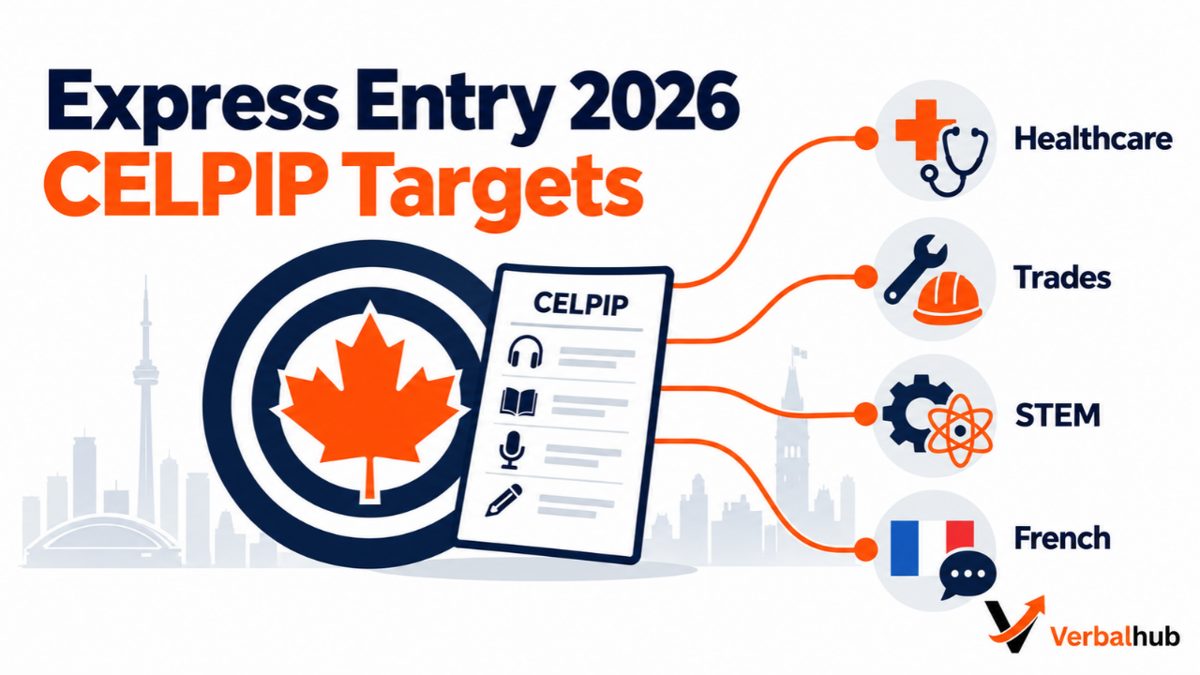
For most English-first Express Entry candidates, CELPIP 9 in all four skills is a sensible target. However, your best route depends on your occupation, current CRS score and French ability. Category-based Express Entry 2026 can change who you compete against, but it does not remove the need to qualify for an immigration program.
If you are asking, "which CELPIP score do I need for Express Entry in 2026", separate three things: the minimum required to enter the pool, the score that improves your CRS, and the requirements of your intended category.
This guide explains how to choose CELPIP targets for Express Entry without spending months chasing a score that adds little to your particular profile.
What Category-Based Draws Are (and Why They Change Your CELPIP Target)
General all-program vs category-based: French-speaking, Trades, STEM, Healthcare, Transport and Agri-food
In a general round, IRCC invites the highest-ranking eligible candidates across the Express Entry programs. A program-specific round considers candidates eligible for a particular program, such as the Canadian Experience Class. Category-based rounds consider candidates meeting a selected language or occupation requirement.
The category list has changed. IRCC currently lists French-language proficiency, healthcare and social services, STEM, trades, education and transport. It also lists categories for physicians, senior managers and researchers with Canadian work experience, and skilled military recruits. Agriculture and agri-food is no longer on the current list.
French-speaking rounds have often had lower CRS cut-offs than general rounds. For historical context, IRCC's 2024 report recorded French-category cut-offs of 336–478, compared with 524–549 for general rounds. Those figures explain the interest in French; they are not predictions for 2026.
When comparing French-speaking draws vs general Express Entry draws, remember that a lower cut-off applies only to people eligible for that round.
How IRCC filters profiles by category and CRS cut-offs
You must first qualify under the Federal Skilled Worker Program, Canadian Experience Class or Federal Skilled Trades Program. Category eligibility is an additional requirement.
IRCC identifies eligible category members, ranks them by CRS and invites the highest-ranking candidates. French-category eligibility requires NCLC 7 in every French ability. For the listed healthcare, STEM, trades, education and transport categories, the current experience requirement is at least 12 months within the previous three years, in one listed occupation. Equivalent part-time experience counts, and the experience need not be continuous.
A job title alone is insufficient. Before planning around a category, compare your actual duties with the relevant NOC description and check the round's instructions.
CELPIP/CLB Floors by Program and Category
FSW/CEC/FST minimums: CLB 7, CLB 5 and CLB 4–5
The English-language minimums are:
- FSW: CLB 7 in listening, reading, writing and speaking.
- CEC, TEER 0 or 1: CLB 7 in every ability.
- CEC, TEER 2 or 3: CLB 5 in every ability.
- FST: CLB 5 in speaking and listening; CLB 4 in reading and writing.
For CELPIP-General, the individual score corresponds directly to the CLB level: a 7 means CLB 7, and a 9 means CLB 9. Each ability counts separately.
The FSW CLB 7 requirement is an entry condition, not an invitation promise. FSW applicants must also satisfy its other requirements, including the separate 67-point selection threshold. That assessment is different from CRS.
For a fuller introduction, read CELPIP for Express Entry 2026: Complete CLB and CRS Guide.
French-speaking category: NCLC 7 in all four French abilities
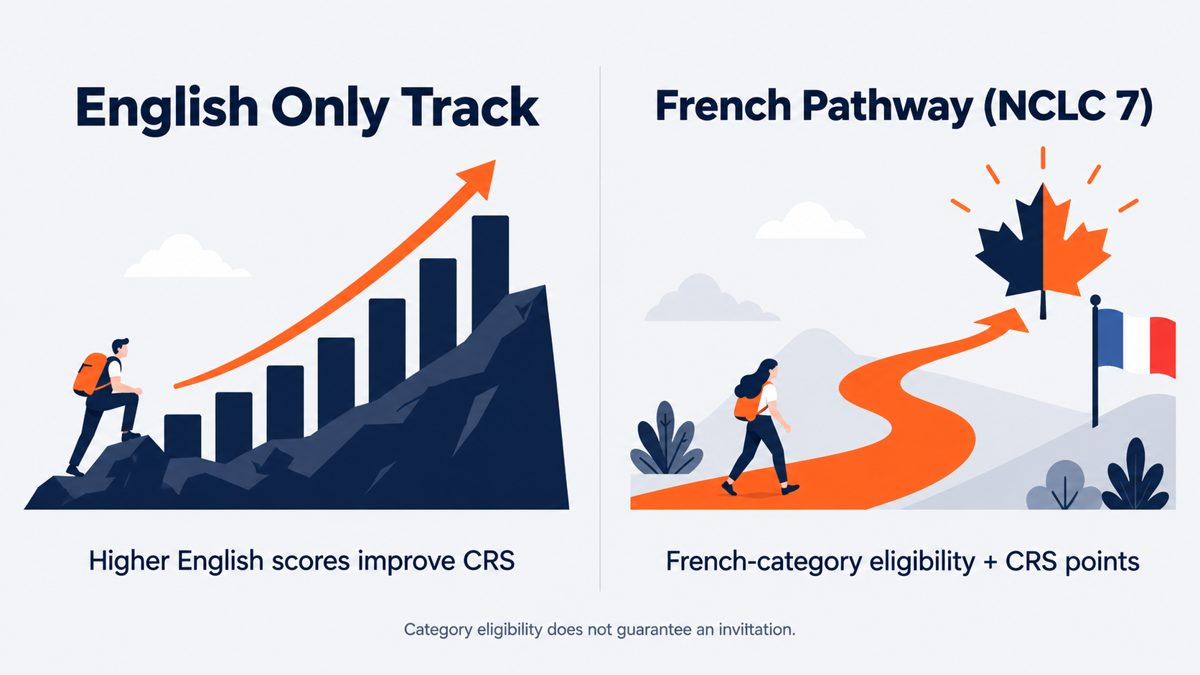
For French-speaking Express Entry draws 2026, aim for at least NCLC 7 in reading, writing, listening and speaking. CLB measures English; NCLC measures French.
IRCC accepts TEF Canada and TCF Canada. On TCF Canada, NCLC 7 corresponds to:
- Listening: 458–502.
- Reading: 453–498.
- Speaking: 10–11.
- Writing: 10–11.
TEF Canada uses a different conversion. Follow IRCC's current instructions for the score-report column to enter; do not assume its numbers match TCF Canada.
Conversational French is a useful start, but formal testing requires more. You must understand recordings, read accurately, organise written responses and speak under time pressure. Being comfortable with introductions or travel conversations does not establish NCLC 7.
CRS Math That Matters in 2026
First-language points: CLB 7 vs 8 vs 9 vs 10+
For an applicant assessed without an accompanying spouse or partner, first-language points per ability are:
- CLB 7: 17 points.
- CLB 8: 23 points.
- CLB 9: 31 points.
- CLB 10 or higher: 34 points.
Four CLB 7s earn 68 points; four CLB 9s earn 124. The difference is 56 core language points, before any transferability increase. Four 10s add another 12 points over four 9s. Accompanying-spouse calculations use different values.
This makes CLB 7 vs CLB 9 for CRS a practical planning decision. If your current performance is close to four 9s, a focused retake deserves serious consideration.
Once you have four 9s, reassess. Further English improvement may help, but compare its likely benefit with the time needed for French or other realistic profile improvements.
Skill transferability: the CLB 9 switch
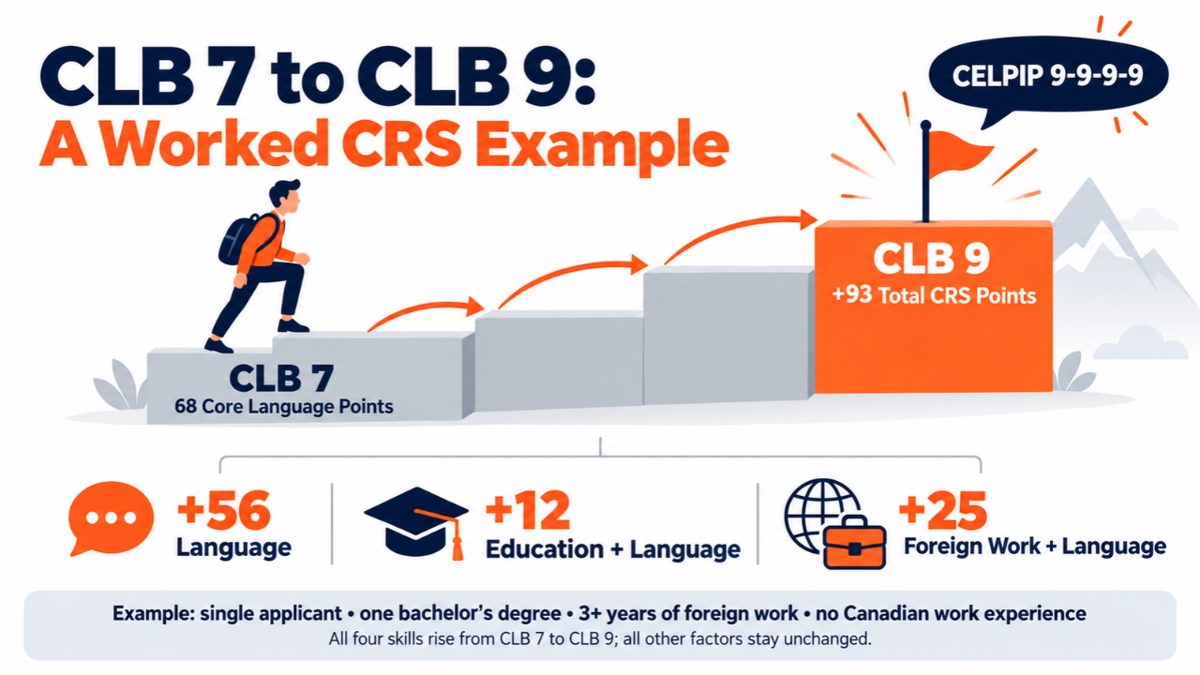
Reaching CLB 9 in all four first-language abilities moves you into the higher language band for education and foreign-work transferability. It does not automatically give everyone the maximum.
For education plus language:
- One bachelor's degree: 13 points becomes 25.
- A master's degree, or qualifying multiple credentials: 25 becomes 50.
For foreign work plus language:
- One or two years: 13 becomes 25.
- Three or more years: 25 becomes 50.
Overall skill-transferability points are capped at 100.
Consider a hypothetical single applicant with one bachelor's degree, three years of eligible foreign experience and no Canadian experience. Moving from four 7s to four 9s could add 56 core language points, 12 education-and-language points and 25 foreign-work-and-language points: 93 points altogether, assuming everything else stays unchanged. These calculations illustrate how four 9s beat four 7s for CRS.
Your own CLB to CRS conversion must use your complete profile. Canadian experience, education and existing caps can change the result.
Bilingual bonuses: when English plus French is worth it
NCLC 7 or higher in every French ability can earn:
- 50 additional CRS points with English CLB 5 or higher in every ability.
- 25 additional points with English CLB 4 or lower, or without an English test.
These bonuses are separate from ordinary language points. French can also earn second-language points when English is your first official language.
French therefore offers two possible benefits: more CRS points and eligibility for French-category rounds.
It deserves consideration if you already have strong English, some French knowledge and enough time for sustained study. If you are close to CLB 9 in English, improving English first may be the more manageable short-term step.
Do not treat the bilingual CRS bonus Canada offers as an easy purchase. You earn it through tested ability across all four skills.
Which CELPIP Target Should You Set? (Decision Tree)
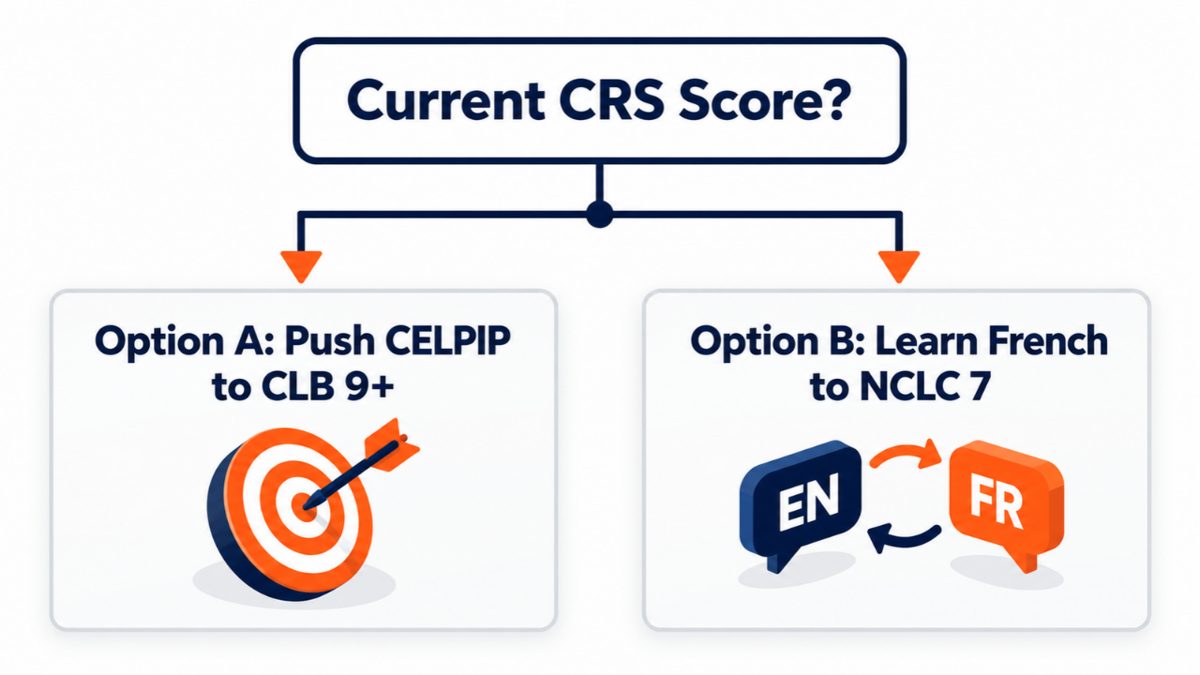
If your CRS is 420–460: French pathway vs English-only retake
A CRS of 420–460 calls for a comparison of realistic options. Begin with your current scores, occupation eligibility and available study hours.
Option A: Aim for CLB 9+ in English.
This is worth examining when:
- One or two abilities are below 9.
- Recent timed practice shows you are close to the target.
- The projected CRS increase is substantial.
- Your work experience may qualify for an occupation category.
Use CELPIP-General, IELTS General Training or PTE Core. PTE Academic and IELTS Academic are not the Express Entry versions; IRCC also does not accept IELTS One Skill Retake for Express Entry.
An English retake can improve your ranking, but it cannot create occupation-category eligibility. Nor does a higher score guarantee that your preferred round will happen.
Option B: Build towards NCLC 7 in French.
A six-to-twelve-month study plan may be reasonable for some learners, particularly those with a foundation. Beginners may need longer. Treat that period as a planning estimate, not a promised completion date.
French is worth assessing when English improvement alone leaves a large CRS gap. Before enrolling, complete a four-skill assessment and decide whether you can sustain lessons, homework and speaking practice alongside work.
French-category rounds have no guaranteed monthly schedule. IRCC's published 2026 priorities include Francophone immigration, but priorities do not fix future cut-offs or invitation dates.
Project three scenarios:
- Your current scores.
- English CLB 9 or 10.
- Strong English plus French NCLC 7.
Then compare the likely gain, preparation time and cost. A CELPIP retake strategy for PR should start with this calculation.
If you are in Trades, STEM or Healthcare: category alignment plus language targets
First check your NOC code against the current list. Being an engineer, analyst, accountant or nurse does not, by itself, establish category eligibility. For example, civil engineers and registered nurses appear on the current lists, while "analyst" is too broad to make a reliable judgement.
Set your language target in stages:
- First: satisfy your program's actual language minimum.
- Next: consider CLB 7 across English abilities as an improvement milestone where your minimum is lower.
- Where achievable: aim for CLB 9 in all four English abilities.
- For the French category: meet NCLC 7 in every French ability.
CLB 7 is not a universal occupation-category requirement or a guaranteed competitive score. A CEC TEER 2 worker and an FSW applicant can have different minimums despite working in the same sector.
A tradesperson should also distinguish the trades category from FST eligibility. FST has its own experience requirements and generally requires a qualifying job offer or Canadian certificate of qualification.
Category eligibility and language preparation should be checked together. Neither replaces the other.
Common Mistakes That Kill ITAs
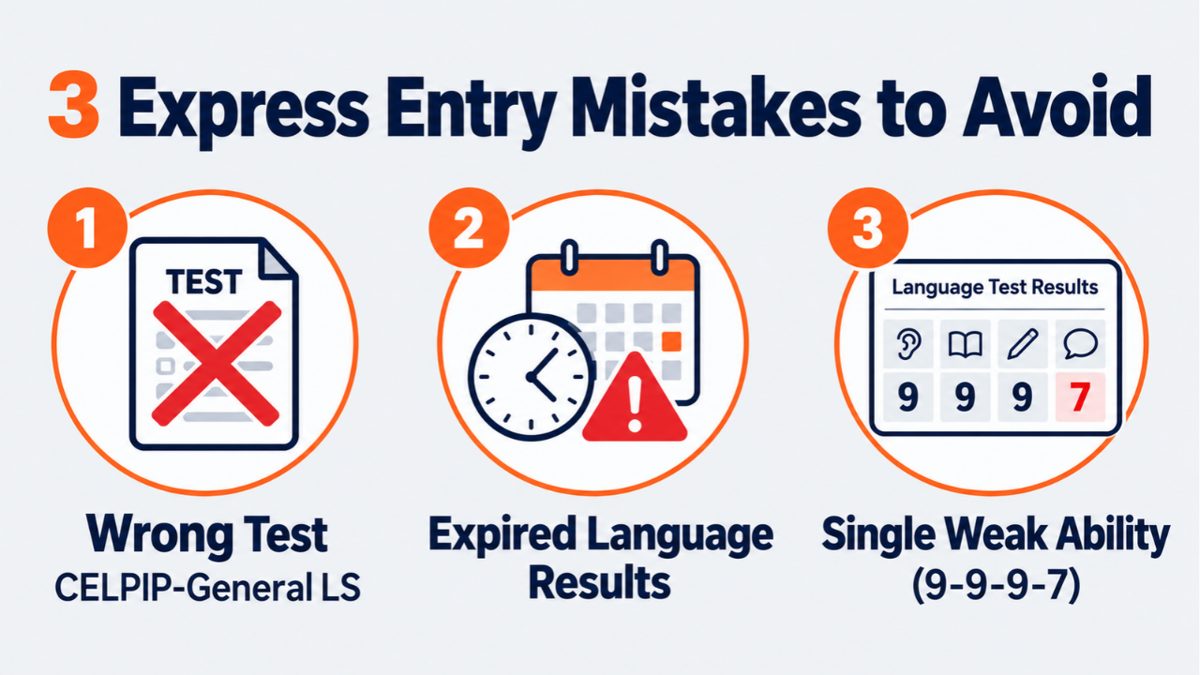
Booking General LS, letting results expire and ignoring the weakest ability
Booking the wrong test
The CELPIP-General LS mistake for FSW and CEC can waste a booking and delay your profile. Express Entry requires CELPIP-General, covering all four abilities. General LS covers listening and speaking only. Check the version before paying, and review CELPIP-General vs General LS and two-year validity rules.
Letting results expire before submission
Your language results must be less than two years old when you complete your profile and submit your permanent residence application. An ITA does not extend their validity.
Record the expiry date immediately. If you are considering French, include the remaining validity of your English results in that timetable.
Preparing around an average
A 9-9-9-7 result does not meet the four-skills CLB 9 condition for higher education-and-language and foreign-work-and-language transferability. The weakest ability matters.
If writing is holding you back, another month of listening practice will not address the main problem. Review whether you answer the task fully, support your points, use suitable tone and finish within the time.
If speaking is weakest, record your responses and listen for incomplete ideas, repeated restarts and poor organisation. VerbalHub's CELPIP Speaking Tips and Tricks 2026 can help you organise that practice.
Action Plan
Book a CELPIP diagnostic, get a CRS projection and choose your test
Before booking another exam, gather:
- Your latest four-skill results and test date.
- Age, education and credential-assessment details.
- Canadian and foreign work history.
- Spouse information, where applicable.
- Any French results or previous French study.
Book a free CELPIP diagnostic and CRS projection call with VerbalHub. The purpose is to map your current scores to an estimated CRS, identify the weakest ability and recommend a test and target CLB that fit your timeline.
Test choice should follow performance. Try representative tasks before deciding. CELPIP suits candidates comfortable with computer-based everyday communication; IELTS General Training includes an examiner-led speaking test, while PTE Core uses a computer-based format. Your weakest skill, typing comfort and timed performance should guide the choice.
Leave the call with a written target, practice priorities and a review date. A diagnostic provides a starting estimate; your official test results determine the language points you can claim.
Why VerbalHub's One-on-One Coaching Can Speed Up Your Score
VerbalHub offers one-on-one CELPIP and MBA exam coaching designed for working professionals and students. A trainer can analyse the exact tasks holding your score back, including Speaking Tasks 3 and 4 or Writing Task 2. Custom drills and detailed feedback make practice more useful than repeating generic tips, while weekly reviews help the trainer adjust your plan. Hasan Sir's experience in CAT, GMAT and XAT preparation, verbal skills training and admissions guidance supports clear thinking and well-structured CELPIP responses. Explore VerbalHub's CELPIP coaching options; families planning management education after Class 12 can also consider IPMAT coaching at VerbalHub. Book a demo / diagnostic call with VerbalHub to see if one-on-one coaching fits your timeline and target score.
Save this blog as a Word document for offline reading and sharing with friends.

Know Your CELPIP Target Before You Book Your Next Test. Free CELPIP diagnostic · CRS projection · One-on-one coaching. Book a Free CELPIP Diagnostic Call.
Frequently Asked Questions
For most English-first candidates, CELPIP 9 in all four skills is a sensible target. The minimum depends on your program: FSW needs CLB 7 in every ability, CEC (TEER 0 or 1) needs CLB 7, CEC (TEER 2 or 3) needs CLB 5, and FST needs CLB 5 in speaking and listening and CLB 4 in reading and writing.
It can be. For a single applicant, four CLB 7s earn 68 core language points and four CLB 9s earn 124, a 56-point difference before any skill-transferability increase. Your own result depends on your complete profile, so run a full CRS calculation.
Book CELPIP-General, which covers all four abilities. CELPIP-General LS covers listening and speaking only and does not meet the Express Entry requirement for FSW or CEC.
Your results must be less than two years old when you complete your profile and when you submit your permanent residence application. An invitation to apply does not extend their validity.
You need NCLC 7 or higher in reading, writing, listening and speaking. IRCC accepts TEF Canada and TCF Canada, and the two tests use different score conversions.
No. The higher language band for education and foreign-work transferability requires CLB 9 in all four first-language abilities, so your weakest ability matters.
No. You must first qualify under the Federal Skilled Worker Program, Canadian Experience Class or Federal Skilled Trades Program. Category eligibility is an additional requirement, and no schedule or cut-off is guaranteed for future rounds.
VerbalHub offers a free CELPIP diagnostic and CRS projection call to map your scores to an estimated CRS, identify your weakest ability and recommend a test and target CLB. One-on-one coaching then uses custom drills, detailed feedback and weekly reviews to address the tasks holding your score back.
Sources and useful links
- IRCC — Express Entry rounds of invitations
- IRCC — Category-based selection and current occupation lists
- IRCC — Express Entry Year-End Report 2024
- IRCC — Express Entry program comparison
- IRCC — Approved language tests, score conversions and validity
- IRCC — Federal Skilled Worker Program
- IRCC — Comprehensive Ranking System criteria
- IRCC — Current Express Entry ministerial instructions
- IRCC — Express Entry for French-speaking skilled workers
- IRCC — 2026 Express Entry priorities
Explore more preparation articles at VerbalHub Blogs.