AI Powered GRE Prep

How to Use AI Tools for Vocabulary Reading Passages and Math Practice
A practical guide for working professionals and self-studiers aiming for a 320 plus GRE score.
Use smart tools to create focused drills, study your mistakes, and practise weak areas. Use official ETS material to measure your true level.
VERBALHUB GRE STUDY GUIDE
Most GRE question banks have one basic weakness: they cannot see how you think.
They do not know that you keep confusing necessary with sufficient, lose time on science passages, or remember a difficult word but fail to use it in a sentence. They simply show the next question and call it practice.
A good language model can respond to your exact mistake. It can create similar questions, explain a point in a simpler way, and change the next drill based on your answer. That makes practice quicker and more focused.
But keep one rule clear: AI is a practice partner, not the final judge. Official ETS questions are still the best way to check your real GRE level.
Before building your plan, review the GRE syllabus and section structure so your drills match the skills the test actually measures.
1 The Shift from Static Question Banks to Dynamic Practice
Old-style GRE preparation often follows a fixed path: read a chapter, learn a list, solve 20 questions, check the key, and move on. This can help when you need basic exposure, but it becomes slow when your weakness is more specific.
A better cycle is Diagnose → Adapt → Practise → Analyse.
1. Diagnose the real reason for the mistake.
2. Adapt the next drill to that weakness.
3. Practise the same skill in a few new forms.
4. Analyse your reasoning, accuracy, and time.
Suppose you divide both sides of an inequality by a variable without checking whether it is positive or negative. A normal answer key shows the correct steps and moves on. A well-written prompt can identify the missed condition, explain why it matters, and create three new questions built around the same trap.
What AI Should Do and What ETS Should Do
Think of AI as your practice room. ETS material is the scoreboard.
| Use AI for | Use official ETS material for |
|---|---|
| Creating extra drills | Measuring realistic performance |
| Explaining one idea in different ways | Learning authentic GRE wording |
| Sorting mistakes into clear groups | Studying real trap patterns |
| Repeating weak topics | Taking timed section tests |
| Learning vocabulary in context | Final score checks |
| Comparing solution methods | Full-length mock practice |
The Confident Wrong Answer Problem
A tool can give a smooth, convincing explanation and still be wrong. Quant is especially risky because one hidden assumption can spoil the whole solution.
- It may ignore a negative or fractional case.
- It may treat a diagram as if it were drawn to scale.
- It may misuse a condition in a Quantitative Comparison question.
- It may create answer choices that do not include the correct answer.
- It may produce a general aptitude question and label it GRE style.
Use three checks: ask for a second method, test boundary values yourself, and compare the style with official questions.
For a wider list of habits that quietly reduce scores, read common GRE preparation mistakes.
2 Prompt Writing for GRE Verbal and Vocabulary
“Give me 20 GRE words” is a weak prompt. It usually returns a random list, short meanings, and unnatural sentences. You may recognise the words later, but recognition alone will not help you choose between close answer options.
A useful prompt tells the tool what type of words you need, how they should be grouped, what question style to use, and when to reveal the answers.
Vocabulary Learn the Difference Between Similar Words
GRE vocabulary is not a spelling contest. You need to understand tone, context, and small differences between words that appear similar.
- Study words by roots and word families.
- Group words by tone such as praise, doubt, criticism, or restraint.
- Pair words that can create the same meaning in Sentence Equivalence.
- Compare close words that are not always interchangeable.
- Use a simple image or situation to make each word easier to recall.
Copy and Paste Vocabulary Prompt
COPY AND PASTE PROMPT
Act as a careful GRE verbal tutor.

Create a set of 10 common GRE words connected by this root or theme: [INSERT ROOT OR THEME].

For each word, give me:
1. A plain meaning in no more than 12 words.
2. One natural academic sentence that shows the meaning.
3. One simple visual memory clue.
4. One commonly confused word and the exact difference.
5. One Sentence Equivalence question using this word family.

Give six answer choices. Exactly two choices must complete the sentence with the same meaning.

Do not disclose the correct option until I reply. After I answer, tell me whether my mistake came from vocabulary, sentence logic, or poor option pairing. Then create one new question for the same weakness.
Mini Vocabulary Example
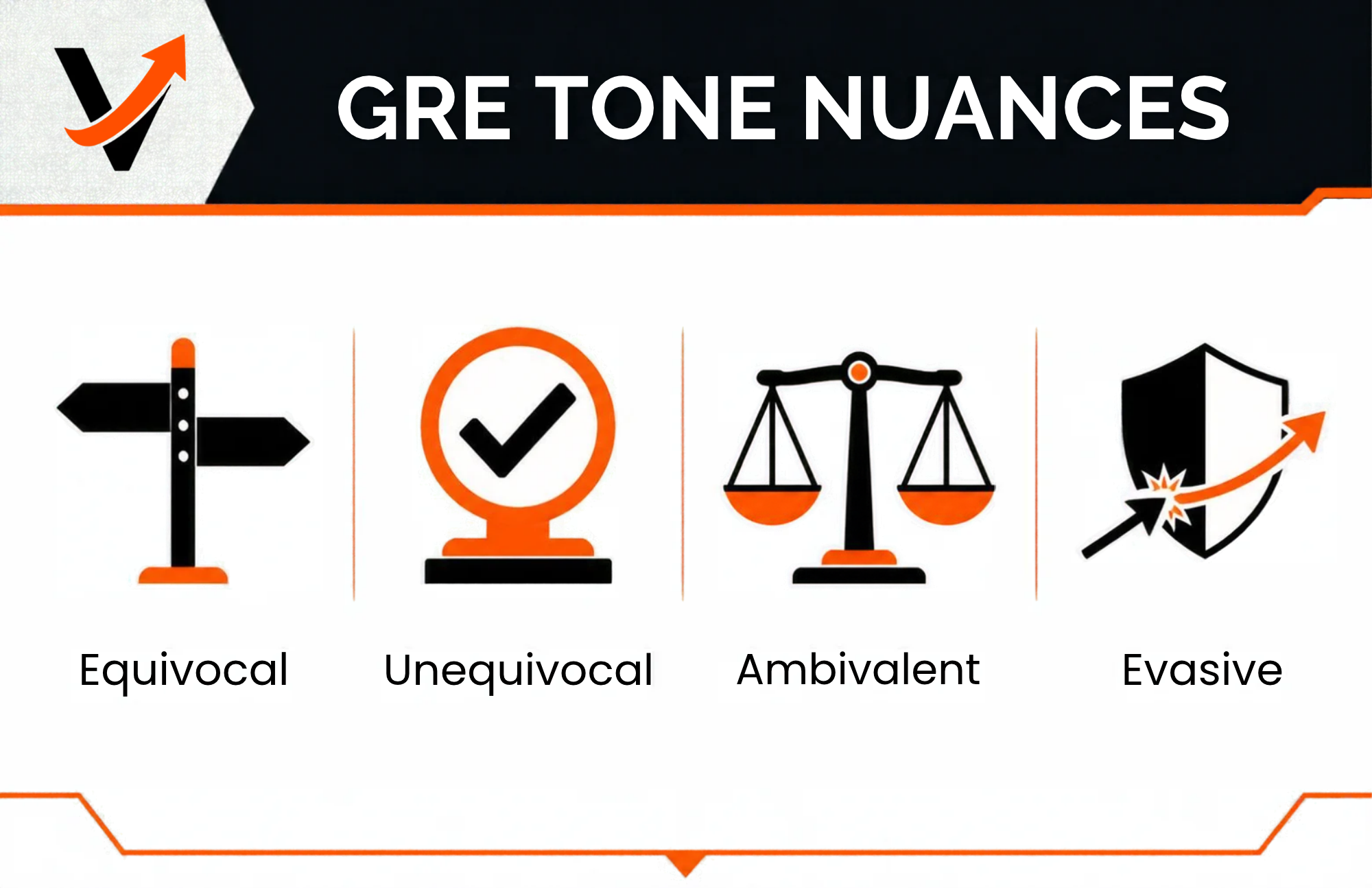
Equivocal: unclear or open to more than one meaning. Context: The spokesperson’s equivocal reply pleased neither side because both wanted a firm answer.
Unequivocal: completely clear and leaving no doubt. Context: The panel gave an unequivocal rejection of the proposal.
Ambivalent: having mixed feelings. Context: Meera accepted the promotion but remained ambivalent about moving abroad.
Evasive: avoiding a direct answer, often on purpose. Context: When asked about the missing money, the director became evasive.
These words all relate to uncertainty or unclear communication, but they do not mean the same thing. That difference is exactly what GRE answer choices often test.
Reading Passages Practise Dense Logic Not Just Long Text
Students often respond to weak Reading Comprehension scores by reading longer passages. Length may not be the real problem. The harder skill is following a short passage that contains a claim, a contrast, a limit, and a final view in only a few lines.
Ask for short passages with clear reasoning patterns: an old view followed by a challenge, two competing explanations, a study with a limit, or an author who agrees only partly.
You can also review this guide to tones used in GRE Reading Comprehension before practising tone and attitude questions.
Copy and Paste Reading Prompt
COPY AND PASTE PROMPT
Act as a GRE verbal passage writer and tutor.

Write one original academic passage of 140 to 180 words on [SOCIAL SCIENCE OR PHYSICAL SCIENCE TOPIC].

The passage must include:
- one widely accepted view;
- one challenge or limit;
- at least one clear change in direction;
- an author’s view that is suggested rather than directly stated.

Create:
1. One question on the main purpose.
2. One question on tone or the purpose of the change in direction.
3. One Text Completion sentence based on the same argument.

Do not disclose the correct option until I reply. After I answer, point to the exact words that support the answer. Explain why every wrong option fails. Classify my mistake as main idea, tone, missed contrast, unsupported inference, or word choice.
Mini Reading Example
Passage: Early studies treated city parks mainly as decorative spaces. Newer research links them with lower local temperatures and better mental health; nevertheless, these findings do not prove that adding parks alone will remove health inequality, which often grows from wider economic problems.
Question: The word “nevertheless” mainly signals:
- A. a rejection of all recent research
- B. a move from reported benefits to a limit on what they prove
- C. an example supporting the older view
- D. doubt about whether cities contain parks
- E. a comparison between two kinds of parks
Answer B. The first part reports benefits. The second part limits the conclusion. The writer is not saying that parks have no value; the writer is saying that their effect should not be overstated.
3 Prompt Writing for GRE Quantitative Reasoning
AI works best in Quant when you name the weak area and the exact mistake. “Teach me probability” is too wide. “Give me five probability questions in which the main trap is using the wrong total” gives the tool a clear job.
Useful tasks include turning words into equations, creating similar problems, comparing a long method with a short one, checking boundary cases, and finding hidden assumptions.
Use Question First Tutor Mode
If the full solution appears immediately, it is easy to feel that you understand it. That feeling can disappear the moment you face a new question. Ask the tutor to question you first and reveal only one hint at a time.
1. Ask what the question is testing.
2. Ask for your first step.
3. Challenge an assumption that has no support.
4. Give one small hint instead of the full answer.
5. After the solution, show the quickest safe method.
Copy and Paste Quant Prompt
COPY AND PASTE PROMPT
Act as a careful GRE Quant tutor. Ask questions before giving explanations.

My weak area is [TOPIC]. My common mistake is [DESCRIBE THE MISTAKE].

Create one original GRE-level problem in this format: [QUANTITATIVE COMPARISON / MULTIPLE CHOICE / NUMERIC ENTRY / DATA INTERPRETATION].

Before showing it, solve it in two ways. Check the answer choices. Test zero, negative, fractional, and equality cases when they matter.

After showing the problem, ask me for my first step. Do not give me the formula or full solution.

If I make a mistake, point to the exact assumption that failed. Give only one hint and ask me to try again.

After I solve it, show:
1. the shortest safe method;
2. the trap in the question;
3. one harder question based on the same idea.
Mini Quant Example
Given: x² > 9
| Quantity A | Quantity B |
|---|---|
| x | 3 |
Tutor: What values of x satisfy x² > 9?
Student: x > 3.
Tutor: That is one interval. Can a negative number also have a square greater than 9?
Student: Yes. x < −3 also works.
When x > 3, Quantity A is greater. When x < −3, Quantity B is greater. The relationship therefore cannot be determined.
The shortcut: rewrite x² > 9 as |x| > 3. This makes both cases visible at once. The trap is not difficult algebra; it is forgetting the negative interval.
For stronger practice, ask for a change in the logic, not only the numbers. Replacing 9 with 16 gives shallow repetition. A better follow-up may compare x with −4 or add the condition x < 0.
4 AI as a Diagnostic Tool and Error Log
A useful error log does not simply record that Question 7 was wrong. It records why the reasoning failed and what you will do next.
- Topic and question type
- Your answer and the correct answer
- Time spent
- Your original reasoning
- The first point where the reasoning became weak
- Mistake type and corrective drill
- Next review date
Error Categorisation Framework
| Mistake type | What it means | Follow-up prompt |
|---|---|---|
| Concept gap | You did not know or apply the rule correctly. | Teach the idea with one simple example. Then give three harder GRE-level questions and hide the solutions. |
| Time crunch | You understood the question but used a slow method or stayed stuck too long. | Compare my method with the quickest safe method. Show where I should have changed my approach. |
| Misread trap | You missed a word, condition, unit, exception, or contrast. | Show the exact word I missed. Create three questions with a similar reading trap. |
| Careless execution | The setup was right, but arithmetic, signs, copying, or answer selection failed. | Create a five-question accuracy drill on signs, units, and copying errors. End with a short checking list. |
| Option elimination | You removed a valid answer or kept one with weak support. | Check my elimination logic one option at a time. State the evidence needed to remove each choice. |
| Recall failure | You had studied the idea or word but could not recall it under pressure. | Create a review drill for today, three days later, and seven days later. |
Copy and Paste Error Log Prompt
COPY AND PASTE PROMPT
Study the GRE mistake below.

Question type:
My answer:
Correct answer:
Time spent:
My reasoning:
Verified solution:

Choose the main cause: concept gap, time crunch, misread trap, careless execution, option elimination, or recall failure.

Then give me:
1. the earliest point where my reasoning went wrong;
2. the evidence for your choice;
3. one short rule I can remember;
4. a three-question practice drill;
5. the best day to review this again.

Do not simply repeat the verified solution.
The words “earliest point” matter. The last wrong step may only be the result of an earlier misunderstanding. Fixing the source of the error is more useful than correcting the final calculation.
Weekly AI and ETS Study Plan
| Day | Focus | AI task | ETS task |
|---|---|---|---|
| Monday | Vocabulary and Sentence Equivalence | Build one word family and complete a focused drill. | Review earlier official questions with similar sentence logic. |
| Tuesday | Reading structure | Create short passages with contrast, limits, and implied tone. | Solve a small official Reading Comprehension set without timing pressure. |
| Wednesday | Quant weak area | Use question-first tutor mode for one idea and three variations. | Redo official questions previously missed in that topic. |
| Thursday | Mixed timed work | Create a short timed set based on error-log patterns. | Save fresh official material for the weekend check. |
| Friday | Accuracy and recall | Review vocabulary and run a careless-error drill. | Study official explanations and update personal rules. |
| Saturday | Benchmark | Use AI only to prepare a timing plan. | Complete an official timed section or planned official test. |
| Sunday | Review and adjust | Sort errors and rewrite next week’s prompts. | Redo missed official questions without viewing the answers. |
How to Adjust the Plan Every Sunday
Do not repeat the same plan simply because it is already written. Let the week’s evidence decide what comes next.
- If most mistakes are concept gaps, reduce timed work for a few days and rebuild the basics.
- If most mistakes come from time pressure, compare methods instead of collecting more questions.
- If most verbal mistakes are misreads, practise contrast words, changes in scope, and qualified conclusions.
- If AI drills improve but official performance does not, the generated questions may be too easy, too unlike GRE wording, or completed without real time pressure.
Use the step-by-step GRE preparation guide to place these daily tasks inside a wider study plan. If you are preparing for the current test, also review the guide to the shorter GRE format.
A Simple 45 Minute Daily Routine
A working professional does not need a complicated system. A short daily session can be useful when every task comes from real evidence rather than mood or guesswork.
| Time | Task |
|---|---|
| 10 minutes | Review yesterday’s error log and recall five words without notes. |
| 15 minutes | Complete one focused AI drill in your weakest topic. |
| 15 minutes | Solve verified GRE questions or redo earlier official questions. |
| 5 minutes | Record the mistake type, corrective rule, and next review date. |
Final Rule Keep Practice Flexible and Measurement Honest
The best study setup is not the one with the longest prompts or the most tools. It is the one that notices a weakness on Monday, works on it during the week, and checks real improvement with official questions on Saturday.
Use AI to create more practice, ask better questions, and study mistakes in detail. Use official ETS material to measure your level and guide major decisions about readiness.
More questions are not always the answer. Better feedback usually is.

Need a personal study plan or expert feedback? Explore VerbalHub GRE coaching or contact the VerbalHub team.