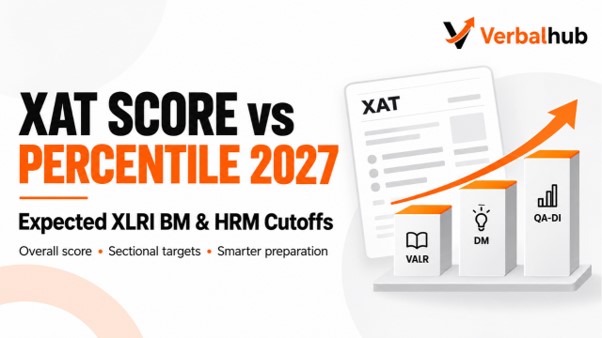
XAT Score vs Percentile 2027 and Expected XLRI BM and HRM Cutoffs
A practical guide to raw marks, sectional targets and what to do after your mock or scorecard.
Your XAT score can look promising while one weak section quietly puts an XLRI shortlist out of reach. This XAT score vs percentile 2027 guide helps you read the overall number alongside Verbal Ability and Logical Reasoning (VALR), Decision Making (DM), and Quantitative Aptitude and Data Interpretation (QA-DI). It also explains why the BM and HRM programmes may call different applicants at different thresholds.
Use the estimates below when analysing a mock, a response sheet or your final score; none is a promised conversion. Paper difficulty, the candidate pool and XLRI's published criteria will determine the actual position. Your academic background, programme choice and interview performance matter further along the admissions process. The useful question is not just "What percentile will I get?" but "Which section should I improve next, and which programmes still fit my profile?"
The official XAT site schedules the exam for 3 January 2027, from 2:00 pm to 5:00 pm, and lists 6 December 2026 as the registration closing date. Confirm any later update on the official portal before applying.
What XAT 2027 score might correspond to each percentile?
Quick answer: For planning, 30-34 marks may align with roughly the 88th-93rd percentile; 35-39 with 93rd-96th; and 40-44 with 96th-98th. These broad bands may move if the paper is easier or harder. XLRI admission also requires meeting the programme's applicable sectional thresholds and later selection criteria.
| Expected raw score | Expected percentile | How to read the range |
|---|---|---|
| 20-24 | 70-80 | Broaden the college list and look for attainable section gains |
| 25-29 | 80-88 | Check individual school and programme criteria |
| 30-34 | 88-93 | Compare options around the 85th-90th percentile |
| 35-39 | 93-96 | Keep XLRI sections balanced; evaluate other strong programmes |
| 40-44 | 96-98 | Potentially competitive for XLRI, depending on sections and profile |
| 45+ | 98+ | Strong overall range, with no admission guarantee |
Expected XAT 2027 score vs percentile range: indicative only. The bands are editorial planning estimates drawn from past-pattern reasoning; they are neither official score conversions nor confirmed 2027 cutoffs. One difficult or easy paper could shift them substantially.
How is a XAT percentile calculated?
A raw score counts marks earned and penalties incurred. A percentile compares your performance with other test takers. The 95th percentile means you performed better than roughly 95 in every 100 candidates; it does not mean you got 95% of the available marks. XAT is held in one slot, so candidates do not need the sort of cross-slot normalisation used in exams with several shifts.
Overall XAT percentile is based on VALR, DM and QA-DI. General Knowledge is scored separately and does not feed the overall percentile or cutoff score, although XLRI says it can consider GK later in selection. A XAT score calculator should therefore keep GK out of its aptitude total and account for both incorrect answers and the penalty after eight unattempted aptitude questions.
Worked example
Suppose you have 45 correct and 12 incorrect answers across 75 aptitude questions. Before the skip penalty, your score is 45 - (12 × 0.25) = 42. You left 18 questions blank; if the eight-free-skip rule applies to those 18, ten further blanks cost 1 mark. The resulting score is 41.
What are the expected XLRI BM cutoff and sectional targets?
XLRI will announce its official shortlist rules. The figures below are preparation targets for 2027, not published XLRI cutoffs or a prediction of an interview call. Check the official shortlist when it is released; categories and applicant group definitions may differ from the simplified planning segments below.
| Planning segment | Overall percentile | VALR | DM | QA-DI | Safer aim |
|---|---|---|---|---|---|
| Male applicants | 95-96+ | 82-85+ | 82-85+ | 85-88+ | 97+ overall; no weak section |
| Female applicants | 92-94+ | 80-82+ | 80-82+ | 80-85+ | 95+ overall; balanced sections |
Important note: All 2027 score and cutoff ranges here are indicative planning estimates. XLRI and other institutes can change shortlist criteria, sectional thresholds and selection procedures.
BM attracts applicants seeking a wide set of management careers. An excellent overall result cannot reliably rescue a section below the required cutoff. For students with strong verbal skills, QA-DI is often the section to protect; for CAT-focused students, XAT Decision Making needs its own practice. XLRI also considers relevant profile information and later selection stages, so a score is only one part of the application.
What are the expected XLRI HRM cutoff and sectional targets?
HRM is a selective programme with a different applicant mix and academic focus. Use these ranges to decide where to strengthen your preparation, then replace them with official XLRI figures as soon as they are available.
| Planning segment | Overall percentile | VALR | DM | QA-DI | Safer aim |
|---|---|---|---|---|---|
| Male applicants | 92-94+ | 80-82+ | 80-82+ | 75-80+ | 95+ overall; steady sections |
| Female applicants | 88-91+ | 75-80+ | 75-80+ | 70-75+ | 92+ overall; sound profile |
Important note: A high overall percentile does not override an applicable section cutoff. These HRM figures are not official and do not imply that HRM is an easier route into XLRI.
Candidates interested in HRM should be ready to discuss people strategy, leadership, organisational behaviour and labour relations with specific examples. The admissions interview is a chance to show why those interests are real. A higher XAT mark by itself cannot supply that narrative.
Why do sectional cutoffs change your XLRI chances?
How should you prepare for XAT VALR?
XAT verbal questions can test reading comprehension, arguments, vocabulary, grammar and unfamiliar passages, sometimes including a poem. A strong QA-DI score may still leave a VALR shortfall. If you already study CAT VARC, keep your reading and option-elimination work, then add critical reasoning and XAT-style verbal logic. For the foundation, see Verbalhub's CAT VARC strategy guide. For a timed-practice perspective, read the CAT VARC 40 plus strategy.
How do you improve XAT Decision Making?
Decision Making asks you to weigh facts, competing interests and likely consequences. A quick rule is: facts → stakeholders → consequences → best balanced action. Reject answers that hide relevant facts, punish someone without evidence or promise a result no sensible manager could deliver. Review past questions by explaining why the attractive wrong option fails. This is the section where XAT preparation differs most clearly from ordinary CAT verbal work.
What should verbal strong students do in QA-DI?
Give arithmetic, percentages, ratios, averages, basic algebra and data interpretation a repeatable weekly slot. Practise in timed sets; then note whether a loss came from a concept gap, a calculation slip, a poor choice of question or time pressure. A modest, dependable QA-DI score is more useful for an XLRI plan than a high mock total with a fragile section.
Which score target fits your goal?
| Goal | Planning score | Indicative percentile | Immediate priority |
|---|---|---|---|
| XLRI BM | 42-45+ | 96-98+ | Balance all sections; reduce avoidable negatives |
| XLRI HRM | 37-42+ | 92-96+ | Build VALR and DM; protect QA-DI |
| Colleges around 90th percentile | 30-35+ | About 90-94 | Improve your weakest reliable section |
| Colleges around 80th percentile | 24-30+ | About 80-89 | Improve accuracy and shortlist realistically |
This table is a study-planning tool, not an admission forecast. The target bands overlap because actual percentile conversion will vary. At 80 percentile, do not assume a named college will accept your score in 2027; review the current programme criteria and application deadlines. Verbalhub's guide to colleges accepting 80 percentile in XAT can start your research.
How should negative marking change your attempt strategy?
The official XAT 2027 site lists +1 for a correct answer and -0.25 for an incorrect one. The first eight unattempted aptitude questions have no skip penalty; each further unattempted question costs 0.10. GK has no negative marking and does not enter the overall percentile. Part 1 has 170 minutes across VALR, DM and QA-DI without sectional time limits; GK has a separate ten-minute window. Confirm the final bulletin before the test.
- Estimate raw marks from correct, incorrect and unattempted aptitude answers; keep GK separate.
- Treat any percentile conversion as a range, then check VALR, DM and QA-DI independently.
- Compare programme targets with your section scores; label safe, marginal and weak areas.
- Build a college list from each school's current programme rules, not a generic "XAT 90 percentile colleges" list.
- If your range could be competitive, prepare evidence for interviews: academics, work, decisions, leadership and programme fit.
- Keep a short weekly review of mistakes and XAT-specific DM practice instead of taking mocks without analysis.
If you are shifting from CAT to XAT, begin with the Verbalhub XAT Preparation 2027 guide. A mentor can then use your error log to decide whether a VALR passage, a DM case or a QA-DI topic deserves the next hour.
Should you choose XLRI BM or HRM?
Choose the programme whose curriculum and future work make sense for you. BM is the broader general management route. It can fit interests in consulting, marketing, strategy, finance, operations, product and leadership. HRM is designed for students who want to understand how organisations hire, develop, motivate and retain people, including questions of culture, industrial relations and business change.
A difference in expected shortlist percentiles is a poor reason to apply for HRM if you have no interest in people management. XLRI can ask why you selected the programme and what experiences led you there. A credible answer gives a concrete example: resolving a team conflict, designing a process, improving employee communication or studying how workplace incentives affect decisions. If BM is your preference, you should be equally specific about the kind of management problem you want to solve.
Both programmes are competitive, and both value performance beyond the entrance test. XLRI states that shortlisting can consider academic background and relevant work experience alongside XAT, while final selection can also take interviews, group discussions where applicable, extracurricular activity and profile into account. This is why a student with a borderline estimate should keep preparing the application rather than treating the predicted cutoff as a verdict.
If you genuinely fit both programmes, explain the connection and the distinction honestly. For example, a career in organisational consulting might make both general management and people strategy relevant, but each choice still needs its own reason. Read the current curriculum, eligibility and selection notices before ranking preferences. Let your long-term role, not a guessed two-point percentile gap, guide the decision.
How can Hasan Sir help you improve the next mock?

Start with a diagnostic across VALR, DM and QA-DI to separate weak concepts from poor choices under time pressure.
- Build a tailored schedule around the sections that threaten the target programme, including XAT-specific Decision Making.
- Review each error live: passage reading, assumption, option elimination, stakeholder balance or a rushed calculation.
- Revisit similar questions in a later timed set so improved confidence is supported by evidence.
This sort of one-on-one guidance can also serve students preparing for CAT verbal, SNAP English, NMAT Language Skills, MAT Language Comprehension, GRE Verbal Reasoning or current GMAT Verbal coaching. The exams are different, so the drills and timing plan must change; the useful common habit is to explain the reasoning behind every answer. For exam-specific help, explore Verbalhub's GMAT personal tutoring or GRE coaching.
Student accounts
Vishankh Bhardwaj reports a CAT result at the 99th percentile and credits several Verbalhub teachers, including Hasan Sir. In his published account, he highlights Hasan Sir's explanations and practice questions. This is a CAT student's experience, not a promise of a XAT outcome.
Verbalhub also reports that Ankit moved from an approximately 500 starting level to a 750 official GMAT result after individual coaching, with Hasan Sir supporting his Verbal preparation. This is a reported GMAT case, not an expected XAT score change or a result every student can reproduce.
Read Vishankh's published review and Ankit's case study in the source notes. For a personal plan, bring your last two section-wise mocks to a one-on-one diagnostic discussion.

YOUR XAT SCORE IS A STARTING POINT. Build your next step, section by section. Mock analysis · Decision Making · Verbal strategy. BOOK A 1-ON-1 SESSION WITH HASAN SIR.
Frequently Asked Questions
A working estimate is about 35-39 raw marks for the 93rd-96th percentile band, so 95 could fall somewhere inside it. The actual mark may change with difficulty and candidate performance. Use the range to set a mock target, then wait for the official scorecard to know your percentile.
On the planning table, 40 falls in the 96th-98th percentile band. That is a strong mock result, but it is not a guaranteed XLRI call. Look at VALR, DM and QA-DI separately, then compare them with the applicable official programme thresholds when XLRI announces them.
For planning, think around 95-96+ overall for male applicants and 92-94+ for female applicants, with the section ranges shown earlier. These are editorial estimates, not XLRI's 2027 notice. The actual categories and thresholds may change, and a shortlist is not the same as admission.
Our planning ranges are 92-94+ overall for male applicants and 88-91+ for female applicants, alongside relevant section targets. Do not treat these numbers as official or HRM as an easy backup. XLRI's published criteria, programme fit and subsequent selection process determine the outcome.
XLRI has used overall and section-wise thresholds for shortlisting in previous cycles. The 2027 values and candidate segments have yet to be published. A high total may still leave you below a required section, so check VALR, DM and QA-DI before making a shortlist prediction.
Yes. DM is one of the three aptitude components, and past XLRI selection criteria have included a DM threshold. A student who prepares only CAT VARC and QA-DI can overlook it. Practise case-based choices, then explain how you weighed facts, affected people and consequences.
No. The official XAT 2027 site says GK does not enter the overall percentile or cutoff score and has no negative marking. XLRI may consider it during selection. Keep GK separate from your aptitude score calculation, but prepare it instead of assuming it has no use.
XAT is scheduled as a single-slot examination, so there is no cross-slot adjustment of the kind needed when papers are held in multiple shifts. Your percentile still depends on relative performance across the candidates who took the exam, and cannot be calculated from raw marks alone in advance.
It depends on whether your QA-DI percentile meets the applicable programme and candidate-segment cutoff. A strong overall score cannot be assumed to compensate for a missed threshold. Compare the official notice with your section result; while preparing, protect a basic QA-DI safety score through regular timed sets.
Start with schools whose current programme notices accept XAT and whose recent admission requirements fit your score, profile and goals. Cutoffs change by programme and year, and some schools add their own assessment stages. Use an 80-percentile college guide for ideas, then verify every current application page before paying a fee.
What is the next sensible step?
Stop refreshing a score prediction after every mock. Build section-wise accuracy, practise XAT Decision Making and ask what each mistake says about your method. Verbalhub can review your mocks with Hasan Sir and shape a realistic study plan around the sections that matter for your programme choice. Bring your latest mock scores and error notes to the discussion.
BOOK A ONE-ON-ONE SESSION. Request a diagnostic conversation with Hasan Sir at Verbalhub. Share your target programme, section scores and exam date so the first session begins with a concrete plan. Book a free Verbalhub demo or mentoring discussion · Review the XAT 2027 preparation guide.