Understanding the GMAT Scoring: A Complete A–Z Guide
Understanding the GMAT score is one of the most critical yet misunderstood parts of GMAT preparation. Many aspirants focus only on achieving a high score, but GMAT understanding your score goes far beyond the final score displayed on the screen. It involves knowing how section-wise performance, question difficulty, accuracy, and consistency come together to determine your result. Understanding your scores GMAT-style helps you interpret what your performance truly reflects, why similar attempts can lead to different outcomes, and how business schools evaluate your profile. By clearly understanding GMAT score mechanics, aspirants can set realistic targets, analyse mock tests intelligently, and design a preparation strategy that actually leads to higher percentiles rather than relying on guesswork.
How the GMAT Focus Edition Score Is Calculated
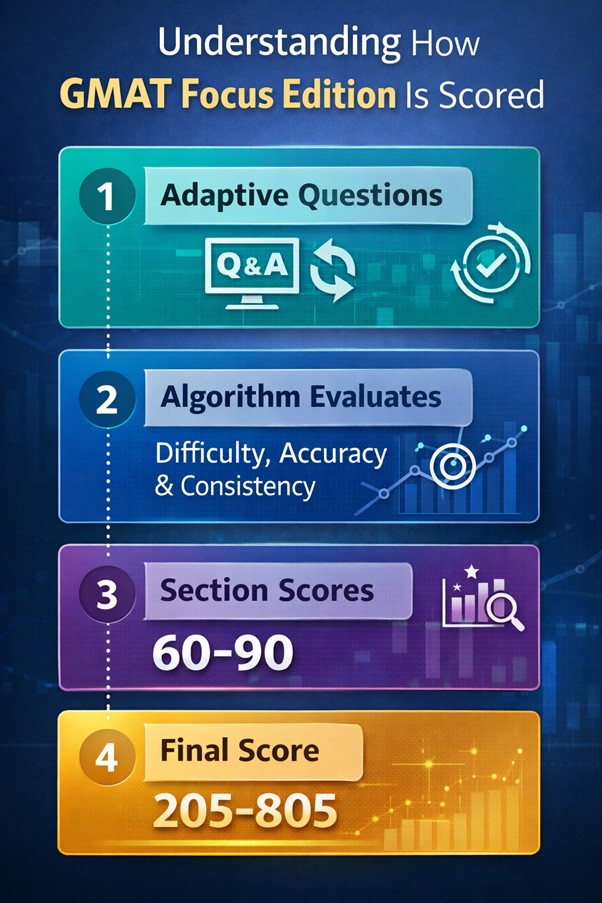
Step 1: You answer adaptive questions
- Each section (Quant, Verbal, Data Insights) is computer-adaptive
Your next question level is decided by your previous question level
- Correct → harder question
- Incorrect → easier question
Step 2: The algorithm evaluates more than correctness
For each section, the system considers:
- Accuracy (right vs wrong)
- Difficulty level of the questions you attempted
- Consistency (pattern of correct/incorrect answers)
- Ability estimate (how strong the system thinks you are)
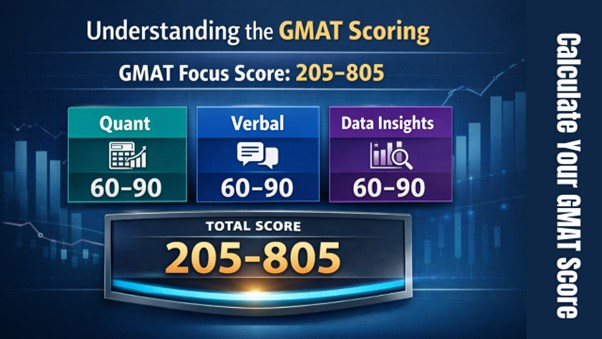
This produces a section score from 60 to 90
Note: Two students with the same number of correct answers can get different section scores.
Step 3: Section scores are scaled
You get three scaled scores:
| • Quant: 60–90 |
| • Verbal: 60–90 |
| • Data Insights: 60–90 |
These are not raw marks and not percentages.
Step 4: Final GMAT Focus score is computed (205–805)
The three-section scores are then combined using a statistical scaling model to ensure:
- Fairness across different test forms
- Comparable scores across dates
Final score range: 205–805 (in 10-point increments)
Important:
The final score is NOT:
- a sum
- an average
- a simple formula like (Q + V + DI) / 3
It’s a calibrated composite score.
Example (Conceptual)
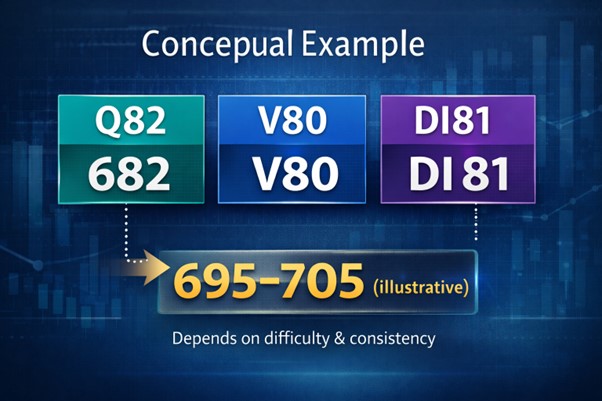
| Section | Score |
|---|---|
| Quant | 82 |
| Verbal | 80 |
| Data Insights | 81 |
Algorithm maps this balanced high performance to
- 695–705 GMAT Focus score
Change the difficulty pattern or consistency, and the score may shift even with the same section numbers.
Why GMAT Focus scoring works this way
- Tests thinking level, not memorisation
- Rewards for handling harder questions
- Penalises random guessing
- Prevents score inflation
1. What does “Understanding the GMAT Score” actually mean?
Understanding the GMAT score means knowing:
- How your final score is calculated
- What your sectional scores represent
- How percentiles work
- Why two candidates with similar performance may get different scores
- How B-schools interpret your score
It is not just “how much you got,” but what your score signals about your ability.
2. What is the difference between GMAT Classic and Focus Edition?
The GMAT Focus Edition is updated exam pattern and the name of the GMAT exam. It tests reasoning and decision-making, not rote knowledge.
Key differences:
- Only 3 sections
- Shorter exam duration
- Equal importance to all sections
- Heavy emphasis on Data Insights
3. What are the sections in GMAT Focus Edition?
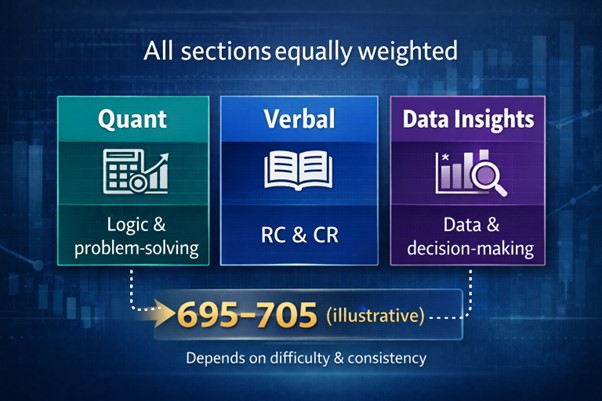
GMAT Focus has three equally weighted sections:
| Section | Skills Tested |
|---|---|
| Quantitative Reasoning | Logical math, problem-solving |
| Verbal Reasoning | Reading comprehension, critical reasoning |
| Data Insights | Data interpretation, analytics, logic |
Each section contributes directly to your final score.
4. What is the scoring range in GMAT Focus?
Section Scores:
- 60 to 90 (1-point increments)
- Final GMAT Focus Score:
- 205 to 805
- In 10-point increments (e.g., 555, 605, 705, 755)
This is central to understanding your scores GMAT-style, because the scale is not linear.
5. Is the GMAT score a total of correct answers?
No.
The GMAT score is not based on:
- Total correct answers
- Percentage
- Simple averages
Instead, it is based on:
- Question difficulty
- Accuracy
- Consistency
- Adaptive performance
This is the most misunderstood part of understanding GMAT score calculation.
6. What does “computer-adaptive” mean in GMAT?
Each section is computer-adaptive:
- Correct answer → harder question
- Wrong answer → easier question
- The algorithm constantly estimates your ability level.
So the GMAT measures how well you handle difficulty, not just correctness.
7. Why do two students with similar accuracy get different scores?
Because the GMAT evaluates:
- Difficulty level of attempted questions
- Sequence of correct/incorrect answers
- Stability of performance
Example:
- Student A answers many hard questions correctly
- Student B answers many easy questions correctly
Student A gets a higher score
8. How is each section score (60–90) calculated?
Each section score is a scaled ability estimate based on:
- Difficulty of questions
- Accuracy
- Error patterns
- Time management behaviour (extreme guessing penalties)
This explains why one mistake at a higher level may hurt less than multiple easy mistakes.
In short: GMAT rewards stable performance at higher difficulty levels.
9. How are the three section scores combined?
There is no public formula, but:
- All three sections are equally important
- The algorithm maps your overall ability profile to a score between 205–805
This ensures fairness across:
- Different test dates
- Different question sets
In short: Your final score reflects your overall ability profile—not a simple calculation.
10. What the percentile mean, and why percentile matter?
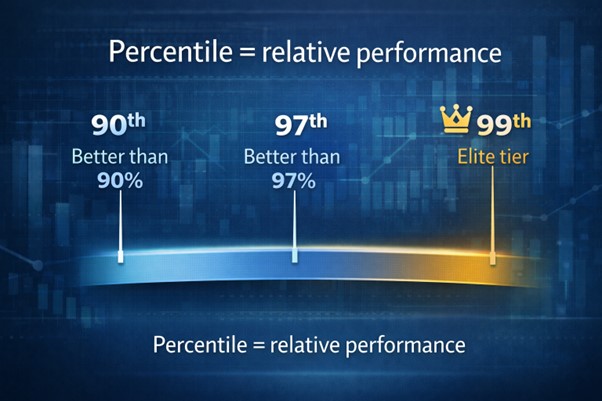
It’s a comparative performance calculator and indicator.
Example:
- 97th percentile that you performed better than 97% of test-takers
B-schools often evaluate:
- Score + percentile
- Not score alone
In short: Percentile tells you where you stand compared to other test-takers.
11. What is the ideal GMAT Focus score?
| GMAT Focus Score | Percentile | Interpretation |
|---|---|---|
| 805 | 100 | Perfect |
| 755 to 715 | 99 | Elite |
| 705 | 98 | Top global |
| 695 | 97 | Top |
| 685 | 96 | High |
| 675 | 95 | Very strong |
| 665 | 94 | Strong |
| 655 | 93 | Challenge |
| 645 | 92 | Competitive |
| 635 | 91 | Decent |
| 623 | 90 | Good |
Top B-schools usually expect 695+, depending on program and profile.
12. Is Data Insights really that important?
Yes—extremely important.
Unlike the old GMAT IR:
- Data Insights is fully scored
- Appears on score reports
- Often used by B-schools to assess analytics readiness
A weak DI score can pull down your overall score sharply.
In short: Data Insights is a core scoring section—prepare for it seriously.
13. Can one strong section compensate for another weak section?
Not easily.
GMAT Focus rewards balance:
- Very high Quant + weak Verbal → score penalty
- High Verbal + weak DI → score penalty
Balanced performance is critical for 700+ scores.
In short: Balance across all three sections is the fastest path to a high score.
14. Does time management affect GMAT score?
Indirectly, yes.
- Random guessing hurts consistency
- Multiple unanswered or rushed questions reduce ability estimation
- Ending a section poorly can lower section score
Good pacing is part of understanding your scores GMAT-wise.
In short: Poor pacing can reduce your score even if your concepts are strong.
15. How do B-schools read GMAT score reports?
Schools look at:
- Overall score
- Section scores
- Percentiles
- Balance across sections
Some schools emphasise Quant + DI, while others value Verbal more (consulting, leadership roles).
16. Can the GMAT Focus be compared to the old GMAT?
Yes, through official concordance, but:
- It’s not a 1:1 conversion
- Focus Edition emphasises reasoning over speed
Example:
- GMAT Focus 705 ≈ Old GMAT 750 – 760 (approximate)
17. What are common myths about GMAT scoring?
- Myth: One wrong answer kills your score
- Myth: Early mistakes ruin everything
- Myth: Speed matters more than accuracy
- Myth: DI is less important
Truth: Difficulty + consistency + balance matter most
18. How should aspirants use score understanding in preparation?
To improve score:
- Track sectional performance, not just total
- Focus on medium–hard accuracy
- Avoid streaks of incorrect answers
- Give equal importance to all three sections
This is the practical side of the GMAT, understanding your score.
19. Why does GMAT use such a complex scoring system?
Because it:
- Prevents cheating advantages
- Ensures fairness
- Measures real reasoning ability
- Differentiates top performers accurately
GMAT is designed to rank thinking ability, not memory.
20. Final takeaway: What does your GMAT score truly represent?
Your GMAT score indicates:
- Your decision-making under pressure
- Your ability to handle complexity
- Your consistency at greater difficulty
- Your readiness for rigorous MBA academics
Understanding the GMAT score properly allows you to:
- Set realistic targets
- Interpret mocks correctly
Build a smart preparation strategy
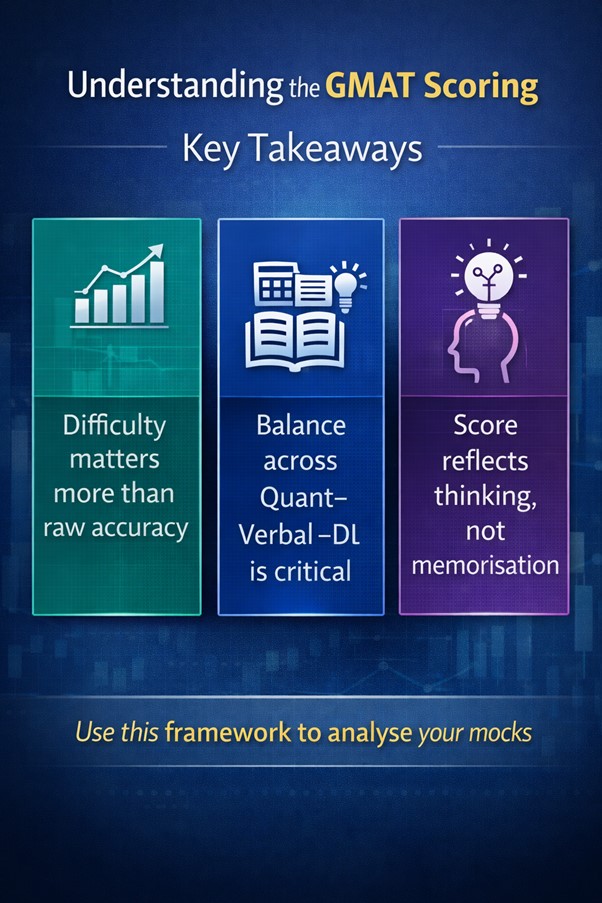
To End With
GMAT understanding your score is not just about knowing the final number you receive on test day, but about interpreting what that score truly represents in terms of reasoning ability, consistency, and preparedness for a strong MBA curriculum. By understanding your scores GMAT-style, aspirants can move beyond myths and misconceptions, evaluate their strengths and gaps accurately, and make informed decisions about preparation and retakes. A clear understanding GMAT score framework empowers candidates to analyse mock tests strategically, balance all sections effectively, and present a strong, credible profile to top business schools. Ultimately, mastering how the GMAT scoring works turns preparation into a focused, data-driven process—bringing you closer to your target score and your dream B-school.



Our Teachers

Dr. G Ravindra Babu
Quant Faculty
Ph. D in Mathematics Asian International University|| Mathematics Professor at Gitam University || Ex-Mathematics Professor SRM University Amaravathi || MBA in finance Acharya Bangalore B School || GMAT Quant 51, CAT Quant 99.58 %tile, GRE Quant 170 || 21 Different Teaching Certification || Believe in “Education is the mother of leadership”
view details

Dr. Rengarajan Parthasarathy
CAT Faculty
Ph. D in Mathematics from YCM University|| Mathematics Professor at Symbiosis International|| Author of Business Ethics || Ex-CAT Exam Syllabus Advisor in IIM || MBA & MPM from Symbiosis International (Deemed University) || College Topper in Mathematics in Ferguson College || Six Scholarships in Mathematics || 15 Years CAT Coaching, GMAT Coaching and GRE Coaching Experience|| UGC NET Qualified || GMAT Q51, V38 & CAT Q 99.31 & DILR 99.38 %tile, GRE Quant 170 || Believe in “Higher Education Shapes The World.”
view details

Dr. Nisha Tejpal
Verbal & AWA Faculty
Ph. D in English || Published a paper in English in ‘Research Journal of Philosophy and Social Sciences’ || MCA and B.Ed CCS University || A subject expert in Verbal Teaching || 10,000 Plus Essays Analysis || CTET and NET Qualified || More than 15 years of Experience || A writer, Author and Poet || Believe in “Think Beyond the Universe”
view details

Dhrithi Khattar
Verbal Faculty
A subject expert in Verbal Aptitude || More than 15 years of Experience || MBA in HR& Marketing & MA in Economics || Active Member of Hindu Alumni Association || Functional Member of Delhi ||Management Association (DMA) || Operational Member of All India Management Association (AIMA) ||The President of Key Club ||An active member of the French Club ||Gold Seal from California Scholarship Federation.
view details
M. U. Mir
DILR & Quant Faculty
A subject expert in Quantitative Aptitude Training || GMAT Q 51 & CAT DILR 99.75 %tile || GATE 2020 Qualified || M. Tech & B. Tech University Toper (1st Rank) || Awarded by Gov of Odisha, Bihar and J& K for the project Magnetic Floating Model || Ex-Quant Subject Expert in Arihant Publication || An Educationist and Social Worker || Believe in “Education is power”
view details

C. S. Rajawat
CAT Faculty
M. A in Mathematics CCS University|| M. Tech from SRM University || Visiting Mathematics Faculty CCS University ||Experience of 11 Years of CAT Coaching || District Topper in 10th & 12th || Best Teacher Awardee in 2021 & 2022 || CAT Quant 99.43 %tile || Discovered a new Theorem based on HCF in Math || Founder of C. S. Classes ||Believe in “Teaching and Training is an Art.”
view details

Dr. S.K. Singh
PTE/IELTS/CELPIP Expert
Ph. D. English Dr. B. R. Ambedkar University || Delhi & Center Government School Mentor || Founder of Entrepreneur & Learning Startup || IELTS & CELTA Certified from British Council || PTE Certified from Pearson...
view detailsRishabh Arora
PTE/IELTS/CELPIP Expert
MBA in HR International Institute of Management Sciences || PTE Certified from Pearson Test of English|| IELTS & CELTA Certified from British Council || BCA from Integral University || PTE 87 in 2017, IELTS 8.5 in 2018
view details
Jyoti Joshi
IELTS Trainer
Master in English (MA) and Bachelor in Education (B.Ed) || Certified Trainer || IELTS Speaking 9.0 Band holder || Believe in “Great teacher can inspire hope, ignite the imagination, and instill a love of learning”
view details
Surbhi Arora
IELTS / PTE Expert
English Language Expert || More than 3 years of Experience || M.A plus B. Ed Delhi University ||Author, Writer & Classical Singer|| Believe in “Language Language Learning & Teaching is Fun”
view details

Dilip Kumar Rathore
Quant Trainer
A business developer and genius in mathematics || Highly experienced || Master in Maths || well-verse in IT || Believe in “The art of teaching is the art of assisting discover”
view details

Imaam Hasan
Communication Expert
Master in English || Journalist and writer || Certified IELTS & PTE Trainer || A social educater and influencer || Believe in “Education is the movement from darkness to light”
view details