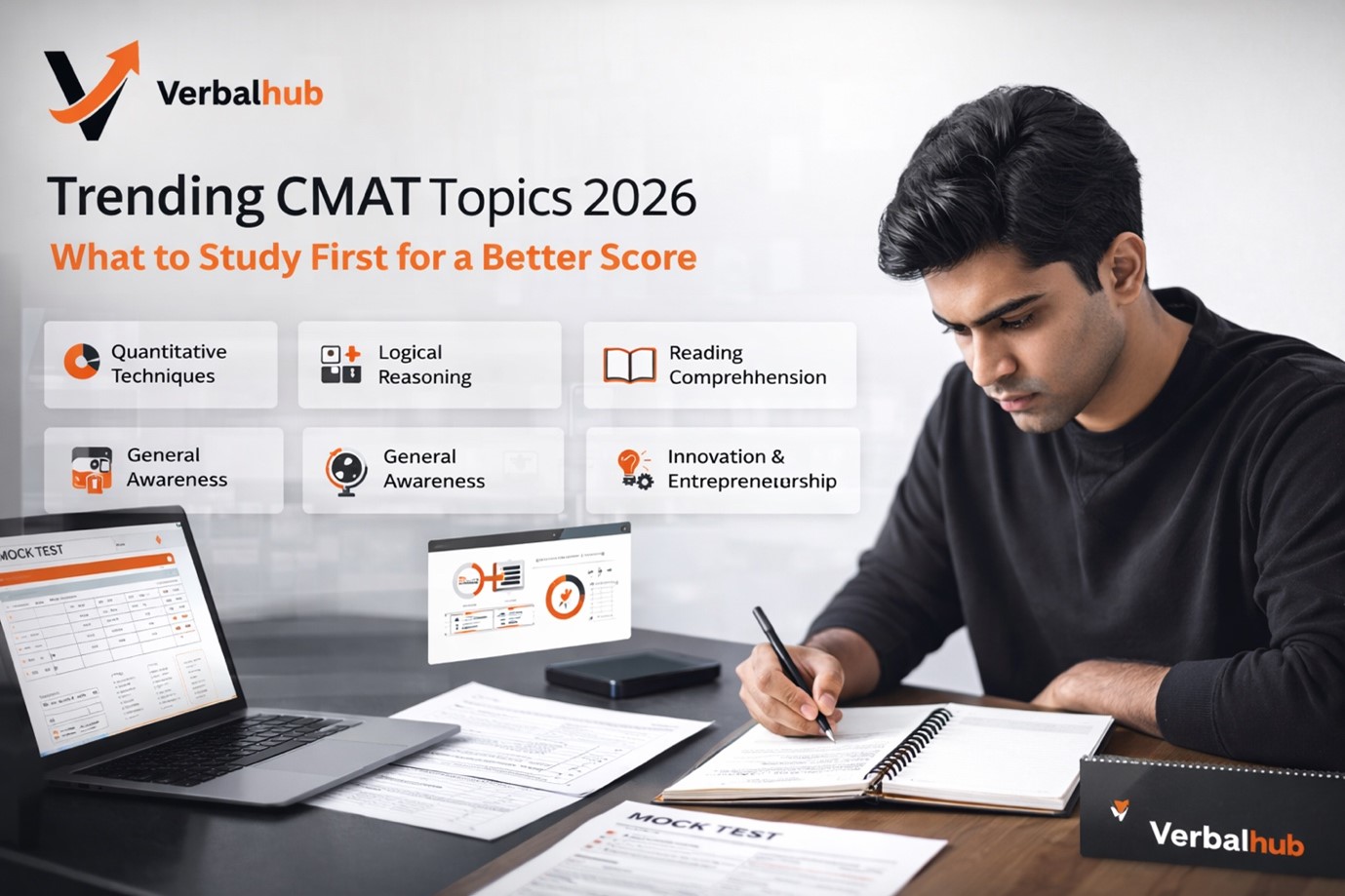
Trending CMAT Topics 2026: What to Study First for a Better Score
The most important CMAT topics for 2026 are Arithmetic, Data Interpretation, Logical Reasoning puzzles, Reading Comprehension, Current Affairs, and Innovation and Entrepreneurship basics. The best way to prepare is to study these high-scoring areas first, then use mocks and revision to improve speed, accuracy, and overall score.
Let us go in depth: CMAT preparation becomes much easier when you know where to focus first. Many students make the mistake of trying to study everything at once, but CMAT rewards smart preparation more than random hard work. If you want better accuracy, faster revision, and stronger mock performance, you need clarity on the most important topics.
That is why understanding CMAT trending topics, high-priority chapters, and the right study order can make a real difference in your score.
In this guide, VerbalHub breaks down the most important topics for CMAT 2026, explains which areas are more scoring, and shows you how to build a practical 30-day preparation plan. The objective is simple: turn your preparation into a clear plan instead of a scattered effort.
Why Topic Selection Matters in CMAT Preparation
CMAT is not only a syllabus-based exam. It is also a test of speed, judgment, and selection. Equal study time does not guarantee equal results; the student who focuses on high-value topics usually performs better.
Here is why topic selection matters:
- It helps you cover the most scoring areas first
- It improves confidence early in preparation
- It saves time during revision
- It makes mock test analysis more useful
- It helps you avoid spending too much time on low-return topics
A good CMAT strategy is not about doing more. It is about focusing on the right priorities in the right sequence.
CMAT 2026 Section-Wise Trending Topics
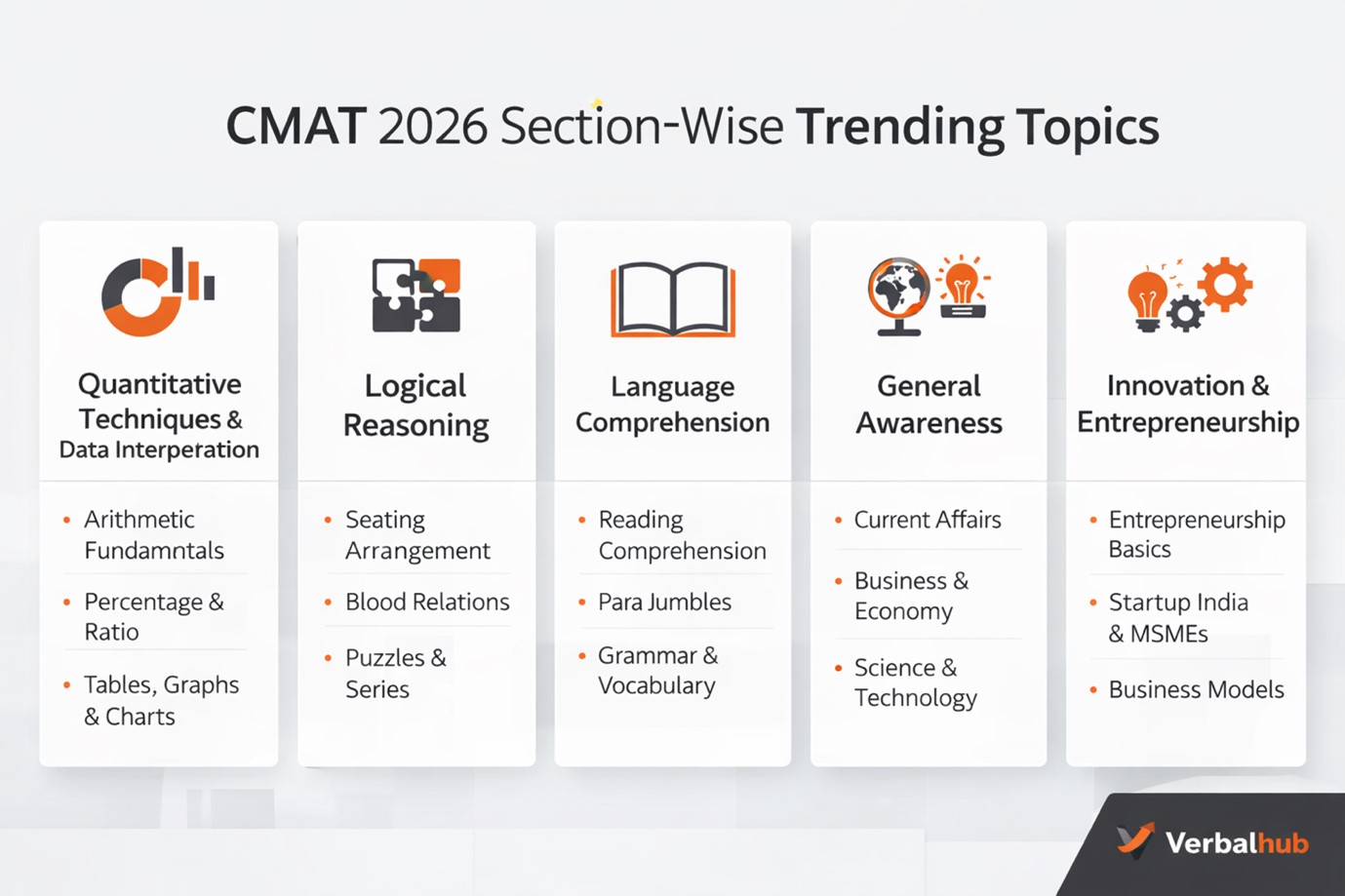
- Quantitative Techniques and Data Interpretation
For many aspirants, this is one of the most important sections for CMAT score improvement. The section is usually built around concepts that can become highly scoring once your basics are clear.
Important CMAT Quant topics:
| Percentages |
| Ratio and proportion |
| Profit and loss |
| Simple and compound interest |
| Time and work |
| Time, speed, and distance |
| Average and partnership |
| Algebra basics |
| Number system |
| Mixture and allegation |
Important Data Interpretation topics:
| Tables |
| Pie charts |
| Bar graphs |
| Line graphs |
| Mixed DI sets |
Why this section matters:
Arithmetic forms the backbone of CMAT Quant. These chapters are concept-based, repeat frequently, and become manageable with practice. DI is also a high-opportunity area because many questions are direct if your calculation speed is decent.
VerbalHub tip:
Start with Arithmetic before moving to advanced Quant. A strong Arithmetic base improves both your confidence and your mock performance quickly.
- Logical Reasoning
CMAT Logical Reasoning is one of the most practice-driven sections in the exam. The more patterns you solve, the better your speed and instinct become.
Important CMAT Logical Reasoning topics:
| Seating arrangement |
| Linear and circular puzzles |
| Blood relations |
| Coding-decoding |
| Direction sense |
| Series |
| Analogy |
| Syllogisms |
| Statement-conclusion |
| Cause and effect |
| Non-verbal reasoning |
Why this section matters:
This section can become very scoring for students who practice consistently. Puzzle-based questions may look tricky at first, but repeated exposure helps you solve them faster with fewer errors.
VerbalHub tip:
Do not prepare LR passively. Solve sets daily. Pattern recognition is the real game here.
- Language Comprehension
This section rewards a mix of reading ability, grammar awareness, and vocabulary control. Students often underestimate it, but it can become a strong scoring section with steady practice.
Important Language Comprehension topics:
| Reading comprehension |
| Para jumbles |
| Sentence correction |
| Error spotting |
| Cloze tests |
| Synonyms and antonyms |
| Idioms and phrases |
| Word usage |
| Grammar fundamentals |
Why this section matters:
Reading comprehension usually carries strong weight and tests more than language. It checks clarity, focus, and interpretation. Vocabulary and grammar-based questions can also help you collect quick marks if prepared properly.
VerbalHub tip:
Read something daily. Even 20 to 30 minutes of quality reading can improve comprehension, vocabulary, and sentence flow over time.
- General Awareness
Many students leave this section for the end, which is a mistake. CMAT General Awareness may feel unpredictable, but a focused preparation strategy can help you score valuable marks.
Important General Awareness areas:
| Current affairs from the last 6 to 12 months |
| Business and economy |
| Awards and honours |
| Government schemes |
| Sports |
| Science and technology |
| International events |
| Static GK related to India |
| Important organisations and days |
Why this section matters:
This section can improve your overall score without requiring lengthy calculations. A well-prepared student can pick up marks quickly here.
VerbalHub tip:
Do not try to memorize everything. Revise smartly using short notes, weekly current affairs summaries, and CMAT-specific GK lists.
- Innovation and Entrepreneurship
This is one of the most unique sections in the CMAT syllabus, and it gives serious aspirants a chance to gain an edge.
Important Innovation and Entrepreneurship topics:
| Startup India |
| Entrepreneurship basics |
| Business models |
| Venture capital and funding |
| MSMEs |
| Intellectual Property Rights |
| Innovation concepts |
| Government support for startups |
| Business growth ideas |
| Leadership and entrepreneurial mindset |
Why this section matters:
With a clear grasp of the basics, this section is often quite approachable.
Students who prepare this area properly often find it easier than expected.
VerbalHub tip:
Treat this section as a scoring opportunity, not an extra burden. Basic conceptual understanding is often enough.
What Are the Most Scoring CMAT Topics to Study First?
If your preparation time is short, prioritise the topics that can improve your score the fastest.
Priority list for CMAT 2026:
- Arithmetic in Quantitative Techniques
- Puzzles and seating arrangement in Logical Reasoning
- Reading comprehension in Language Comprehension
- Current affairs and business news in General Awareness
- Startup and entrepreneurship basics in Innovation and Entrepreneurship
This study order works well because it balances concept building, scoring potential, and confidence improvement.
Smart Study Priority Order for CMAT 2026
A practical order can help you avoid overload and prepare more strategically.
Step 1: Build your base
Start with Arithmetic, core LR topics, and reading comprehension.
Step 2: Add scoring support
Move to vocabulary, grammar, DI, and current affairs.
Step 3: Cover edge-giving sections
Prepare Innovation and Entrepreneurship with short concept notes.
Step 4: Test and refine
Use mocks to test yourself, identify errors, and improve the areas that need more attention.
This sequence helps you build momentum first and polish performance later.
A Simple 30-Day CMAT Preparation Plan
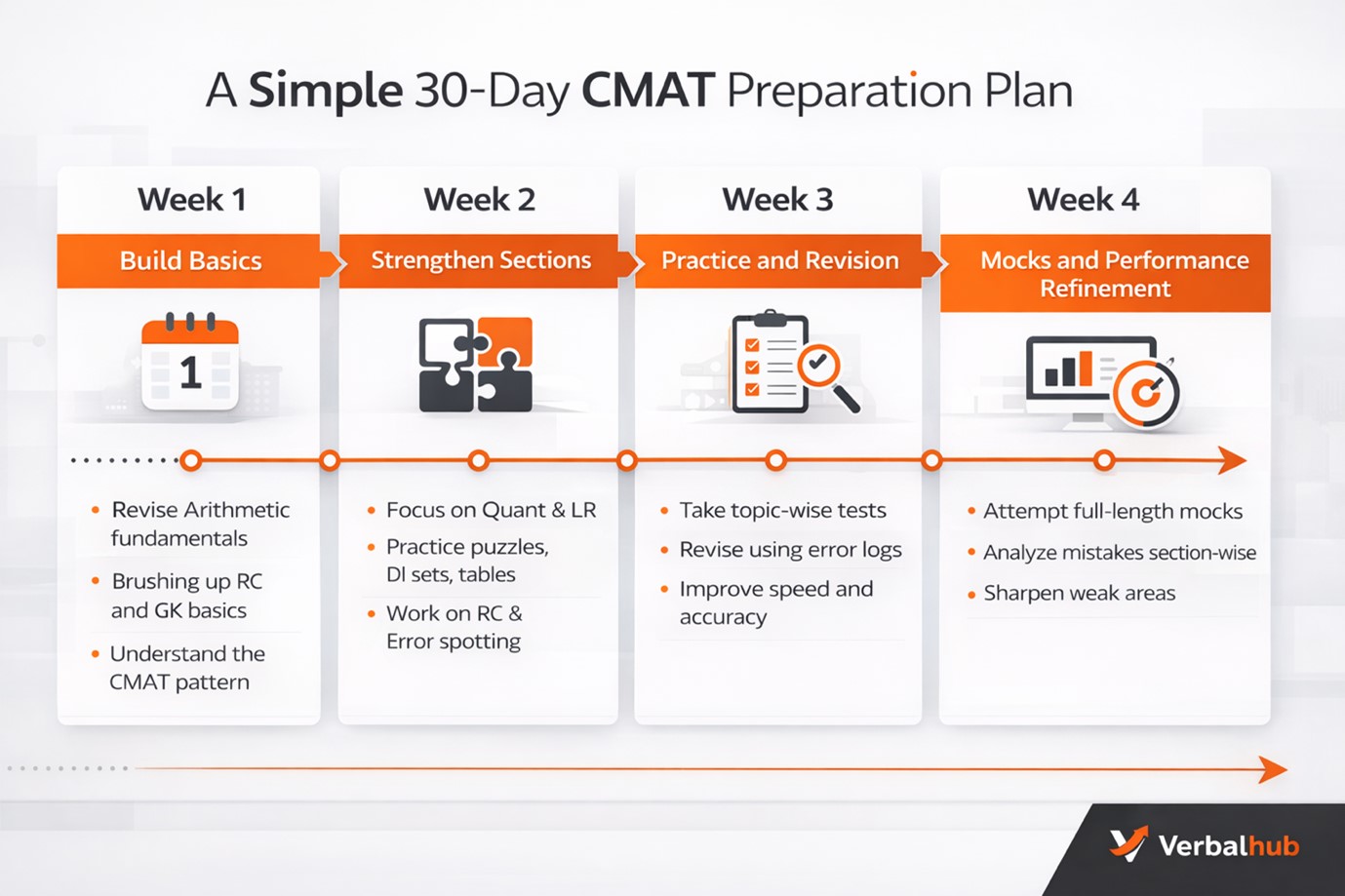
If you have one month left, do not panic. A focused 30-day strategy can still help you improve significantly.
Week 1: Strengthen basics
| Arithmetic fundamentals | LR basics like blood relations, coding-decoding, direction sense | Start daily reading practice | Begin current affairs revision |
Week 2: Build section-wise control
| Practice DI sets | Solve seating arrangement and puzzle questions | Work on RC, para jumbles, and grammar | Revise entrepreneurship basics |
Week 3: Increase application
| Attempt sectional tests | Identify weak areas | Revise important GK topics | Practice mixed question sets for speed |
Week 4: Convert preparation into performance
| Take full-length CMAT mocks | Analyse accuracy and time usage | Revise formulas, vocabulary, and notes | Focus only on improvement areas, not new topics |
VerbalHub advice:
- During the last 10 days, mock analysis matters more than random study. Every mock should tell you what to fix next.
- Common Mistakes to Avoid in CMAT Preparation
- A strong plan also means avoiding avoidable errors.
Do not:
- Study all topics with equal intensity
- Ignore mock test analysis
- Leave GK and Innovation for the last week
- Spend excessive time on topics that require effort but deliver low returns.
- Skip revision in favour of only solving new questions
- Smart preparation is always more effective than chaotic effort.
Frequently Asked Questions
The most important CMAT topics for 2026 include Arithmetic, Data Interpretation, Puzzles, Seating Arrangement, Reading Comprehension, Current Affairs, and Innovation and Entrepreneurship basics. These topics are often seen as high-priority because they offer strong scoring potential and form the core of effective CMAT preparation.
Most students should begin with Quantitative Techniques and Logical Reasoning, especially Arithmetic and puzzle-based LR. These areas take time to build and improve with practice. Once the basics are clear, you can move to Language Comprehension, General Awareness, and Innovation and Entrepreneurship
Yes, General Awareness is very important in CMAT. Although it can feel unpredictable, this section can help improve your overall score quickly if you revise current affairs, business news, important awards, government schemes, and static GK consistently.
A smart 30-day CMAT plan should begin with Quant and LR basics, then move to Reading Comprehension, grammar, vocabulary, current affairs, and entrepreneurship concepts. The final week should focus on mocks, revision, and error analysis instead of learning too many new topics.
Arithmetic topics such as percentages, ratio and proportion, profit and loss, averages, time and work, and time-speed-distance are considered among the most scoring topics in CMAT Quant. Data Interpretation is also highly important.
For many students, Innovation and Entrepreneurship can become one of the easier scoring sections if prepared properly. Basic knowledge of startups, business models, MSMEs, funding, and innovation concepts is often enough to answer many questions confidently.
Final Takeaway
The best CMAT preparation strategy starts with clarity. Once you know the CMAT important topics, your study plan becomes sharper, faster, and more productive. Instead of trying to cover everything blindly, focus first on the topics that appear often, carry strong scoring potential, and help you build confidence early.
For CMAT 2026, start with Arithmetic, Logical Reasoning patterns, Reading Comprehension, Current Affairs, and Innovation basics. Follow that with mocks, analysis, and revision. That is how score improvement becomes realistic.
At VerbalHub, we believe smart preparation beats scattered preparation. If you want structured guidance, expert mentoring, and a preparation plan that actually feels manageable, VerbalHub can help you prepare with confidence and clarity.

Get your CMAT 2026 preparation on the right track with VerbalHub’s structured guidance, smart topic prioritisation, and mock-based improvement strategy.



Our Teachers

Dr. G Ravindra Babu
Quant Faculty
Ph. D in Mathematics Asian International University|| Mathematics Professor at Gitam University || Ex-Mathematics Professor SRM University Amaravathi || MBA in finance Acharya Bangalore B School || GMAT Quant 51, CAT Quant 99.58 %tile, GRE Quant 170 || 21 Different Teaching Certification || Believe in “Education is the mother of leadership”
view details

Dr. Rengarajan Parthasarathy
CAT Faculty
Ph. D in Mathematics from YCM University|| Mathematics Professor at Symbiosis International|| Author of Business Ethics || Ex-CAT Exam Syllabus Advisor in IIM || MBA & MPM from Symbiosis International (Deemed University) || College Topper in Mathematics in Ferguson College || Six Scholarships in Mathematics || 15 Years CAT Coaching, GMAT Coaching and GRE Coaching Experience|| UGC NET Qualified || GMAT Q51, V38 & CAT Q 99.31 & DILR 99.38 %tile, GRE Quant 170 || Believe in “Higher Education Shapes The World.”
view details

Dr. Nisha Tejpal
Verbal & AWA Faculty
Ph. D in English || Published a paper in English in ‘Research Journal of Philosophy and Social Sciences’ || MCA and B.Ed CCS University || A subject expert in Verbal Teaching || 10,000 Plus Essays Analysis || CTET and NET Qualified || More than 15 years of Experience || A writer, Author and Poet || Believe in “Think Beyond the Universe”
view details

Dhrithi Khattar
Verbal Faculty
A subject expert in Verbal Aptitude || More than 15 years of Experience || MBA in HR& Marketing & MA in Economics || Active Member of Hindu Alumni Association || Functional Member of Delhi ||Management Association (DMA) || Operational Member of All India Management Association (AIMA) ||The President of Key Club ||An active member of the French Club ||Gold Seal from California Scholarship Federation.
view details
M. U. Mir
DILR & Quant Faculty
A subject expert in Quantitative Aptitude Training || GMAT Q 51 & CAT DILR 99.75 %tile || GATE 2020 Qualified || M. Tech & B. Tech University Toper (1st Rank) || Awarded by Gov of Odisha, Bihar and J& K for the project Magnetic Floating Model || Ex-Quant Subject Expert in Arihant Publication || An Educationist and Social Worker || Believe in “Education is power”
view details

C. S. Rajawat
CAT Faculty
M. A in Mathematics CCS University|| M. Tech from SRM University || Visiting Mathematics Faculty CCS University ||Experience of 11 Years of CAT Coaching || District Topper in 10th & 12th || Best Teacher Awardee in 2021 & 2022 || CAT Quant 99.43 %tile || Discovered a new Theorem based on HCF in Math || Founder of C. S. Classes ||Believe in “Teaching and Training is an Art.”
view details

Dr. S.K. Singh
PTE/IELTS/CELPIP Expert
Ph. D. English Dr. B. R. Ambedkar University || Delhi & Center Government School Mentor || Founder of Entrepreneur & Learning Startup || IELTS & CELTA Certified from British Council || PTE Certified from Pearson...
view detailsRishabh Arora
PTE/IELTS/CELPIP Expert
MBA in HR International Institute of Management Sciences || PTE Certified from Pearson Test of English|| IELTS & CELTA Certified from British Council || BCA from Integral University || PTE 87 in 2017, IELTS 8.5 in 2018
view details
Jyoti Joshi
IELTS Trainer
Master in English (MA) and Bachelor in Education (B.Ed) || Certified Trainer || IELTS Speaking 9.0 Band holder || Believe in “Great teacher can inspire hope, ignite the imagination, and instill a love of learning”
view details
Surbhi Arora
IELTS / PTE Expert
English Language Expert || More than 3 years of Experience || M.A plus B. Ed Delhi University ||Author, Writer & Classical Singer|| Believe in “Language Language Learning & Teaching is Fun”
view details

Dilip Kumar Rathore
Quant Trainer
A business developer and genius in mathematics || Highly experienced || Master in Maths || well-verse in IT || Believe in “The art of teaching is the art of assisting discover”
view details

Imaam Hasan
Communication Expert
Master in English || Journalist and writer || Certified IELTS & PTE Trainer || A social educater and influencer || Believe in “Education is the movement from darkness to light”
view details