
CAT SUCCESS STORY — 99 PERCENTILE

99CAT Percentile
IIM IndoreCall Received
IIM BangaloreCall Received
IIM CalcuttaCall Received
Quick Snapshot
| CAT Percentile | 99 |
| IIM Calls Reported | IIM Indore, IIM Bangalore, IIM Calcutta |
| Key Challenge | Choosing the right questions, sets and passages under time pressure |
| Solution | Section-wise teaching, personal mentoring and regular All-India CAT mock tests |
| Training Provider | VerbalHub |
A high CAT percentile does not come from studying every topic for the same number of hours.
It comes from making better choices.
Which passage should you attempt first? Which DILR set should you leave? When should you stop working on a difficult Quant question? What should you change after a poor mock score?
These decisions played a major part in Shiven's CAT preparation.
With structured classes, section-wise faculty support, personal mentoring and regular All-India CAT mock tests at VerbalHub, Shiven scored 99 percentile in CAT. He also received calls from IIM Indore, IIM Bangalore and IIM Calcutta, as reported on VerbalHub's result pages.
His result offers a useful lesson for every CAT aspirant:
You do not need to solve every question. You need to recognise the right questions, attempt them accurately and learn from every test.
How Did Shiven Score 99 Percentile in CAT?
Shiven followed a section-wise CAT preparation strategy that combined concept learning, timed practice, mock-test analysis and personal feedback. Instead of studying without a clear direction, he used his test performance to decide what to work on next.
CAT tests much more than subject knowledge.
A student may understand Arithmetic but still lose marks by choosing lengthy questions. Another may read well but fall for close answer choices in VARC. Someone who can solve difficult DILR sets at home may struggle to select the right set during the exam.
Shiven's preparation addressed these problems separately.
His study process included:
- Concept classes for VARC, DILR and Quant
- Topic-wise and sectional practice
- Timed question-solving sessions
- Full-length All-India CAT mock tests
- Detailed review of incorrect and unattempted questions
- Personal feedback from VerbalHub faculty
- Changes to the weekly plan based on test performance
This helped him connect classroom learning with the decisions required in the actual CAT exam.
Why Are Good Academic Marks Not Enough for CAT?
Strong school or college marks can give you a useful base, but they do not automatically lead to a high CAT percentile. CAT also tests question selection, accuracy, time control and the ability to think clearly under pressure.
Many students start CAT preparation with a strong academic record. They know how to study, understand concepts and work hard.
Yet their mock scores remain uneven.
The reason is simple: CAT does not reward effort alone. It rewards the quality of the decisions made during a limited test window.
A student must know:
- Which questions are worth attempting
- Which questions should be left immediately
- How much time to give a Reading Comprehension passage
- How to compare two attractive VARC options
- Which DILR set offers the best chance of completion
- When to use a short Quant method
- When to stop before one question damages the entire section
These skills improve through timed practice followed by careful analysis.
That was an important part of Shiven's preparation at VerbalHub.
Why Should CAT Be Prepared as Three Separate Sections?

VARC, DILR and Quant test different abilities, so each section needs its own preparation method. A single study routine cannot fix every weakness across all three sections.
A common CAT preparation mistake is to treat the syllabus as one long list of topics.
In practice, CAT is closer to three different tests.
VARC checks how you read and judge
VARC is not only a test of English vocabulary. It checks whether you can follow an argument, understand the role of a paragraph, identify the author's position and reject answer choices that sound reasonable but lack textual support.
DILR checks how you organise information
Knowing how to solve a set is only one part of DILR. Students must also scan the available sets, judge their difficulty, recognise a workable structure and choose where to begin.
Quant checks concepts and application
Memorising formulas does not guarantee a strong Quant score. You must understand the underlying concept, recognise the suitable method and decide whether a question deserves your time.
VerbalHub's section-wise teaching helped Shiven work on these demands separately.
What Is the Best Way to Improve CAT VARC Accuracy?
To improve CAT VARC accuracy, focus on passage structure, evidence-based answer selection and option elimination. Review why each wrong option looked attractive instead of checking only the correct answer.
Reading more articles can improve comfort with unfamiliar subjects, but reading alone is rarely enough.
CAT VARC questions often contain options that are:
- Broader than the passage
- Narrower than the author's point
- Partly correct but incomplete
- Based on outside knowledge
- Written in extreme language
- Related to the topic but unsupported by the text
Students therefore need a repeatable way to read and evaluate options.
How Did Hasan Sir Support Shiven's VARC Preparation?
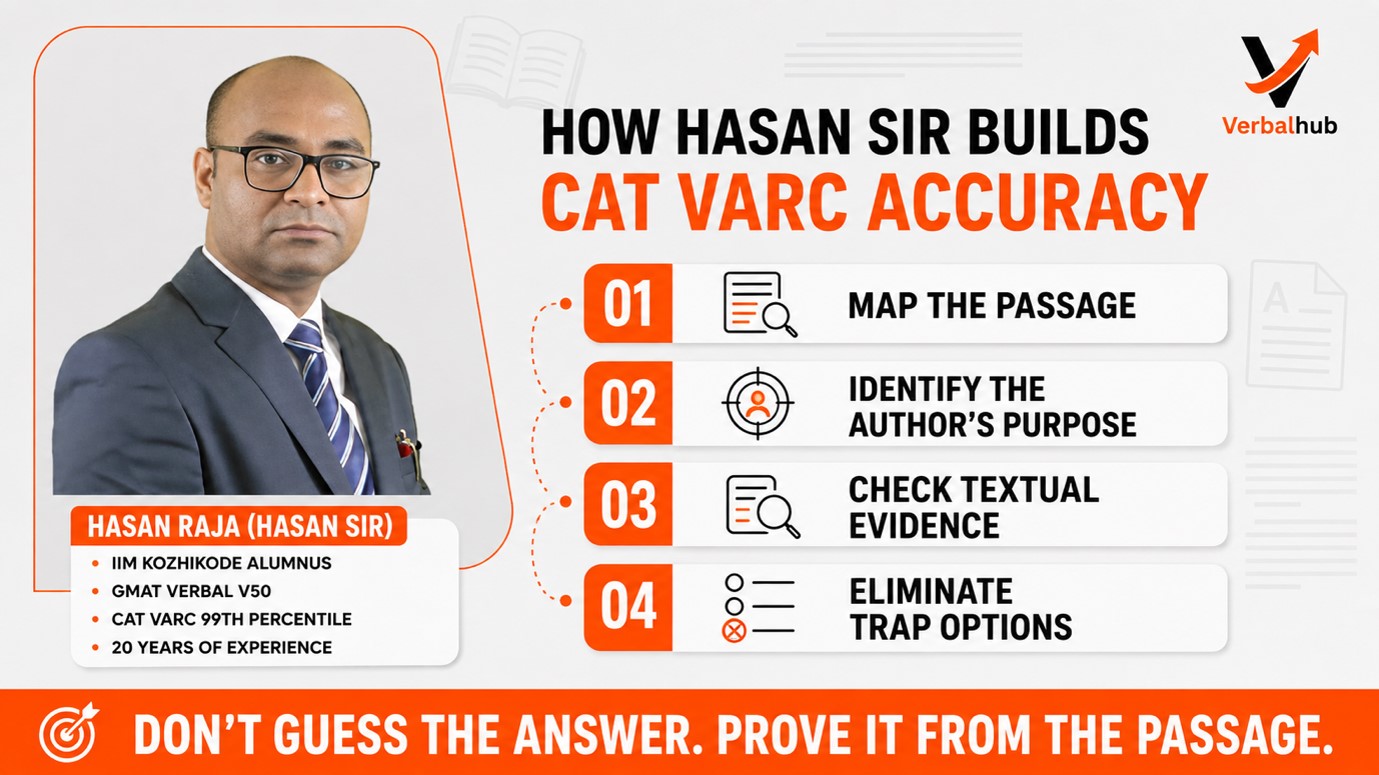
Hasan Raja's CAT VARC teaching focuses on passage structure, author intent, evidence checking and the reasoning behind option elimination. His approach helps students understand why an answer is correct and why the other choices fail.
Hasan Raja is an IIM Kozhikode alumnus and Senior Verbal Faculty member at VerbalHub.
His published credentials include:
- 20 years of Verbal teaching experience
- GMAT Verbal V50 score
- 99th-percentile performance in CAT VARC
- Experience in Reading Comprehension and Critical Reasoning
- More than 10,000 learners trained across exam preparation and language programmes
During VARC preparation, students are encouraged to ask:
- What is the author trying to establish?
- What purpose does this paragraph serve?
- Has the tone changed anywhere in the passage?
- Is this option supported by a specific line or idea?
- Does the answer exaggerate what the passage says?
- Am I selecting this option because it is correct or because it sounds familiar?
This method turns VARC review into a reasoning exercise.
It also helps students identify repeated mistakes instead of blaming every wrong answer on weak vocabulary.
How Do You Select the Right DILR Sets in CAT?
Begin by scanning all DILR sets and checking their structure, conditions and possible entry points. Select a set based on clarity and solvability, not merely because its topic looks familiar.
Students often practise DILR by solving one set placed in front of them.
The real CAT exam creates another problem: you must first decide which set deserves your time.
A difficult-looking set may become manageable after a simple table is created. A familiar arrangement set may contain too many conditions and consume valuable minutes.
VerbalHub's DILR preparation works on both solving and selection.
Students practise how to:
- Scan the complete section before committing
- Identify sets with clear starting information
- Estimate the number of cases required
- Build tables and diagrams cleanly
- Notice restrictive conditions
- Leave an unproductive set without panic
- Review whether the original set choice was correct
The DILR and Quant faculty, including M. U. Mir, support this section of the programme. His published credentials include a 99.75 percentile in CAT DILR and a GMAT Quant Q51 score.
The goal is not to make every set easy. It is to help students recognise the sets they can solve accurately within the available time.
What Is the Right CAT Quant Preparation Strategy?
Build your Quant foundations first, then move to timed mixed practice. Track whether marks are being lost because of a concept gap, calculation error, poor question choice or slow execution.
Many students rush into difficult CAT questions before their basic concepts are stable.
This creates two problems. First, they struggle to recognise the right method. Second, they spend too much time learning from solutions without being able to reproduce the reasoning independently.
VerbalHub's CAT Quant preparation begins with core areas such as:
- Arithmetic
- Algebra
- Geometry
- Number Systems
- Modern Mathematics
After concept practice, students move to mixed and timed question sets.
At this stage, the focus shifts from "Can I solve this?" to more practical questions:
- Can I recognise the topic quickly?
- Is there a shorter method?
- Should I attempt this question now?
- Can I solve it accurately within the required time?
- Was the long calculation necessary?
- Did I miss a simpler observation?
Faculty members such as M. U. Mir and C. S. Rajawat, who has years of specialised CAT Quant teaching experience, help students strengthen concepts and apply them under exam conditions.
How Do Small CAT Batches Improve Preparation?
Small live batches give students more opportunities to ask questions, explain their reasoning and receive individual feedback. They also help teachers notice personal learning patterns that may remain hidden in a large class.
VerbalHub generally keeps its live CAT batches to around 5–7 students.
This allows a class discussion to go beyond whether an answer is right or wrong.
A teacher can ask:
- Why did you choose this VARC option?
- Why did you start with this DILR set?
- Why did you use this Quant method?
- At what point did you realise the question was difficult?
- Is this mistake appearing in several mocks?
These conversations matter because two students with the same score may have completely different problems.
One may need stronger concepts. Another may understand the concepts but attempt the wrong questions. A third may perform well during practice but lose accuracy under time pressure.
A smaller class makes it easier to spot these differences early.
How Does Personalised CAT Mentoring Help?

Personalised CAT mentoring turns scores and practice results into a practical weekly plan. The mentor identifies the student's current weakness, sets priorities and checks whether the recommended changes improve performance.
Generic advice such as "practise more" does not tell a student what to practise.
Personalised guidance makes the next step clearer.
Depending on the student's performance, a VerbalHub mentor may recommend:
- Revising a specific Quant concept
- Reducing RC attempts temporarily to improve accuracy
- Practising DILR set scanning
- Changing the order of attempts
- Working on time checkpoints
- Reviewing unsupported VARC options
- Taking a sectional test before the next full mock
- Building a personal error log
- Retesting previously weak question types
The plan can also be adjusted around college classes, examinations or working hours.
This prevents students from spending equal time on every topic when only a few areas are pulling down the score.
What Role Did VerbalHub's All-India CAT Mock Tests Play?
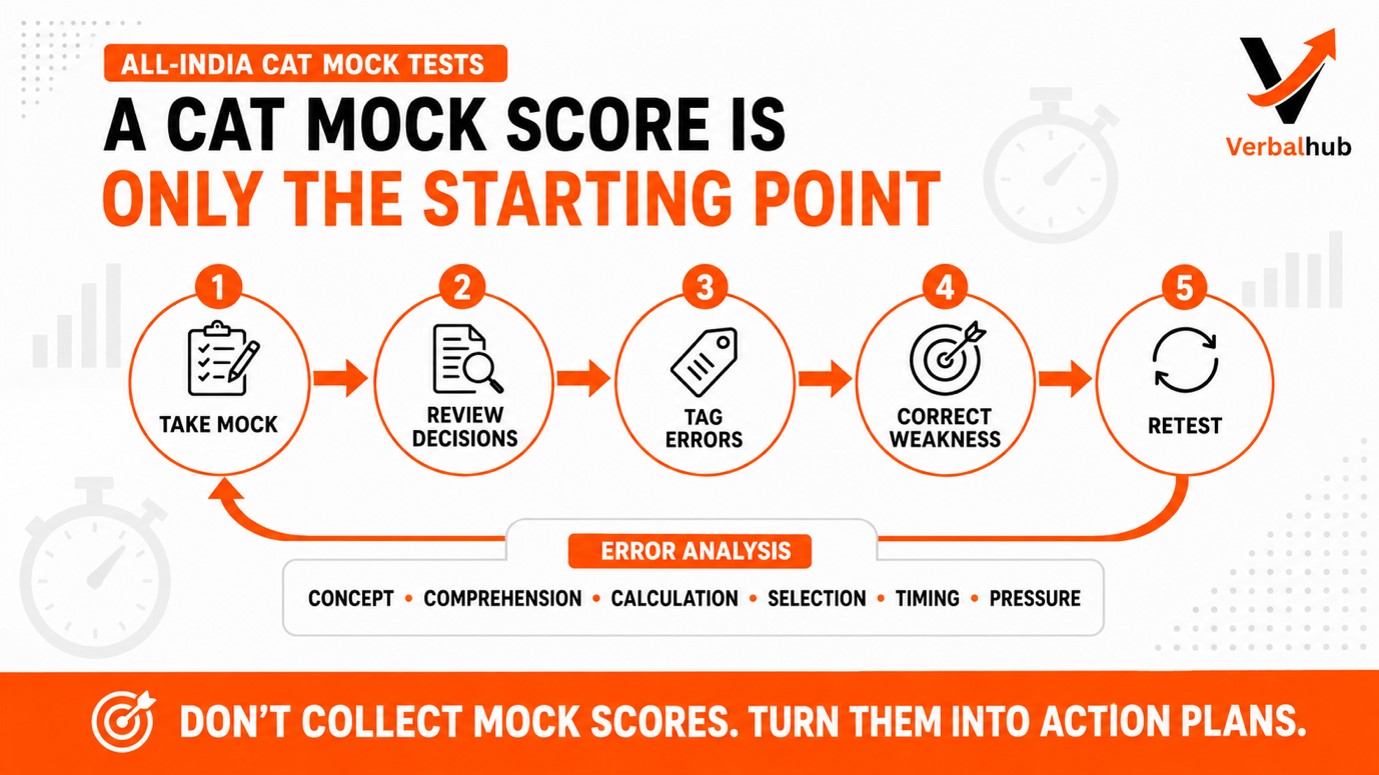
All-India CAT mock tests helped Shiven practise under realistic time limits and compare his performance within a competitive test pool. More importantly, mock analysis showed where he was losing marks and what needed to change before the next test.
A CAT mock is useful only when it leads to action.
The percentile is important, but it is not the complete result.
After every mock, students should review:
- Which easy questions did I miss?
- Which difficult questions took too much time?
- Did I select the right RC passages and DILR sets?
- Where did my accuracy fall?
- Did my section strategy work?
- Which mistake appeared more than once?
- What will I change in the next mock?
VerbalHub's mock-test programme includes full-length national-level tests, sectional tests and performance analysis across VARC, DILR and Quant.
These tests help students track:
- Overall and sectional percentile
- Accuracy
- Attempt rate
- Time spent per question
- Question selection
- Topic-wise performance
- Repeated error patterns
For Shiven, mocks were not simply score-reporting exercises. They became a regular part of the learning process.
How Should You Analyse a CAT Mock Test?
Review every incorrect and unattempted question, then label the reason behind the lost marks. Use the findings to create a short correction plan for the following week.
A useful error log can include six categories:
Concept: I did not know the method.
Comprehension: I misunderstood the question or passage.
Calculation: I knew the approach but made a numerical error.
Selection: I chose a poor question, passage or set.
Timing: I continued for too long before moving on.
Pressure: I changed a sound approach because I panicked.
The label determines the correction.
If "concept" appears repeatedly in Quant, revise the topic before taking another mock.
If "selection" dominates DILR, practise scanning sets rather than solving random sets one after another.
If "comprehension" is the main VARC problem, focus on passage structure and evidence before attempting speed drills.
Mock analysis works when the diagnosis changes the next week's preparation.
What Weekly CAT Preparation Routine Can Students Follow?
Use a weekly cycle of goal setting, concept review, timed practice, testing and error analysis. Repeat the cycle with one or two clear changes instead of rebuilding the entire plan after every score.
- Set the goal — Choose one measurable target for the week. Example: improve RC accuracy, revise Arithmetic or reduce DILR set-selection time.
- Strengthen the concept — Study the method carefully and solve a few questions without time pressure.
- Practise under time limits — Use mixed questions and sectional tests to apply the method in CAT conditions.
- Take a mock test — Follow the planned section order and time checkpoints.
- Review every decision — Study wrong answers, skipped questions, long attempts and moments of confusion.
- Correct and retest — Practise the identified weakness and check whether the change works in the next test.
The cycle can be remembered as:
Learn → Practise → Test → Diagnose → Correct → Retest
What Can CAT Aspirants Learn from Shiven's Result?
Shiven's CAT 99 percentile result shows that preparation improves when students know what to correct.
The main lessons are straightforward:
- Treat VARC, DILR and Quant differently
- Build concepts before chasing speed
- Practise question and set selection
- Take mocks in realistic conditions
- Analyse mistakes by cause
- Use feedback to change the weekly plan
- Track repeated errors
- Stay consistent when scores fluctuate
No teacher can take the CAT on behalf of a student.
The final result still depends on the learner's effort, discipline, starting level, available preparation time and exam-day decisions.
Good coaching makes that effort more focused.
For Shiven, the combination of section-specialist teaching, small live batches, personal mentoring and All-India CAT mock-test analysis helped turn daily preparation into a clear performance plan.
Is VerbalHub the Right CAT Coaching Option for You?
VerbalHub may be a suitable choice if you are looking for:
- Live CAT classes in small batches
- Dedicated VARC, DILR and Quant faculty
- Personalised CAT study plans
- One-to-one mentoring
- Regular doubt support
- Sectional and full-length CAT mock tests
- Detailed performance analysis
- Individual feedback on repeated mistakes
The aim is not to give every student the same timetable.
It is to understand where each student is losing marks and build the preparation plan around that evidence.
Frequently Asked Questions
Shiven scored 99 percentile in CAT. VerbalHub's published result pages also report calls from IIM Indore, IIM Bangalore and IIM Calcutta.
His preparation included section-wise teaching, personalised mentoring, timed practice, full-length mock tests and detailed performance analysis.
Hasan Raja is a Senior Verbal Faculty member and CAT VARC specialist at VerbalHub. He is an IIM Kozhikode alumnus with 20 years of teaching experience, a GMAT Verbal V50 score and 99th-percentile performance in CAT VARC.
Yes. VerbalHub's CAT courses cover VARC, DILR and Quant through section-specific faculty, concept classes, timed practice and mock analysis.
VerbalHub generally keeps its live CAT batches small, with around 5–7 students, to allow direct interaction and personal feedback.
Yes. Its CAT preparation programme includes national-level full-length mock tests, sectional tests and detailed performance analysis.
No responsible coaching programme can guarantee a fixed CAT percentile. Results depend on the student's starting level, preparation time, consistency, test strategy and performance on exam day.
Result note: Shiven's percentile and reported IIM calls are based on VerbalHub's published result information. Individual outcomes may vary.