
PTE SUCCESS STORY — SPEAKING 60 TO 79

Quick Snapshot
| Target | 65+ in every PTE section for Australian migration |
| Before | PTE Speaking 60 |
| After | PTE Speaking 79 |
| Overall Score | PTE 79 |
| Training | Approximately five hours of focused, individual coaching |
| Training Provider | VerbalHub |
Soni improved her PTE Speaking score from 60 to 79 after her training shifted from general practice to personalised correction. Her trainer identified the exact speaking habits affecting her performance and helped her work on them through focused practice, immediate feedback and repetition.
That short answer explains the result. The longer story explains why it matters.
For almost a year, Soni had been working towards one clear target: at least 65 in each PTE module for her migration journey to Australia.
She was not beginning from a low level. Her Writing score had reached 90, while her Reading and Listening performance was close to what she needed. Speaking was the section holding her back.
At one point, her PTE Speaking score had been as low as 47. Months of preparation helped her reach approximately 60, but she could not consistently cross the required 65.
She practised more, watched online lessons and approached different training providers. Yet one question remained unanswered:
What exactly was going wrong in her Speaking responses?
Finding the answer changed the direction of her PTE preparation.
Why Was Soni's PTE Speaking Score Stuck at 60?
Soni's score was not stuck because she lacked effort. She had already spent months studying English, building vocabulary and practising PTE tasks.
The problem was that practice alone could not reveal the small speaking habits reducing her score. Without specific feedback, she was repeating some of the same patterns in every practice session.
This happens to many PTE students. They complete more mock tests, repeat Read Aloud passages and collect templates, but their score barely changes. The issue is often not the amount of practice. It is the absence of a clear diagnosis.
A student may need help with:
- Uneven speaking pace
- Long or misplaced pauses
- Unclear pronunciation
- Dropped word endings
- Mother-tongue influence
- Hesitation when reading unfamiliar sentences
- Fluency that breaks when the student tries to correct a word
Two students can receive the same Speaking score for completely different reasons. That is why a generic study plan may not solve an individual performance problem.
How Did VerbalHub's Personalised PTE Coaching Help Soni?
Soni's VerbalHub journey began with a discussion about her target, previous test scores, available preparation time and the section preventing her from moving forward.
Hasan Sir focused first on understanding the score gap instead of placing her into a standard course plan. Since Speaking was the clear concern, her preparation was built around that section.
Rishabh Sir then worked closely with her on her Speaking responses. He listened to her Read Aloud performance, asked her to repeat sentences and identified patterns connected with pace, pauses, pronunciation, mother-tongue influence and word endings.
The feedback was practical. Soni was not simply told to "speak more fluently." She was shown where her fluency was breaking and what she could do differently in the next attempt.
This is the difference between broad advice and personalised PTE coaching:
- Broad advice identifies a general weakness.
- Personalised feedback identifies the behaviour causing it.
- Focused practice gives the student a way to correct that behaviour.
- Retesting shows whether the correction is working.
Soni's classes were short and concentrated because she did not need to restart every PTE section. She needed individual attention on the area that was limiting her result.
What Did Her PTE-Certified Trainer Correct in Speaking?
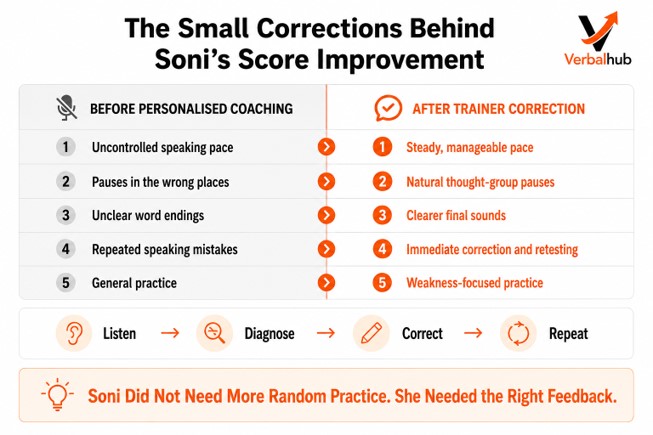
The trainer worked on small, repeatable habits that Soni could apply during the exam.
- Speaking at a controlled pace — Speaking quickly does not always produce better fluency. When a student rushes, pronunciation may become unclear, word endings may disappear and a single mistake can disturb the rest of the sentence. Soni practised maintaining a steady pace that she could control from the beginning to the end of a response.
- Pausing at natural points — Random pauses can make a response sound broken. Avoiding every pause can also reduce clarity. Her trainer helped her pause at full stops and natural thought groups, making her delivery easier to manage without interrupting the flow of the sentence.
- Pronouncing word endings clearly — Final sounds can become unclear when a student speaks quickly or carries speech habits from their first language into English. Through repeated Read Aloud practice, Soni became more aware of sounds and endings that she was dropping or changing.
- Reducing hesitation — Trying to fix every imperfect word in the middle of a response can damage fluency. Soni worked on continuing with control rather than stopping repeatedly to self-correct.
- Applying feedback immediately — Each correction was followed by another attempt. This allowed the trainer to check whether the same issue remained and helped Soni practise the improved pattern while the feedback was still fresh.
The process was simple:
Listen → Diagnose → Correct → Repeat
The value came from applying that process to Soni's actual speech rather than giving her a list of general Speaking tips.
How Quickly Did Soni Improve Her PTE Speaking Score?
Soni improved from approximately 60 in Speaking to 79 after roughly one week of preparation and around five hours of focused classes.
She had initially expected to prepare for longer. An urgent update connected with her Australia process meant she needed to take the test sooner than planned.
She entered the exam with a short preparation window but a clearer understanding of what she needed to do. During the test, she could recall her trainer's reminders about pace, pauses, pronunciation and fluency.
Her final result was:
- PTE Speaking: 79
- Overall PTE score: 79
This does not mean every student will improve by the same number of points in the same period. Preparation time depends on a learner's starting level, target score, weak tasks and ability to apply feedback.
Soni's result shows something more useful: when the main score barrier is correctly identified, targeted training can make preparation far more efficient.
How Do VerbalHub's Personalised PTE Classes Work?
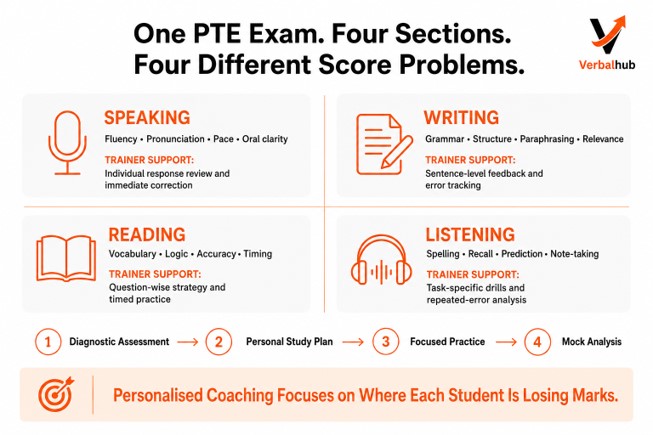
VerbalHub's PTE training is built around the learner's current performance, target score and section-wise needs. The aim is not to give every student the same material. It is to identify where marks are being lost and decide what should be practised next.
A personalised preparation plan may include a diagnostic assessment, live online classes, individual feedback, task-wise exercises, section tests and mock-test analysis.
The trainer's approach changes across the four PTE sections:
| PTE Section | Skills Reviewed | Personalised Trainer Support |
|---|---|---|
| Speaking | Fluency, pronunciation, pace, oral clarity and task execution | Listening to individual responses, identifying speech patterns and providing immediate correction |
| Writing | Grammar, sentence construction, structure, relevance and time management | Reviewing responses, marking repeated errors and explaining how to improve specific sentences |
| Reading | Vocabulary in context, collocations, comprehension, logic and timing | Using question-wise strategies and timed practice based on the learner's accuracy patterns |
| Listening | Spelling, prediction, note-taking, short-term recall and task accuracy | Tracking repeated mistakes and assigning focused practice for tasks such as Write From Dictation |
Templates can help students organise a response, but they cannot replace language control, task understanding or individual correction. A useful strategy must fit both the task and the learner.
Students looking for structured support can explore VerbalHub's PTE preparation options and one-to-one PTE training.
Why Does Personal Attention Matter in PTE Preparation?
Personal attention turns a vague weakness into a specific action.
"Improve your Speaking" is too broad. A student needs to know whether to control pace, reduce long pauses, pronounce endings more clearly or practise a particular task.
The same principle applies to every section:
- A Writing score may be affected by repeated grammar errors rather than a lack of templates.
- A Reading problem may come from slow decisions, weak collocations or difficulty following sentence connections.
- A Listening score may fall because of spelling mistakes even when the student understands the audio.
- A Speaking problem may involve fluency, pronunciation or both.
Individual feedback helps the trainer separate these causes. It also gives the student a clear priority for the next class or practice session.
What Is the PTE Feedback Loop?
An effective PTE feedback loop has four stages:
- Practise — Complete one task under suitable conditions.
- Review — Identify the exact reason marks may be lost.
- Correct — Work directly on that repeated weakness.
- Retest — Complete another response and check whether the error has reduced.
Mock tests become more useful when they feed this process. A score tells you what happened. Detailed analysis helps explain why it happened and what to change next.
Soni's preparation followed this pattern. Her trainer listened, corrected and asked her to repeat. That steady feedback helped her replace familiar speaking habits with more controlled ones.
What Can PTE Students Learn from Soni's Success Story?
If your PTE score has stopped improving, do not immediately assume that you need more study hours.
Review your recent attempts and ask:
- Is one section repeatedly pulling down my overall score?
- Do I know the exact reason I am losing marks?
- Am I receiving task-specific feedback or only general suggestions?
- Have I practised the correction under timed conditions?
- Is my next study session based on evidence from my previous attempt?
If you cannot answer these questions, another full mock test may only reproduce the same result.
Soni did not need another year of random practice. She needed someone to listen closely, identify what she could not hear in her own responses and show her how to correct it.
More practice gave Soni experience. Personalised feedback helped her turn that experience into a result.
Frequently Asked Questions About Improving PTE Speaking
Start by identifying the specific reason your score is low. Record your responses and review fluency, pronunciation, pace, pauses and task completion. Focused feedback from a qualified trainer can help you recognise patterns that are difficult to notice on your own.
Personalised coaching can help when practice is not producing progress because it connects each exercise to an identified weakness. Results and preparation time vary, but a targeted plan is usually more useful than repeating the same general material.
Templates may support structure in some tasks, but they cannot correct pronunciation, fluency, grammar, spelling or comprehension. Students still need task knowledge, language control, timed practice and feedback.
There is no specific number of hours. A shorter session built around one diagnosed weakness can be more productive than several hours of unfocused repetition. Review the quality of your corrections, not only the time spent practising.
A diagnostic assessment reviews your current level, target score and performance across relevant tasks. The results help the trainer decide which sections, question types and recurring errors should receive the most attention.
Build a PTE Preparation Plan Around Your Score Gap
Soni's journey moved through several stages: a Speaking score of 47, a long plateau around 60 and finally a score of 79. The progress was not instant, and it was not based on a special template.
It came when her preparation became specific.
Her trainer identified the performance gap, corrected one habit at a time and checked whether she could apply the feedback. Soni then carried those corrections into her test.
If your PTE score is stuck, ask what more you should do to achieve your PTE score.
Ask:
"What exactly do I need to fix next?"
Speak with a VerbalHub PTE trainer to discuss your target score, current challenges and a personalised preparation plan.
About VerbalHub PTE Training
VerbalHub provides live PTE online coaching and one-to-one preparation for Speaking, Writing, Reading and Listening. Its training approach includes diagnostic assessment, personalised study planning, individual feedback, section-wise practice and mock-test analysis.
Student outcomes vary according to starting level, preparation time, attendance, practice and test-day performance. Soni's result is her individual experience and should not be interpreted as a guaranteed score improvement.