
PTE SUCCESS STORY — SCORE 71

Quick Snapshot
| PTE Score | 71 |
| Key Challenge | Turning practice into consistent section-wise performance |
| Solution | Diagnostic analysis, targeted practice, individual feedback and mock-test review |
| Preparation Approach | Personalised PTE coaching |
| Training Provider | VerbalHub |
"I have practised so many PTE questions. Why is my score still not improving?"
It is a question PTE trainers hear all the time.
The problem is usually not effort.
Students practise Read Aloud repeatedly. They memorise essay formats. They attempt mock after mock. They collect templates from YouTube and Telegram groups.
Yet their scores remain stuck.
Why?
Because PTE preparation is not only about knowing what to do. You must be aware of the area that is losing marks.
Kavya Jain's PTE 71 success story is a good example.
Her preparation at VerbalHub focused on understanding the test section by section, identifying areas that needed attention, practising them deliberately and using feedback to correct repeated mistakes.
The goal was not to complete more material.
The goal was to make the preparation more personal.
That difference matters.
Why Do Students Struggle With Generic PTE Preparation?
Generic PTE preparation treats every student as if they have the same problem. They don't.
One student may need help with Speaking fluency. Another may be losing marks because of spelling in Listening. Someone else may understand Reading well but perform poorly when working against the clock.
A fixed study plan cannot respond to all three students in the same way.
This is where many candidates get trapped.
They think:
"Maybe I need another template."
Or:
"I should take five more mocks."
Or:
"I need to practise for another three hours every day."
Sometimes none of these is the real answer.
If your repeated mistake is poor pronunciation, another Reading mock will not fix it.
If your Listening problem is spelling, simply listening to more audio without tracking spelling errors may produce very little improvement.
If you understand Writing structure but repeatedly make grammar mistakes, learning another essay template does not address the real weakness.
A strong PTE preparation strategy starts with diagnosis, not volume.
That was an important idea behind Kavya's preparation with VerbalHub.
What Is the Core Problem With Generic PTE Templates?
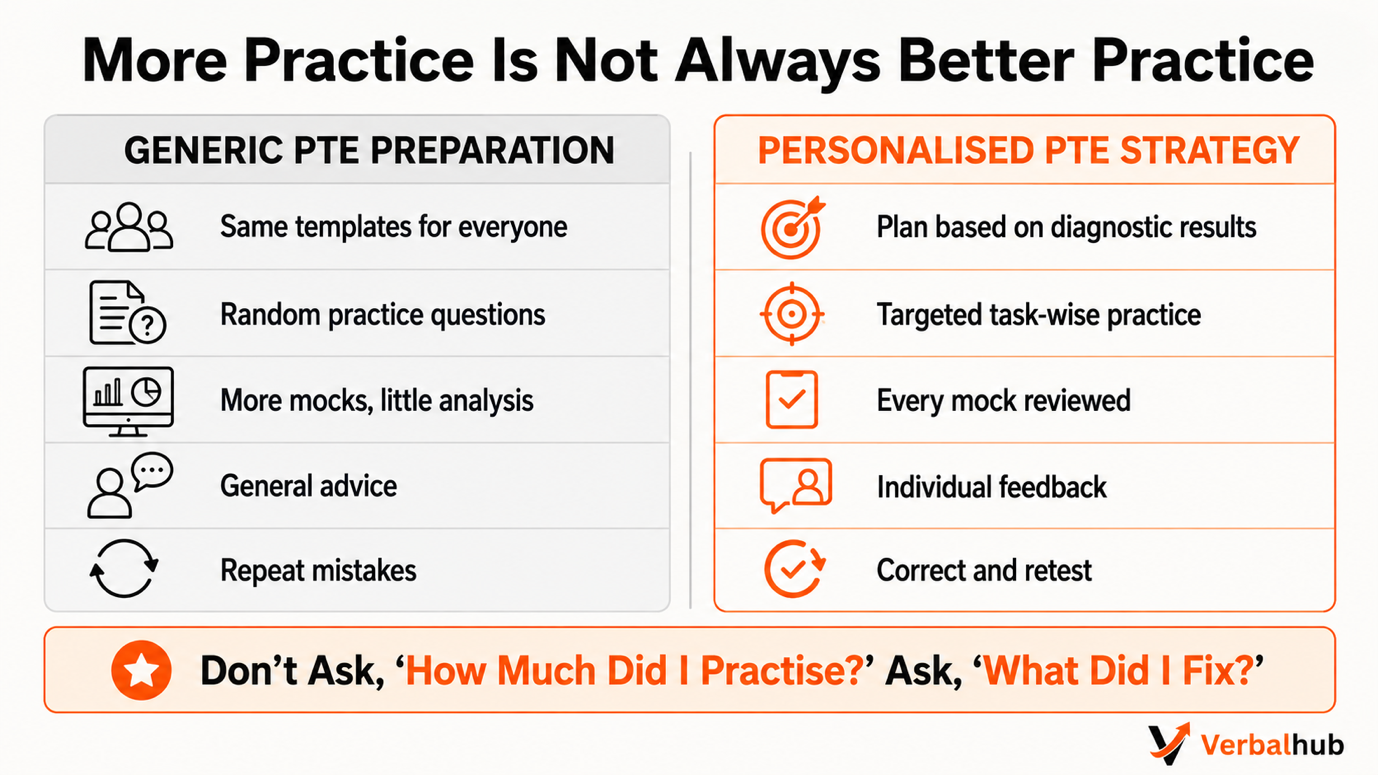
Templates can help you organise a response. They cannot diagnose your performance.
That distinction is easy to miss.
A Speaking template does not tell you that your pauses are breaking your fluency.
A Writing template does not tell you that you keep repeating the same grammatical error.
A Reading shortcut does not tell you why you keep selecting the wrong option.
A Listening strategy does not tell you that your comprehension is fine but your spelling is costing you marks.
That is why personalised PTE coaching works differently from simply giving every student the same list of tricks.
The trainer needs to ask:
- What is this student already doing well?
- Where are marks being lost?
- Which errors keep repeating?
- Which question types deserve more practice?
- Is the problem knowledge, execution or timing?
- What changes are required before the next mock?
Once those questions are answered, practice becomes much more purposeful.
How Did VerbalHub Help Kavya Prepare for PTE 71?
Kavya's preparation was built around a simple principle:
Practise → get feedback → correct the problem → test again.
Instead of seeing PTE as one large exam, the preparation was broken into individual skills and task types.
That allowed the trainer to work more closely on Speaking, Writing, Reading and Listening rather than giving the same advice across every section.
This section-wise approach is a central part of VerbalHub PTE training.
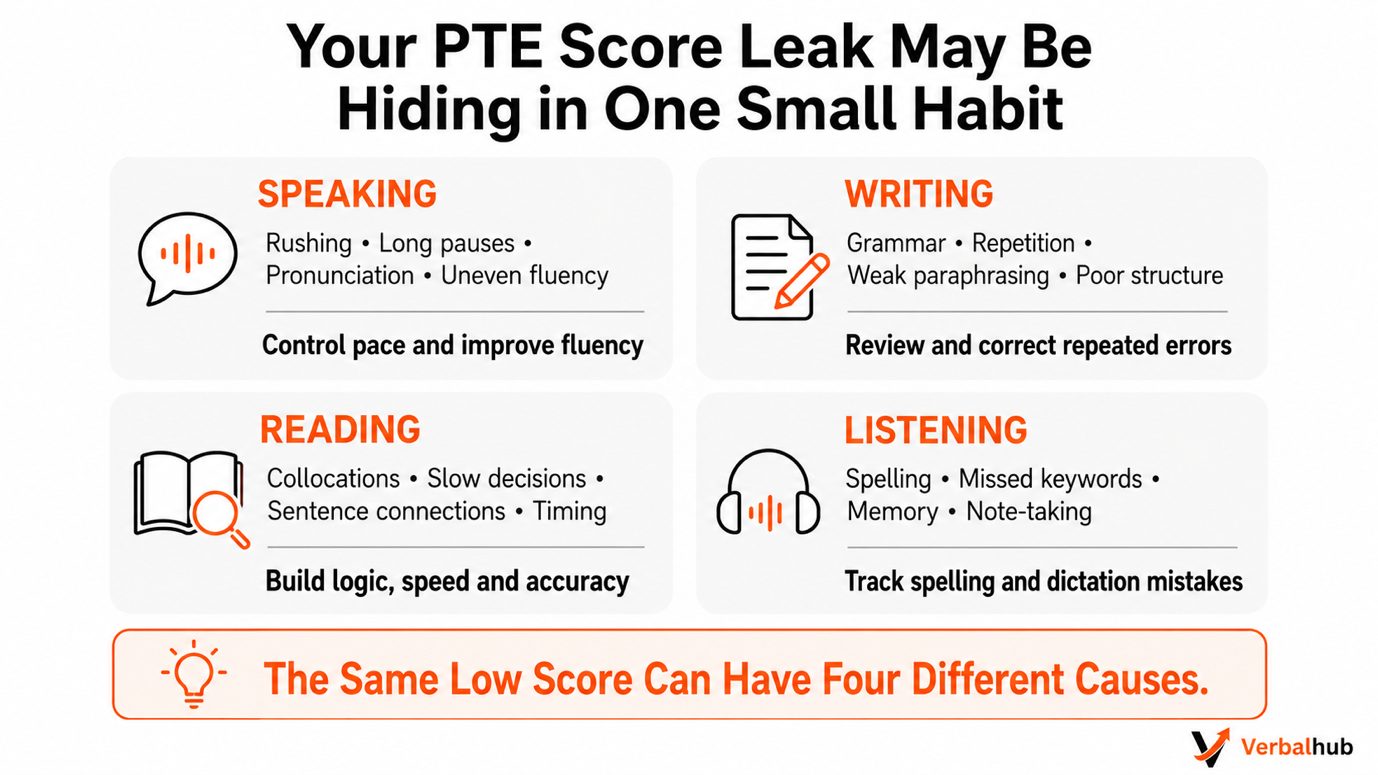
Section-Wise Breakdown: Where Are PTE Marks Actually Lost?
| PTE Section | Common Hidden Issue | VerbalHub Personalised Solution |
|---|---|---|
| Speaking | Rushing, unnatural pauses, pronunciation issues, inconsistent fluency | Individual speaking practice, fluency correction, pronunciation feedback, chunking and pacing |
| Writing | Grammar mistakes, repetition, weak paraphrasing, poor structure | Writing review, sentence correction, timed practice and personalised feedback |
| Reading | Weak collocations, slow decisions, poor sentence connections | Targeted Reading drills, vocabulary in context, logic training and timed accuracy practice |
| Listening | Spelling errors, weak note-taking, missed keywords, memory problems | Dictation drills, prediction practice, spelling review, note-taking and error tracking |
The table looks simple.
But it highlights one of the biggest lessons from successful PTE preparation:
The same low score can have completely different causes.
You cannot fix the score properly until you find the cause.
How Can You Improve PTE Speaking Fluency?
PTE Speaking fluency improves when you learn to speak at a controlled, natural pace with fewer unnecessary pauses. Simply speaking faster is not the answer.
Students often become nervous about the computer-based format and try to rush.
That can make speech less natural.
Personalised Speaking practice can focus on:
- Read Aloud
- Repeat Sentence
- Describe Image
- Retell Lecture
- Pronunciation
- Chunking
- Pausing
- Stress
- Oral fluency
- Speed versus clarity
A trainer can hear patterns that students often fail to notice themselves.
Perhaps you pause after every three words.
Perhaps your pace changes when you encounter a difficult word.
Perhaps pronunciation is reasonably good but nervousness affects fluency.
These problems require different corrections.
That is why asking "How to improve PTE Speaking fluency?" should lead to another question:
What exactly is affecting your fluency?
Why Do PTE Writing Templates Stop Working?
A template gives structure. Your actual response still needs control.
Students may know exactly how an essay should be organised and still struggle with:
- Grammar
- Sentence construction
- Paraphrasing
- Repetition
- Vocabulary
- Relevance
- Time management
Good Writing feedback is specific.
"Improve your grammar" is not enough.
A trainer should be able to show you which grammatical errors keep appearing, which sentences are unnecessarily complicated and where your response loses clarity.
That turns Writing practice into correction rather than repetition.
Why Do Students Lose Marks in PTE Reading?
Reading errors are not always caused by poor English.
Sometimes the real problem is decision-making.
Students may spend too much time on one question, miss a familiar collocation, fail to connect two sentences or choose an option because it "sounds right."
Targeted Reading preparation can therefore work on:
- Vocabulary in context
- Collocations
- Fill in the Blanks
- Re-order Paragraphs
- Sentence connections
- Pattern recognition
- Accuracy under time pressure
The goal is not just to read faster.
The aim is to make faster decisions.
What Are the Most Common PTE Listening Mistakes?
Common PTE Listening mistakes include spelling errors, incomplete notes, missed keywords, weak short-term recall and losing concentration while the audio continues.
This is particularly frustrating because students may understand what they heard but still fail to convert that understanding into marks.
Listening practice can therefore include:
- Summarise Spoken Text
- Listening Fill in the Blanks
- Highlight Correct Summary
- Select Missing Word
- Write From Dictation
- Spelling correction
- Prediction
- Memory and chunking
- Note-taking
An error log becomes especially useful here.
If you miss a word once, it may be accidental.
If you repeatedly make the same type of mistake across ten Listening exercises, you have found something worth fixing.
What Is a PTE Diagnostic Test, and Why Does It Matter?
A PTE diagnostic test helps identify your current performance level and shows which sections, question types and skills need the most attention.
Think of it as the starting point for a personal study plan.
Without diagnosis, students often distribute their time equally.
Thirty minutes of Speaking. Thirty minutes of Writing. Thirty minutes of Reading. Thirty minutes of Listening.
It sounds organised, but equal time is not always smart preparation.
If Speaking is already strong while Listening is consistently pulling your score down, those two sections may not deserve equal attention.
A diagnostic approach helps answer:
- Where am I currently losing marks?
- Which mistakes happen repeatedly?
- Which section offers the biggest opportunity for improvement?
- Do I need more concept work or more timed practice?
- Is my problem accuracy or pacing?
- What should I prioritise this week?
This is where a PTE diagnostic test becomes more useful than simply starting another general study plan.
Why Does Personalised PTE Coaching Make a Difference?
Personalised coaching allows the trainer to change the preparation according to the student's actual performance rather than following one fixed timetable for everyone.
At VerbalHub, the idea is to use individual attention, section-wise practice, performance feedback and mock analysis to decide what the learner should work on next.
That also creates accountability.
When students prepare alone, it is easy to judge practice by quantity:
"I studied for three hours." "I completed 100 questions." "I attempted four mocks."
Those numbers can feel productive.
But a better question is:
What did you fix?
That is the question that moves preparation forward.
The Feedback Loop That Delivers 70+ Scores
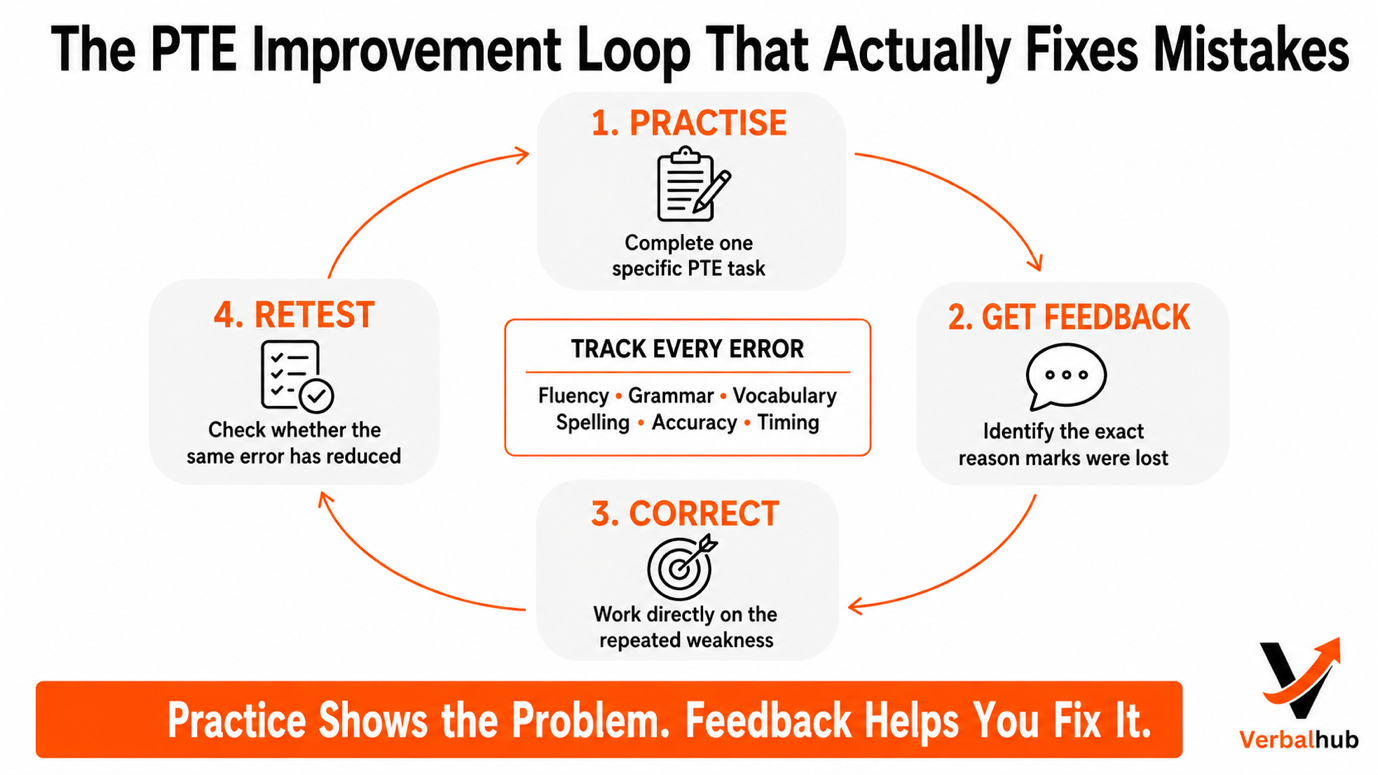
A useful PTE preparation strategy can be reduced to four steps:
- Practice — Work on a specific PTE task under realistic conditions. Do not practise everything at once. Give each session a purpose.
- Feedback — Review what happened. Was the problem fluency? Grammar? Vocabulary? Accuracy? Timing? Spelling? Comprehension? The answer should be specific.
- Correction — Work directly on the identified problem. If pronunciation is weak, practise pronunciation. If spelling is costing marks, build a spelling error list. If timing is the issue, practise that task with controlled time limits.
- Retest — Return to a similar question type and check whether the error has actually reduced.
This creates the cycle:
Practice → Feedback → Correction → Retest
Then repeat.
That is very different from:
Mock → Mock → Mock → Mock
A mock test tells you where you are.
PTE error analysis helps explain why you are there.
And that "why" is what should determine your next study session.
What Can Other PTE Students Learn From Kavya Jain's PTE 71 Success Story?
Kavya's result is worth celebrating.
But the more useful lesson for another student is not simply the number 71.
It is the preparation principle behind the result.
You do not need to copy another student's daily timetable exactly.
You do not need every template available online.
You do not need to solve questions endlessly just to feel productive.
You need to identify the mistakes that are holding your score back.
Then you need to correct them consistently.
That is the difference between doing PTE preparation and having a PTE preparation strategy.
Frequently Asked Questions About PTE Score Improvement
Start analysing your mistakes instead of immediately increasing your practice volume. Categorise errors by section, question type and reason, then spend more time on the patterns that appear repeatedly. Daily practice helps only when the feedback from yesterday changes what you do today.
It depends on the student. Self-study helps the student who is highly disciplined, who can spot their mistakes accurately, and who can fix them then and there. Personalised coaching is useful when you need individual feedback, structure or help understanding why your score has stopped improving. It's not about just having a PTE trainer, but it is about having someone analyse your performance and adjust the preparation accordingly.
A diagnostic test highlights your real knowledge of subject areas before you build a study plan. It helps prevent you from spending equal time on sections that may not need equal attention. The results can be used to create a more focused plan around your target score.
There is no useful universal number. The quality of your mock analysis matters more than simply accumulating tests. After each mock, review the errors, identify repeated patterns, correct those weaknesses and then test again. A mock without analysis is mostly a score report. A mock with proper analysis becomes a study plan.
Build a PTE Strategy Around Your Score, Not Someone Else's
Kavya Jain achieved an overall PTE score of 71, but her story carries a broader message for anyone preparing for the exam.
Your preparation should become more personal as you progress.
Start by understanding the exam. Then understand your own performance. Identify weak areas. Practise deliberately. Get feedback. Correct repeated mistakes. And retest.
Your next score improvement may not require more material. It may require a clearer understanding of why you are losing marks.