
CAT SUCCESS STORY

Quick Snapshot
| Key Challenge | Turning consistent hard work into targeted, section-wise improvement |
| Solution | Section-wise diagnosis, timed practice, mock-test analysis and personal feedback |
| Preparation Approach | Personalised CAT mentoring |
| Training Provider | VerbalHub |
Hard work is rarely the missing ingredient in CAT preparation.
Most serious aspirants are already studying for hours, solving questions and taking mocks. The main issue is the right investment of those hours that do not always go where they are needed most.
Do you need another 50 Quant questions? Another RC passage? Another DILR set? Or do you need to stop to understand the reason behind the repeat of the same mistakes?
For Nandini Sharma, CAT preparation became more useful when it became more specific. Instead of treating the syllabus as one long checklist, her preparation focused on the three sections separately, followed by timed practice, mock analysis and personal feedback.
Her story offers a simple lesson for anyone trying to work out how to crack the CAT exam without getting buried under endless practice.
The big lesson from Nandini's CAT journey: More practice helps only when you know what that practice is supposed to fix. Diagnose the problem first, then train for it.
How Do I Improve My CAT Score When I Am Already Studying Hard?
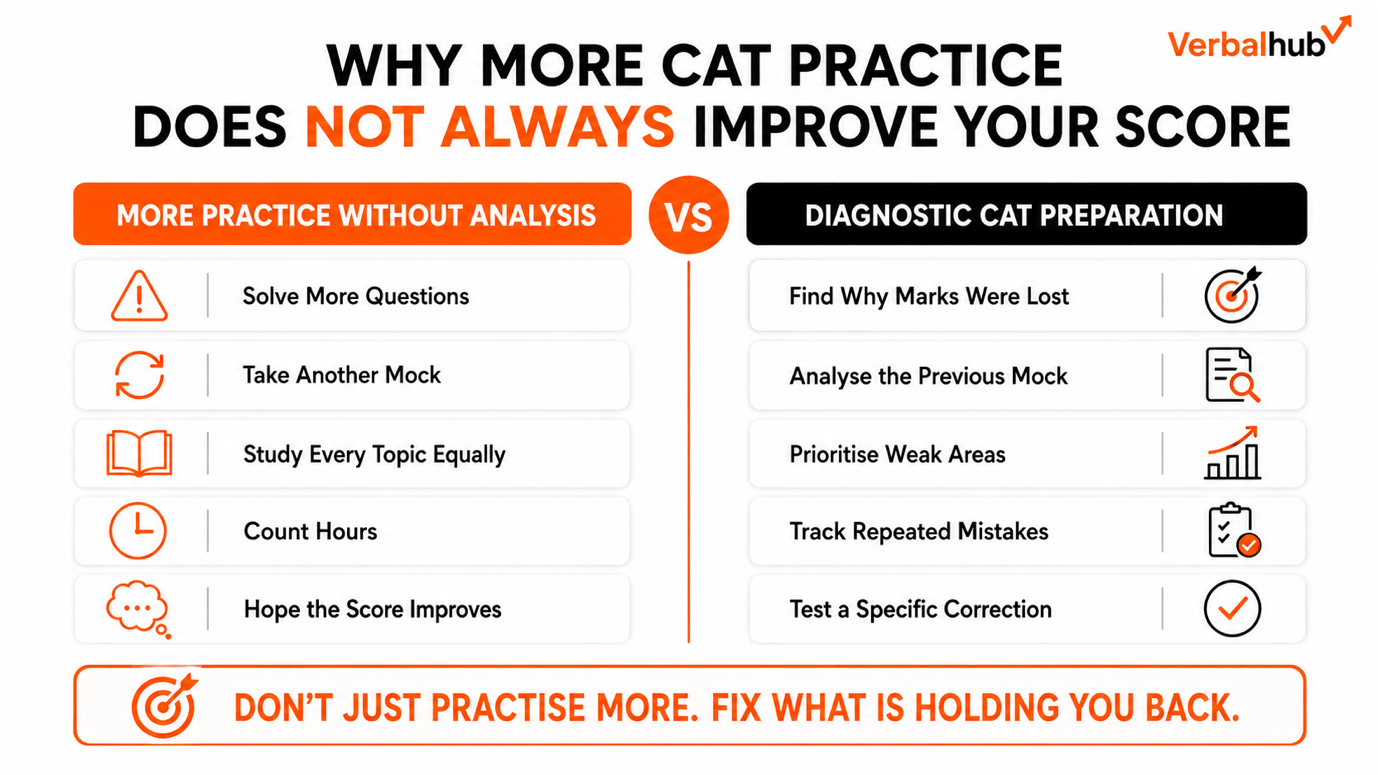
Start by finding the exact reason you are losing marks. A low CAT mock score can come from weak concepts, poor accuracy, bad question selection, slow execution or simply spending too long on the wrong questions. The fix depends on the cause.
This was an important shift in Nandini's preparation.
Many CAT aspirants measure effort in numbers:
- hours studied
- questions solved
- RC passages completed
- DILR sets attempted
- mocks taken
Those numbers tell you that you worked. They do not tell you whether the work fixed anything.
A stronger CAT preparation strategy starts with a different set of questions:
- Which section is pulling down my overall performance?
- Am I getting questions wrong because I do not know the concept?
- Do I understand the question but make a calculation or reading error?
- Am I attempting questions that I should leave?
- Do I spend too long on one difficult DILR set?
- Are the same RC trap options fooling me repeatedly?
- Which topic should I revise before my next mock?
Once you can answer these questions, your next week of preparation stops being random.
That is the thinking behind VerbalHub's current CAT coaching programme, which combines concept work with timed practice, sectional tests, mock analysis and study planning based on a student's current level and target.
Should I Prepare for CAT as One Exam or Three Separate Sections?
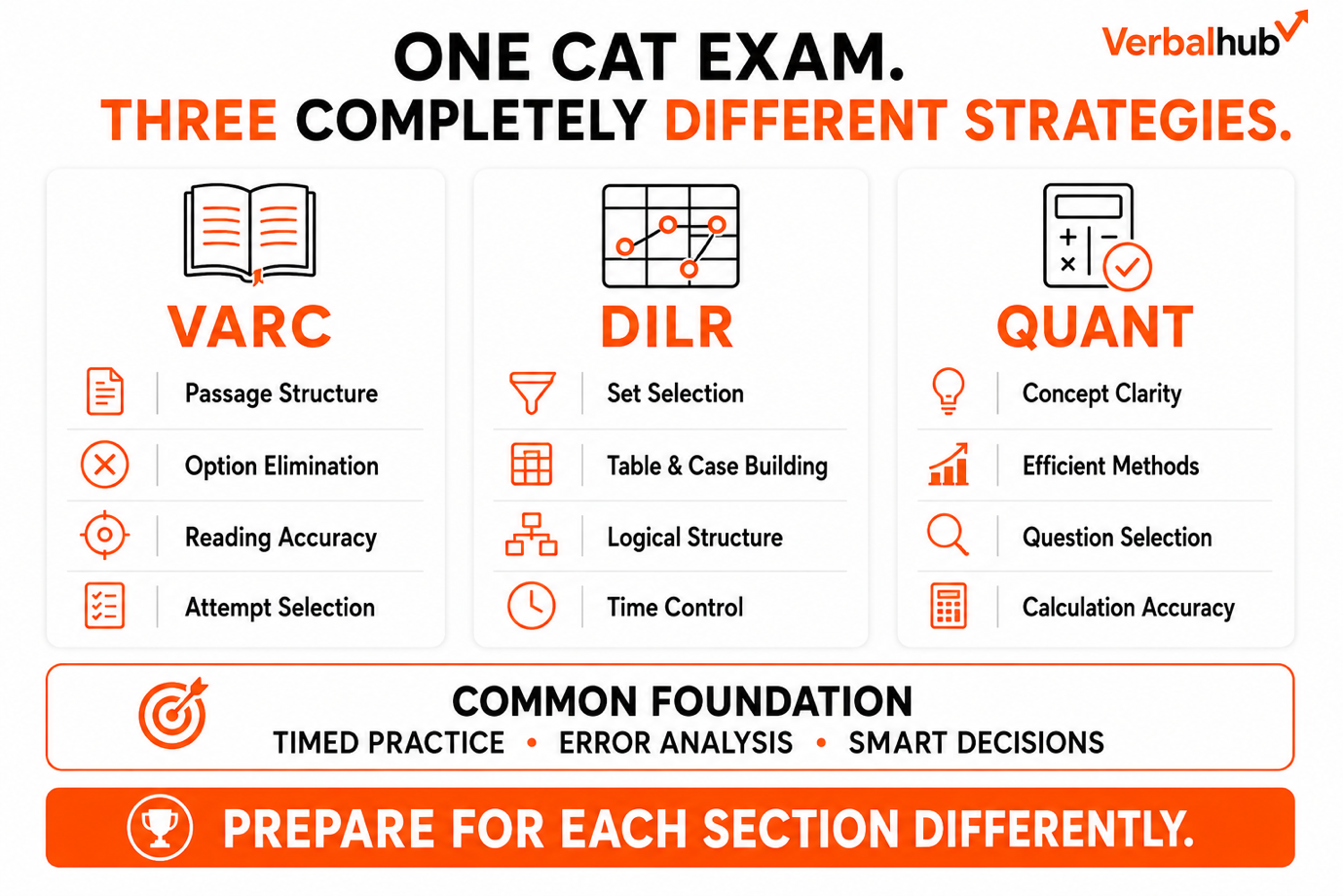
Treat VARC, DILR and Quant as three different performance problems. Each section rewards a different mix of comprehension, decision-making, accuracy, speed and question selection, so the same study method will not work equally well across all three.
That section-wise approach helped make Nandini's preparation more focused.
1. VARC — Read for structure, not just for speed
A good VARC strategy is not simply "read more." You need to understand how an RC passage is built, what the author is trying to do and why one answer choice is stronger than another.
- Understanding the main point and paragraph roles
- Separating the author's view from examples or quoted views
- Eliminating choices that are too broad, too narrow or unsupported
- Improving accuracy before forcing speed
- Making better attempt decisions under a time limit
2. DILR — Set selection is part of the skill
DILR set selection can matter as much as solving ability. A student may be perfectly capable of solving a set and still damage the section by spending too much time on it.
- Scan the available sets before committing
- Spot familiar structures quickly
- Judge whether a set is opening up or becoming a time sink
- Build tables, cases or diagrams cleanly
- Move on when the return on time is poor
3. Quant — Concepts first, then efficient execution
Good CAT Quant preparation starts with the basics, but cannot end there. Arithmetic, Algebra, Geometry, Numbers and Modern Math need concept clarity, followed by efficient, exam-ready methods.
A Quant error should be labelled properly — concept gap, calculation mistake, missed condition, poor method, or simply staying with a question too long. That label tells you what to do next.
This matters because two students can get the same RC question wrong for completely different reasons. One may misunderstand the passage. The other may understand it perfectly but fall for a tempting answer choice.
Those two students need different feedback.
What Is the Best Way to Use CAT Mock Tests?
Use every mock as a diagnostic report, not just as a scorecard. CAT mock test analysis should show where time was lost, which questions were poorly selected, what type of mistakes repeated and what needs to change before the next test.
It is easy to fall into the "one more mock" cycle.
You take a mock. The score disappoints you. You take another one three days later, hoping the number will rise.
But if nothing meaningful changed between the two tests, why should the result change?
For Nandini, the more useful approach was to connect practice with review. That means looking past the final percentile and breaking the paper down.
CAT Mock-Test Diagnostic Checklist
After every mock, ask:
- Accuracy: Which questions did I get wrong, and why?
- Timing: Where did I spend more time than the question deserved?
- Selection: Which questions or sets should I have skipped?
- Concepts: Which topics need to go back into revision?
- Patterns: Is the same mistake appearing across multiple mocks?
- Execution: Did my strategy change once I felt pressure?
- Next step: What are the two or three things I will fix before the next mock?
This is where CAT mock test analysis becomes useful. It converts a score into an action plan.
VerbalHub's CAT approach reviews performance across VARC, DILR and QA after mocks, with attention to accuracy, timing and question selection. Students who want a more individual format can also explore one-on-one CAT coaching, where the study plan and review process are built around the learner's own gaps.
Does Personalized CAT Mentoring Really Make a Difference?
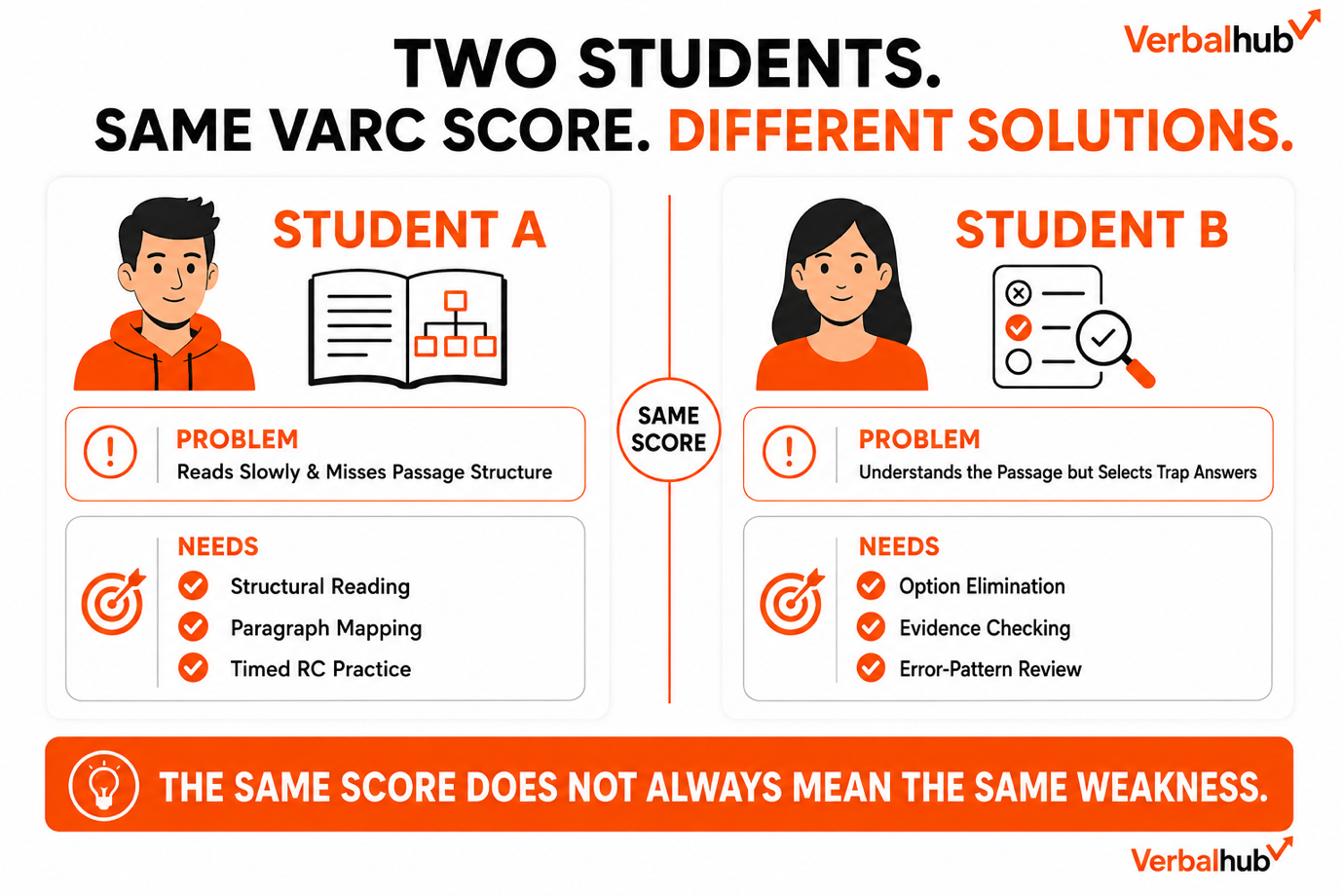
Personalized CAT mentoring is most useful when your problem is specific. A mentor can compare your attempts, timing and error patterns and then decide whether you need concept revision, better question selection, more timed practice or a change in test strategy.
CAT students rarely have identical problems.
Imagine two aspirants scoring poorly in VARC.
Student A reads slowly and misses the structure of dense passages.
Student B reads comfortably but repeatedly chooses options that sound reasonable without being supported by the passage.
Giving both students the same reading list will not solve both problems.
The same is true in Quant. One student may need to rebuild Arithmetic. Another may already know the concepts but lose marks because they refuse to leave difficult questions.
This is why personal feedback became an important part of Nandini's CAT preparation. The useful question was not just, "Was this answer wrong?" It was, "Why did you choose it?"
That second question exposes the thinking pattern behind the mistake.
According to VerbalHub's About Us page, its live batches generally have 5–7 students, with personalised study plans, progress reviews, timed practice and detailed mock-test analysis. The point of a smaller learning setup is straightforward: a student gets more room to explain how they approached a question and receive feedback on that reasoning.
Why Do Section Specialists Matter in CAT Preparation?
Section specialists can give more targeted feedback because VARC, DILR and Quant demand different skills. A reading error needs a different correction from a set-selection mistake or a Quant speed bottleneck.
VerbalHub's published faculty information reflects this section-wise model.
| Section | Faculty | Credentials |
|---|---|---|
| VARC | Hasan Raja | IIM Kozhikode alumnus; senior Verbal faculty; 20 years of teaching experience; CAT VARC performances in the 99th percentile; focus on Reading Comprehension and reasoning |
| DILR & Quant | M. U. Mir | Senior Quant & DILR Faculty; reported 99.75 percentile in CAT DILR; GMAT Quant Q51 score |
| Quant | C. S. Rajawat | Senior Quantitative Aptitude Faculty; 11 years of specialised CAT coaching experience |
The practical benefit is not the credential by itself. It is the ability to diagnose section-specific problems and give the student a clearer correction.
For Nandini, this meant VARC, DILR and Quant did not have to be forced into one generic preparation method.
How Can I Build a Practical CAT Preparation Strategy?
Use a four-step cycle: Build → Time → Diagnose → Refine. First learn the concept or method, then practise it under time pressure, study what went wrong, and adjust the next round of preparation. Repeat the cycle instead of moving blindly from topic to topic.
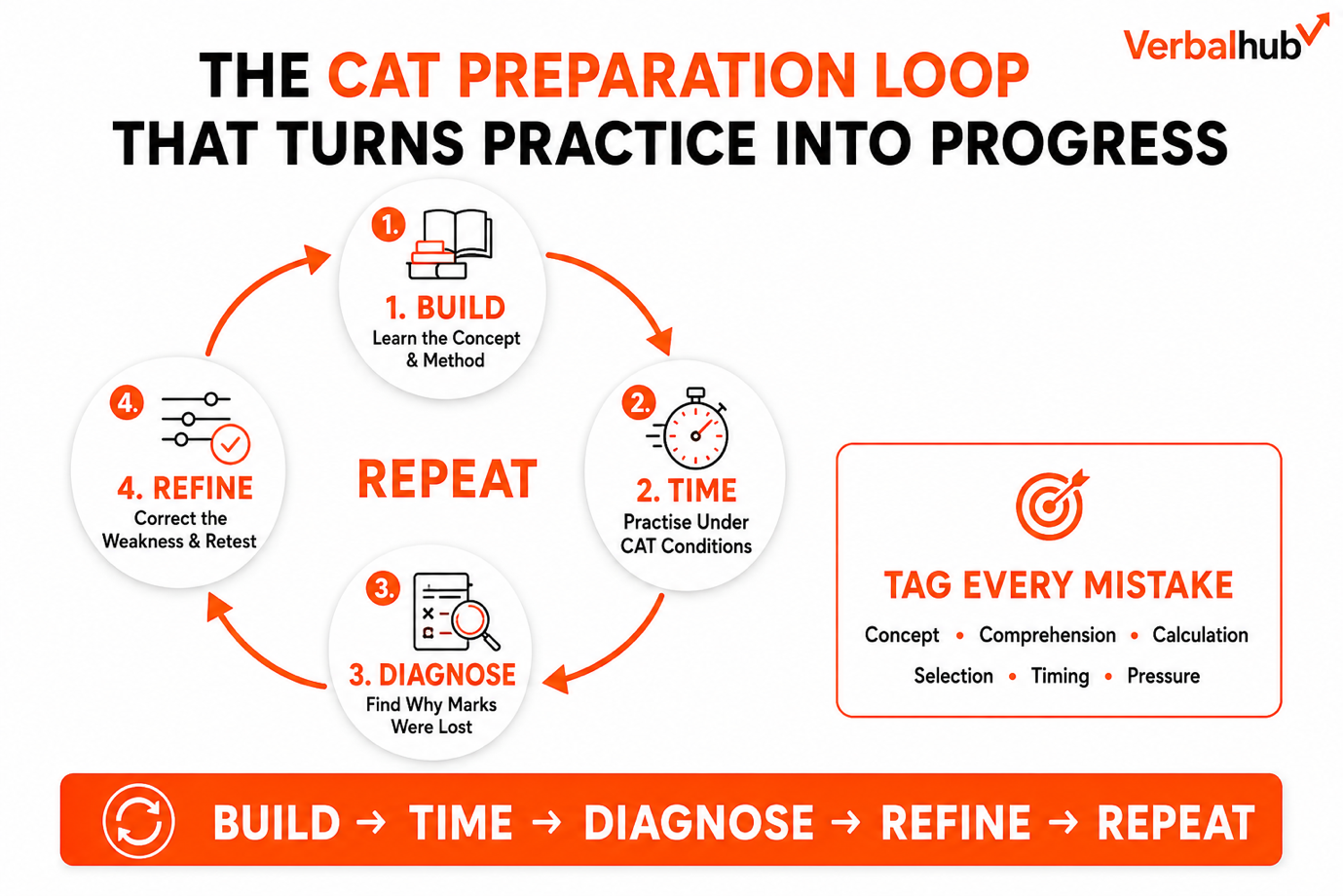
- Build — Build the foundation before chasing speed. VARC: passage structure, comprehension and option logic. DILR: set types, representation and reasoning methods. Quant: core concepts and reliable solving methods.
- Time — Move from comfortable practice to timed execution. Use topic tests, sectionals and full mocks to see what happens when the clock starts influencing your decisions.
- Diagnose — Do not stop at right versus wrong. Tag each meaningful mistake: concept, comprehension, calculation, selection, timing or pressure. Look for patterns across several tests.
- Refine — Change the next week of preparation based on the diagnosis. Revise the weak concept. Practise the troublesome question type. Change the DILR selection rule. Work on RC option elimination. Set a time limit for questions you tend to over-invest in. Then test the change.
Build → Time → Diagnose → Refine → Repeat.
That is a much more useful CAT preparation loop than simply trying to complete a huge question count.
How Did VerbalHub Help in Nandini Sharma's CAT Journey?
VerbalHub supported Nandini with structured, section-wise CAT preparation, timed practice, mock analysis and personalised feedback. The aim was to help her identify what needed attention in VARC, DILR and Quant instead of giving every section the same amount and type of practice.
The result should still be credited where it belongs: to Nandini.
No mentor can sit for CAT on a student's behalf. No course can replace the discipline needed to practise, revise and perform on exam day.
Good coaching can make that effort more focused.
It can catch a repeated mistake earlier.
It can show you when more practice is not the answer.
It can turn a weak mock into a clear plan for the next seven days.
And it can help you stop wasting time on areas that are already working while a real weakness remains untouched.
That is the real value of Nandini Sharma's CAT success story. It is not a story about a magic shortcut. It is a story about giving hard work a direction.
What Should I Learn From Nandini Sharma's CAT Success Story?
Do not measure CAT preparation only by hours, questions or mocks. Measure it by how well you understand your weak areas and whether the same mistakes are becoming less frequent over time.
If you are working hard but your mock scores are not moving, pause before adding another pile of questions.
Ask one honest question:
Do I know exactly why I am losing marks?
If you do, you have something specific to fix.
If you do not, your next task is diagnosis—not more volume.
Nandini's journey points to a practical way forward: learn the skill, test it under time pressure, study the mistake, make a correction and test again.
Sometimes the biggest improvement in CAT preparation does not come from studying more.
It comes from finally knowing what to improve next.
CAT Mock Test Series
Individual CAT results vary based on starting level, preparation time, consistency, test strategy and exam-day performance. Coaching and mentoring can provide structure and feedback, but no fixed score or percentile should be assumed.