
GMAT SUCCESS STORY — 695 TO IIM RANCHI

A working professional's journey through focused GMAT Verbal preparation, detailed mock analysis and Executive MBA interview practice.
695GMAT Score
IIM RANCHIExecutive MBA
1-TO-1Personalised Guidance
Preparing for the GMAT with a full-time job can be tiring. Work deadlines take priority, study hours keep changing and mock scores do not always improve as expected. Jitendra experienced many of these challenges while working towards his Executive MBA goal.
He did not need another pile of study material. He needed to understand where he was losing marks, how to use his limited preparation time and what changes could improve his performance.
THE RESULT: With a focused study plan, regular mock reviews and personalised guidance from Hasan Sir, Jitendra scored 695 on the GMAT and secured admission to IIM Ranchi.
The Goal Was Bigger Than a GMAT Score
Jitendra's final aim was not simply to perform well on the GMAT. He wanted to join an Executive MBA programme that could prepare him for broader responsibilities at work.
That meant preparing for two different stages. The first was the GMAT, where he had to solve reasoning-heavy questions within strict time limits. The second was the IIM Ranchi interview, where he had to explain his professional journey, management goals and reason for pursuing an Executive MBA.
For the GMAT, he needed a reliable method. For the interview, he needed clarity and honest examples from his career.
Why a Standard Study Plan Was Not Right for Jitendra
Most working professionals cannot study at the same time every day. Some weeks are manageable, while others are taken over by meetings, travel or urgent work.
Jitendra needed a plan that could work around his routine. Before increasing his study hours, he first had to identify the real reasons behind his score gaps.
- Which GMAT Verbal question types were causing the most trouble?
- Was he misunderstanding arguments or choosing tempting options?
- Did his accuracy fall when he tried to solve questions faster?
- Was he spending too much time on a few difficult questions?
- Did he review his mock tests deeply enough?
- Which skills required attention first?
This assessment became the base of his preparation. It prevented him from spending valuable time revising topics he had already understood.
Personalised GMAT Tutoring Made the Plan More Practical
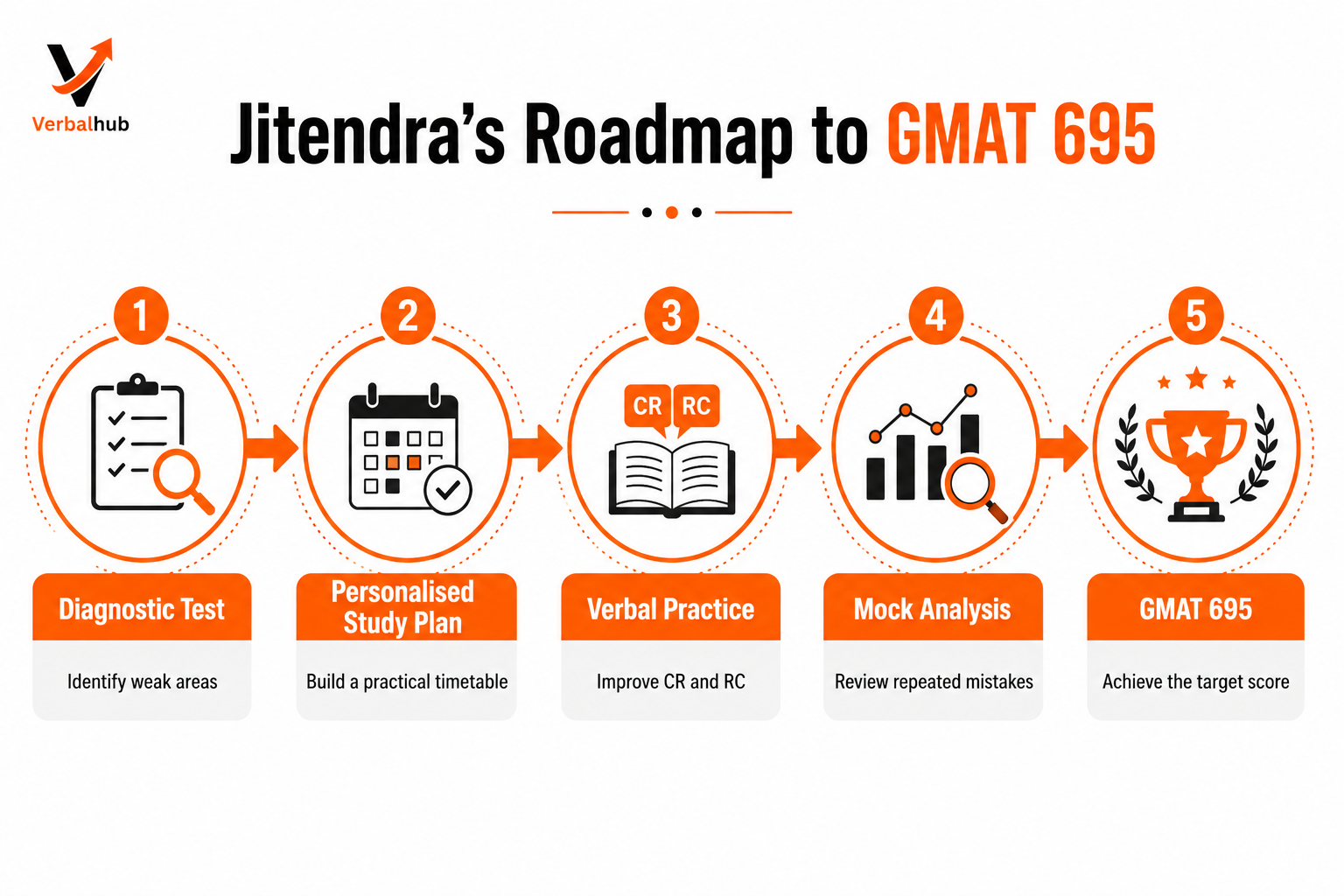
Jitendra's preparation was built around his strengths, weak areas and available study time. This is where personalised GMAT tutoring was useful.
Instead of following the same daily targets as every other student, he worked with smaller and more specific goals. One session might focus on identifying conclusions in Critical Reasoning. Another might examine why two Reading Comprehension options looked similar.
The purpose was not to complete material quickly. It was to correct the habits that were affecting his score.
- Topic-wise verbal practice
- Timed and untimed question sets
- Detailed review of wrong answers
- Identification of recurring mistakes
- Sectional test analysis
- Full-length mock reviews
- Changes to his time-management plan
- One-to-one feedback on weak areas
How Hasan Sir Helped Jitendra Improve
Jitendra was guided by Hasan Sir, his GMAT verbal trainer and GMAT verbal mentor.
MEET THE MENTOR: Hasan Sir is an IIM Kozhikode alumnus, GMAT Verbal V50 scorer and three-time CAT VARC 99th percentiler. He has 20 years of teaching experience and has mentored more than 10,000 students.
During Jitendra's preparation, Hasan Sir focused on more than concept teaching. He studied how Jitendra approached questions, where his reasoning changed direction and why certain incorrect choices appeared convincing.
- Read arguments with greater care
- Separate conclusions from supporting evidence
- Recognise unstated assumptions
- Understand the structure of RC passages
- Eliminate options using clear reasons
- Control the time spent on difficult questions
- Review mock tests without depending only on the final score
Changing the Approach to Critical Reasoning
Critical Reasoning questions can look short, but each one demands careful reading. A single word can change the meaning of an argument or an answer choice.
Earlier, Jitendra sometimes moved to the options before fully understanding the argument. This made attractive but irrelevant choices harder to reject.
- Find the main conclusion.
- Identify the evidence used to support it.
- Notice what the argument assumes.
- Understand the exact task in the question.
- Check every option against that task.
PRACTICAL LESSON: An answer can be factually sensible and still be wrong if it does not perform the exact job asked in the question.
Reading Comprehension Without Memorising Everything
Long passages often create unnecessary pressure. Many students try to remember every example, name and technical detail. By the time they reach the questions, they may have forgotten the main point.
Jitendra worked on reading passages for structure. He began tracking:
- What the passage was mainly discussing
- Why the author had written it
- What each paragraph contributed
- Where the author agreed or disagreed
- Whether the tone was neutral, doubtful or critical
- How examples supported the main discussion
This gave him a mental map of the passage. When a question asked about a specific detail, he knew where to return instead of searching through the entire text. His aim was not to read faster at any cost. It was to read with a clear purpose.
Learning to Eliminate Answers Properly
GMAT Verbal questions are designed to include choices that seem partly correct. The real challenge is often deciding which option answers the exact question without adding unsupported information.
During his GMAT verbal coaching, Jitendra learned to reject an answer for a clear reason.
- The option went beyond the passage.
- It answered a different question.
- It used language that was too broad or absolute.
- It reversed the author's meaning.
- It repeated passage words but changed their purpose.
- It was generally true but irrelevant to the argument.
Why Reviewing Errors Was More Valuable Than Solving More Questions
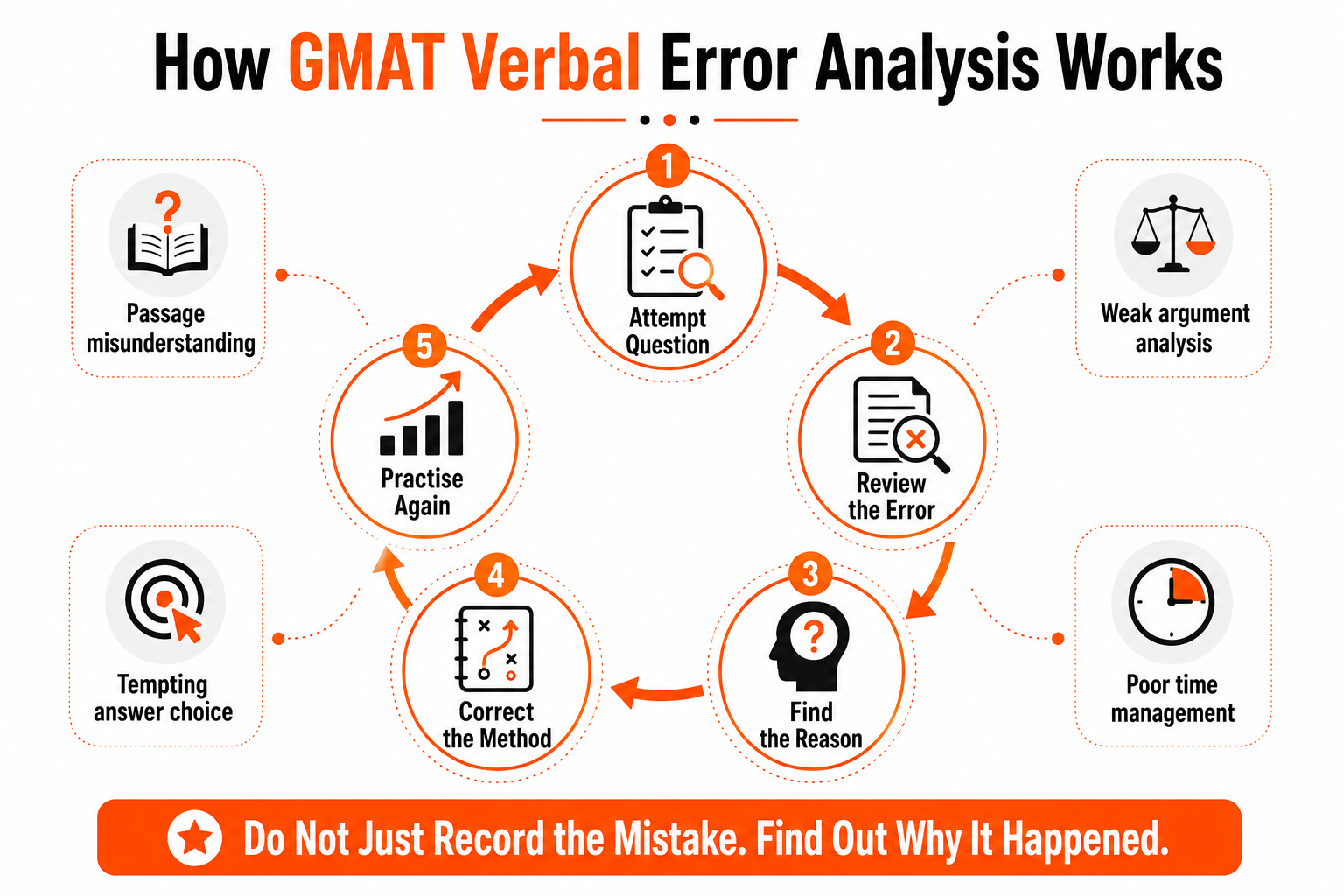
Doing more questions can feel productive, but the number of questions completed does not guarantee improvement. If a student makes the same mistake repeatedly, additional practice may only strengthen the wrong habit.
Jitendra's error review examined the full decision-making process. For every important mistake, he asked:
- What did I understand incorrectly?
- At what point did my reasoning go wrong?
- Why did I choose this particular option?
- What evidence did I overlook?
- Did I rush because of time?
- Have I made the same mistake before?
- What rule or step should I use next time?
ERROR-LOG INSIGHT: Five incorrect answers from different topics may still come from one repeated habit, such as making assumptions that the passage never supports.
Mock Tests Became a Source of Information
Mock scores naturally rise and fall. One test may suit a student's strengths, while another may include more questions from weaker areas.
Jitendra learned not to treat every lower score as a setback. Each mock was used to understand what was happening during the test.
- Accuracy in different question types
- Average time spent per question
- Questions that consumed too much time
- Performance during the final part of a section
- Mistakes caused by fatigue
- Incorrect answers after changing an initial choice
- Easy or medium questions that should not have been missed
Reaching a GMAT Score of 695
Jitendra eventually scored 695 on the GMAT. The result was not based on one shortcut or a last-minute trick. It came from improving several small parts of his preparation.
- A clear solving method
- Better answer elimination
- Regular error analysis
- Controlled time management
- Careful mock reviews
- Consistent guidance
MILESTONE: The 695 GMAT score strengthened Jitendra's Executive MBA application, but the IIM Ranchi interview was still an important part of the journey.
Preparing for the IIM Ranchi Executive MBA Interview
A high GMAT score can support an application, but it cannot speak on behalf of the candidate during an interview.
Jitendra's Executive MBA interview preparation focused on presenting his professional experience clearly. He had to explain what he had done, what he had learned and why an Executive MBA was the right next step.
- What motivates you to pursue an Executive MBA?
- Why have you selected IIM Ranchi?
- What are your short-term and long-term career plans?
- The professional achievement you are proud of?
- Tell us about a difficult workplace situation.
- How have you handled disagreement within a team?
- What kind of leader are you?
- What skills do you currently need to develop?
- What will you contribute to the programme?
- How will you manage the demands of the course?
The aim was not to prepare scripted replies. Memorising the answers seems usual but fails when the interviewer asks a follow-up question. Jitendra worked on organising his real experiences so that he could explain them with confidence.
Making Professional Answers More Specific
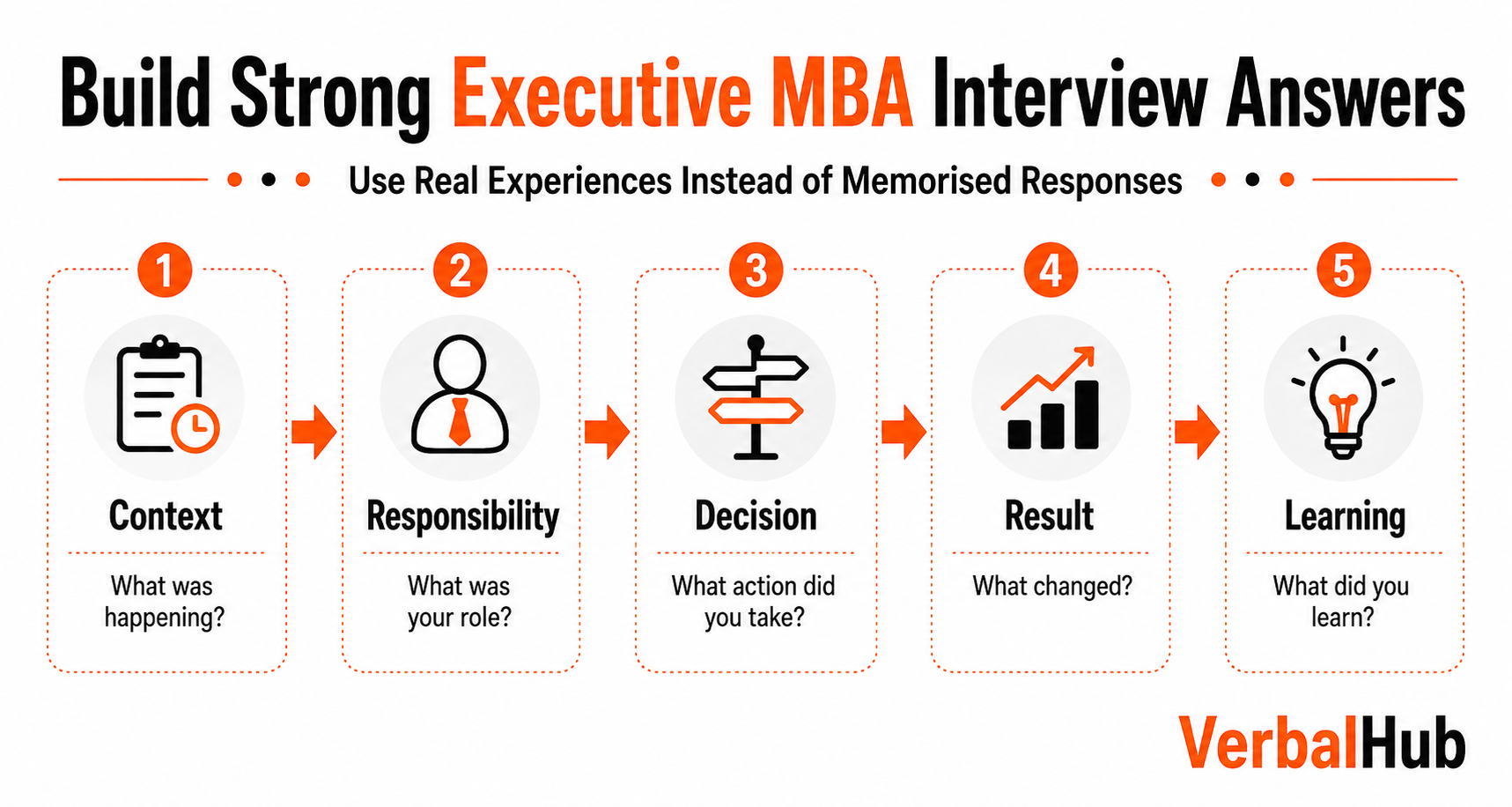
Many Executive MBA candidates have good work experience but describe it too broadly. Statements such as 'I handled a team' or 'I delivered an important project' provide very little information.
INTERVIEW ANSWER STRUCTURE: Context → Responsibility → Decision → Result → Learning
This structure helped Jitendra explain what was happening, what he was responsible for, what action he took, what result followed and what the experience taught him.
Building a Clear Answer to "Why MBA?"
'Why do you want an Executive MBA?' appears simple, but vague answers can weaken an otherwise strong interview. Wanting career growth is understandable, but it does not explain what kind of growth the candidate wants.
Jitendra connected his answer to three areas:
- The experience he had already gained
- The skills or business exposure he now needed
- The responsibilities he wanted to take up in the future
This gave his answer a clear direction. It showed that the Executive MBA was part of a considered career plan, not simply another qualification.
The Final Result: Admission to IIM Ranchi
After completing the GMAT and interview stages, Jitendra secured admission to the IIM Ranchi Executive MBA programme.
- A study plan that fitted his work schedule
- Focused verbal coaching for GMAT
- Personal feedback from an experienced trainer
- Structured Executive MBA interview preparation
Jitendra's result shows why preparation must be built around the individual. Two students may have the same target score but need completely different improvement plans.
What to Look for in GMAT Verbal Coaching
Many students search online for the best verbal course for GMAT, but course names and large question banks do not tell the complete story.
A useful GMAT Verbal course should help students understand how they think while solving a question. It should include:
- A diagnostic assessment
- A plan based on the student's current level
- Practical methods for Critical Reasoning and Reading Comprehension
- Timed practice
- Doubt-clearing support
- Error-log review
- Sectional and mock analysis
- Direct feedback from a GMAT verbal trainer
The best course for GMAT Verbal should not overload students with material. It should help them decide what to study, how to practise and what to correct.
Is GMAT Verbal Online Coaching Suitable for Working Professionals?
For working candidates, GMAT verbal online coaching can make preparation easier to manage. Students can attend sessions from home and avoid spending extra time travelling.
Before choosing a GMAT verbal online course, students should check:
- Are the sessions live or only recorded?
- Can students ask questions during class?
- Does the trainer review individual mistakes?
- Are mock tests discussed in detail?
- Is the study plan adjusted according to performance?
- Does the course offer one-to-one mentoring?
The best GMAT verbal online course should provide both convenience and regular interaction. Recorded lessons can explain a concept, but they cannot always identify a student's repeated reasoning habits. That requires personal review.
Lessons from Jitendra's GMAT and IIM Ranchi Journey
- Begin with an assessment of your present level.
- Do not copy another student's timetable blindly.
- Study according to the cause of your mistakes.
- Before attempting the next mock, review the current one in detail.
- Use a fixed process for Critical Reasoning questions.
- Read RC passages for structure rather than memorisation.
- Practise rejecting options with specific reasons.
- Prepare interview examples from your actual work experience.
- Explain why an Executive MBA is needed at this point in your career.
- Choose personalised GMAT tutoring if individual feedback is missing from your current preparation.
A Strong Result Begins with the Right Process
Jitendra's journey from GMAT preparation to IIM Ranchi admission was built step by step. The 695 GMAT score was important, but so were the habits behind it: thoughtful practice, close review and the willingness to correct repeated mistakes.
For a working professional, the best GMAT verbal coaching is not necessarily the programme with the longest classes or the most practice questions. It is the one that identifies what is holding the student back and provides a practical way to fix it.
FINAL TAKEAWAY
With the right GMAT verbal mentor, a realistic study routine and detailed feedback, preparation can become far more focused and manageable.
Frequently Asked Questions
Jitendra scored 695 on the GMAT before securing admission to the IIM Ranchi Executive MBA programme.
Jitendra received guidance from Hasan Sir, an IIM Kozhikode alumnus and GMAT Verbal V50 scorer. Hasan Sir is also a three-time CAT VARC 99th percentiler with 20 years of teaching experience and more than 10,000 students mentored.
It helped him focus on his own error patterns, weaker question types and time-management problems. His plan was adjusted according to his performance instead of following a fixed routine designed for every student.
A GMAT verbal trainer helps students understand arguments, read passages structurally, eliminate incorrect choices and manage time. A good trainer also reviews mistakes and helps students develop a consistent solving process.
It can be effective when it includes live classes, personal feedback, doubt support and detailed mock analysis. Watching recorded videos without reviewing individual mistakes may not be enough for every student.
Look for a course that offers an initial assessment, structured CR and RC methods, individual error analysis, timed practice, mock reviews and access to an experienced GMAT verbal mentor.
Candidates should prepare their career story, leadership examples, achievements, difficult decisions, future goals and reason for choosing the programme. Answers should use genuine examples rather than memorised lines.
A good GMAT score can strengthen an application, but admission also depends on work experience, career clarity, the written application, the interview and the institute's selection requirements.